



Abstract
Activating employee engagement continues to be a challenge for organizations despite interest by many, if not most, organizations. Recent research suggests that the expression of virtue could be a key to addressing this challenge. The authors examine how employees’ perceptions of virtuous leadership behaviors shape employee engagement. Specifically, this research bridges virtuous leadership theory with employee engagement theory, explicitly focusing on the attitudinal change in employees as they witness leaders intentionally incorporating the classic virtues in workplace interactions. The authors explore through a mixed-method field study with two facilities of a multinational company how virtuous leadership behaviors can shift employee engagement over a 3-year period. Results indicate that after leaders completed a training program on how to enact virtuous leadership behaviors that employee engagement dipped, initially. The reduction in employee engagement was temporary while employees assessed the longevity of the initiative. As leaders continued to practice virtuous leadership behaviors, employee engagement increased significantly beyond the levels before the dip. The findings suggest that engagement may not initially improve while employees are assessing whether leaders will remain committed to virtuous leadership behaviors. However, the findings indicate that the commitment to ongoing practice of virtuous leadership behaviors can create meaningful change in employee engagement.
To win in the marketplace you must first win in the workplace. – Doug Conant, former CEO of Campbell’s Soup
Introduction
Recent research on the development of virtuous leaders has clearly noted that “a gap remains between our theorizing and the actual practices of organizational leaders and the approaches used by organizations” (Newstead et al., 2020: 606). Virtuous leadership behavior or the “situational appropriate expression of virtues” that others perceive and deem worthy to attempt to express as well (Wang and Hackett, 2016: 326) in theory should have a positive impact on the organization justifying the attention and resources required. Still, leaders may wonder if the efforts are indeed worthwhile and will produce a more successful organization. In other words, will such efforts enhance critical organizational outcomes?
One key measure of organizational health is employee engagement (cf. Harter et al., 2002). Theory is not conclusive on whether or not virtuous leadership behavior might improve employee engagement. Positive leader behaviors of various kinds have demonstrated a positive relationship with employee engagement (Knight et al., 2019; Saks and Gruman, 2014); however, as part of the enactment of virtuous leadership behaviors, discomfort may occur as issues are brought to light rather than ignored and as skepticism may challenge the sincerity of espoused virtues. Through a mixed-method field study over a 3-year time period, the authors uncover a nonlinear path of the impact of virtuous leadership behaviors on employee engagement.
The authors define employee engagement using the well-accepted understanding that it is a “positive, fulfilling, work-related state of mind characterized by vigor, dedication and absorption” (Schaufeli et al., 2002: 74). Meta-analyses show significant positive outcomes from engagement on meaningful organizational outcomes such as enhanced safety, customer satisfaction, productivity and profit, as well as reduced turnover (Nahrgang et al., 2011). Yet, many organizations find achieving employee engagement an ongoing puzzle (cf. Bennett et al., 2018). Exploratory research has offered indications that the perception of organizational initiatives can affect employee engagement (Hejjas et al., 2019).
Of the studies with empirical evidence examining what drives employee engagement (see Wollard and Shuck, 2011 for a review), the vast majority of antecedents considered have been either employee-based (e.g., employee optimism and employee work/life balance) or organization-based (e.g., reward system and authenticity of culture). Yet, Gallup survey results illustrate that the influence of leaders accounts for an impressive 70% of the variance in employee engagement (Beck and Harter, 2015). Thus, a critical focal point to understand employee engagement is the leader’s behavior in these efforts.
Companies have responded to the reality that leaders impact engagement in different ways. For example, companies regularly implement formal manager training programs in hopes of enhancing employee engagement; however, these programs often drift into rather simplified checklists without sustainable benefits (Beer et al., 2016). Other companies pursue informal, temporary, attempts to enliven the workplace, but these activities can run the risk of trivializing the manager–employee relationship (McClear, 2019). When research has incorporated the leader into models of engagement, the research has tended to be early exploratory work (Carter and Baghurst, 2014), considered the element of leadership as a distant antecedent (Hansen et al., 2014), or only examined the effects of leadership on engagement in a single point in time (Den Hartog and Belschak, 2012). Each of these previous models was essential to move the literature on employee engagement forward. The previous models leave open an opportunity to specifically examine the impact of leaders’ behaviors on employee engagement over time to better understand whether employees dismiss the behavior change as temporary or beneficial change.
To address this phenomenon, the authors start with a deeply rooted notion of leadership—that of virtuous leadership—exploring the age-old idea that excellence is a practiced habit (cf. Williamson, 2008). The pursuit of virtuous actions has been described as the path to maximize flourishing and overall well-being, eudaimonia (Irwin, 1999; Neubert et al., 2009). Economist Adam Smith pronounced the need for virtue in pursuit of success within organizations (McCloskey, 2008; Neubert et al., 2009). Wang and Hackett (2016) even more strongly suggest that practicing virtuous leadership demonstrates consistency with economic performance and strategic sustainability.
At the macro-level, an organization’s virtuous behavior, such as organizational forgiveness, organizational trust and integrity, organizational optimism, and organizational compassion has been found to positively impact organizational innovation, quality, turnover, and customer retention (Cameron et al., 2004). At the other end of the spectrum, recent research has conceptually linked a leader’s virtuous behavior to a follower’s own moral identity (Wang and Hackett, 2020). A missing link in building a more robust theory on virtuous leadership behavior is to explain how virtuous leadership behavior impacts the followers’ engagement with their work.
There has been poignant discussion in the literature on whether and how virtuous behavior relates to business and how to best measure this behavior (see Dawson, 2018, for a review). For decades, there has been a divide between the traditional, more common place materialist-individualist orientation to effective, even moral management (Weber, 1958) and more radical virtues, like mercy, as underpinning what society should pursue as effective management (Dyck and Schroeder, 2005; MacIntyre, 1981; Mintzberg, 2005; Pfeffer, 2005). Too often virtue theory, however, has been relegated to business ethics, in spite of its potential strength in enhancing theory and practice in the management field (Neubert, 2011). This study brings that literature into mainstream leadership development, specifically as an appropriate theory to enhance employee engagement.
The aim of this research is not to debate whether or not virtuous leadership behavior is indeed preferable in business or belongs in business, or to determine which specific list of virtues are better than others. Rather, this research focuses explicitly on how a leader’s continual pursuit and demonstration of virtuous behavior may impact employee engagement over time. Employee engagement may still be considered an emerging concept in the leadership development literature (Wollard and Shuck, 2011); thus, this study moves an understanding of this important construct forward by examining specific leader behaviors that generate engaged employees. Further, a greater understanding of virtuous leadership is offered by examining the process by which leaders are seen as virtuous and the impact on employee engagement.
The element of time in this research is important for two reasons. First, virtues are practiced and observed over time, and second employees assess changes in leadership initiatives over time. Theory suggests that, in fact, when faced with leaders’ attempts to improve that employees may resist, or at least pause to determine if the change is long-lasting (cf. Dent and Goldberg, 1999; Piderit, 2000). Given that organizational change initiatives like those within leadership development programs are considered “the new constant,” it is important to understand how employee engagement may shift in response to the initiative.
In the next sections, an overview of the literature is presented relating to virtuous leadership behavior and employee engagement. This overview is followed by a mixed-methods field study in three parts. First, a longitudinal field experiment was conducted at two time periods across two locations of a successful Fortune 500 company to investigate the impact of development of virtuous leadership behavior on employee engagement. In one location, virtuous leadership behaviors were specifically coached and developed, while the other location operated without intervention. The field experiment is followed with semi-structured interviews with employees at both locations to provide deeper understanding of
Virtuous leadership behavior
The employee engagement literature ultimately focuses on achieving organizational excellence. Virtues provide one, potentially powerful, perspective to examine in relation to employee engagement given the general assumption of “virtue as a basis for defining and explaining the dimensions of excellence” (Bright et al., 2014: 445). A virtuous action has been described as, “a rational act based on a wise, purposeful assessment of the factual situation, chosen for a pure motive and consistent with a steady disposition of the actor’s character” (Whetstone, 2001: 104). Virtues are “the human inclination to feel, think, and act in ways that express moral excellence and contribute to the common good” (Newstead et al., 2018: 446). Thus, it is not surprising that business ethicists have found virtues to operate across culture and context (cf. Fernando and Moore, 2015).
In contemporary times, a focus on consistent virtuous behavior has been often side-stepped to focus on systems of compliance aimed at preventing bad business behavior and legal or financial penalties (cf. Hauser, 2020). This focus on compliance may be especially pressing for organizations given that a recent study found that a quarter of employees in the US feel pressure to take unethical actions and fear speaking up (Ivcevic et al., 2020). It is worth noting, however, that virtuous leadership theory taps into deep motivational drives emphasizing leading through enhancement of overall well-being, rather than surface-level actions.
While virtuous leadership thought is rooted in the work of classic philosophers including Confucius and Aristotle, modern work environments may perceive discussion of such deep-rooted virtues as outside of a workplace discussion for concern that such discussion may be perceived as naive or misplaced. Instead, discussions may focus on targeted metrics and analytics. Robert Kennedy expressed the limitation of metrics such as GNP, “It measures neither our wit nor our courage, neither our wisdom nor our learning, neither our compassion nor our devotion to our country. It measures everything, in short, except that which makes life worthwhile” (Clifton, 2022: 72). Similarly, research has acknowledged that organizational leaders must be knowledgeable about virtues in order to fulfill their organizational and societal roles (Wang and Hackett, 2016). Left unknown is whether the explicit demonstration of such behaviors will engender greater employee engagement.
Virtuous leadership theory has primarily found its home in the ethics literature. Literature suggests that virtuous leadership behaviors generally lead to positive outcomes for a leader and an organization (cf. Mayer et al., 2012; Neubert et al., 2009; Wright and Goodstein, 2007). With leadership development programs in abundance, the match seems straight forward: train leaders in virtuous leadership behavior and positive outcomes will follow. Yet, leadership development programs rarely result in significantly changed leader virtues or ethical cultures. Why?
Virtue theorists assert that virtuous behavior must be practiced over time. Critical to virtuous leadership behaviors is that virtues are characterized by regular, ongoing practice (Bragues, 2006; Wang and Hackett, 2016). The importance of habitual change in demonstrating virtuous leadership behaviors suggests that it may take time also for employees to observe and respond to this change.
Employee engagement
While engagement specifically relates to a person’s formal role performance rather than their extra-role behavior (Saks, 2006), the engagement literature generally describes engaged employees as placing more energy into their work as well as extra role behaviors, and disengaged employees decreasing the energy that they devote to work and extra role behaviors (cf. Christian et al., 2015). Distinguished from an attitude, engagement includes emotions, behaviors and cognitions about how employees apply themselves to their performance in their jobs (Saks, 2006). Numerous studies have found that engagement reduces turnover and turnover intentions (Maslach et al., 2001; Saks, 2006; Saks and Gruman, 2014; Shuck et al., 2011), and enhances performance, organizational citizenship behaviors, productivity, discretionary effort, organizational commitment, psychological climate, and customer service (see Wollard and Shuck, 2011; Saks and Gruman, 2014 for reviews). Further, organizations that enjoy increased employee engagement see higher profit levels and revenue growth (Xanthopoulou et al., 2009). Clearly, the results of having an engaged workforce are significant and meaningful to organizations. In fact, several studies have concluded this is a key to successful organizational performance (Saks and Gruman, 2014).
Previous research has suggested three types of employee engagement: cognitive, emotional, and behavioral (cf. Shuck et al., 2017). Each of these three types of employee engagement “builds on the next” (Shuck and Wollard, 2010: p. 103), with behavioral engagement as the final level of the sequence (Macey and Schneider, 2008). It is not enough for employees to merely understand and make sense of their work environment. Rather, engagement is ultimately observed in actions. Research clearly points to direct leaders as impactful on employee engagement. Understanding the linkage between leadership initiatives and activation of employee behaviors may explain why there are inconsistent positive results in leadership initiatives.
Collectively, the employee engagement and virtuous leadership literatures suggest the following research question: If employees witness leaders’ virtuous leadership behaviors, will employee engagement increase?
Study 1: Field experiment
Participants and procedure
A longitudinal field experiment was conducted at two time periods across two locations of a successful Fortune 500 company. One location served as a control, in which no intervention was offered. The other location’s leaders went through an involved virtuous leadership behavior development program. In both locations, we measured the employees’ assessment of their leaders’ demonstration of the focal virtues at two points in time. In our intervention condition, the virtuous leadership training occurred between the two points of time, whereas, in our control condition no such training session was conducted. This offered us the ability to compare employees’ perceptions of any change in the leaders’ virtuous behaviors across the two facilities, and to better understand the impact of the virtuous leadership behaviors on employee engagement.
The two locations were carefully and specifically selected because of the similarities between the two. Both locations had similar customers, size, and processes, and they were located about 75 miles apart in rural communities. Both locations were in the same division of the company, and in fact the division had been targeted due to low employee engagement.
The intervention involved an intensive, hands-on set of developmental sessions over a 2-day period with different levels of leaders about virtuous leadership. These sessions were highly interactive and participant-led, hosted by a content-expert. For instance, prior to the first session, participants were to research an assigned virtue and “teach the class” on what that virtue was and how it looked to enact it in their environment. The 2-day intensive developmental sessions were followed by group coaching sessions by phone. These group coaching sessions occurred once each month for 3 months and were led by the same content expert. In addition, a division leader mentored and coached leaders at the location on an ongoing basis using a strengths-based orientation, role plays and discussion.
The focus of the training was to develop deep personal understanding and individual change rather than learning how to implement a specific model, the training was learner directed. The first step focused on building a common language to understand how the abstract idea of virtuous behavior could be made more concrete. Each leader came to the first session having researched one of the virtues and prepared to teach that virtue to his/her colleagues with practical applications that fit into their specific contexts. The content was evidenced-based linking virtue with the science of high performance. Then the leaders made the concepts practical in their particular teams. Leaders in development thought about how to get better in their own practices and “worked out” with each other. For example, line leads, supervisors, and managers developed their own cases where they would demonstrate compassion with their team members. Behaviors in line with compassion included asking for input, listening attentively to problems working machinery and processing tasks but also to personal issues that didn’t involve workers’ professional role.
The method for leadership development is as important as the content. Importantly, the focus is not on “teaching” virtues; rather on cultivating what is already inside a person. The executive leaders believe that everyone has a lay understanding of these virtues. They just need to bring it to life. Thus, the training relies on a self-discovery process. The methodology of the training involves the teams working with one another through regular encouragement and practice to invest in behaving as virtuous leaders, with the focus on the fact that it is not a virtue until we act on it. It is vital for trainers and coaches reflect that virtues are understood as aspirational in that we all practice virtue imperfectly. Humility is demonstrated in that trainers do not set themselves up as paragons of how it is done, but as co-learners in the process of becoming and thinking together about virtuous leadership.
The most challenging dimension of practicing virtue is creating habits to do so despite pressure to perform in uncertain, volatile conditions where short-term results are demanded, in spite of results from the previous quarter. To this end, after the training session, leaders were involved in monthly phone calls with a coach. The calls were focused on cultivating the habit of virtuous leading, especially when under pressure. This encouraged deliberate practice.
The company was investing in a holistic approach to coaching, developing, and practicing virtuous behavior. The intervention was part of a larger vision to spread understanding and enactment of virtuous leadership behaviors across the entire company globally, with an eye to employee engagement as one key outcome of interest. During the sessions, leaders discussed classic virtues (including compassion and courage along with insights on issues such as gratitude and resilience) and how these virtues might be enacted. The sessions, both in-person and the monthly group phone conversations, included structured conversations focusing on examples of what virtuous behavior looks like in an environment with high demands from customers and investors, and how more virtuous behaviors could specifically be enacted.
Timeline of data collection.
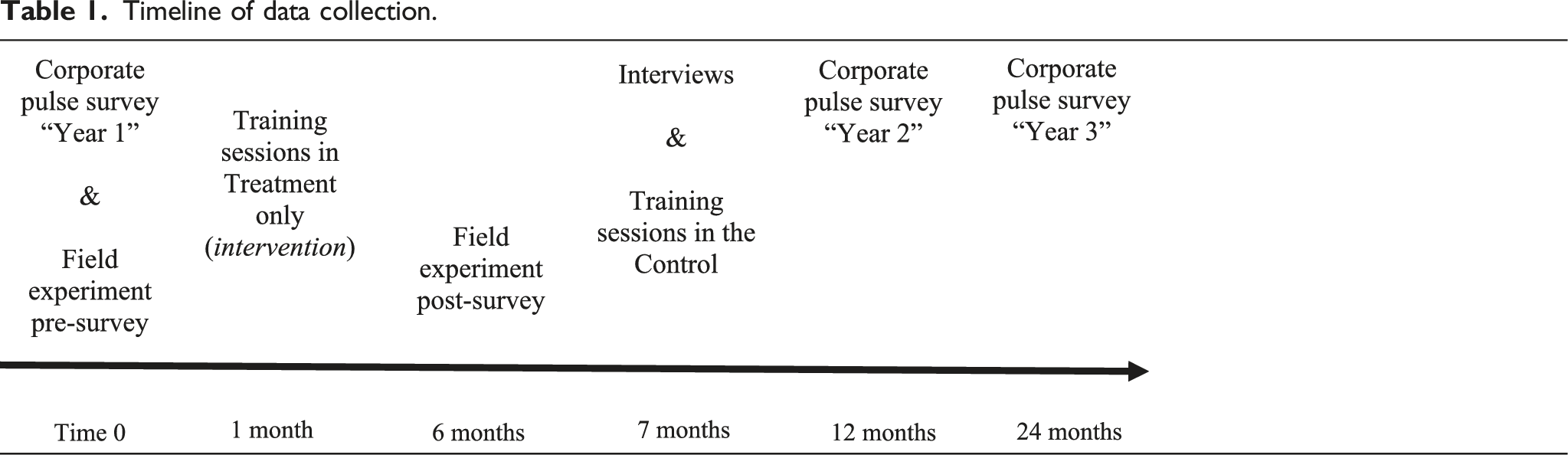
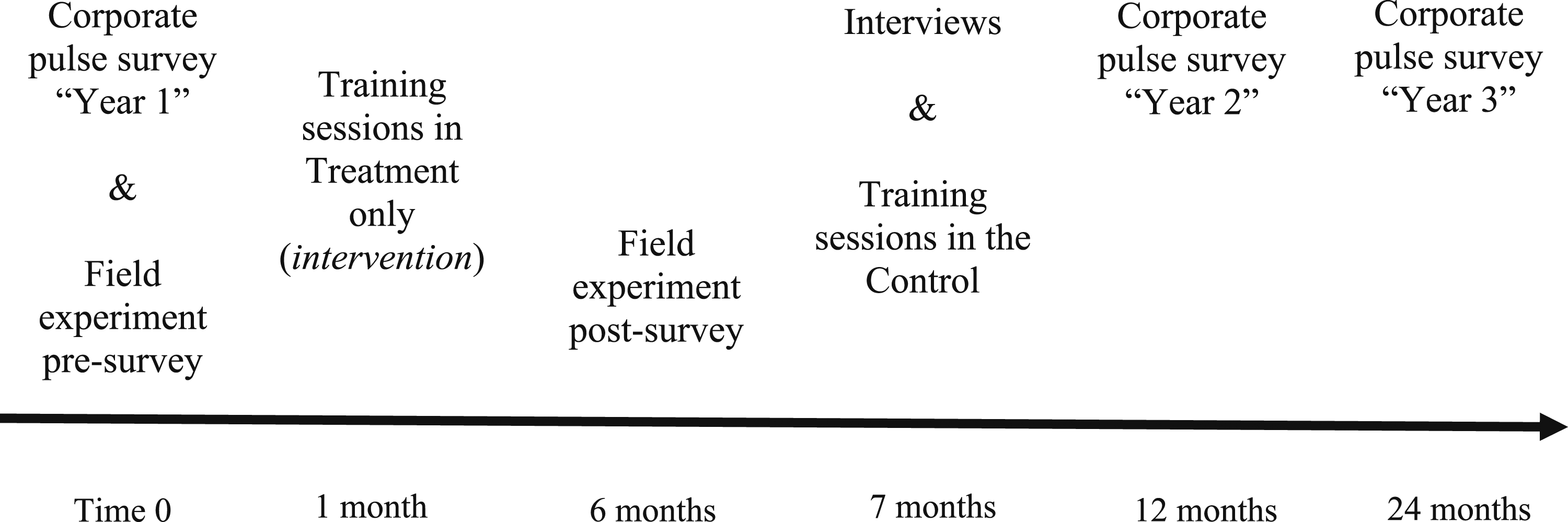
The participants in the virtuous leadership training were supervisors, as well as senior leaders. Due to the sensitive nature of the survey asking directly about the employee’s supervisor, the human resource team distributed the surveys in paper form and asked employees to return the surveys to a locked box. Employees were provided time during work hours to complete the surveys. The surveys were then mailed directly to the researchers.
For the first survey (“pre-survey”), a total of 332 employees participated, 162 from the Control and 170 from the Treatment. For the second survey (“post-survey”), a total of 307 employees participated, 140 from the Control and 167 from the Treatment. This represented nearly full participation from both plants. The only employees who did not participate were those who were on vacation or were sick, etc.
Participants
The employees in both locations worked for the company for a wide variety of time periods, ranging from less than 6 months to over 20 years. Across the locations, 39.5% worked for the company 10 years or more, 22.7% worked for the company for 5 years to less than 10 years, and 37.8% worked for the company less than 5 years.
Employees in both locations took the first survey at “Time 0.” Six months later, employees were given the same survey again, following the same procedures. The intervention occurred 1 month after Time 0, and intentionally only involved leaders from one location (“Treatment”). Engagement has been considered a relatively stable construct, so the time period from pre-survey to post-survey allowed time for any potential change to occur in engagement (Gutermann et al., 2017; Kahn, 1990; Saks, 2006; Schaufeli et al., 2002). The second location’s leaders did not go through the training, nor were they told about the training (“Control”) until after the second survey was complete.
Measures
The survey included measures for four key virtuous behaviors, all measured on a 5-point scale (strongly disagree-strongly agree): compassion (4 items), gratitude (5 items), courage (4 items), and resilience (4 items) as well as the key outcome of employee engagement (4 items). These virtuous behaviors, while not a comprehensive list of all virtues, are representative of generally agreed upon virtuous work-relevant behaviors. These virtues encompass a leader’s care and concern for others in the workplace (compassion), the leader’s expressed appreciation for the work of others (gratitude), the leader’s strength in facing a challenging situation (courage), and the leader’s ability to withstand challenging workplace situations (resilience). The Appendix provides the measures and reliabilities for each construct. 1
Analysis
The general linear model (GLM) allowed a robust analysis of the variables of interest across the pre-test and post-test design. The focus was not comparing the two locations, but rather to determine whether or not the intervention (virtuous leadership training) affected the degree to which employees observed virtuous leadership behaviors and the way in which employees were engaged. Therefore, first, the results in the Control from the pre- and post-survey data were compared. In all comparisons, the length of time the employee worked for his/her current leader as well as the length of time the employee worked for the company was included as control variables. These were useful control variables given the premise that it may take time for employees to observe virtuous behaviors of leaders.
Results
Means and summary statistics for the field experiment, Study 1.
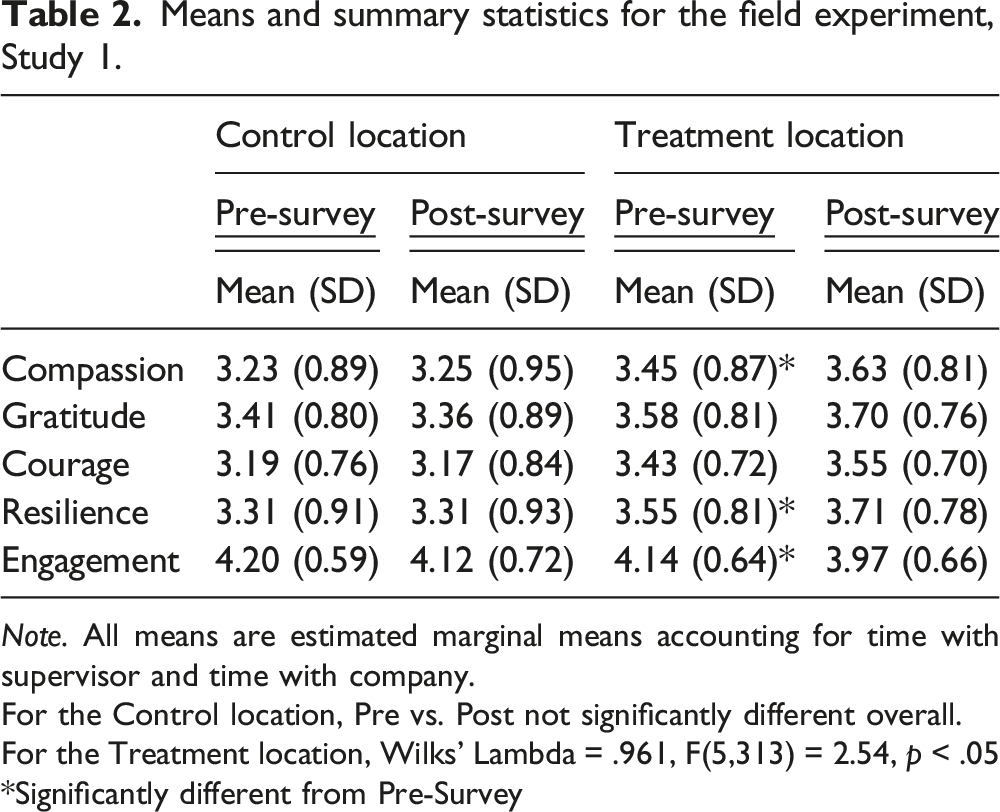
Note. All means are estimated marginal means accounting for time with supervisor and time with company.
For the Control location, Pre vs. Post not significantly different overall.
For the Treatment location, Wilks’ Lambda = .961, F(5,313) = 2.54, p < .05
*Significantly different from Pre-Survey
In the Treatment group, which did receive the intervention between the time of the two surveys, significant differences were found (Wilks’ Lambda = 0.961, F(5,313) = 2.54, p
Post-hoc comparisons were conducted as to whether or not there were significant differences in engagement at Time 0 between the Control and Treatment. This result would rule out whether or not the two locations were starting at different levels of engagement as a potential alternative explanation for results. No significant differences were found in engagement at Time 0 between the two facilities (p = .419). Significant differences were found between the two locations in engagement in the post-survey, with engagement higher in the Control location than the Treatment location (F(1,301) = 5.16, p < .05, MControl = 4.15, MTreatment = 3.97). This difference is consistent with the results of the decline in engagement in the Treatment location between the pre- and post-survey, while no change in the Control location.
Discussion
Virtuous behavior is a deeply rooted, extraordinarily personal, expression, reflective of individual values and character. Why was there decline in engagement when employees were presented with leaders attempting to behave more virtuously, whereas employees in the Control continued as normal with no change in engagement? The initial results showed that in the short-run, employees adopt a “wait and see” attitude toward their perception of virtuous leadership behaviors. One reasonable explanation for this result is that the impact of virtuous leadership behaviors may indeed take time. A steady stream of literature focuses on characteristics of employees that enhance their ability to cope with organizational change (cf. Judge et al., 1999). The challenges with organizational change often have been described as rooted in employees resisting or fearing change (Dent and Goldberg, 1999; Kotter, 1995, 2012), or employees holding a cynical view of change or becoming cynical as a self-defensive mechanism (Reichers et al., 1997). Other research has described the reluctance of employees to believe that management may truly be committed to the change (Labianca et al., 2000). The latter is important to explaining why employee engagement may not initially have improved, and in fact declined. The interviews conducted in Study 2 elucidate this point.
Before the survey was conducted, both locations were already flagged by executives as having lower levels of engagement compared to other parts of the organization. This further reduction in engagement in the treatment, suggested that the intervention indeed created change, though not a positive change—at least in the short-term. The authors probed this further by conducting interviews with employees at both locations.
Study 2: Semi-structured interviews
Participants and procedure
To investigate how virtuous leader behaviors are viewed, a series of interviews were conducted with both locations to better understand how employees witnessed virtuous leadership behaviors and how it affected them. The interviews helped understand how employees mentally process (or even if they recognize) leaders deliberately incorporating the classic virtues in workplace interactions. The timing of the interviews was intentionally set such that the interviews were conducted before the authors knew the results of the field experiment.
After the post-surveys were complete, the authors conducted in-person interviews with employees at both the Control and Treatment locations. Rather than differentiating between the two locations, as was the focus of the field experiment, the purpose of the interviews was to discover what employees believed virtuous leadership behaviors actually looked like and to obtain examples of specific exemplary behaviors. Through the examples that employees shared, the authors were able to better understand how employees respond to virtuous leadership behaviors. The interviews were conducted 1 month after employees completed the post-survey.
Interview instrument
A semi-structured interview protocol was followed with a total of 50 employees. Of that total, 22 were from the Control and 22 were from the Treatment, and the remaining six interviews were of division leaders. Two of the co-authors separately interviewed employees over a 2-day period, with one-on-one interviews occurring simultaneously in two separate rooms. Interviews were conducted at each location.
The employees were selected by each location’s human resource team. The team gave attention in selecting employees to provide the researchers with as much variety as possible with respect to the employees’ tenure with the company, technical background, job description and classification, and direct supervisor. Participants were intentionally chosen to be representative of all different dimensions of employees in each location, including those who exhibited high and low levels of commitment. There were also open opportunities for employees to volunteer to participate in the interviews. The interviews lasted approximately 25–30 min each. All interviews were taped and transcribed.
The overall design was carefully managed such that during the time the researchers conducted interviews, the leaders of the Control location were in the 2-day virtuous leadership training. This allowed all the leaders in the division to ultimately receive the training, but not contaminate the experiment.
Each interviewee was told, “You may remember taking a survey about leadership recently. [Your company] has partnered with [our university] trying to better understand what works well in business and how businesses can do more of that.” The interviewers explained that one area of interest is how employees’ perceptions of leaders’ virtuous behaviors may impact others. The interviewees were asked a few key questions, including: 1. Would you share a story or two about times when leaders at your location have shown virtues at work or missed an opportunity to do so, and what was the impact, if any? 2. What has gone really well with how your leaders show these virtues? How do you think leaders might do more of that?
Analysis
After all of the interviews were conducted and transcribed, two trained coders who were not part of any of the interviews independently coded the transcribed interviews to identify specific virtuous leadership behaviors described by interviewees. Scholars have classified different virtuous behaviors across various categories, from the cardinal four virtues described in Plato’s Republic (Plato, 1943) to the broader collection of 24 virtues described by Peterson and Seligman (2004). Since the focus was not on the impact of a particular virtue or set of virtues, but rather on virtuous leadership behaviors’ impact on employee engagement, the focus was on the virtues that the company elaborated on in the virtuous leadership behavior sessions, which included both classic virtues and more broadly classified virtuous behaviors.
Coders were provided definitions of the virtues that were used in the training sessions. The definitions were expressed in plain, direct language to the coders. The coders independently identified virtuous leadership behaviors that the interviewees described as being enacted by leaders, as well as those that were deemed by the interviewees as missed opportunities for the leaders to enact virtue. Each of the 50 transcripts resulted in approximately 20 pages of interview content. After each coder completed coding the interviews, they met to resolve differences. The interrater reliability was 0.88, above acceptable standards (Perreault and Leigh, 1989). Two of the co-authors then reviewed all data, with specific attention to exemplary themes that emerged.
Results
Several themes became evident in the interviews. First, employees could indeed identify when leaders demonstrated virtuous leadership behaviors, as well as missed opportunities to do so. Second, employees were reluctant to believe that the changes would be long-lasting. These two themes will be described briefly below.
Employees recognize virtuous leadership behavior…and know when absent
Examples from the interviews of virtuous leadership behaviors observed, Study 2.

The most prevalently mentioned virtuous leadership behavior was compassion. Thirty-eight percent of descriptions of virtuous leadership behaviors that employees shared were of leaders’ acts of compassion, and a little more than a quarter (28%) of the missed opportunities were those involving compassion. The question in many workplaces, particularly in contexts such as this study of a large multinational corporation, revolves around what exactly compassion looks like in the eyes of employees in the workplace? At first blush, the display of compassion in the workplace might be feared to involve bending or ignoring company rules or lowering the bar for performance expectations. This was not the view of compassion that was found in the interviews. While employees verbalized pride in a job well done and a strong work ethic, and they saw compassion as involving a leader’s human discernment for caring behavior. Compassion was recognized as a discretionary act. Employees noted that compassion involves communication—both listening and talking.
Employees noted the resilience, or mental toughness that leaders demonstrated after difficulties, in a range of situations at work. Key to resilience was the consistency in which the leader recovered after a set-back and managed the stress associated with the difficulties. Resilient leaders became those that employees could be counted on, even when a set-back occurred.
Distinct from resilience, but also an important, recognizable virtuous leadership behavior is courage. Employees were often caught off-guard by a leader’s act of courage because these behaviors were not what other leaders for whom they had worked might do in similar situations. Employees witnessed that courageous leaders step in to resolve conflict and take actions that, while not popular, were right.
Employees, likewise, recognized both the presence and absence of a leader’s gratitude. They clearly sensed the difference in leaders who shared with employees that they mattered and daily appreciated the work that went above and beyond, versus those leaders who seemed to suggest it was all part of the job and implied that employees should be doing more without recognition.
Employees in wait and see mode
Recall that employee engagement in the Treatment group decreased from the pre-survey to the post-survey, while remaining unchanged in the Control group. This result was concerning. Why would engagement decline when the leaders had been actively working at exhibiting virtuous leadership behaviors? The interviews helped shed light on why results did not show higher employee engagement scores. The interviews took place 6 months after the virtuous leadership behavior coaching and development sessions in the Treatment, and concurrently with the training in the Control.
The results emphasize that there is no quick fix to improving employee engagement. The interviews suggested that employees were open to change, but cautious to believe that the change would last. This “wait and see” mode required extra monitoring by employees to assess how genuine and lasting the change in leaders was. One employee described this as continuing to wonder after years of different initiatives that did not have lasting continuity, “What are they taking away from us now? We are always, kind of, on guard” (Interviewee #7).
An employee noted the disconnection between words and actions in describing missed opportunity to show compassion in regard to balancing life and work in what had turned into multiple years of mandatory overtime: For me, it’s overtime. We work a massive amount of overtime, and yeah, we talk that we care. But [management is] here five days a week. Why would we want them here Saturday? People need a two-day break, right? That’s what we need to be working towards. We don’t send that message. What we hear is, ‘That’s part of business. That’s part of business.’ Well, it doesn’t have to be. It’s an excuse. Showing compassion is part of business. (Interviewee #11)
Another employee [from Treatment] described his skepticism that the initiative would have staying power as follows, But from a business standpoint, you’ve got to do what you’ve got to do. So, I have a feeling [virtues and business] are going to kind of conflict. Like I have a feeling that as soon as a virtue runs across a business metric, we’re going to put the virtue to the side. (Interviewee #47)
Employees described a variety of plans that leaders had abandoned. This lack of workplace perseverance frustrated employees. An employee [from Treatment] aptly described much of the tone in the location, I’m a little bit skeptical about actions like putting up the virtue posters. When I saw them going up, I was just like, ‘Okay, well, what is the point here?’ Hey, the jury’s still out, you know? I’m not sure yet. When I see something, I want to say, ‘All right. Has this got legs? How long is this going to last?’ But I’m curious, especially since we are such a metrics-driven company. (Interviewee #39)
Discussion
The interviews against the backdrop of the field experiment suggested that employees may pause as leaders enact virtuous leadership behaviors to decide if the change is temporary, or if they can count on the sustainability of the change and match the efforts in their own engagement. With new initiatives often commonplace in organizations, waiting to assess the viability of the leaders’ actions before more fully engaging in one’s work is a rational approach by employees.
The authors suggest that because of the personal nature of deep change, in particular, value laden change like enacting virtuous actions that were promised by the company, that employees may have redirected personal resources from engagement to observation to see if indeed the leaders would express virtuous behavior consistently. Embracing change of such a personal nature that later is not continued may result in an employee feeling foolish or being perceived by others as naive, a resource loss in both esteem and reputation. Further, employees facing the possibility of a changed leader may have concerns of whether their change will require employees to change as well.
For leaders, time was needed to have both the opportunity and practice to enact virtuous leadership behaviors at work. In the next section, we share the results of what unfolded over time in the company as leaders continued to practice virtuous leadership behaviors offering employees more confidence that the organizational efforts may be long-standing.
Study 3: Corporate pulse survey
Participants and procedure
If the supposition that patience is required to win with virtuous leadership behaviors, then at some point improvement in employee engagement should occur. The question is when?
At the conclusion of the field experiment and interviews, the division of which the two locations were a part continued active practice of virtuous leadership behaviors, reinforced by regular coaching, and discussions. A strategic focus on living virtuous leadership behaviors was ongoing within the company. Leaders worked to get more information about virtues to teammates by talking about the virtues and sharing videos about virtuous behavior in regular team meetings. The leaders in the division estimated about 50% of the employees wanted to learn more about the virtues after they viewed a video about virtuous leadership behaviors. As a result, leaders created a handout to explain how teammates could access the company-wide tools available through a website the company created for employees.
During a voluntary lunch and learn, a video on compassion was shown and teammates discussed relevance to their work. This was repeated as an exercise with other teammates, all voluntary and open to any interested employee. The location began to have an increased awareness of how employees can positively affect one another. The language of virtues became more commonplace and was heard during decision-making and performance evaluations to show appreciation and highlight positive conduct.
To probe the question about how engagement might change over time, the authors obtained the results of employee engagement assessment completed each year through the corporate pulse survey. The authors received 3 years of data. Each year, on behalf of the company, an external consulting company was commissioned to administer the corporate pulse survey to all employees world-wide. The focus of the corporate pulse survey was employee engagement (with no mention of the virtues).
The secondary data from these 3 years of the pulse survey data points could be divided to distinguish the locations in this study. These data allowed a further exploration of the proposition that changes in engagement may take time as employees observe leaders to determine whether virtuous leadership behaviors would be demonstrated consistently, or come and go as the company shifted to other initiatives and economic pressures.
Measures
Percent favorable employee engagement as measured by the corporate pulse survey across time, Study 3.

Note. Superscripts with different letters indicate statistical significance between rows within a specific year. Superscripts with different (numbers) indicate statistical significance across columns from year to year, within either the Control or Treatment.
Measures.

Analysis
The first of the 3 years of data received coincided with the timing of the “Time 0” pre-survey in the field experiment. This offered an excellent baseline before the intervention to compare the next 2 years of the corporate pulse survey data. Additionally, it allowed the comparison of the results of the pre-survey with the year one of the corporate pulse survey.
An examination was conducted to determine whether the two locations differed from one another in employee engagement at Time 0. While the primary focus is on changes in employee engagement after the intervention, rather than between locations, this similarity in starting point of the two locations allowed an examination of the implications of the Year 2 and Year 3 corporate pulse study both within and across locations. Then tests were conducted to compare the locations across time.
Results
The results across the 3 years were affirming. (See Table 4 for a summary.) In Year 1 of the corporate pulse survey, similar in time to the first survey of Study 1, there were no significant differences in the percent of engaged employees between the Control and Treatment (48% and 56%, respectively; χ2 = 2.04, p = .15). This similarity is consistent with the pre-survey findings from the field experiment. This result suggests that both locations were at similar levels of employee engagement before the virtuous leadership training sessions, as measured by two different instruments—the company’s pulse survey and the Time 0 pre-survey in the field experiment.
From Year 1 to Year 2’s pulse survey, the Treatment did not improve significantly, though directionally higher. Most notably there was not a decline. Recall in the field experiment, after the intervention that engagement declined in the Treatment. During this “wait and see” period post-intervention, engagement returned to Year 1 levels in the Treatment. As might be expected due to the short time frame between the initiation of virtuous leadership behavior development and the survey in the Control (5 months), the Year 1 and Year 2 pulse survey results indicated no significant difference in engagement.
The Year 2 corporate pulse survey results are especially of interest. At the time of the Year 2 corporate pulse survey, 11 months had passed since the Treatment group received the intervention in the field experiment, and 5 months passed since the Control also was involved in the virtuous leadership behavior sessions and the interviews. The Year 2 corporate pulse survey results offer evidence as to whether employee engagement indeed improved after the dip initially.
During this passage of time, the company continued to emphasize virtuous leadership behaviors, with continued virtuous leadership behavior coaching and development sessions. First, engagement between the Treatment and the Control was compared. Engagement in the Treatment was significantly higher than in the Control (64% and 53% respectively; χ2 = 3.97, p
Year 3’s pulse survey indicated the company’s consistent efforts were starting to pay off. In Year 3, further improvement resulted. In the Treatment location, employee engagement rose significantly from 64% in Year 2 to 78% in Year 3 (χ2 = 8.02, p
Discussion
These positive and significant changes in engagement across the 3 years of pulse survey data emphasized the necessity of consistently practiced virtuous leadership behaviors to begin to positively shape employee engagement. While the initial results in the field experiment showing the decline in engagement in the Treatment concerned the company, their dedication to encouraging and developing virtuous leadership behaviors had a favorable impact. Clearly, leaders must “walk the talk” for employees to believe the change, invest in it, and respond with engagement.
The company continued to engage with leadership teams across the division and rolled out the efforts throughout the globe. The division-wide improvements illustrated that the company was benefiting from the consistent efforts to encourage and reinforce virtuous leadership behaviors. The vernacular, reflection, and actions were starting to take root within the culture. Reflecting on these results, the division HR director shared the significant changes that had occurred, I can identify positive outcomes from the process. We have lower turnover and increased willingness for people to refer others to our company. I think we listen more and therefore they want to stay and bring friends and family to the division. In general, there is more engagement at a local level. (Division’s HR director)
In a follow-up conversation, the senior executive responsible for the virtuous leadership behavior program globally was interviewed. This leader had world-wide responsibility across the company to guide the virtuous leadership behavior workshops and coaching sessions.
The executive shared that management found the numbers from the results “stunning.” He sensibly and humbly added that, “Certainly, these results are no reason to claim victory. More effort and more changes are needed since there is plenty of room for additional improvement. With that limitation in mind, something seems to have contributed to these results.”
The combined results of this study and their follow-up clearly indicated to management that there is no “quick fix” for meaningful, long-term change. The executive shared, Some people are still struggling to let go of or deal with baggage of past behavior. But, everyone is more open and willing to try as we work at this consistently. Engagement can’t be solved with just extrinsic motivation. The typical model to change engagement is a rewards and recognition program. That’s often the flavor of the day. But, employees want to know how they will be treated and whether their work makes a difference. Focusing on virtues is an alternative model. It gets results over time, and we have to work to keep those results! The practice of virtues in the workplace or otherwise requires diligence and commitment. Remember, it’s not a virtue until you act it. (Executive responsible for the program)
The executive concluded, “If you are patient, diligent and committed enough, then there is a payoff.”
Implications
The results of this 15-month, mixed-method study are valuable to both scholars and business executives. Through the longitudinal field experiment, qualitative interviews, and secondary data from the corporation’s engagement survey, the findings indicate that employees indeed recognize changes in the virtuous behaviors of leaders. Most importantly, though, the findings indicate that it takes time for employees to believe this change will be ongoing and subsequently improve employee engagement.
The field experiment, interviews and corporate pulse survey suggest important implications. First, it takes practice for leaders to enact virtuous behavior across all the pockets of their work. The literature regularly includes “practice” in the discussion of virtuous behavior. Bragues (2006) reminds that virtuous behavior must be practiced and become habitual. Wang and Hackett (2016) suggest that virtuous behavior is lost in the absence of practice. The research finds that employees witness this practice and wait to see if it will continue. Virtuous behavior is intrinsically motivated and must be driven by a change in the person, not because of rules, control, or external gain. This type of deep change requires time for leaders to adopt a new way of thinking, interaction, and practice.
Second, seeing is believing. Employees must experience the leader’s virtuous behaviors over time before they “believe them.” Research has suggested that exposure to managerial communication better helps employees understand the benefits of change and overall strategic value of the change (Sonenshein and Dholakia, 2012). Relatedly, virtues must be practiced over time to earn the leader a reputation of being consistent and faithful. Virtuous behavior in general is so deeply personal that company initiatives must illustrate true commitment over a period of time; otherwise they risk being offensive to employees.
Third, the results indicate the importance of leaders engaging in a process to deliberately consider the way in which they communicate and show care to their teams. Leaders in the study spent time learning to build a common language about what an excellent culture looks like, as defined by the virtues, how virtue impacts high performance and how a virtue-based culture can guide business decisions. The first step is building a common language to understand how the abstract idea of culture could be made more concrete. The content was evidenced-based linking virtue with the science of high performance. The leaders then made the concepts practical in their particular teams. Next, they focused on how to be more intentional in the practice of virtues. Finally, the leaders thought about how to get better in their own practices. The results indicate the benefits of the company’s focus not on “teaching” virtues, rather on cultivating what is already inside each person. The methodology of the training involves the teams teaching one another through regular encouragement and practice to invest in behaving as a virtuous leader, with the focus on the fact that it is not a virtue until we act.
Limitations and future research
The results underscore how critical it is that firms encourage the deliberate, and ongoing, practice of virtues over time, rather than the one-and-done approach to corporate leadership development that unfortunately is often commonplace. Our research examines the impact of four core virtuous leadership behaviors, we do not consider the list exhaustive. Rather, we suggest that these virtuous behaviors offer a platform from which employee engagement can be enhanced and additional virtuous behaviors encouraged. The findings encourage scholars to continue to pursue studies that capture the impact of leaders’ behaviors over time in spite of the difficulty of this type of research. For researchers, the study of leadership development (particularly virtuous leadership) must include a lagged effect on outcome measures. Further research is needed to understand what elements of an organization’s culture may help truncate the amount of time necessary for employees to observe the virtuous behavior of leaders.
In addition, this research calls for further investigation of practical enactment of virtues. Empirical research is encouraged to confirm these findings and to further investigate the different ways that virtuous behavior may be enacted in the workplace to gain positive outcomes. Further, research is needed to determine whether or not certain combinations of virtues when demonstrated in the workplace have more impact than other combinations. Research is also needed to better understand which virtues are more observable to employees, as well as more salient in the workplace.
This research examined only the impact employee perceptions of their direct supervisor’s virtuous behavior has on employee engagement. Future research examining the impact of virtuous behavior on a variety of other relevant metrics, including organizational citizenship behaviors and successful promotion within the firm may be fruitful. Additionally, while this research focused on the direct supervisor–employee relationship, future research would be useful to determine the impact of virtuous leadership behaviors on upper level leaders throughout and across the organization (e.g., senior leader to senior leader, as well as senior leader to middle management).
There are several limitations of this research that should be considered. The research was all conducted within a single industry. While this allowed us to control for extraneous factors, there is need to determine if virtuous leadership behaviors have a greater impact in other industries, as well as across different countries. Additionally, we do not suggest that virtuous leadership behaviors can compensate for lack of key competencies, though these behaviors may guide a leader to a wide array of skill development. Further, any long-term study of human behavior, even with a field experiment, cannot rule out all sources of skill development (or lack of) that may occur.
Another limitation of this study is that while the employee engagement measures in Study 1 and the separate measures in Study 3 reflected the overall sense of employee engagement, the measures were not identical between the two studies. Study 1 (primary data) was implemented by the authors and the measures of engagement were identical in the pre- and post-survey. The survey in Study 3 (secondary data) was implemented by the company’s headquarters through a third-party firm as part of their regular assessment of engagement. The firm used slightly different measures than the authors’ Study 1 measures of engagement. However, all 3 years of the Study 3 data used identical engagement measures. The patterns found in Study 1 and Study 3 were consistent despite any wording differences between the studies.
Conclusion
By definition virtuous leadership behaviors are practiced over time, continually. Organizations must recognize that employees may not react to the positive changes until the behaviors of leaders are perceived to be a part of the way in which the organization conducts itself. Through a mixed method field study, the authors illustrate that a decline in engagement is temporary as employees assess whether the change in leaders will be ongoing and is genuine. This contribution is important to the employee engagement literature because it illustrates a nonlinear path of engagement. Further, it suggests that reduction in engagement may not be the result of the oft-attributed resistance to change, but the assessment of the leader’s commitment to the change.
Conservation of resources theory (De Cuyper et al., 2012) and change cynicism (Thundiyil et al., 2015) explain that employees reserve adoption while they assess whether the changes warrant the necessary investment of energy. This cautious response suggests that rather than attempting to convince employees not to resist the change, that efforts should be made to encourage leaders to continue practicing virtuous leadership behaviors, even when the response on the part of employees does not seem immediately forthcoming.
Taken together, this research illustrates that virtuous leadership behaviors do positively impact employee engagement. Employees take note of virtuous leadership behaviors quickly but are likely to wait before they commit themselves. Over time, employee engagement is enhanced as a result of leaders’ consistent virtuous leadership behaviors.
Footnotes
Declaration of conflicting interests
The author(s) declared no potential conflicts of interest with respect to the research, authorship, and/or publication of this article.
Funding
The author(s) received no financial support for the research, authorship, and/or publication of this article.