



Abstract
Unethical behavior within organizations is a very prevalent and costly problem. This study investigates employees’ unethical pro-organizational behavior (UPB), which is unethical behavior with the intention to help the organization. Leveraging social identity theory and social exchange theory, this research evaluates the direct relationship between organizational commitment and UPB and the indirect relationship through employee work engagement. The theoretical model was tested using structural equation modeling based on a sample of 499 U.S. service sector employees. Results indicate that organizational commitment can motivate employees to engage in UPB. However, channeling the commitment into work engagement can reduce employees’ motivation to engage in UPB. As such, the findings extend the UPB literature while providing practitioners with a clearer understanding of the importance of monitoring organizational commitment alongside work engagement.
Keywords
Introduction
Competition is fierce in the present business era, and human capital has become more critical. Organizations seek employees with high levels of organizational commitment and identification, highly engaged employees, and satisfied employees to gain and maintain a competitive advantage. Employees with high organizational commitment often go beyond their job description to contribute to their organization’s success. Additionally, engaged employees are completely involved in their work. Cameron (2008) suggests that favorable organizational conditions can produce positive change. However, not all outcomes of organizational commitment and employee work engagement are beneficial. Some actions intended to benefit the organization can ultimately be detrimental (Cullinan et al., 2008; Fulmore and Fulmore, 2021; Umphress et al., 2010). One such damaging outcome is unethical pro-organizational behavior (UPB), defined as unethical, immoral, or illegal acts committed with the intent to benefit the organization (Umphress and Bingham, 2011; Umphress et al., 2010). Unethical pro-organizational behavior consists of intentional pro-organizational behaviors that are exhibited at employees’ discretion and are not directly recognized by the organization’s formal reward system and can take place in the form of falsifying information as well as withholding certain information (Umphress and Bingham, 2011; Umphress et al., 2010). Examples include hiding product defects, falsifying documents, using questionable accounting practices, bribery, lying to external stakeholders, and environmental pollution (Effelsberg et al., 2014; Miao et al., 2013; Umphress and Bingham, 2011; Umphress et al., 2010). These actions, though intended to help the organization, are unethical.
While UPB might offer short-term organizational benefits, it is harmful in the long run and often comes at the expense of stakeholders (Bryant and Merritt, 2019; Umphress and Bingham, 2011; Umphress et al., 2010; Zhang, 2020). Some businesses have witnessed several situations involving UPB, with the Enron and WorldCom scandals being two of the most memorable (Steele and Branson, 2014). Additional examples include Volkswagen’s emissions humiliation, as well as the accounting fraud disgraces at Wells Fargo, Steinhoff International, and Toshiba that have eroded public confidence in corporations (Bryant and Merritt, 2019; Castille et al., 2016; Zhang, 2020). Not only can UPB lead to financial losses and damage the reputation of an organization, but it can also have more dire consequences, such as was the case with the Boeing situation that resulted in the death of hundreds of individuals (Cruz and De Oliveira Dias, 2020; Griep et al., 2023). Hence, it is understandable that scholars have researched antecedents of UPB to try and mitigate such harmful behavior.
To date, organizational commitment and employee work engagement have been researched extensively in the management literature. Both are known to increase productivity and organizational citizenship behavior in employees while also reducing absenteeism and turnover intentions (Alagaraja and Shuck, 2015; Kim et al., 2013; Shuck et al., 2011, 2014; Yalabik et al., 2013). In addition, existing research on UPB has separately assessed organizational commitment and employee work engagement with UPB, identifying both as important antecedents to UPB (Fulmore, 2018; Fulmore and Fulmore, 2021; Gigol, 2020; Matherne and Litchfield, 2012; Zhang and Xiao, 2020). However, the two constructs have not yet been tested together as motivators of UPB. Considering the importance of organizational commitment and employee work engagement in organizational research, further theoretical and empirical exploration of how these two antecedents interact together with UPB is warranted. Therefore, the purpose of this study is to evaluate the relationship between organizational commitment and UPB, directly and indirectly, through employee work engagement.
This study begins by reviewing the organizational commitment, employee work engagement, and UPB relevant literature, with a focus on the theoretical framework that informs these constructs. Then the hypothesized relationships between organizational commitment and UPB, employee work engagement and UPB, and organizational commitment through employee work engagement and UPB are tested. Last, the study offers contributions to research and practice to help further the understanding of unethical employee behavior. The findings of this study have the potential to inform policies and practices designed to prevent such unethical behavior among employees.
Literature review, conceptual framework, and hypotheses
There is a growing body of literature on antecedents of UPB at the individual level. Findings indicate that organizational commitment, organizational identification, job satisfaction, and employee work engagement can increase an employee’s propensity to engage in UPB (Ebrahimi and Yurtkoru, 2017; Fulmore, 2018; Fulmore and Fulmore, 2021; Gigol, 2020; Grabowski et al., 2019; Luan et al., 2023; Matherne and Litchfield, 2012; Zhang, 2020). Below, the relevant literature on (a) organizational commitment and UPB, (b) employee work engagement and UPB, and (c) organizational commitment and employee work engagement is discussed, along with the proposed hypotheses.
Organizational commitment and UPB
Organizational commitment has been defined as “a psychological link between the employee and his or her organization that makes it less likely that the employee will voluntary leave the organization” (Allen and Meyer, 1996: 252). The most highly cited conceptualization of organizational commitment is the three-component model, which considers three dimensions: (a) normative commitment; (b) continuance commitment; and (c) affective commitment. The psychological link refers to the affective component of the employee’s emotional attachment to, identification with, and involvement in the organization and a desire to remain with the company (Allen and Meyer, 1990; Meyer and Allen, 1997). It’s important to recognize that scholars have distinguished between and interchangeably used the constructs of organizational commitment and organizational identification in related literature.
Organizational identification has had many definitions proposed over the years (Riketta, 2005). Most scholars have conceptualized it as a cognitive construct, specifically, as the “perception of oneness or belongingness to” an organization (Ashforth and Mael, 1989: 34). Thematically the proposed definitions imply that organizational members link their membership to their self-concepts cognitively and emotionally (Riketta, 2005). From the perspective of Ashforth and Mael (1989), organizational identification is a specific form of social identification. Social identification, as presented in social identity theory, is the “realization that the self is included in some social categories, and excluded from others” (Ellemers and Haslam, 2012: 382). This implies that the self is identified with a particular group and shares its characteristic features (Ellemers and Haslam, 2012). Social identification refers to the cognitive awareness that one can be included in a particular group and incorporates the emotional significance of that group membership for the self (Tajfel, 1978). Organizational identification combines these cognitive and affective (emotional) components (Ashforth and Mael, 1989). Moreover, organizational identification is closely conceptually related to affective organizational commitment demonstrated by the overlap in the definitions (Harris and Cameron, 2005; Riketta, 2005).
The present study is interested in the affective dimension of organizational commitment, which focuses on employees’ psychological attachments to their organizations. The theoretical connection between affective organizational commitment and UPB is framed by social identity theory that, as it pertains to an organizational setting, focuses on individuals’ self-concepts based on organizational membership (Tajfel, 1978). When organizational identification is high, individuals internalize organizational failures and successes as their own and are willing to exert efforts on behalf of the organization (Ashforth and Mael, 1989), influencing their willingness to engage in UPB (Umphress and Bingham, 2011). When employees are emotionally and affectively committed to their organizations, they feel at the time that it is the “right thing to do.” Ergo when affective organizational commitment is high, individuals are attached, are involved, and identify with their organizational membership (Meyer and Allen, 1997) while also wanting their organization to reach its goals, which could entice them to behave unethically to benefit the organization (Ebrahimi and Yurtkoru, 2017).
Several researchers have assessed UPB, focusing on this affective component of organizational commitment. Most findings indicated a significant positive relationship between affective organizational commitment and UPB (Ebrahimi and Yurtkoru, 2017; Fulmore, 2018; Fulmore and Fulmore, 2021; Grabowski et al., 2019; Matherne and Litchfield, 2012). However, two studies showed a significant negative relationship between affective organizational commitment and UPB (Park et al., 2023; Wang et al., 2021). Additionally, Luan et al. (2023) attributed their nonsignificant meta-analytic findings to a very small sample size. Based on the presented theory, constructs, and relevant literature, the following hypothesis is formulated:
Organizational commitment is positively related to UPB.
Employee work engagement and UPB
Engaged employees are wholly involved in the work they are performing. More specifically, Schaufeli et al. (2006: 701) define employee work engagement as a “fulfilling work-related state of mind that is characterized by vigor, dedication, and absorption.” Employees who exhibit vigor are energetic, determined, and mentally resilient, consistently putting effort into their work. Those with dedication show high involvement in their work, marked by enthusiasm and inspiration. Absorbed employees are highly concentrated and often unaware of the time they spend on their work.
Social exchange theory provides a theoretical underpinning to this employee work engagement construct. Social exchanges involve the interaction between two parties motivated by the outcomes they anticipate (Blau, 1964; Cropanzano and Mitchell, 2005). One party performs a service in the hope of receiving something in return. This interaction has been labeled the social exchange theory (Blau, 1964; Cropanzano and Mitchell, 2005). Extending this theory, employees who receive a valued exchange from their employers have a sense of obligation resulting in reciprocation, which in turn creates an attachment to the organization, increasing the employee’s investment in the organization and their work (Shuck et al., 2011; Umphress et al., 2010; Yalabik et al., 2013).
Job satisfaction is a closely related concept to employee work engagement supported in the literature. It has been noted that job satisfaction is an evaluation of the emotional state of an employee, which results in how individuals perceive, think, or feel about their job (Weiss, 2022). Incorporating social exchange theory, some have argued that satisfaction with various job characteristic facets is important “for employees to become energetic, dedicated and absorbed in their job” (Yalabik and Rayton, 2017: 250). Relatedly, it has been found that people with a high level of job satisfaction are more willing to engage in UPB due to a sense of belonging to the company (Dou et al., 2019). Although UPB has been studied with several constructs, only one empirical study was found that assessed employee work engagement as an antecedent to UPB using a sample of employees in Poland (Gigol, 2020). Findings indicated that engagement could lead to UPB in employees (Gigol, 2020). Therefore, based on the presented theory, constructs, and relevant literature, the following hypothesis is proposed:
Employee work engagement is positively related to UPB.
Organizational commitment and employee work engagement
There has been a debate in the engagement literature on the causal relationship between organizational commitment and employee work engagement (Yalabik et al., 2013). However, several studies support that organizational commitment is an antecedent to employee work engagement (Asif et al., 2019; Poon, 2013; Rayton et al., 2019; Shuck et al., 2011; Yalabik et al., 2013). In addition, Yalabik et al. (2013) provide longitudinal evidence that a model with organizational commitment as an antecedent to employee work engagement has a better fit than the outcome model. Organizational commitment should have a predictive effect on employee work engagement. If an employee is affectively committed to their organization by demonstrating attachment, identity with, and involvement, it has been argued that this could increase the likelihood the person would engage in UPB. And if an employee feels an obligation to reciprocate valued exchanges they experienced due to their vigor, dedication, and absorption (i.e., employee work engagement) which has increased their commitment to the organization, this might entice the employee to demonstrate UPB. Therefore, the following two hypotheses are posited:
Organizational commitment is positively related to employee work engagement.
Employee work engagement intervenes in the relationship between organizational commitment and UPB. Figure 1 depicts the hypothesized research model between organizational commitment and UPB, directly, as well as indirectly, through employee work engagement.
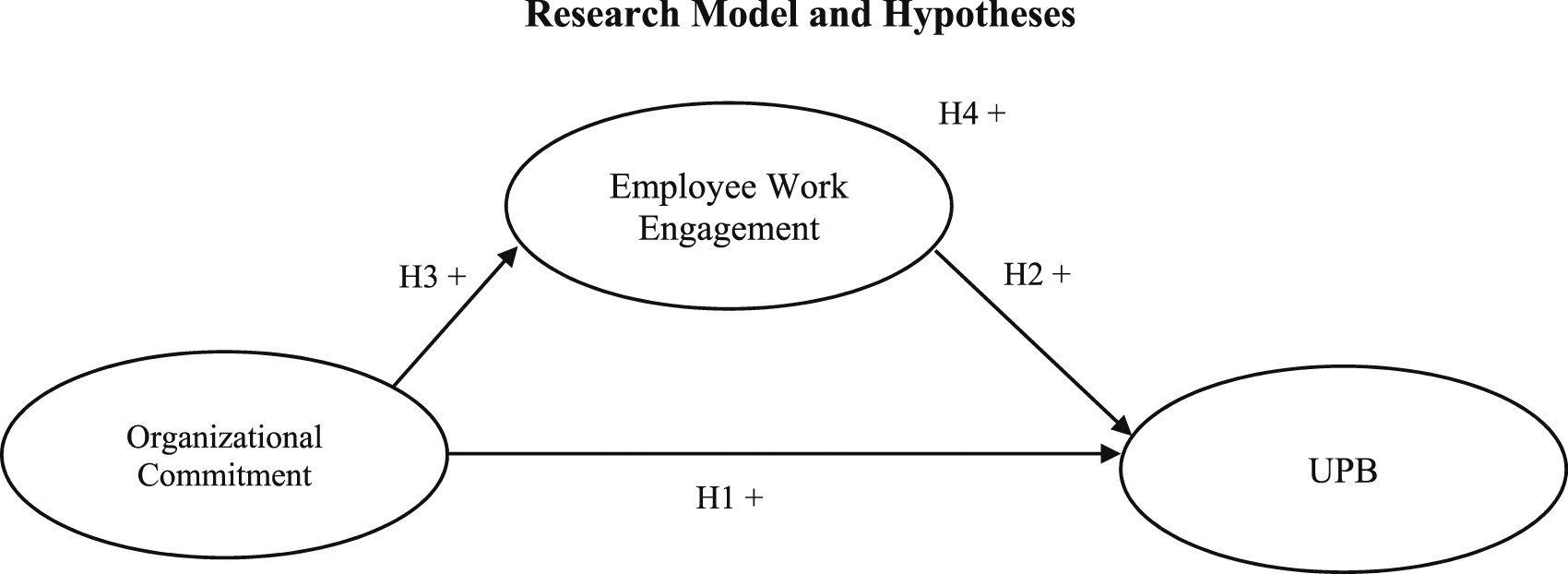
Research model and hypotheses.
Method
Sample and procedure
The population for this survey was U.S. employees working in the service sector. The service sector constitutes the largest industry sector in the United States with 80.3% of employees working in this sector (Bureau of Labor Statistics, 2020). A total of 673 employees completed the survey. However, the responses of 174 employees had to be excluded due to failing the attention checks or straight-lining, which indicated a lack of full engagement by the respondents. After data cleaning, the final sample consisted of 499 employees.
The final valid sample consisted of 47.7% females and 52.3% males. The average age was 41.89 (SD = 11.63) and ranged from 22 years to 68 years. Of the respondents, 80.6% were White, 9.0% were Black, 6.6% were Asians or Pacific Islanders, and 3.8% belonged to other races/ethnic groups. A total of 85.0% of the participants were full-time employees, while the remaining 15.0% were part-time employees. The average tenure of respondents ranged from less than 1 year to 35 years, with an average of 8.84 years (SD = 7.15). A total of 51.1% of the participants were employed at firms with 1-499 employees, while 48.9% of the participants were employed at firms with 500 or more employees.
The online survey platform Qualtrics® was utilized to collect the data via a cross-sectional survey design. Study participants were recruited with the assistance of MTurk®. MTurk® is an online survey distribution platform that connects researchers with respondents. MTurk® not only allows the surveying of large samples within a short period of time but often results in diverse samples due to surveying respondents from a very diverse set of occupations and organizations (Aguinis et al., 2021; Buhrmester et al., 2011). In addition, data collection via MTurk® is as valid and reliable as traditional methods such as American college samples and convenience samples (Aguinis et al., 2021; Behrend et al., 2011; Berinsky et al., 2012; Buhrmester et al., 2011; Feitosa et al., 2015; Landers and Behrend, 2015). Furthermore, MTurk® allows the pre-qualification of workers based on the desired sample characteristics (Aguinis et al., 2021).
Instrumentation
Unethical Pro-Organizational Behavior
The UPB scale (Umphress et al., 2010) was used to measure UPB. The UPB scale consists of 6 items anchored on a 7-point Likert-type scale, with 1 indicating strongly disagree and 7 indicating strongly agree. The UPB scale asks respondents to indicate how much they agree with statements such as “If it would help my organization, I would misrepresent the truth to make my organization look good.”
Organizational commitment
The affective commitment subscale of the three-component model of organizational commitment (Meyer and Allen, 1997) was used to measure organizational commitment. The affective commitment subscale consists of six items and is anchored on a 7-point Likert-type scale, with 1 indicating strongly disagree and 7 indicating strongly agree. The affective commitment subscale asks respondents to indicate how much they agree with statements such as “I would be very happy to spend the rest of my career with this organization.”
Work engagement
Employee work engagement was measured using the 9-item Utrecht Work Engagement Scale (UWES; Schaufeli et al., 2006), which consists of three dimensions that are measured on a 7-point scale with 1 indicating never and 7 indicating every day. Sample items of the three dimensions are “At my work, I feel bursting with energy,” for vigor, “I am enthusiastic about my job,” for dedication, and “I am immersed in my work,” for absorption. The first-order factor of the three UWES dimensions has been confirmed across a ten international samples study (n = 14,521; Schaufeli et al., 2006). In addition, scale scores from the UWES have demonstrated strong reliability (Martin, 2017; Mills et al., 2012; Zigarmi et al., 2011).
Marker variable
The three negatively worded items hostile, nervous, and afraid of the I-PANAS-SF (Thompson, 2007) were used as marker variables for common method variance (CMV) as they have been successfully used in several studies (Kim et al., 2015; Shuck et al., 2017; Zigarmi et al., 2018). The items were anchored on a 5-point Likert-type scale ranging from 1 (“never”) to 5 (“always”).
Controls
Based on the UPB literature, several variables were considered control variables. The consideration of control variables was based on significant associations (i.e., correlations) with UPB as indicated within the literature (Becker, 2005). Extant literature on UPB supports the usage of gender, age, and tenure as control variables (Fulmore, 2018; Fulmore and Fulmore, 2021; Kalshoven et al., 2016; Tian and Peterson, 2016; Zhang, 2020). Gender is controlled for because women are more engaged in their jobs (Richman et al., 2008). In addition, age has been linked with work engagement (Schaufeli et al., 2006). Furthermore, previous studies have also suggested that work engagement is lower (Richman et al., 2008) for workers with higher levels of tenure.
Data analysis
The statistical data analysis and structural equation modeling (SEM) was conducted using the IBM® SPSS® AMOS 29.0.0 software package. Maximum likelihood was used as the estimation technique based on a covariance matrix, which assumes multivariate normality (Kline, 2016). The presence of multivariate outliers was assessed via the squared Mahalanobis distance (D2; Kline, 2016). All D2 values with p < .001 were closely examined (Byrne, 2010). Multivariate normality was assessed by computing Mardia’s statistic (Kankainen et al., 2004). The departure of multivariate normality is indicated by a significant result of the Mardia statistic and a critical ratio higher than 5.0 (Byrne, 2010; Kankainen et al., 2004).
Before conducting SEM to test the hypothesized intervening model, a confirmatory factor analysis (CFA) was conducted to assess the model’s goodness-of-fit to the data (Kline, 2016; Schumacker and Lomax, 2016). All factors were allowed to correlate (i.e., five-factor correlated model) as part of the measurement model assessment. Commonly used fit indices were compared to evaluate the model fit of several measurement models. The goodness-of-fit for the measurement model was assessed based on the following cut-off criteria: (a) the standardized root mean square residuals (SRMRs) ≤ .08; (b) the root mean squared error of approximation (RMSEA) ≤ .08; (c) the comparative fit index (CFI) ≥ .90; (d) the smallest value of the Akaike information criterion (AIC); (e) the smallest value of the Bayes information criterion (BIC); and (f) the absolute correlation residuals (ACR) ≤ .10 (Byrne, 2010; Kline, 2016; Schumacker and Lomax, 2016). In addition, pattern and structure coefficients were assessed to determine whether the construct variable correlated most highly with its corresponding factor, as indicated by the structure coefficients (Graham et al., 2003). Further statistics evaluated were factor loadings, composite reliability (CR), average variance extracted (AVE), and the square root of the AVE to assess convergent and discriminant validity (Bagozzi and Yi, 1988; Hair et al., 2018; Kline, 2016).
As an examination of common method variance, Harman’s single-factor test was conducted (Podsakoff et al., 2003). In addition, the CFA marker technique was used to test for common method bias (Podsakoff et al., 2003). The CFA marker technique is a more informative and sophisticated technique than Harman’s single-factor test used in the reference study, which is insensitive to detecting CMV (Nimon, 2017). The purpose of the CFA marker technique is the “testing for the presence of and equality of method effects associated with the marker latent variable” (Williams et al., 2010: 494). A marker variable is one that is theoretically unrelated to the research variables of interest in the study but shares the same method, such as being measured from the same source as the other variables (Podsakoff et al., 2012; Williams et al., 2010). The CFA marker technique includes five steps that involve the evaluation of the initial CFA model with the marker variable (CFA), baseline model (Baseline), constrained method-C model (Model-C), unconstrained method-U model (Model-U), and restricted parameters method-R model (Model-R; Williams et al., 2010). Model comparison of Baseline model vs. Model-C, Model-C vs. Model-U, and Model-C or Model-U vs. Model-R is assessed based on a statistically significant change in the chi-squared value (Δχ2) at p ≤ .05 (Williams et al., 2010). Method effects are determined as present if Δχ2 is statistically significant (Williams et al., 2010).
Results
The covariance data matrix of the raw data was positive definite. The assessment of multivariate outliers based on D2 values identified no multivariate outliers. Multivariate normality was not met for the raw data (Mardia = 195.109, p < .001) and a critical ratio of 70.115. Therefore, a 5,000-case bootstrapping procedure at the 95% confidence level was conducted (Kline, 2016). The results indicated that the non-bootstrapped estimates were not substantively different compared to the bootstrapped estimates. Thus, data were considered to be multivariate normal with no outliers, and non-bootstrapped estimates were reported except for the standardized indirect and direct effects that are reported for the structural model (Kline, 2016).
CFA
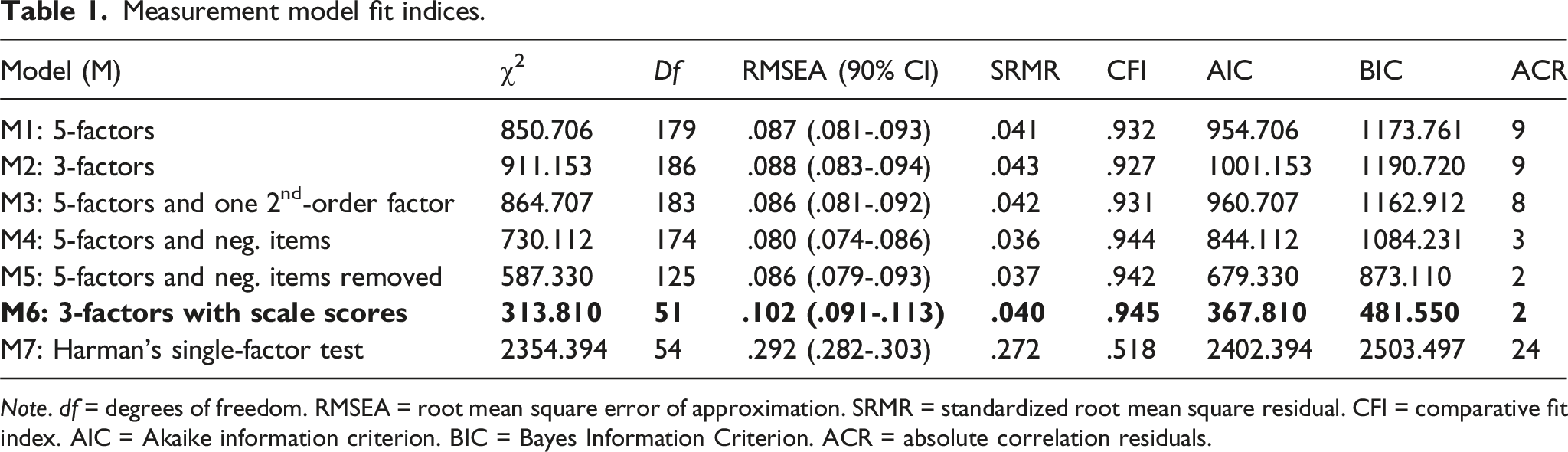
Measurement model fit indices.
Note. df = degrees of freedom. RMSEA = root mean square error of approximation. SRMR = standardized root mean square residual. CFI = comparative fit index. AIC = Akaike information criterion. BIC = Bayes Information Criterion. ACR = absolute correlation residuals.
In Model 4, all negatively worded items were loaded on one factor to test for a method effect of negatively worded items (DiStefano and Motl, 2006). An increased fit of Model 4 compared to Model 1 was found (Δχ2 [5] = 120.594, p < .001), which indicated that a method effect due to the negatively worded items was present. Therefore, for Model 5, all negatively worded items were removed (RMSEA = .086, SRMR = .037, CFI = .942), which fit the data better than Model 1 (Δχ2 [54] = 263.376, p < .001).
As a further assessment of the measurement model fit of Model 5, average variance extracted (AVE) values were evaluated to assess convergent validity (Bagozzi and Yi, 1988). All AVE values (.65-.80) met the recommended .5 threshold (Bagozzi and Yi, 1988). However, Model 5 showed a lack of discriminant validity between the three engagement constructs vigor, dedication, and absorption as indicated by higher correlations between the factors than the square root of the AVE for the individual factors (Bagozzi and Yi, 1988).
A review of the literature on the UWES scale indicated that composite scores from the UWES have demonstrated strong reliability (Schaufeli et al., 2006; Zigarmi et al., 2011). In measurement Model 6, the composite scores for vigor, dedication, and absorptions were used as indicators for the overall factor of work engagement (c.f., Zigarmi et al., 2011). An increased fit of Model 6 compared to Model 5 was found (Δχ2 [74] = 273.52, p < .001).
Standardized pattern (P) and structure (S) coefficients for measurement Model 6.

Note. UPB = unethical pro-organizational behavior. AC = affective organizational commitment. EWE = employee work engagement.
Implied correlations, average variance extracted (AVE), and composite reliability (CR) for measurement Model 6.

Note. Square root of AVE along the diagonal.
UPB = unethical pro-organizational behavior.
AC = affective organizational commitment. EWE = employee work engagement.
Common method variance
Two additional CFA models were run to test for common method variance (Podsakoff et al., 2003). The Harman’s single-factor test conducted in Model 7 (see Table 1) resulted in a decreased fit compared to Model 6 (Δχ2[3] = 2,040.58, p < .001), indicating that common method variance was not an issue. However, since this test is not very sensitive, a second test for common method variance, the CFA marker technique was conducted (Williams et al., 2010).
Model fit indices and model comparisons for CFA models with marker variable for measurement Model 6.

Note. CFA = confirmatory factor analysis. df = degrees of freedom. RMSEA = root mean square error of approximation. LR = likelihood ratio test; U = unconstrained; C = common; R = restricted.
Descriptive statistics.

Note. N = 511. Correlations for the scales are based on measurement model M5. * Correlation is significant at p < .05. ** Correlation is significant at p < .01. Values in parentheses represent internal consistency reliabilities (Cronbach’s alpha coefficients). UPB = unethical pro-organizational behavior. AC = affective organizational commitment. EWE = employee work engagement.
Table 5 provides an assessment of gender, age, and tenure as potential covariates. Gender did not have any significant correlations. Therefore, the demographic variable gender was omitted in the structural analyses to present the most parsimonious model and avoid spurious suppression through control variables (Becker 2005).
SEM
Fit indices for structural models.

Note. df = degrees of freedom. RMSEA = root mean square error of approximation. SRMR = standardized root mean square residual. CFI = comparative fit index. AIC = Akaike information criterion. BIC = Bayes information criterion.
Bootstrapped confidence intervals of direct effects for structural Model 1.

Note. Results are based on a 5,000-case bootstrapping procedure. SE = standard error. CI = confidence interval. UPB = unethical pro-organizational behavior. AC = affective organizational commitment. EWE = employee work engagement.
Model 1 is the fully saturated structural model, which indicates a partially intervening model. An effect decomposition analysis was conducted to determine whether the indirect effect is significant. The findings indicated a significant negative indirect effect of organizational commitment (−0.254 [−.436, −.120], SE = .079, p < .001) on UPB. Hence, Hypothesis 4 is supported.
Discussion
This study examined the relationship between organizational commitment and UPB both directly and indirectly through employee work engagement. It represents the first known investigation of organizational commitment and employee work engagement combined as motivators of UPB. The findings align with existing literature, confirming a positive correlation between organizational commitment and UPB. This suggests that employees with higher levels of organizational commitment are more prone to engage in UPB (Ebrahimi and Yurtkoru, 2017; Fulmore, 2018; Fulmore and Fulmore, 2021; Grabowski et al., 2019; Matherne and Litchfield, 2012). In addition, the study supports existing research demonstrating a positive link between organizational commitment and employee work engagement (Asif et al., 2019; Poon, 2013; Rayton et al., 2019; Shuck et al., 2011; Yalabik et al., 2013), indicating that increased organizational commitment leads to greater work engagement among employees.
The results of this study expanded upon the UPB literature by finding a partial indirect effect of organizational commitment on UPB through work engagement. While a positive direct relationship between organizational commitment and UPB was observed, the indirect effect through employee work engagement emerged as negative. In addition, the direct effect of employee work engagement on UPB was also negative. These findings indicate that while organizational commitment can motivate employees to engage in UPB, channeling this commitment into work engagement may actually diminish their inclination to engage in UPB. By redirecting employees’ organizational commitment toward work engagement, their reciprocity behaviors, stemming from their attachment to the organization, are focused more on enhancing their work investment rather than on unethical pro-organizational activities.
Contribution to research and practice
The findings of the present study contribute to the UPB literature by providing an understanding of how organizational commitment and employee work engagement can motivate or demotivate employees to engage in UPB. While employees possess the inclination toward positive change (Cameron, 2008), the resulting supportive behaviors might not always be within ethical bounds. Understanding what motivates employees to engage in UPB is a vital step to being able to reduce or eliminate such behavior.
Organizations and managers play an essential part in creating an ethical work environment. While these groups strive to have employees who are highly committed to the organization and encourage employee work engagement, it is crucial to understand that increased organizational commitment may also result in negative outcomes (Ebrahimi and Yurtkoru, 2017; Fulmore, 2018; Fulmore and Fulmore, 2021; Matherne and Litchfield, 2012). Employee work engagement focuses on the relationship between the employee and his or her work being performed, while organizational commitment focuses on the relationship between the employee and the organization (Kim et al., 2017). This is an important distinction when it comes to the practical usefulness of this study’s findings and application for management practitioners. While it is crucial to encourage organizational commitment, organizational decision-makers must recognize that such commitment should be directed toward employee work engagement to reduce the possibility of UPB. For example, managers recognizing high emotional attachment, identity, and involvement in an organization by an employee should also investigate whether that same employee exhibits vigor, dedication, and absorption in his/her job. If work engagement is not particularly high, this presents an opportunity for managers to help employees redirect organizationally committed behaviors toward work engagement behaviors, thus reducing the propensity to engage in UPB on behalf of the organization.
From a pragmatic perspective, managers must be trained to recognize signs of excessive organizational commitment that might predispose employees to commit UPB. Grasping these nuances allows managers to appropriately monitor and address potential issues concerning UPB, especially since empirical evidence indicates the possibility of a contagion effect of UPB between employees when individuals exhibit high levels of organizational identification (Xiaocun, 2015). At the organizational level, codes of ethics that explicitly define what behaviors are acceptable and what are not should be further developed. Such codes need to be in harmony with the organization’s strategic goals and its espoused values, thereby underscoring the discrepancy between the organization’s aims and the employment of UPB. In addition, providing ethical training, encouraging open communication, weighing ethical considerations alongside performance metrics, and highlighting the consequences of UPB can be effective tools for management practitioners.
Limitations and directions for future research
The study has several limitations. First, there are several sources of common method bias, such as the collection of all predictor and criterion variables at the same point in time along with the utilization of a common scale format of Likert-type items (Podsakoff et al., 2003). However, Harman’s single-factor test, as well as the unmeasured latent method factor test, was conducted, and no evidence of common method variance was found (Podsakoff et al., 2003). Second, the items for UPB are susceptible to social desirability bias, because the items ask respondents to respond to their likelihood to commit certain unethical acts (Podsakoff et al., 2003). However, an effort was made to mitigate sources of social desirability bias via a deliberate survey design that ensured respondents’ anonymity. Last, there is the issue of generalizability beyond the sample population. This study focused on service sector employees. Hence, caution is warranted for organizational leadership to generalize these findings to other industry sectors.
Considering the study findings and the noted limitations, the following suggestions are offered for future research. First, the data collection process may be improved to overcome potential issues of common method bias by collecting data for predictor and criterion variables at different points in time (Podsakoff et al., 2003). In addition, incorporating experimental designs could help establish cause-and-effect relationships more definitively. Second, replicating this study in other settings will help researchers understand more about the model’s generalizability. More specifically, investigating these dynamics within the accounting profession would add valuable insights, considering recent accounting fraud scandals at Wells Fargo, Steinhoff International, and Toshiba that are examples of UPB (Bryant and Merritt, 2019; Castille et al., 2016; Zhang, 2020). Moreover, reflecting on how work settings have changed since COVID-19, further research could examine how remote work environments affect the interplay between organizational commitment, work engagement, and UPB.
Lastly, future research could investigate organizational culture as a potential moderator affecting the tested model. Organizational culture possesses the power to influence the alignment between employees’ emotional attachment to the organization and their conduct. Hence, organizational culture could explain why this study supported the majority of published findings indicating a positive relationship between affective organizational commitment and UPB (Ebrahimi and Yurtkoru, 2017; Fulmore, 2018; Fulmore and Fulmore, 2021; Grabowski et al., 2019; Matherne and Litchfield, 2012), while other studies showed a significant negative relationship between affective organizational commitment and UPB (Park et al., 2023; Wang et al., 2021).
Conclusion
This study sought to empirically assess the relationship between organizational commitment and UPB, directly and indirectly, through employee work engagement. The results indicated that as organizational commitment increases, it can increase a willingness to commit UPB. However, organizational commitment also increases employees’ work engagement, which in return reduces a willingness to commit UPB. Hence, while it is crucial to encourage organizational commitment, this commitment should be focused on the job toward employee work engagement to reduce the possibility of UPB.
Footnotes
Declaration of Conflicting Interests
The author(s) declared no potential conflicts of interest with respect to the research, authorship, and/or publication of this article.
Funding
The author(s) received no financial support for the research, authorship, and/or publication of this article.
