



Abstract
The current study builds upon and extends research on the glass cliff by analyzing the antecedents and repercussions of CEO dismissal. Recent research on the relationship between performance, gender, and CEO dismissal has led to contrary conclusions. We build on this nascent work by examining whether negative firm performance places women CEOs of US firms at a greater risk of involuntary dismissal relative to men CEOs. We further explore whether gender moderates market response to the dismissal announcement and replacement. Our analysis relies on data of all CEOs from the United States’ Russell 3000 index, which represents a spectrum of small to large companies, who departed their organizations between 2016 and 2022. We also rely on a novel measure of CEO dismissal, the push-out score, which overcomes previous limitations related to the nature of CEO departures. We find that women are more vulnerable than men to involuntary dismissal during periods of performance decline and that investors reward firms that replace dismissed women CEOs with white men. Our findings have implications for gender equity in the C-Suite.
Women remain underrepresented in senior corporate leadership roles and progress toward representational equity is glacial (Perdue and Isaac, 2018). To explain these trends, scholars of leadership inequality have begun to interrogate the challenges women CEOs face above the glass ceiling. Women in senior positions, including the CEO, continue to face doubts about their competence, a relative lack of support (Florou and Pope, 2008; Glass and Cook, 2020a), and less organizational power and authority compared to their male peers (Glass and Cook, 2016).
These challenges often begin at the point of hire. Research finds that women tend to be appointed to senior leadership positions during times of crisis, a phenomenon termed the glass cliff (Ryan and Haslam, 2005). The glass cliff characterizes these appointments because, although women are appointed to highly visible and powerful roles, their appointments occur during a time of crisis, thereby increasing the precarity of the position. In this way, the glass cliff serves as a metaphor for the “interrelation of precariousness and risk” that define women’s leadership trajectory (Ryan and Haslam, 2009). As the metaphor suggests, the challenges associated with upward mobility in organizations do not disappear when women enter the C-suite. From the moment of appointment, women CEOs continue to face barriers that limit their ability to lead effectively (DeHart-Davis et al., 2020).
Scholars have documented the glass cliff at appointment across time and institutional context (Bruckmuller et al., 2014; Haslam and Ryan, 2008; Ryan et al., 2010). In their study of CEO appointments in the United States’ Fortune 500 over a fifteen-year period, Cook and Glass (2014a) found that women are more likely than men to be appointed CEO of weakly performing firms. Scholars have confirmed the presence of the glass cliff in male- and female-dominated professions including law, politics, sports, and education (Ashby et al., 2020; Cook and Glass, 2013; Kulich et al., 2015; Smith, 2014). The mechanisms contributing to the glass cliff are varied and include implicit gender biases, organizational signaling, selection bias, and the strategic agency of women leaders themselves (Glass and Cook, 2020a; Ryan et al., 2016).
While disproportionate risk facing newly appointed women leaders has been well-researched, much less scholarship has considered whether and how precarity extends beyond the appointment for women CEOs. The relatively few studies that do exist have reached contrary conclusions. For example, Elsaid and Ursel (2018) analyzed a large sample of North American firms from 1992–2014 and found lower turnover rates among women CEOs compared to men CEOs even following glass cliff appointments. By contrast, in their analysis of CEO dismissals between 2000–2014, Gupta et al. (2020) found that women CEOs were more likely to be dismissed compared to men even when firms are performing well. While the authors did not consider the appointment conditions of CEOs, their findings suggest that women CEOs face greater turnover post-appointment compared to men. The authors concluded that while performance remains a strong predictor of men’s dismissal, the predictors of women CEOs’ dismissals are less clear (Gupta et al., 2020). A more recent study of CEO transitions in China finds that women CEOs tend to be evaluated more negatively than men CEOs, resulting in a greater risk of turnover among women CEOs when firm performance declines (Ma, 2022). Again, while Ma (2022) did not consider glass cliff appointments per se, these findings suggest that women CEOs face greater scrutiny than their male counterparts.
Considering these discordant findings, the current study builds upon and extends this stream of research in three ways. First, we situate the question of CEO turnover in the context of mounting evidence of the glass cliff for women CEOs. We explicitly extend analyses of women CEOs’ precarity to their relative risk of dismissal, thereby extending our understanding of the challenges women CEOs face post-appointment. Second, we rely on a novel measure of CEO dismissal that allows us to disaggregate involuntary departures from routine and/or voluntary departures. This measure reflects a significant advancement over previous research on dismissals, which likely underestimated the rate of involuntary departures among CEOs (Larcker et al., 2022) and which did not account for the recent increase in CEO dismissals. Finally, we extend Ma’s (2022) finding that women CEOs are evaluated more harshly by internal actors to evaluate external market reactions to their dismissal. Specifically, we evaluate whether there is evidence that investors react more negatively to announcements of women CEOs’ dismissal and whether these reactions reflect gendered assessments of women CEOs’ competence and ability. Share price reflects investors’ evaluation of the reputation of the outgoing and incoming CEO (Gaines-Ross, 2000). Thus, analyzing share price reactions allow us to assess the market’s gendered assessments regarding CEO turnover.
CEO dismissal and market response
While CEO succession is routine, involuntary dismissals of senior corporate executives are on the rise (Berns et al., 2021). CEO dismissal reflects the board’s assessment that the current CEO lacks the competence or ability to lead effectively, and a strategic change is necessary (Bruton et al., 2000; Cornelli et al., 2013; Nyberg et al., 2021; Wangrow et al., 2022). Thus, the involuntary exit of a corporate leader is disruptive because it signals to stakeholders that current leadership is dysfunctional or ineffectual (Tao and Zhao, 2019). In fact, there is evidence that corporate boards and top management teams suffer penalties following CEO dismissals as they are held accountable for appointing an unsuccessful leader (Florou, 2005; Tao and Zhao, 2019).
CEO dismissal also affects the value of the firm. Share price serves as a metric of perceived firm health, and research on share price fluctuations finds that the value of a company’s shares is strongly linked to perceptions of CEO ability (Smith et al., 2021). Therefore, the involuntary dismissal of a CEO impacts share price because it forces investors to respond to the unexpected turnover of a company’s most senior executive.
Theoretically, involuntary CEO dismissal should signal to investors that the company is holding ineffective leaders accountable and that a change in leadership will result in improved firm performance. Under these conditions, investors should respond positively to dismissal announcements since dismissals signal the firm is headed in a new direction and will likely exhibit improved performance in the future. However, findings on share price reactions to CEO dismissals are mixed. In fact, research finds that firm performance is a weak predictor of CEO dismissal (Finklestein et al., 2009), and that CEO accountability only partially explains involuntary exits (Crossland and Chen, 2013). Some evidence suggests that when negative firm performance precedes CEO dismissal, firm value actually increases (Cools and van Praag, 2007; Gao et al., 2012; Marshall et al., 2014; Shen and Lin, 2009). However, other studies find that CEO dismissal results in negative valuation as investors respond to the disruption and anticipated restructuring following an unplanned CEO departure (Tao and Zhao, 2019).
Critically, for the current study, financial markets and investor reactions are gendered (Dobbin and Jung, 2010; Solal and Snellman, 2019). In their study of share price reaction to the appointment of women CEOs, Lee and James (2007) found that investor reactions are significantly more negative following the announcement of women’s appointments net of firm performance. Thus, while the study did not consider performance at the time of appointment as a dependent variable, the authors note that press announcing the appointment of women are more likely to emphasize their gender compared to comparable press coverage of men CEOs’ appointment, underscoring the hypervisibility these leaders face (Lee and James, 2007). More recently, Jannati et al. (2023) found that men analysts tend to have lower earnings forecasts and worse stock recommendations for companies headed by women compared to companies headed by men. This research suggests that investor reaction to CEO dismissal is likely contextual and dependent on gendered perceptions of CEO ability, competence, and efficacy.
Token theory and the paradox of visibility
To understand the impact of CEO gender on involuntary dismissal and resulting market response, we draw on Kanter’s (1977) token theory and Van Den Brink and Stobbe’s (2009) “paradox of visibility” perspective. Token theory predicts that numerical minorities within certain roles or positions face challenges due to their paucity. As a result of their underrepresentation, token role incumbents endure performance pressures, hyper scrutiny, and a burden of doubt regarding their competence and ability to perform effectively (Eagly and Karau, 2002; Heilman, 2012; Konrad et al., 2008).
These challenges result in what Van Den Brink and Stobbe (2009) term the “paradox of visibility.” Visibility refers to the ability of individuals, including top leaders, to be fully seen and recognized by peers, subordinates, superiors, and other stakeholders. However, low status outsiders or tokens often lack recognition as legitimate members of a position or role (Settles et al., 2019). Recognition as qualified and competent leaders is particularly difficult for women given the tendency to associate leadership with masculine status expectations (Schein and Davidson, 1993). Indeed, women who violate normative gendered expectations by occupying roles traditionally or typically occupied by men are often subject to negative evaluation bias (Eagly and Karau, 2002). As a result, women in token leadership positions are rendered simultaneously hypervisible as outsiders and invisible as capable and efficacious leaders (Van Den Brink and Stobbe, 2009).
As highly visible tokens, women CEOs are subject to what Cook et al. (2024) term a “legitimacy gap” relative to men CEOs. As tokens, women CEOs are subject to performance pressures, surveillance, and negative stereotypes related to their competence and ability. Announcements of women’s appointment to CEO receive significantly more media scrutiny than announcements of men’s appointment (Smith et al., 2021), and women CEOs receive more negative media coverage than their male peers (Shor et al., 2022). While some evidence suggests that women’s representation on the board of directors can mediate some token pressures for women CEOs (Cook and Glass, 2014b), most research finds that the continued scarcity of women CEOs reinforces the salience of their atypical status and enhances the token pressures women CEOs face (e.g., Malhotra et al., 2021). In particular, external assessments and pressures facing women CEOs are particularly influenced by women’s scarcity in the CEO role, which reinforces negative stereotypes, performance pressures, and scrutiny (e.g., Lee and James, 2007).
Negative media attention is also associated with an increased risk of dismissal for women CEOs (Bednar, 2012). Compared to men, women leaders are also held to a higher standard of performance and to a higher level of accountability for real or perceived mistakes (Brescoll et al., 2010). For instance, a recent study by Ma (2022) found that women CEOs are evaluated more critically than men when firm performance declines during their tenure. These challenges significantly impact women’s leadership trajectory, resulting in shorter average tenures and a greater risk of involuntary dismissal compared to men CEOs irrespective of firm performance (Cook et al., 2024; Gupta et al., 2020).
Off the glass cliff? Firm performance and involuntary dismissal
Are women at a greater risk than men to experience involuntary dismissal when performance declines? The glass cliff refers to the tendency of women to be appointed to firms that are facing performance declines (Ryan and Haslam, 2005). Glass cliff appointments create a degree of precarity for women CEOs, who are expected to reverse the firm’s performance trajectory. While some evidence explores the consequences of the glass cliff post-appointment (e.g., Gupta et al., 2018), relatively few studies have analyzed whether women face a glass cliff in terms of involuntary dismissal.
We expect that token pressures combined with the paradox of visibility work to sustain the scrutiny and performance pressure women CEOs face. Rather than abating across their leadership tenure, we predict that any real or perceived missteps, including short-term performance declines, reinforce negative stereotypes and the burden of doubt regarding women’s ability to lead effectively. Scrutiny and performance pressures combine to hold women to a higher level of accountability than men (Brescoll et al., 2010). As a result, women are more likely to be blamed by negative performance metrics than men (Ma, 2022). Rather than receiving the benefit of the doubt, women face a burden of doubt that tends to blame them personally for any decline in firm performance. We predict that these mechanisms will make women more vulnerable to dismissal when performance declines. We test the following hypothesis:
Women CEOs are more likely to be dismissed compared to men CEOs when firm performance declines.
Market response to women CEO dismissals
How might gender affect investor reaction to CEO dismissals? As noted above, we predict that women CEOs’ token status and paradoxical visibility will result in a greater burden of doubt regarding their ability to lead effectively. Negative media coverage, performance pressures, and scrutiny of women’s missteps will result in skepticism about their ability. Not only do women CEOs receive more negative media coverage than men (Shor et al., 2022), but media coverage of CEO succession is also associated with negative market reactions following women’s exit and positive market reactions following men’s exit (Smith et al., 2021).
Women’s involuntary dismissal is likely to attract significant media attention (Shor et al., 2022), including press coverage that emphasizes their gender status (Lee and James, 2007), thereby activating and reinforcing negative stereotypes and further damaging investors’ evaluation of the firm immediately following the announcement. The announcement of women CEOs’ dismissal will serve as confirmation biases of views that hold women as less effective leaders than men. Thus, while investors’ reaction on the day of the announcement will be negative irrespective of CEO gender due to the disruptive nature of such events (Tao and Zhao, 2019), we predict that investors will react more negatively to the dismissal of women CEOs. Negative market reaction serves to hold firms accountable for enabling leaders perceived as less qualified and skilled to occupy a critical leadership role. Thus, we expect the dismissal announcement to serve as a confirmation bias that the woman CEO was not prepared for leadership and investors will respond accordingly. We predict the following hypotheses:
The announcement of a CEO dismissal will result in a significant share price decline.
Dismissal announcements of women CEOs will result in a more significant share price decline compared to dismissal announcements of men CEOs.
While we expect that the degree of negative reactions to the announcement of a CEOs’ dismissal will vary based on the gender of the outgoing CEO, we also predict that the share value will recover more quickly following the dismissal of a woman CEO compared to a man CEO. In other words, we predict that investor response to the dismissal of a woman CEO will be curvilinear; firms will face penalties on or near the day of announcement but will receive rewards for moving on from a CEO perceived to have damaged the firm’s value. By dismissing the woman CEO, firms can signal that they are headed in a new direction and doing so is likely to restore investors’ confidence in the firm’s value. Previous research finds that new CEOs are highly engaged in practices that seek to realign the organization with its environment (see Ma et al., 2015). The realignment process includes a range of efforts, including reestablishing strong relationships with external actors, including investors (Westphal et al., 2006). Indeed, Gangloff et al. (2014) found that firms engage in either scapegoating the dismissed CEO or signaling change by appointing a new executive. Both strategies result in restored investor confidence (Gangloff et al., 2014). Particularly following an involuntary dismissal, firms seek to communicate to investors that previous problems have been eliminated and the firm is under new and better leadership (Arthaud-Day et al., 2006).
While post-dismissal realignment efforts are likely to restore investors’ confidence in the firm, we expect a stronger investor response to realignment efforts following the dismissal of a woman CEO. While the immediate announcement of a CEO dismissal will activate gender bias and enhance concern about a firm’s status, investor perception of the firm’s value will become increasingly optimistic as the firm moves forward to replace women CEOs. By engaging in either scapegoating the previous CEO or signaling that the firm is moving forward in a new direction (Gangloff et al., 2014), the firm will distance itself from perceptions that it has erred in its senior leadership appointments. Over time, investors will anticipate that a change in leadership will result in improved firm performance (“signaling”) and any negative performance measures will be blamed on the outgoing woman CEO (“scapegoating”) (Emrich, 1999; Gangloff et al., 2014). Thus, a faster share price recovery following the involuntary dismissal of women CEOs compared to men CEOs will reflect investors’ confidence in the firm’s new direction. We test the following:
Share price will recover more significantly in the month following the dismissal of a woman CEO compared to a man CEO.
Importantly, share price reaction to CEO dismissal announcements reflects investors’ assessment of the outgoing CEO as well as the incoming CEO. Research on glass cliff appointments finds that when women CEOs are unable to improve firm performance in a short period of time, they tend to be blamed and replaced by white men CEOs, termed “the savior effect” (Cook and Glass, 2014a). The savior effect occurs due to multiple factors, including performance pressures and the burden of doubt associated with women’s token status and the paradox of visibility. Because women CEOs face a higher standard of performance and greater surveillance and scrutiny compared to men CEOs, any perceived missteps confirm stereotypes about women’s inability to lead effectively. Thus, women CEOs are granted fewer degrees of freedom and often blamed for organizational crises that preceded their appointment (Cook and Glass, 2016). As a result, dismissing them and replacing them with white men leaders is a means of signaling that the firm has returned to normal. Given this documented tendency, we predict that investors will respond to the savior effect in predictable ways. Specifically, when women CEOs are dismissed and replaced by white men CEOs, investors will be reassured that stability will be restored in the focal firm. Thus, we predict that share price will reflect investors’ confidence in a return to the status quo following women’s dismissals and will recover more quickly when women CEOs’ replacements are white men.
When women CEOs are dismissed and replaced by white men (compared to non-white men, women, or an unknown replacement), share price will recover more quickly.
Methods
Data
To investigate our research questions, we examine data from the Exechange database (see more detail following), the Compustat database, which is from the Wharton Research Database Services, and the CRSP database which is from the Center for Research in Security Prices at the University of Chicago. From the Exechange database, we collected executive age and departure information for the executives, and we collected internal or external status of the successor. We collected firm-level measures from Compustat, and we collected share price information from CRSP. Our analyses cover all men and women CEOs from the Russell 3000 index that departed their organization between January 1, 2016, and July 31, 2022. The Russell 3000 represents a comprehensive assessment of U.S. firms and covers approximately 96% of the investable equity market within the United States. This resulted in 98 women CEOs and 1521 men CEOs.
A financial journalist, Daniel Schrauber, developed the Exechange database. He created a proprietary measure called the Push-Out ScoreTM. When CEOs step down, it is often difficult to determine the circumstances around their departure. He created a method to systematically evaluate the circumstances of a CEO leaving his or her position. Although some clear-cut cases exist where a succession plan has been known well in advance or a CEO has been abruptly fired, more often the case is ambiguous, and it is unknown whether the separation was voluntary or involuntary. The push-out score carefully and methodically assesses nine factors surrounding the CEOs’ departure and assigns a ranking of 0–10 (based on counting the factors) to gauge the likelihood of a voluntary or involuntary split. As illustrated in prior research (Larcker et al., 2022), this relatively new database offers researchers unique insights into CEO turnover.
The nine factors assessed are the following: tenure with the company; share price determining recent shifts in performance; the official reason given and assessing the clarity of that reason; circumstances, such as lawsuits, other controversies, or industry performance; form of the change announcement, such as the length of disclosure or dedicated press release; language of announcement, such as the tone or language used; age of the executive relative to retirement age; notice period determining length of time between the announcement and the departure; and succession identifying continuity, internal or external successor, or an interim or permanent replacement announced. The total push-out score is the count total across all nine factors. If a firm directly states that the CEO was terminated, the push-out score is a ten.
Measures
Push-out score
The push-out score was measured by its actual score between zero and ten. It was used as both a dependent and independent variable in our analyses. For Hypothesis 1, we used the push-out score as the outcome variable when examining if women were more likely to get “pushed out” than men when experiencing poor firm performance. We also used the push-out score as a predictor variable to examine its relationship with the corresponding abnormal and cumulative abnormal stock market returns.
Likely pushed out
This dichotomous variable was used to split the file for the event study analyses. It was not used within the OLS regression analyses, but it was necessary to further analyze investor reaction when CEOs were likely pushed out rather than voluntarily stepping down. As noted in prior work (Gow et al., 2017), the average push-out score is five; thus, a score higher than the average may be indicative of a leader being pushed out. As such, we categorized CEOs as pushed-out if they had a push-out score of six or higher.
Abnormal share price return and cumulative abnormal share price returns
Using event study methodology, we examined the abnormal stock market return for the day of the departure announcement and the cumulative abnormal stock market return from the day of the departure announcement to 30 days past the announcement. As noted by MacKinlay (1997: 13), “using financial market data, an event study measures the impact of a specific event on the value of a firm.” The underpinning of an event study is that once new information is provided to the public, investors react given their adjusted perceptions of the organization’s future cash flow or reduced risk (Fama, 1970; Woolridge and Snow, 1990). Event studies involve three main steps (MacKinlay, 1997): first, estimate the expected shareholder returns; second, estimate the abnormal, or unexpected shareholder returns; and last, analyze the abnormal returns. A firm’s abnormal return has a predicted mean of zero for the event timeframe. If an abnormal return occurs during that time, it is recognized as an adjustment by the market given the new information available. Next, to determine whether an abnormal return is present, we estimate the expected shareholder return for the timeframe examined. This estimation statistically models the relation between a firm’s shareholder return over the past year to its shareholder return for the same time period based on a CRSP benchmark index that is comprised of an equally weighted portfolio from the American Stock Exchange, the New York Stock Exchange, and the NASDAQ.
Gender
Women CEOs were coded as one and men CEOs as zero. Gender was used as a predictor variable in both assessing the likelihood of being “pushed out” with poor performance and as a predictor variable when assessing the market reaction to the departure announcement.
Race
Race was determined by looking up each person that followed a woman CEO to determine if the savior effect (i.e., traditional white man appointed CEO following a woman) was present. We used Bloomberg profiles, LinkedIn, and other biography sources to determine race.
Firm performance
ROE was collected for the quarter prior to the departure announcement. This variable was used as an independent variable when examining if women were more likely to be “pushed out” than men when experiencing poor performance. When examining the abnormal share price returns, firm performance was used as a control variable.
Control variables
Our analyses controlled for several factors that could impact market response to an executive’s dismissal. At the firm level, we controlled for firm size, firm leverage, Tobin’s Q, and internal succession. Specifically, firm size was measured as the natural log of firm employees and leverage was measured as the ratio of assets to equity. Tobin’s Q was included as a forward-looking measure for market value, and internal succession was coded as 1. We also controlled for the industry of operation (Global Industrial Classification—GIC) and the year of dismissal. And for the individual level, we controlled for the executive’s age which has a direct relationship with leaving the position.
Analyses
We tested our hypotheses using Eventus (a program to run the event study), Poisson regression, and OLS regression. The push-out score is a count variable (counting each factor (or “flag”) to determine the score), as such, when the push-out score is the dependent variable, a Poisson regression is the most appropriate analysis to use. We used Eventus to examine the abnormal returns and the cumulative abnormal returns for each examined group of CEOs. And we conducted further analyses on our abnormal returns and cumulative abnormal returns using OLS regression.
We also ran supplemental Eventus analyses examining potential differences in investors’ reactions pre- versus post-Covid, as well as how investors react when a woman follows a man CEO. Within OLS regression, we ran additional interaction analyses examining how gender might interact with age or firm size to impact investors’ reactions.
Results
Descriptives.

Correlations.
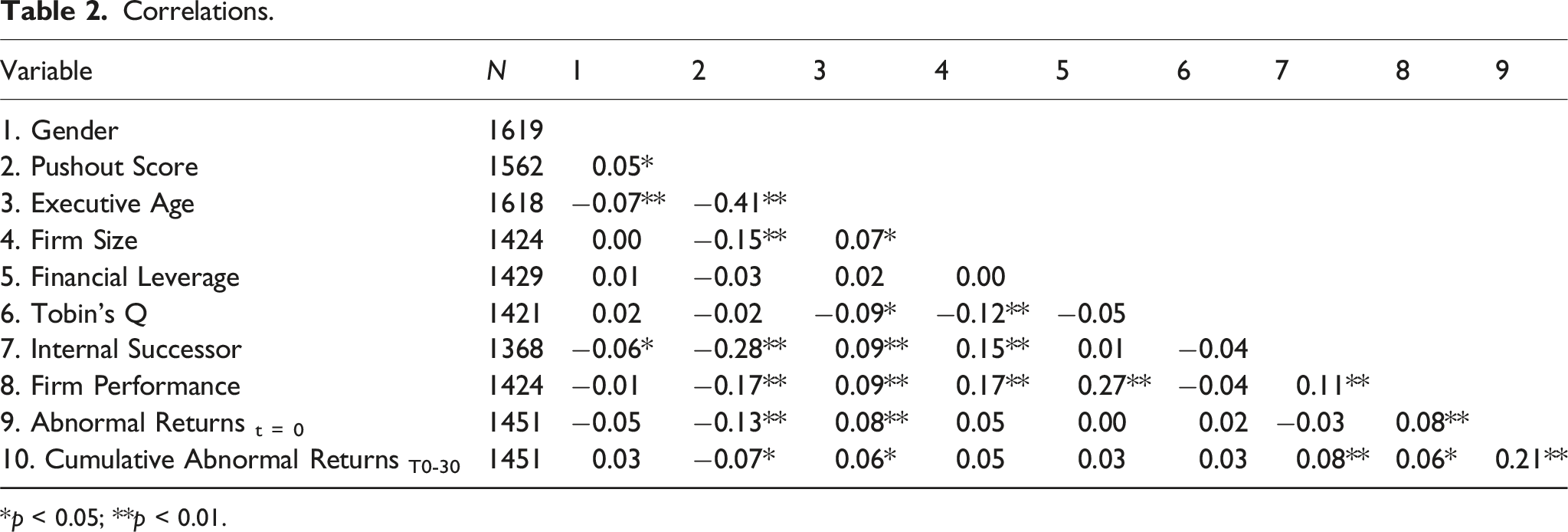
*p < 0.05; **p < 0.01.
Poisson regression. Test for Hypothesis 1.

*p < 0.10; ***p < 0.001.
N = 1132 (refer to Figure 1 for greater interpretation of the interaction).
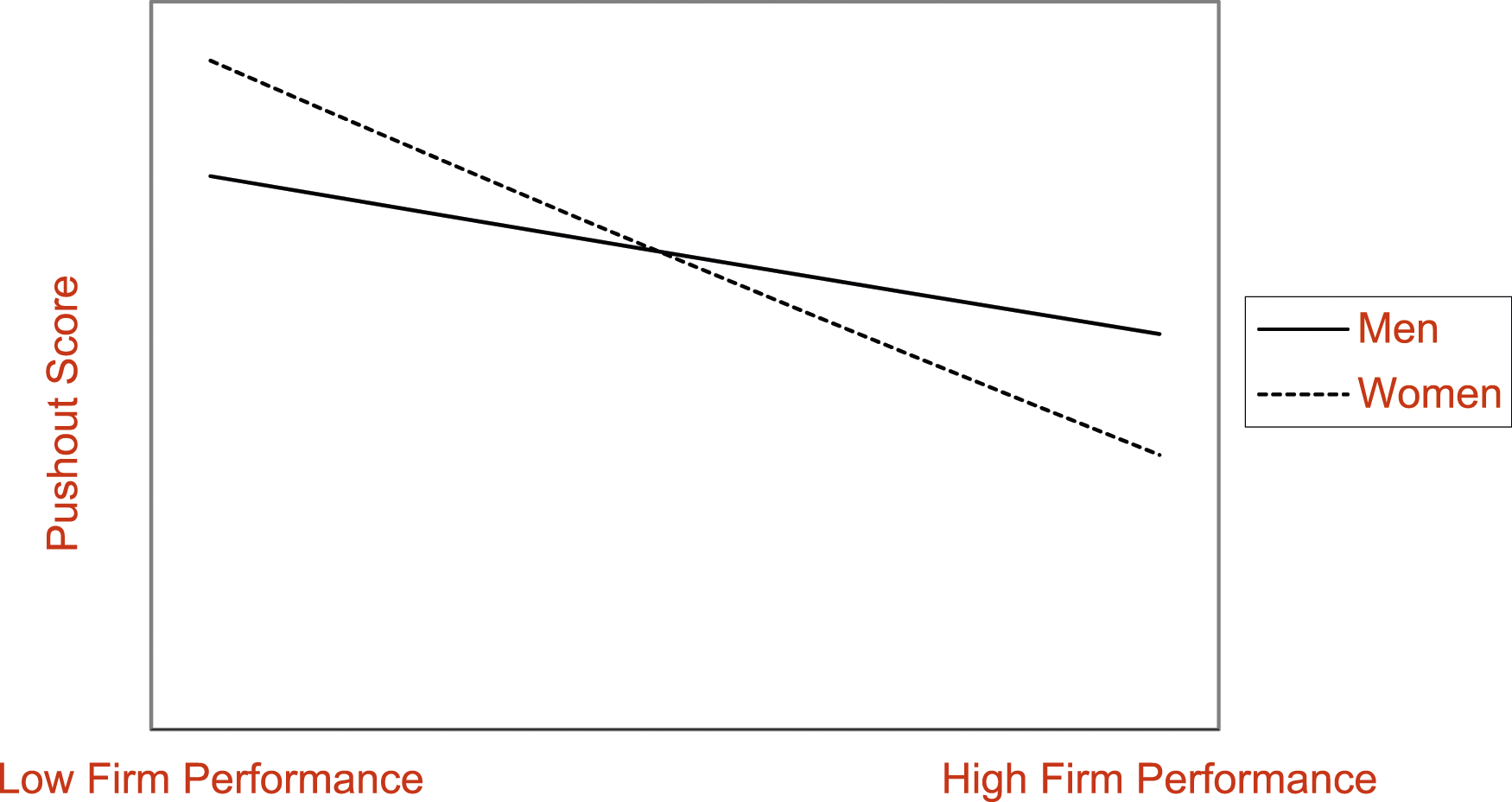
Two-way Poisson interaction of gender X firm performance on Pushout Score.
Abnormal returns (AR) and cumulative abnormal returns (CAR).
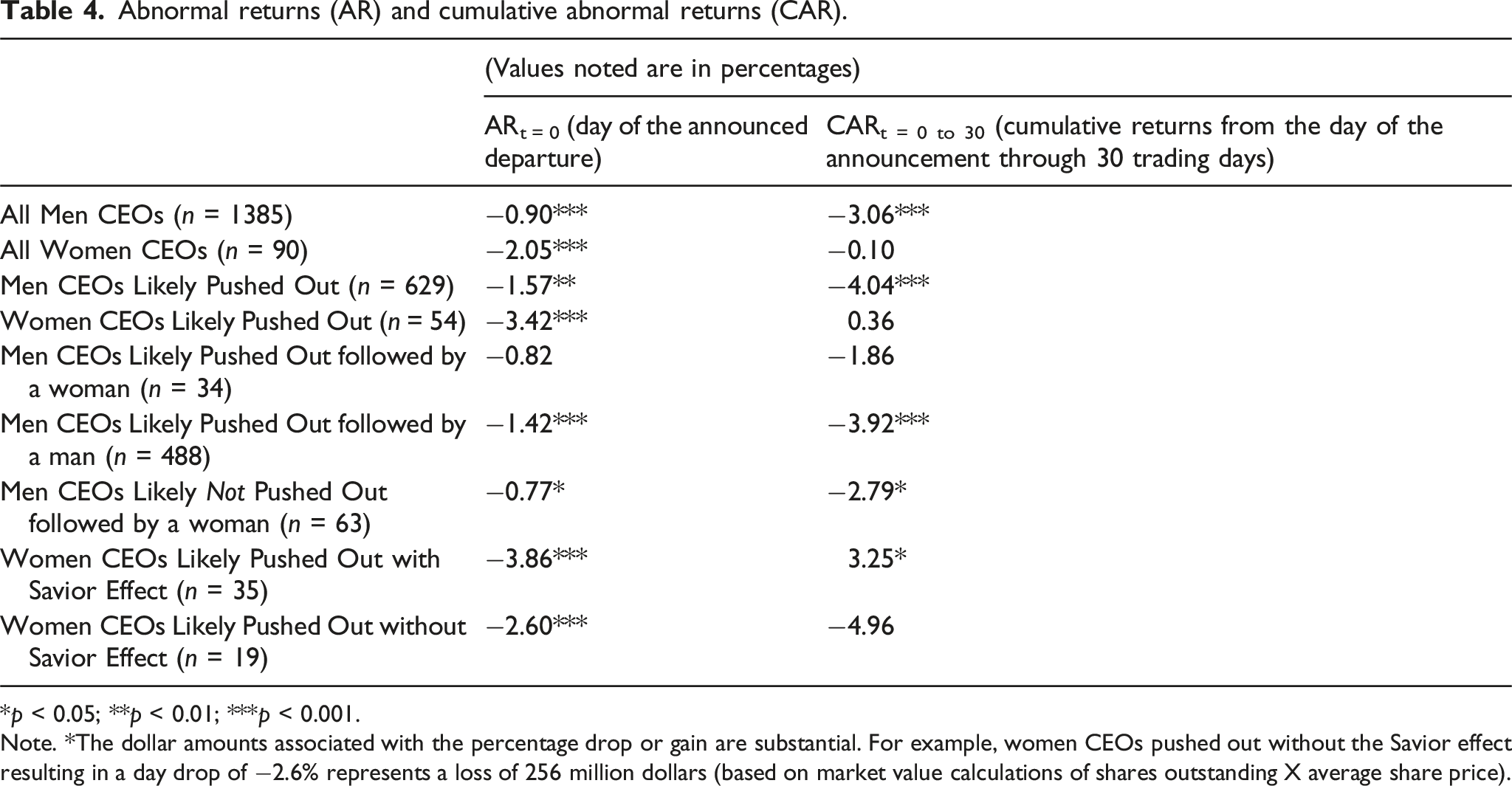
*p < 0.05; **p < 0.01; ***p < 0.001.
Note. *The dollar amounts associated with the percentage drop or gain are substantial. For example, women CEOs pushed out without the Savior effect resulting in a day drop of −2.6% represents a loss of 256 million dollars (based on market value calculations of shares outstanding X average share price).
Regression & interaction analyses of abnormal and cumulative abnormal returns.

<p < 0.10; *p < 0.05; **p < 0.01.
N = 1126 (refer to Figure 2 for greater interpretation of the significant interaction).

Two-way linear interaction of pushout score X gender on AR t = 0.
Hypothesis 3 examines the recovery of the share price following the departure announcement. We suggest that the share price will recover more quickly for those firms who have women CEOs at the time of the departure announcement relative to firms with men CEOs. In our event study analysis reported in Table 3, we examined the cumulative returns from the day of the departure announcement to 30 days following the announcement. In that 30-day window, firms with women CEOs had cumulative abnormal share price declines of only −0.10%, whereas firms with men CEOs had cumulative abnormal share price declines of −3.06% (p < 0.001). In market value losses, firms with men CEOs, over that 30-day window, had lost the equivalency of 427 million dollars. Firms with women CEOs who departed recovered much of their early losses to have only 10 million in market value loss. The difference is even more emphasized when looking at the sample of those CEOs who were likely pushed out. With men CEOs, the cumulative abnormal return is −4.04% (p < 0.001), and for women CEOs, the cumulative abnormal return is a positive 0.36% (refer to Table 4). Results suggest support for Hypothesis 3 which asserts that share price will recover more quickly following the dismissal of a woman CEO than a man CEO. This is also affirmed in our OLS regression analyses with all controls included. With a standardized coefficient of .08 and a standard error of 2.28, gender is positively and significantly (p < 0.05) related to the cumulative abnormal return (refer to Table 5).
Our last hypothesis suggests that share price will recover more quickly if a woman CEO is replaced by a white man than if she is replaced by another non-traditional leader (woman or person of color) or has an unknown replacement. This hypothesis tests the “savior effect,” which specifically examines women being replaced by white men as leaders. As illustrated in Table 4, women CEOs who are pushed out with a traditional leader known as their replacement face an abnormal return on the day of the dismissal announcement of −3.86% (p < 0.001, equivalent to 380 million market value loss); however, in examining the 30-day window, the cumulative abnormal return flips that loss into a gain of 3.25% (p < 0.05, equivalent to a 320 million market value gain). Women CEOs who are pushed out without the traditional leader replacing them start with an abnormal return on the day of the dismissal announcement of −2.6% (p < 0.001, equivalent to 256 million market value loss), and it continues to decline during the 30-day window with a cumulative abnormal return of −4.96% (p = 0.11, equivalent to 488 million market value loss). Given these findings, we suggest support for Hypothesis 4 which asserts the share price of firms dismissing women CEOs and replacing them with a traditional leader will recover more quickly than firms dismissing women CEOs and replacing them with non-traditional leaders or if the replacement is unknown (refer to Table 4).
Supplemental analyses
In examining women CEOs being replaced by white men, we also conducted supplemental analyses to examine how investors react when men CEOs are replaced with women. As shown in Table 4, when men CEOs are likely pushed out, investors actually respond more positively when a woman is the successor rather than another man. Specifically, on the day of the announcement when a woman is the replacement, the abnormal return is only −0.82 and non-significant. For 30 days following, the cumulative abnormal return is −1.86 and also non-significant. When a man is the replacement, the abnormal return on the day of the announcement is a negative and significant (p < 0.001) −1.42%. For the 30-day window, the investor response grows more negative at −3.92 (p < 0.001). Now, if the CEO was not likely pushed out and was being replaced by a woman, the investor response is negative and significant for both the day of the announcement and the 30-day window (p < 0.05). These findings illustrate that investors respond less negatively if a woman is replacing a man who is being pushed out. If he is simply stepping down, investors do not react well to the appointment of a woman (refer to Table 4).
Supplemental analysis of abnormal returns (AR) and cumulative abnormal returns (CAR) for pre- and post-Covid leadership departures.
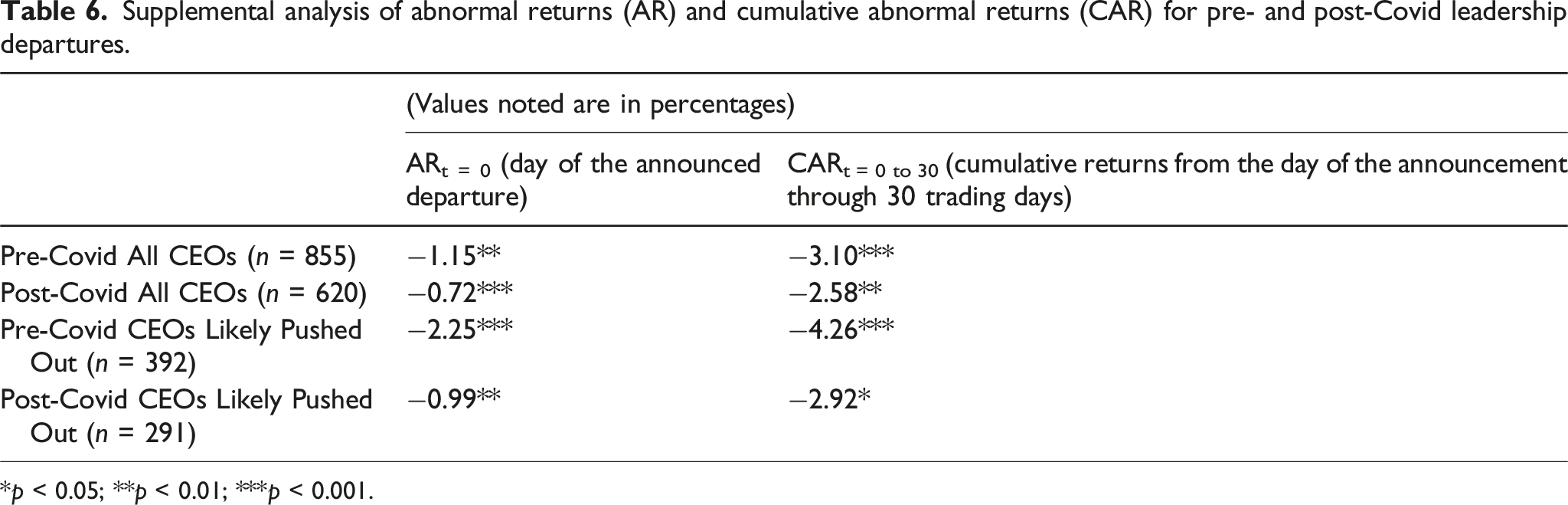
*p < 0.05; **p < 0.01; ***p < 0.001.
We also ran additional interaction analyses to determine if some of our key variables significantly interacted with gender to affect stock price. Specifically, we examined gender’s interaction with executive age, and gender’s interaction with firm size. None of these additional analyses resulted in significant findings.
Discussion and conclusion
The purpose of this study is to examine the antecedents and repercussions of CEO dismissal. We seek to build upon and extend scholarship on the glass cliff by analyzing whether negative firm performance places women CEOs at heightened risk of involuntary dismissal relative to men. We further explore post-CEO dismissals to examine whether gender mediates the market response to the dismissal announcements and the replacement decisions. Our findings suggest that women are more likely than men to face a glass cliff at the point of dismissal. We also find evidence, consistent with the corporate savior effect, that investors reward firms who replace dismissed women CEOs with white men.
Our first hypothesis focused on the antecedents to CEO dismissal and examined whether women CEOs are more vulnerable to involuntary dismissal in the face of performance declines. We find clear support for our prediction. Not only are women more likely to be involuntarily dismissed than men net of performance, but women CEOs face greater repercussions for poor performance relative to men. Though the effect of performance declines on women’s greater risk of dismissal is marginal, it suggests that women CEOs are more vulnerable to dismissal than men when their firms perform poorly. These findings are consistent with the predictions of token theory and the paradox of visibility, which suggest that due to women’s numerical rarity in the CEO role, women CEOs face hyper scrutiny, performance pressures, and a burden of doubt regarding their ability to lead effectively. These pressures combine to increase women’s vulnerability to blame and consequences for any real or perceived missteps (Ma, 2022). By contrast, men CEOs are much less vulnerable to dismissal overall and when performance declines, confirming that CEO dismissal is a gendered and not simply a merit-based mechanism to replace an ineffective leader.
Our subsequent analysis explored the gendered repercussions of CEO dismissal. How does the market respond to the dismissal of CEOs and does gender moderate investors’ responses? Consistent with our predictions, we find that, while all firms face a share price decline immediately following the announcement of a CEO dismissal, share price value declines much more precipitously following the dismissal of a woman CEO compared to a man CEO. We interpret these findings as consistent with the token theory and the paradox of visibility; negative reaction to the dismissal announcement is a way that investors can hold firms accountable for appointing a woman perceived to be unsuccessful or unqualified to lead effectively.
Our next tests explored whether and how share price recovers in the month following the dismissal announcement. While we expected share price to recover post-announcement for all firms, we predicted that share price would recover more quickly following the dismissal of a woman CEO. In fact, we find that within a month, firms that dismissed a woman CEO have recovered a significant proportion of their earlier losses. The more rapid share price recovery following the departure of women CEOs compared to men suggests that investors’ concerns about women’s dismissal are short-lived and likely to evolve into optimism regarding the future of the firm. We interpret the rapid recovery in share price following a more precipitous decline to indicate investors’ confidence that the firm is taking steps to right the ship following a period of instability and/or incompetent leadership.
Finally, we test whether the market’s reaction to CEO dismissal is consistent with the predictions of the savior effect. In previous work on the glass cliff, scholars found that when newly appointed women CEOs are unable to address performance declines in a short period of time, they are often blamed for the crisis and replaced by white men CEOs (Cook and Glass, 2014a). Moving our lens from CEO appointment to dismissal, we test whether share price recovers more quickly when the firm announces that an outgoing woman CEO will be replaced by a white man CEO, thereby restoring confidence among investors that the firm is returning to stable ground. We find clear support for this hypothesis; share value recovers more quickly following the dismissal of women CEOs when the firm announces that her replacement is a white man. In contrast, when women are dismissed without a white male replacement—in other words, when women’s replacement is unknown or is a white women or person of color, firms experience significant and continued loss of share value. When women CEOs are replaced by white men, firms experience significant value gains.
There are several implications of our findings. First, Ryan and Haslam (2009) define the glass cliff as a metaphor to describe the “interrelation of precariousness and risk” that characterize women’s leadership trajectory. Our findings confirm that this phenomenon extends beyond the point of hire to shape women CEOs’ experience of leadership and dismissal. While several scholars have documented the glass cliff in terms of CEO appointments (Ashby et al., 2020; Cook and Glass, 2013; Kulich et al., 2015; Smith, 2014), ours is one of the first studies to explore the glass cliff at the point of dismissal. Our findings regarding the antecedents of involuntary dismissal confirm that compared to men, women CEOs face greater risk of dismissal when firm performance declines. Thus, compared to men, women CEOs are held to a higher standard of performance and face greater penalties for even short-term declines. Involuntary dismissal is particularly consequential for the leadership careers of women. Compared to men, former women CEOs are much less likely than men to get a leadership role of equivalent status and visibility and are more likely to exit the corporate world following their departure (Glass and Cook, 2016). These findings suggest that women CEOs are given very few opportunities, and the CEO role may be their only chance to prove their leadership abilities. Yet, due to a greater burden of precarity and risk at the point of appointment and departure, they are less likely than men to build a reputation for strong and sustained leadership.
Support for the savior effect also strengthens our understanding of the particular challenges women leaders face. Women’s dismissal leads to significant consequences for the firm; following the announcement that a woman CEO is being dismissed involuntarily, the share price value declines precipitously. However, compared to firms who dismiss men CEOs, the share price recovers more quickly particularly if and when the firm announces that a white man will replace the outgoing CEO. This suggests that while women leaders have made substantial inroads in leadership, they continue to face performance pressures, hyper scrutiny, and negative evaluation bias. Any real or perceived missteps—including short-term performance declines—serve as confirmation that women CEOs are not sufficiently skilled to run a large company. The announcement that they will be replaced by white men restores confidence and optimism among investors and, as a result, the value of the firm’s shares increases accordingly. As with the evidence of the glass cliff, these findings reveal an enduring burden of doubt regarding women’s ability to lead effectively.
A primary limitation of the current study is its sole focus on gender to the exclusion of other axis of difference. Future research can expand our analysis by considering whether and how other characteristics, including race and ethnicity, shape the antecedents and repercussions of CEO dismissal. There is evidence that people of color face a glass cliff at the point of appointment (Cook and Glass, 2013, 2014a, 2015), and that racial and gender bias contribute to challenges post-appointment (Glass and Cook, 2020b; Gündemir et al., 2014; Hill et al., 2015; Ursel et al., 2023). Yet we know very little about whether race and ethnicity contribute to a greater risk of involuntary dismissal. In particular, we encourage scholars to consider the intersection of gender with race and ethnicity to evaluate whether women of color face particular challenges navigating highly visible senior leadership roles (Rosette et al., 2018).
Footnotes
Declaration of conflicting interests
The author(s) declared no potential conflicts of interest with respect to the research, authorship, and/or publication of this article.
Funding
The author(s) received no financial support for the research, authorship, and/or publication of this article.
