



Abstract
The World Trade Organization (WTO) dispute settlement procedure is a key arena for establishing global legal norms for what counts as relevant knowledge. As a high-profile case, the WTO trade dispute on GMOs mobilized scientific expertise in somewhat novel ways. Early on, the Panel put the dispute under the Sanitary and Phytosanitary (SPS) Agreement through a new legal ontology; it classified transgenes as potential pests and limited all environmental issues to the ‘plant and animal health’ category. The selection of scientific experts sought a multi-party consensus through a fast adversarial process, reflecting a specific legal epistemology. For the SPS framing, focusing on the defendant’s regulatory procedures, the Panel staged scientific expertise in specific ways that set up how experts were questioned, the answers they would give, their specific role in the legal arena, and the way their statements would complement the Panel’s findings. In these ways, the dispute settlement procedure co-produced legal and scientific expertise within the Panel’s SPS framework. Moreover, the Panel operated a procedural turn in WTO jurisprudence by representing its findings as a purely legal-administrative judgement on whether the EC’s regulatory procedures violated the SPS Agreement, while keeping implicit its own judgements on substantive risk issues. As this case illustrates, the WTO settlement procedure mobilizes scientific expertise for sophisticated, multiple aims: it recruits a source of credibility from the scientific arena, thus reinforcing the standard narrative of ‘science-based trade discipline’, while also constructing new scientific expertise for the main task – namely, challenging trade restrictions for being unduly cautious.
Keywords
In recent decades, global flows – whether of goods, services, capital, pests, chemicals or greenhouse gases – have expanded, together with new technologies, norms and institutions that govern these circulations. Several processes tend to denationalize what had been constructed as national in the modern era – policies, markets, capital, culture, and so forth – and to establish new global powers and subjectivities (Beck, 2000, Kellner, 2000; Negri and Hardt, 2000; Sassen, 2006).
The World Trade Organization (WTO), which superseded the General Agreement on Tariffs and Trade (GATT) in 1995, is a central node of this newly emerging global order. Established to police trade barriers for compliance with internationally agreed rules, it also sets global norms, such as standards of intellectual property and risk assessment for health and environmental issues. An agile institution, the WTO Secretariat is a relatively small bureaucracy – using about one-third of UNESCO’s budget – around which hundreds of country representatives swarm in Geneva. While many international institutions have suffered significant budget reductions and political weakening in recent decades, the WTO has exerted a growing influence on nations throughout the world. Unlike most UN institutions and conventions, the WTO has a stringent enforcement capacity with efficient, fast dispute-settlement procedures (Yerxa and Wilson, 2005). The WTO’s dispute resolution mechanism was employed over 400 times in its first 15 years of existence, compared with the mere 300 disputes settled over the 45+ years of the GATT era. While only one GATT dispute settlement drew upon scientific experts, more than a dozen trade disputes did so in the early years of WTO (Pauwelyn, 2002).
Globalization has prompted new means of knowledge production, validation and appropriation alongside the burgeoning of new technologies. Conversely, science and technology craft and legitimize the new global arrangements. Under the WTO trade regime, science and law are articulated in specific powerful ways, expanding the scientific-expert authority to scrutinize any domestic regulations that impose trade barriers. The WTO’s basic assumption is that free trade is good for the world, so no product ought to be excluded from free circulation unless proven dangerous through a risk assessment with scientific evidence.
With its neoliberal agenda, its global scope and its stringent enforcement system, the WTO is one of the most powerful organizations in the world. Yet little is known about its knowledge-making practices. Scholars in international relations and law have analysed the role of knowledge in policy convergence across nation states (Brosset and Truilhé-Marengo, 2006; Haas, 1992). However, these analyses tend to view science as an external source of consensus.
By contrast, science and technology studies (STS) has put forward a more sophisticated perspective, whereby socio-legal-technical dynamics simultaneously shape both the cognitive and social order (Jasanoff, 2004). This co-productionist perspective offers a fruitful way to analyse local practices and choices that link the ‘is’ (knowledge) and the ‘ought’ (trade, health and environmental norms) within international institutions. STS scholars have analysed the expanding global mechanisms behind the making of policy-relevant knowledge across a burgeoning network of actors, objects, codified forms of reasoning and institutions (for example, Goldman, 2005; Halfon, 2010; Winickoff and Bushey, 2010; Winickoff et al., 2005).
The WTO dispute settlement system is a site where WTO Agreements, often phrased in vague and open-ended fashion to facilitate consensus, are interpreted and enacted in practice. Hence disputes constitute a key arena for analysing how the WTO jointly establishes global legal norms and what counts as relevant knowledge. To understand how the WTO co-produces global norms and authoritative knowledge in practice, this article examines the mobilization of scientific expertise in the GMO dispute. A complaint was filed in 2003 by the USA, Canada and Argentina against the European Communities (EC) for operating a de facto ‘illegal moratorium’ since 1999. The WTO Dispute Settlement Panel reached its findings on that complaint in 2006, largely supporting the plaintiffs’ accusations against the EU.
Our inquiry starts from an apparent paradox. The dispute settlement Panel created a judicial stage for lengthy, often divergent expert judgements over the risk issues. These discussions total more than 1000 pages – including submissions from parties, as well as the Panel’s reports and annexes – and comprise almost half of the entire report. This omnipresence of science is in line with the ‘science-based trade discipline’ discourse that backed the creation of the WTO and enhanced its legitimacy. However, the Panel hardly refers to scientific arguments in its findings, which instead emphasize the defendant’s procedural failures, and the Panel’s conclusions are strictly fashioned as a legal interpretation. Moreover, the Panel avoids any substantive judgement on whether or not the defendant’s procedures were based on scientific evidence of risk.
So why did the Panel call for such an enormous input from experts, and yet ultimately draw very little from their testimonies? This apparent paradox warrants a closer look at relationships between law and science in this dispute. Here we ask the following questions: What kinds of scientific expertise and knowledge counted as reliable and relevant in the dispute settlement process? How were particular forms of legal reasoning and scientific expertise mutually constituted through the judicial procedure? And how does this matter for understanding the expanding power of WTO discipline over health and environmental policy-making in the world? To answer those questions, we draw upon interviews with staff from the WTO Secretariat, parties to the dispute, as well as scientific experts. We also rely on publicly available documents and unpublished correspondence between the Secretariat, the Panel and parties.
The first section discusses the role of science as a tool for regulatory discipline in the WTO Sanitary and Phytosanitary (SPS) Agreement, as envisioned by negotiators, WTO critics, legal scholars and STS scholars. The sections that follow analyse how scientific knowledge was mobilized – generated, scripted, staged, channelled and translated – during the genetically modified organisms (GMO) dispute settlement procedure. Finally we conclude by solving the apparent paradox and discuss wider implications for regulatory-trade disciplines.
Science in the new global trade regime: SPS and STS perspectives
Values, culture, interests and context play a crucial role in shaping regulatory decisions about health and environmental risks. And, as decades of STS taught us, neither regulatory science nor research science can claim to stand free from historical, political and cultural situations. Even in a globalized world, different social groups produce different modes of public reasoning, different epistemic cultures and different forms of knowledge. The fact that objectivity is an historical construction and a social technology, rather than a given in nature, has not limited the appeal of science as a vital resource in national and international decision-making. The more adversarial and contentious the contexts, with conflicting interests and values, the greater the emphasis placed on science by ruling institutions, so as to provide a disinterested, objective ‘view from nowhere’ that lends epistemic authority to norm-making (Haraway, 1996; Jasanoff, 2011; Nagel, 1986).
Agriculture became such a contentious ground, as it went from being a geopolitical issue to a highly disputed market in the post-Cold War context, eventually leading to an increased articulation of science and trade law by the WTO. The initial 1947 GATT text required similar treatments of foreign and domestic goods, but it also allowed members to take any measure deemed ‘necessary to protect human, animal of plant life’, as long as it was non-discriminatory (Article XXb). Although agricultural tariff barriers were reduced, agriculture-exporting countries could foresee the development of protectionist barriers based on sanitary and phytosanitary arguments, hindering the food globalization agenda, as illustrated by EC’s ban in the 1980s on beef from hormone-treated cattle. The 1986 Punta del Este Declaration, which launched the Uruguay Round, specifically called for stricter limits on SPS measures, such as those relating to food safety and animal and plant health in relation to imported pests and diseases.
Pushed by exporter countries and big agribusiness, the SPS Agreement agenda set constraints on member’s domestic safety standard-setting processes (Peel, 2010). The negotiation initially focused on the promotion of international standards set by international expert bodies such as the Codex Alimentarius, the International Office of Epizootics and the International Plant Protection Convention. For instance, for matters such as food additives, veterinary drug and pesticide residues, the SPS Agreement ensured that member states can sue other members for trade-restrictive regulatory practices that go beyond Codex standards. This transformed the Codex Alimentarius from a little-known Food and Agriculture Organization (FAO)–World Health Organization (WHO) commission into an authoritative international agency (Winickoff and Bushey, 2010).
However, given the range of potential risks, issues and regulatory preferences, no rapid consensus would be reached on a single, all-encompassing, set of global safety standards. While the Reagan administration had pushed for ‘uniform food regulation’, a new US submission to the negotiation in October 1989 proposed to ‘ensure that measures … are based on a sound scientific evidence and recognize the principle of equivalency’ (Aaronson, 2001: 150). Member states’ measures would be allowed to depart from the standards of international expert bodies, but only if such measures were ‘founded on scientific principles’, ‘not maintained without sufficient scientific evidence’ (SPS Article 2.2) and ‘based on an assessment … of the risks to human, animal or plant life or health, taking into account risk assessment techniques developed by the relevant international organizations’ (Article 5.1).
This two-fold strategy, combining deference to international norm-setting expert bodies and a judicially challengeable set of requirements for risk decisions, constituted the SPS Agreement as the most ambitious technocratic achievement of the Uruguay Round. The new trade regime invoked science’s epistemic authority to expose as potentially ‘protectionist’ a wide range of sanitary or environmental regulatory measures. Science was assigned the task of clearly distinguishing between ‘science-based’ trade restrictions and any other measures – which must be eliminated.
Jasanoff views this move as globalizing ‘the US culture of objectivity’. She analyses this particular US culture, established at the domestic level during the conservative 1980s, as codifications of risk assessment and management that co-produced both a faith in science as an external, neutral arbitrator and a space for stringent judicial review over regulatory agencies (Jasanoff, 2011). Starting in the 1980s, US officials were indeed powerful advocates of ‘science-based’ international trade disciplines. In 2002, US Secretary of Agriculture Ann Veneman praised the SPS Agreement for providing ‘common ground, not a battle ground’. She depicted science as offering an external, objective basis to scrutinize national policies:
Today the argument is more compelling than ever for clear and common standards based on sound science … unfortunately, in Europe there is now a competing concept called the Precautionary Principle, which seems to rest on the premise of the mere existence of theoretical risk. … [T]his concept, which is not based on any objective standard, could easily block some of the most promising new agricultural products … especially those based on biotechnology. (Veneman, 2002)
This image of science as objective and consensual, to lend authority to the WTO’s norms, has provoked a counter-discourse. In sharp contrast with claims about regulating international trade along ‘simple and objective principles’, the non-governmental organization (NGO) Public Citizen argues that ‘the WTO rules are subjective’ because they constrain the level of food safety and environmental protection that a country can choose (Wallach and Woodall, 2004: 1). Each in their own way, Wallach and Veneman both appeal to an objectivity ‘out there’ provided by a science that would be ideally separated from politics or industry influence.
Commenting on ‘science-based trade disciplines’, legal scholarship has stressed the new prominence given to science in international trade law (Wirth, 1994, 817; see also Boisson de Chazournes et al., 2006, 2009; Christoforou, 2000; Cossy, 2005; Motaal, 2004; Pauwelyn, 2002). Most legal accounts have seen ‘science’ as pre-existing knowledge available as expert evidence for adjudicating legal proceedings in a more objective way. Despite the conflict around regulatory science, both within and across US and EU arenas (Murphy and Levidow, 2006), many commentators explain the transatlantic conflict in terms of ‘sound science’ versus the ‘precautionary principle’ (Motaal, 2004). Taking the official rhetoric of trade liberalization at face value, mainstream legal literature generally sees ‘science’ as an external resource that could – at least ideally – provide a neutral arbitrator in trade law. Likewise they accept the conceptual separation between ‘science’ and ‘policy’ underlying the standard narrative of ‘science-based trade disciplines’.
However, after analysing 15 years of WTO jurisprudence, the jurist Jacqueline Peel concludes that ‘science-based dispute resolution under the SPS Agreement has not yielded the clear standards for differentiating between protectionist and legitimate risk measures that were originally hoped for’ (Peel, 2010). This epitomizes a growing body of scholarship that acknowledges the contextual nature of both legal and scientific knowledge-making practices. ‘The involvement of science in legal fact-finding pressures scientists to transform their reasoning patterns into those of legal reasoning’, argues Vern Walker (2006: 166). He also notes that:
determining that the available scientific evidence warrants a finding of risk requires decisions about acceptable degrees of various types of uncertainty …. Finding a risk that triggers precautions cannot be a purely scientific act, notwithstanding the myth that a ‘value-neutral’ science can do so. (Walker, 2003: 197)
These more sophisticated views from recent legal studies (see also Pauwelyn, 2002, Perez, 2004) echo STS scholarship on the relationship between science and law. Key STS scholars have contributed to the debate around WTO’s global governance of risk and environment. In an Amicus Brief to the EC-Biotech WTO Panel, they argued that in practice ‘risk assessment is neither a single methodology, nor a “science” … contrary to the view advanced in the U.S.’ (Busch et al., 2004: 5). From their diagnosis of ‘science-based disciplines’ as value-laden, the authors proposed that the WTO should limit itself to an administrative review of the EC’s procedures:
The understanding of risk assessment that we have outlined, which accords with the social science of risk as well as the empirical record, implies a judicial role that should emphasize procedural norms as a means toward rendering domestic (and international) administrative decision making more transparent. Put another way, the science-based disciplines should not function as draconian enforcement of substantive standards that have been considered and rejected by Member State citizens. (Busch et al., 2004: 39, also 6)
More generally, STS scholarship has shown that in a regulatory or legal arena that mobilizes scientific advice, regulators or judges do not merely use or neglect ‘science’. Rather, a particular situated science is produced, given the specific procedural arrangement, legal context and framing of a dispute (Jasanoff, 1995).
WTO dispute settlements create a legal arena in which scientific expert advice is the object of interaction between two social worlds. Selected representatives of ‘science’ – individuals, norms of knowledge-making, categories, all shaped by previous interactions with law and policy arenas – are invited and staged on a WTO legal arena and constituted as global policy-relevant knowledge (on the concept of arena, see Hilgartner and Bosk (1988) and Bonneuil et al. (2008)). While scientists play a leading role in core activities of the scientific arena, such as peer-review, they are mere guests in the dispute settlement arena. In interaction with parties, it is the Panel that decides whether to seek scientific advice, which experts to consult, how they should work, and how such expertise should be cited as grounds for their legal findings. The Panel’s judgement, procedures and stage management are therefore very important; hence our use of the theatrical metaphor in this article, following Goffmann (1959) and Hilgartner (2000).
At the interface between legal studies and STS, recent work has explored how different legal contexts favour contrasting framings, ontologies and epistemologies. The concept of ‘legal epistemology’ describes how a particular legal body knows – that is, uses criteria and procedures to select experts – how to assess expert claims and to conduct its reasoning (Jasanoff, 2007; Leclerc, 2007). This can be linked with a ‘co-production’ perspective to illuminate how scientific knowledge-making becomes intertwined with norm-making in policy or law, while remaining formally separate (Jasanoff, 2004; Winickoff and Bushey, 2010).
Rather than presume an a priori boundary between ‘science’ and ‘international law’, with a single optimal way to align them, the co-productionist perspective looks at actors’ work to (de)construct a boundary between ‘scientific’ versus ‘non-scientific’ aspects of social life (Gieryn, 1983). In a judicial procedure, various actors indeed promote different divisions of authority between scientific and legal expertise – especially between what counts as a scientific issue or a legal issue. When setting particular boundaries, they craft specific representations of ‘science’ and ‘law’, alongside specific ways of articulating them (Edmond, 2002; Jasanoff, 2007). For instance, judicial procedures defer to an image of science which ‘is importantly a construct of the legal process itself’; evidence ‘is a hybrid product conforming to legal as well as scientific criteria of reliability’ (Jasanoff, 2007: 772).
These perspectives enable us to explore how each actor in the GMO dispute demarcated legal from scientific issues, trustworthy from untrustworthy scientific advisors, and sufficient from insufficient scientific information. While WTO law sets science the impossible mission to provide the ‘facts’ so as to close the open universe in which decision-making operates, this can only be achieved by deferring to science ‘in its legally reconstructed image’ (Perez, 2004: 127). The following sections explore the image of science that has been constructed in the dispute, and discuss how scientific knowledge was mobilized and staged during each step of the dispute settlement process.
Scripting GMOs into an SPS plot
After inconclusive attempts at diplomatic negotiation, in September 2003 the WTO’s Dispute Settlement Board appointed a Dispute Settlement Panel to review the case. WTO Panels are composed of three ‘judges’, who are economists or trade lawyers by profession. The procedure is usually as follows: the Panel issues a report of findings, which parties can appeal; then the appeal is heard by the Appellate Body, consisting of seven judges, which also files a report. This process is supposed to last no more than 15 months. However, in the GMO case, that process extended to almost 3 years, even without an appeal.
From the start of the dispute, the parties disagreed over its nature, its legal basis and the relevance of science. Argentina and Canada argued that the potential risks associated with GMOs do not differ from those with crops with similar traits obtained through other methods (such as mutation), thus denying any basis for regulatory caution for GMOs. The US Trade Representative (USTR) emphasized that European measures contradict the SPS Agreement’s requirement that procedures should be completed ‘without undue delay’, thus posing unjustified trade barriers (US Trade Representative, 2004a: 5). The European Commission Legal Services justified regulatory delays by mentioning scientific uncertainty about environmental and health risks. To avoid the narrower SPS disciplines, which would limit any precautionary approach, the Commission argued that the WTO Agreement on Technical Barriers to Trade (TBT) and the Cartagena Protocol on Biosafety also should be reference points for judging EC regulatory procedures. As early as 2004, however, the Panel had decided to frame the GMO dispute within the SPS Agreement alone, thus rejecting the EC’s broader framing (Peel, 2006).
Perhaps it was no coincidence for this decision that Gretchen Stanton, who was appointed Secretary of the Panel, had also been Secretary of the WTO’s SPS Committee since its inception.
Personally, I thought from the beginning that this case was likely to be primarily an SPS case – which is why I was involved from the beginning. (WTO Secretariat Staff, 1 December 2010)
The secretariats to the Panels, who are provided by WTO Secretariat staff, indeed play a determining role:
It would be virtually impossible for 3 panellists – who all have other full time jobs – to manage the process without the help of the secretariat … we manage all the logistical/administrative work …. Secondly, the secretariat generally prepares internal ‘issues papers’ …, we identify what kinds of scientific input may be needed – what kinds of expertise – …. We also prepare the first draft of questions to the experts …. [W]e participate in internal discussions of the Panel, as they discuss what they think and what they are likely to rule. … [Finally,] the secretariat starts to draft the Panel report, finding those responses from the experts that support the views of the Panel. (WTO Secretariat Staff, 1 December 2010)
To fit the entire dispute into an SPS plot, the Secretariat and the Panel redefined the ontology of GM crops within a relevant risk category. Originally the SPS Agreement targeted epizootic and epiphytic diseases – which were seen as risks to ‘human, animal and plant life or health’ – that may justify national measures limiting trade. As its first move, the Panel classified any environmental harm, including threats to biodiversity, under the SPS category of risks to ‘animal and plant life or health’ (World Trade Organization, 2006: paragraph 7.219). Second, the Panel cast GMOs as SPS agents: GM crops were redefined as ‘pests’ (transgene escape hence becoming a ‘pest effect’) or as ‘invasive species’. Transgenes were recast as ‘food additives’. GM pollen became a kind of ‘animal feed’ because it could be ingested by bees (World Trade Organization, 2006: paragraphs 7.225–7.299). Within the latter move, EC regulations on GMOs become SPS measures applied to protect human life or health from risks arising indirectly from the entry, establishment or spread of weeds as ‘pests’ (World Trade Organization, 2006: para 7.360).
With those two ontological moves, the Panel established a particular link between GMOs’ biological identity as ecological agents and GMOs’ legal identity as subjects of SPS rules. Some of these new constructs contradicted definitions from the very international expert bodies that the SPS Agreement itself had designated as global benchmarks for regulatory standards. For instance, the Panel’s framing of transgenes as ‘food additives’ diverged from Codex Alimentarius’ definition of ‘food additives’ as additions made ‘in the manufacture’ stage of food production. Nevertheless, the Panel argued that:
in the special case of ‘plant production’, substances intentionally added at the stage of seed development and production could be reasonably considered to be substances added in the manufacture of the food plant, if the substances are present in the harvested plant as a component or affect the characteristics of the harvested plant (World Trade Organization, 2006: 7.299)
The Panel hence created new legal ontologies for GMOs and related ecological effects to make them amenable to SPS disciplines. This SPS plot, in turn, constrained how scientific advice would be mobilized and performed in the dispute settlement procedure, as we shall see.
Should scientists come on stage? Disputing the need for scientific advice
It was also contentious whether the Panel needed scientific advice. For Canada, ‘there is no material scientific issue in dispute in this case that cannot be resolved by reference to the conclusions of the EC’s own Community level scientific committees and the conclusions of international bodies’ (unpublished correspondence, Canada to Panel, 22 July 2004). Similarly, for the US, the Panel must simply judge whether EC delays and bans were compliant with SPS article 5.1, which requires any measure to rest on a ‘risk assessment’ under international standards:
[The US] has not identified any dispositive scientific or technical issues with respect to which the advice of scientific or technical experts would assist the Panel. … [T]he dispositive issues in this dispute are either legal issues, or non-scientific, non-technical issues of fact. … [T]he EC has acknowledged that it has not performed an across-the-board risk assessment in an attempt to justify its moratorium. (Unpublished correspondence, USA to Panel, 22 July 2004; see also, World Trade Organization, 2006: Annex I-1, paragraph 1)
On the other side, the EC argued that ‘many of the factual and legal matters so far raised in the submissions and in the Panel’s questions concern scientific or technical issues’ (Commission of the European Communities, 2004b: 1). Anticipating that some EC practices would be assessed under the SPS regime, the Commission further noted that the Panel would need to judge whether scientific evidence was sufficient to justify the precautionary provisional measure allowed by SPS Article 5.7. The Panel needed an Expert Group to understand the scientific issues, given the uncertainties and controversies on the risk issues. Otherwise, warned the Commission, ‘a failure by the Panel to have regard to this broader context will risk undermining the legitimacy of the WTO system’ (Commission of the European Communities, 2004a: 3). The Commission’s argument had the advantage of legal precedent. As its US adversary acknowledged, every SPS case has had an Expert Group, so an objection would have had weak grounds (USTR interview, 15 July 2005).
In August 2004 the Panel announced its decision to seek expert advice, as in previous disputes involving the SPS Agreement. Given widespread criticism of the WTO’s illegitimacy and pro-business bias, especially since the 1999 Seattle protest, there was an additional rationale for seeking to enhance its credibility, as indicated by a WTO staff member:
Involving external experts can also contribute to enhance the credibility of the Panel’s final decision and aid public confidence in the outcome of the dispute. Another incentive may be to disarm NGOs’ criticism that Panels do not have the necessary expertise to reach a decision on matters related to public health or the protection or the environment. (Cossy, 2005: 205)
However, the Panel warned: ‘it is possible that the Panel will not use some of this information in its findings. This will depend, for instance, on the legal interpretations to be developed by the Panel’ (unpublished correspondence, Panel to parties, 4 August 2004). In this way, experts were assigned to a subordinate position on the dispute settlement stage, within a ‘pick and choose’ discretion by the Panel. This staging of science as flexibly available ‘information’ for decision-making was in line with WTO guidance, which puts experts ‘under the Panel’s authority…. Their terms of reference and detailed working procedure shall be decided by the Panel’ (Dispute Settlement Understanding: Para 1 appendix 4).
Like a stage director, the Panel has also the last word on whether experts should get on stage in chorus or as soloists. Most regulatory agencies, both in the USA and in Europe, resort to collective expert Panels when seeking scientific advice. According to the WTO dispute settlement rules, each Panel has the option of seeking advice from ‘expert review group’.
In practice, all WTO Panels have used their discretionary power to interpret these prescriptions broadly, so as to seek scientific advice by consulting individual experts separately (Pauwelyn, 2002). In the hormone beef dispute, the Panel were backed by the Appellate Body when the EC appealed against this ‘entrenched practice of WTO Panels … to seek scientific advice by consulting scientific experts only in their individual capacity’ (Christoforou, 2000: 647–648). While EC Legal Services had proposed a collective expertise in such SPS cases, they did not do so in the biotech dispute. Instead, they anticipated that individual experts would disagree about substantive risk issues, thus highlighting dissensus within science and scientific uncertainty about risks (interview with EC Legal Services staff, 3 October 2005).
Casting experts
Once the script gave experts a solo role, there was a contentious casting process to select the performers. WTO rules state that experts should be ‘independent and impartial’ and ‘of professional standing and expertise in the field in question’, and should have no conflicts of interest (World Trade Organization, 1994b: Appendix 4). But these criteria left open many questions: How many experts? Which skills, epistemic cultures within biology and views of risk issues should be given a voice? Documenting how these questions were addressed in practice during the selection process will illuminate the particular legal epistemology that was at work in the WTO.
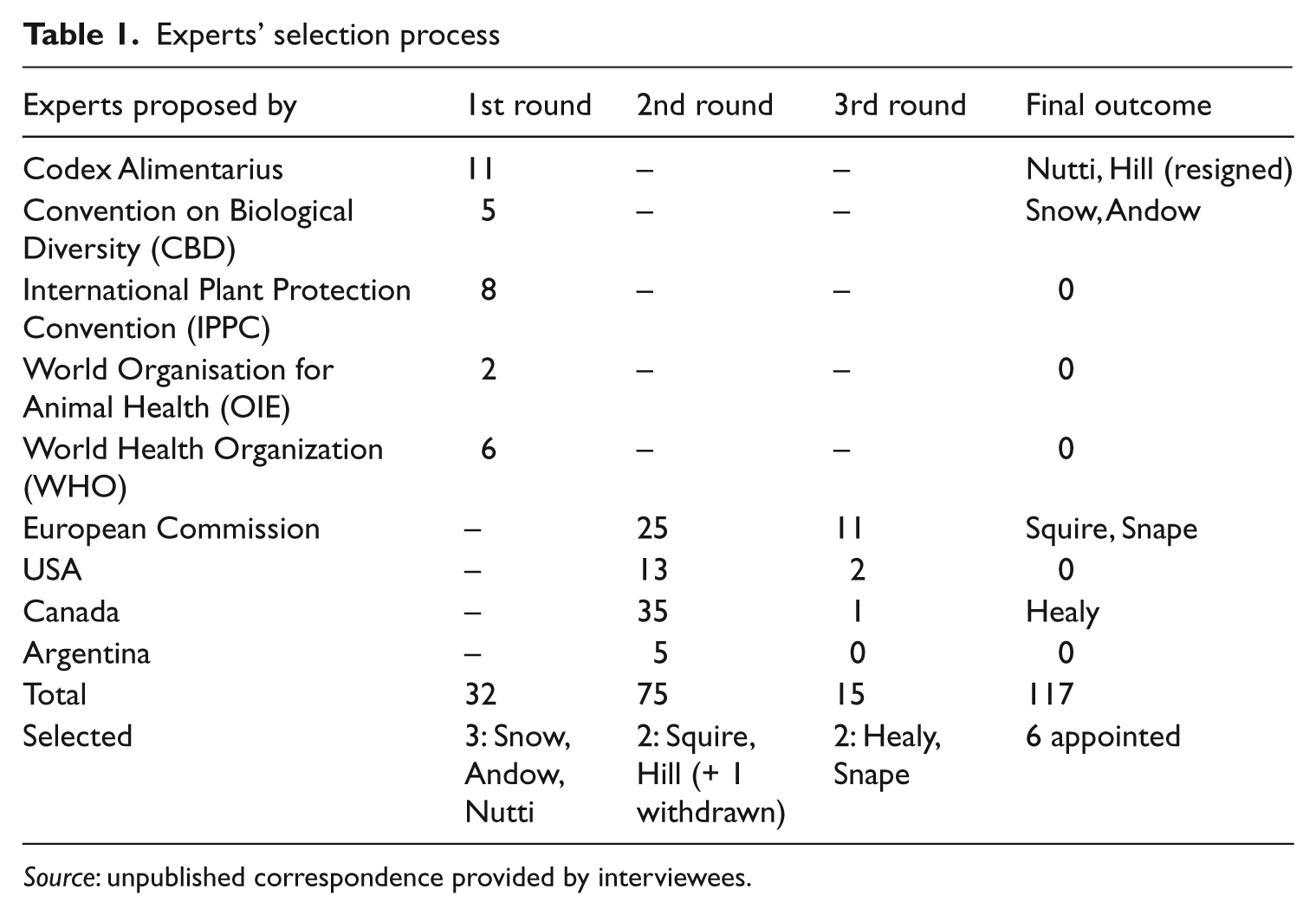
From August 2004, 117 experts were proposed – even more than the 71 in the first hormone dispute. Then they were contacted to request their CVs and declarations of interest, as a basis for comment by parties (see Table 1). According to the rules, experts are ‘chosen by the Panel in consultation with the parties to the dispute’ (SPS Art. 11.2). This process was a tactical ‘killer game’ since each party to the dispute anticipated the views of each potential expert. By December, six experts were selected after three contentious rounds. The detailed procedure ran as follows.
Experts’ selection process
Source: unpublished correspondence provided by interviewees.
In the first round, experts were to be nominated by international organizations, including the Codex Alimentarius, the secretariat of the International Plant Protection Convention, the World Organisation for Animal Health and the World Health Organization. In addition, the EC successfully proposed that the Convention on Biodiversity (CBD)/Cartagena Protocol on Biosafety also should be consulted. Among 32 names, only three escaped rejection by a party to the dispute. A second round was then launched: 75 names were proposed by the parties, but they agreed on only two, one of whom withdrew. In a third round, all 15 nominees were rejected by another party. The Panel used its discretionary power to select two of them – one who had been rejected by the defendant and one who had been rejected by the plaintiffs. Thus the initial stage eliminated nearly all the 117 scientists who had been asked to send information.
The parties displayed different tactics in the selection process. The EC proposed a wide range of names, overloading the adversary party with work to find information on the proposed experts, hence increasing the chance for at least one nominee to avoid rejection. EC Legal Services also hoped that many experts would be appointed so as to maximize dissensus among them.
An opposite strategy, adopted by the plaintiffs in the last round, was to propose few names and to reject all experts proposed by the adversary party in order to limit the number of experts. For instance, the plaintiffs were satisfied with the selection of a Brazilian biochemist, whose views they considered close to their own, in the first round. So they made sure that no other food safety specialist passed the following rounds.
The Panel simply accepted the parties’ demands for rejection without evaluating them; hence a low standard of evidence allowed somewhat arbitrary arguments. For instance, a world-renowned gene flow specialist from the University of California Riverside, who voiced views towards GM crops less critical than those of two experts selected in the first round, got rejected by a plaintiff simply by claiming that he ‘has made a series of publications where, in our view, he has taken positions which are functional to the interests of the EC in this dispute’ (unpublished correspondence, Argentina to Panel, 11 October 2004). Another scientist, famous for publishing on the presence of transgenes in maize landraces in Mexico, was rejected on grounds that he ‘is an activist opposed to biotechnology’ (unpublished correspondence, USA to Panel, 24 November 2004).
In their comments, the parties drew boundaries between ‘science’ and ‘non-science’ (such as ‘activist’), and likewise between scientific and non-scientific experts. To import authority from the scientific arena into the regulatory arena, some regulatory bodies explicitly require that experts in their advisory panels ‘be well published’ (for example, Environmental Protection Agency, 2009). At the WTO, this criterion is merely a contingent tactical argument. For instance, Canada rejected a Swiss scientist for having ‘worked more in the policy and regulatory spheres, rather than engaging in scientific research’, as shown ‘by the absence of publications of a scientific nature’. Yet Canada successfully proposed a regulatory scientist from Australia who had no more research publications than the Swiss scientist whom they rejected (unpublished correspondence, Canada to Panel, 23 September 2004).
To analyse the implicit criteria for selecting experts, we compared the nominations with a comprehensive database of 1751 refereed articles published in international journals on risk research for GM crops or food (Bonneuil, 2005). Few of the original 117 nominees were among the most published scientists in this field. Although four of the six selected experts had important scientific publications in the area, some had none or very few.
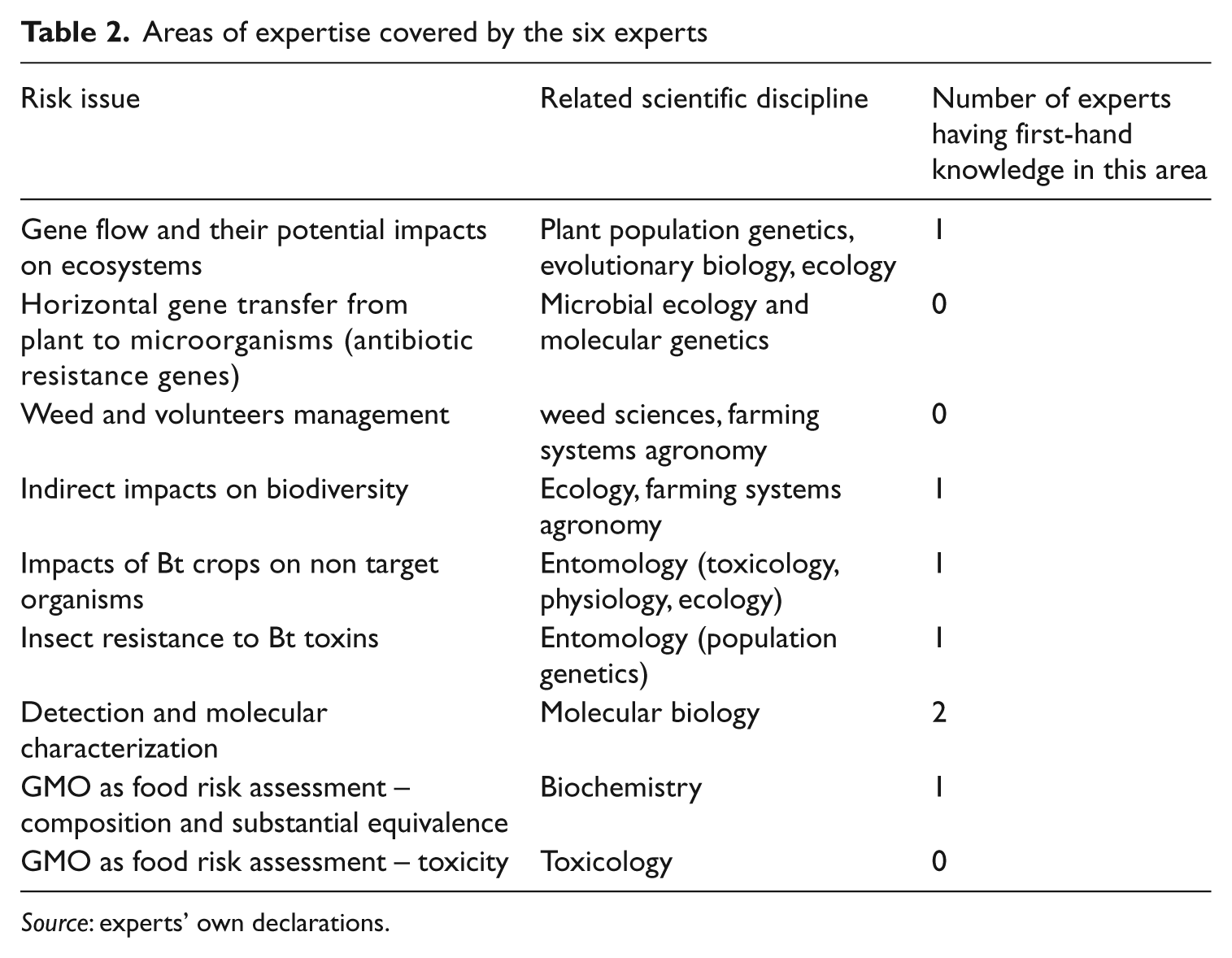
Six experts could not cover all areas relevant to the dispute. At the onset of the casting process, the EC had tactically listed more than 40 scientific disciplines and areas where experts should be sought (unpublished correspondence, EC to Panel, 16 August 2004). From the Panel’s report, we have identified nine broad risk issues/areas at stake in the dispute (Table 2). Among these, three potential risk issues (for example, toxicity and risks from antibiotic resistance genes) were not covered at all. Five were covered only by one expert with first-hand expertise, thus further minimizing the scope for internal disagreement.
Areas of expertise covered by the six experts
Source: experts’ own declarations.
What does this process tell us about the WTO’s way of knowing – its legal epistemology? Diverse legal epistemologies have been documented (Jasanoff, 2007; Leclerc, 2007). In the US legal system, for example, parties may recruit as many experts as they can afford; and scientific experts are not selected in advance of the trial by the court. Parties are able to petition for a pre-trial admissibility hearing on the reliability of the expert knowledge the adversary’s witnesses propose to present (Edmond, 2002; Jasanoff, 1995; Leclerc, 2007). When forming scientific advisory panels and selecting experts, US and EU agencies explicitly invoke criteria, such as the scientific standing of the experts, their absence of conflicts of interest, and the relevance of their disciplinary fields.
In contrast, WTO Panels apply different criteria for selecting experts. As we have shown here, the legitimacy of scientific expertise does not depend upon importing criteria from the scientific arena, nor upon gathering a substantial range of disciplinary expertise. It also does not require an adversarial hearing for all experts proposed by the parties. In the GMO case, four of the six experts were from the nation of a party in the dispute – an undesirable situation, according to the Dispute Settlement Understanding (World Trade Organization, 1994b: Appendix 4, para 3). One even held shares in DuPont, whose assets include a major vendor of GM seeds (Pioneer HiBred), thus contradicting the Dispute Settlement Understanding (DSU) criterion that experts should be ‘impartial’.
But such substantive aspects are secondary – as long as no party rejects a nominee. In this killer game, a fast-track, apparently wasteful, consensus-seeking and adversarial process reflects the WTO’s legal epistemology: namely, an appropriate expert is one whom no party rejects. This criterion prevailed over any other potential criteria.
Scripting questions to experts
Once selected, the experts were not invited to comment freely on the scientific issues at hand, but rather they were asked to express their views on specific questions, ‘solely for the purpose of assisting the Panel in its limited task of making findings of fact for purposes of these disputes’ (unpublished terms of reference, WTO Secretariat, September 2004)
During autumn 2004, the Panel and parties exchanged views on the questionnaire that would be sent to the experts. The final version included 114 questions. One-quarter addressed general risk issues, such as sanitary risks related to genetic markers for antibiotic resistance, toxicity of Bt crops for humans and non-target animals, and invasiveness of herbicide-tolerant crops. In line with the Panel’s SPS framing, most questions focused on the scientific basis of the 27 regulatory delays and 11 national bans.
The US proposed to amend the initial draft questions in order to increase the burden of evidence on the Commission to demonstrate clearly that such a scientific basis existed. It also argued that:
even if evidence of risks exists, an SPS measure must be ‘based on an assessment, as appropriate to the circumstances, of the risks.’ Furthermore, evidence of ‘existence’ of risk is not dispositive to the application of Article 5.7. Instead, the ‘relevant scientific information’ with regard to the risk must be insufficient. (Unpublished correspondence, USA to Panel, 24 September 2004)
For instance, the US proposed to ask the experts about all of the disputed delays or bans in which extra data had been requested from the companies on the potential risks associated with their products: ‘Is there any basis to expect that [this requested data] would identify any adverse effect that had not previously been identified?’ (US Trade Representative, 2004b: 59). Such questions strongly shifted the burden of evidence to the Panel to demonstrate that extra data were necessary as well as feasibly obtainable.
Although the Panel’s secretariat did not adopt the exact US wording, the questionnaire’s final version gave the defendant a strong burden of evidence to justify why available evidence was insufficient. In particular, it asked 36 times whether the information requested by a specific Competent Authority was really ‘necessary to ensure that conclusions of the safety assessment were valid?’ (World Trade Organization, 2006, Annex H).
By contrast, the EC sought to broaden the experts’ role. It posed questions highlighting uncertainties and limitations of scientific knowledge during the decade before the plaintiffs filed their complaint in 2003. For instance, for one draft question, the Commission proposed to add:
What has been the evolution of the scientific understanding … of biotech products and derived products over the last 10 years? Please specifically address … gene interactions, gene expression, gene silencing, molecular characterisation, product specific detection, as well as impacts on the environment, especially as regards indirect, delayed, combined and cumulative effects. (Unpublished correspondence, EC to Panel, 24 September 2004: 25)
The EC’s strategy was thus to emphasize knowledge gaps and uncertainties within scientific knowledge – understood as evolving over time, with much dissensus among scientists. The extra questions aimed to focus the experts’ attention on temporal changes. As the EC later reiterated: ‘We should not forget that we are looking at the science at that time’ (World Trade Organization, 2006: Annex J, paragraph 437). By engaging experts in a reflexive historicisation of scientific knowledge, the EC strategy demonstrated how science was co-evolving along with regulatory concerns.
In such ways, the Commission framed the dispute as a debate on past decisions made with knowledge at the time, which was then – but less so now – uncertain and thus insufficient for risk assessment. This historical narrative provided a way to manage the tension between the EC’s international and domestic agendas. The Commission Legal Services could defend the EC’s regulatory sovereignty, while also limiting member states’ scope to continue the de facto moratorium (Levidow and Carr, 2010: 156–159).
In the context of the dispute, the Commission’s strategy also aimed to broaden the notion of risk assessment by emphasizing divergent scientific views as evidence of uncertainty. In the beef hormone dispute, the Appellate Body had stated that:
[SPS Agreement] Article 5.1 does not require that the risk assessment must necessarily embody only the view of a majority of the relevant scientific community … governments may act in good faith on the basis of what, at a given time, may be a divergent opinion coming from qualified and respected sources. (World Trade Organization, 1998: paragraph 194)
In this understanding of the Appellate Body, a minority scientific view can justify a precautionary measure (SPS Art. 5.7), without needing a formal ‘risk assessment’ required by SPS Article 5.1 (Boisson de Chazournes et al., 2009).
EC proposals were accommodated somewhat in the questions as redrafted by the WTO Secretariat. Regarding national safeguard measures, the Commission proposed additional questions about whether there was any ‘material scientific uncertainty’ on each concern cited by a member state (unpublished correspondence, EC to Panel, 16 August 2004). Instead, the Secretariat asked whether the scientific documentation ‘is sufficient to support the safeguard measure’. In cases of potential adverse effects, moreover, ‘what risk management options are available to mitigate any resulting risks?’ (unpublished correspondence, Panel Secretary’s draft questions to experts, 14 September 2004). The final version added, ‘and what is their efficacy?’ (World Trade Organization, 2006, Annex H: 21).
More importantly, the final version of the questionnaire accommodated the USA’s stringent view of the legitimate basis for regulators to adopt provisional measures under SPS Article 5.7. Many questions challenged the evidence for regulatory delays or bans, by asking experts: Was there enough information to make a proper risk assessment as required by Article 5.1 before taking a precautionary measure under Article 5.7? Was the additional information requested really necessary to ensure the safety of the product? Or could not a ‘technical deficiency’ be mitigated by providing other available safety information?
Such questions pressed experts to challenge the Commission’s defence arguments, thus eliciting expert opinions that could both be cast as ‘scientific’ and be used along SPS lines of legal reasoning.
Experts on stage
In the dispute settlement process, the mise-en-scène of science was deeply framed by the WTO setting and a narrow interpretation of the SPS Agreement as the basis for judging the defendant’s regulatory practices. On the one hand, in the SPS Agreement, Article 5.1 requires that any measure restricting trade must be based on a risk assessment
Members shall ensure that their sanitary or phytosanitary measures are based on an assessment, as appropriate to the circumstances, of the risks to human, animal or plant life or health, taking into account risk assessment techniques developed by the relevant international organizations. (World Trade Organization, 1994a)
On the other hand, Article 5.7 leaves some room for precautionary measures in the face of scientific uncertainty:
In cases where relevant scientific evidence is insufficient, a Member may provisionally adopt sanitary or phytosanitary measures on the basis of available pertinent information, including that from the relevant international organizations …. In such circumstances, Members shall seek to obtain the additional information necessary for a more objective assessment of risk and review the sanitary or phytosanitary measure accordingly within a reasonable period of time. (World Trade Organization, 1994a)
The Panel’s questions directed the experts to scrutinize EC regulatory practices, especially in relation to the above criteria in the SPS Agreement. The experts had to answer first in a written form, and then in person during the joint meeting with the parties in February 2005. They had broad scope to decide which questions they were qualified to answer. If they crossed the boundaries of their scientific expertise, however, they risked attack by one of the parties. For instance, the food biochemistry expert asserted that ‘there are no reports that [antibiotic resistance] markers genes and plant DNA transfer to these cells [bacteria]’. Challenged by the Commission, she later had to acknowledge that she had overlooked published evidence on such horizontal gene transfer from plants to bacteria (World Trade Organization, 2006: Annex J paragraph 191–192).
A discursive distinction between law and science reinforced the image of science as an external resource, thus downplaying its construction for the dispute’s SPS framework. For example, at the start of meeting ecologist David Andow said, ‘As the Panel Chair told us this morning, there is WTO language and there is biotech language’ (World Trade Organization, 2006: Annex J, para 15). During the joint meeting, only legal representatives from the parties were entitled to question the six experts, although the parties also brought their own scientific experts into the meeting. These internal experts passed notes to delegates in real time. On one occasion a delegate tried to ask a question that was suggested in such a written note, but he could not grasp the scientific elements behind the question, so he was unable to formulate it properly (interview with EC delegate, 29 August 2007). This episode illustrates the gap between two social worlds interacting on the dispute arena, as well as constraints stemming from the rules of procedure.
The science/law boundary was also a flexible, discursive resource to be used tactically by the different actors. Each party and expert constructed different boundaries between science and law, as well as between the experts’ role and judges’ role. Some experts chose not to answer some questions on issues they deemed as beyond science. For example: ‘First of all, as a scientist, I am not a risk assessor. I am not in a position to make these decisions as to when we have enough information’ [for a risk assessment] (Andow in World Trade Organization, 2006: Annex J, paragraph 199). The Commission expressed appreciation that ‘the experts have by and large taken care, notwithstanding the leading questions on occasion put by the plaintiffs, to limit themselves to scientific issues and not to legal issues’ (World Trade Organization, 2006: Annex J, paragraph 437). When an expert made a legal judgement favourable to its case, however, the Commission quoted his advice to support its case. For instance, the EC cited Squire on the French rejection of herbicide-tolerant oilseed rape as ‘compatible with the tone of the SPS Agreement’ (World Trade Organization, 2006: Annex I-4, paragraph 657). The USA advocated a strict boundary between scientific and legal issues, but then later cited experts’ views as evidence that regulatory measures were inconsistent with SPS obligations (World Trade Organization, 2006: Annex I, n57).
Thus science/law boundaries were constantly dramatized, tested, displaced and reconstructed throughout the process. Boundary work was selectively used to mobilize expert claims to legitimize or challenge particular regulatory practices. As noted earlier, the plaintiffs asked particular experts whether the EC defendant’s delays or bans were the only way to manage scientific uncertainty, whether the additional information that the defendants requested from companies was essential and if there were alternative ways to manage the potential risks. These questions pressed the experts to comment on risk management issues.
For example, the Panel and plaintiffs posed questions about whether the EC procedures delayed product authorizations by requesting extra molecular data. In response, M. Nutti and M. Healy argued that detection methods were not a necessary component of risk assessment (World Trade Organization, 2006: Annex J, paragraph 22). Such arguments implicitly cast the issue under a narrow interpretation of the SPS Agreement, whereby any risk management measure requires a proper ‘risk assessment’, as if this were the only legitimate reason to require specific data. So the EC responded:
[detection] methods are indispensable for risk management measures, as well as communication measures such as labelling which are legislative requirements in the EC and which have not been challenged. (World Trade Organization, 2006: annex J, paragraph 55)
Scientific experts sometimes expressed divergent views, especially on the state of scientific knowledge and its adequacy for risk assessment. As in the case of molecular characterization mentioned above, for each risk issue, some members declared that the available knowledge was already sufficient for a favourable risk assessment. According to more cautious experts, however, available scientific knowledge in the late 1990s had not always been sufficient. For instance, when an expert explained uncertainties about methods for testing whether Bt crops harm soil organisms, a plaintiff asked him:
In other words, you are saying that we don’t know yet something that can modify a decision taken five years ago.
We don’t know yet. That is correct. … Unless you look for effects where Bt has been grown widely, you cannot say that in-field effects will not occur. (World Trade Organization, 2006: Annex J, paragraph 100–101)
Such expert disagreements often arose between less- versus more-cautious members: Nutti versus Andow, and Healy versus Snape. Citing their divergent answers, the Commission emphasized scientific uncertainties that warrant precautionary measures:
experts have taken very different approaches, and frequently disagree among themselves. … This confirms that there is legitimate room for disagreement on many of the issues. Such disagreement contributes to uncertainty and is bound to be taken into account by the Panel as it carries out its tasks. (World Trade Organization, 2006: Annex I-4)
However, these expert disagreements made no difference to the Panel’s findings, as the next section explains.
Exodus: Staging the Panel’s verdict
The Panel’s findings far exceeded the length of any previous report from an SPS dispute. They included not only the final conclusions, but also detailed reports of exchanges with scientific experts. Amidst all that detail, the Conclusions section made only a brief, marginal statement on risk issues, stating that ‘the transfer of antibiotic resistance from marker genes used in the production of some biotech plants to bacteria in the human gut’ was ‘highly unlikely’; ‘the development of pesticide-resistance’ was downplayed on grounds that it also arises from conventional crops (World Trade Organization, 2006: 1068, paragraph 8.5). With such brief comments, the Panel signalled that it had explored the relevant substantive scientific issues.
However, the Panel’s findings did not refer to judgements on such issues. Instead, they focused on the defendant’s procedures: between 1999 and 2003 the EC had applied a general de facto moratorium, which led to its failure to complete regulatory procedures for 24 applications (out of 27 targeted by plaintiffs) without ‘undue delay’, thus violating Article 8 and Annex C of the SPS Agreement. In addition, the nine national safeguard measures (bans) violated SPS Article 5.1’s requirement for a ‘risk assessment’.
For both categories of complaint, the Panel gave the EC’s advisory body a decisive role, while maintaining distance from any particular judgement by scientific experts:
EC committees issued opinions on each product and also reviewed the arguments and the evidence submitted by the member State to justify the prohibition and did not consider that such information called into question its earlier conclusions. The Panel thus considered that sufficient scientific evidence was available to permit a risk assessment as required by the SPS Agreement [Article 5.1]. Hence in no case was the situation one in which the Panel had been persuaded that the relevant scientific evidence was insufficient to perform a risk assessment, such that the member State might have had recourse to a provisional measure under Article 5.7 of the SPS Agreement. (World Trade Organization, 2006: 1068, paragraph 8.09)
In that way, the Panel rejected the defendant’s main argument, ostensibly on legal-procedural grounds. The EC had cited SPS Article 5.7 as a basis for precautionary measures due to scientific uncertainties, as evidenced by disagreements among the scientific experts during the dispute procedure as well as the wider risk debate. By contrast, the Panel interpreted SPS Article 5.7 as a legitimate basis for a provisional restrictive measure only when the relevant scientific evidence was insufficient to perform a proper risk assessment under Article 5.1.
For that legal issue, the Panel deferred to favourable EC risk assessments – such as those from the Scientific Committee on Plants and Scientific Committee on Food, whose earlier opinions had declared that information was adequate for a risk assessment on GM products relevant to the WTO dispute. Moreover, given the existence of official EU risk assessments, this placed a retrospective burden of evidence on EU member states for an alternative risk assessment to demonstrate the inadequacy of evidence at that time. In this regard, the Panel cited the SPS Agreement, which defined a risk assessment as ‘the evaluation of the likelihood of entry, establishment or spread of a pest or disease within the territory of an importing Member … and of the associated potential biological and economic consequences’ (World Trade Organization, 1994a, Annex A(4)). The Panel did not explicitly judge whether EC scientific committees’ opinions fulfilled that definition, but it did judge that national objections failed to do so.
With the Panel’s narrative of ‘sufficient evidence available’, any scientific uncertainties and dissensus were cast as irrelevant. This excluded the EC’s narrative of science as historically contingent and contested. To understand how the Panel constructed judgements about legally relevant (and irrelevant) scientific knowledge as a straightforward matter, let us examine how the more precautionary arguments were marginalized along three parallel lines.
First, as we have seen, the dispute settlement process generated divergent expert views about knowledge gaps and risks associated with biotech products at the time when EC procedures delayed decisions. However, these divergent expert views played only a marginal role. The Expert Group had only six experts drawn from the wide range of scientific disciplines involved in agbiotech risk assessment, so only one or two scientific experts were seen as relevant to each specific issue. This selectivity limited the scope for expert dissensus.
Second, the Panel’s reasoning was narrowly framed around a few procedural issues, such as ‘undue delay’ in EC regulatory procedures, EC committees’ opinions as evidence of ‘sufficient information’, and no proper ‘risk assessment’ to justify national bans. Experts were pressed to address numerous questions around these aspects (see the section above on ‘Casting experts’). On the ‘extra information’ versus ‘undue delay’ issue, even the more cautious experts – who argued that scientific uncertainty and inadequate knowledge warranted extra data for a risk assessment – were led to acknowledge that some national demands were so vaguely worded that it was difficult for applicants to respond appropriately. Some demands specified techniques that were not yet available, and/or extra knowledge that could have been obtained by a member state was not actively pursued. For example:
I judged the information that was in front of Austria to be insufficient …. They probably could have had the information to make a decision by 2003, had they pursued those uncertainties. (World Trade Organization, 2006: Annex J, paragraph 428)
By black-boxing substantive risk issues into such procedural matters, the Panel’s questions channelled expert views into a narrow form amenable to SPS reasoning. They also led scientists to express judgements that they had never made before in academic or advisory contexts, for instance about the un/necessary nature of additional information for risk assessment. This kind of scientific knowledge did not pre-exist the dispute settlement process, but rather was co-produced there. Through this particular channelling of knowledge production, it made little difference that experts expressed divergent scientific opinions on substantive risk issues–as long as the questions led them, at some point, to make statements that could be used to find the EC’s procedures in violation of WTO law.
As a third reason for the marginal role of divergent expert views in the Panel’s final report, the Panel imposed a narrow understanding of what constitutes a risk assessment as a basis to ignore or reject experts’ views supporting national bans. Two examples follow.
In the case of the 1998 French ban on the MS1/RF1 herbicide-tolerant oilseed rape, some experts saw a basis in the SPS:
It could be argued that France’s position was compatible with the tone of the SPS Agreement, Annex A, paragraph 4 (including economic as well as biological consequences) and compatible also with ISPM-11 Annex 3 on ‘Determining the potential for a LMO to be a pest’. (Squire in World Trade Organization, 2006: Annex H, paragraph 812) France had valid reasons to follow the advice of its Biomolecular Engineering Committee …. Scientists in France were well aware of the fact that transgenes would be dispersed by means of pollen and seeds, making it difficult to design management plans that would prevent problems in the future. These problems could be compounded if transgenes for glyphosate tolerance were also approved in … other crops. (Snow in World Trade Organization, 2006: Annex H, paragraph 812)
Despite such expert views, the Panel ruled that the French ban had ‘no apparent rational relationship’ to any risk assessment. Indeed, no available document counted as a ‘risk assessment’:
The French measure was based on a scientific opinion of its Biomolecular Engineering Committee (BEC), which documented the possibility of hybridization of GM rapeseed with wild relatives hence leading to new herbicide resistant weeds. But this was discarded by the Panel: the document does not ‘evaluate’ the likelihood of the risk of establishment, entry or spread of a pest (in casu, hybrid plants). … It is merely concluded that ‘dispersal into the environment [of herbicide tolerance transgenes] is likely.’ [It] did not provide any analysis of the associated potential biological and economic consequences of these hybrids, nor does it purport to evaluate the likelihood of entry, establishment or spread of these hybrids …. Consequently, we do not consider that the 2001 BEC report fulfils all of the criteria of a risk assessment in accordance with the definition in Annex A(4). (World Trade Organization, 2006: paragraphs 7.3116 and 7.3120)
Circumventing Snow and Squire’s statements, the Panel’s demands – to quantify (in 1998) the likelihood and ecological consequences of gene escape – imposed a retrospective burden to demonstrate prematurely the results and implications of ecological research that was just underway by 2003.
A similar manoeuvre happened over the Austrian ban on GM maize T25. This product contained the bla transgene conferring resistance to the antibiotic ampicillin and playing the role of a marker gene. The European Food Safety Authority (EFSA) had proposed a ban on the same gene in commercial GM products (European Food Safety Authority, 2004). This gene was present in GM maize T25, so EFSA’s opinion could have served as a risk assessment under the SPS. Instead the Panel followed a procedural argument, ruling that Austria had not provided a ‘risk assessment’ to justify its ban. Given EFSA’s earlier positive evaluation of T25 maize, Austria had to explain ‘how and why they assessed the risks differently, and to provide their revised or supplemented assessment of the risks’ (World Trade Organization, 2006: paragraph 7.3062). By interpreting the SPS Agreement in this way, the Panel marginalized any expert views that justified precautionary practices, even EFSA’s negative opinion on the bla gene.
In sum, the Panel (and Secretariat) linked issues of (in)sufficient scientific knowledge with practical regulatory issues, such as demands for extra information and risk management measures. Overall, the experts’ statements were generated and channelled to support two key arguments: that a need for extra information did not always justify EU-level regulatory delays, and that national bans were not based on a ‘risk assessment’, as defined and required by the SPS Agreement. The experts’ views were relatively more convergent on those regulatory-procedural issues than on scientific unknowns. The Panel interpreted the SPS Agreement to cite expert views as putting regulatory delays and blockages on the defensive, especially vis-a-vis safety claims made by the EU’s official expert advice. Then, when finding that EU practices violated WTO rules, the Panel could represent its implicit substantive judgements as purely legal-administrative interpretations of WTO rules.
Conclusion: Constructing scientific expertise for trade disciplines
In the Greek theatre, the Chorus’ final words are based on the principle of catharsis: to purge passions and inspire fear among members of the audience. In the WTO dispute, the dangerous passions were restrictive measures lacking a ‘rational relationship’ to a ‘risk assessment’ – as defined in the SPS Agreement and interpreted by the Panel. The audience to be frightened was made up of regulatory officials (in Europe and elsewhere) who might dare to indulge such passions. Scientific expertise was staged to achieve a catharsis, thus setting a precedent that could frame future disputes and perhaps even pre-empt them through self-discipline. The Panel interpreted the SPS framework as a requirement for ‘risk assessment’ – quantifying likelihoods and consequences, and imposing extra burdens upon the defendant to produce evidence. By imposing ‘the narrowest applications to date of the notion of SPS risk assessment’ (Peel, 2010: 244), the WTO Panel further globalized a ‘science-based risk assessment’ narrative that had emerged during the USA’s Reagan administration (Jasanoff, 2011).
Co-producing law and science within an SPS framing
We can now address the questions posed in the Introduction: What kind of knowledge counts as reliable and relevant for the WTO judges? How are particular forms of global legal norms and global scientific knowledge co-produced through the judicial procedure? In sum, the WTO Panel’s procedure co-produced legal and scientific expertise in the following ways.
By innovating a specific legal ontology (for transgenes, related risks and the environment), the Panel justified the SPS Agreement as the appropriate legal framework. Based on this juridical precedent, any trade-restrictive measure to protect the environment could now be interpreted as an SPS measure, thus triggering stringent requirements which are not otherwise required in international treaties and protocols on environmental issues (Peel, 2006). Beyond agbiotech regulation issues, this SPS framing set a precedent for disciplining or even pre-empting any precautionary approach to the domestic regulation of environmental risks.
This SPS script informed the WTO’s legal epistemology, a particular way of generating and validating appropriate knowledge for testing the defendant’s compliance with WTO–SPS obligations. In particular, it devised specific means to recruit and select scientists as experts, set their role in the dispute settlement arena, and channel their answers towards particular issues such as ‘undue delay’ or ‘insufficient information’. In the selection procedure, an appropriate expert was one to whom no party objected. This criterion complemented the experts’ role – namely, to provide individual statements that could help justify the Panel’s findings without a need to deliberate upon risk issues. Amid the detailed discussions, participants argued about the boundary between ‘legal’ and ‘scientific’ issues, and thus the appropriate role for each type of expertise, while speaking as if science came from a separate world. This discursive distinction reinforced the image of science as an external resource, thus downplaying its construction, especially for the SPS framework in this dispute.
The process imported into the legal arena some elements from the scientific arena – persons, status, epistemological norms, ontological categories, claims, and so forth – all of which were staged in ways that produced new knowledge along the lines of the chosen legal reasoning. Through its specific questions about risk assessment procedures, the Panel led the experts to make new statements questioning the scientific basis for the EC’s regulatory delays and national bans. The Panel’s particular interpretation of the SPS Agreement for the case, which focused on apparent procedural issues such as ‘undue delay’ and appropriate ‘risk assessment’ (subordination of Article 5.7 to Article 5.1), indeed channelled the way experts would be questioned, the answers they would give, and thus the part they could play on the legal stage.
Most questions for experts increased the burden of evidence needed to demonstrate the scientific justification for regulatory delays or bans for each of the 36 products or measures under dispute. This generated scientific opinion on regulatory procedures. Such scientific knowledge did not exist prior to the Panel’s demand for it, but rather was generated in the dispute settlement arena. Through this particular way of channelling knowledge production, it made little difference that experts expressed divergent scientific opinions on substantive risk issues, as long as they made some statements that could justify the Panel’s findings against the EC on procedural grounds.
In those ways, the procedure generated new expert scientific views that could complement the Panel’s judgement. The WTO procedure actively constructed the scientific facts that it presumed to ‘find’ by analogy to other judicial procedures (Jasanoff, 2007: 776). Thus the Panel’s legal epistemology deferred to an image of science that was ‘a construct of the legal process itself’ (Jasanoff, 2007: 772). In these explicit and implicit ways, the procedure co-produced legal and scientific expertise along lines that gave authority to the Panel’s findings against the defendant. Having answered the Panel’s questions from within an SPS frame, the experts’ statements were then implicitly translated back into SPS legal terms by the Panel without much need to cite those statements.
Procedural turn: Representing risk issues as legal-administrative judgements
We can now return to the apparent paradox mentioned in our Introduction. The dispute settlement’s process devoted enormous time and resources to expert scientific opinion, but these were barely cited as grounds for the Panel’s findings, which were represented instead as legal-administrative judgements on the defendant’s procedures. Why?
First, the Panel did make substantive claims in several ways – for example, by innovating ontological categories (GMOs are pest, transgenes are food additives, and so on), by asserting that antibiotic markers genes are not dangerous, or by disregarding uncertainties that did not fit its narrow model of risk assessment. But these substantive judgements were not acknowledged as such. They were represented either as dictionary-based elaboration of terms and definitions in the SPS Agreements, or else as a purely legal review of the EC’s regulatory procedures, rather than as an engagement with scientific knowledge. Hence it seemed pointless to address substantive risk issues in the findings.
While previous Panels’ findings in SPS disputes had reviewed both defendants’ regulatory practices on substantive grounds and the opinions of scientific experts, the GMO Panel chose a different strategy. Its findings focused on the defendant’s regulatory procedures, while avoiding any serious discussion of expert claims. This procedural turn was later reinforced by the Appellate Body’s 2008 ruling which criticized the Hormones II Panel for having ‘reviewed the scientific experts’ opinions and somewhat peremptorily deciding what it considered to be the best science’ (Peel, 2010: 216; World Trade Organization, 2008: 612).
This shift may be understood in a political context where previous Panels’ engagement with scientific risk issues had been criticized by anti-globalization activists, EC officials (Christoforou, 2000) and scholars (Busch et al., 2004). The WTO was even warned against becoming a new ‘trans-science organization’, thus undermining regulatory pluralism through a false, narrow conception of science (Walker, 1998). Facing such criticism, especially in the hot social-political context of the GMOs dispute, WTO decision-makers found apparently less intrusive means to review the risk issues as a basis for their decisions. Hence the procedural turn in SPS jurisprudence constituted a significant shift in the WTO’s formation of knowledge and norms.
As pioneered in the GMO dispute settlement, the procedural turn constructs both an interface and boundary between science and law. The legitimacy of the judgement rests on its ‘science-based’ imprimatur, mobilizing scientific experts and scientific knowledge in the dispute settlement arena. Yet this expertise is framed in a way that allows WTO judges to avoid any explicit engagement with scientific knowledge. Under a procedural requirement for a ‘risk assessment’, the Panel applied a stringent standard of review to the defendants’ substantive risk claims. In several cases involving technical issues, by contrast, US courts have operated a legal epistemology whereby judges explicitly engage with scientific claims in order to separate sound science from junk science or marginal scientific views (Edmond, 2002; Jasanoff, 1995; Leclerc, 2007). Such explicit engagement can also be found in previous SPS findings (Peel, 2010: 254).
As this case illustrates, the WTO settlement process mobilizes scientific expertise in particular ways that can achieve multiple aims: it recruits a source of credibility from the scientific arena, reinforces the standard narrative of a ‘science-based’ trade discipline, and constructs a new scientific expertise for the main task – namely, challenging trade restrictions for being unduly cautious. Moreover, by operating a procedural turn in the WTO’s way of knowing, the Panel now keeps implicit its own judgements on substantive scientific issues. The decision-makers’ engagement with scientific aspects therefore becomes less explicit and less accountable.
These elements shed new light on the Amicus brief submitted early in the GMO dispute by STS scholars, who rightly warned against a specific model of risk assessment, especially as a means for the Panel to disregard scientific uncertainties. The authors also asked the WTO to limit its review to judicial-administrative aspects (Busch et al., 2004: 6, 39), implying that these could be kept separate from any risk assessment model and from substantive risk issues. As our analysis suggests, however, these aspects are not separable, at least not in the WTO–SPS context. Therefore a WTO review focusing on regulatory procedures does not provide as ready a solution as some might have hoped towards regulatory pluralism, reflexivity on the science-law relationship or democratic accountability.
Footnotes
Acknowledgements
The authors thank Christophe Charlier, David Winickoff, Samuel Evans, Chris Jones, Sheila Jasanoff, Nicolas Baya Lafitte, Jacqueline Peel and three anonymous reviewers for their very helpful comments on earlier versions of this article. The research was funded by a grant from the Agence Nationale de la Recherche for a project, ‘La gouvernance internationale du commerce des OGM’ (GICOGM).