



Abstract
This article looks to propose a new way to understand the repair of failing large sociotechnical systems. Leaving aside romantic valuations, repair always involves a certain degree of normalization. Derived from conceptualizations by Foucault, repair as normalization is understood as a particular form of power that, first, recognizes a certain normal state to which the failing system should evolve and, second, develops different strategies to reach it, usually involving the deployment of particular disciplinary devices. The ultimate aim of such practices is usually not only the improvement of the system but centrally the maintenance of a certain kind of power. In order to show the empirical usability of such conceptualization, the article analyzes the case of Transantiago, a thoroughgoing reform of the public transport system of Santiago, Chile. The start of Transantiago in February 2007 was marred by multiple failures, becoming one of the biggest public controversies in the country in recent decades. Given this, several different strategies were developed to repair such failures, understanding them explicitly as normalization. The article analyzes two particular strategies: attempts to change the negative ‘public perception’ about Transantiago through the use of quantitative indicators and the introduction of an unexpected type of infrastructure to increase the overall speed of the system. Finally, the conclusion analyzes how the conception of repair as normalization can help us better understand the complexities involved in dealing with failing large sociotechnical systems such as Transantiago, pointing to the need to sometimes move beyond repair.
Repair as normalization
Transantiago was born in a spirit of radical reform. Planning for this restructuring of Santiago’s public transit system started in 2000. Using up-to-date knowledge devices from transport planning, Transantiago was intended to transform almost every single aspect of the existing system. Beyond its multiple single components, and like any other large sociotechnical system (LSS; Hughes, 1983), Transantiago needs to be seen as a ‘complex system which links material technologies with organizations, institutional rules, and cultural values’ (Moss, 2000: 65). As an important body of research has shown (Bijker et al., 1989; Coutard, 1999; Hughes, 1983; Myantz and Hughes, 1988; Summerton, 1994), LSSs such as Transantiago are never simply ‘built’ in a particular moment and then put to work to produce certain results. On the contrary, they are constantly emerging ‘in practice, connected to activities and structures’ (Star and Ruhleder, 1996: 112); in their emergence, they are continually changing and being redefined as new elements are included, redefined, and/or discarded.
Given this, the development of Transantiago was never going to be easy or straightforward. Derived from conceptual developments carried out at state and academic levels starting in the late 1980s and summarized in a policy proposal published in 2000 (MOPTT, 2000), a multitude of heterogeneous elements needed to be brought into being and connected in order to create a completely new way of organizing public transport in the city. Such a process was interspersed with conflicts but at last succeeded in constituting, by early 2007, a network comprising authorities, a new design for the bus route network, new buses and urban infrastructure, professional bus drivers, contactless payment cards, new regulations and standards, adverts on the media, and so on. However, in order to become a proper public transport system, Transantiago needed to take one further step and start mobilizing users from one location to the other. As seen in the literature, such a move, such an extension in scale usually represents the main source of problems in the development of LSSs, as ‘systems designed and imagined within discrete limits are called upon to sustain activities of an undesigned-for size, scope, nature, and intensity’ (Jackson et al., 2007). Transantiago was in no way an exception to this trend.
The start of the system on 10 February 2007 was chaotic. From the very first hours, the actors in charge of the process faced dozens of serious ‘reverse salients’ (Hughes, 1983) as several components of the system started to behave in unexpected ways: there were not enough buses on the streets, the software to control the bus fleet was not operational, the contactless payment card failed massively, people had very little information about how to use the system, and so on. The situation was made more critical given that several of these salients, due to the ‘interactive’ (Perrow, 1999) connectivity of the system’s components, cascaded into each other; this resulted in almost every aspect of the system being affected. Given the amount and interactivity of these salients, it became impossible for the actors in charge to deal with them in an efficient way, with consequences both for users and at the central level. Users had to wait for hours or walk long distances to catch a bus, they had to travel on extremely crowded buses and metro, they had to deal with the uncertainty of not knowing how to reach their destinations, and so on. For administrators, the interactive failures led to a situation of emergency during the first weeks of functioning, when the possibility of a total breakdown of the system was palpable for most of the involved actors. 1 As a consequence, after just a few days, Transantiago became one of the biggest public controversies any Chilean government had faced since the return of democracy in 1990. In this context, it was not surprising that in the days following 10 February, multiple voices were raised demanding that the government arreglar Transantiago – repair Transantiago.
The concept of repair has received a growing amount of attention in the social sciences lately (Dant, 2010; Edensor, 2011; Graham and Thrift, 2007; Gregson et al., 2009; Jacobs and Cairns, 2011; Strebel, 2011). The usual starting point is the recognition that in society ‘disconnection and disassembly are just as important [as connection and assembly] in that they resist entities’ means of enacting themselves: failure is key’ (Graham and Thrift, 2007: 7). Given the pervasiveness of failure, repair and maintenance practices are seen as a main way through which the very existence of artifacts, from single devices to LSS, is extended in time and space. Without continual repair there is no durability, only decay.
Such recognition has motivated a wide-ranging agenda in the study of repair practices, bringing to light this often poorly understood but central component of any kind of ordering. This study, however, has so far been tainted by a degree of romanticism that has limited the full comprehension of repair in its multifaceted forms. Repair is almost universally presented as something valuable, good, and inherently ‘human’, something that should be lauded and preserved and even actively defended. Such a valuation has two main manifestations. On the one hand, and inspired by the first ethnographies on repair (Harper, 1987; Orr, 1996), repair work is usually presented as an opportunity to re-value manual labor (Sennett, 2008), establishing a contrast between ‘the human, artisanal character of repair work … [and] the more alienating work of machine-based manufacture’ (Dant, 2010: 4). On the other hand, repair practices, mainly enabling recycling, appear as key to opposing rampant consumerism and the disposal of goods, ‘a form of everyday resistance to the alienating effects of contemporary society’ (Watson and Shove, 2008: 75); repair becomes a key component of the ‘good city’ (Amin, 2006). Both positions present us with the concept of repair not only as a particular set of practices but also as an intrinsically ethical activity.
Without denying that repair practices can sometimes be enriching and inherently ethical, this article looks to propose a contrasting version of repair as normalization, a conception derived especially from the work of Michel Foucault. The word ‘repair’, as its etymology reveals, comes from the Latin word reparare, meaning ‘to restore, to put back in order’ – such a notion is also present in the Spanish verb arreglar, meaning ‘to put in rule or order’ (poner en regla o en orden), used extensively in the weeks after 10 February 2007 to refer to the actions needed to improve Transantiago. Therefore, the concept always assumes the existence of a state of ‘order’, usually located in a certain previous configuration, to which the failing device or system should be ‘restored’ to function properly again. Such a state of order is usually understood to be the ‘normal’ situation. To use this concept is not meaningless. Starting from the work of Georges Canguilhem (1978), the concept of the normal has been seen, in Foucault’s (1979) words, as ‘one of the great instruments of power at the end of the classical age’ (p. 184). The power of the concept is derived from the double sense of the term normal:
(1) normal is that which is such that it ought to be; (2) normal … is that which is met with in the majority of cases of a determinate kind, or that constitute either the average or standard of a measurable characteristic. (Canguilhem, 1978: 69)
Therefore, the normal, as a concept, is always descriptive and prescriptive: ‘[O]ne can, then, use the word “normal” to say how things are, but also to say how they ought to be’ (Hacking, 1990: 163). Consequently, the normal always lies in this tension; it describes a supposedly average reality while it performs a desirable state toward which the existent reality should evolve.
Therefore, the usage of the term ‘normal’ is usually associated with practices of normalization. Normalization usually consists of a double process: ‘first of all in positing a model, an optimal model that is constructed in terms of a certain result, and the operation of disciplinary normalization consists of trying to get people, movements, and actions to conform to this model’ (Foucault, 2007: 85). Therefore, normalization as a process always starts with positing an ‘optimal model’ in which all the components of a system are ordered in certain specific ways. Such models are made of a multiplicity of materials, from detailed blueprints to moral judgments, and when compared with existing realities, they usually highlight certain abnormalities or components ‘incapable of conforming to the norm’ (Foucault, 2007: 85). Disciplinary measures align such abnormals to the plan, ranging from directly (even physically) aligning them with the model to setting new regulations and standards through which they are governed or called to self-govern in certain normal ways.
Understood as normalization, repair practices can be seen not only as contributing to the long-term survival of a system but also as a key strategy for the maintenance of power, something that has been recognized in the science and technology studies (STS) literature on the issue. STS’s starting point is the recognition that infrastructures are usually invisible when functioning correctly, exerting power in a seemingly natural way. However, failures make them visible (Star and Ruhleder, 1996), opening the black box of infrastructural power to possible questionings and/or transformations by actors who might feel disenfranchised from it. Then dealing effectively with the system’s reverse salients, especially in an unnoticed and routine way, is key for the system’s ability to maintain power. As a result, ‘repair is not at the margins of order, waiting to be deployed if something goes wrong. Instead, it is a practice at the center of social order: repair work makes … [an LSS] normal’ (Henke, 2000: 57). It is through continual repair work that complex LSSs are able to normalize their existence and, by doing so, give a certain naturalness to a particular kind of power. Repair practices are never only ‘the techniques actors use to maintain the practices, institutions, and technologies that form a system’ (Sims and Henke, 2012: 326) but also a key component in ‘the maintenance of power’ (Henke, 2007: 138).
In concrete terms, repair practices operate in similar ways as do other normalization processes. First, there is the identification of certain abnormalities based on a mismatch between the optimal model, usually taking the form of detailed ‘scripts’ (Akrich, 1992) describing how the different components of the LSS should be ordered, and their actual behavior. After this, multiple ‘disciplinary devices’ (Ureta, 2013) are introduced, devices aiming to align abnormal components with their scripts. Disciplinary devices can take many forms: encoding the scripts in new ways so that the abnormal components start self-governing; materially enforcing their alignment (even using violent means); or, ultimately, removing components that are unwilling or unable to become normal. As can be expected, and contrary to monolithic notions of power, repair practices are always contested. As Foucault (1980) recognized, ‘there are no relations of power without resistances’ (p. 142). The deployment of disciplinary devices always causes different kinds of anti-programs (Latour, 1991), as the system’s components challenge being normalized. Some of these anti-programs – humble acts of resistance – might go unnoticed, while others could have seismic effects, even affecting the viability of the system as a whole. In this last scenario, as will be explored at the end of the article, it might be better for the improvement of an LSS experiencing multiple abnormalities to implement interventions that go beyond repair.
Finally, it is important to note that normalization should not be taken necessarily as some sort of ‘dark side’ of repair work. Repair can be both enriching and normalizing. For example, repairing a failing LSS can provide a lot of relief for a population, even if repair is accomplished by the enforcement of a set conception of the normal. But, as the general literature on repair suggests, repair work also can go in opposite directions, generating oppressive states of the system and even actively causing suffering. As affirmed by Jackson (2014), ‘repair is not always heroic or directed towards noble ends, and may function as much in defense as in resistance to anti-democratic and anti-humanist projects’ (p. 233). This is so because the ultimate aim of repair as normalization is first and foremost the maintenance of power, not the improvement of societies and/or individuals.
In order to explore the empirical value of this conceptualization, the next sections of the article will study particular repair strategies introduced in the case of Transantiago. 2 First, the article will show how normalization was adopted as the explicit strategy to deal with the failures of the system. Second, it will study attempts to change the ‘public perception’ about the system through the enactment of a quantified normal user of the system. Third, it will study the introduction of specific kinds of infrastructure to buffer the unexpected behaviors of users. Finally, the conclusion will analyze how the conception of repair as normalization can help us better understand the complexities involved in dealing with failing LSSs such as Transantiago, proposing the need to sometimes move beyond repair.
Normal Transantiago, normal users
On the night of 26 March 2007, Chile’s President Michele Bachelet started a nationwide television hookup to talk about the problems faced by Transantiago with the following phrases:
Chileans, it is not common that a president stands in front of the nation and says: ‘things have not been done well’ … It is unacceptable that a transport system made to better integrate the city has become a source of difficulties and discrimination. I’m not going to tolerate this anymore. I assume the state’s responsibility in the deficiencies in the start of Transantiago, as well as in its design problems. Neither the government nor the involved entrepreneurs have acted well. Nor [the ones] whose responsibility was to deliver everything on time; the ones who were in charge of key components of the system and then didn’t deliver … The difficulties were minimized and even though every aspect was checked several times, it was not enough … It is our responsibility, then, to face these problems, to present the solutions and say: ‘this must improve now’ … But I’m not here to lament … This is why I took some time to find the answers and choose who should head this new stage, on which no further mistakes will be accepted.
In the first section of this speech, we can identify a usual strategy in which authorities deal with massive failures in the implementation of LSSs, which Bovens et al. (1999) call repentance. Bachelet ‘publicly admit[s] … [her government’s] failures, ask[s] for forgiveness, and promise[s] that it will never happen again’ (p. 140). Through this strategy, she hoped to minimize the damage that Transantiago was causing to her government.
In adopting this strategy, we can see how Transantiago’s failures were never solely technical but were perceived as damaging the kind of power exerted by Bachelet’s administration. She came to power in 2006 putting an emphasis on top-down technocratic policymaking, an approach that has been common in Chile since the early 20th century (Silva, 2008). Such an approach is especially clear in the case of Transantiago, a plan that was the brainchild of highly respected technical and academic actors from its very start (MOPTT, 2000). Therefore, the normalization of Transantiago was never solely about having a working public transport system in Santiago but also about the maintenance of the traditional way in which state power has been exerted in Chile.
An emphasis on the maintenance of power was clear in the selection of the new head of Transantiago. A few hours before her statement, Bachelet asked for the resignation of Sergio Espejo, the Minister of Transport. A lawyer, Espejo was widely seen as a key guilty party in Transantiago’s failures, given his lack of expertise in the area of public transport. As his replacement, Bachelet named René Córtazar. An economist with a PhD from Massachusetts Institute of Technology (MIT), Córtazar was widely perceived as the right man for the job. Even though he also did not have any experience in the transport sector, successful past appointments as labor minister during the Aylwin administration (1990–1994), researcher for the highly prestigious think tank Corporación de Estudios para Latinoamérica (CIEPLAN), and director of the national broadcasting company TVN had lent him an aura of technical proficiency difficult to match by any other candidate for the job. Córtazar, we could say, was one of the most advantaged alumni of the kind of technocratic governance characteristic of Chile. For these reasons, he appeared capable of delivering the technical steering needed to put Transantiago to work as expected and, in so doing, restate the validity of Chilean technocratic governance.
After taking some weeks to make a diagnosis of the situation, on 19 May, Córtazar held a press conference to explain the new strategy for repairing Transantiago. He started by acknowledging the existence of several technical failures constituting a particular ‘crisis’ and the efforts that the government had been making to correct such a situation. Then he talked about the strategy developed at the Ministry of Transport and Telecommunications (MTT) to transform the situation, identifying explicitly as its final objective the full normalización (normalization) of Transantiago. Such a framing, as could be expected, made it almost inevitable that a repair strategy was going to be the ultimate way to deal with the failures of the system.
A first stage in implementing such a repair was to define the ‘normal’. Córtazar started by (reversing Perrow’s (1999) argument) understanding the failures experienced by Transantiago as abnormal, a result of an erroneous implementation of the system’s blueprint. In consequence, the normal was to be found in the correction of this situation, in a Transantiago that would work in accordance with its original script. Its main components, in comparison to the former system, are summarized in Table 1.
Comparison between Transantiago and the former public transport system of Santiago.

Source: Reproduced based on MOPTT (2000) and other official documents.
As can be seen, the script proposed transformations to all the major components of the public transport system of the city, from changing buses and routes to users’ management of transport information. A ‘normal’ Transantiago, from this perspective, could only mean a Transantiago in which all these different transformations had been implemented and, crucially, were working without major problems. As promised in countless government brochures for the plan, such a system would be ‘modern, efficient, integrated and with the highest standards of quality for its users’ (MOPTT, 2004: 3). Such a normal Transantiago would not only provide a ‘world class’ public transport service for the city, as was repeated exhaustively in the plans’ brochures, but also reaffirm the government’s technocratic capacity to plan effectively. In summary, ‘progress and the normal state became inextricably linked’ (Hacking, 1990: 168).
At Córtazar’s press conference, and in other related documents, such a normalization strategy was translated in terms of a series of quantitative standards (larger bus fleets, extended night bus routes, increased number of bus stop shelters, reshuffled routes, etc.) that the system had to surpass within a temporal framework. With these standards at hand, several disciplinary devices were introduced to align the multiple actors related to Transantiago (government offices, entrepreneurs, academics, etc.) who were not behaving in accordance with the script. While some of them aligned themselves with the MTT through self-governance, in other cases the MTT had to apply more direct disciplinary devices, even threatening the more rebellious components (such as the entrepreneurs running the bus network) with outright exclusion from the system. The subsequent weeks and months witnessed multiple transformations in the system’s components, as they were progressively aligned with their original scripts: larger bus fleets, a fluid payment structure, and so on.
This normalization was aimed not only at repairing a series of massive failing technical devices but also at the performance of ‘normal’ subjects. Given the centrality of users for any LSS (Oudshoorn and Pinch, 2003), no matter how well other – technical – failures were corrected, if the human components were not ‘normalized’, Transantiago would never be fully repaired. Therefore, and in parallel with transforming technical components, a significant amount of effort was directed toward making ‘people repair’ (Henke, 2000: 65) or trying to finally materialize the user scripted in the original proposals: a subject that ‘move[s] with tranquility and in an expedited way between one place and the other, in comfortable and safe conditions’ (MOPTT, 2000: 48). Any other kind of user, especially the ones ubiquitously presented as experiencing discomfort when using the system, was deemed abnormal. The next sections of the article analyze in depth two particular ways in which such abnormal users tried to be normalized: repair by numbers and repair by buffering. 3
Repair by numbers
From day one, Chilean (and international) media outlets carried prominent pictures of and stories about users experiencing all kinds of discomforts, even pain, when using the system. Filling newspapers and TV news every time the word Transantiago was uttered were images of people traveling in incredibly crowded buses, fighting to enter a metro station, or crying because they had to walk for hours to reach their homes. Such a situation, a radical contrast to the generally positive media coverage of the plan before its starting date, caused actors from MTT to recognize early on that their efforts to repair the system would be unsuccessful if they were not able to challenge this negative ‘public perception’, as they called it. Therefore, from the very start, and besides repairing the technical components of the system, these actors engaged in discursive repair looking to ‘transform the frames around an ecology’ (Henke, 2008: 12). Such repair practices looked to align the public opinion versions of the ‘user of Transantiago’ with the one that was rapidly gaining hold among MTT’s personnel, who had been reinvigorated by Córtazar’s program: a user who was every day experiencing fewer and fewer problems and slowly starting to enjoy the benefits of the new system.
The starting point of the challenge was to develop a script of the current users as ‘traumatized’ by the problems faced at the beginning of the implementation, as Matias Rojas, a high authority within MTT, did when talking about ways to communicate the normalization program:
… the perception of the people is quite fixed in the past. This was a very traumatic experience, very traumatic, very traumatic, and because of this the perception of the system is quite fixed in the past, even though if you look at the last surveys it has started to improve. But there is a gap between perception and reality, very clear and very natural. I can prove this by the fact that in surveys users always have a better perception than non-users … Nowadays Transantiago has become a villain, it is a generic word. As when people say that they’re going to make a Xerox, it wasn’t a brand, it was a synonym for a photocopy. Transantiago is a synonym of … it is the trans-this, the trans-lousy, the trans … It has become a synonym of a traumatic situation. It is quite difficult to fight against a generic name when it has been born and therefore what we have to aspire to is to continue improving the system, to consolidate it, and know that these are social processes that have a periodicity, have a slow tempo and … take time.
Rojas presents users as carriers of subjective perceptions that are expressed in opinions. Given the problems experienced when using Transantiago in the first weeks and months, users were traumatized, with the result that even their later opinions about the system were quite negative; Transantiago became the epitome of something bad, as a ‘Xerox’ became synonymous with a photocopy. Rojas presented the trauma as causing a gap between the reality of the system, which has objectively improved, and the opinions of users, which have remained more or less the same. From this perspective, and taking a quasi-mechanistic approach, the main way to normalize the system was to bring the realm of perceptions closer to the one of reality, so users would start perceiving the objective improvements in the system and change their opinions about it.
As hinted at in the quoted passage above, the main way to ‘prove’ the existence of a trauma and challenge it was through a survey that could produce quantifiable results. As the literature on the subject has shown (for an introduction, see Espeland and Stevens, 2008), quantifications have become a central technology of government, due to their capacity to bridge distances, both spatial and social (Porter, 1995), allowing governments to ‘act at a distance’ (Rose and Miller, 1992). ‘Quantification offers a shared language and discipline that transcends other forms of differences that threaten collective or competing social projects’ (Espeland and Stevens, 2008: 419). Therefore, quantifications are central to normalizing powers in contemporary societies; they ‘create and can be compared with norms’ (Porter, 1995: 45) because they make behaviors and expectations uniform.
Given this, we can talk of the existence of repair by numbers, or a particular kind of repair that uses commensurations in general as disciplinary devices to align failing components of a system with a certain script. The effectiveness of repair by numbers is derived from the recognition that quantifications are never merely descriptive but also performative; they ‘not only reflect reality but, in a certain sense, establish it by providing the players with a language to put reality on stage and act upon it’ (Desrosières, 2001: 352). When effective, repair by numbers creates a new commensurate reality in which the failing components work as expected, contributing actively to make ‘worlds embedded within wider social projects turning on authority and control’ (Barnes and Hannah, 2001: 379). Any component failing to align with the script proposed by the commensuration is immediately deemed abnormal, an object of further discipline or exclusion.
In this particular case, repair by numbers was based mainly on the regular production and diffusion through the media of quantitative indicators showing improvements in the system, especially at the user level. MTT hired the Division of Transport Engineering and Logistics (DICTUC in Spanish) of the Catholic University of Chile to run this project. Besides being one of the leading universities of the country, the Transport Engineering Department with which DICTUC was connected housed several highly respected actors in the field, endowing its measures with a double layer of prestige and technical proficiency. Starting from mid-2007, every 2 weeks, DICTUC produced a series of indicators – for example, in terms of waiting and traveling times in different areas of the city. These numbers were used not merely to show which areas required better attention but also, and centrally, to repair with the authority of objective data the trauma the users had experienced. For this reason, from the very beginning of the repair efforts both MTT and DICTUC published these indicators, using them as the main displays of the increasingly satisfied users of the system they were hoping to mobilize in public opinion.
At first, this repair strategy did not seem to produce the expected results, as can be seen in this extract from Córtazar’s statement of 21 November 2007 to the Parliamentary Committee investigating Transantiago:
In relation with restoring the credibility to Transantiago there is a wider issue that has to do with perceptions and reality. We know that when there is a crisis as acute as this one it is not enough to change reality for perceptions to adjust immediately; there is a process of adjustment and in it everyone who has a certain degree of leadership in society has a function to accomplish. It is frustrating – I say this with all sincerity – when we are trying to change the system and the waiting times have descended objectively that someone could say quietly that there are no improvements. How could there be no improvement if we just showed an independent study that shows that in June there were 20% of people that waited for more than 10 minutes in each bus stop and now this indicator is 11%? How could it be no improvement? If we say to the population all day that the situation has not changed at all and that everything is the same naturally the frustration is enormous. But we have objective improvements. It is not the same that there are 20% of people who wait more than ten minutes than 11%. With this I’m not saying that the problem has been solved or does not exist. I’m the uttermost critic of the system from the start in relation with the things that should be corrected and changed.
Here, we have another demarcation between perception (abnormal) and reality (normal). On the one hand, in the realm of reality, Córtazar claims that the quality of service has improved importantly. In order to ground this claim, he showed a bar graph (Figure 1) representing the reduction in people who wait for more than 10 minutes from 21 percent in June to 11 percent in September. Above the graph, it is affirmed that this is ‘representative data for a working day’, in order to leave no doubts about the scientific value of the information. On the other hand, in the realm of perception, there is the trauma, caused not only by the initial experiences of users but also by actors with ‘a certain degree of leadership in society’ who ‘say to the population all day that the situation has not changed at all and that everything is the same’. Given this negative publicity, the population does not recognize improvements, with the result that ‘the frustration is enormous’. There were no numbers supporting negative perceptions, and given that ‘commensuration is a prerequisite to rationality’ (Espeland and Stevens, 1998: 324), the image of the user as still experiencing problems should be discarded. In making this distinction, Córtazar is heir to ‘a peculiarly modern ontology, in which the real easily becomes coextensive with what is measurable’ (Espeland and Stevens, 2008: 432). The normal user of Transantiago, or so the numbers said, was the one experiencing continuous improvements in the service, nothing else.
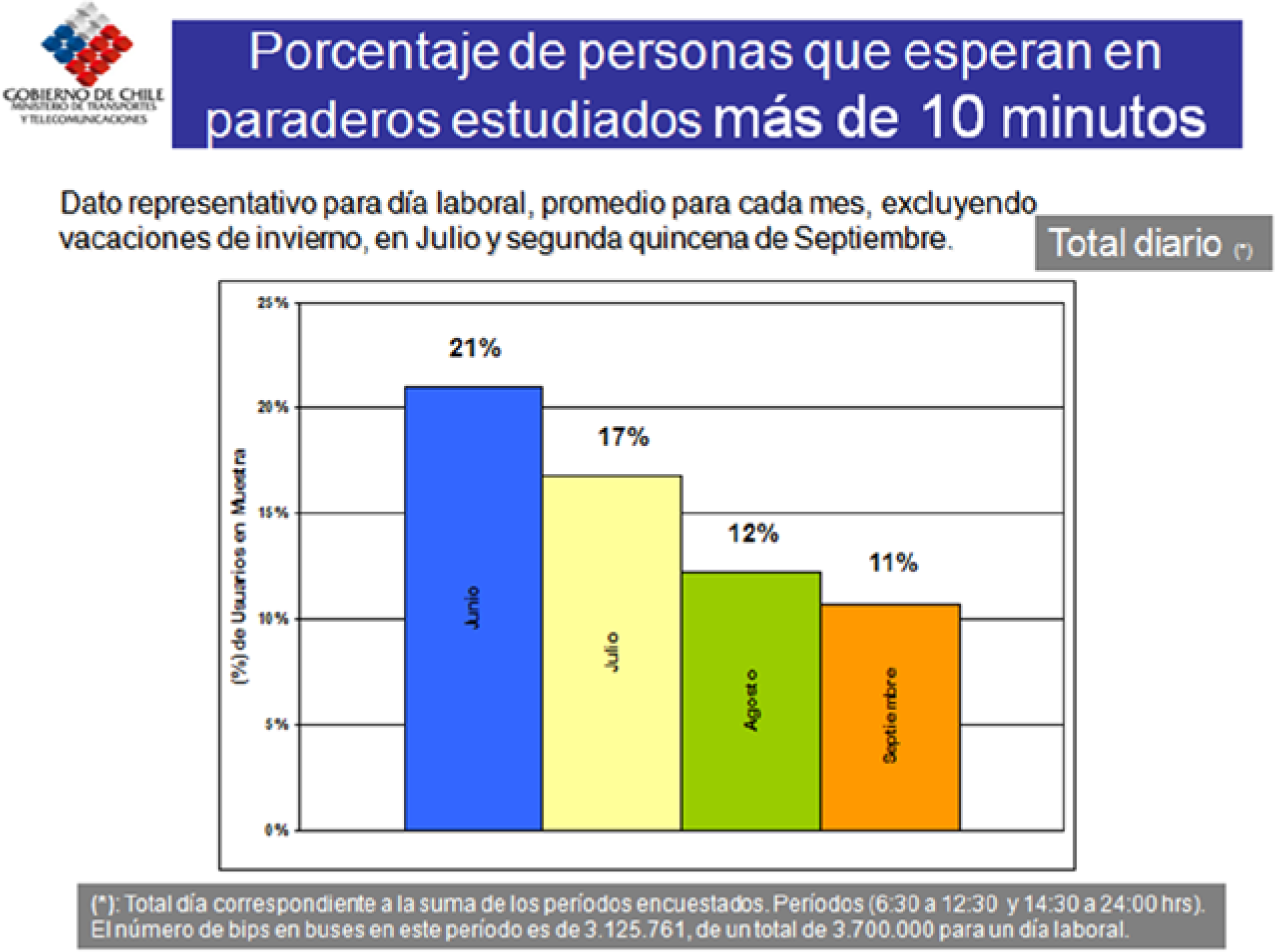
Percentage of people waiting for more than 10 minutes at the studied bus stops.
At various points during 2008, DICTUC and actors at MTT again referred to and/or displayed quantitative data showing further improvements in the quality of service. However, the shared perception was that none of these claims were having enough impact on public opinion; the image of the user experiencing problems proved to be much more resilient than expected, appearing over and over again in the media. For this reason, the MTT decided to hold a press conference on 10 January 2009 to publicize the fact that the system had finally reached ‘normality’ in accordance with the standards set in May 2007.
The press conference started with a presentation by Juan Enrique Coeymans, a professor at the Transport Engineering department of Universidad Católica and manager of DICTUC. Based on a PowerPoint presentation containing several charts and tables, Coeymans showed how the waiting and travel times had decreased significantly in the previous year and a half. Figure 2 shows one example, in the form of a graph showing the decreasing tendency in both travel (top) and waiting (bottom) times in the period from 21 May 2007 to 21 November 2008. He concluded that ‘these indicators show that we are fine at an international level and there is clear tendency towards a decrease in the waiting times because [bus] frequency has increased and there are more buses’.
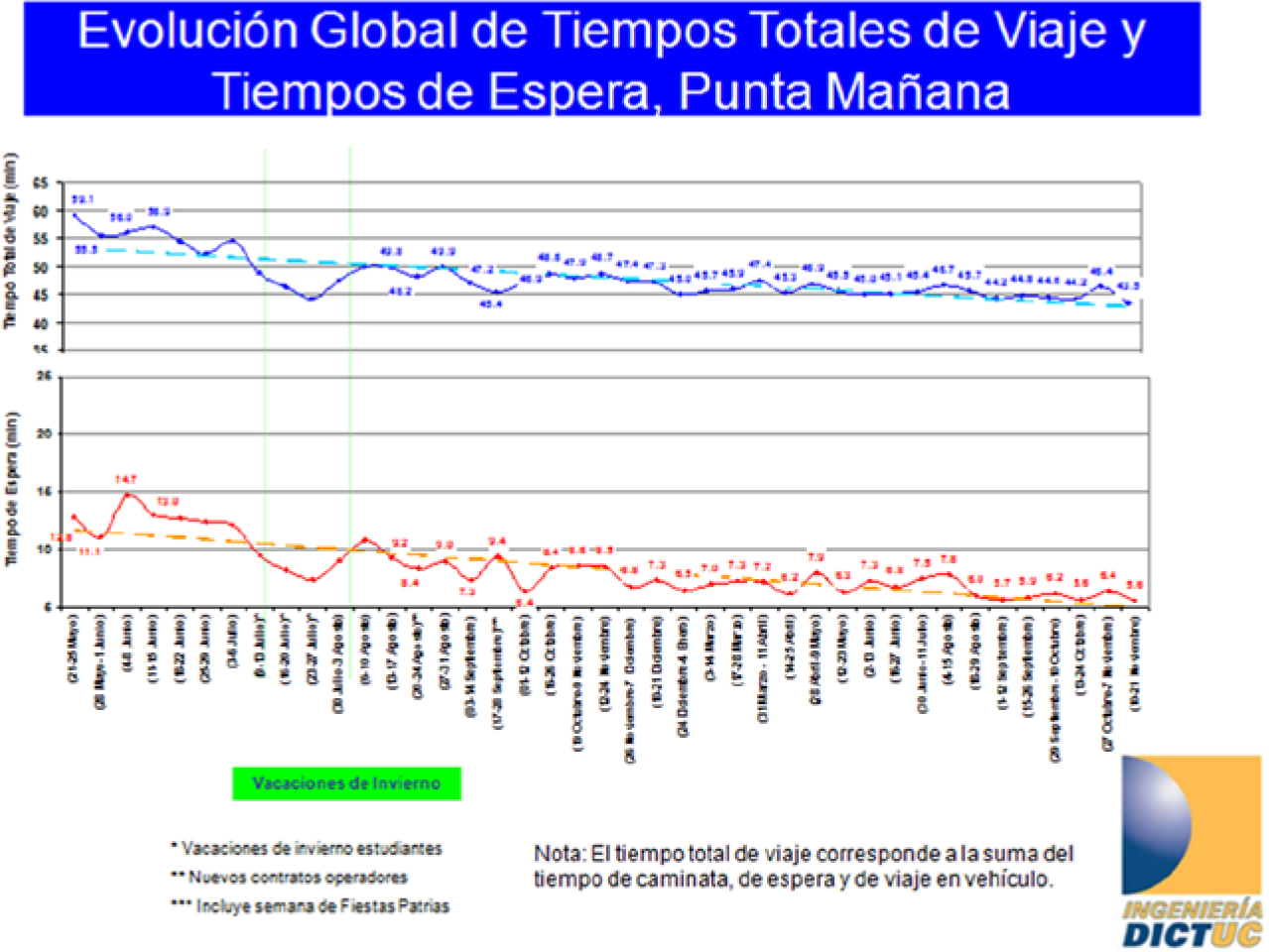
Global evolution of total travel and waiting times, morning peak time.
Córtazar followed Coeymans, presenting the plan for Transantiago in 2009 and commenting on the information provided by Coeymans:
I think the debate should be based on reality and for this we must have objective indicators; and this thermometer, we believe, is a contribution to the debate, in order for the public opinion to know the results of how the system has evolved regarding travel and wait times … Here is an independent academic institution, that is the Universidad Católica, that says that the system has drastically changed in terms of performance and these numbers do not show a crisis any longer. This does not mean that there are no problems … but the important thing is that we have to face them from the objective reality of the whole system … Here there is no message to anyone, nor is it part of a political controversy, what we gave today is a balance with the objective results of how the system is behaving, how it has evolved and the actual levels. (Source: MTT)
Here, again we can see repair by numbers at play. There is a world of debate that should be based on objective data, and out of which public opinion should be informed. The data are surrounded by an aura of scientific objectivity and speak clearly: ‘these numbers do not show a crisis any longer’. The system still has problems, but these problems have to be faced from a standpoint of normality.
Through numbers, Córtazar tried to depoliticize the discussion of Transantiago’s failures, transforming it into a matter of certain quantitative standards. Given that the standards were surpassed in accordance with the data provided by DICTUC, he concluded that normalization had arrived and that any argument to the contrary was just part of a ‘political controversy’. By doing this, Córtazar was not only claiming that the service provided by Transantiago to users had improved but also restating the particular kind of technocratic power traditionally exerted by the Chilean state.
Repair by buffering
The second case to be analyzed relates to one particular technical device of Transantiago called Zonas Pagas (pre-pay zones). In the weeks following the start of the plan, Zonas Pagas were constructed at the principal intersecting streets of Santiago. Each consisted of a fenced area around a bus stop, leaving only a couple of entrances. In order to catch buses in these locations, users had to enter the Zona Paga, paying their fare while doing it. The aim of creating these zones was twofold. First, they were to reduce the huge levels of fare evasion that appeared with the introduction of the new payment system based on a smart card. 4 This was done mainly by stationing an MTT employee at each entrance to a Zona Paga, to control that each person entering paid for his or her trip by putting their card in front of a card reader. Second, the Zonas Pagas were supposed to increase the transfer speed of passengers between bus stops and buses, one of the most time-consuming operations of public transport systems. This was accomplished by allowing users to access buses through all doors, since they had already paid their fares. Zonas Pagas were thus supposed to address two critical issues emerging at the start of Transantiago: lower than expected revenues and higher than expected traveling times.
Transantiago was planned to operate without a public subsidy, so its income had to be at least equal to its costs. This mandate guided the design of the new buses for the system, with the consequence that the number of seats per bus was reduced substantially in comparison with the buses of the former system: more passengers could travel on each bus and so the system could require smaller fleets. Obviously, fewer seats and a higher number of passengers per bus meant that most users would travel standing and often in crowded conditions. Such a loss of comfort, however, did not appear to be an issue for the system’s designers because of the script of the user behind their models. In line with most transport planning (Schiefelbusch, 2010), the script of the user embedded into the engineering models of Transantiago enacted them as fare-and-time-optimizers: rational consumers who when traveling value only low fares and reduced travel times. 5 So the decline in the levels of comfort was compensated for by (1) reduced fares derived from the general optimization of the system and (2) an increase in the traffic speed due in part to the smaller number of buses clogging the streets of the city. The introduction of Zonas Pagas looked not only to provide urgently needed revenues for the system but also to materialize this normal user as a fare-and-time-optimizer. In so doing, the Zonas Pagas were to help increase the general satisfaction of the users with the system (a key issue, as seen above) and validate the transport and econometric models behind the planning of Transantiago.
Early on, the functioning of Zonas Pagas faced an unexpected challenge. Nicole Arias, an engineer working on MTT at the time, talked about it in the following terms:
… Zonas Pagas had two advantages. One reducing evasion because people pay outside [the bus] … and second to increase the speed of buses … Then Zonas pagas are very important, but the users have the habit of making queues … because they want to travel seated in their return home and they are tired. [When], you try to introduce them [inside the Zona Paga] they say ‘no way, if I go inside I’ll lose [my place in] the queue and if I lose [my place in] the queue I won’t be able to travel seated and I want to travel seated and I don’t care about people’ … As much as we had tried we haven’t been able to convince them and … the people wait [for their buses] outside [Zonas Pagas] because they want to travel seated … We said ‘but, if the bus arrives every two minutes you won’t have to wait for a long time’, ‘I don’t care, I want to travel seated’ … So we can’t reduce travelling times because people don’t want to change their behavior.
Arias’ argument shows a key problem faced when trying to mobilize the user as fare-and-time-optimizer from Transantiago’s models to the streets of the city.
Such a script materialized more or less as expected during morning peak times. Given the need to arrive to their destinations on time, passengers accepted spending most of the trip standing in crowded buses, exchanging their comfort for (at least in theory) a general reduction in travel times. However, at other times of the day, especially during evening peak times, the situation was quite different. In the absence of pressure to arrive somewhere on time, users prioritized the comfort of traveling seated above savings in terms of travel time. They resisted being enrolled as fare-and-time-optimizers, opting instead for enacting comfort-seekers, a kind of user who highly values comfort in his or her travels. As Arias recognized, and this recognition is supported by the author’s fieldwork, such users perceived the scripted mandate of entering buses as fast as possible and through all its doors as openly impinging on the fair way of accessing the bus (and its scarce seats): based on users’ order of arrival to bus stops. To diminish such risk, the users opted instead for making long queues materializing their preferred order, as can be seen in Figure 3.
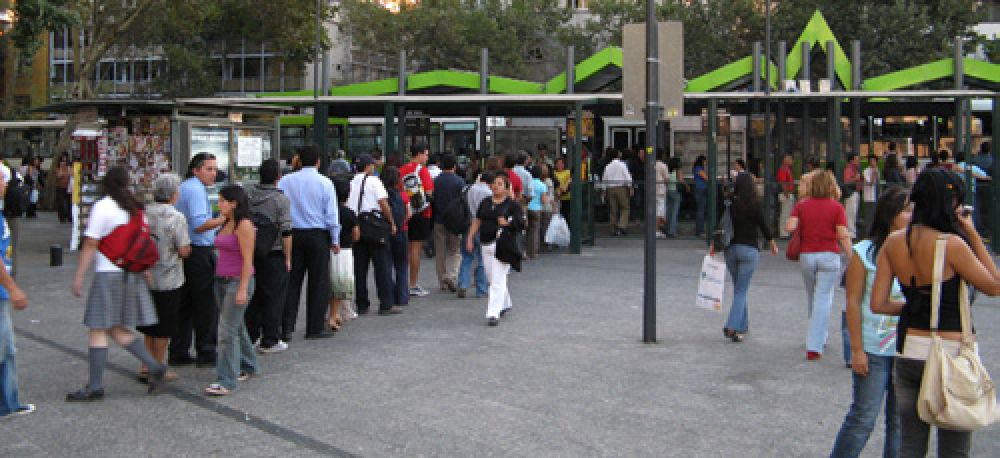
Users queuing outside a Zona Paga in Plaza Italia (Downtown Santiago).
This anti-program greatly affected the performance of the Zona Paga in terms of its contribution to the overall speed of the system. First, given that the queues commonly exceeded the area covered by the Zona Paga, all the temporal gains of people paying for their trips before the bus arrived were lost, because people occupying positions outside the Zona Paga had to pay for their trips only when the bus arrived, as they would when taking a bus at an ordinary bus stop. Second, and more critical, people in the queues commonly refused to enter a waiting bus if all the seats were already taken, greatly reducing the level of usage of the fleet and making it necessary to have more buses. In short, queuing all but nullified any advantage that Zonas Pagas could have in terms of travel times, even further reducing the overall speed of the system.
Besides these immediate impacts, the anti-program openly defied the main script of the user behind Transantiago. From the bus design to the travel information system, most components of the system had been designed based on users as fare-and-time-optimizers. For this reason, comfort-seekers not only represented a problem in terms of the functioning of Zonas Pagas but challenged the normal rule that Transantiago planned to enact. As a result, urgent disciplinary devices were introduced to try to align unruly (queuing) users with the original script.
At first such devices found little success, as Arias recalls:
The [authorities from the MTT] said ‘we need help from the area of Transantiago Informa because we have immense queues and we want to break them down, then let’s send instructors, in order to educate the people not to make them’. They [instructors] have received blows, have been fooled, policemen had to arrive, do you understand? It is always like … we are not able to make them change this behavior … There are zones in which you just can’t understand what is the logic of people to make it change … Obviously people only care about how they can … travel seated, or being more comfortable, they don’t care about the people that are by their side, who are tired or elderly, they don’t matter, well and for this [they make the] queues, as the people don’t care about this. People got used to doing this. They like the queue because it gives them … it respects their place, I mean, the first that arrives is the first that leaves, in contrast when there are no queues the strongest win.
Following the usual transport planning script of users as rational planners (Schiefelbusch, 2010), at first the queues were viewed as a matter of subjects behaving irrationally, because of a lack of information. As soon as the relevant information was provided, or so this argument predicted, they would change their behavior and start acting as proper fare-and-time-optimizers. Therefore, instead of carrying out repair through devices that physically discipline such abnormal behaviors, it was necessary only to produce a ‘technology of the self’ (Foucault, 1993) through which these individuals would ‘act upon themselves, rendering themselves subjects of government’ (Nadesan, 2008: 9). Transantiago Informa 6 personnel were sent to the bus stops to provide arguments so that users would realize the irrationality of their behaviors and dissolve the queues. However, these attempts at ‘people repair’ through self-governance proved unsuccessful. Even after being informed, users resisted performing the fare-and-time-optimizers script in the afternoons, and the queues continued.
The failure of self-governance efforts forced actors from MTT to produce an alternative repair strategy. This was explained to me by Emilio Burgos, an engineer from the infrastructure area:
At the beginning we tried to break-up the queues, that in the Zonas Pagas the buses opened all their doors, because if off-bus payment was available it was as simple as just going inside, but no, [users] wanted order, and the order that they wanted was that a logic exists and the one who arrives first can travel seated … At the very end I think that they have won the battle because effectively nowadays what is consolidating in these points … is that two groups are made, one for the users who want to travel seated and the other for the rest, in consequence our designs are mutating towards this arrangement …
As Burgos recognizes, comfort-seekers ‘won the battle’ in their efforts at comfort on their journeys home. Being unable to transform all of them into proper fare-and-time-optimizers, the MTT was forced to accept that regarding Zonas Pagas there was more than one version of the user. This was a significant change, as we can see from one example mentioned by Burgos in an interview.
At the very beginning of Transantiago, and given the urgency to provide a solution to the huge levels of fare evasion, Zonas Pagas were makeshift pieces of infrastructure, little more than adjoined mobile fences surrounding the bus stops. However, with the passage of time the MTT provided more permanent designs for the most used Zonas Pagas, among them the one located in front of Clinica Alemana in the eastern borough of Vitacura. The usage of this stop is more intense in the afternoons and evenings when people working in the surrounding areas take buses to return home. It is therefore a location where the queues were especially long.
In providing a new design for this Zona Paga, the recognition of two kinds of users was very much present. As can be seen in Figure 4, the new design established that individuals enter the Zona Paga through the central area (1). After passing their card through a card reader, they have to decide which kind of user they want to perform. If they want to perform comfort-seekers they turn left and make a queue through the zigzag (2). If they want to perform fare-and-time-optimizers they turn right and wait in an open area (3). When a bus arrives, it first stops in front of the comfort-seekers section (4) and opens only its front door, through which queued users enter until all the seats are occupied. Then the bus continues and stops in front of the fare-and-time-optimizers section (5), opening all its doors so these users fill all available standing space. Therefore, instead of insisting on forcing users into performing the ‘normal’ fare-and-time-optimizers, this design recognizes the existence of a dual version of the user, offering the people who want to use the system the option of choosing which one of them they want to perform at this particular moment.

Design for the new Zona Paga at Manquehue Avenue.
Accepting such dual performance of users was not a trivial matter, as Burgos continues,
this is something that we would have never imagined. I mean, even more, if someone had said to us this before the start of the plan, we would have found it an aberration, an aberration because effectively from the standpoint of the bus operation the fact that it stops twice is like anti-nature. I mean, the bus must stop once! It is in the handbooks. The bus opens its doors and people rapidly get on and then pum!, it departs. [But] you cannot go against the habits of the people. People want to travel seated and you have to answer with a design in accordance to this … Then we are developing a design that is utterly ‘made in Chile’ [sic] that can solve this phenomena. At the very end engineering, architecture, must be in the service … of the phenomena and not the other way round. We tried, we tried to get people to get used to this other way, but no … people value a lot, a lot, the fact of travelling seated and this is something that they are not willing to lose …
This new design was not repair as usual. There was nothing in the ‘handbooks’ of transport planning from which the plans for the new design could be taken; there was no restoration to any pre-given blueprint or state. On the contrary, it was an ‘aberration’, as Burgos called it, to the original script of how Zonas Pagas should be designed. The improvised design was ‘utterly made in Chile’. Only through performing this aberration at this particular location was the MTT able to produce a design for the new bus stop that was able to house both fare-and-time-optimizers and comfort-seekers as two valid performances of the user of Transantiago. The new design was closer to being transformative rather than maintenance repair, using the classification proposed by Henke (2007).
However, we are here analyzing Transantiago as an LSS, not merely as the sum of particular devices such as Zonas Pagas. From this perspective, such an aberration looks quite different. First, the fieldwork on which this article is based revealed that only a handful of Transantiago’s devices used the comfort-seeker as a valid script of the user. All the major components – new buses, information devices, smartcards, and so on – were designed to enact mainly the fare-and-time-optimizer. Given this, Zonas Pagas’ new design should not be seen as a radical departure from the normalizing project of Córtazar and the MTT but as a particular kind of disciplinary device: a buffer. A buffer, its definition tells us, is a device that ‘separates potentially antagonistic entities, as an area between two rival powers that serves to lessen the danger of conflict’ (Times-Collins, 2000). The new design is a buffering device mediating between, on the one hand, people with multiple motivations to use public transport and, on the other, a system that mostly enacts them as fare-and-time-optimizers. Instead of the single normalization offered by the earlier design, this buffer offers people two options to become users. In doing so it makes a key dual operation: (1) it eases the tension for users that resulted from being considered only as fare-and-time-optimizers and (2) it provides much-needed fare-paying users for the system. Therefore, buffering devices should be seen above all as technologies of transition, of interchange, between the external and the internal aspects of an LSS, continually helping to appease the tensions arising from the limited number of scripts embodied in each of LSS’s components.
Repair by buffering, however, is still normalization. The bus stop only gives two options for the prospective users to take, not whatever they choose. No doubt there are other (potential) kinds of users still not considered by the new design. In addition, and more importantly, once inside the bus the situation was mostly business as usual. Beyond the fact of traveling seated (typically for only a short while, given the need to transfer to another bus or the Metro to complete most trips), the comfort-seekers were treated as fare-and-time-optimizers all along their trip. There were no special entrances at the Metro, nor more breathing space inside the next crowded bus to be taken. Therefore, from the perspective of the whole LSS, this device was ultimately disciplinary, easing the entrance of the two kinds of users to the system and then normalizing by force comfort-seekers into fare-and-time-optimizers.
This conclusion shows two things. First is the relevance of always understanding repair practices as emergent phenomena, changing continually as they move in time and space. And in this continual emergence, its own components and effects also change, as it happened here. Using the categorization developed by Henke (2007) again, we can see this as a case of transformative repair (for actors such as Burgos and his team) turned into mere maintenance repair when moving from the local case to becoming a part of complex organization.
Second, the quite limited extension of the comfort-seeker as a valid version of the user shows how commonly the ultimate end of repair practices is not the bettering of people or societies but the maintenance of power. An LSS that recognizes the plurality of desires and motivations that people have all along their trips (even through only considering two kinds of users) would contribute to an improved travel experience. However, to make that move would mean to generalize the ‘aberration’ made by Burgos and his team to the whole system. Such option would involve not only the development of dozens of other unexpected devices such as the new Zonas Pagas, but also to fundamentally challenge the kind of rule materialized in the figure of the fare-and-time-optimizer. It would mean to recognize that transport planning, and its highly respected followers in the Chilean academia and government, has been wrong in claiming that there was only one kind of public transport user all along. And no one in the government seemed willing to follow this path, despite Bachelet’s words of contrition on 26 March 2007.
Conclusion: repair and beyond
On the occasion of Transantiago’s fifth anniversary in February 2012, Andres Chadwick, the government’s spokesman, called it ‘the worst public policy ever implemented in our country’. Besides the curious fact of speaking in such a critical way about a policy that the government he represented was managing, what was striking from his declaration was that no one really disagreed or found it an exaggeration. In an almost nonstop fashion since February 2007, Transantiago has erupted every few months into new controversies regarding an ample variety of aspects: users who protest about the poor quality of service, bus companies on the verge of going bankrupt, congestion inside the metro network, bus drivers who strike for higher wages, and so on. In STS terms, we could say that Transantiago has never become black boxed, has never reached anything resembling closure, but its characteristics (and even its own existence) have been a matter of continual debate and critique with each new failure. As a consequence, Transantiago can be easily seen as a ‘permanently failing organization’ (Meyer and Sucker, 1989) or an LSS ‘which continues to exist yet fails to achieve … [its] avowed objectives over long periods of time’ (Hood, 2000: 44). Millions of people still travel every day throughout the city using it, but the original promise of a ‘world class’ public transport system is still far from being delivered, especially at the user level. 7 In this sense, we can conclude that Transantiago is still very much under repair; it has never become fully normalized in accordance with the script set in 2000.
However, the authorities’ insistence on repairing Transantiago was not completely misguided. Even though it has not been able to deliver the promised ‘world class’ public transport system and its happy users, the strategy has been more effective regarding the other aim of repair: the maintenance of power. With the exception of some scattered comments in the very first weeks, the Chilean traditional ‘rule of experts’ (Mitchell, 2002) was never thoroughly questioned after the Transantiago fiasco. Despite how deeply involved different kind of experts, institutions, and devices were in the planning and running of it, from highly prestigious academics to up-to-date transport models, no major criticisms were made about the particular kind of power they have in Chilean policymaking. On the contrary, as the arrival of Córtazar showed, the problems experienced by Transantiago were dealt with by reinforcing this kind of rule.
The repair/normalization program played a key role. In the confusion that followed the messy start of the system, the program offered a clear way out; it promised that if some neat steps were taken, in due course everything would be back to ‘normal’. Not only in terms of the public transport system (everyone knew that this was going to take a long time) but also in relation to the ‘normal’ kind of rule exerted by Chilean governments. And most of the involved actors followed suit. After all, as Foucault (2008) has recognized, ‘the greatest evil of government, what makes it a bad government, is not that the prince is wicked, but that he is ignorant’ (p. 17). The government must know what to do about a failing LSS, especially a government in which expertise occupied such a high place, and this was what the normalization program offered. Even though it did not properly repair Transantiago, it repaired Bachelet’s government, transforming it from the confused entity of the first weeks back to a business-as-usual technocratic machine that delivered results of reasonable quality (Silva, 2008). And this was more than enough.
Was there an alternative? Was there another way to intervene in Transantiago that could have produced better results in terms of the proper functioning of the system and the service received by its users? I think so: to move beyond repair.
The starting point for such an affirmation is the recognition that failing components of an LSS can be intervened on in multiple ways. Some of them are usually (even necessarily) repair based; they are aimed at restoring the system to a previously set ‘normal’ state. Beyond-repair interventions, on the other hand, do not have such an aim in mind. 8 Recognizing the limits of any previously set analytical framework to deal with the multiple anti-programs that a new LSS would cause (especially an LSS of Transantiago’s scale), a beyond-repair strategy opts to take at first a cautious and experimental approach. As a result, anti-programs are framed not as components to be disciplined but as valuable signals about the shortcomings of the available scripts. Based on such knowledge, new non-normal orderings are generated, mixing some of the previous elements with concatenations of entities that no previous script has foreseen. Therefore, a beyond-repair intervention on a failing LSS will explicitly look for these non-normal, unexpected ways in which the problems of the system could be tackled. 9 It is a movement from discipline to incorporation, accepting the unavoidable plurality that comes with it.
In terms of power, such a move undeniably involves more risks than repair as usual. A governing body that takes an observational and cautious stance toward anti-programs could easily be seen as ‘ignorant’ and weak. However, if the deployment of such an approach is well managed (e.g. making clear from the outset the limits of expert knowledge and the need to experiment and adjust), it could end up producing arrangements that not only take better account of the multiple agencies of the actors involved in the LSS but also generate a more fluid kind of order, better equipped to deal with the unexpected outcomes that the instauration of any LSS implies.
The argument about the need sometimes to move beyond repair in dealing with a failing LSS is not meant to signal that repair is a second rate or limited kind of intervention. Repair can be radical and involve high risks. Besides, moving beyond repair should not be idealized. Such interventions can also be unfair and undemocratic, and cause more distress and suffering to populations than a repair-based strategy. Not all anti-programs can be followed; usually there are too many and some can lead the system to dangerous places, even to its dissolution.
Beyond this, the relevance of making such a distinction between repair and transformation beyond repair is twofold. On the one hand, it looks to control a certain overgrowth currently facing repair as a concept. In its current formulation, it is easy to assume that any kind of intervention on a failing LSS is repair. Such a conception risks turning repair into a meaningless concept: if repair is everything, then it is nothing. For repair to maintain its full power as analytical concept, a limit should be established demarcating what is and what is not repair. In this article, following a Foucauldian approach, I have argued for the need to see repair as always involving a certain degree of normalization. Such a conception could (even, should) be challenged. What is important is to work always with a conception of repair that leaves certain things out, that avoids becoming totalizing.
On the other hand, the distinction looks to highlight the value of the un-repairable. It is usual to argue in repair literature about the intrinsic value of failure as a source of knowledge, but such valuation is usually made from the standpoint of subsequent repair. Therefore, failures can only be valued after repair, and mainly as a way of avoiding new failures in the future. Such an approach diminishes the value that failure can have in transforming LSSs for the better; it blinds us to the possibility that in some cases the solution should be not to repair failures, but to take them as an opportunity to move the LSS somewhere else. As the continuing controversies regarding Transantiago clearly show, sometimes it is reasonable to follow failure and not only to try to repair it.
Footnotes
Acknowledgements
I appreciate the very helpful comments given by the three reviewers and the editor of Social Studies of Science.
Funding
This research was carried out with funding from Chile’s National Council for Science and Technology, CONICYT, and Marie Curie International Incoming Fellowships (grant numbers 11060348 and PIIF-GA-2009-235895, respectively).