




Abstract
Controversies over string theory (collectively termed the ‘string wars’) intensified in 2005. Also in that year, the open-access preprint publisher arXiv instituted a new feature called a ‘trackback’. This new feature enabled authors of blog posts discussing a paper on arXiv to leave a trackback (a link) to the post on the paper’s abstract page on arXiv. The determination of which specific bloggers would have access to the feature generated a public controversy that was played out in the blogosphere. Although the community was in almost unanimous agreement that so-called ‘crackpots’ should not have access to the trackback feature, it was unable to reach a consensus as to how to define a ‘crackpot’ or an ‘active researcher’. Blogs may provide a window into science in the making, yet this study shows that blogs confound categorization as permanent or ephemeral scholarly communication. The trackback feature was originally conceived to develop certain blog discourse as an alternative or complementary form of peer review. However, the high-energy physics community as a whole questions the ongoing function of the blog.
The term ‘string wars’ describes the often public debates over string theory that reached a climax in 2006–2007. These debates were played out in op-eds, blog posts, popular books, book reviews and recorded public debates. Between critics and defenders of string theory, points of disagreement turn on complex and highly technical matters, prescriptions concerning the nature of scientific progress and the demarcation of science from non-science, and debates over the sociological norms of scientific inquiry and the scientific ethos.
In 2005, the open-access preprint publisher arXiv instituted a new feature called ‘trackback’ that enabled authors of external blog posts referring to arXiv papers to leave links to the posts on the relevant arXiv abstract pages. The inception of trackback, and the process of determining which bloggers would get access to the feature, generated a public controversy within the blogosphere. In particular, noted string theory critic Peter Woit was denied access to the trackback feature for his blog Not Even Wrong (2004–2016). In response to Woit’s (and his supporters’) questions and criticisms, arXiv advisory board member and string theorist Jacques Distler blogged that arXiv only allowed ‘active researchers’ access to the trackback feature. This situation generated significant disagreement within the high-energy physics community. The disagreement centred on descriptive and prescriptive definitions of ‘active researcher’ and also the norms of the high-energy physics community concerning the organization of scientific communities. Despite an almost unanimous agreement that ‘crackpots’ should not have access to the trackback feature, the community was unable to reach a consensus about the definitions of ‘crackpot’ and ‘active researcher’.
I present the controversy over the trackback feature as a case study of how blog discourse can confound the distinction between permanent and ephemeral communication. The trackback feature was originally conceived to develop certain blog discourse as an alternative or complementary form of peer review. However, the high-energy physics community disputes the notion of the blog as a form of scholarly communication, in terms of both its function and the identity of the bloggers who may contribute.
Thematic concerns from the literature
A growing body of literature from the fields of science communications and information studies and a smaller body of literature in Science and Technology Studies (STS) are examining blogs and other Web 2.0 applications as forms of scholarly communication. Various authors are beginning to express three themes: that blogs are an ephemeral form of scholarly communication, that blogs are a window into ‘science in the making’ and that blogs perform a function akin to peer review. This article will explore each of these themes with reference to the case study presented, arguing for three claims along the way. First, the trackback controversy is evidence that certain blogs are a window into science-in-the-making. Second, there is a tension between ephemerality and permanence in blog discourse, which is important to recognize in relation to the potential for blogs to provide public peer review. And, finally, the concept of the ‘peer’ is contested sufficiently that it problematizes the potential for blogs to become sites of peer review.
Ephemeral scholarly communication
Many authors have claimed that science blogs are a kind of informal scholarly communication (Kouper, 2010: 8; Maron and Smith, 2008: 28; Pikas, 2008: 100; Puschmann and Mahrt, 2012: 180; Smith, 2008: 15). For example, discussing online knowledge, Meyer and Schroeder (2009: 247) distinguish between ‘formal outlets, such as journals and data archives, [and] informal outlets, such as blogs, webpages, and podcasts’. Warden (2010) notes the interactive nature of blogging: ‘blogging is one Web 2.0 tool that is well suited to informal communication by researchers’ (p. 203).
An important element to the characterization of blog discourse as informal is the perceived ephemerality of the form, like the ephemerality of such informal scientific communication as conversations in hallways, with small audiences, over drinks at the pub, or comments on drafts from supervisors or colleagues (Garvey, 1979). It seems intuitive to describe science blogs as ephemeral, given both popular understandings of blogging and social media and also common assumptions in much of the literature on blogs as scientific discourse (Shema et al., 2012). Wilkins (2008) has argued that ‘blogs are a highly idiosyncratic, personal and ephemeral means of public expression’ (p. 411; see also Trench, 2012). Whereas journal papers and academic books, once published, do not change, blog posts evolve in two ways: authors may edit their posts, and comments may be added or deleted. The author of the blog moderates the discussion, perhaps choosing to delete comments (this frequently occurs). Comments have the potential to change how a post is read in a number of ways, situating a post in an evolving context. And the perceived ephemerality of science blogs may stem from an idea that blog text can disappear without a record.
A window into ‘science-in-the-making’
Many scholars of science communication argue that blogs may provide a view into ‘science-in-the-making’. Carroll (2006c) deems the situation positive: ‘it’s a great opportunity for physicists to exchange ideas more readily with each other, and to let the rest of the world share the thrill of the process by which science truly progresses’ (p. 8). Similarly, Wilkins (2008) writes, ‘blogging is also a way to demythologize science. Unlike laws and sausages, the public should see science during its manufacture’ (p. 411). Griffiths (2007) appraises the situation with more reservation: for better or worse, blogs have opened up a new form of discourse in physics that can – as it is carried out in a public fashion – be propelled into a broader context in a way that a discussion at a conference, say, would not have been. (p. 25)
In 2008, Trench explored the idea, quoting a line published in Nature in 2007: ‘blogs are windows into academic coffee room chatter of the sort the media is not normally privy to’ (Tomlin, quoted in Trench, 2008). After 4 years, he requoted the same line in the context of a very different position, claiming that, with the exception of particular physics blogs and their interaction with arXiv, the majority of blogs do not provide even brief opportunities to examine ‘science in the making’ (Trench, 2012: 280). Trench’s later claim was that links between blogs and arXiv ‘offered relatively rare examples of blogs facilitating public view of science-in-the-making’ (Trench, 2012: 280). He did not, however, elaborate on that claim, as his primary investigation centred on climate change blogs.
Peer review
A number of authors have recently claimed that blogs may be providing a kind of public peer review, without clearly indicating how they conceptualize peer review. These claims typically rely on the anecdotal evidence of a few, sometimes repeated, examples. Batts et al. (2008) describe how a researcher was ‘beaten to the punch’ in his attempt to write a letter to the editor at Nature to criticize the conclusion of an article: A post-doctoral researcher blogged a version of the criticism first. Apparently, the researcher and the post-doc went on to co-author a paper, making their argument together. This example is presented as evidence that ‘blogs can have a substantial impact on traditional academia by providing a quick forum for public peer review’ (Batts et al., 2008: 1837). Bonnetta (2007) offers a version of the same example, although in this version the author of the blog post is a PhD candidate.
In discussions of blogs as a form of peer review, peer review is construed as having two functions. The first is criticism: ‘the ability of those within and outside the group to read, comment on and challenge blog posts has come to serve as a form of informal peer review’ (Riesch and Mendel, 2014: 54); blogs can make visible the kind of ‘informal second stage peer review’ that occurs at conferences, which would not otherwise have been made public or available to colleagues unable to attend (Schmidt, 2008: 208); and ‘science blogs can add to the transparency of the scientific process by reviewing and discussing the science culture in general and scientific research in particular’ (Shema et al., 2012: 1).
The second function is to identify the relevance and potential impact of papers. Shema et al. (2014: e35869) argue that ‘[science blogs] allow informal post publication peer-review’. They claim this proposal is backed by their data, which indicates that journal papers with blog entries dedicated to them receive a higher number of citations. They conclude that blogs ‘will become part of future research evaluation metrics’. Shuai et al. (2012) have also noted that papers announced on Twitter at the time of publication have higher citation rates. This focus on the apparent capacity of blogs to identify relevance and impact construes peer review as a democratic process that harnesses what Minol et al. (2007) refer to as ‘the wisdom of the masses’ or utilizing a ‘collective intelligence’ (p. 1132).
A significant difficulty with the literature’s discussion of ‘science blogging’ as a general phenomenon is that it does not acknowledge differing practices of particular communities. Only 9 of Shema et al.’s (2012) 913 references are to blog entries that discuss papers on arXiv, and Shema et al. do not make clear whether those arXiv papers had been through traditional peer review when they were uploaded. One exception is the aforementioned article by Trench (2012), which offers a case study of the ‘Climategate’ affair, briefly drawing on interactions through arXiv and blogs between astrophysicists and particle physicists. Trench (2012) argued that he had found ‘indications’ of ‘possibilities for a kind of public peer review through blogs … in the contrasting domains of astrophysics and particle physics, on the one hand, and climate science on the other’ (p. 286). Like Minol et al. (2007), Trench sees evidence that blogs are facilitating a critical appraisal from a wider public.
Methodological concerns with the scientific blogosphere
Using blog posts as source material creates difficulties, particularly because, as discussed earlier, they are not always static. Each of the bloggers discussed in this case study meticulously archives each post so that it is relatively easy to retrieve posts dating back to the creation of the blog. The main text from most of the posts on each blog remains, to a large extent, permanent, and bloggers tend to add time-stamped updates to posts, as opposed to editing the original text. However, if a blogger did choose to edit the text of a post without having previously archived a copy, it would be very difficult to determine whether or not an edit had taken place. Furthermore, links to blogs that are no longer active are often broken, and often material has been removed. 1
An additional difficulty is that each blogger moderates the comments section of his or her own blog according to his or her own personal standards. Consequently, it is impossible to determine, particularly years later, if comments have been deleted. Similarly, bloggers have the ability to ‘close comments’ and will typically publish that ‘comments are now closed’ without indicating the time of closure. I archived each post that I used as primary source material in this case study.
A further difficulty with using blog posts as source material concerns issues of identity and anonymity. Perhaps contrary to received intuitions about how people participate in Internet controversies, very few participants in the controversy concerning access to the arXiv trackback feature participated anonymously. The bloggers discussed in this study list their names and institutional affiliations on their blogs, with one exception: a blogger who writes under the pseudonym ‘Capitalist Imperialist Pig’ (2004–2016). However, this blogger makes clear that he or she has a position at a university in the United States. Among the individuals who comment on those blogs, there is a mix of known individuals, anonymous individuals and individuals writing under pseudonyms (whose real-life identities are often known within the community). If a commentator is also a blogger, his or her name will confirm the commentator’s identity by functioning as a link to his or her blog.
String theory and controversy
In the first detailed treatment of the controversy over string theory, Galison (1995) argues that controversy surrounding string theory is evidence for a ‘profound and contested shift in the position of theory in physics’ (p. 372). In particular, The string debates revolve around an agreement and a profound disagreement. By consensus, theorists agree that theory must operate under a series of constraints, and that those constraints must confine theoretical work to a very few, if not a single representation of the world. The dispute is over the source and appropriateness of those constraints. (p. 374)
Dawid (2007) also characterizes the string theory debate in terms of concern about string theory’s lack of contact with experiment (see also Kragh, 2011; Rickles, 2014). Dawid (2007) argues that the issue should be understood from a Kuhnian perspective as a ‘meta-paradigmatic rift’ where the ‘two sides do not agree on the definition of science’ (p. 8). He therefore characterizes the dispute over string theory as a ‘classical paradigm’ in conflict with an ‘emergent paradigm’, where both sides agree on the problems of string theory but nonetheless draw different conclusions (Dawid, 2009: 987).
Ritson and Camilleri (2015) attempt to draw attention to the plurality of the controversies over string theory, framing the debates over sting theory as boundary work. Protagonists appeal to, and rhetorically construct, different views about the scientific method and the scientific etho, in an effort to legitimize or delegitimize string theory. Ritson and Camilleri argue that the debates over string theory are unlike many other studied episodes of boundary work: Instead of holders of a minority position attempting to widen a conceptualization of science so as to permit their own membership, in the case of the string theory debates, the string theorists were forced to defend their dominance against accusations that string theory was not science.
ArXiv
While each new generation thinks it’s somehow unique, there are objective reasons to believe that the past two decades have witnessed an essential change in the way information is accessed, and how it is communicated to and from the general public, and among research professionals. (Ginsparg, 2011: 1)
Paul Ginsparg created hep-th@xxx.lanl.gov, an automated email server for a small community of high-energy physicists, the majority of whom were string theorists (Taubes, 1993: 1246). The server was expected to receive around 100 submissions a year (Ginsparg, 2011: 4). In 1992, Ginsparg (1994) installed WorldWideWeb.app, transforming the e-print archive into a web server located at xxx.lanl.gov (p. 159). In that same year, David Mermin (1992: 9) suggested that ‘this could well end up as [string theorists’] greatest contribution to science’. 2
ArXiv evolved into an open-access resource and publisher of over 945,000 preprints (or e-prints) 3 in physics, mathematics, computer science, quantitative biology, quantitative finance and statistics. In 2004, in an attempt to restrict access, arXiv instituted a two-step filtering process for uploading papers:
The author must be an approved submitter, usually through having been
Each paper from an approved submitter must be accepted by the moderator for that section of the arXiv. (Distler, 2006)
Moderators check that content is ‘on topic’ (rather than checking for accuracy) and endorsement of an author may come from a record of previous submissions, institutional affiliation or via another author who has authored ‘a certain number’ of papers within the same field. Today, Cornell University hosts arXiv, which is the primary means of access to papers for high-energy physicists (and several other disciplines within physics, mathematics; Gunnarsdóttir, 2005).
Trackbacks
At the time this article was written, the arXiv trackback feature involved a link located on the abstract page of a paper published on arXiv (see Figure 1). If clicked, the link took the reader to a list of links to blogs that featured a discussion of the paper published on arXiv.

Example abstract page from arXiv.org.
More generally, trackbacks between blogs – not necessarily with respect to arXiv – are used by participants to follow a conversation across more than one blog. Luzón (2009) argues that trackbacks have the rhetorical function of community formation. For example, if a discovery is announced, an author may include links to each of the blog posts that discuss the same discovery. Such inclusion serves a variety of purposes, such as to endorse blog posts that an author thinks offer a useful contribution or to deliver criticism of posts that include statements the author views as inaccurate.
Controversy over the trackback feature
Beginnings
The precise origins of arXiv’s trackback feature are difficult to ascertain, given that arXiv did not invent the concept of trackback, and this mechanism has taken on a variety of forms. Jacques Distler (2002), a string theorist from the University of Texas and author of the blog Musings (2002–2016), has claimed that arXiv’s trackback feature was motivated by his blog post ‘With enough eyeballs: a manifesto’. In that post, Distler argued that the blog may be able to provide a ‘feedback loop’ for e-print archives, and as a result, the blog might perform the function of peer review.
Distler (2002) wrote that he was inspired by what he called an ‘oft-quoted maxim from the world of open access software’: One of the core practices used in open-source software is peer review: Because everyone can see the code, everyone can see your work. One obvious benefit of peer review is that mistakes get caught sooner. I call this Linus’s Law, after Linus Torvalds: ‘With enough eyeballs, all bugs are shallow’. (Raymond, 1999, as cited in Distler, 2002; emphasis original)
The second source of inspiration is the Bogdanov hoax that featured two brothers, Igor and Grichka Bogdanov, who had two papers accepted for publication in a peer-reviewed journal. After the papers were published, rumours circulated that the papers were part of a Sokal-style hoax. Unlike the Sokal case, the brothers denied that the papers were a hoax and a controversy erupted, to a large extent in an online discussion group run by John Baez, as the string theory and high-energy physics communities struggled to determine the legitimacy of the papers.
In the main body of the post, Distler (2002) claimed that three developments might provide the means for making the blog a model for peer review:
Moveable type (blogging software);
The Trackback;
MathML 2.0 (a nice way to do mathematics).
Distler (2002) described the trackback as a feature that provides an ‘automated way to link back to another site which references a given article’ (emphasis in original) and claimed that trackback would enable communities easily to follow discussion of an article. By connecting references to their abstract pages, trackback would keep a centralized record of all contributions to discussion of an article.
An announcement of the adoption of the trackback feature
On 24 August 2005 at 6.14 p.m., Sean Carroll (2005a), a cosmologist from Caltech,
5
announced that arXiv was adopting the trackback feature. Carroll pointed out that most physicists submit papers to arXiv before they submit to journals and confine their reading almost exclusively to arXiv articles. Carroll (2005a) claimed, Now your blog post can send trackbacks to the abstracts of papers at the arxiv! … Now, if you write a paper and people comment on it on their blogs, that fact will be recorded right there at the abstract on arxiv.org. Drawing us one step closer to the use of blogs as research tools.
This was the first public announcement of the new feature. The discussion quickly (within 2.5 hours) moved to Distler’s blog. However, the initial comments on Carroll’s post voice concerns over noise, flame wars, crackpots and anonymous attacks – the central concerns of the controversy.
ArXiv’s ‘official’ announcement of its adoption of the trackback feature
Twenty minutes after Carroll’s post, Distler (2005) posted ‘Trackbacks and the Arxivs’ to his blog. He began the entry by claiming that a forum for critique for arXiv was an expressed interest of the high-energy physics community: ‘ever since hep-th was founded in 1991 (or maybe a couple of years later, when it sprouted a web interface), people have talked about trying to overlay some sort of “discussion” or “commentary” layer’ (Distler, 2005). Distler (2005) claimed that blogs created the possibility of ‘interwoven, distributed conversation’, but lacked ‘ability to plug into the conversation’. Distler also revealed that he had been lobbying Ginsparg to feature trackbacks on the arXiv site. Distler (2005) was now able to announce, and claim the credit for, arXiv’s adoption of the trackback feature.
Finally, Distler (2005) added, So does that mean that every crackpot and trackback spammer on the internet can now get linked-to from the arXivs? Well, … no. Just as you need to be a registered author to submit papers, your weblog needs to be on an approved list, in order for your Trackbacks to appear. Going forward, the precise mechanism for getting on that list is yet to be determined. But, in the short term, the list of serious physicist-bloggers is short enough to handle by hand. You know who you are …
This was the second announcement about who would be eligible to receive trackbacks to their blogs. (Carroll (2005a) had reported that arXiv had indicated that there would be a ‘semi-automated editorial process’.) 6 It was, however, the first announcement to consider in some detail the thoughts behind access to the trackback feature. Distler also made explicit that, despite his quoting Torvalds in 2002, the trackback feature was not designed to support peer review as ‘wisdom of the masses’: Only certain actors are supposed to be included in trackback-enabled discussions.
At the time this article is being written, the post has 11 visible comments, in the form of questions and mainly positive feedback. Several questions concern the notion of the ‘serious physicist blogger’. For example, ‘Michael’ asks, ‘But your post suggests that crackpots will be blocked. In that case, it’s not clear what “known blogs” means in the arXiv’s description. Who’s right? Who are the “serious physicist-bloggers”?’ Distler (2005) clarifies, ‘trackbacks to the arXivs are, indeed, moderated’. Notice that Distler does not provide details about who is considered a ‘serious physicist-blogger’. From the time of the trackback feature’s inception, blogs have been deemed ‘in’ or ‘out’ based on the author rather than the content (although, of course, these are linked). Some physicists are categorized as ‘serious’, and, consequently, their online output is deemed worthy of trackback.
Letter to arXiv advisory board
On 23 February 2006, in response to an official notice that his trackbacks would not be allowed on arXiv, Woit (2006) published a letter he had written to the eight-member arXiv advisory board to protest the decision and therefore request that it be overturned. Woit argued that ‘it seems clear to me that this censorship is primarily driven by the moderators’ desire to paint as intellectually illegitimate and suppress any commentary that is critical of string/M-theory research’. Woit claimed that the actions of the arXiv advisory board were ‘suppression of dissent, accomplished using arguments that I have not been allowed to see or answer’, painting himself as the archetypal Galileo character, railing against an unethical or ideologically motivated majority. Here, Woit characterizes his opponent’s motive as censorship of a dissenting view, rather than as censorship of an illegitimate view.
Woit’s post transformed the discussion about trackbacks into a multi-factioned controversy. His letter spawned many blog posts
7
and elicited 122 comments, which are still up as this article is being written. The initial exchanges had a markedly combative mood: Peter, I’m not sure if you’re looking for an answer or just trying to pick a fight. If you want an answer, I can help you out: We don’t need anyone commenting on string theory papers who hasn’t done any research in the area, has been academically dead since the 80s. (‘Michael’, in Woit, 2006)
‘D R Lunsford’ responded with, ‘Michael, you are such an ass. Peter, good luck’ (in Woit, 2006).
The pace of the thread of conversation is astounding. One part of a comment by Chris Oakley attempted to get the attention of Nigel Cook: ‘while we are on the subject of ArXiv – here is a note for Nigel Cook, who I know reads this and whose e-mail does not seem to work’ (Oakley, commenting on Woit, 2006). Despite not having previously commented on the post, Cook responded within 9 minutes, suggesting that he had been following the discussion closely or that the discussion was brought to his attention by someone else following it closely (Cook, commenting on Woit, 2006). This behaviour indicates that there are ‘lurkers’ who follow the discussions closely but do not comment.
The discussion displays issues about ideological commitments in science. Woit compares his blog Not Even Wrong to that of string theorist Lubos Motl, The Reference Frame: Our stringy universe from a conservative viewpoint (2004–2016). Motl often used his blog to promote ideas in string theory and degrade alternative approaches. In this instance, Woit criticizes what he views as Motl’s ‘fanaticism’: [Motl] is a fanatic and an extremist, both in his political and scientific views … he goes on and on about how anyone who disagrees with him about politics or string theory is an incompetent fool, and does whatever he can to suppress any such disagreement … the problem is that the moderators of the arXiv, while lacking Lubos’s political fanaticism share his scientific fanaticism. This form of fanaticism has done a huge amount of damage by now to theoretical physics, and promises to do much more in coming years unless people take a stand against it. (Woit, in Woit, 2006)
Several commentators also blurred the lines between criticism of content of blog postings and criticism of bloggers themselves, either claiming the blogger was not a (good) scientist or that the blogger operated in the public, non-scientific domain. For example, ‘Benni’ attacked Woit, saying, ‘I think you are banned, because you do not [do] scientific work. You only criticise stringtheorie [sic] in a rather “public” manner’ (Benni, in Woit, 2006). Woit’s critics and his supporters each accuse the other group of violating the norms of the scientific community. Woit and his supporters assert that it is ‘scientifically unethical’ to operate in an opaque manner and they level accusations of censorship at arXiv. Woit’s detractors believe it would be unethical to endorse the work of someone who does not do science by giving that person access to the trackback feature. These conflicting norms reveal that despite the introduction of the trackback feature, there is still a norm that criticism should be contained within the community. We see here a classic example of what Gieryn (1983, 1999) calls ‘boundary work’, where participants in controversies engage in the rhetorical construction of boundaries (in this particular case normative construction of science) so that one’s opponent is deemed outside of science.
Woit receives some support
A little less than a week after Woit published his letter, the controversy further escalated, when Sean Carroll (2006a) wrote a blog post in defence of Woit, titled ‘Crackpots, contrarians, and the free market of ideas’. Carroll (2006a) argued that On the one hand, I certainly don’t think that scientists have any obligation to treat the opinions of complete crackpots with the same respect that they treat those of their colleagues … On the other hand, I don’t think there is any sense in which Peter is a crackpot, even if I completely disagree with his ideas about string theory. He is a contrarian, to be sure, not falling in line with the majority view, but that’s hardly the same thing. Admittedly, it can be difficult to articulate the difference between principled disagreement and complete nuttiness (the crackpot index is, despite being both funny and telling, not actually a very good guide), but we usually know it when we see it.
The comment ‘we know it when we see it’ is particularly revealing and has been repeated by several commentators. There is unanimous agreement that ‘crackpots’ exist. However, a significant amount of the discussion in this controversy attempts to establish a characterological boundary between the ‘crackpot’ and the legitimate contributor. Despite difficulties in establishing that boundary, the existence of a community norm against crackpots is not up for dispute: Even in the face of an almost complete lack of consensus about how to define the terms of the norm, Carroll can still argue both that the norm exists and that people recognize how to follow it.
Carroll’s post garnered over 100 comments from all over the high-energy physics community, and community participants continued to comment for over a month. For example, a former member of arXiv’s advisory board said, As a long time reader of Peter’s blog, a journal editor, and a (former) member of the ArXiv advisory board, I have a few comments. I offer them for what they’re worth. Bear in mind that they do not represent the official opinion of the ArXiv, its advisory board, Johns Hopkins University, or any scientific journal or organization, past, present and future. The ArXiv instituted a standard that they would allow trackbacks only to blogs run by active researchers. That excludes Peter, who likes to discuss physics, but is not a researcher. It also excludes lots of other people, although I can’t remember anyone else’s name coming up. (Vishniac, commenting on Carroll, 2006a)
This blog comment was the first public description of details of arXiv’s policies on who has access to the trackback feature. Central to the description of the policies seems to be the category of ‘active researcher’, but the comment does not define the category beyond Woit’s exclusion from it.
Several commentators advocated the trackback feature be removed completely: I fully support blocking most of the trackbacks from his website, and if these policies cause serious problems, I would support to cancel the trackback system altogether. From a moral viewpoint, I find it outrageous that people who don’t even try to contribute anything to science – and who build on purely negative support of various crackpots and science-haters – should have a better access to scientific resources than, for example, graduate students who work hard and struggle with serious scientific questions. (Motl, commenting on Carroll, 2006a)
Motl was not unique in his use of rhetoric focused on ethics. ‘Loop Quantum Gravity’ 8 theorist Lee Smolin, in his defence of Woit, also commented, ‘it seems to me that this is not an issue of personal judgment, as there are principles and ethics in professional academic life that are expressed in policies that those employed by universities are governed by’ (Smolin, in Carroll, 2006a). Quoting the 2002 Cornell University Faculty Handbook section on ‘Freedom in Research’, Smolin argued that the principle of academic freedom meant that an academic institution should ‘do nothing to impede free discussion by professionally competent experts on scientific controversies’ (Smolin, in Carroll, 2006a). Woit, said Smolin, is part of the academic community: He has a PhD in physics, holds a faculty position at a major university and had published papers and a book in press 9 at the time he was excluded from arXiv.
Most, if not all, contributors both to the blog posts and to the commentary sections of those posts favour some level of moderation of the trackback feature. The point of conflict revolves around how a community, an institution or even a blog owner can identify and eliminate the contributions of ‘crackpots’. Smolin does not argue that everyone should have access to the trackback feature; instead, he argues for some level of restriction, couching his claim in terms of ‘professional competen[ce]’ and members of the ‘academic community’ (Smolin, in Carroll, 2006a). Similarly, Woit argues that a line should be drawn as to who should have access to the trackback feature; he just disagrees with where that line is currently placed (Woit, in Carroll, 2006a). Indeed, despite the almost complete lack of consensus regarding access to the trackback feature, there is nonetheless unanimous agreement that some level of restriction should occur.
Woit receives some additional criticism
Motl took to his own blog the next day to further express his views in a post titled ‘Crackpots and scientific resources’ (Motl, 2006). We see familiar themes repeated in Motl’s (2006) opening statements: Several blogs have discussed the question whether the crackpots, fringe scientists and especially ‘professional science critics’ should have a free access to scientific resources such as arXiv.org. The boundaries between these groups on one side and scientists on the other side may sometimes be fuzzy, but when you see one, you usually know it’s a crackpot.
Motl extends this claim to a discussion about whose ‘sight’ should determine the policies of institutional science: Those outside a field ‘simply shouldn’t determine the policies of arXiv.org because they are laymen or outsiders’ (Motl, 2006). Motl further argues that a university affiliation is not sufficient to determine scientific legitimacy because although he believes that there is a positive correlation between a university affiliation and scientific legitimacy, there are enough counter-examples to render a university affiliation unreliable. Moreover, Motl rails against granting anyone who does not express the views of scientific orthodoxy any kind of institutional power. 10 This power, he believes, should rest in the hands of those at arXiv: ‘it’s the job of the arXiv.org to try and protect the scientific server from an uncontrollable flow of links to scientifically defective resources’ (Motl, 2006). Motl’s picture of arXiv is a one of a repository of items of ‘scientific value’, where only a community of ‘insiders’ should have the power and the responsibility to maintain and to determine what is of value.
The ‘active researcher’
On 5 March (2 days after Carroll’s post), Distler (2006), after having refrained from commenting on other blogs, wrote a post titled ‘arXiv Trackback Policy’ on his own blog. His stated intention was to ‘explain the thinking that went into the policy, and then solicit your feedback’ (Distler, 2006). This announcement was unusual, insofar as it was both published on a personal blog and also had the official status of being written by someone connected to arXiv.
As promised, Distler outlined both the process and the details of the policy. He explained that a single stage of filtering had been chosen for unspecified practical reasons. The consequence was that each blogger either had all or none of his or her trackbacks approved. The filtering system for publications on arXiv was deemed too loose for the trackback feature. Distler (2006) further claimed that ‘it is also vital to have a reasonably objective standard. “This looks like an interesting weblog” was not going to be a workable criterion. Nor would any number of other subjective criteria’. The standard, which Vishniac had previously introduced, was that a blogger must be an ‘active researcher’: It’s not particularly hard to figure out who’s an active researcher: just look at their publications. Exactly what level of activity counts as ‘active’ is an issue. Wherever you draw the line, there will be borderline cases that require a judgement-call. But in most cases, the decision should be (and, indeed, has proven to be) straightforward. (Distler, 2006)
Distler’s use of the word ‘objective’ is unusual; he simultaneously claims that the concept of the ‘active researcher’ is an objective standard and also admits that the concept is vague and will result in borderline cases that require a subject to make a judgement call. However, Distler (2006) was adamant that Woit was not one such borderline case: ‘Peter Woit’s publication record doesn’t put him anywhere close to “active researcher” status … with any reasonable choice to draw the line Woit isn’t one of those borderline cases’ (emphasis in original). Distler also included a link to Woit’s publications on arXiv (there were two). As Figure 2 records, the post was updated after Paul Ginsparg sent Distler the latest statistics from the trackback database.
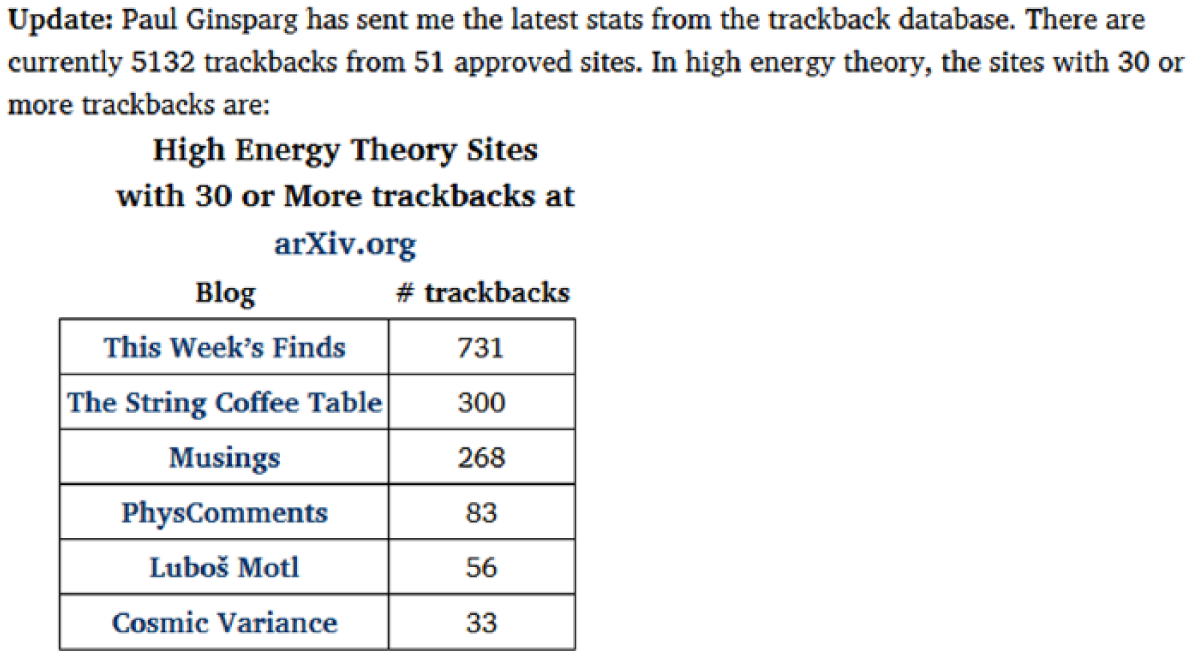
List of the top 5 high-energy theory blogs by number of trackbacks (Distler, 2006). 11
No precisely defined understanding of the ‘active researcher’ was to be given by Distler (2006): ‘It’s probably not worthwhile trying to pin down what the precise boundary between “active researcher” and John Q. Blogger should be’. Instead, Distler (2006) gave one example of a blogger who was not an active researcher (Woit) and a list of examples of those who qualified for such a status (see Figure 2). These examples serve as bookends on the crackpot to active researcher spectrum.
At the time of writing, Distler’s blog post was featured on five other blogs and elicited over 100 comments. The controversy raged in the commentary section, with over 22,000 words thrown around (Distler, 2006). Consequently, it is difficult to do justice to the variety of concerns and critiques expressed. However, from the large number of comments to Distler’s post, a central concern emerged: ‘what is an active researcher?’ Loosely paraphrased, some of the typical comments concerning the meaning of ‘active researcher’ were as follows: How many publications are required of an active researcher? How many pages must those publications be? Over what time period must the researcher be considered active? Is there a time limit? Do the papers need to be on arXiv? Does the researcher need publications in the sub-field in which they wish to leave trackbacks, or do ‘active researchers’ have access to the feature across the whole of arXiv? What about incivility? What about Nobel Laureates who have not published anything lately? Do the papers need to be peer reviewed? What about Perelman, who, while solving the Poincaré conjecture, did not publish for nearly a decade? What about anonymous blogs? Are graduate students subject to the same conditions? (Distler, 2006). These questions illustrate a community grappling with complex two part question: How does a community decide who has earned an epistemically privileged status, and is this status permanent or revokable? This philosophically heavy debate played out on a public medium.
Woit responded on various points, including on the central one: ‘You aren’t using the dictionary definition of “active researcher,” you’re making up your own, and not able to tell us precisely what it is’ (Woit, quoted in Distler, 2006). Of course, there is no dictionary definition of ‘active researcher’, so the ‘dictionary definition’ is unclear. However, Woit’s intention is clear: Distler and arXiv’s advisory board’s use of the term ‘active researcher’ was not in keeping with the usage of the high-energy physics community.
In the days that followed Distler’s post, a couple of bloggers, Chad Orzel (2006) and Capitalist Imperialist Pig (2006) each wrote a commentary on the evolving controversy. In explicit agreement with Capitalist Imperialist Pig, Orzel (2006) wrote, Are you trying to cause problems? … Having the ArXiv board decide who is and isn’t an ‘active researcher’ is just insane, if the goal is actually to avoid controversy. Not only is the closed-group nature of the decision ample fodder for conspiracy theorists, just the name is a disaster. If you’re going to be insulting, why not go all the way, and just call your approved posters ‘Really Smart People?’
Discussion
Recently, Collins (2014) has claimed that ‘there has been little systematic work on how experts reject what they consider to be maverick claims … we do not have any systematic information about how maverick claims are treated by different groups of scientists’ (p. 723). With this study, I add to the body of work that attempts to describe how a dominant group of scientists deal with ‘maverick’ or ‘crackpot’ claims, highlighting the complexity of these attempts.
Initially, it seems that what is at stake in this controversy is who should get an institutionally amplified voice. With arXiv performing such an integral role for the high-energy physics community, there is unanimous agreement that not everybody should be able to have links to their blog on an abstract page on arXiv, as this implies authority to comment on the paper in question. However, there are other contested and negotiated normative concerns: At stake is the function of science blogs within the scientific community and the role of science blogs within scientific discourse. Are (some) blogs playing the role of a kind of public peer review? This study responds to each of the general claims in the literature on blogs and in so doing presents a more complicated picture of the function of science blogs.
What constitutes a crackpot?
Several themes emerge from the blog posts and ensuing discussions of how to define a ‘crackpot’. John Baez’s (1998) ‘crack-pot index’ starts each individual off with the score of negative 5 and then gives points ranging from 2 to 50 for making various claims (see also Siegel, n.d.; ‘t Hooft, n.d.). The list of practices identified by Baez is frequently referred to as ‘insightful’ and amusing but not definitive (Carroll, 2006a). Instead, much of the debate surrounding how to define a crackpot revolves around what a crackpot is not: A crackpot is not an outsider (Motl, 2006), a crackpot is not a contrarian or a crackpot is not an individual with an in-principle disagreement (Carroll, 2006a). However, these arguments merely shift the disagreement, and unlike the controversies over climate change, within the wider context of the ‘string wars’ there is no consensus opinion on which to fall back.
What demarcates the category of ‘active researchers’?
This case study is situated within the wider context of the multi-faceted string wars, where the very status of the string theory research programme as a science is contested, defended and asserted (Ritson and Camilleri, 2015). The controversy differs from most examples of boundary work, insofar as the majority group (as opposed to the minority group) is in the defensive position. Distler, as part of the dominant majority, initially attempted to widen the boundaries of legitimate scientific practice so as to include blogging practices. However, faced with criticism, Distler, and by extension the arXiv advisory board, was forced to defend a conception of the active researcher. Some participants in the debates deem Distler’s examples deeply problematic, and those involved offered no uncontested examples of crackpots, contrarians or active researchers.
Two core concerns emerged from the controversy over the ‘active researcher’. First, what is the relevance of institutional affiliation to a person’s status as an active (or non-active) researcher? Participants in the debate agree that there is a significant difference between a tenured professor and a graduate student, but struggle to articulate the difference and its significance. Furthermore, it is not clear whether a tenured professor who is considered an active researcher should be granted permanent membership in that category. Perhaps active researcher status should be contingent on other factors, such as publication. Another consideration is the hierarchical differences between research institutions or universities.
The second concern is the relevance of publications to a person’s status as an active researcher. Again, there are questions of permanence: Should there be a threshold of a certain number of papers that, once passed, confer permanent active researcher status on the author? An alternative measure, rate of publications per year, was proposed. However, the concept of a minimum rate of publications raised further questions regarding length, quality, open access, peer review and strength of the publishing journal. Distler claimed that Woit was not a borderline case by posting a link to his arXiv publications, but that claim was later disputed by Woit, who pointed to his peer-reviewed publications listed on SPIRES (now inSPIRE (2014)). 12
These concerns are hardly revelatory to those in STS. However, in the case of arXiv’s trackback feature, a scientific community openly struggled to form stable concepts in order to prevent certain individuals from contributing. It is interesting to note that in contrast to the traditional demarcation debate in the philosophy of science, the debate in the high-energy physics community has focused on the individual rather than on output: Can individual ‘A’ be demarcated as an active researcher, not can theory ‘B’ be demarcated as falsifiable? In the case of the string wars, each participant would like to secure both the legitimacy of his or her claims and membership in the authoritative group. Gieryn (1999: 28) has described similar controversies as ‘second-order cartographic squabble[s]’ about ‘who really has the epistemic authority to map science’, or in this case, about who has the epistemic authority to label scientists.
Despite the controversy surrounding ‘active researchers’ and ‘crackpots’, there is consensus both that the categories exist and that it is important that some kind of segregation should exist. Furthermore, people in the high-energy physics community use expressions like ‘we know it when we see it’ and in such expressions embrace the collective ‘we’ (Carroll, 2006a).
Blogs are ephemeral?
While blogs have been placed in the category of ephemeral scholarly communication (a characterization that seems intuitive for blog discourse with vitriolic content), the case of the controversy over arXiv’s trackback feature offers counter-examples. Importantly, the arXiv trackback feature itself demonstrates that the various attempts to characterize blogs as ephemeral fail to recognize the role blogs played in certain spheres. Once a trackback was listed on the abstract page at arXiv, it remained there so that readers of the paper had permanent links to the blog commentary. To be clear, I do not argue that all blog posts are permanent or are as permanent as traditional print media such as journal papers and books. Rather, some blog discourse within a select community had more than a ‘transitory existence’. The trackback feature, which facilitated the semi-permanence of certain blog discourse, is contested and subject to controversy. To characterize the blog discourse as ephemeral is to misunderstand its contested functionality within the high-energy physics community.
Not only are blogs to some degree permanent, they are also highly public: Bloggers are aware that audiences could include anyone, from the New York Times to a graduate student. This awareness leads many bloggers to guard themselves from anticipated criticism by drawing on support from leaders in the field or canonical references. These actions give some posts the appearance of a finalized product. In a sense, a blog post mirrors a conference presentation: It has a (mostly) static public opening section by one author, followed by questions and comments from a variety of individuals. In anticipation of criticism from peers during questions and comments, conference presenters often attempt to fortify the static part of their presentation. In addition, certain bloggers use their personal sites to publish official announcements from academic institutions.
However, blogs do not fit into the category of permanent scholarly communication. While bloggers write so as to protect themselves from anticipated future criticism, each blog post is open-ended and in some cases becomes a work in progress as new information and comments are received. Furthermore, the blogger’s capacity to respond to feedback, particularly through comments sections, is evidence for the interactive nature of certain blog posts. Consequently, unlike journal articles and books, blog posts may evolve in response to criticism and feedback and contain the most up to date information.
Providing a form of ‘public peer review’?
Lack of institutionalized credit mechanisms means that some high-energy physics bloggers refrain from making novel positive contributions in the context of blogs. However, this situation does not prevent new negative contributions. A recent example 13 is the blog community’s response to the results of the BICEP2 experiments. The BICEP2 team, based at Harvard, published its results on arXiv on 17 March 2014 (Ade et al., 2014a) and submitted the same paper to Physical Review Letters for review. The arXiv paper generated a significant amount of buzz in the astrophysics and high-energy physics communities, which speculated that this was potentially a Nobel Prize winning discovery. On Monday, 12 May, a French blog, ‘Resonances’, published the post ‘Is Bicep2 Wrong’ (Falkowski, 2014) and delivered a review of the results and claims outlined in the arXiv paper. This post was linked to the abstract page at arXiv by a trackback (there are 19 other trackbacks on the abstract page, as of this writing). Although the BICEP2 team denied that any changes were necessary in response to the Resonances criticisms (Grossman, 2014), when the peer-reviewed paper appeared on 19 June it contained significant revisions that addressed, but did not mention, those criticisms (Ade et al., 2014b).
Arguments that blogs should perform the function of public peer review were present from the very origins of the trackback feature (Distler, 2002). The trackback feature, as instituted on arXiv, was explicitly designed to facilitate peer review. The semi-permanence achieved through archiving and linking practices provides blog discourse with the opportunity to perform a function akin to public peer review. The semi-ephemerality of an evolving medium which allows text to be altered over time also provides the possibility that blogs could perform a function akin to public peer review. The interactive nature of the commentary section allows for rapid criticism and response that is much faster than traditional peer review (as was the case with BICEP2). This enables blogs posts to develop raw information quickly, and this information is archived and linked back to the original paper.
While there are promising indications that blog discourse may provide an alternative or complementary form of public peer review within certain communities, this case study highlights the complicated nature negotiating the propriety of intellectual practices. Although I have argued against the idea that blog discourse is merely ephemeral, I have not argued that blog discourse is permanent. As is apparent from the methodical challenges using blog posts as source material, blogs are to a certain extent transitory. The kind of blog discourse examined in this case study is to a certain extent both permanent and ephemeral. The fact that the terms ‘semi-permanence’ and ‘semi-ephemerality’ are clunky and inexact speaks to the need for better understanding of Web 2.0 communications as a form of scholarly communication. There is more work to be done on blog discourse, and blogs are an excellent site for investigating the tension between permanence and ephemerality.
A lack of consensus around membership in the community was the most significant impediment to blog discourse as public peer review in high-energy physics. Present from the very origins of the trackback feature was a claim that critique (or ‘public peer review’) was to be performed only by members of the community (Distler, 2002). As the controversy evolved, there were repeated statements of commitment to this norm, even as the organization or border of the community was contested. This represents a second tension. Yet, despite almost no consensus as to what makes someone a peer, there was unanimous agreement that not everyone is one. This consensus that the individuals who are able criticize should be limited amounts to a rejection of ‘the wisdom of the masses’ in favour of the ‘wisdom of the few’.
Footnotes
Acknowledgements
I would like to thank the anonymous reviewers and editors at Social Studies of Science for helpful comments and suggestions. I would also like to thank the Cambridge University HPS History Workshop group for helpful comments on an earlier draft.
Funding
The author was supported by an Australian Postgraduate Award.