




Abstract
Rome has long been central to the story of Galileo’s life and scientific work. Through an analysis of the metadata of Galileo’s surviving letters, combined with a close reading of the letters themselves, we discuss how Galileo used correspondence to build a Roman network. Galileo initially assembled this network around the members of the Lincean Academy, a few carefully nurtured relationships with important ecclesiastics, and the expertise of well positioned Tuscan diplomats in the Eternal City. However, an analysis of Galileo’s correspondence in the aftermath of the trial of 1633 provides us with a unique opportunity to interrogate how his altered circumstances transformed his social relations. Forced to confront the limitations on his activities imposed by Catholic censure and house arrest, Galileo experienced the effects of these restrictions in his relationships with others and especially in his plans for publication. In the years following 1633, Galileo turned his epistolary attention north to the Veneto and to Paris in order to publish his Two New Sciences. While Galileo’s Lincean network and papal contacts in Rome were defunct after 1633, we see how Rome remained important to him as the site of a number of Roman disciples who would continue his intellectual project long after his own death.
Keywords
Galileo Galilei’s condemnation by the Roman Inquisition on June 22, 1633, for having openly advocated Copernican astronomy in his controversial Dialogue Concerning the Two Chief World Systems (1632) produced many long-lasting and unanticipated consequences for Italy’s best-known mathematician, physicist, and astronomer. On February 13, 1633, two days shy of his the sixty-ninth birthday, Galileo arrived in Rome, where he had previously been fêted for his astronomical discoveries with the telescope, to stand trial, vehemently suspected of heresy. The results of several months of deliberations were devastating. Clothed in penitential robes, Galileo was forced to publicly abjure any belief in heliocentrism. His Dialogue was placed on the Index of Prohibited Books, and he was placed under house arrest at his villa of Arcetri until his death in 1642. Quite unusually, Pope Urban VIII commanded local inquisitions throughout Italy to publicize the condemnation of the man and the book before audiences of theologians, philosophers, and mathematicians to ensure that news of the outcome of Galileo’s trial circulated. 1
Ever since Galileo’s trial made him a virtual martyr of science at the altar of his faith, historians have puzzled over the causes and consequences of this conflicted decision and have offered a myriad of explanations as to why it happened. 2 In the late 1980s and early 1990s, Galileo became an exemplary case study in scientific patronage, producing important work that focused on his relationships with powerful and influential figures whose approval and disapproval were decisive turning points in his career (Biagioli, 1993; Moran, 1991; Westfall, 1989). Yet Galileo had many different kinds of relations in the course of a long and variegated life – with family, friends, students, colleagues, patrons, publishers, readers and many others whose interactions with Galileo cannot be so easily categorized; we might describe this group as Galileo’s network (cf. Wilding, 2014).
In this essay, we examine Galileo’s trial from a different perspective, namely, its effect on his Roman network, or more accurately networks, as seen through his surviving correspondence. For more than a century, Galileo’s correspondence has been the backbone of any serious study of Galileo’s life and work. Galileo’s self-consciousness about his correspondence is well known. ‘I do not have time to write personal letters to all my friends and patrons’, Galileo explained to the Florentine patrician Filippo Salviati (1582–1614) from Rome in April 1611, ‘and in writing to you I shall imagine that I am writing to all’ (Favaro, 1890–1909: X, 89; cf. Biagioli, 1992; Shea and Artigas, 2003: 39). His surviving letters, edited and published by Antonio Favaro as part of the National Edition of Galileo’s works, provide us with a wealth of information about his daily activities, ambitions and most fundamental human relations: how he developed and presented his ideas, instruments, and discoveries, who his most intimate friends and important patrons were, the roles they played at different moments in his life and, last but not least, his often conflicted familial relations.
Our research builds upon work done over a hundred years ago by Favaro as well as by generations of historians who have subsequently used this important document collection. The object of our analysis is the 3,257 letters written directly to or from Galileo in volumes X-XVIII of the National Edition, following Favaro’s distinction between ‘correspondence’ and ‘scribally published tracts’. 3 By looking at people in Galileo’s worlds whose relationships with him can be charted in surviving letters, our goal is to make a virtue of Favaro’s highly archival, philological, and biographical endeavor to document Galileo’s life and works, in particular shedding new light on a narrative that has become one of the central episodes in the history of science. The letters by no means capture the whole of Galileo’s network, but can anchor this sort of analysis (Edelstein et al., in press). Galileo’s Roman letters provide an especially important case study of what we can learn through a reconstruction of conversation conducted in correspondence, and are central to understanding Galileo’s successes and failures as a problem of community.
Put a different way, Galileo’s letters are the best cumulative physical evidence we have of the nature and evolution of his relationships with key actors and communities in the Eternal City. We can explore this crucial node within his larger network, both synchronically and diachronically. A network analysis has the virtue of not privileging any particular relationship, emphasizing instead the search for significant patterns, degrees of density, and strength of ties (Castells, 2010; Knoke and Yang, 2008; Scott, 2000; Wasserman and Faust, 1997). By looking at Galileo’s correspondence as a body of historical evidence deserving of this kind of treatment, we have been exploring how digital humanities tools, when combined with a close reading of Galileo’s letters and allied documentation, provide interesting opportunities to analyze, visualize and ultimately come to a better understanding of Galileo’s world. Our goal, in short, is to mobilize his archive (Miller, 2015: 13).
We need not necessarily decenter Galileo in order to study him but we should certainly examine him from different vantage points to get to know him better, indeed to understand him as one human actor on a large and complex stage. Feldhay (2000) has thoughtfully challenged the inevitability of conflict as the narrative imperative of Galileo’s trial. More recently, Bucciantini et al. (2015) have effectively shown how studying Galileo’s world as a dynamic environment in which many people shaped the uses and meaning of the telescope considerably enriches our perspective on Galileo’s accomplishments and their controversial reception. Our own research builds upon this approach by reconstructing the many different kinds of relations that connected Galileo to Rome from the beginning to the end of his life. We are interested in how precisely Galileo forged relationships with a variety of different people in Rome, what he hoped they would do for him, what they actually did for him, and how these relationships changed over the entirety of his career.
While networks have their own narratives, or unfolding logic, reconstructing them does not begin with the construction of historical narrative but instead focuses quite simply on what we can know and not know from the surviving documents. Galileo’s correspondence is only a partial record of his relationships and its incompleteness is not just a matter of missing evidence. Not everything that matters ends up in letters, since they cannot record conversations that required no paper trail, and letters can disappear. Not all letters are equally important as witnesses to human relationships, let alone as a record of the evolution of ideas, discoveries, inventions, publications and controversies. At the same time, letters were indeed the most reliable method of maintaining relationships, communicating ideas and doing business at a distance. Galileo understood this basic fact of his world quite well since he was a master of the seventeenth-century art of communication. This method of exploring Galileo’s correspondence provides an opportunity to reconsider elements of the overarching narrative of Galileo’s life and work in light of the role that Rome played in his spectacular rise and fall.
To return to Feldhay’s point about the Galileo affair as a narrative of conflict, examining Galileo’s Roman network tells a different story. Put simply, it becomes a narrative of scale, punctuated by moments of increased volume, density, and complexity, and raising important questions about the importance of individual relationships and the survival of any given document. It invites a heightened archival consciousness and critical awareness of the materials from which we write history. The trial and its aftermath wreaked havoc on Galileo’s archive (Bucciantini, 1998). What did it do to his network and how can we capture its effects in surviving letters?
Letters alone do not make a network, but they can provide evidence of how a network builds up and how it breaks down. Correspondence is an entryway into the web of social relationships surrounding Galileo. We can follow these spokes outward to begin to reconstruct, with greater precision than has previously been offered, a broader network of people with connections and relationships that extend beyond the realm of correspondence. To take one example, Galileo’s relationship with the members of the Accademia de’ Lincei (1603–30), the Roman scientific academy that published and promoted his work after making him one of its most celebrated members, has been frequently discussed, but we have not fully explored the place of this node in a far more complex network of Roman relationships that he formed during the most crucial decades of his life (cf. Drake, 1981: 79–94; Freedberg, 2002; Redondi, 1987: 68–106; Westfall, 1984: 189–200). This article reconstructs how Galileo used correspondence to activate and consolidate these social relationships, and how changing circumstances caused these networks to break and reform in the years surrounding 1633.
Letters also bear witness to the material constraints and rhythms of conversation at a distance. While the Italian states famously improved and extended their postal systems during the course of the sixteenth century, they could never eliminate the many problems that made the delivery of mail an uncertain business (Behringer, 2003; Caizzi, 1993; Dursteler, 2009). Through Galileo’s letters, we reconsider the stages of the evolution of his Roman network, especially in the years between the 1610 publication of the Sidereus Nuncius, his famous account of his telescopic discoveries, and his 1633 condemnation, with some reflection on his final years under house arrest in Arcetri. Galileo’s engagement with his correspondence changed significantly in the period immediately before, during, and after his trial. Forced to confront the limitations on his activities imposed by Catholic censure and house arrest, Galileo experienced the effect of these restrictions in his relationships with others and on his plans for publication, a major subject of his correspondence throughout his entire life. How exactly did he respond to these changes? Can we describe his network as breaking down?
Fundamentally, Galileo’s contemporaries did not have the same relationship to him after 1633, nor he to them. Altered circumstances do indeed transform social relations. Writing to Galileo took on new meaning after the trial, when sending a letter became a declaration of allegiance and support. Galileo’s own letters, which have survived in smaller quantities than those written to him, also served different purposes. We offer the evidence of Galileo’s correspondence as the beginnings of an answer, being highly cognizant of its limits but also mindful of its importance in formulating an answer to these larger questions. Do changes in correspondence reflect true changes in a network? How does exploring this material at different levels of analysis bridge the gap between Moretti’s (2013) distant reading and close textual analysis? While metadata has helped us establish the outlines of Galileo’s network, the dynamics of this community only emerge when we read the content of his letters. Let us turn now to Galileo’s correspondence to see what we can learn about how his world was reformulated around the events of the trial.
Building a Roman network
Since Galileo’s trial took place in Rome, reconstructing his Roman network is the starting point for our analysis. We have long understood the importance of Rome to the making and breaking of Galileo’s career, but how exactly did this manifest itself in his correspondence? Galileo’s surviving correspondence contains 66 (15%) letters written by him to correspondents in Rome. This number is a mere fraction of the correspondence sent to Galileo, where 757 letters (27%) sent from Rome remain; this is in comparison to 395 letters (14%) from Venice and 275 letters (10%) from Florence. We also have 39 letters (9%) sent by Galileo from his visits to Rome. Quantitatively, Rome was far and away the most common city of origin of letters to Galileo. Conversely, Galileo sent nearly twice as many letters to Florence (127 letters or 30%) as to Rome. This was, in part, because he frequently had news to share when he was away from home. ‘I did not write you in the last post’, Galileo informed the Tuscan secretary of state Curzio Picchena on March 6, 1616, ‘because there was nothing new to report’ (Favaro, 1890–1909: XII, 243–245). Galileo’s changing relationship with the Eternal City and its inhabitants is central to understanding his life (Redondi, 1987; Shea and Artigas, 2003); Biagioli, 1993: 245–265). Rome was a privileged site of information and exchange, and this fact is essential to understanding how Galileo formed, deployed, and reformed his correspondence networks (Burke, 2002; Delumeau, 1957–1959: I, 37).
The earliest of all surviving letters written by Galileo is a missive sent from Florence to the Jesuit mathematician Christopher Clavius in Rome, dated January 8, 1588, following their meeting there in the fall of 1587. It deals with a proof of a theorem about the center of gravity of a sliver of a rectangle framed by a cone. This letter represents an offering of a young mathematician hoping to make his reputation by engaging one of the leading minds of an earlier generation. Clavius responded a little over a week later, thanking Galileo for his correction to the proof and suggesting that he looked forward to having the opportunity to revisit the work and would write then with his thoughts (Favaro, 1890–1909: X, 24; cf. Lattis, 1994; Shea and Artigas, 2003: 15). This letter’s status as the earliest of Galileo’s correspondence is surely an accident of survival. Galileo’s actual correspondence may have begun somewhere else with someone else, and have been part of a very different conversation. And yet, the letter to Clavius belongs to a pattern of his overall correspondence that is not at all serendipitous.
The first surviving letter that Galileo wrote when he returned to Florence in 1610, after eighteen years in Padua, was also to Clavius, with whom he could correspond more easily from Tuscany than from the Venetian Republic, which had recently been under papal interdict (1606–07) and was strongly antagonistic to the presence of the Jesuits. ‘It is time for me to break my long silence’, he wrote on September 17, 1610 (Favaro, 1890–1909: X, 431–432; also Biagioli, 1993: 253;; Bucciantini et al., 2015: 200; Heilbron, 2010: 163; Wootton, 2010: 115). Despite these early missives to Clavius, Rome was not the focus of Galileo’s epistolary energy between 1587 and 1610. During this period he directed the majority of letters to correspondents in the Venetian Republic and Tuscany in pursuit of jobs and promotions. About one-tenth of his total correspondence comes from this early period (Wootton, 2010: 51).
However, after the telescopic discoveries and the publication of the Sidereus Nuncius in March 1610, Galileo began to turn his attention to the possibilities offered by supporters in the Eternal City. Rome was a site of authority and legitimation but also a place in which to form new relationships. In April 1610, Cardinal Carlo Conti became one of the first members of the Roman curia to receive a much desired copy of Galileo’s telescope; Cardinal Odoardo Farnese, a direct descendant of Paul III, to whom Nicolaus Copernicus dedicated his On the Revolutions of the Heavenly Spheres (1543), acknowledged receipt of another example in August 1610. From the Eternal City, Galileo’s close friend and regular correspondent, the Tuscan painter Ludovico Cardi da Cigoli (1559–1613), sent him news regarding the reception of the announcement of his instrument and the discoveries he made with it (Favaro, 1890–1909: XI, 317–318, 410–411; cf. Camerota, 2004: 200). Soon thereafter, Galileo’s correspondence increased and diversified.
By the end of 1610, Galileo recognized that he needed to follow up on his scientific discoveries by personally meeting with those in Rome who were still skeptical of his instrument and observations. He implored the Tuscan secretary of state Belisario Vinta that there would be ‘no time as opportune as the present’ for him to travel to Rome. In February 1611, one month before his departure, he wrote to one of his most influential Venetian friends, the Servite friar Paolo Sarpi, describing his desire to gain the support of mathematicians, especially those in ‘Rome in particular’ (Favaro, 1890–1909: XI, 26–27, 46–50; cf. Bucciantini et al., 2015: 192). Laying the groundwork for this quasi-diplomatic mission to Rome, Galileo wrote to two influential figures who could facilitate what he hoped to accomplish in Rome – the Tuscan ambassador Giovanni Niccolini and Cardinal Francesco Maria del Monte, who also represented the Grand Duchy of Tuscany’s interests within the Papal States. On March 29, 1611 he arrived, bearing letters from Don Antonio de’ Medici and Michelangelo Buonarroti the Younger (1568–1646), great-nephew of the famous artist and one of the literary lights of the Medici court, addressed to a lively and learned cardinal named Maffeo Barberini (1568–1644), who came from a Tuscan family and who happened to be Buonarroti’s dear friend from their university days in Pisa (Favaro, 1890–1909: XI, 60–61; cf. Beltrán Marí, 2006: 132; Camerota, 2004: 400; Rossi, 1972: XV, 178–181). From the start, Galileo understood that to succeed in Rome one had to lay the groundwork for productive relations with the Roman curia. Galileo’s correspondence highlights three potential areas of special interest – the Jesuit mathematicians of the Roman College, the Roman families connected to the Farnese, and influential Tuscans in Rome (Favino, 2011: 163–185).
Galileo’s letters to and from Rome should be read alongside an itinerary of his travel (Figure 1). As Shea and Artigas (2003) have observed, Galileo traveled to Rome six times, for a total of over five hundred days during the course of his life. This is significant for a man who even before his house arrest was not given to peregrination – he never once traveled further than 300 kilometers from his native Tuscany (Shea and Artigas, 2003: ix, 20). It is also significant because the other most important sites of Galileo’s correspondence (Florence, Pisa, and the Veneto) were all places where he lived and worked.
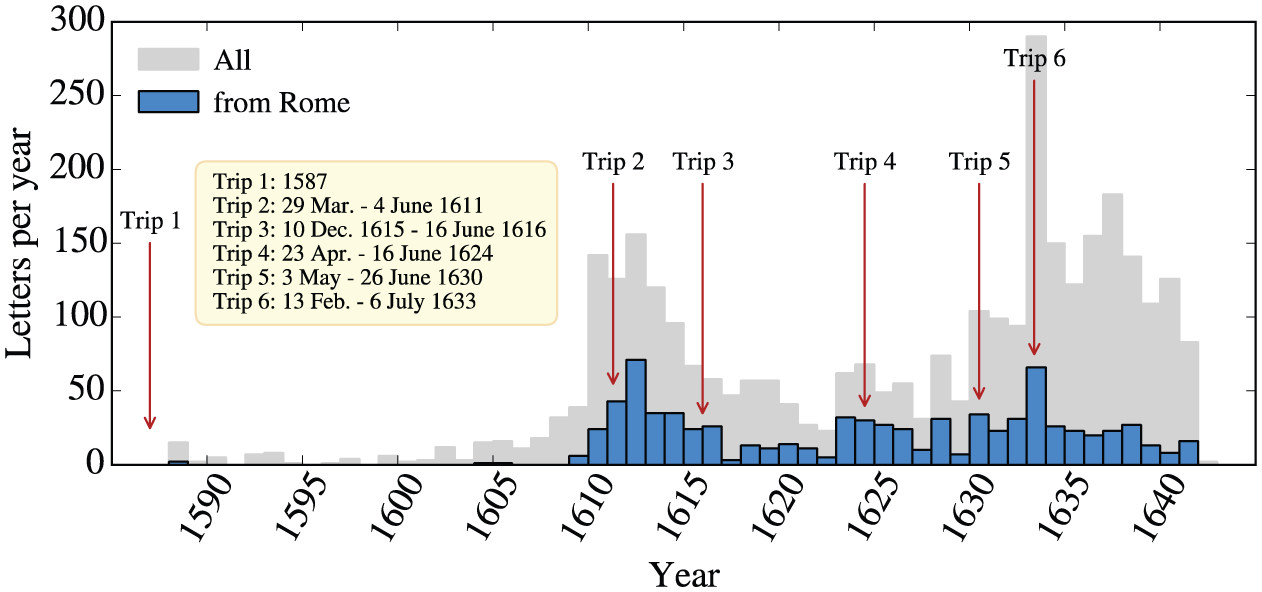
Galileo’s correspondence from Rome and travel to Rome.
Between 1609 and 1632, Rome became especially central to the realization of Galileo’s ambitions. We see this reflected in the patterns of Galileo’s surviving correspondence, especially the intensity of his Roman correspondence in the early years of his fame. Galileo’s letters were not only a convenient vehicle of communication, at a distance and even in proximity, but also a powerful rhetorical weapon that Galileo wielded effectively. Letters, combined with his publications and periodic visits to Rome, were one of Galileo’s most important tools for garnering support and magnifying his own reputation at important phases of his career. He exhibited a great self-consciousness about what a letter could do.
During Galileo’s second trip to Rome in 1611, his gifts and letters paved the way for new relations within a widening circle. In Palazzo Farnese he met the young cousin of the Duke of Parma, Virginio Cesarini. As Favino observes, the Farnese enjoyed close relations with the Society of Jesus, which had been founded under the Farnese pope Paul III in 1540. Did Galileo understand that they might smooth the way in his desire to gain a hearing from the Jesuit mathematicians, separate from his direct correspondence with Clavius? The cultural world of the Farnese also opened new doors, including access to some of the leading academies in early seventeenth–century Rome, among them, the Accademia de’ Lincei. The Farnese and Lincean networks were deeply intertwined (Baldriga, 2002; Battistini et al., 2007; Freedberg, 2002). Cesarini was not only one of the original academicians but cousin to the prince of this academy, a young noble from Acquasparta named Federico Cesi (1585–1630), who founded the Accademia dei Lincei with four friends in 1603. After Cesi’s father forcibly disbanded the academy between 1606 and 1610, its secretary Francesco Stelluti spent several years away from Rome at the Farnese court in Parma (Bucciantini et al., 2015: 214; Favino, 2011: 168, 172–173). As a result of his telescopic discoveries, Galileo became the sixth member of this scientific academy on April 25, 1611. Galileo’s correspondence with Odoardo Farnese bore fruit when he first came to Rome.
In the years that followed, much of Galileo’s Roman correspondence became a Lincean correspondence. Five of Galileo’s top ten and seven of his top fifteen correspondents belonged to this academy (Table 1).
Top 20 Correspondents, Listed with Number of Letters Sent to Galileo from Rome, 1589–1642.
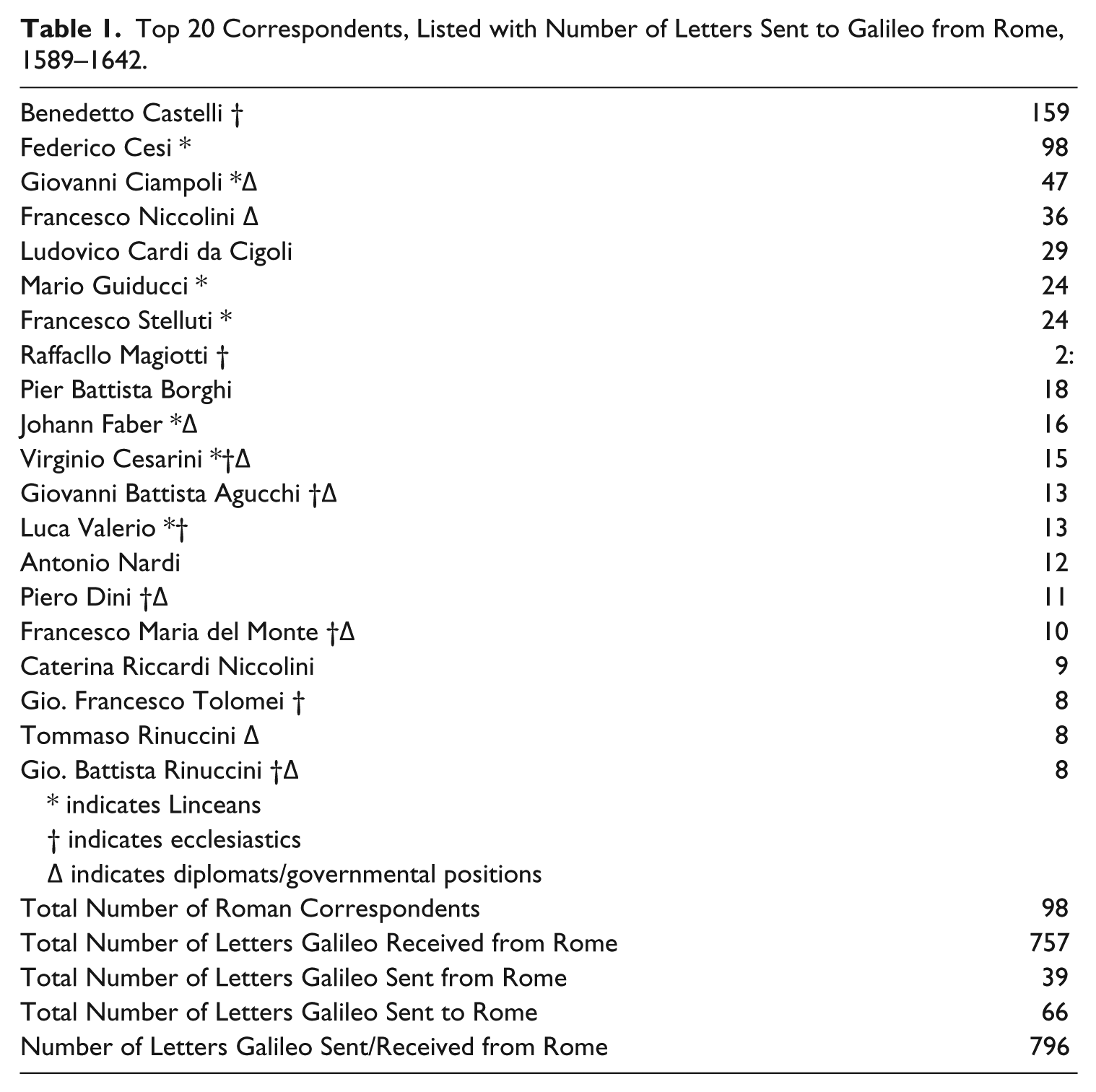
These numbers do not even include the small but significant handful of missives that Galileo exchanged with the most prolific letter-writer in early seventeenth-century Rome, Cassiano dal Pozzo (1588–1657), and his powerful patron, Cardinal Francesco Barberini (1597–1679), both of them also members of the Accademia de’ Lincei. Lincean correspondence on the whole comprises 15% of all surviving correspondence (416 letters to Galileo and 61 letters from Galileo). Twenty-one members of this Roman academy wrote to Galileo and he engaged at least sixteen with his letters. While Galileo’s correspondence alone cannot capture their relations with each other, it was nonetheless a dense and vibrant network at the height of its activity (Gabrieli, 1996; Savoia, 2011).
The Lincean community thrived from approximately 1611 until around 1627, when it declined in the years prior to the cessation of the academy in 1630. The intensity of Galileo’s relationship with Cesi as he sought to bring his Dialogue to completion masks the narrowing of the conversation, which seemed quite reduced in this final stage to the realization of a single project by a few principal actors. After Cesi’s death in 1630, faint traces of the Lincean network remained until 1633, after which it disappeared. Galileo’s unceremonious departure from Padua in 1610, combined with his growing desire to forge alliances and find patrons and friends in Rome, had led to a similarly abrupt decline in his Venetian correspondence during the 1610s (Wootton, 2010: 126). Observing this particularly crucial node within Galileo’s Roman network helps us to pinpoint many of the ups and downs of Galileo’s experience of the Eternal City.
Take the example of Galileo’s relations with the mathematician Luca Valerio (1553–1618), tutor to Margherita Sarocchi (1560–1617), the learned Roman writer of epic poetry, whose interests included astrology and mathematics (Ray, 2016). The Lincean Valerio introduced Galileo to Sarocchi, who was as eager to have his Medici patrons know about her literary work as Galileo was to triumph in Rome. Valerio facilitated some of Galileo’s other early relations in Rome that emerged as a result of his 1611 visit, including access to Roman literary and cultural academies (Bellini, 1997). However, the warmth and intensity of their relationship in 1611–12 did not persist. As Galileo found himself increasingly embroiled in debates about the theological implications of Copernican astronomy, many early admirers increasingly distanced themselves, leading to a cessation of their correspondence. At a crucial moment early in 1614, Galileo asked Monsignor Piero Dini to distribute copies of his version of a letter he had written to Benedetto Castelli outlining his understanding of the relationship between science and faith to key figures in Rome: the Austrian Jesuit mathematician Christoph Grienberger (1561–1636) who succeeded Clavius as professor of mathematics at the Roman College in 1612, the distinguished Jesuit theologian and Cardinal Inquisitor Robert Bellarmine, the Dominicans who largely staffed the Roman Inquisition, and Valerio (Camerota, 2004: 279). This list tells us many things, highlighting Valerio’s significance as an early interlocutor in Galileo’s efforts to assure good relations with the Roman Catholic Church. The demise of their correspondence by 1616 – along with the end of Galileo’s epistolary relations with Cardinal Conti, his brother Duke Lothario, and their patron Odoardo Farnese – underscores how fragile and ultimately fractured this early Roman network became in the face of mounting controversy (Beltrán Marí, 2006: 384; Favino, 2011: 176–182).
The Linceans were also important because of their strong ties with two successive papacies. Even before the election of Maffeo Barberini as Urban VIII (1623–44), the Linceans had begun to consolidate a position of importance at the center of power. Cesi’s cousin Cesarini and the Florentine Giovanni Ciampoli, who met Galileo through Cesarini, both enjoyed key positions during the brief papacy of Gregory XV (1621–23). Cesarini was appointed privy chamberlain in 1621. Ciampoli, who had recently become secretary of Latin letters for Cardinal Ludovico Ludovisi with the death in that year of his previous patron, Cardinal Pietro Aldobrandini, became Segretario dei Brevi ai Principi, dealing primarily with the papal chancellery’s correspondence with Germany and Poland. Cesarini would also be chamberlain for Urban VIII, while Ciampoli, who had known Barberini since the early 1610s, was elevated to cameriere segreto (Favino, 2015: 4). This succession of appointments was a measure of their staying power in the notoriously mercurial papal court, where regime changes and fickle temperaments often produced a dramatic reshuffling of personnel (Mayer, 2013). Returning to their role in the evolution of Galileo’s Roman network, in the year prior to Galileo’s third trip to Rome in December 1615, after Monsignor Dini distributed Galileo’s own version of his Letter to Castelli to counter the circulation of another version filled with subtle but important changes, three Roman correspondents in particular offered advice on how to handle the mounting challenge posed by Dominican critics. One was the influential Cardinal Del Monte, another was Cardinal Barberini, and the third was the then obscure acquaintance Ciampoli who was not yet even a member of the Accademia de’ Lincei, which he joined in 1618 – the same year as Cesarini (Camerota, 2004: 280). In contrast to Valerio, Sarocchi, and the cultural and ecclesiastical circle that had formed around Cardinal Farnese, they did not withdraw their support for Galileo when the situation became more complicated.
This kind of perceived stability within an otherwise unstable system established a base of support for Galileo, who especially expressed his appreciation of Cesi’s ongoing advice on ‘the state of things in Rome’ (Favaro, 1890–1909: XIII, 144; cf. Fosi, 1997; Freedberg, 2002: 143; Redondi, 1987: 97; Signoretto and Visceglia, 2004). The two decades of correspondence between Galileo and Cesi concerned many of Galileo’s publications, while also leaving a record of their conversations about other academy projects and, of course, Roman politics and culture. Galileo encouraged Cesi’s second marriage in 1616 to Isabella Salviati, who belonged to the Roman branch of the Florentine family that had produced his good friend Filippo Salviati, later immortalized in the Dialogue (Biagioli, 1992). The first time Galileo visited Rome after the election of Urban VIII in 1623, he wrote to Cesi to report on how the plan they had discussed in Acquasparta played out at the papal court. There was no one Galileo valued more for advice about how to make the best of his Roman connections and opportunities (Favaro, 1890–1909: XIII, 134–135).
Observing the role of various Linceans in Galileo’s correspondence, we see clearly how much membership in this academy generated and most importantly extended the conversations that he had with people in Rome, furthering the development of a community of potential patrons and friends in support of his endeavors. To be sure, not every effort succeeded. After Clavius’s death in 1612, Cesi encouraged Galileo to cultivate a good relationship with Clavius’s successor Grienberger, who personally admired Galileo’s work but increasingly found himself limited in what he could say or do in support of Galilean astronomy, as a result of mounting pressure within the Society of Jesus to uphold Aristotelian orthodoxy and promote Tychonic astronomy. Efforts to work around these constraints – led principally by another Lincean, the Bamberg physician Johan Faber, whose relations with Grienberger were partly defined by their belonging to the German residential community in Rome, as well as by Grienberger’s former mathematics student Giovanni Bardi and Galileo’s important Paduan friend Paolo Gualdo – failed (Favaro, 1890–1909: XI, 431, 434, 512, XII, 76, 80, 112, 115; cf. Beltrán Marí, 2006: 158–165; Feingold, 2003; Gorman, 2003). By 1614 the correspondence between Galileo and Grienberger had ceased, even as they continued to express sentiments of esteem through mutual acquaintances.
As a result, Galileo was unable to maintain productive relations with his early Jesuit correspondents. His interactions with the great Jesuit theologian Bellarmine, who lived until 1621, were equally limited and ultimately strained by Bellarmine’s complex role in the injunction he issued to Galileo with the placement of Copernicus’s On the Revolutions on the Index of Prohibited Books in 1616; only one letter from Bellarmine survives and it predates the proceedings brought against Galileo in 1615–16 (Favaro, 1890–1909: XI, 337–338). The conspicuous absence of letters to or from younger generations of Jesuit mathematicians reinforces the idea that after 1615 Galileo primarily engaged this scholarly and religious community in published debate rather than ongoing epistolary conversation. He used the form of the letter as a cultural weapon against Jesuit adversaries such as Christoph Scheiner and Orazio Grassi, with great effect in the controversies over the nature of sunspots and comets (Biagioli, 1993: 267–311; Drake and O’Malley, 1960; Galilei and Scheiner, 2010; Moss, 1993).
Nonetheless, Galileo’s Roman network had a strong religious component, because he was corresponding with a city of clerics and the men who worked for them. Galileo corresponded regularly with Cesi, but more letters survive from the Benedictine monk and mathematician Benedetto Castelli (1578–1643), Galileo’s long-time disciple, intimate friend, and heir to his professorship in mathematics at Pisa before taking up the same position at La Sapienza in 1626. Long before Castelli moved to Rome, Galileo’s Letter to Castelli was one of his most controversial and widely circulated letters in the Eternal City. To take a more obscure example, Galileo also corresponded intensively with Monsignor Giovanni Battista Agucchi (1570–1632) between 1611 and 1613, after they met in Rome through the Lincean mathematician Valerio (Beltrán Marí, 2006: 174–176). During this period Agucchi was indulging in the free time that came with having fallen out of papal favor with the election of Paul V. He decided to write to Galileo.
A native of Bologna, Agucchi was deeply involved in artistic and scientific life in Rome and enjoyed a close relationship with a number of prominent painters. Domenichino (Domenico Zampieri) painted portraits of Agucchi’s brother, Cardinal Girolamo Agucchi, and the Lincean Cesarini, while the Bolognese painter Annibale Carracci, patronized so fulsomely by the Farnese in Rome, portrayed Giovan Battista Agucchi, prior to his elevation as papal secretary but already indicating how his identity was shaped by correspondence (Figure 2). Agucchi is captured in the act of opening a letter, which was both his profession and his passion (Biow, 2002: 155–196). We see the creases and folds as Agucchi looks up from his reading, possibly thinking about what he has just learned, acknowledging someone we cannot see. We are reminded of Saint Augustine in his study preparing to pen a letter to Saint Jerome as depicted by Vittore Carpaccio in 1502. Augustine looks up from the letter to the window where Jerome’s voice has come to him, and the message of the letter transcends its physical medium. In stark contrast to Carpaccio’s depiction of the scholar surrounded by a jumble of books, instruments, a discarded letter, and a companionable dog, in the Agucchi portrait, the letter and the recipient are equal protagonists.

Annibale Carracci, Portrait of Giovanni Battista Agucchi (1603–04). Courtesy of York Museums Trust.
Agucchi’s steady stream of letters to the Medici court philosopher and mathematician was stimulated by reading Galileo’s works, including his letters on sunspots that Cesi loaned to Agucchi. This was no passing interest since, prior to their correspondence, Agucchi had published a treatise on the corruptibility of the heavens that explored, among other things, the relation between nature and scripture (Bucciantini, 1999: 237–248). His desire to replicate and even lecture on Galileo’s observations became the crux of their conversation. Agucchi’s direct epistolary relationship with Galileo came to an end in July 1613, though letter writing remained an integral part of his professional and intellectual identity, as did his passion for astronomy, including a lost treatise on comets written around 1618. In 1621, not long after this portrait was completed, Gregory XV appointed Agucchi as the secretary concerned with state correspondence (Segretario dei Brevi ai Principi). Like Ciampoli, he had been a client of Cardinal Aldobrandini and ultimately the young Cardinal Barberini. In 1621 Ciampoli passed on Agucchi’s greetings when both of them became part of the circle of intimates around Gregory XVI, wading through the sea of papal correspondence that defined its foreign policy (Favaro, 1890–1909: XIII, 78; cf. Drake, 1978: 211–212; Favaro, 1983: I, 373–395). Even though Agucchi expressed doubts about Copernican astronomy, he did not necessarily oppose Galileo. Agucchi ended his career as the Venetian nuncio under Urban VIII (Toesca and Zapperi, 1960: I, 504–505). Galileo had indeed made a new and interesting friend in Rome.
Epistolary controversies
In stages, however, Rome became an increasingly problematic destination for Galileo, creating curious absences in his correspondence, such as the virtual disappearance of most correspondence from 1615–16; this was even as the Letter to the Grand Duchess Christina survived, in the wake of increasingly complicated conversations about the Letter to Castelli, and spawning new astronomical and natural–philosophical letters such as Galileo’s missives to Monsignor Dini and Cardinal Alessandro Orsini (Damanti, 2010). During these years the letter became an increasingly controversial artifact for Galileo, as he thought carefully about what a letter could do.
The sixth months that Galileo spent in the Eternal City in 1615–16 were the longest period of his residence there (Wootton, 2010: 154). Galileo arrived in Rome in December 1615, bearing letters from Grand Duke Cosimo II to three influential cardinals – Francesco Maria del Monte, Paolo Giordano Orsini, and the papal nephew Scipione Borghese – as well as the newly minted cardinal Alessandro Orsini. Intense conversations and presumably many pages of correspondence ensued, as the fate of the idea of heliocentrism and books advocating this scientific theory hung in the balance. There are oblique discussions of urgent letters arriving late at night. Very little of this paper trail survives. We should understand this absence as an artifact not only of growing concerns just before and after the condemnation of heliocentrism on February 24, 1616 and the private injunction Cardinal Bellarmine issued to Galileo on March 5, but ultimately as an outcome of Galileo’s sixth and final trip to Rome in 1633, when the record of these years came under increasingly intense scrutiny.
During his trip to Rome in 1615–16, Galileo recognized that despite his widely admired skill at public debate, the written word, often in the form of a letter, could be more effective in winning converts to his cause. Yet he recognized that it had to be handled carefully. He told Vinta’s successor Curzio Picchena,
I have also needed to write down some points on paper and arrange that they secretly arrive in the hands of the one I desire, for I find it easier in many places to achieve concessions to dead writing than to a live voice, since writings allow other people to agree, to contradict, and finally to submit to reason, without blushing (Favaro, 1890–1909: XII, 227).
As circumstances changed, so too did the meaning of these letters. The persistent unease of these years made communications with crucial supporters in Rome a complex and often frustrating endeavor.
As Favino (2011) argues, one of the signal features of Galileo’s Roman network was its ability to reform itself due to the periodic regeneration of the Roman political elite, with each new appointment to the College of Cardinals and with each successive papacy. The urbane Cardinal Barberini, who bedazzled Galileo by writing a poem about him in 1620, was essential to this process. He recommended Ciampoli, and in all likelihood Agucchi, for a position in Gregory XV’s administration (Redondi, 1987: 93; Rietbergen, 2006: 95–147). Barberini’s elevation to the papacy in August 1623 was not the beginning but the culmination of a political process begun under the previous papacy. Its effect on Galileo’s network was almost instantaneous and became famously visible in the publication that had been in press as this news broke.
Galileo’s witty methodological manifesto The Assayer (1623) rightly has been described as a publication that became a public opportunity. In the context of analyzing Galileo’s correspondence, we should consider its similarities with the first letters that Galileo published as a Lincean on his sunspot observations in 1613. Unpublished letters were a means of negotiating a position, while published letters, at least as Galileo envisioned them, were often bold declarations of the conclusions he drew from his observations of the natural world, designed to question commonly held beliefs about how to interpret nature.
The title page of The Assayer visibly advertised Cesarini’s role in the new papacy: ‘Written in the form of a letter to the Illustrious and Reverend Monsignor Don Virginio Cesarini, Lincean Academician, Lord Chamberlain to His Holiness’ by ‘Signor Galileo Galilei, Lincean Academician, Gentleman of Florence, Chief Philosopher and Mathematician to the Serene Grand Duke of Tuscany’ (Figure 3).
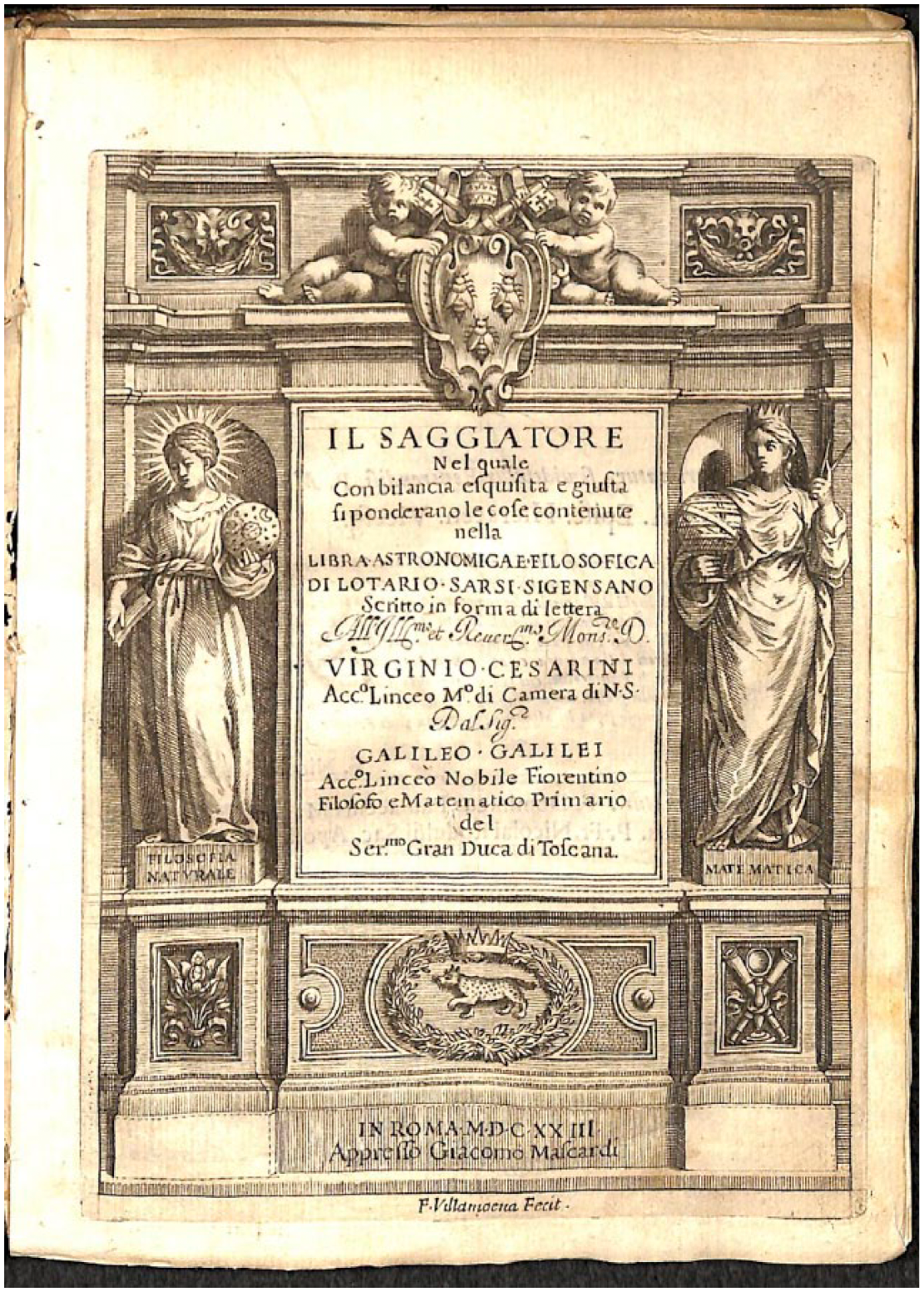
Galileo’s Assayer (1623). Courtesy of Special Collections, Stanford University Libraries.
The Assayer was an epistolary weapon that delivered the coup de grâce in an escalating contest between Galileo and his Jesuit adversary Grassi, further straining Galileo’s ability to correspond with Jesuits more sympathetic to his position (Biagioli, 1993: 281, 289–290, 309–311; cf. Ardissino, 2010). Galileo acknowledged that the length and breadth of The Assayer hardly fit the requirements of a standard letter. ‘I have been compelled to pass far beyond the bounds of a letter’, he observed in the opening pages. Still, Galileo considered the scientific letter a genre of writing with merit, adding: ‘I have nevertheless adhered to my original decision to address myself to your Excellency, however extended my reply may be’ (Galilei, 1960: 151, 170–171). Cesarini was the strategic link between Galileo’s Lincean network and the ecclesiastical hierarchy whose approval was so important to Galileo’s ambitions. He closed the circle, so to speak, which is why his untimely death on April 11, 1624 devastated the entire community who knew him. Not even Ciampoli, who played a similar role as a Lincean engaged in papal affairs, could entirely fill the void.
Ciampoli was not Roman but Florentine, which returns us to this important dimension of the Roman network that Galileo built. Surrounding the Lincean nucleus was a diffuse Tuscan network of patronage, diplomacy, friends, and disciples living and working in the Eternal City. Mario Guiducci was a Florentine educated at the Roman College and the University of Pisa, where he became Castelli’s and ultimately Galileo’s disciple and defender in his debates with Grassi. Let us return for a moment to the list of Galileo’s top correspondents. Who do we see besides Linceans and clerics? The answer is Tuscans in Rome: the ambassador Francesco Niccolini, his wife Caterina Riccardi Niccolini, Monsignor Piero Dini, and Cardinal Francesco Maria del Monte, who was commonly known as Il Cardinale di Firenze, are all there, revealing precisely how important Tuscans in Rome were to Galileo’s network (Waźbiński, 1994). They formed a second nucleus in which we can also place Barberini, a Tuscan cardinal who studied in Pisa. Galileo’s most stalwart Roman disciples are also present, not only Castelli but also Raffaello Magiotti and Antonio Nardi (Torrini, 1979b). In contrast to their Venetian counterparts, Florentine politics and culture were intimately connected to Rome, creating a constant flow of people and letters between these two adjoining states. Galileo naturally took advantage of these connections.
This, in brief, was the essential nature of Galileo’s Roman network, but what exactly did he want it to do for him? The answer repeatedly lay in publication, culminating in the vexed and complicated history of the Florentine publication of his Dialogue Concerning the Two Chief World Systems, that ‘ambrosia of the intellects’ that Ciampoli and so many others had long awaited (Favaro, 1890–1909: XIV, 64). Galileo filled his correspondence in 1629 and 1630 with details about problems with his health and his efforts to finish and then publish the Dialogue. On May 3, 1630, Galileo traveled to Rome to be present in person for the arrangements to have his Dialogue reviewed and printed. For several years, Galileo’s correspondence with Rome had been primarily conducted through his patron Cesi and his dear friend Castelli. Between 1626 and 1630 nearly forty percent of surviving letters written to Galileo were from Castelli, and all four of the surviving letters that Galileo wrote in these years are addressed to these two men. It was an intense and intimate conversation that seemed to have been narrowing rather than expanding.
Emptying out Rome: The network breaks
Perhaps Galileo understood in 1630 that his Roman correspondence network was changing and that he would benefit from advocating for himself there in person. On August 1, 1630, Cesi died of an acute fever. The next day, Francesco Stelluti penned a letter to Galileo conveying the news and grieving their loss. ‘The damage to the republic of letters caused by the loss of so many of his fine studies, all of which he left incomplete at the time of his death, is inestimable, and it leaves me unimaginably sad’ (Freedberg, 2002: 65). If his compositions were lost to the republic of letters as a community of learning writ large, the loss of Cesi as a patron and interlocutor was devastating for Galileo’s republic of letters writ small. Galileo’s Roman network was now endangered.
In retrospect, it seems obvious that Galileo would have immediately availed himself of the influence of another Tuscan in the service of the Barberini, Cardinal Francesco Barberini’s secretary Cassiano dal Pozzo. Dal Pozzo’s rapidly growing correspondence made him one of the most prolific letter-writers of the first half of the seventeenth century, second only to one of Galileo’s French correspondents, Nicolas-Claude Fabri de Peiresc (1580–1637), whose letters were the stuff of legend and whose network is increasingly well studied (Hatch, 1998; Miller, 2000, 2015). Curiously, Galileo did not do this, even though the handful of surviving letters they exchanged all date from the period after Cesi’s death. So perhaps an attempt was made and it failed. Cassiano would ultimately become, with Stelluti’s capable assistance, the guardian of the memory of the Lincean Academy, after purchasing Cesi’s library and papers from his widow in 1633 (Freedberg, 2002; Nicolò, 1991; Solinas, 1989). But he did not facilitate Galileo’s publications in Rome or rush to defend him in the difficult months of his trial. The paucity of their correspondence reflects the limited nature of their relationship; in the end, dal Pozzo was beholden to the Barberini. Yet some kind of relationship remained, since Galileo later penned a letter to Rome’s most famous cultural broker, writing ‘from the villa of Arcetri, my continued prison and exile from the city’ in January 1641 (Favaro, 1890–1909: XVIII, 291; Finocchiaro, 2005: 64).
Cesi’s death was not the only loss that Galileo endured. There is another way to see the list of Galileo’s most important Roman correspondents: as a necrology of people who had been influential in different aspects of his life and work, many of whom were no longer around by 1630. The painter Ludovico Cardi da Cigoli died in 1613; the Lincean Valerio in 1618 and his celebrated Roman patron and companion Margherita Sarocchi the year before, all of them preceding Cesarini’s much lamented death in 1624. These early losses were compounded by the deaths of Monsignor Dini in 1625, Cardinal del Monte in 1627, the Lincean physician Johann Faber in 1629, and finally Cesi the following year. While Galileo’s Tuscan diplomatic and intellectual connections in Rome remained relatively healthy and stable – despite the death of del Monte, whose position in Rome was immediately absorbed into the Barberini’s ambitious plans for themselves as Rome’s new cultural brokers under the young Cardinal Francesco (Castiglione, 2005; Mochi Onori et al., 2007; Rietbergen, 2006) – the Lincean community was falling apart. Despite preliminary efforts to identify someone who might replace Cesi as its prince, the Barberini never actively supported the reconstitution of this academy after 1630.
The loss of these connections altered Galileo’s relationship to the papal court. His efforts to use other channels to achieve the result he desired, namely the publication of his Dialogue, infamously produced a less than satisfactory result. Divergent views of what permission to publish allowed and how procedures should be followed to achieve the ends desired led Galileo to publish in Florence while claiming permission from Rome. He made these decisions without the benefit of the kind of local support and advice that had previously made it possible for him to navigate the fine line between encouraging an idea to thrive and being accused of insisting upon it too strongly.
There were also material constraints that further destabilized and distanced communication between Tuscany and Rome at a crucial moment. By mid-August 1630, the plague infesting many corners of Tuscany and the Papal States had begun to disrupt communication. A pandemic could quarantine letters for up to a month, which prompted Galileo to entrust letters from this period to couriers bound for pestilence-free Genoa, where they traveled by boat to the papal port of Civitavecchia and thence to Rome (Cipolla, 1981; Shea and Artigas, 2003: 147). If the aftermath of the trial signaled the collapse of Galileo’s Roman network, it had already become fragile well before his humiliation before the Holy Office.
Nonetheless, Galileo’s personal visit to Rome in 1630 appears to have reactivated a broader network there, at least in the short term. Michelangelo Buonarroti the Younger assured Galileo in June 1630, two months before Cesi’s death: ‘[Y]ou don’t have a greater friend than … the Pope himself’ (Favaro, 1890–1909: XIV, 111; Favino, 2015). Yet Buonarroti himself was in a precarious situation between Florence and Rome, having lost the good will of the Grand Duchess Christina of Lorraine and having failed to gain strong support from his friend who was now pope, even after dedicating a book of poems to Urban VIII in 1623 and taking two trips to the Eternal City in 1629–30 (Rossi, 1972). Galileo probably should have taken a lesson from this unsatisfactory episode between two of his important friends.
Between 1630 and February 1633, when Galileo reluctantly arrived in Rome for his trial, the number of letters coming from Rome increased to levels that nearly equaled or surpassed every other period of Galileo’s life. The negotiations leading up to the publication of the Dialogue and the ensuing scandal of its publication created one of the richest correspondence moments that we have within Galileo’s surviving corpus of letters. In the absence of Cesi, Galileo had more work to do at a distance to realize his ambitions in Rome. Letters became a talisman of his efforts to fill a void created by the death of this Roman patron and a number of other key interlocutors.
Galileo’s 1633 trial and condemnation at the hands of the Roman Inquisition, the condemnation of his works, and his house arrest at Arcetri sparked a flurry of correspondence that sheds light on how Galileo actively shaped his correspondence networks and how those networks changed in the tumultuous years surrounding 1633. Diplomats such as Niccolini played an increasingly important role in Galileo’s Roman network in the period immediately surrounding the trial, since diplomacy was what was sorely needed and in short supply in the heat of the moment. Galileo had always understood with some precision that his prominent young Florentine friend Salviati, whose virtues would be immortalized in Galileo’s fictional portrait of him as one of the principal interlocutors of his Dialogue, could do far less to advance his cause than the Tuscan secretaries of state Vinta and Cioli, or the Tuscan ambassadors in Rome, culminating in Niccolini. In addition to being more long-lived than Salviati, who died in 1614, these other actors were active political participants in Medicean Florence and papal Rome. Moreover, they were sophisticated communicators, used to seeing correspondence as a diplomatic weapon in the thrust and parry of early modern politics, knowing when to reveal secrets and when to obscure them. Their assessment of the problems and possibilities that Galileo’s situation posed was crucial in attempts to find a graceful exit from increasingly dire circumstances (Biagioli, 1993). The resolution did not come easily, let alone entirely, but intensive epistolary communication was essential for this result.
In short, after carefully cultivating ties in Rome that facilitated publications and provided patronage, advice, and less tangible forms of intellectual and moral support, Galileo watched it all crumble quite dramatically after Cesi’s death and the dissolution of the Accademia de’ Lincei in 1630. By April 1632, Monsignor Ciampoli had been unceremoniously forced out of his Vatican post, reassigned to the obscure governorship of Montalto di Castro in the Apennines and permanently exiled from Rome as of November 1632 (Biagioli, 1993: 322, 333–337, 340; Favino, 2002, 2015; Redondi, 1987: 266–267). The ties that Galileo maintained with a few ecclesiastics there, some of which were necessary especially within the context of the trial, largely disappeared after 1634, in contrast to the warm reception offered by the archbishop of Siena, Ascanio Piccolomini, as Galileo progressed from Rome to his house imprisonment in Arcetri. Rome was no longer an arena in which Galileo fought for the support of churchmen and learned gentlemen. Nor was it a diplomatic hub for Galileo’s intellectual goals. Instead, he reinitiated contacts from his days in the Venetian Republic and looked north to the European-wide, religiously heterodox republic of letters as the future audience for and publishers of his work.
A network transformed
The changes brought about by Galileo’s trial in 1633 cemented the shifts that were already underway in Galileo’s epistolary network, especially in Rome. As the dust settled around Arcetri, Galileo returned to work. He reactivated friendships that had been important to him earlier in his career, wistfully recalling his relationship with his long deceased Venetian friend Sagredo, while increasing his correspondence with Fulgenzio Micanzio (1570–1654), who succeeded his controversial mentor Paolo Sarpi to the position of theologian to the Venetian Republic (Favaro, 1890–1909: XVI, 414; Wilding, 2006: 232). He received sympathetic letters from correspondents who were appalled at what had occurred. Galileo also began to cultivate relationships he had previously found less interesting, especially with colleagues in Protestant Europe. The Roman Inquisition’s decision seems to have dealt a final and fatal blow to Galileo’s Roman network, forcing him to look elsewhere for support. When Francesco Barberini sent word through the Florentine Inquisition that Galileo should stop importuning him for greater freedoms from his house imprisonment, it became clear that he had to look elsewhere for support.
Not long after Galileo left Rome on 30 June 1633, disgraced and penitent, ‘a letter written to me by I don’t know who from the northern lands and sent to me in Rome, where the writer must have thought I was still residing’ arrived in the papal city, ‘full of praises for my Dialogue’ (Favaro, 1890–1909: XVI, 115–119). 4 The letter was opened, its contents read, and the original delivered to Cardinal Francesco Barberini. The papal nephew Barberini was not only a fellow Lincean and occasional correspondent, but a member of the Roman Inquisition that prosecuted Galileo; he was absent at the crucial meeting when the inquisitors deliberated Galileo’s fate, so his name was not affixed to this decision. Barberini did, however, remove the Copernican armillary spheres from his famous library as a tangible expression of his assent to religious orthodoxy (Wootton, 2010: 199). He would become a focal point of a series of unsuccessful efforts to rehabilitate Galileo immediately after the trial. Galileo expressed his relief that the intercepted letter did not further implicate him in the eyes of Rome, as a Catholic with admiring Protestant readers. ‘Fortunately the letter was not a reply but a first contact’, he observed tersely in July 1634 (Favaro, 1890–1909: XVI, 115–119). Copies circulated in the city, which is how Galileo heard about it from his house arrest at Arcetri. He eventually hoped to read it himself, perhaps to remind himself that not everyone agreed with or answered to Rome.
This telling episode encapsulates the decline of Galileo’s original Roman network and the rise of a different Galilean network, in his belated discovery of the importance of cultivating relations with influential brokers in the republic of letters, especially in Northern Europe. Galileo addressed this July 1634 letter to his most important Parisian correspondent, a Swiss Calvinist lawyer named Elia Diodati (1576–1661) whose family had emigrated from Lucca to Geneva. Diodati facilitated the translation and publication in 1635 of Galileo’s Dialogue, the bilingual edition of his Letter to the Grand Duchess Christina in Strasbourg in 1636, and ultimately the publication of his Two New Sciences by Louis Elsevier in Leiden in 1638 (Garcia, 2004; Gardair, 1984: 391–398). Galileo invited Diodati to share his news with the French philosopher and astronomer Pierre Gassendi, since he had yet to respond to Gassendi’s ‘letter full of his usual benignity’ written immediately after the trial. He also apologized for not yet responding to the great French broker Peiresc, who had also written to express his solidarity and sympathy with Galileo as he sought to persuade Cardinal Barberini to intervene with Urban VIII on Galileo’s behalf (Lewis, 2006).
In this important letter Galileo outlined the emergence of a new system of communication that involved his cousin Roberto Galilei, a well-established Lyon merchant, who became a conduit of news, information, books and manuscripts between Galileo and his French correspondents (Favaro, 1992: II, 487–489). After 1633, Paris became crucial to the further realization of Galileo’s scientific ambitions and publications and the extension of his correspondence network, eclipsing Rome as the most important location outside of Tuscany and the Venetian Republic. Between his return to Arcetri and his death in 1642, Galileo sent thirty-three surviving letters to correspondents in Paris, twenty to Venice, nineteen to Florence, six each to Bologna, Genoa, and Prato, followed by four respectively to Amsterdam, Pisa and Padua, two each to Strasbourg and Aix and one to Warsaw. This pattern is a distinct contrast to his earlier correspondence, in which Rome loomed so large. During this same period he sent a total of fourteen letters to the Eternal City. In short, Galileo became a participant in a much larger and more geographically diffuse intellectual community, filled with sympathetic allies willing to activate their own networks of information, publication and diplomacy in support of his desire not to have the trial become an unwelcome coda to a long and distinguished career (Raphael, 2012; Torrini, 2002).
During this same period, Galileo also rediscovered his Venetian friendships, corresponding regularly with the Venetian theologian Micanzio. More letters survive from Micanzio to Galileo (139) than any other correspondent between 1633 and 1642, indicating the intensity and importance of this relationship in the final decade of Galileo’s life. Micanzio was equally committed to finding avenues for Galileo to continue his work. When he discovered that it was impossible for Galileo to publish in Venice after the trial and condemnation, Micanzio encouraged Galileo to seek out their friends in Paris who were beyond the reach of Rome. The choice of Diodati as the central axis of Galileo’s network after 1633 was not random, but was deliberately chosen in consultation with friends who understood precisely what was at stake in finding new avenues for publication.
But did Galileo’s Roman network truly collapse in 1633? Not entirely. Let us recall the fact that someone sent Galileo news from Rome of the letter from his unknown northern European admirer in 1634. While there are a number of possibilities – including the Tuscan diplomat Francesco Niccolini – the most likely bearer of this news was Galileo’s loyal disciple Castelli. The Benedictine Castelli was second only to Micanzio in the number of letters (88) he sent to Galileo between 1633 and 1642. During the trial he had been unceremoniously ejected from Rome to tend to papal business in Brescia, rushing breathlessly back to the city to discover to his dismay that he had only just missed Galileo on the road to Siena (Favaro, 1890–1909: XV, 188–189). Once Galileo returned to Arcetri in December 1633, Castelli received grudging papal permission to visit Galileo, under strict injunction not to discuss heliocentrism, talking only of matters concerning health and faith; the Roman Catholic Church denied his request to join Galileo permanently at Arcetri, as Mario Guiducci did. Forced to stay in Rome, Castelli instead worked behind the scenes with another Galilean disciple, the French ambassador François de Noailles, and their allies to mitigate the effects of the condemnation (Favaro, 1890–1909: XVI, 449–450; Favaro, 1992: II, 809). With Ciampoli and Guiducci no longer in Rome, Castelli was the epicenter of the Roman network that remained (Figure 5).
Castelli ultimately failed to rehabilitate Galileo with his Roman patrons, but perhaps he succeeded in other, more subtle goals. In August 1639, Galileo wrote to Castelli, asking to be remembered to ‘the usual dear friends Nardi, Magiotti, and Borghi’. If we return to our list of Galileo’s most important Roman correspondents, Antonio Nardi, Raffaello Magiotti, and Pier Battista Borghi are all there (Table 1). By 1641, Galileo included Evangelista Torricelli in his greetings when writing to this loyal group of Roman correspondents, since this talented young Roman disciple of Castelli rejoined them in Rome after working closely with Galileo at Arcetri; he had previously been Castelli’s secretary (Favino, 2009). Galileo’s Lincean network and papal contacts were defunct, but his circle of Roman disciples was stronger than ever (Figure 4) (Torrini, 1979a). More than a third of his Roman correspondence (294 letters or 37%) and 10.5% of his surviving incoming correspondence came from his Roman disciples. Even when we exclude Ciampoli and Guiducci, in order to focus on the group that remained or arrived in Rome after the trial, over one quarter of his Roman correspondence (223 letters or 28%) and almost 8% of all incoming letters are products of these conversations. In the last three years of his life, all but three of the surviving letters sent to Galileo from Rome were written by Castelli, Nardi, Magiotti, Borghi, Torricelli, and another disciple, Clemente Settimi.

Galileo’s Letters to Rome.
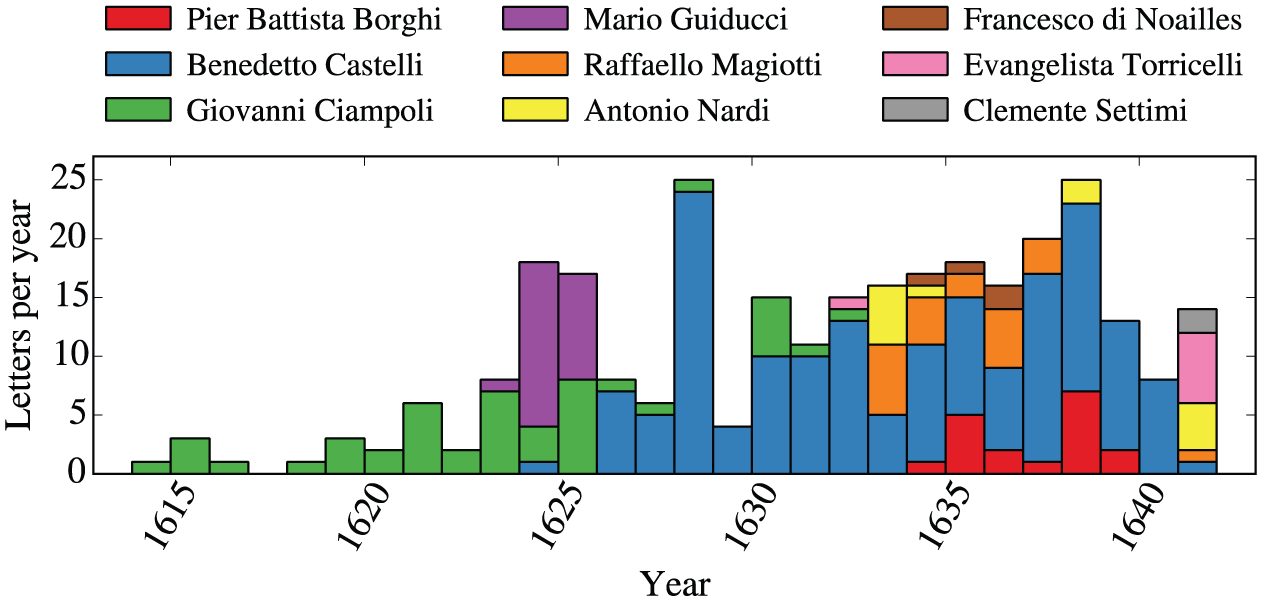
Letters to Galileo from his Roman disciples.
Galileo’s disciples in Rome after the trial did not facilitate Galileo’s publications – as Diodati did from Paris with the encouragement of Peiresc in Aix and Micanzio from Venice with the participation of Matthias Bernegger in Strasbourg and Louis Elsevier in Leiden – but they nourished him in other ways. Much like Galileo’s correspondence with the Jesuate mathematician Bonaventura Cavalieri in Bologna – one of Galileo’s most prolific correspondents, with 114 surviving letters, four of which were sent from Rome –they shared their work with him, facilitating a rich scientific conversation among absent friends that continued unabated, with the important proviso to avoid anything related to Copernican astronomy (Alexander, 2014). In August 1639, Galileo warmly thanked Castelli for preserving his name and memory, indicating that he understood well that the revenge of his Roman network lay in the applications of the principles of Galilean mechanics to new problems in mathematical physics (Favaro, 1890–1909: XVIII, 80–82). 5
In the end, Galileo’s Roman network turned out to be far more than what he sought when he first looked towards the Eternal City in search of support from crucial figures. The papacy ultimately rejected the cosmological implications of Galileo’s astronomy, yet it did not entirely break the network of Galileo’s Roman disciples that developed during Urban VIII’s papacy and would continue to thrive in the generation after the trial, regenerating itself in the years after 1667 when a newly made Cardinal Leopoldo de’ Medici, the princely founder of the Accademia del Cimento (1657–1667) in Florence, came to Rome. Nonetheless, it must be said that Galileo’s vision of his world and his sense of community shifted perceptibly by 1634 and in the years immediately following his return to Arcetri. As his eyesight faltered, communications became more complicated, mediated through the hands of amanuenses who wrote and read on his behalf. Writing, dictating, and receiving letters from Rome in the final years of his life, Galileo surely thought of a previous generation of correspondents who had assured his fame and nurtured his aspirations after 1610. This included the pope who once called Galileo ‘brother’, declared his confidence in Galileo’s efforts to realize his goal of a new science, and as a cardinal expressed the fond wish, in a poem in praise of Galileo’s astronomy, that his Tuscan friend live a long life for the benefit of the public (Favaro, 1890–1909: XI, 216, XIII, 48–49; cf. Beretta, 2002).
Footnotes
Acknowledgements
We are grateful to Mark Braude, Giorgio Caviglia, and Nicole Coleman for their assistance in navigating through the technical issues as we worked with the early iterations of Stanford’s visualization software, Palladio, and to Morgan MacLeod for his help in creating the final images. Max Morales, a Stanford undergraduate, helped check the final database for errors. Warm thanks to colleagues in Stanford, Jerusalem, Davis, and Toronto for comments, especially the participants in this special issue, the three anonymous reviewers, Dan Edelstein, Howard Hotson, Iva Lelková, Suzanne Sutherland, and Nick Wilding.
Funding
The author(s) disclosed receipt of the following financial support for the research, authorship, and/or publication of this article: This essay emerged from the ‘Mapping Galileo’ project, developed as part of Stanford University’s ‘Mapping the Republic of Letters’, a collaborative research project supported by grants from the Office of the President and the National Endowment for the Humanities now housed in Stanford’s CESTA. The Stanford Humanities Center provided Paula Findlen with the opportunity to develop this project as the Ellen Andrews Wright Senior Fellow in 2011–2012, including support for Kyle Lee-Crossett, who constructed the initial database as a Humanities Undergraduate Fellow with input from Marcus and Findlen.