



Abstract
Early Science and Technology Studies (STS) scholars recognized that the social construction of knowledge depends on skepticism’s parasitic relationship to background expectations and trust. Subsequent generations have paid less empirical attention to skepticism in science and its relationship with trust. I seek to rehabilitate skepticism in STS – particularly, Merton’s view of skepticism as a scientific norm sustained by trust among status peers – with a study of what I call ‘civil skepticism’. The empirical grounding is a case in contemporary dendroclimatology and the development of a method (‘Blue Intensity’) for generating knowledge about climate change from trees. I present a sequence of four instances of civil skepticism involved in making Blue Intensity more resistant to critique, and hence credible (in laboratory experiments, workshops, conferences, and peer-review of articles). These skeptical interactions depended upon maintaining communal notions of civility among an increasingly extended network of mutually trusted peers through a variety of means: by making Blue Intensity complementary to existing methods used to study a diverse natural world (tree-ring patterns) and by contributing to a shared professional goal (the study of global climate change). I conclude with a sociological theory about the role of civil skepticism in constituting knowledge-claims of greater generality and relevance.
While actors’ schemes may set trust and skepticism in opposition, the invitation to the analyst is to envisage a relationship between trust and skepticism in which the character of skepticism depends upon the extent and quality of trust. (Shapin, 1994: 19)
Rehabilitating skepticism in STS
This article takes up Shapin’s invitation above, and sets out to examine empirically how the social construction of knowledge is based on skepticism’s subsidiary relationship to background expectations and trust. While early Science and Technology Studies (STS) scholars acknowledged that skepticism is parasitic on trust (Ramírez-i-Ollé, 2018b), subsequent generations have rightly focused on characterizing the types of trust (in people, institutions, machines and other material and epistemic objects) necessary in different sciences (see, e.g. Reyes-Galindo, 2014) and have paid less empirical attention to skepticism.
Whilst I disapprove of Merton’s over-generalized account of ‘organized skepticism’ as a counter-norm to ‘organized dogma’ (Merton, 1973: 254, 383; Mitroff, 1974), I am keen to revive his argument that scientific communities are ‘status groups’ (Barnes, 2007). Membership in a scientific status group is defined through participation in a moral community and a shared code of honor and purpose; members accord each other (and expect from outsiders) trust, recognition and rewards (Hagstrom, 1982) for contributing to the quality of their esoteric knowledge.
I employ the concept of ‘civil skepticism’ to develop further the idea that skepticism, as an evaluative practice implicated in the maintenance of status groups and specialized knowledge, is regulated by honorific relations and mutual recognition of bonds of trust between peers. I borrow the concept of civil skepticism from Bloor (1998) and broadly define it as any skeptical practice that is regarded by members of a status group as both conforming to communal notions of civility and usefully contributing to shared knowledge. Civil skepticism refers to challenges that people would ordinarily perceive as constructive criticism. The precise distinction between ‘civil’ and ‘uncivil’ skepticism, i.e., whether certain practices are seen as departing from or conforming to particular norms and expectations about when and how skepticism should be practiced, is subject to negotiations by those maintaining specific relations of trust. In this respect, rehabilitating studies of skepticism in STS involves adopting a ‘finitist’ approach to knowledge (Barnes et al., 1996).
Methodology
This article is based on a three-year ethnographic study of a group of scientists studying past climates from trees and, more specifically, attempting to establish whether current temperatures in Scotland are anomalously warm from the analysis of Scots pine tree growth. For periods before the existence of meteorological records, scientists or ‘paleoclimatologists’ use different materials (trees, ice-cores, sediments, corals and documents among others) as ‘climate proxies’ and sources of information of past climate for different timescales (Bradley, 1999: 7; Decker, 2017; Schinkel, 2016; Skrydstrup, 2017). Dendroclimatology is a science that employs trees (‘dendron’ is the Greek word for ‘tree’) for understanding the changes in climate over the past millennium.
The main protagonists of this study are Dr Rob Wilson and his collaborators in the Scottish Pine Project (‘SPP’ hereafter). Rob is currently a Reader in the Department of Earth and Environmental Sciences at the University of St Andrews in Scotland, where he trains students in dendroclimatology. One of these students, now Dr Miloš Rydval, participated in the SPP as a doctoral candidate; his dissertation consisted of creating a temperature reconstruction for Scotland with the data generated by himself and other members of the project, particularly Dr Björn Günnarson, who is the head of the tree-ring laboratory at Stockholm University.
The SPP formally started in 2007, when Rob first obtained funding for the project and a full time faculty position, and my study covers the period from April 2012 to September 2015. The episode I describe here roughly includes the period from August 2012 until June 2014. In order to generate observations of the work of the members of the SPP, I participated in their everyday routines. I worked one day per week for a year as a volunteer technician, accessed Rob and Miloš’ presentation slides and article drafts, and attended a workshop in St Andrews in April 2013 and a conference in Australia in January 2014. I developed friendships that became essential for securing these researchers’ consent and trust and generating sociological knowledge (Ramírez-i-Ollé, 2018a). I use the real names of those who have granted me permission. For those who do not wish to be named, I use pseudonyms.
Dendroclimatology: Assembling a global tree-ring database
Dendroclimatologists’ core assumption, upon which all their work is based, is that the tree, as a living thing, reacts to changes in temperature and precipitation, among other climatic factors. One textbook author describes the tree as an ‘integrator’ of environmental conditions (Schweingruber, 1988: 6). Dendroclimatologists believe that their knowledge of past climates is determined by this independent biological (‘tree’) and environmental reality (‘climate’). This is why dendroclimatologists describe their skill as involving the ‘extraction of climate from trees’ (Sheppard, 2010) or, in the more metaphorical language employed by the renowned dendroclimatologist Harold Fritts (1976), as reading the ‘tales trees tell’ about past climates. 1
Dendroclimatologists generate measurements of the annual growth layers of wood (of tree-rings) in order to represent the reaction of trees to changes in climate. Textbooks commonly include images (Figure 1) to illustrate that different tree species growing in different climatic zones might react differently to particular environmental factors, and thus, their rings do not provide the same climatic information (Schweingruber, 1988: 102–139; Speer, 2010: 50–71). Dendroclimatologists have developed different methodologies for measuring three parameters or physical properties of rings: ring-width, wood density, and stable isotopes. For reasons of limited space and relevance, I will only describe the efforts to create data from ring-width and density. 2
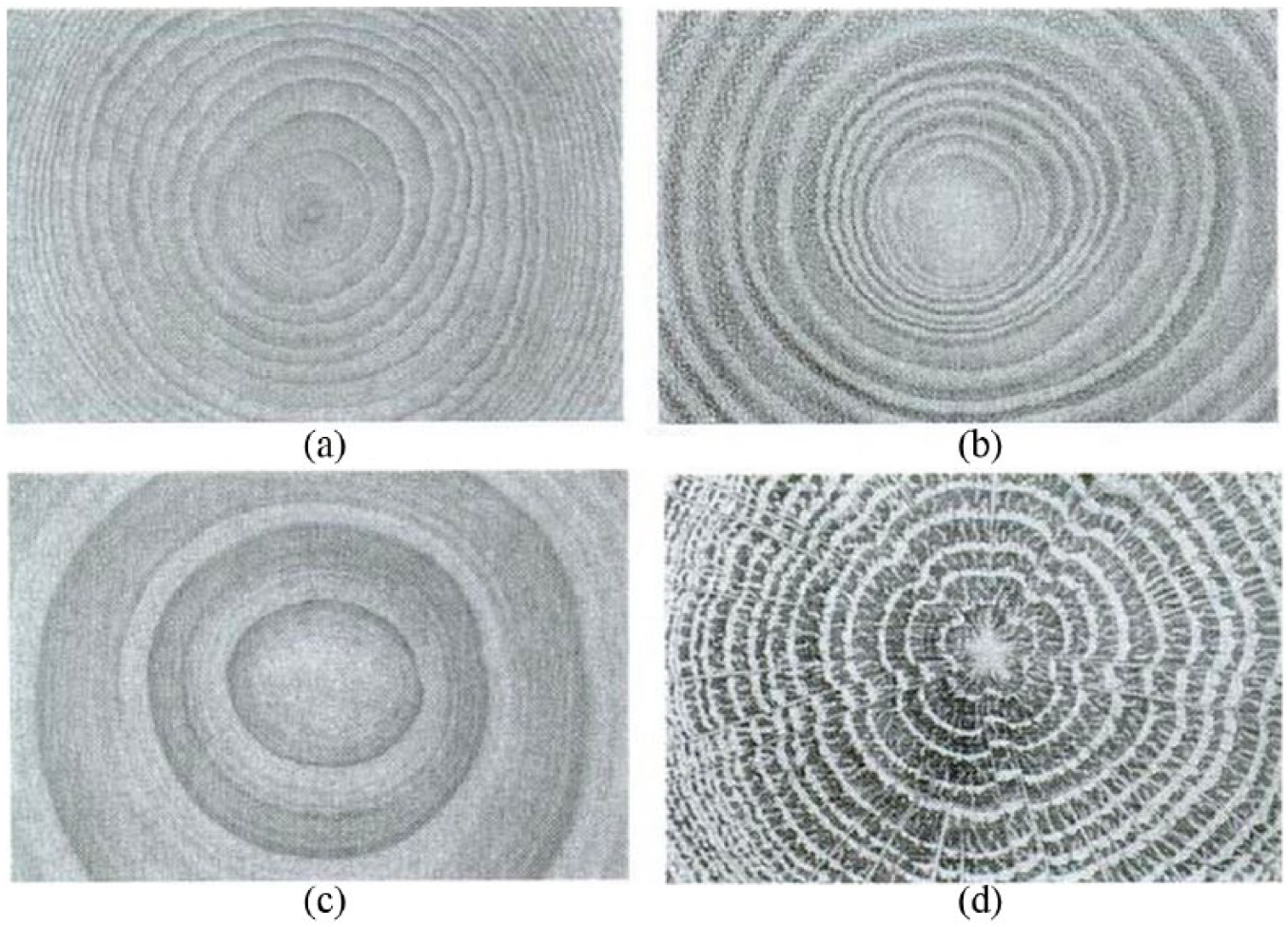
This textbook image shows the layers of annual wood growth arranged as concentric rings and the different ring patterns across four tree species (A: beech; B: catalpa; C: sumak; D: oak). Such pedagogical images sensitize neophytes to the idea of the diversity of the natural world under study.
The first attempts to employ ring-width data are associated with the birth of ‘North American dendrochronology’ in the early 20th century and the work of Andrew Ellicott Douglass and his doctoral student, Edmund Schulman. 3 They worked in the Southwestern United States with bristlecone pines and observed similarities between ring-width measurements and estimates of river flows and rainfall (Douglass, 1914; Schulman, 1951). Over time, dendroclimatologists have concluded that ring-width data are particularly valuable for deriving information about long-term (decadal to centennial) precipitation changes from trees growing in dry and low elevation areas. The growth of these trees is affected by very distinct seasonal changes, which is seen to explain why the trees produce clear patterns of wide and narrow tree-rings. Today, ring-width is the most widely measured parameter, mainly because the equipment needed (a measuring stage, microscope, computer, and scanner) is relatively affordable.
The first measurements of wood density are attributed to ‘European dendrochronology’ and the work of Hubert Polge and Fritz Schweingruber. In the 1970s, Polge and Schweingruber sought an alternative method for obtaining climatic information from oaks, grand fir and Norway spruce growing in the cold, moist and high altitude areas of the Alps and Central Europe. Due to the advancement of optical and electronic equipment, they were able to conclude that measurements of cell wall thickness were a better proxy for short-term (yearly) temperature changes in high-latitude areas than ring-width. Today, only a few laboratories can afford the machinery (X-ray) and the specialized workforce needed to produce density measurements, which explains the relatively lower number of density datasets.
Dendroclimatologists have sought to expand their activities into new geographical areas and to generate more data from different tree species worldwide. 4 This communal endeavor was crystallized in the creation, in 1974, of the ‘International Tree-Ring Data Bank’ (ITRDB), a public archive described as ‘an enhanced global dataset serving the global scientific community’ (Grissino-Mayer and Fritts, 1997). In 1996 the ITRDB contained ring-width, density and isotope data from over 1,500 places and was managed by dendroclimatologists from the University of Arizona (Grissino-Mayer and Fritts, 1997). By 2017 this number had increased to 4,000 and the repository was hosted by a US-wide scientific agency (the ‘National Oceanic and Atmospheric Administration’). The growth in the number of tree-ring data from around the world has led to the creation of a web-based interface (‘Dendrobox’) that seeks to popularize the ITRDB (Figure 2).
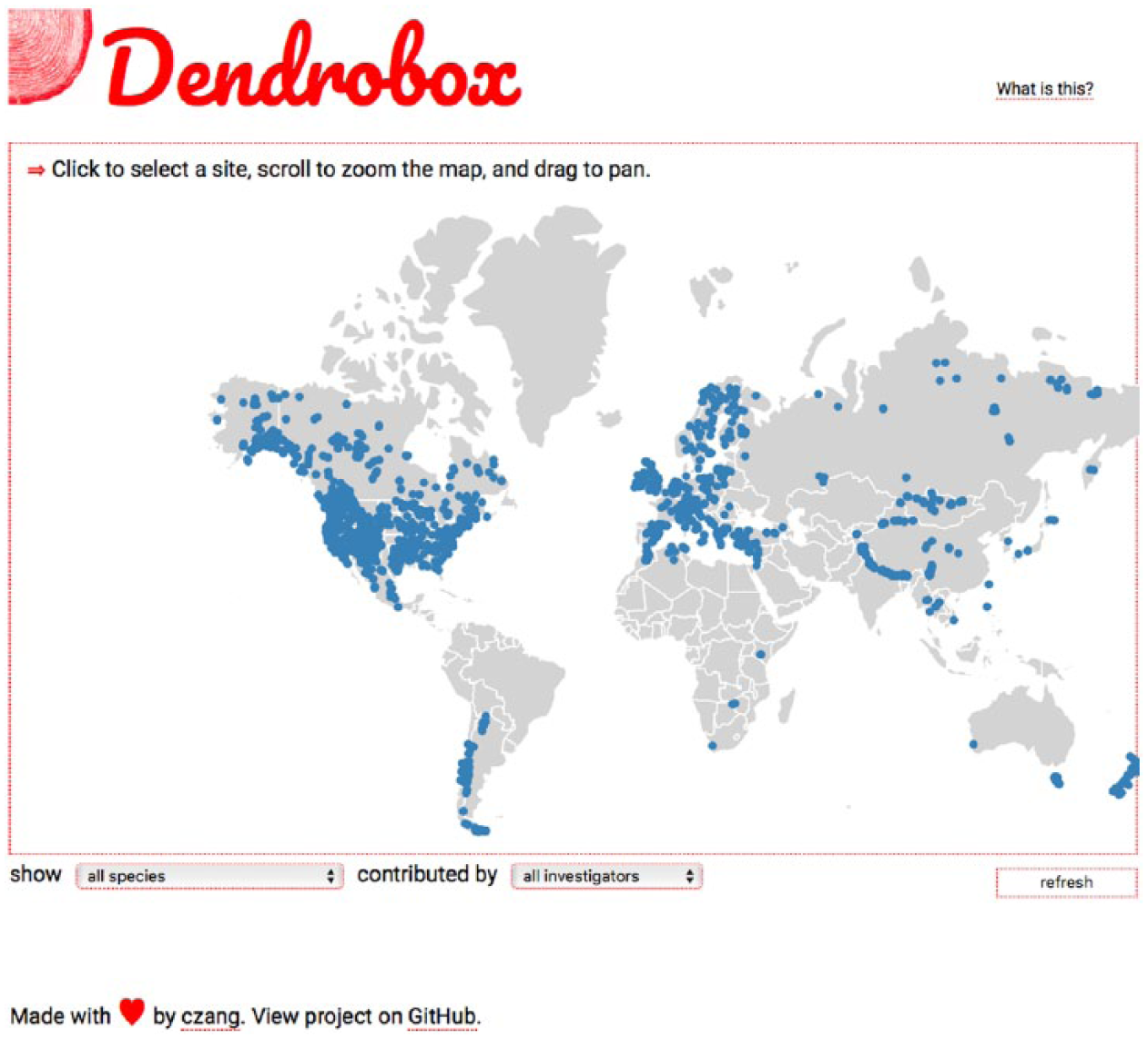
Dendrobox’s first page shows the geographical distribution of tree-ring data. The archived ‘global’ dataset is filtered for ‘local’ features such as tree species and contributor.
Dendroclimatologists’ effort to assemble a global tree-ring database is in line with their goal of creating large-scale (‘Northern Hemisphere’) temperature reconstructions for comparison with models of past and future climates. 5 Since the 1990s there has been a rapid growth in the number of millennium temperature reconstructions. As a recent group of reviewers (including Rob) noted, this increase is related to governments’ interest, via the Intergovernmental Panel on Climate Change, in evaluating the risks of global climate change (Frank et al., 2010). The present role of dendroclimatology as a supplier of data for models is part of a broader hierarchy of credibility within climate sciences where modelling currently enjoys a hegemonic status (Shackley et al., 1998) following historical tensions between paleoclimatologists and meteorologists (Martin-Nielsen, 2015). The veteran dendroclimatologist Malcolm Hughes (2002) claims that these power struggles have disappeared, and that ‘physical climatologists are taking the results of dendroclimatologists’ work very seriously’ (p. 96). Paleoclimatologists (including dendroclimatologists) and physical climatologists now share a form of reasoning based on prognostication and foretelling (Skrydstrup, 2017): Dendroclimatologists accept that the societal and scientific value of dendroclimatology is to anticipate what the future climate might be like by reconstructing the past (Grissino-Mayer, 2016; Hughes, 2002; Sheppard, 2010).
The ‘small science’ of the Scottish Pine Project
In comparison with the resources and scope of other scientific projects, the SPP is small science. Though Rob works in one of the most prestigious universities in the UK and worldwide, for many years, his students shared laboratory space and some equipment with others in the department. The budget of the SPP for the period 2007–2016 was £590,730, which came from a national research council and British charities. Most of the money went to hiring one PhD student (Miloš) and one technician and covering research expenses arising from fieldwork. The SPP involved an interdisciplinary team of 16 people – including paleoclimatologists, geochemists, archeologists, ecologists and a specialist in robotics – working in universities and research centers in the UK and Sweden. While Rob was actively involved in other transnational projects that aimed to reconstruct climate change in the Northern Hemisphere, the aim of the SPP was constrained to reconstructing the regional climate of the Scottish Highlands.
Rob believed that density was the most reliable tree-ring parameter for obtaining climate data from Scots Pine trees growing in the cold and wet environment of the Scottish Highlands, but he did not have the resources to generate density data. Instead, he employed density datasets generated by others. Rob downloaded one density data from Scotland archived in the ITRDB, which had been created by a group of dendroclimatologists in the 1970s. Rob’s collaboration with Björn was based on the agreement that Björn would generate new density data from the Scottish samples, as his laboratory was one of the few in the world that had the equipment to do so.
In addition to generating new ring-width and density data, Rob decided to explore a relatively new tree-ring parameter, the so-called ‘Blue Intensity’ (‘BI’ hereafter). BI data results from measuring the darkness of reflected (blue) light from scanned images of wood, which is taken as a proxy for cell density. Rob learned about BI in 2004, while he was working with dendroclimatologists from Wales on the European project where he met Björn. Rob immediately saw the potential of BI but could not afford the measuring package used by the researchers in Wales to generate BI data. In 2007, Rob met through an online dendroclimatology forum a software designer, Lars, who had developed a software program (‘CooRecorder’) to measure ring-width from scanned images. Rob asked Lars if he could add a function to measure wood reflectance, and within days of Rob’s request, Lars had sent him the first beta version of CooRecorder with an added BI function. When I met Rob and Miloš in April 2012, they, with the help of many others, were starting to experiment with CooRecorder to develop a cheaper methodology for generating BI data.
The development of Blue Intensity
Laboratory experiments
In August 2011, after having collaborated in other projects for more than six years, Rob and Björn agreed to conduct an inter-laboratory experiment that compared the performance of BI against density. When I asked Björn if this experiment could threaten the status of his laboratory, which specialized in density data, he looked at me in surprise and said, ‘No! Developing a cheaper method is good news for all dendroclimatologists, including our lab.’
Rob and Björn delegated the execution of the experiment to two junior staff members in their respective laboratories. Miloš had been Rob’s undergraduate student at St Andrews, and in Rob’s words, was ‘one of the best undergraduate students I have ever supervised’. After Miloš graduated in 2008, Rob hired him as a technician and later, in 2011, obtained a doctoral scholarship for him. In the inter-laboratory experiment, Miloš was responsible for generating BI data with CooRecorder and for coordinating with Björn’s Masters student, ‘Emily’, who produced the density data. Miloš and Emily first met during the fieldwork expedition of April 2012 in the Cairngorms (the Eastern Highlands of Scotland), where they executed the experimental design on which their supervisors had previously agreed. The experiment involved: (i) extracting ten pairs of samples from two Scots Pine forests (‘Ryvoan’ and ‘Ballochbuie’) in order to generate comparable results from density and BI; (ii) trying two different chemical treatments (ethanol and acetone) for removing resins from the wood.
While Miloš was waiting to receive the density data from Emily, he decided to conduct a few other tests with BI. He tested a few aspects of the preparation of the wood samples and the use of the scanner. For instance, he tried different time lengths for submersion of wood into acetone. He also constructed a black box and used it to cover the scanner (without the lid) to ascertain if there was a potential for ambient light from the surrounding room to influence the scanned image. Finally, he tested the measurement settings of CooRecorder and reported the results back to Lars, as the agreement between Rob and Lars was that Miloš would help to refine the beta version.
Miloš did not test all the aspects of the BI methodology. For instance, he did not experiment with the ‘calibration cards’. One of the things I did as a technician was to scan pieces of acetone-treated wood. The first step, Miloš showed me, was to remove any dust from the scanner’s glass with a cloth. I then had to place a glossy piece of paper that contained small color boxes (the ‘calibration card’) on the scanner’s glass, scan it, use a software program to define the area of the scanned card image and press another button. Afterwards, Miloš told me, the scanner was calibrated and ready to capture the darkness of the wood surface accurately. One day, while Miloš was testing the black box, I asked him if he was also planning to test the calibration card. He responded,
No. These calibration cards have been calibrated according to international standards, and I assume that other people have done many tests with them and they have concluded that these cards work fine. … [3 seconds of silence] Even if I knew that the calibration card was not perfect, I would not know how to fix it, so I prefer to use it as as it is.
While Miloš was conducting tests with BI, Rob carried out another experiment with different samples. For his Masters dissertation, Rob had generated both ring-width and density data from Engelmann spruce trees growing in British Columbia. In December 2012, after learning that one of his undergraduate students was doing a year abroad at Rob’s old university (University of Western Ontario), Rob asked her to bring back the Engelman spruce samples that Rob’s supervisor had kept. Rob wanted to generate new BI data from the British Columbia samples and see how well they compared against the original density and ring-width data. Rob delegated the production of new BI data to an undergraduate student, as he often assigned aspects of the SPP as dissertation projects.
Workshop
In April 2013, Rob organized a one-day workshop at St Andrews University to discuss the results of the experiments. Rob initially invited Björn, Miloš, Emily (though she could not attend) and the two undergraduate students who had transported the samples from Canada and generated BI data from them. Eventually Rob extended the invitation to other people whom he knew were working on BI, such as Jesper, a Swedish PhD student co-supervised by Björn and Dr Ryszard Kaczka, a Polish researcher who Rob had met at a conference. In total, there were eight attendees, including me. The workshop started with Miloš’s presentation, titled ‘BI – Data quality and biases’. Miloš began by inviting the audience to ‘stop me at any point and ask me any questions’. Workshop attendees took Miloš’s invitation literally. During the 45 minutes of his talk I counted more than 20 exchanges (the undergraduate students remained silent during the entire workshop) similar to the following:
Exchange 1
Could you explain what does this number mean in CooRecorder?
Yeah, I am not sure if I understand where you’re getting these values from …
I knew you would ask me about this, so let me show you this slide …
Exchange 2
All this means that using a black box makes a huge difference …
Do you think we should re-measure all the samples using the black box?
I don’t know … [3 seconds of silence] Yes, this is a good point. The black box issue adds some uncertainty so we should explore it further.
Exchange 3
I did not intend to generate data about this, but after treating chemically the samples and drying them out, I noticed that the samples had become smaller because of the material that had been extracted. The samples are just a few millimeters smaller though …
Could the humidity in the room matter?
Potentially …
If humidity played a role, then the samples would expand rather than shrink, wouldn’t they? It’s always wet in Scotland!
[Everybody laughs]
Exactly, I consistently observed a wood shrinkage … In any case, I really don’t think this is an important issue …
Yeah …
I will move on to a more important bias.
These exchanges illustrate the different ways in which Miloš dealt with the questioning from workshop attendees. In Exchange 1 he tried to anticipate the question; in Exchange 2 he conceded the value of the question; and in Exchange 3 he refused to discuss the question further, alleging more important biases. Overall, the questioning was an opportunity to discuss and agree on the significance of the ‘biases’ of the BI methodology and a series of ‘optimal’ solutions.
Jesper, Björn’s PhD student, followed this by talking about what he referred to as ‘the Heartwood and Sapwood Problem’ in the BI data. Jesper explained that, after treating his Scots Pine tree samples (the same tree species used by Miloš in his experiment) from Sweden with ethanol, he could still identify a clear color difference between the heartwood (darker inner wood) and sapwood (light outer wood). He illustrated his explanation with pictures of wood pieces included in his PowerPoint (Figure 3). Jesper argued that the remnant resins in the darker heartwood could bias the resulting BI data (because of the darkness of the wood), and spent his presentation persuading attendees that this bias could exist in other BI datasets.
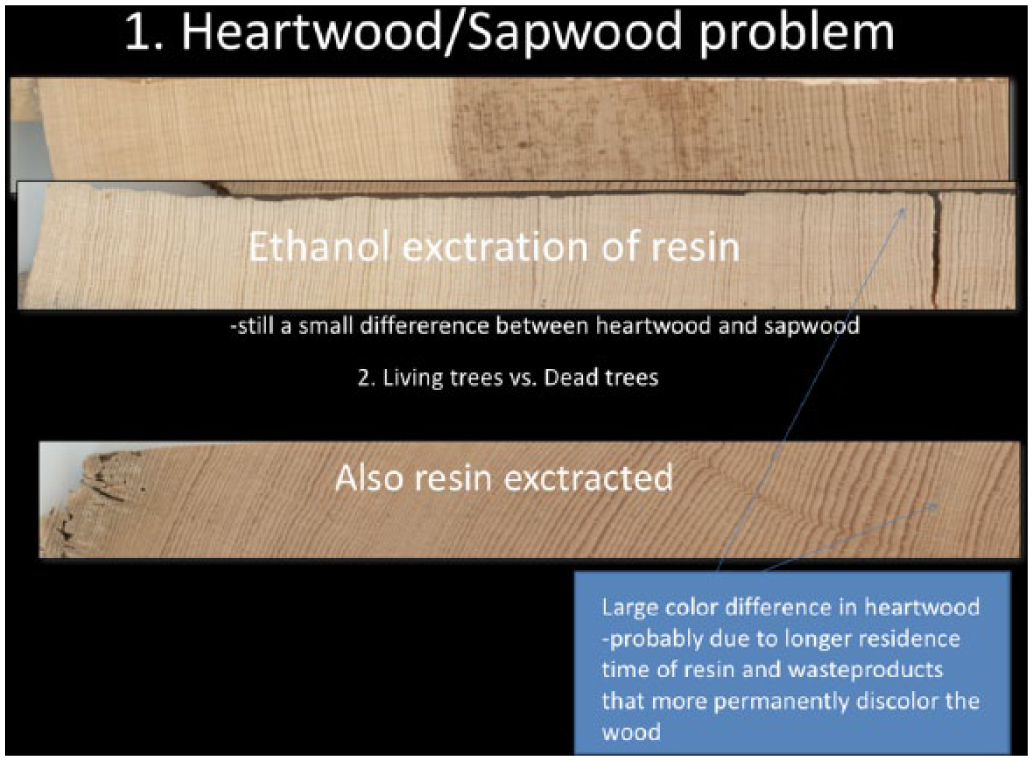
Jesper illustrated the potential for color bias using a sequence of two PowerPoint slides.
The last two presenters, Ryszard and Rob, introduced their presentations as cases where workshop participants could be optimistic about the potential of BI. Ryszard presented a ‘successful application of BI to dendroarchaeology’ in which he used BI to date archeological buildings in Poland. Rob presented the results of his experiment as an ‘example of what BI can do if the wood has no color boundary problems’ in reference to Jesper’s talk. He reported that Engelmann spruce trees from British Columbia did not have any observable heartwood/sapwood color distinctions. Rob focused, instead, on what he referred to as the ‘unknowns’ of his experiment results. He showed a statistic that he interpreted as evidence that BI data had less variance than density data and added: ‘Whether this is a good or a bad thing, I really don’t know.’ Pressured by the catering team, who were bringing trays of food into the workshop room, Rob jumped to the last slide where there was a sentence in red reading: ‘Overall, very encouraging results for BI for this tree species’.
The BI workshop finished with Rob giving a tour of the new laboratory (in Rob’s office), where he showed attendees the most valuable old sample in the SPP. We had an evening stroll along the St Andrews West Sands beach (famous for the opening scene of the film ‘Chariots of Fire’, as Rob reminded us). During the walk and ensuing dinner, the attendees continued talking about work and got to know each other personally and professionally.
Conferences
Rob, Jesper, and Ryszard met again nine months after the workshop, in January 2014, at an international conference in Melbourne. This is a fieldnote excerpt about their presentations:
What a morning! Just a couple of hours before his talk, Rob realized that he had forgotten the memory stick with his presentation slides in the hotel and had to go back to pick it up. In the conference program, Rob was the first presenter of the ‘methods development session’ but he negotiated with the other five presenters to shuffle the order of the talks just in case he wouldn’t be back to the conference venue on time. Eventually, they agreed to divide the session into two blocks of talks: the first block would be about density (three presenters) and the second block would be about BI (Rob, Jesper and Ryszard). Rob managed to be back at the conference venue on time. Despite all the stress, he was pleased to have changed the order of the talks, ‘Because now we have a distinct “blue session”’. The last density talk is from a researcher from Belgium who presents a new density machine that her team has been developing. There are thirty people in the room. I sit next to Rob. ‘This machine looks very expensive!’, Rob whispers to me. During the Q&A, Rob asks the researcher how much the machine costs; to his surprise, she does not know the cost exactly. It’s Rob’s turn. He stands up and goes to the front of the room. More people come in. Are they here to see the density talk that was originally scheduled? No, all of them stay when they see Rob’s introductory slide. There are around a hundred people, twenty of them sitting on the floor. I go to the back of the room to have a better view. I see a few familiar faces in the audience. For instance, ‘Antonio’, an Argentinian researcher that I had met on a dendroclimatology course that had taken place before the Melbourne conference, where I had done fieldwork. Antonio was one of my teachers and we got on particularly well, I think, because we were the only native Spanish speakers in the course. I say ‘hi’ to Antonio and he introduces me to two researchers working in his laboratory. Antonio has heard about Rob’s ‘new method’ and is eager to learn more about it. I overhear Antonio saying to his students in Spanish, ‘At last, we will learn about a method that poor dendro labs like ours can afford!’ Rob acts like a master of ceremonies. He begins his talk by welcoming the audience to the ‘blue session’ and telling us that his talk will be ‘complemented’ by Jesper and Ryszard’s talks. Rob shows us two slides where he has included Jesper and Ryszard’s names and a short sentence summarizing their contributions. The content of their presentations is the same as in the workshop in St Andrews, but their style and goals are different. The workshop was about examining BI conscientiously among people who were already committed to developing this new parameter. The conference in Melbourne is about convincing new people to join in the efforts. In Melbourne, Rob, Jesper and Ryszard transmit passion and excitement about BI. Rob invites (shouts!) everybody to ‘go out there and measure blue’. Jesper and Ryszard finish their talks with enthusiastic appeals to the audience ‘to go blue’. They have also coordinated their appearance; Rob tells me that they all have agreed to use blue in their slides. I listen and look at Rob, Jesper and Ryszard in Melbourne and I feel as though I am in the bustling food markets of my native Catalonia: Rob, Jesper and Ryszard act like lively market vendors trying to sell their best product.
The response of conference attendees to Rob, Jesper, and Ryszard’s invitation to experiment with BI was generally positive. Jesper was awarded a prize for his presentation and has become increasingly recognized as a BI expert. In February 2015, he began a postdoctoral job at a highly regarded Swiss laboratory, during which he planned to continue experimenting with BI. After the conference, Ryszard became a regular teacher of BI on a European annual summer course. While Rob was disappointed that nobody had asked him any questions after his talk (he complained that ‘[c]onferences are in fact really useless to get good feedback!’), he convinced Antonio to experiment with BI. Rob and Antonio knew each other by name, but met face-to-face in the course of a trip along the Ocean Road that I organized after the conference, to which I invited both. During this car trip, they agreed that Rob would train a student working in Antonio’s laboratory on how to generate BI data and, in exchange, Rob would receive the BI dataset from the Argentinian samples.
Rob’s ultimate goal, as he put it in another of his talks, was ‘painting the world BLUE’. By mid-2015, Rob had assembled BI datasets from Scotland, British Columbia, Sweden, Tasmania, Argentina, and the Yukon through different forms of collaboration. Rob knew a few researchers in Tasmania from the time he had worked there as a technician, and they allowed him to generate new BI data from local samples (after the Melbourne conference, Rob stayed in Tasmania for a month). Rob obtained the BI data from Sweden via Jesper. In the case of the Yukon, Rob generated BI data from the samples that he had inherited from his doctoral supervisor when he retired. In August 2015, Rob travelled to Canada to collect the inherited samples and deposited them at a laboratory in New York, ‘Lamont’, where he had worked as a postdoctoral student and maintained an affiliation. Rob had persuaded the members of Lamont to experiment with BI, and on his return trip to Scotland he stopped for a week at Lamont to train a couple of members of the laboratory and to generate BI data from the Yukon samples.
Rob’s strategy of expansion culminated in the first official symposium about BI, which took place at an international conference in Argentina in April 2016 hosted by Antonio’s laboratory. Antonio invited Rob to co-chair a symposium that brought together many collaborators of the extended network that Rob had cultivated over the years. In the session, called ‘Applications of BI in Dendrochronology’, participants examined BI datasets from around the world and Jesper presented the preliminary results of his new experiment in the Swiss laboratory.
Peer-reviewed articles
In April and June 2014, Miloš and Rob published the results of their respective experiments in two different journals. Miloš was the main author of a paper submitted in the European journal of dendrochronology (Dendrochronologia) and Rob published his paper in a more general paleoclimatology journal (The Holocene).
During the drafting of Miloš’s paper, they disagreed over the potential color bias in the BI dataset from Scotland. After hearing Jesper’s talk at the workshop, Miloš suspected that the color differences he had initially ignored in the Scottish samples could bias the two datasets (Ryvoan and Ballochbuie) used in the experiment. In his first draft, Miloš included a sentence expressing this possibility, but Rob included a comment, ‘Where is the evidence for this bias? You are creating problems out of nothing.’ Rob and Miloš met in September 2013 to discuss their disagreement:
You’re telling me not to make a deal about this heartwood-sapwood boundary change in the Scottish dataset and, yet, Jesper highlights very strongly in his draft paper that this is an issue.
The reason why I am telling you not to worry about it is because the data you’re including in the paper don’t show it.
Well, Ryvoan [dataset] sort of does …
Show me the graph! [They spend 5 seconds looking at the screen]
You see, there is a difference, especially in the Ryvoan data …. Can I just ignore it?
Just a minute. You’re seeing a difference but this is in just one site, we can’t make any judgments about the overall dataset. I think you should say [in the paper]: ‘We have compared chemical treatments on the same samples, for two sites [forests], and overall, the R2 results [statistics] are very similar’. So be positive about the whole thing! We want to sell the potential of BI and not get too bogged down in issues we have not yet fully addressed.
But …
Wait, let me finish …. Then in the conclusion of the paper you could say: ‘However, there is a potential for biases arising from heartwood and sapwood that needs further exploration.’ Then you can refer to Jesper’s paper.
Can I ask something? Miloš, what are you worried about?
I don’t want to get into a situation where Jesper, at about the same time, publishes a paper which addresses all the color bias problems quite straight on, and then in my paper I don’t make any mention of them as if I was trying to hide them … like in the ‘hide the decline’! [Miloš laughs nervously].
I understand but I am just trying to simplify your PhD process. In your first paper, this one, you want to make it as easy as possible. You’ve been lucky that these two sites behave quite well, but we now know that the wider network [entire dataset] has some problems. Your work with the CST method might resolve them. We will address these problems in a later paper.
Miloš was not convinced by Rob’s arguments and continued to investigate the potential biases. As Miloš explains above, he knew then that the overall Scottish dataset had some problems and, in light of Jesper’s paper about the color biases in the Swedish dataset, he felt he could not ignore them. As his comment about the ‘hide the decline’ also indicates, Miloš was concerned that outsiders to the community of dendroclimatology would accuse him of scientific fraud as had recently occurred during the so-called ‘Climategate’ scandal (Ramírez-i-Ollé, 2015).
After conducting a few more tests, Miloš reported triumphantly by email that ‘I have been able to demonstrate that the color bias in BI data does exist, and it is masked by specific detrending choices.’ Rob agreed with Miloš’s conclusion and was happy for Miloš to include one new figure (Figure 4) in the paper that was seen to represent this bias (Rydval et al., 2014: 202).
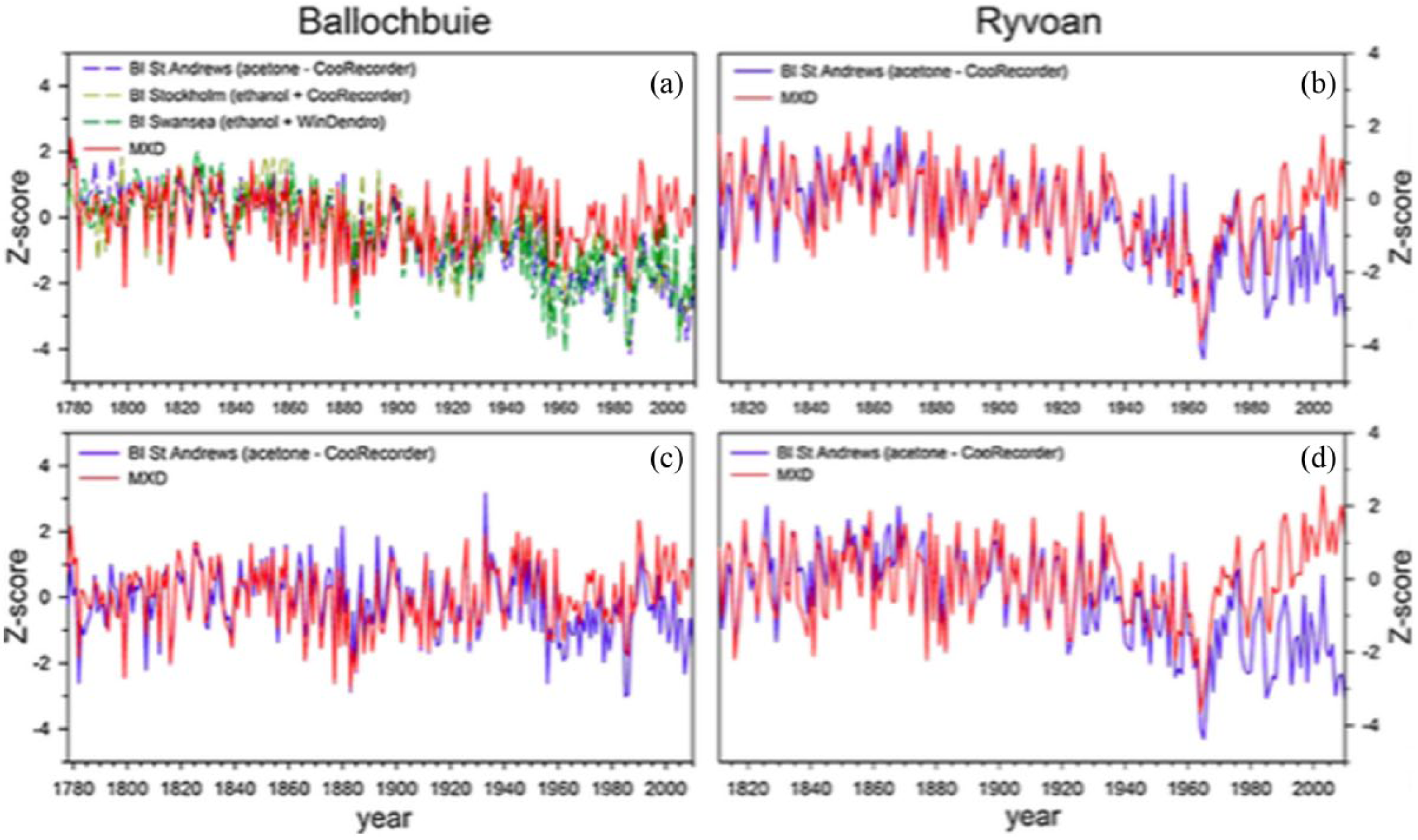
Miloš created this graph to convey his suspicion that the Scottish BI data were biased (‘a’, ‘b’, ‘c’ and ‘d’ are generated with different ‘detrending’ options; see Rydval, 2014: 202).
In turn, during the first round of reviewing of Rob’s paper, one reviewer complained that Rob was ‘overstating the cheapness of the method’. In the subsequent drafts, Rob sought to justify the importance of BI’s affordability by including a reference to a recent controversy in dendroclimatology. In Rob’s opinion, this controversy had shown the problems associated with the high costs of generating density data and having fewer density datasets. Rob’s overall point was that while BI was still experimental, its low cost would help less well-resourced laboratories to generate much larger volumes of data capable of yielding equally reliable climate information. Rob’s strategy was eventually successful, as one of the journal referees commented that
The work with its companion paper [Miloš’s paper] will be very much sought after in the literature as researchers move forward on technologies and new analyses. Wilson et al. have done a great service to the community here.
In their drafts, both Rob and Miloš were very careful to offer an assessment of the weaknesses of BI and to show that the relationship between BI and density was a win-win. Miloš calculated a statistic (the ‘Expressed Population Signal’) that he saw as an indication that BI was less ‘efficient’ than density because density provided better climatic information with fewer samples. Miloš concluded his paper by acknowledging the limited efficiency of BI but emphasizing its affordability:
Although some methodological issues still remain to be resolved, it is certainly not the case that there is little justification for the use of BI over MXD as suggested by Tene et al. (2011). On the contrary, the ease with which BI data can currently be generated and the relatively low associated costs alone should justify the attractiveness of this method for dendroclimatological research. (Rydval et al., 2014: 203)
After listing all the problems with BI, Rob concluded his paper recommending density over BI:
At this time, we still recommend, if funds allow, that density is the method of choice as there are still many potential uncertainties with the use of BI data. (Wilson et al., 2014: 9)
Civil skepticism and scientific credibility
In this section I will examine skeptical practices in the four sites described in this article – laboratory experiments, workshops, conferences, and peer-reviewed journals – in terms of four features: temporality, materiality, discursivity and performativity. This analysis is meant to offer a finer characterization of the ways in which civil skepticism was manifested in this case study while also illustrating the scope of a sociology of skepticism applied in other contexts. I will also conceptualize the overall role of civil skepticism in the constitution of BI and scientific knowledge.
Sketching a sociology of skepticism
Judgments about what is appropriate to doubt change over time. I conceptualize this temporality in terms of ‘suspensions of skepticism’, inspired by phenomenological analysis of everyday life that suggests that the mechanism of ‘bracketing’, or putting aside particular doubts, is important in maintaining interaction and preventing life from becoming paralyzed (Berger and Luckmann, 1967: 33). Reyes-Galindo (2014: 747) suggests that the ‘suspension of doubt is the sociological mechanism that allows knowledge to flow across the largest social distances’ in science. This is because, I suggest, suspensions of skepticism are themselves an act of trust in the skeptical abilities of others. If we were constantly skeptical about whether others are properly skeptical, we would end up not being able to use their knowledge.
As it applies to everyday scientific life, suspensions of skepticism occur when scientists defer the exercise of skepticism to other trusted students and colleagues, whether personally known or not, in order to consolidate knowledge and trust relations. One example of a suspension of skepticism is Miloš’s decision (made explicit by my questioning) not to test the calibration cards. As Miloš himself explained to me, he had neither the resources nor the expertise to put his skepticism into practice; instead he trusted anonymous experts and their ‘international standards’. Delegating the examination of doubts to other experts is the scientist’s ‘civil’ response to perceived divisions of labor and the limits to one’s competence as a skeptic. As a volunteer technician I also had to learn to become a ‘civil’ skeptic: I had to accept Miloš’s word and use the calibration card ‘as it is’, so that he could carry out other tests that he considered to be more important for developing BI and maintaining his trust relations with colleagues (crucially with Rob).
Training is the main ‘civilizing process’ (Elias, 2000 [1939]) whereby the neophyte learns to practice skepticism in line with communal norms of ‘civility’. As the student accepts the authority and instructions of the teacher, she becomes trusted as a competent member by the teacher and the community of experts that recognize the teacher as such (Barnes, 1985: 72–79). The relationship between Rob and Miloš illustrates how this mutuality emerges and affects skeptical practices. Because Rob considered Miloš ‘one of the best undergraduate students’ he had ever supervised, he entrusted him with the development of BI and the management of associated relations (i.e. by obtaining a doctoral scholarship for him and allowing him to coordinate the experiment). As Szerszynski (1999) suggests, trusting others is performative insofar as it is ‘an attempt to bind the “trusted” into a relationship and attitude of responsibility – and thus perhaps to alter their behaviour – through the taking up of a position in a social ritual’. In this sense, Rob was generally successful in binding students into a relation of responsibility by entrusting them with aspects of the SPP as student dissertation projects. Miloš certainly felt co-responsible for developing the SPP and BI and had a strong desire to reciprocate Rob’s trust by agreeing, either explicitly or implicitly, to suspend his judgment about certain ‘biases’ of BI that Rob and colleagues considered to be irrelevant (i.e. the calibration card or, as Exchange 3 illustrates, the effects of room humidity on BI data).
The fact that Miloš had been Rob’ student for a long time explains why, for the most part, Miloš’s skepticism was aligned to Rob’s. The only time when Rob thought that Milos’ skepticism was improper and that he was ‘creating problems out of nothing’ was during the drafting of Milos’ first research paper, which was a situation they had never encountered before. During their conversation, Rob sought to modulate Miloš’s skepticism in a way that ‘simplified’ his ‘PhD process’ into an article acceptable to peer reviewers and colleagues. This ‘simplification’ involved suspending Miloš’s judgment about the biases in the overall Scottish data and referring readers to a trusted expert (i.e. Jesper). Even though Miloš did not follow Rob’s instructions and insisted on investigating the bias identified by Jesper, his disobedience was not perceived by Rob as ‘uncivil’ because Miloš managed to mobilize new empirical evidence (Figure 4) that they both regarded as convincing. As I develop below, social arrangements are not sufficient for explaining patterns of skepticism and we need to consider material arrangements (including new datasets and evidence) that shape the way we perceive the world and the questions we ask about it.
Changes in both material/empirical and social circumstances can cause individuals to re-examine doubts previously suspended. Miloš’s reappraisal of the ‘heartwood/sapwood problem’ in his Scots Pine samples is one example. The workshop was a space where social relations were reconfigured – attendees established new trust relations and agreed upon aspects of BI about which to be skeptical. The fact that Miloš came to trust Jesper and his evidence about color biases during the workshop (Figure 3) explains why the former reconsidered the color differences of his samples. A few months afterwards, Miloš had grown very suspicious about the quality of his BI dataset. At the time of his discussion with Rob, Miloš was not only aware that the Scottish dataset had wider problems, but also that outsiders to the community of dendroclimatology could re-examine these problems in an ‘uncivil’ manner, as had happened during ‘Climategate’. Broader social changes, and more specifically the rise of a ‘culture of suspicion’ towards scientific experts (Barnes, 2005; O’Neill, 2002), can affect the skeptical dynamics within scientific communities and force their members to re-evaluate their work and practices as problematic.
A related second point is that civil skepticism has an important empirical and material dimension. Civil skepticism is not solely a matter of drawing on interpersonal trust relations or sharing a common skeptical attitude; it also results from the causal stimuli of our embodied engagements with objects in the physical world. In contrast with other approaches (Law, 2008; Barad, 2007), the kind of materialism I propose here retains a form of humanism – it values the epistemology of human communities and the ways we come to make sense of what is ‘real’ in the world (Calvert-Minor, 2014; Pinch, 2011) – and upholds the subject-object schema insofar as it seeks to investigate how humans work with, learn about, and represent a world ‘out there’ affecting humans’ senses and actions (Barnes, 2013; Bloor, 1999: 106). Østerlie et al. (2012) offer the concept of ‘dual materiality’ to understand the relationship between knowing and materiality and argue that ‘[k]nowing arises from the emerging patterns of interaction between material phenomena, the material arrangements for knowing about these phenomena, and knowledge practices.’ To explicate the dual materiality of civil skepticism would, therefore, involve showing the interplay between two materials: the phenomenon or research material under study and the conventional tools and techniques (including theories) that render the phenomenon problematic. In this article, the phenomenon under study is climate change (mediated by trees) and the tool and techniques are those for measuring and representing tree-ring parameters.
Two examples illustrate how the dual materiality of the trees and the techniques used to generate BI data matter when understanding the kind of doubts that Rob and colleagues felt appropriate to raise. The first example refers to Figures 3 and 4, which became accepted as evidence of the color biases arising from Scots Pine trees. Both images resulted from Jesper’s and Miloš’s skillful and socially ordered manipulation of digital visual technologies (PowerPoint, photographs, scanner and graphic software), measurement devices (CooRecorder) and chemically-treated wood. As Rob explained in the workshop, he did not need to worry about the ‘heartwood/sapwood problem’ in his experiment with samples from British Columbia because Engelmann spruce are physiologically different from Scots Pine trees and produce fewer resins. This example shows how the materiality of different tree species determined which aspects of the BI methodology were seen as worth investigating. The second example relates to the historical development of tree-ring parameters. Earlier, I argued that the ring-width and density parameters (material tools and techniques) developed as a means to apprehend locally diverse tree-ring patterns (material phenomena). Rob could not afford to produce density data, and thus, the (expensive) materiality of tools and techniques matters when understanding why he wanted to develop BI and why other ‘poor dendro labs’, using Antonio’s words, might also be interested. More generally, focusing on the materiality of tools and techniques allows us to examine the political economies of knowledge (Sismondo, 2010: 189). Rob clearly saw the development of a cheaper parameter as an opportunity for overcoming barriers to producing meaningful tree-ring data. For him, questioning the high costs of producing density data (as he did with the Belgian researcher in the conference) was entirely appropriate and necessary for producing better dendroclimatological knowledge.
The third point is that civil skepticism should also be regarded as a discursive practice. I have coined the term ‘skeptical display’ to describe exchanges of critical discourse that, within certain conventions of polite conversation and courteous mutual scrutiny, ensure that knowledge claims are ‘properly’ challenged. Skeptical displays are not purely discursive, because they always involve non-verbal practices of manipulation, representation and demonstration, but here I am emphasizing their discursive dimensions. As applied to scientific discourse, analyzing instances of skeptical display would involve describing and explaining the patterned variability of scientists’ skeptical utterances according to the available ‘conventions’, ‘audiences’, ‘situation’ and ‘purposes’ (Golinski, 1987, 1998: 107). The etymology of the word ‘skeptic’ – related to the Greek word ‘skopein’ (meaning ‘to view’), ‘specter’ (meaning ‘to see’), and ‘spectacle’ (Partridge, 2006 [1958]: 4217) – also suggests that skeptical displays could be seen as a form of ‘public demonstration’ in the broad sense given to this concept by Rosental (2013). In this way, expressions of doubt, both in talk and text, have a persuasive role (i.e. to gain support for one’s knowledge-claims) as well as an interactive one (i.e. to facilitate and create new exchanges and social relations).
Analyzing skepticism as a form of public demonstration, in the context of this article, means comparing spoken and written displays of skepticism across the four sites. In the workshop, there was the persistent presence of the language of doubt (Miloš’s ‘biases’, Jesper’s heartwood/sapwood ‘problem’, and Rob’s ‘unknowns’), which provoked intense interactions and audience interrogation. The fact that the undergraduate students did not ask questions during the workshop is indicative that there was a hierarchal distribution of skeptical interactions related to the status of attendees and their research experience (see Owen-Smith, 2001). Miloš’s presentation in the workshop also illustrates the existence of rhetorical scripts enabling civilized critical exchanges: he tried to preempt the audience’s objections by preparing extra PowerPoint slides in advance (Exchange 1), to acknowledge questions as valuable for future investigations (Exchange 2), or to argue, as politely as possible, that other questions are more important (Exchange 3).
The form, distribution, and intensity of skeptical exchanges at academic conferences generally differ from those in more intimate venues like a workshop. During conference presentations, possibly due to their formality and brevity, it is unusual to interrupt a speaker or ask multiple questions during the Q&A in the way Rob and colleagues did at the workshop. The relative heterogeneity of conference audiences might also mean that one potentially receives ‘uncivil’ questions from people who are not part of one’s group of colleagues, and hence do not share the same assumptions about what constitutes useful criticism. Rob’s disappointment about the lack of questions after his talk in Melbourne and his complaint that ‘conferences are in fact really useless to get good feedback’ is indicative of the different ways in which questioning (or lack thereof) is interpreted. From Rob’s point of view, the Melbourne audience did not respond to his expectation (shared with workshop attendants) of useful critical engagement and ‘good feedback’.
The way doubts are articulated and expressed is also important. STS accounts have traditionally emphasized the persistent removal of uncertainties throughout the fact-making process (Latour and Woolgar, 1986: 75; Star, 1985); however, the fact that both Rob and Miloš concluded their articles by emphasizing the ‘inefficiency’ of BI – and even recommended density over BI – is in line with recent literature that argues that displays of ignorance and uncertainty may be a resource that scientists use to become more credible (Rappert and Balmer, 2015) and to be able to cooperate with others (Shackley and Wynne, 1996). Balmer (2012: 73) also points to the idea that doubt can have a positive function in science (in terms of reinforcing trust relations and constituting collective identities) when he says that “scientists are socially legitimated doubters”.
A final aspect of civil skepticism is its performative effects, either corrosive or generative, on the relationships of trust upon which it is based. I use the metaphor of the parasite, particularly the feedback effects that the parasite generates on the host, to develop this argument. Traditionally, parasitism has been conceived as having negative effects as the parasite can harm and kill its host. Analogically, people who are seen to practice skepticism improperly could be characterized as practicing ‘uncivil’ skepticism and damaging trust relations. ‘Uncivil’ sceptics are not trusted by community members to be competently skeptical and are thus excluded from the community of producers of knowledge. In this article, I have shown that Rob’s comments about the cheapness of BI were seen by one reviewer as ‘overstated’, which could have potentially jeopardized the trust in which Rob was held by colleagues. By defending the relevance of the affordability of BI in relation to a recent controversy, Rob managed to transform his emphasis on the cheapness of BI from a reason to be skeptical about him and his new method to a reason for trusting him. Classic studies of scientific controversies (Barnes and Shapin, 1979) are typical examples of ‘uncivil’ skepticism, in which trust relations break down as a result of improper questioning.
If we consider parasitism as a symbiotic relationship – Gullestad (2011) suggests that certain parasites contribute to the survival of their hosts by protecting them from damaging organisms – we could argue that skepticism might have positive effects, making trust relations stronger and allowing the resulting knowledge to be seen as more objective.
The key argument I want to make here is that the four skeptical activities described –experimentation, workshop, conference and peer-reviewing – reinforced and expanded trust relations and made BI more credible. By performing the experiment as originally designed by Rob and Björn, Miloš honored the trust of his doctoral supervisor, and in turn, Rob was able to maintain his collaborations with Björn and Lars. Through the sharing of mutual and courteous skeptical evaluations of each other’s work, workshop attendees established an emergent community of trust and expertise on BI that became visible during the ‘blue session’ in the Melbourne conference. The enthusiastic skeptical displays that Jesper, Rob and Ryszard enacted in the conference in Melbourne reinforced the relationships that they had with members of his community. Jesper was awarded a prize and started a job in a reputed institution from which he could develop BI further. Ryszard became a regular teacher of BI in a summer course and potentially enlarged the community of BI users. Rob convinced Antonio to generate a new BI dataset, and this new collaboration was later the basis upon which Rob was invited to co-chair the first ever official symposium about BI, to which he also invited the researchers from the Lamont laboratory in New York. Finally, the skepticism that Rob and Miloš displayed in their papers was evaluated positively by one reviewer, and their methodology was described as ‘a great service to the community’.
The theory of the externalization of trust relations
In this concluding section I will analyze the laboratory experiments, the workshop, the conference, and the peer-reviewing as a sequence of events and offer an explanation of their overall role in the development of BI in the form of a theory that I call ‘the externalization of trust relations’. This theory builds upon Pinch’s (1985) schema about the constitution of observational reports in science and his argument that accounts of scientific observations can be characterized by their degree of ‘externality’ and ‘evidential context’. Externality refers to the degree of generalization of a claim from the particular empirical instance that it is supposed to represent. The evidential context refers to the contexts and audiences for whom a claim becomes significant. As Pinch (1985: 14) emphasizes, the value of his framework lies in clarifying credibility disputes by linking the content of a claim (its degree of generality) to the economy of risks and rewards of the relevant community of knowledge and intended audiences. Universal claims about a wide-ranging phenomenon might be more rewarding in terms of allowing scientists to make a more valued contribution to knowledge and society, but are also riskier because they involve more assumptions and ‘black-boxing’, and therefore are more likely to be criticized for being ‘overgeneralizations’.
The theory of the externalization of trust relations that I present here adds a third dimension – the expansion of the group of trusted peers beyond a ‘core-set’ (Collins, 1981) – to Pinch’s account of the constitution of knowledge-claims of greater relevance and generality (see Figure 5). 6 My interpretation is that there is a relationship between the development of BI and the trust relations upon which the four instances of skepticism were parasitic. As Rob managed to expand the number and geographical spread of BI datasets (higher externality in Pinch’s terms) and make BI more scientifically and politically relevant for studying global climate change (higher evidential context in Pinch’s terms), the trust relations upon which he depended to examine the method and make it more resistant to critique, and hence credible, became increasingly ‘external’ to the small group of collaborators of the SPP involved in the laboratory experiments.
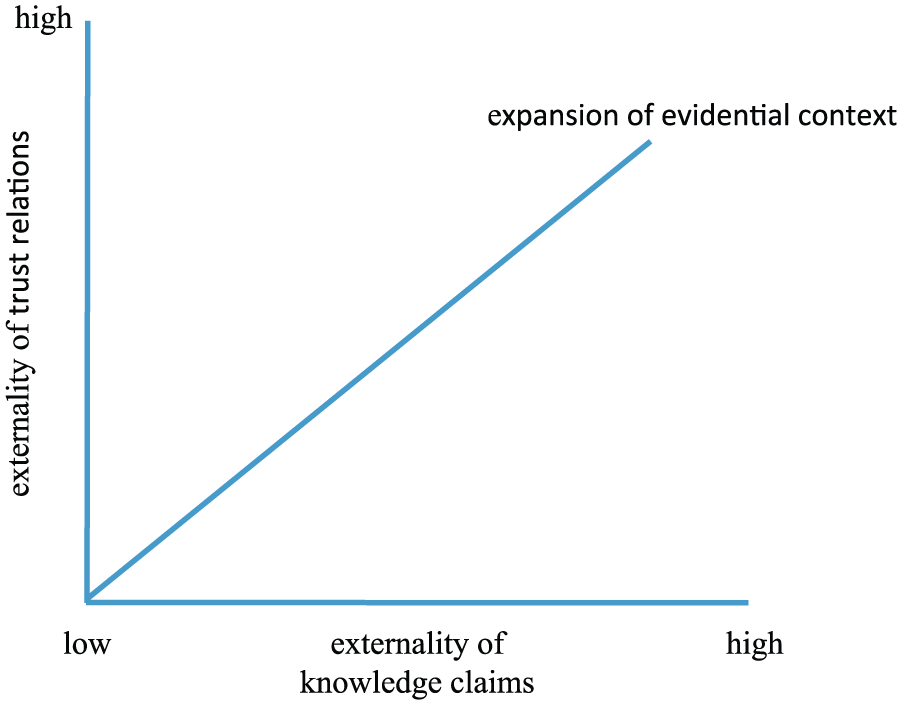
The externalization of trust and knowledge represented as a function of the expansion of evidential contexts and audiences.
Rob built up a larger and more extended community of trusted civil skeptics and developers of BI in two ways: first, by mobilizing ‘weak ties’ (Granovetter, 1973) in relations with acquaintances such as Lars, Ryszard and colleagues in Tasmania, Canada and New York; and second, by building upon the recommendations of friends or ‘strong ties’. 7 Because Björn recommended them as competent skeptical students, Rob accepted Emily into the experiment and invited Jesper to the workshop. Likewise, the collaboration between Rob and Antonio partly resulted from the fact that I had invited Antonio on the Ocean Road car trip. The importance of familiarity is obvious in the process of externalization of trust relations described here. It remains uncertain, though, whether trust in anonymous and abstract systems of expertise could become more relevant as the ‘core-set’ expands and more BI datasets are assembled. My hypothesis is that personal reputation linked to specific geographical areas of expertise is still important for the constitution of global climate knowledge infrastructures like the ITRDB (this is why the archived data can be filtered by the name of the ‘contributor’ and the local tree species– see Figure 3; see Decker, 2017: 16; Mahony and Hulme, 2016 for additional evidence supporting my supposition).
I characterize the expansion of the trust relations observed in this article as a ‘network’. 8 Rob ended up co-chairing the symposium in Argentina, but the development of BI should not be understood as a ‘monopoly’ whereby Rob managed to successfully impose a uniform practice. Rob facilitated the creation of new dispersed sites of BI practices (Tasmania, Argentina and New York) and made them interact with existing sites (Jesper in Switzerland and Ryszard in Poland) in gatherings such as the workshop and conferences. The clearest evidence of the disunified development of BI is that Jesper and Ryszard had already been developing BI before Rob invited them to the workshop, and they continued to do so afterwards in the form of new experiments and training without Rob’s intervention.
Rob’s distinct role in the development of BI was to coordinate ‘nodes of trust’ – that is, assemblages of people and their trusted students/colleagues, technologies, datasets and samples who were either already developing BI or had acceded to develop it after Rob’s mediation – and to create spaces where these nodes of trust could be scrutinized collectively and reinforced. 9 Ultimately, Rob’s power and leadership originated from his connectivity to distributed centers of knowledge and his ability to coordinate them in a way that served their collective interest in studying global climate change. 10 The nodes of trust that Rob convened in the workshop and conferences, despite being linked to independent research agendas, shared Rob’s goal to continue assembling a global tree-ring dataset (the ITRDB) that represents the local diversity of tree-ring species and patterns. These dendroclimatologists were not motivated to ‘invert the credibility’ (Lynch, 2010) of density with BI, but rather to establish an ‘equilibrium of credibility’ among methods, which might explain why Björn did not perceive the rise of BI as a threat.
The fact that a group of dendroclimatologists cooperated in developing BI does not mean that they did not pursue particular interests (Rob was clear that he wanted to ‘paint the world BLUE’, and ‘poor dendro labs’ saw BI as an opportunity to achieve more status and recognition within the community). What brought these ‘nodes of trust’ together was their shared commitment to achieving a communal and professional goal – that is, formulating claims about climate change of higher generality and relevance – which in turn sustained localized strategies and negotiations about what constituted appropriate, civil and constructive skepticism about BI.
Footnotes
Acknowledgements
My most wholehearted gratitude goes to Dr. Rob Wilson and Dr. Miloš Rydval who have endured my presence and my questions for years. Much of the research and analysis on which this article is based was conducted in the course of my Ph.D. studies at the University of Edinburgh. I am grateful to friends and colleagues in Edinburgh, in particular Professor Steve Sturdy, Dr. Emma Frow and Dr. Sara Beà, for their advice and support. I would also like to thank Roy MacLeod, the anonymous reviewers and the editors of this journal for their insightful comments and collegiality.
Funding
This work was supported by Obra Social Sa Nostra Caixa de Balears (Beca per a estudiar a l’estranger, 2009); the Economic and Social Research Council (studentship number ES/I017917/1); and The Sociological Review Limited Foundation (Research Fellowship 2017).