




Abstract
This article employs a feminist science and technology studies perspective to investigate how the cryo-vitality of frozen pet DNA is potentialized and animated. This is accomplished by empirically foregrounding the marketing material and online presence of two genetic pet preservation companies: PerPETuate and ViaGen Pets. While the allure of cryopreservation for pet owners is situated in light of the ability to re-animate and re-entangle biological matter into future (old) pets, the preservation of pet DNA is potentialized through the logics of love, sameness, purity, and kinship. The article shows how preserved dog DNA moves from a rescue discourse in which exceptional kinds of dogs are preserved to a preservation-of-kin discourse in which the preserved pet DNA is narrated in humanist kinship terms. Exploring the ways that pet DNA preservation and culturing is articulated from kin(d) to brand, the study speaks to the human-animal cryo-interface calling for scholarly attention to the emergent businesses in preserving biological material for one’s future use.
I was so devastated by the loss of my dear Samantha, after 14 years together, that I just wanted to keep her with me in some way.
Theorizing and analyzing cryo-kennels
Though the recent cloning of singer and actor Barbara Streisand’s dog, Samantha, caused a social media stir, 1 the genetic preservation of pet DNA appears to be the next step for an already commoditized and technologized pet and kin-making culture (Kroløkke et al., 2016; Nast, 2006b). In this article, I pursue a feminist science and technology studies (STS) perspective and respond to the questions: How is frozen pet DNA, in the case of PerPETuate and ViaGen Pets, potentialized? Upon which logics does the marketing of pet preservation draw? Whereas pet DNA preservation is offered as a service by a handful of businesses in the United States, PerPETuate and ViaGen Pets are the two leading North American preservation and cloning businesses. 2 Because pet preservation is mediated and marketed in various online forums, I empirically prioritize PerPETuate and ViaGen Pets’ online presence. All of the empirical work was undertaken during the period 2017–2018, and the data consists of the two company websites, thirty-nine client testimonials (available on the websites), two YouTube videos, one blog, and one transcribed radio interview. 3
In this section, I develop the concept of ‘cryo-vitality’ and put it in dialogue with the existing STS scholarship, thereby theorizing how frozen pet DNA is potentialized and animated back to life. Before discussing the ‘cryo’ component of cryo-vitality, however, I will briefly focus on relevant insights. Notably, STS scholars have theorized cryopreservation in light of the concepts of ‘latency’ and ‘suspension’ (Chrulew, 2017; Hoeyer, 2017; Kowal and Radin, 2013, 2015; Radin, 2013).
The choice to give priority to online marketing material was made for several reasons. Not only does the internet today, in general, function as a consumer platform for health and reproductive services (Kroløkke and Kotsi, 2019; Wilson and Suraya, 2004), it additionally grants prospective clients a glimpse of becoming consumers that are ‘free to buy any products (including specialized surgeries) in an increasingly mobile marketplace’ (Viladrich and Baron-Faust, 2014: 117). While marketing material, compared to interviews or observational studies, narrowly highlights the mediated cryo-commercial practices, this type of empirical material can also be seen, as noted in Nelkin and Lindee’s (2004: 11) work, as ‘narratives of meaning’ that manage and ‘filter complex ideas’ in very culture-specific ways. Consequently, in the case of pet DNA preservation, I archived the ways that preservation is mediated and marketed, offering an understanding of the taken-for-granted beliefs on cryopreservation, pets, DNA as well as the making of interspecies kin.
Once frozen, biological matter becomes latent. It transgresses bodily and temporal borders, enabling mobility and exchangeability providing frozen matter with new value (Radin, 2013). Key to latency is how cryo gives biological matter plasticity (Landecker, 2007). Biological material can be stored for personal future use as well as contributing to future biological resources employed in the biomedical sciences. In an analysis of the International Biological Program (1964–1974), for example, Radin (2013: 488) reveals how frozen indigenous blood turned into ‘new knowledge about biological variation as novel analytical techniques were developed’. Once frozen, the so-called ‘primitive’ indigenous blood became ‘latent’ material, transformed into ‘untapped genetic resources’ (Radin, 2013: 492). Paradoxically, the value assigned to indigenous frozen blood was predicated, as TallBear (2017) reveals, on the logic of indigenous death. In this imaginary, indigenous populations are turned into ‘static storehouses of data or natural resources for the production of knowledge for nonindigenous society’ (TallBear, 2017: 199). While latency refers to the ability to hold biological matter ‘still’ (Radin, 2013), ‘suspension’ additionally reveals what Hoeyer (2017) calls cryopreservation’s icy dramas. Cryopreservation produces ‘suspense’ in the sense of worry or excitement as well as in the sense of ‘suspension’ meaning postponement or delay (Hoeyer, 2017). In combination, the twin concepts of latency and suspension frame how frozen biological matter enters different value domains and achieves cryo-vitality in the process.
Because cryo-vitality, in this article, refers specifically to the domain of pet preservation, I also reference feminist scholars who challenge the human/animal divide (DeMello, 2012; Haraway, 2008; Nast, 2006a, 2006b; Squier, 2011). To these scholars, the breeding of animals constitutes an especially interesting and potent empirical site. For example, while dog breeding has historically been entangled with commercial practices centered on the ideals of exceptionality and purity, dogs have also gained value as workers, patients, technologies and family members (Haraway, 2008; Nast, 2006b). Through what Haraway (2008) frames as pet commercial practices and Nast (2006b) calls mobility in pets, pet love (notably the love for dogs) is heavily entangled with commodity culture. Shukin (2009) conceptualizes this entanglement of animals and capital in what she refers to as ‘animal capital’ (p. 7). Similarly, Squier (2011: 53), in her analysis of chicken and human fashion shows, theorizes what she calls an interspecies ‘cross-over aesthetic’ (p. 70). Jointly, feminist STS scholars help deconstruct the human/non-human divide while also examining how dogs, in particular, are anthropomorphized. Greenebaum (2004) shows how a commodity-driven marketplace becomes marketed as a family excursion and experience for a clientele of mostly purebred dogs and their owners. It is also at the heart of Nast’s (2006a: 897) coining of ‘critical pet studies’, which situates pet love in light of a larger political economic milieu.
Consequently, in suggesting ‘cryo-vitality’ as a theoretical concept, this article builds upon existing feminist work while simultaneously placing pet preservation within the politics of vitality (Rose, 2007). As Rose (2007) remarks, vitality involves the engineering and manipulation of life itself. In the specific case of frozen DNA, vitality engages with a selective yet ‘promissory relationship’ to the future (Chrulew, 2017; Thompson, 2005). The ability to freeze is, as Van Dooren (2017: 263) succinctly frames it, ‘the promise of vitality to come’ (see also Doyle, 1997; Kroløkke, under review). Cryopreservation promises to hold still as well as, on a more practical level, manage complex breeding logistics. In the case of animal reproduction, forwarding a shipment of frozen sperm cells is much easier (and cheaper) than sending the animal itself. The field of human reproductive medicine has historically borrowed from many of the techniques and methods developed elsewhere (Friese and Clarke, 2011; Parry, 2015), and today, preservation enables human sperm cells to be shipped by UPS across national boundaries (Adrian, 2017), for women to bank their egg cells for their own later use (Carroll and Kroløkke, 2018; Waldby, 2015). Cryo-vitality is exemplified in the making of ‘hopeful projects’ (Van Dooren, 2017: 262) as well as potentialized by visions of a (better) future. In the case of pet preservation, this may include the hopes of regaining a lost pet relationship as well as the preservation of pets that are made to appear ‘exceptional’.
Whereas cryo-vitality serves as a theoretical framework for understanding the human/animal/nature/culture/technology interface, I use the concepts of potentiality and animacy analytically throughout this article to help reveal how frozen pet DNA gains cryo-vitality. Taussig et al. (2013) trace potentiality as both an analytic and an object of study, showing how, within the field of medicine, it is frequently aligned with the promise of better treatment and new medical interventions. Potentiality is, according to them, ‘premised on disrupting the negative potentials of life – for example, various types of genetic mutations, deleterious microbes, unwanted cell growth and death, and injury and aging’ (Taussig et al., 2013: S4). Meanwhile, Waldby (2019) uses the term ‘potentiate’ to describe the cultural and technological processes through which women’s egg cells gain value. In this way, and specifically within the realm of anthropological and sociological knowledge, potentiality becomes future-oriented, revealing a plasticity of sorts (of the body, the cell, matter or the principle of potentiality itself) (Taussig et al., 2013: S4). Potentiality helps delineate how biological material gains value and at times becomes exchangeable.
Throughout this article, I transform ‘potentiality’ into a verb to help show how frozen pet DNA, in marketing material and client stories, is potentiated or potentialized. This is similar to Svendsen’s (2011, 2014) and Svendsen and Koch’s (2013) ethnographic studies, in which they show how piglets are potentialized through the rhetorical crafting of a salvation story. According to Svendsen (2014), in Denmark, piglets are bred and born to improve the lives of human premature infants. In her work, she questions how and under what circumstances ‘biological’ life is turned into ‘biographical’ life (p. 178). Here, biographical life is the result of potentializing the human infant (unlike the piglet) within a kinship and state structure reiterated in the presence of a home, a family, siblings, love as well as the prospect of becoming a fully-fledged member of the welfare state (p. 187). The manipulation of pigs’ lives is, in this context, deemed just and necessary, when entangled with the potential to save human infants (Svendsen and Koch, 2013). Consequently, potentializing involves ‘disciplining work’ as well as ‘a process of detachment and reattachment’ (Svendsen and Koch, 2013: S127). This process works, for example, when piglets are detached from the mother sow and transformed into biosamples. Once piglets become conceptualized as biosamples, the path ‘across space and species to neonatology’ is, according to Svendsen and Koch (2013: S127), paved. In the practices of de- and re-attachment, then, the piglet’s suffering and death is re-entangled with the promise and ‘responsibility for better human lives’ (Svendsen and Koch, 2013: S127).
Thus, in order to critically situate pet DNA preservation within reproductive and commodity culture, I analytically reference new feminist materialist and interspecies perspectives (Chen, 2012; Haraway, 2016). New materialism constitutes a stark reminder of the importance of the inanimate and the non-human. Relying upon the field of anthropological linguistics, Chen (2012: 24–25) discusses how ‘animacy hierarchies’ produce a particular order in which humans are positioned at the top of the hierarchy, receiving the most agential power, unlike ‘things’, which become linguistically objectified to ‘belong’ to the bottom. According to Chen (2012), humans and non-humans can become entangled to allow forms of humanization and dehumanization, reproducing particular hierarchies of stature and power. For example, suspected terrorists are depicted through an animacy hierarchy in which they are made to appear as ‘wild animals’, hunted down and dehumanized in the process. ‘Dehumanization involves the removal of qualities especially cherished as human’ (Chen, 2012: 43). Conversely, pets – and dogs in particular – are frequently ascribed human qualities (Greenebaum, 2004; Nast, 2006a). According to Nast (2006a), today pets supersede children as love objects, yet pet love is individualized, thus simultaneously upholding neoliberal and frequently also racial hierarchies. Pet love is animated as a predominantly white, individualized, free market and commodity affair.
In combination, whereas STS scholars help theorize how cryopreservation facilitates disentanglements (biological matter is suspended when removed) as well as re-entanglements (frozen biological matter becomes latent, enabling matter to enter into new social relationships), an interspecies framework acknowledges the ways in which bio- and reproductive technologies move between human-animal domains: from the domain of domesticated animals (such as dogs or the freezing and selling of bull sperm) to the preservation of wildlife and endangered species to the domain of human material (Friese and Clarke, 2011; Parry, 2015). The twin concepts of potentiate and potentialize are used interchangeably to discuss how preserved pet DNA gains cryo-vitality. The concept of animacy is employed to delineate power differentials related to the ways that species, humans and kinship, in the empirical material, come to matter. Meanwhile, cryo-vitality is developed and used to discuss how cryopreservation suspends future (pet) life, yet simultaneously opens up space for hopeful heteronormative potentiating stories to unfold.
Pet DNA preservation: The market and the logics
The preservation of pet DNA is, for PerPETuate and ViaGen Pets, an affectional commercial practice while simultaneously positioned as ‘the ultimate breeding technology’. 4 Like cord blood banking (Martin et al., 2008), the use of saliva as a source for measuring health and illness (Kragh-Furbo and Tutton, 2017) and the banking of one’s own egg cells (Waldby, 2015), pet cell lines turn into promissory substances, hopeful futures and commercial practices. In this way, pet preservation capitalizes hope and engages the promissory bioeconomy of ice (Kroløkke, 2018; Martin et al., 2008). Hope itself becomes a commodity ‘in the formation of new firms, services and markets’ (Martin et al., 2008: 141). In the case of pet DNA preservation, the process is made to appear simple and empowering. PerPETuate estimates its four-step process to take three weeks to complete. It involves ordering a cell collection kit and necessitates a trip to the veterinarian, who then harvests and ships small skin biopsies to the chosen laboratory. The laboratory processes and cultures the skin tissue, turning it into viable cell lines that can be readily cryopreserved. According to ViaGen Pets, millions of cells are cultured during a one-month process, then frozen and made to appear ‘indefinitely’ available (personal communication with ViaGen Pets). Once a clone is desired, the company harvests egg cells from a donor, removes the nucleus and injects the cells with the preserved DNA. In this way, several embryos are created and either frozen or implanted into a surrogate. 5 While emergency procedures are available for deceased pets, both PerPETuate and ViaGen Pets encourage prospective clients to bank for the future by procuring DNA from living pets.
Located in the United States, PerPETuate (Massachusetts) as well as ViaGen Pets (Texas) rhetorically establish themselves as global experts in the field of pet preservation and cloning. Whereas PerPETuate advertises itself as the first and foremost animal genetic preservation company when it stresses that ‘more pets have been cloned from our cells than from any other company’, 6 ViaGen Pets refers to its high-level, quality procedures, describing itself as the ‘Cadillac’ of animal care and technology. 7 In the case of ViaGen Pets, the love for animals, especially dogs, is moreover articulated and re-naturalized through photos of employees with their own apparently beloved dogs. 8 In its presentation, ViaGen Pets draws upon nationalist, elitist rhetoric, situated within an interpersonal and relational customer-oriented agenda (‘we’re committed to developing long-lasting relationships with pet owners’ 9 ). Meanwhile, PerPETuate, in its choice to visually and rhetorically foreground the ‘exceptional’ pet, positions itself closer to eugenics, yet simultaneously within a first-mover (‘the world’s first and foremost pet genetic preservation company’ 10 ) framework. The fact that PerPETuate, in its choice of visual imagery and story related to its founder, relies on an everyday presentational style, also gives this company a more populist appeal. The fee for culturing and cryopreserving cell lines is between US $1,300 and $1,600, while the total price of cloning a dog approximates US $50,000. 11 This includes a team of ‘world-wide experts’ and a ‘dedicated laboratory, with very specialized equipment in order to produce the miracle’. 12 At this price, the potential clientele is most likely to be upper or upper-middle class and white, and this is similarly reflected in the choice of visual imagery.
In what follows, the analysis is divided into three sections. The first section centers on a discussion of how pet preservation achieves cryo-vitality through discourses of ‘love’, ‘sameness’ and ‘purity’. The second section focuses on the ways in which frozen pet DNA achieves cryo-vitality when animated as a heteronormative kinship practice yet also, in this anthropocentric discourse, relies on the reinstatement of human exceptionalism. In the last section, I discuss the ways in which preserved pet cell lines refute the finality of death, yet in the marketing material escape monstrosity and manage to fit comfortably within quite normative interspecies relations.
The animation of love, sameness, and purity
Pet DNA achieves cryo-vitality when potentialized through discourses of love, sameness, and purity. In this discourse, preservation and cloning are normalized as ‘safe’ and even ‘natural’ procedures. ViaGen Pets, for example, advances a ‘nature’ argument, when it describes the clone as a ‘genetic twin’ who will live ‘a normal healthy and happy life just like any other pet’. 13 The use of the word ‘twin’ (unlike ‘copy’ or ‘clone’) naturalizes cloning technologies in light of a recognizable (and at times romanticized) reproductive outcome. Meanwhile, the procedure is further normalized through the production of a healthy clone (‘just like any other pet’). In this way, the ‘original’ and the ‘copy’ blend together – even temporally – reassuring clients that pet DNA preservation enables the re-creation of the old pet including the characteristics that made it beloved in the first place, such as intelligence, temperament and appearance. Unlike in Svendsen’s (2014) research findings, therefore, in this empirical material, cryo-vitality is premised on the fact that biographical life (the formerly living pet) becomes biological life (DNA) to return – as a ‘perfect’ copy or twin – to its former biographical life (the clone).
Moreover, throughout the empirical material, pet love and routinized forms of relations spark vitality into the cryopreserved DNA. As noted by one client in reference to the death of her dog: ‘No longer being able to wake up snoring, each blaming the other! No howls together under mad moon, paging antiquity. No face-licks of crystal love’. 14 While the interspecies intimacy here blends human and canine traits, it figuratively represents the power of pure love. Whereas interspecies intimacy might border on bestiality, turning the old as well as the future pet into a romantic love object, it is instead, in the testimonial accounts, managed by re-positioning the effect of love in light of human-maternal qualities. For example, one client recollects affections of care and love by stating: ‘He [the dog] would lay on his big soft dog bed with his head on the edge like a pillow and wait for me to “tuck him in”. I would cover him to his chin with his bright blue blanket.’ 15 In engendering interspecies love in the shape of a maternal behavior, pet preservation is turned into the prospect of a continued maternal, loving future. This client also notes: ‘Looking forward to the day when we welcome his “twin” home!!’ 16 Love legitimizes, as Ahmed (2003, 2004) says, a particular future, naturalizing bonds and reinstating gendered behaviors and markers in the process.
While pet love naturalizes the desire to preserve pet DNA, preservation is simultaneously potentialized in light of a desire for sameness. Unlike the breeding of pets, which is seen as resulting in only ‘half of the genetics’, the company assures that preservation engages the promise of ‘all of the genetics’ (radio interview, PerPETuate). ViaGen Pets similarly stresses the vitality of sameness and productivity (‘all of the genetics’), when it guarantees its success through the dog pedigree, rearticulated here as a genetic report from an independent university genetic laboratory that testifies to the unaltered genetic material. Moreover, sameness is manifested not only in the relationship between the ‘copy’ and the ‘original’, but is also cemented in the reiteration of the continued (same) human-animal relationship. Here, the preserved dog DNA is imagined as ultimately resulting in a dog that is both new and old. As noted by one client: ‘I’m hoping that someday, I can bring back at least a version of Jack, and love him as much as I did the original.’ 17 While the trajectory of preserved pet DNA achieves vitality, when moving along a trail of sameness in which the frozen cultured cell lines are mobilized to provide the preserver with pet and affective continuity; in the articulation of sameness and authenticity, preserved pet DNA once again becomes biographical life. It becomes life that engages the promise of a continued human-pet relationship. In human contexts, biographical life is accomplished by ‘placing the child in social relationships and linking him or her to the homes where parents and older siblings, close relatives, or friends have their everyday lives’ (Svendsen, 2014: 184). Similarly, in this case, frozen pet DNA is articulated as having a home, expressed also in the desire to bring the dog (biographical life) ‘back’ as well as in affective outbursts (‘love him as much as I did the original’).
Whereas pet DNA preservation is an attempt to ensure sameness, it also achieves vitality when its ‘plasticity’ (Landecker, 2007) secures a particular kind of breed. On the ViaGen Pets website, for example, we can read about the dog Jetta who epitomizes ‘perfection’, characterized here discursively as ‘beauty, personality, heart and temperament’. Similarly, in a radio interview, the president of PerPETuate stresses exceptionality as an underlying reason for preservation in the first place, when he says: ‘You only want to do this because your dog is exceptional – which probably means that he is exceptionally intelligent’. 18 The reasons why people choose to preserve pet DNA and later clone it is reiterated throughout the radio interview within discourses of purity and exceptionality: ‘It is people who have exceptional pets. Most of these people have more than one pet – this is the most exceptional pet that I have ever had, and I cannot afford – emotionally – to lose him’. 19 Alternatively, exceptionality and purity can be accomplished in the making of what is constructed as great dogs that ‘embody the type of breed’ (Haraway, 2008: 148). Meanwhile, Parry (2015) frames exceptionality critically when arguing that assumed superior genetic traits reproduce imaginaries of ‘biosocial elites’ (p. 54). In PerPETuate’s marketing material, exceptionality is visually portrayed through purebred looking puppies that are made to appear cute and simultaneously come to represent smaller and younger versions of the adult dogs being cloned.
Whereas puppy clones hold the promise of continuation (and multiplication) of adult dogs, often personalized and gendered, pet preservation is turned into bits and pieces of various biomedical markers articulated on the PerPETuate website as the dog’s ‘DNA signature’. As echoed in the work of Nelkin and Lindee (2004: 16), DNA has become a marker of identity: ‘The gene is, rather, a symbol, a metaphor; a convenient way to define personhood, identity, and relationships in socially meaningful ways.’ It becomes, Nelkin and Lindee (2004) note, a ‘supergene’ (p. 16) or a ‘truth machine’ (p. xxi). This is also evident in the use of the recognizable double helix as well as in listings of biomedical markers representing the cloned dog’s new pedigree. Through this recognizable icon, the dog’s qualities, now reformulated into a DNA signature, are framed as easily preserved for later use. Consequently, while puppies come to signify the promise of sameness and purity, certificates of preservation turn into pedigrees promising particular kinds of dog. In this way, pedigrees reiterate what Parry (2015) calls a ‘biologized vision of society’ (p. 54).
Although preservation can potentially be used on all pets, only the DNA of certain pets is, in the empirical material, animated as having cryo-vitality. Notably, the owner of PerPETuate uses a eugenics discourse when he terms pet preservation as a rescue technology, resulting in breeding potentially becoming obsolete: ‘Through this technology, we may be able to eliminate the unwanted pets. You would do away with breeding – you would just neuter every pet that is born, and you could do away with some of the diseases that pets have’. 20 As echoed in feminist STS, preservation is frequently potentialized in light of salvation imaginaries (Kowal and Radin, 2015; Radin, 2013). Here, the preservation of pet DNA is, moreover, re-aligned with the production of a superior kind. In this way, pet preservation is framed to facilitate the production of certain ‘desirable’ kinds of pets. As noted by Koch (2004), eugenics has historically involved attempts made at controlling reproduction. Parry (2015) also points to this in her comparison of the pedigree and advanced sperm donor profiling. According to her, selection is a mechanism rooted in ‘the eugenicist agenda of propagating the fit at the expense of those deemed less worthy of reproduction’ (p. 69). Pet DNA preservation expands this understanding of eugenics, however, by enabling the individual pet parent (based on their economic and affective human-dog ties) to (re)gain their ‘superior’ dog.
From kind to kin 21 : Keeping it in the (human) family
Anthropologists and STS scholars have documented how dogs have historically been positioned as workers, guards, helpers, commodities and stand-ins for humans, as well as companions (DeMello, 2012; Haraway, 2008; Tjørnhøj-Thomsen, 2016; Williams and DeMello, 2007). In this section, I analyze how dog DNA gains cryo-vitality when potentialized as kinning. In so doing, I echo Haraway’s (2008: 150) notion that kind and kin, in the face of bio- and reproductive technologies, often mutate. Preserved dog DNA achieves cryo-vitality in part due to the reinstatement of the beloved pet within existing human kinship structures.
In anthropomorphizing dogs as family members, the preservation of pet DNA is re-articulated as a form of responsible, even attractive type of kinning. ViaGen Pets, for example, emphasizes a human kinship structure when it promises to serve ‘pet parents worldwide’ 22 (emphasis added). In several of the testimonials, available on the ViaGen Pets website, dogs are repositioned, in their commitment and interactions with humans, as heroes as well as unique companions. Angel, for example, is positioned as having rescued her owner when crawling underneath the bed, saving her diabetic owner from a low blood sugar episode. As noted by the owner: ‘I want to clone “Angel” in the hope that there will be another “Angel” like her, in my life.’ 23 Meanwhile, preserved pet DNA gains cryo-vitality when restoring other kinship structures such as canine-sibling relationships. Another testimonial account reiterates this sentiment: ‘Jetta and her sister Axe were inseparable, and Axe is patiently awaiting her twin clone. As a pack, we shared exciting, unforgettable adventures together and we are ecstatic about Team ViaGen reuniting us one day.’ 24 While dogs are potentialized through a human kinship structure in which they become important, even irreplaceable family members, humans, at times, also take on animal-like behaviors: ‘As a pack, we shared exciting, unforgettable adventures together.’ 25
The ViaGen Pets YouTube video similarly paints a recognizable kinship picture. Here the heterosexual, white, nuclear and perfectly sexed and gender-balanced family centers on the image of their dog. In the first image, the children, sitting next to their same-sex parent, are younger (crawling on their knees or in the arms of a parent; see Figure 1) while in the second image, they have matured and visually transformed into excited and playful ‘siblings’. Whereas the dog Buddy is featured as friendly and, at the age of 12, wise and accomplished (wearing graduation and birthday gear as well as glasses; see Figure 1), he is re-potentialized when turned into a puppy and Buddy 2. In the screenshot of Buddy 2, the viewer is assured that Buddy’s genetic material has not been altered (‘none of the [DNA] was changed’). Meanwhile, the second image replaces the clouds (perhaps signaling the onset of aging and death) with the sunny outdoors (re-signifying the birth of Buddy 2, Figure 2). In both images, Buddy is made to appear real, while his nuclear family appears cartoon-like and, accordingly, could be any white, heteronormative, home-owning (middle-class), nuclear family. While Buddy moves up the animacy hierarchy by taking on the position as a key family member (located visually in the middle of the group), the vitality of this white, heterosexual, middle-class, perfectly gender-balanced family is re-animated as well.
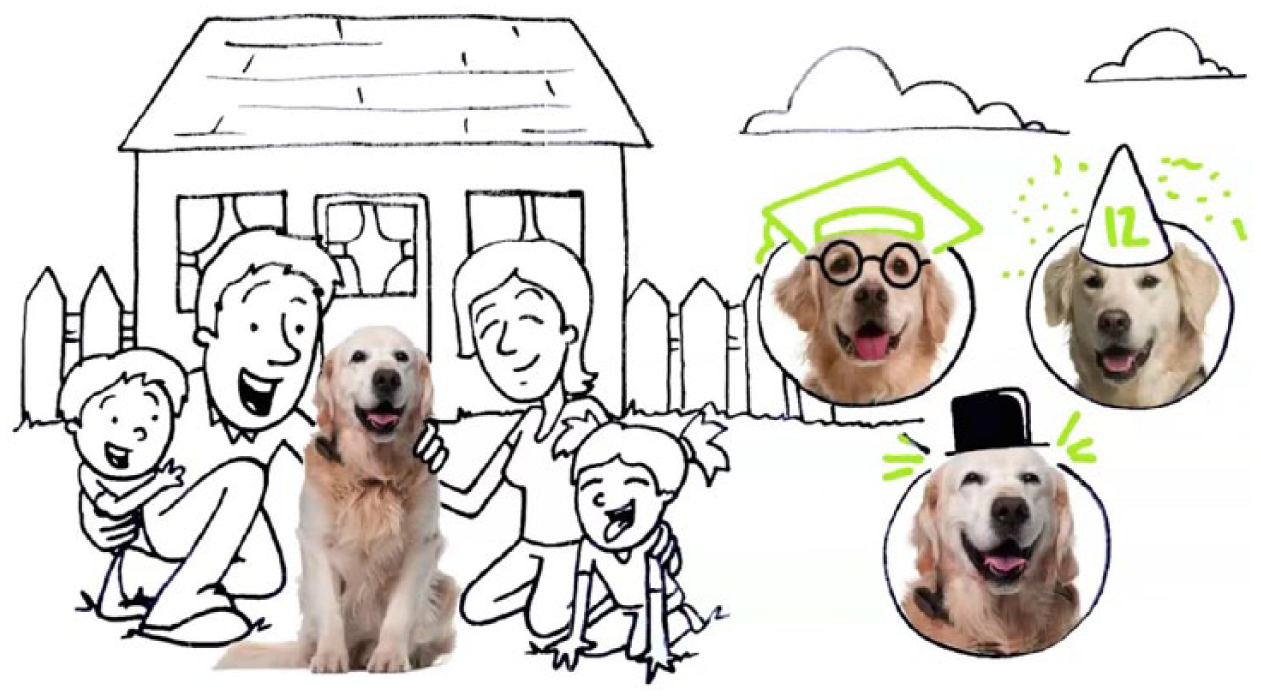
Screenshots from ViaGen Pets YouTube video. The cloning of Buddy (Buddy 1) (taken from: https://www.youtube.com/watch?v=8WM5ZH_8x2w, accessed 5 March 2018).

Screenshots from ViaGen Pets YouTube video. The cloning of Buddy (Buddy 2) (taken from: https://www.youtube.com/watch?v=8WM5ZH_8x2w, accessed 5 March 2018).
In the testimonials, preservation becomes re-articulated as a form of grief management. One ViaGen Pets client stresses this, when she, in reference to her dead dog, says: ‘I lost my child and 138 days later the only comfort I have is knowing that because of the work of places like ViaGen one day I might be able to hold my precious baby girl again.’ 26 Here the potentializing of the pet as a human ‘child’ and the desire for future relations animate the dog as a very particular type of biological kin: that of the human girl child. Similarly, another client notes that preservation turns absence or death into a future promise: ‘I look forward to the day he bounds into the room and jumps on the couch to give me a big lick on the face.’ 27 Characteristic of the client testimonials is the promise that preservation will restore the vitality of what once was – including that of the human-pet relationship. Here, preservation and later cloning become alternatives to cremation or a funeral. In this type of grief management, death itself is put on hold or, as noted by Radin (2013), cryopreservation transgresses temporal borders.
In the discourse of dogs becoming children, pets take on particular ‘child-like’ behaviors. As noted by one client in reference to her dog: ‘He also had a temper, throwing his dish and clubbing me with it when he didn’t get his preferred meal.’ 28 While this dog is positioned as ill-behaved, he is anthropomorphized, not unlike a child or a teenager, as having a bad temper and being self-centered. In the discourse of which this is a part, pets move up the animacy hierarchy by becoming animated with human-like traits (enthusiasm, determination and even self-centeredness) yet simultaneously reiterate very normative understandings of human families, including that of teenage and child-like behaviors. More broadly, the burgeoning economy in pets and pet-related services indicates that pets are increasingly being treated like children. 29 As an analyst for the market research company Packaged Facts says: ‘Whatever you might want to give yourself and your children, you might want to do for your pets’ (Entis, 2016). This might include specialized pet foods, designer clothes and collars, high-end pet hotels, webcam TVs (so that humans can watch their pets while they are away at work or on holiday), pet photography, pet spas and facials, daycare, and end-of-life care at select pet hospices. In her study of ‘Yappy Hour’ at Fido’s Barkery (a dog treat bakery) located in Hartford Connecticut, USA, Greenebaum (2004) reveals how the marketplace in pet activities has contributed to a change in human-animal social relations. At the Barkery, dogs are seen to take on the personality and traits of their ‘pet parents’, effectively transforming pets into children, or what Greenebaum (2004: 117) humorously labels, ‘fur babies’.
Throughout my empirical material, kinship with dogs involves doing extensive memory work (Carsten, 2004; Kramer, 2011). In the client testimonials, kinship is expressed through remembrance practices, seen, for example, when dogs take on the position of the child: ‘we taught him to swim’. Or the dogs might become protectors: ‘When we swam, Bozz watched us closely. He could tell when the water got too high, and would cry, dive in the water and drag us ashore. He felt swings were dangerous for us, too.’ 30 As noted by Kramer (2011), memorialization works by creating a link between the living and the dead. The activity of remembrance re-establishes meaningful relations, and even naturalizes affective connections, between pets and their owners. Pet preservation gains vitality, as it is mediated here, in its ability to restore not only the particular dog, but in fact the particular human-dog kin relationship. As noted by Haraway (2008), and in reference to reproductive technologies, in general, the ‘lure of kin making is the name of this promissory game of reproduction’ (p. 66). Pet preservation gains cryo-vitality by engaging the hope and promise of a particular future including that of the restored heteronormative, white, middle-class family unit.
Does frozen dog DNA bark back?
While the cryo-vitality of pet preservation is potentialized as honoring that ‘special pet’, 31 the founder of PerPETuate makes one exception to this, perhaps accidentally invoking a Frankenstein’s monster. When explaining the reproductive processes involved in preserving and later cloning, he says: ‘Cryopreserve the cells till you are ready to clone. Shoot it with a shot of electricity and it becomes an embryo. The surrogate mother takes it to term’. 32 The disruption involved in bringing dead matter to life, along with the excessive desire for a particular pet is, however, consistently, in the empirical material, taken out of potential monstrosity and instead managed in light of a discourse of specialness and the human family. Moreover, completely absent from this discourse is the reproductive labor involved, including that of the surrogate pet. As it is managed here, pet preservation and cloning bear a strong resemblance to human assisted reproduction in which the desire of the intending parents and the clinical reproductive expertise overshadow the reproductive labor involved (Pande, 2014; Rudrappa, 2015) In contrast to the vitality and the animacy of the clone, the surrogate is positioned low on the animacy hierarchy. A researcher from the South Korean Sooam Biotech Research Foundation, in an interview with Vanity Fair, states: ‘We breed the surrogate moms to be docile and gentle’ (Duncan, 2018).
Interestingly, in the marketing material and in client testimonials, the suspense of Frankenstein monstrosities frequently associated with cloning are nowhere to be found. Franklin (2007), in her work on Dolly the sheep, situates cloning in light of technological and economic innovations. She simultaneously roots these technologies within British nationalist and imperialist self-understandings, when she says about sheep in general: ‘As an ensemble, these sheep offer images of nature, culture, and industry woven together in sheep’s wool to suggest the fabric of a nation in which even the animals are man-made’ (p. 83). Similarly, the preservation of dog DNA is rhetorically situated within the commodification and technological kin-making culture supporting neoliberal, North American white family values. Pet cloning is made to appear acceptable in part due to its sharp species boundaries (notably between the puppy and the human baby). With reference to Dolly the cloned sheep, Franklin (2007) argues: ‘She thus stands for the desire to distinguish the animal from the human, and to prevent their mixture, while also, paradoxically, embodying their ever more proximate union’ (p. 30). Consequently, while dogs are articulated in the marketing material and in the testimonial accounts as ‘furry love-children’, it is exactly because they are not children that they – as clones – can reappear as dogs.
Pet DNA preservation disrupts temporality in several ways. For one, preservation promises to expand the lifespan of a particular pet and a particular pet relationship. As noted by ViaGen Pets in an interview with The Washington Post: ‘Pets’ lives are very short compared to ours’ (Marks, 2017). In the marketing material, pet preservation readjusts the human-canine relationship to fit that of a human lifespan. While ViaGen Pets, on its website, specifies that preservation opens a ‘new window for extending their relationships with their beloved pets’, 33 in popular media accounts, preservation is also narrated as the reiteration of a monogamous human-pet relationship: ‘In the future, you will have the same pet your entire life’ (Winkie, 2017). Thus, although preservation disrupts the finality of death (Radin and Kowal, 2017), in its promise to clone and restore the ‘original’ pet, another lineage is reiterated. Preservation promises to secure the temporality of an already perfect kind/kin and in this way, the quest to preserve for the future aligns itself with other preservation efforts such as the preservation of endangered species animated through the use of rescue and conservation logics. This is also echoed on the ViaGen Pets website, when they write: ‘We believe that moving the promising and exciting area of animal genetic research forward will benefit all animals.’ 34 In this discourse, the cryo-vitality of the frozen cultured cells lies in their ability to restore temporality in order to fit that of the exceptional human life, including the restoration of quite normative family values as well as their future potential as a rescue technology.
In the midst of these affective commercial practices, does frozen dog DNA voice a chilly bark? While the technology of pet DNA preservation, and most notably the client testimonials, may disrupt what cross-species intimacy looks like, my analysis has highlighted how PerPETuate and ViaGen Pets, in their marketing material, cover up this potential disruption. In the commercial discourses, preservation and cloning practices are turned into recognizable affective conservation efforts involved in the rescuing of so-called special dogs. Moreover, both companies go to great lengths to reassure us that pet preservation – no matter how expensive and technology-based – is solidly situated within core white, middle-class family values. Unlike the suspense associated with the preservation of human DNA and the potential cloning of human children, in this marketing material, cloned pets reiterate firm species boundaries. Thus, whereas the beloved pet metaphorically takes on the role of the human child, it is in fact its position as a pet that enables it to swiftly move into the domain of a clone. Moreover, rather than transgressing into the monstrous domains of bestiality, as evidenced, for example, when individuals choose to marry their pets, 35 the desire to preserve (and later clone) one’s dog becomes domesticated in order to fit within arguments of greatness, including that of (white) Western family values. In this way, pet preservation reiterates what Haraway (2008: 146) calls the ‘reproductive tie’ to the preservation of endangered species, plants and human reproductive tissue, yet also to human exceptionalism.
From kin(d) to brand
Pet DNA preservation achieves cryo-vitality through discourses of love, sameness and purity, as well as in the reinstatement of the perfectly cloned pet and the white, heteronormative nuclear family. Pet DNA is potentialized through pet love and the use of human-like characteristics. In the preservation of ‘special’ pets, cultural ideas of kin (dogs as ‘fur babies’), kind (type of breed and the exceptionality of particular breeds), and brands (Barbara Streisand’s Coton de Tulear clones, for example) come together. In this concluding section, I return to an interspecies framework (Chen, 2012; Haraway, 2008, 2016; Parry, 2004) in order to summarize the logics upon which the marketing of pet preservation draws.
Pet DNA preservation cements the idea that (certain) dogs 36 can be mobile and exceptional human companions forever. Cryopreserved pet cell lines secure the making of kin/kinds as well as the production of individualized types of brands such as Streisand’s dog. In the case of pet preservation, pets become temporally mobile, promising the re-establishment of pet love and interspecies forms of kinship. When cryopreservation is further ignited in light of ‘genetic merit’ and thus draws upon a eugenics discourse, it raises questions related to which animals are worth preserving including the re-iteration of the exceptionality of particular types of breeds. In this way, pet DNA preservation and cryo-vitality become entangled with an increasingly commercialized, biologized, and anthropocentric cryo-culture.
The preservation of pet DNA disrupts a linear temporality and blurs the boundaries between life and death. Yet the fact that the ‘copied’ dog, without any cultural unease, becomes the ‘twin’, who extends the biographical life of the ‘original’ dog, reiterates that pet preservation relies upon strict biologized species boundaries in which only pets (not human children) can be cloned. Preserved dog DNA restores the vitality of the white, Western nuclear family in the (re)production of hyper-individualized kin(d) and brands of dogs. This study testifies to humans and dogs becoming, as Haraway (2008) aptly notes, ‘mutually adapted partners in the nature-cultures of lively capital’ (p. 62). Cryopreserved pet DNA achieves cryo-vitality, revealing the affective power and technological vibrancy and promises associated with putting cell lines on ice.
Footnotes
Acknowledgements
I am profoundly grateful to The Five College Women’s Studies Research Center (FCWSRC) for providing me with the space to imagine, talk and write this project. Thank you to the 2017–2018 sharp and fun research fellows and thank you to Jennifer Hamilton for her ideas and leadership. Thank you also to the participants in the Cold Storage: Time, Temperature and Transit in Feminist Science and Technology Studies symposium (held at FCWSRC) and to the Independent Research Fund Denmark for generously funding my research stay (Grant # DFF 7013-00042). The four reviewers and the editors of Social Studies of Science provided me with very engaged and constructive suggestions: Thank you!
Funding
The author(s) received financial support for the research, authorship, and/or publication of this article: Independent Research Fund Denmark, Grant # DFF 7013-00042.
