



Abstract
This study shows how occupational, organizational and institutional boundaries can be reworked to enable innovation. Based on an historical case study of NASA’s Spitzer Space Telescope, which spanned three decades and two dozen organizations, I show how megaproject members made boundaries a target of strategic action. Megaprojects, in particular, require us to think about boundaries at multiple levels as they commonly draw on expertise and resources from different disciplines, organizations, and institutional domains. This case reveals several mechanisms by which boundaries can be modified to coordinate diverse innovation partners, from reconfiguring the ways members relate to one another (splicing, fitting and channeling) to reshaping the environment they work in (softening, fusing and corralling). Overall, this study contributes to our understanding of how actors make room for new ideas and cause institutional change as part of innovation processes. By treating boundaries as malleable and multiplex, I extend organizational theory, which tends to view boundaries as given and things to be spanned. I extend the STS literature that takes boundaries as fluid, identifying several mechanisms of making and unmaking them. A more dynamic treatment of boundaries is called for in both innovation research and practice, and this study opens a path for research that looks not only at boundary objects but also boundary actions, and moves from boundary organizations to boundary organizing.
Managing boundaries in innovation projects
Boundaries order the social world. They form conceptual grids on which we lay out the meaningful distinctions between social entities and the relations among them. We readily create boundaries, whether of places (laboratories, legislatures), persons (scientists, senators), or practices (research, regulation). A boundary is fundamentally a choice about what to include and what to leave out (Zerubavel, 1993) – choices that bind groups and influence social relations (Bowker and Star, 2000; Lamont and Molnár, 2002). According to Tilly (2004), boundaries exist when there are distinctive social relations within each group, distinctive relations between them, and shared representations of these distinctions across the groups. Thus, a boundary is a shared understanding about whether and how things are connected, both relationally and structurally.
Ideas originate and live within domains (Gieryn, 1983), yet during the innovation process ideas are imported, exported, relocated and recombined. Thus, boundaries are regularly breached due to the displacement that occurs during the introduction of new products, processes, materials, markets or organizational arrangements (Fagerberg et al., 2005; Vaughan, 1999). Integrating novelty into existing arrangements is challenging because, as Dougherty and Heller (1994) observe, innovation activities ‘either violate prevailing practice, inside and outside the firm, or require ways of thinking and acting that are “undoable” or “unthinkable”’ (p. 202). In other words, boundaries are problematic in innovation – and studying this tension can yield insights about the dynamics of boundaries. Boundaries are defined by (and in turn define) the very occupations, organizations and institutions that must be brought together for innovation – a common theme in radical or large-scale scientific projects (Biagioli, 2007; Lifshitz-Assaf, 2018; McCray, 2004; Messeri, 2017; Vertesi, 2012). When these domains are too far apart, innovation is hindered (Ferlie et al., 2005; Rogers, 2003).
Integrating ideas and resources in an innovation project is especially challenging due to the multilevel boundaries that need to be taken into account – the occupations of the actors, the organizations responsible for the work, and the institutions that impact the activity. A wide range of bridging and brokering mechanisms have been proposed for innovation, including boundary-spanning individuals (e.g. Aldrich and Herker, 1977; Evans and Collins, 2010; Levina and Vaast, 2005; Obstfeld, 2005; Ribes et al., 2019; Tushman and Scanlan, 1981), boundary objects (e.g. Carlile, 2002; Fujimura, 1992; Latour, 1987; Star and Griesemer, 1989; Star, 2010), boundary organizations (e.g. Guston, 1999; O’Mahony and Bechky, 2008) and boundary zones (e.g. Galison, 2010). The literature is fragmented, although a few scholars have begun to examine multiple levels (e.g., on objects and spanners: Di Marco, 2011; Levina and Vaast, 2008). However, as the innovation literature makes clear, boundaries are problematic even within projects that span a single organization (Bechky, 2003; Carlile, 2004) or a few weeks’ duration (Kellogg et al., 2006).
While this literature is useful and rich, it focuses on questions about how actors adapt to boundaries that are left in place. When boundaries are treated as an exogenous condition, this overlooks the ways in which those boundaries may be altered or erased from within. In this paper, I ask: How are boundaries reworked to enable resource flows for innovation? I examine this question through an historical case analysis of Spitzer, an infrared telescope at the National Aeronautics and Space Administration (NASA) that was under development for nearly three decades and involved more than 1,000 people from 24 organizations, including government, universities and for-profit firms. Spitzer is an example of a megaproject, projects that are large in scale, impact, and cost, and generally require cooperation between the public and private sectors (Flyvbjerg, 2014). Because megaprojects involve diverse stakeholders and long timespans, boundaries are especially problematic. This makes Spitzer a particularly relevant case for examining boundary dynamics.
This study develops an understanding of boundaries as multilevel and malleable, and details how they can be a target of strategic action. I articulate a set of mechanisms by which boundaries can be reworked. This set of relational and structural mechanisms is grounded in how Spitzer’s members reconfigured resource flows by relating (splicing, fitting and channeling) and reshaping (softening, fusing and corralling) a priori boundaries. This study highlights how megaproject members struggled with boundaries until they treated them as multilevel and malleable. I draw out implications for how we might better attend to the endogenous possibilities of boundaries in our research, as well as better manage innovation projects in practice.
A project is a coordinating structure (Cattani et al., 2011), but one that we might expect to evolve, like a startup, over the life and stages of the project. What might those dynamics look like or what might make the project structure more adaptive to evolving needs? Henfridsson and Yoo (2014) studied car designers at a single firm to bring focus to how institutional entrepreneurs navigate the transition from an established order to a new one. They offer a process model to explain how individuals recognize boundary problems and develop solutions to them within an organization.
Many of the descriptions of mechanisms for navigating boundaries – boundary objects, brokers and organizations – have generally treated boundaries as given. Although some scholars have advanced the view that boundaries are relational and malleable (e.g., Barrett et al., 2012; Gieryn, 1983; Santos and Eisenhardt, 2005), the literature that is explicitly about boundaries does not focus on their dynamics. This is perhaps because the research often has been on projects within a single organization or of short duration (e.g., Bechky, 2003; Carlile, 2004; Fujimura, 1992; Kellogg et al., 2006; Obstfeld, 2005). Thus, what may appear as stable boundaries is a reflection of the short-term and deeply institutionalized contexts under study, leaving open the question of boundary dynamics in projects.
Among studies that have explicitly considered boundary change, the focus has tended to be at a single level, from the micro-level where problems get defined (Ewenstein and Whyte, 2009; Leonardi, 2011) to the macro-level where organizations are defined (Sapsed and Salter, 2004; Santos and Eisenhardt, 2005). One notable exception is Lifshitz-Assaf (2018), who shows that knowledge workers at NASA sought to either protect or dismantle their professional identities in response to open innovation solutions obtained from the public. She provides insight into the dynamics by which professional boundaries are redefined in response to technology (Barley, 1986; Murray, 2010). To better understand how boundaries are constituted in practice and give more texture to the idea that boundaries are fluid (Law and Mol, 2001), it will be useful to consider a very large, complex and long-term project – one that cuts across occupational, organizational, and institutional boundaries.
Data and method
Research setting: A megaproject at NASA
The technical and social complexity of megaprojects makes them an interesting setting for this study. Megaprojects are large in scale, impact and cost, and generally require cooperation between the public and private sectors. Examples include dams, airports and particle accelerators, all of which can cost a billion dollars or more (Flyvbjerg, 2014; Miller and Lessard, 2000). Organizing thousands of people in a megaproject requires working across disciplines and partner organizations. Given their increased project duration and stakeholder diversity, megaprojects provide research sites that can go beyond the limitations of the prior literature in two ways. First, we are more likely to observe a range of boundary dynamics than within a single organization or a short-term project. Second, we are more likely to encounter dynamics at multiple levels, possibly allowing for a more holistic view than could be seen at most other research sites.
The setting for this study is the Spitzer Space Telescope project, which was under development from 1971–2003 by NASA. Spitzer measures the infrared radiation of stellar objects. Infrared is invisible, but sensors enable Spitzer to ‘see’ through clouds of dust, enabling the discovery of stellar nurseries, extrasolar planets and early remnants of the Big Bang. After 32 years on the drawing board, Spitzer reached orbit in 2003. This megaproject was sustained for a generation, despite divergent stakeholders, diffuse organizational boundaries, and project cancellations. Overseen by NASA, Spitzer was designed and built by over 1,200 individuals from twelve for-profit contractors, seven universities, three NASA centers, and two government laboratories (see Figure 1 for the project ecology).
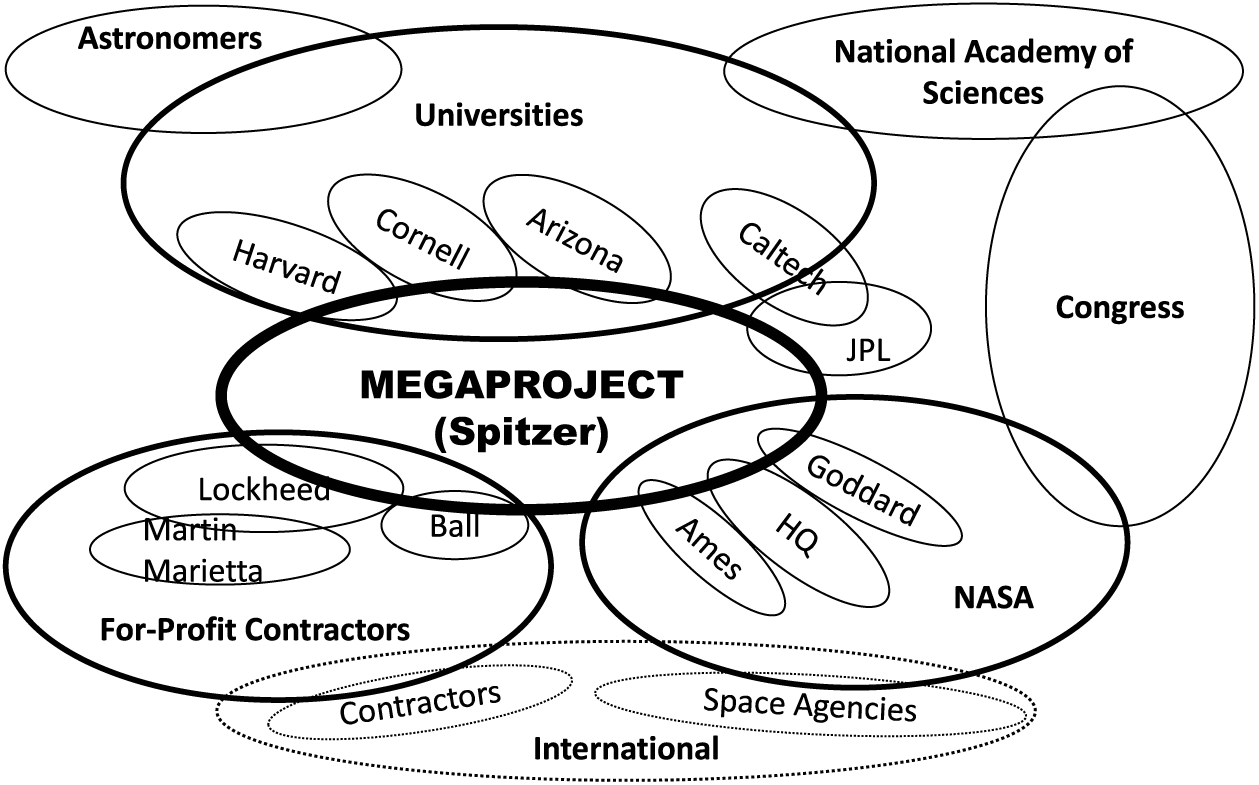
Participants and boundaries in the Spitzer megaproject.
NASA is, above everything, a project-based organization. Program managers at NASA Headquarters (Washington, DC) oversee portfolios of projects. The day-to-day development of each project is assigned to one of the NASA Centers such as Goddard (Maryland) or Jet Propulsion Lab (California). While the Centers help with construction and testing, large projects are developed in collaboration with contractors, such as Lockheed-Martin. If the project is a scientific instrument like Spitzer, the academic community also collaborates on the design, ensuring that the project’s technical capabilities meet scientific data requirements.
Projects are often initiated at one of the NASA Centers, where researchers conduct design feasibility studies. Success is not assured, however. As a NASA Headquarters executive [6] 1 noted: ‘Everything that gets a design study by no means flies. It’s just the first step, but it’s by no means a guarantee.’ If portfolio managers at Headquarters believe that results warrant further investment, they provide resources and recruit scientists to establish the scope and breadth of the project. This specification is the task of the Science Working Group, which is chaired by a NASA project scientist, with the remaining 10–12 members mostly drawn from academia. Once the set of design specifications are approved by NASA, preliminary development begins. If technical and budget feasibility appear sound, then the project enters final construction and launch.
Research design and data
For the analyses, I first prepared a book-length history of the project (Rottner, 2017) that was peer-reviewed by NASA experts and historians. 2 The source materials included archival documents, meeting minutes of the project team, and interviews, from which I conducted a set of qualitative analyses that focused on boundary-related actions.
Archival documents
To reconstruct the history of the project and contextualize boundary actions, I used archival analysis to examine the primary documents (Bucheli and Wadhwani, 2013; Ventresca and Mohr, 2002). I collected primary and secondary materials, including meeting minutes, presentation materials, academic journal articles, white papers, diaries and newspaper clippings. Data from the Science Working Group (which met 48 times from 1984–2003) includes presentation materials that ran from 50–500 pages, plus the meeting minutes that were prepared by several participants shortly after each meeting. During site visits to the NASA centers where Spitzer was managed, I also obtained diaries of the lead project scientist [1] (2000–2003), and the Infrared Branch Chief at Headquarters [7] (1988–1996). Lastly, I obtained numerous journal articles on Spitzer and infrared astronomy, white papers on Spitzer’s mission, feasibility studies of the technical design, press clippings, data on NASA budgets, and organization charts.
Interviews
To ensure an accurate understanding of the archival materials, I conducted interviews using oral history protocols (Yow, 2005). I interviewed 27 people involved in Spitzer’s development, including executives from NASA Headquarters who set policy and oversee the project portfolio, scientists from the Science Working Group who set the performance requirements, managers at the NASA Centers responsible for day-to-day project management, and contractors and external advisors who oversaw construction. Each interview was audio recorded, transcribed, fact-checked by an independent editor, and verified by the interviewee, resulting in 850 pages of transcripts (~60 hours). Triangulating these accounts with the diaries and meeting minutes helped me to counter retrospective bias in the interviews.
Analytical procedure
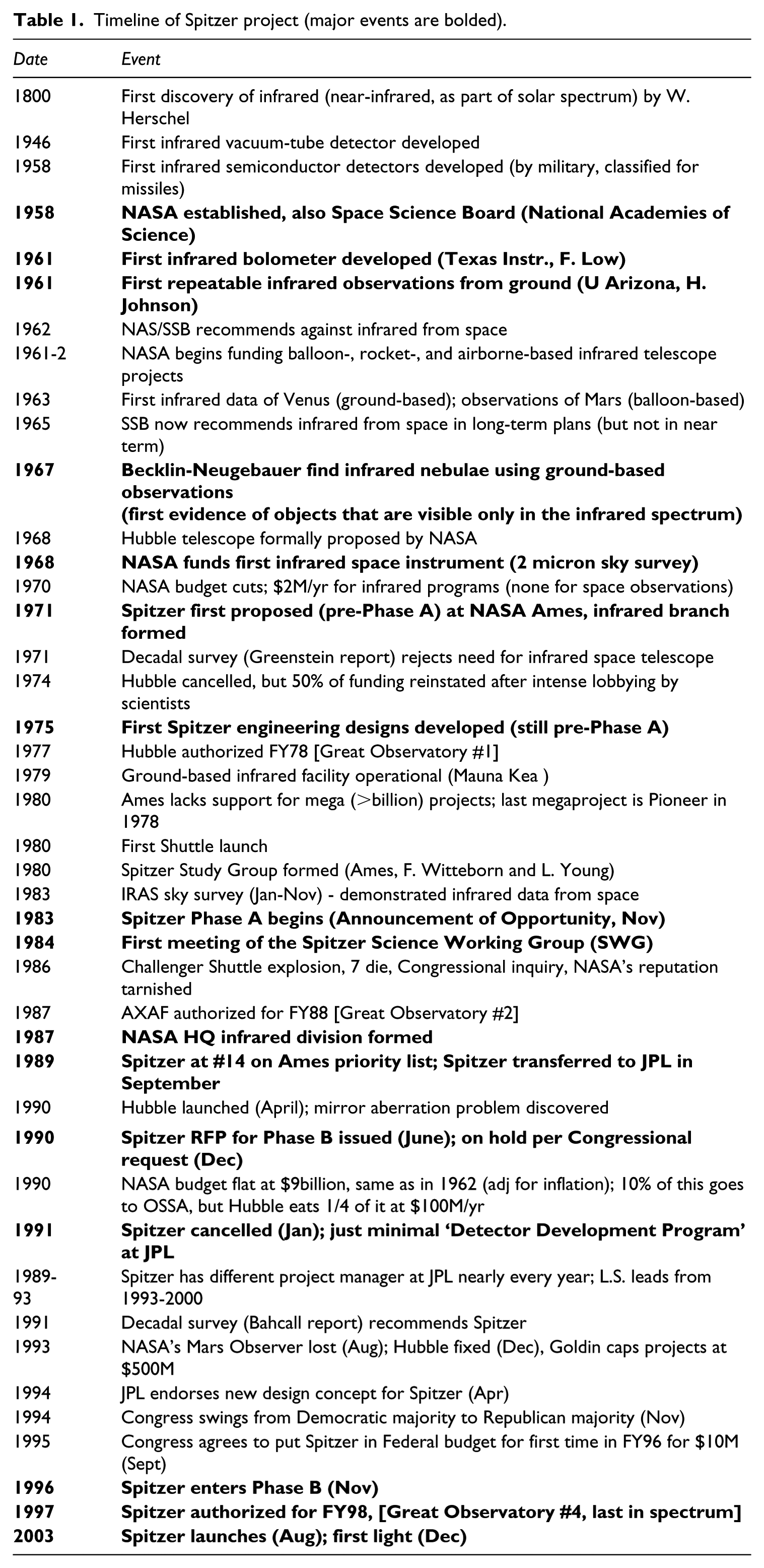
A narrative of the sequence (or pattern) of events is a recommended starting point for analysis (Langley, 1999; Pentland, 1999). After writing the book, I established a timeline of 173 events involving resource flows. My empirical focus is on events, which allow for within-case comparisons and improve the validity and reliability of the single-case method (Yin, 2008). I conducted a within-case analysis of the actions surrounding each resource event and followed the longitudinal, qualitative data method developed by Saldaña (2009) that breaks the history into blocks of time and compares the changes between each period. Finally, based on a grounded and systematic understanding of the case, I shifted my analyses to uncover the mechanisms by which boundaries are reworked. I entered all data documents into Atlas.ti and coded for instances of boundary activities to affect resource flows. Then, I developed initial clusters of boundary actions at individual, project, and institutional levels, and iteratively refined these concepts during secondary coding following grounded theory methods (Strauss and Corbin, 1998). Given the complexity of Spitzer, a timeline is provided in Table 1, showing the most crucial events in Spitzer’s history in bold.
Timeline of Spitzer project (major events are bolded).
Reworking multiplex boundaries
This section details the boundaries and resource challenges the Spitzer team encountered and how they responded. Overall, the data show that boundaries are both relational and structural and that they can be reworked to reorganize tasks and resources. The team faced a set of occupational, organizational, and institutional boundaries. They took strategic action to rework these boundaries. From the analyses, I identified six boundary-changing mechanisms over the course of the project. By way of an overview, the first two mechanisms occur at the individual level, where team members spliced and softened occupational boundaries. (1) Splicing occurs when individuals extend their own roles by blending two or more occupational domains; in turn, managers supported role splicing by (2) softening, which is the diminishing of formal role boundaries or formal structures. At the project level, members fitted and fused organizational boundaries. (3) Fitting occurs when team members create new connections between two or more organizational domains; while (4) fusing occurs when the team stabilizes new interorganizational connections by restructuring the interaction process. Lastly, at the field level, members channeled and corralled institutional boundaries. (5) Channeling occurs when project participants open up information or resource flows between institutional domains; while (6) corralling occurs when participants create enduring means for these intra-institutional information/resource flows. The rest of this section details the boundary problems the project faced and how the six mechanisms were employed to change the problematic boundary. Figure 2 graphically represents the dynamics of these mechanisms.
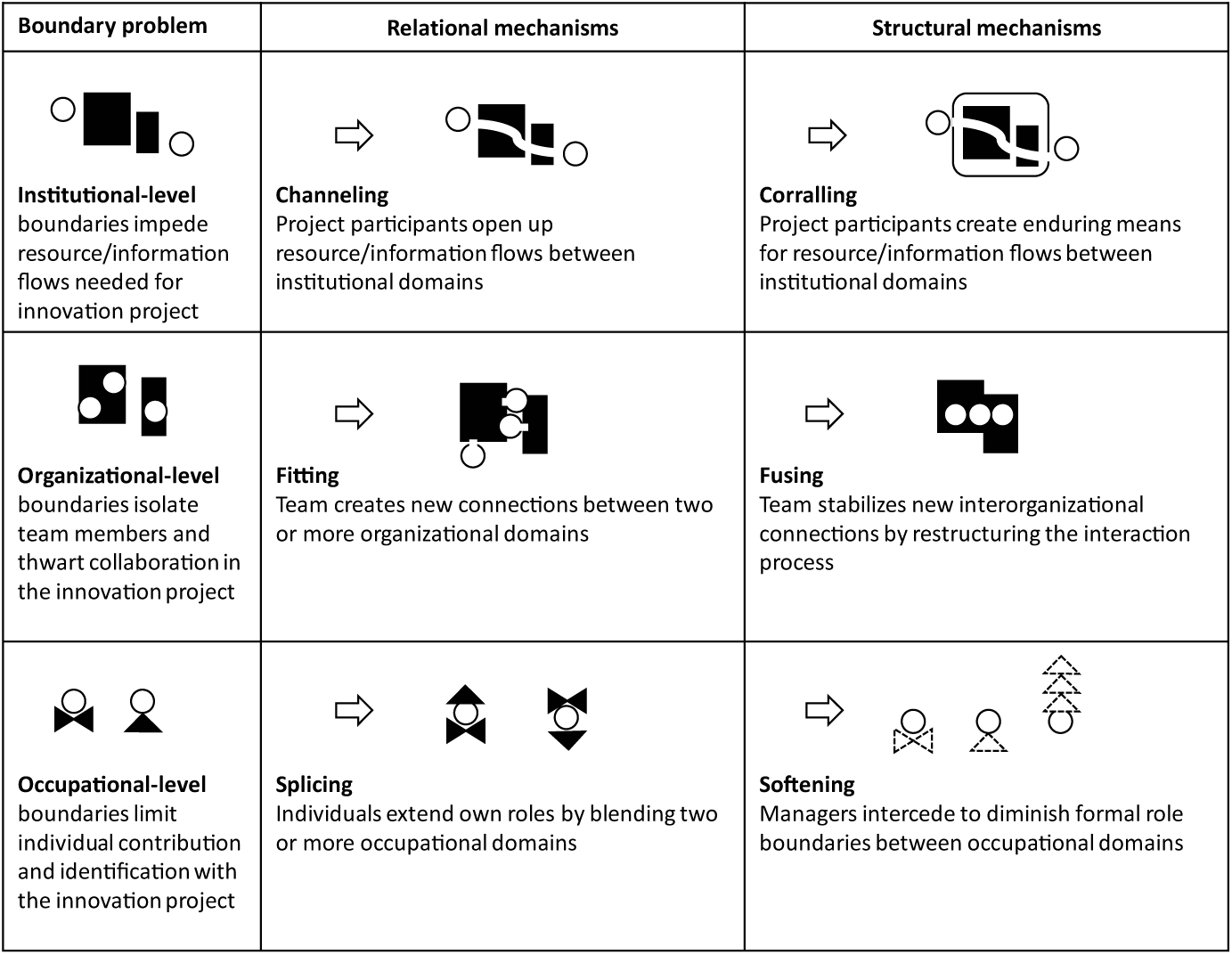
Relational and structural mechanisms for reworking multilevel boundaries.
Boundary problems at the micro-level: Occupational boundaries
On Spitzer, occupational boundaries were highly salient. Different occupations are trained to define and solve problems in particular ways (Barley and Orr, 1997; Gieryn, 1983). The engineers, scientists, and managers working on Spitzer readily articulated the differences arising from their occupations (science or engineering) and roles (technical or managerial), as in these representative quotes: [I have] an engineering doctorate … but a lot of engineers feel that [the scientists] don’t take us too seriously and don’t have the same kind of respect that they have towards the other scientists. Engineer [18] The engineers have completely different motivations. They really like to learn new technology, try new technology, invent new technology. And then they like to see what happens as a result. … Sometimes the engineers would say, ‘I have a clever way of doing this. We have to do it.’ Sometimes I got worried that it was a little bit too clever. Scientist [3] Project managers in general think of the project scientist kind of as the enemy: That yes, we’re doing the mission for them, but, you know, they always want more; they want more bells and whistles, and they never know when enough is enough. Project manager [20] On my job, I take it personally if I don’t meet my budget and schedule requirements. Project manager [21]
Whether through training or experience, individuals form identities and interests along occupational lines, and also attribute them to others (Tilly, 2004) – laying a foundation for interpersonal conflict. If hundreds of people are involved (more than 1,000 in the case of Spitzer), the occupational diversity on which the innovation depends also becomes increasingly difficult to manage. On the one hand, these differences create a wide knowledge base for innovation, which is useful; as a project manager [19] noted, ‘the kind of stuff that we do at NASA tends to be one of a kind, you’ve never done it before, and you are not quite sure how you are going to do it’. On the other hand, these differences create uncertainty and hamper assigning roles and tasks along occupational lines. This is because solutions might come from any member – a scientist or engineer, a contactor or professor – and expertise depends on how ‘the problem’ gets defined. This manager [19] added: you come to realize that even though you’re not in the business of dealing with people in a buy/sell relationship, the thing that makes the project work or not work are the people. You have to sit back and say, well, who are the important people and what are the roles of the various people and how do I deal with them.
Reworking boundaries at the micro-level: Splicing and softening
Occupation-level boundaries were deliberately modified. There were two types of mechanisms to rework occupational boundaries: splicing and softening. The first mechanism is splicing, which is a reconfiguration of roles to blend two or more occupational domains. A splice is made when weaving two ends of things together, as in a rope. However, also as for a rope, a slice can be temporary: a splice can be undone and the threads separated back into distinct work roles or disciplines. A second mechanism to rework occupational boundaries is softening, which occurs when managers intercede to reduce the force of existing boundary structures (such as roles) on the flow of resources. In softening, boundaries are not dismantled but are made more permeable, allowing for tasks and resources to be redirected.
Splicing boundaries
Individuals extended their own roles by integrating another occupational domain with their own. A project manager [20] said: ‘The role of scientists on Spitzer was different from anything I did before and anything I’ve done since. We used scientists like engineers. We gave them difficult, sometimes very difficult, technical problems.’ Ordinarily, in a technically complex project, the necessary expertise will be spread across dozens of engineering and scientific specializations. On Spitzer, the scientists repeatedly took on parts of other roles, entwining different disciplines in their project work. According to a NASA scientist [1], ‘[t]he Science Working Group [was] involved at a very detailed level in what might have been thought of as engineering parts of the project. When teams were set up to address particular aspects of the mission, people from every part of the project would work on it together. It didn’t matter whose problem it was.’
To illustrate splicing, the following example is about an academic scientist [4], who was building infrared sensors. He had fashioned a workshop in the basement of the astronomy building at his university. The incoming Spitzer project manager [19] visited the professor and said: The scientist [4] showed me his lab, and he’s got these guys who have been building these detectors for five, six, or seven years, and said, ‘It’s going to be really tough getting this work transitioned to industry.’ I said, ‘Why are we transitioning it to industry?’ He said, ‘Well, we’re not going to be allowed to build flight hardware here at the university.’ I said, ‘Why not?’ He said, ‘NASA won’t let us.’ I said, ‘I’m NASA, and I’ll let you.’ He didn’t believe me.
This example of an academic scientist building flight-ready hardware illustrates the splicing of occupations, for it is unusual that a scientist should be doing engineering work at all, and particularly on a component that would be flown in space. The scientist’s skepticism was reasonable, as engineering and science are typically not done by the same individual, according to a long-time executive of NASA [8]: Flight projects are a whole different deal … just antithetical to research. Researchers … are going to do the best of everything, and they’re not going to use processes …. Flight projects have very rigorous processes for testing. … It’s not unusual for a space system to spend eighteen months in test before it launches.
However, Spitzer was an innovation that necessitated interdependencies. A NASA scientist [1] noted that, ‘A car can be built with interchangeable people as well as interchangeable parts. But Spitzer couldn’t be, and the very first prototype car probably couldn’t be, either … [so] we made the best use of the talents and abilities of the people we had ….’ As the detector-building professor [4] said, ‘It’s outside the envelope that the scientists involved would be the ones who had a large amount of technical expertise, so they could get into the trenches with the engineers when there was a problem and genuinely help solve the problem, rather than just being in the way.’ Indeed, the very use of the term ‘envelope’ refers to a boundary – a physical boundary that test pilots challenge when they ‘push the envelope’ to check the performance limits of an aircraft.
The data show that individuals regularly overcame occupational boundaries by blending roles. Partly, this blending was out of necessity, because of the demands of innovation. The science that could be done with the telescope would depend on its construction, and the construction depended on what science needed to be done. Too much was unknown, and expertise was limited as infrared space-based astronomy was still so new. Therefore, while occupational boundaries were clearly understood, team members set them aside and willfully combined domains.
Softening boundaries
Given such strong norms and rationales, how did the occupational boundaries get remade in Spitzer? I argue that managers support role splicing by diminishing formal role boundaries. As the examples will show, this occurred not just between engineers and scientists, but between academics and contractors, and was actively encouraged by project managers, whether they were employed by NASA or a contractor.
A few details on the project management context are useful. JPL, the NASA Center where Spitzer was managed from 1989 onward, is a matrix organization in which employees report both to their immediate line (department) manager, as well as a project manager, whose authority cuts horizontally across relevant departments. The line managers are responsible for developing and delivering the project and oversee functional areas such as electronics or materials. Typically, the project manager oversees the budget and interacts with the customer (in the case of Spitzer, the customer is NASA Headquarters and the telescope user community). The project office determines the customer’s needs, develops the technical specifications for the various project components, and contracts with line managers to obtain those component work products. Although this matrix structure is intended to foster cross-organizational teaming, it often has the opposite effect, due to conflicts over project scope, schedule and responsibility (Baroff, 2006). How this played out at JPL is described by a project manager [19]: The tension that exists is whether the people who are core to the project reside in the project organization or in the line organization …. The project [office] would say, ‘We want you to build us a set of control electronics.’ The [line manager for that division] would say, ‘Well, where are the specifications?’ It was almost like dealing with a contractor …. In a perfect world, the project manager could get half a dozen divisions to give him their stuff and then sit back and wait for the product to be delivered. But the reality is that the divisions have to interact with each other, and the connection for that is the project.
Within JPL, project managers had to work around the boundaries set by the matrix structure. For example, JPL staff members insisted that their roles on Spitzer be defined. They wrote job descriptions, but the project manager deliberately ignored these documents and ultimately, so did the staff. The project manager [19] describes what happened: [My team] said, ‘We need role statements.’ I said, ‘Well, our job is to get Spitzer built.’ … At the time at JPL, you’d write a role statement, they’d sign it, I’d sign it, we’d put it in a book, and then somehow it would become part of the history of the project. Then when you went to give them raises and stuff, you’d drag out the role statements and say, ‘This guy is responsible for this and this, and therefore he should get a big raise’, or whatever. But I didn’t do that. I just said, ‘OK, you want a role statement, write a role statement.’ They wrote it, and I put them in a drawer and never got them out again. They never brought it up again, either.
For another example of softening, we return to the detectors built by a professor [4]. By allowing sensors of academic origins to be used in the final construction of the telescope, the project manager [19] softened the boundaries between NASA and the university. In doing so, he overcame traditional boundaries that dictate who is allowed to do what type of work (scientist vs. engineer, academic vs. contractor). Moreover, by accepting the work product, the manager ensured that the scientist’s role splicing would hold. The manager not only had to convince the scientist that this work would be accepted, but he interceded so that other project members would accept these sensors despite their academic origins.
This softening of role boundaries extended across the project. Managers at the partner organizations, for example, fostered this attitude so that all team members – whether NASA employees, contractors or university scientists – did not allow perceived roles and reporting structures to constrain individuals in ways that limited the project. The active softening of boundaries by non-NASA managers involved in Spitzer allowed occupational boundaries to be perforated. This willingness to ignore hard boundaries was unusual, as multiple participants noted. For example, contractors also actively loosened the boundaries, as a university scientist [10] recalls: We [scientists] all took on responsibility for working with the contractors to make sure that everything worked. My job was to work with Ball Aerospace on every aspect of the optical system. So I was actually in the test chamber in a bunny-suit [a clean room coverall], with the Ball guys, helping them test … and put stuff together. That’s highly unusual. One of my friends … who works at [another contractor], says they would never let the scientists be working hand in hand with a contractor, just because of fear of the legal repercussions if something didn’t work out.
Like other managers, the NASA project manager [19] regularly interceded on behalf of the project members to change the boundaries that stood in their way. He said that ‘much of the structure was perception rather than real’, and described his management philosophy: Think about each of us standing in a cardboard box. If we are all in one box, we can move around, we can help each other. If you fall down, I can pick you up. But if we’re all in separate boxes and the line between your box and mine is well-defined, then I can’t help you very much …. That’s what structure can do, if you’re not careful. [19]
In sum, the team members and team leaders in Spitzer actively reworked the boundaries that circumscribed their professional activities. Roles, chains of command, and routines are typically all well-defined and are set by precedent. What I find is that personal initiative was necessary to splice roles, but managerial intercession was needed to allow those splices to hold. Splicing is a relational reconfiguration, while softening is a structural reconfiguration of occupations.
Boundary problems at the meso-level: Organizational boundaries
Organizational level boundaries compound the occupational differences. In a megaproject, dozens of legal entities may be involved, each with its own boundary. This can cause problems, according to two executives at Headquarters who were responsible for 10% of NASA’s budget and ran the Astrophysics directorate from 1975–1993. By way of explanation, one of the executives [14] said that ‘the Hubble Space Telescope was a very complicated mission in many ways. It wasn’t because the telescope was necessarily hard to do – which it was – it was because there were multiple [organizations] involved: Marshall, Goddard, JPL, Lockheed, Perkin-Elmer.’ The same was true of Spitzer. And while such organizational diversity provides a wide knowledge base for innovation, it also creates the conditions for boundary issues. As the executive [14] observed: I’ve learned [that] you’ve got to keep minimizing the interfaces. You’ve got to be able to do systems engineering on projects. You’ve got to be able to keep these things where people can manage them, because these things are hard enough to do just to build them.
There are three additional issues with organizational boundaries. First, boundaries can proliferate even within a single organization. For example, at NASA there are eight major field centers with three distinct organizational cultures. As another NASA executive [8] summarized it: ‘There’s the unmanned culture, which is JPL and Goddard. There’s the human-flight culture, which is Marshall, Johnson, and Kennedy … and then there’s the research culture: Ames, Glenn, and Langley. They’re very different, all of them …. they don’t mix together.’ The other executive [14] elaborated: When people are all part of one organization – one NASA center, or one company – they tend to behave differently when they get in a tough situation. … The difficulty with these things is that when it gets center-to-center, or when it gets company-to-company … your loyalties are outside. People tend to go native, and when trouble happens, it’s ‘us against them’, as opposed to ‘we’re all in this together’.
A second issue with organizational boundaries is that it is difficult to reduce their number. Some organizational boundaries seem to indicate kinship, such as among contractors that share a for-profit motive. Clustering similar firms within a shared boundary might make project management easier. However, within a single type of organization, the heterogeneity of interests rarely allows for partnering incentives to be managed in the same way. For example, the contractors didn’t share the same motivations. One of the NASA executives [8] compared two of the primary firms working on Spitzer, saying that at Lockheed-Martin ‘their deal is systems engineering. They build big systems … you need a C-5A [transport plane] to move it … very rigorous processes, checks and balances everywhere. Their systems always work.’ In contrast, Ball Aerospace ‘is kind of like a high-tech boutique. You go buy special things there. … it builds things you can fit in the back of a pickup truck.’ Although these are for-profit firms, the systems companies like Lockheed derived most of their revenue from classified military work – ‘the only reason they do NASA work is that it’s something they can talk about’, a NASA executive [8] said – whereas the NASA contracts made up a greater part of Ball’s business. In managing a megaproject, one cannot assume that the interests and incentive structures will be equally valid across organizations of the same type.
A third problem is that existing organizational boundaries may not be stable over the life of the project. Given the long duration of many megaprojects, organizations may shrink, grow, or merge. For example, during the decades that Spitzer was under development, the Cold War officially ended and contractors faced declining military budgets. Therefore, in 1995, Lockheed merged with Martin Marietta – two firms that had been in operation since 1912 and direct competitors since 1961. The new firm, Lockheed-Martin, won the contract to design Spitzer’s flight-control software. A contractor [14] noted that in proposing this contract it made sense to leverage the merged parts of the company, but this turned out to be ‘a better marketing story than it is an implementation story’. Intending to save costs by re-using code previously written by Martin Marietta’s Denver, Colorado group, the actual software development team sat 1,200 miles away in Sunnyvale, California. Even if had been easier to communicate at a distance at the time – the first web browser, Mosaic Netscape, was released just the year before – the two firms were merged in name only: ‘They were totally different cultures. That created a lot of problems in getting a team together,’ said a NASA manager [20]. He continued: ‘It was difficult for a bunch of reasons. We were sort of at the peak of the dot.com boom, so getting good software engineers was hard, because they’d rather go make a lot of money. I remember they had job fairs right outside the Lockheed-Martin gates in Sunnyvale.’ The changing organizational boundaries caused coordination and staffing issues that led to project cost and schedule overruns, although ‘in the end, we got a product that actually worked pretty well.’
Reworking boundaries at the meso-level: Fitting and fusing
The Spitzer project participants treated the organizational boundaries just as malleably as occupational boundaries. They changed the boundaries through the mechanisms of fitting and fusing. Fitting is when the team creates new connections between two or more organizational domains. This changes the relational patterns between the organizations. Fusing is when the team stabilizes new interorganizational connections by restructuring the interaction process. This alters the structural patterns between the organizations. The next section details these mechanisms.
Fitting boundaries
The leaders sought to create new connections among the employees of different organizations who were helping to build Spitzer. An opportunity to rework the boundaries arose in 1993, when the project was transferred from NASA-Ames to NASA-JPL, where Spitzer was assigned a new project manager [19]. By this point the scientists had been together for over a decade, trying to develop a specification that met their scientific objectives. At the same time, the project moved from the specification to design study phase, the stage at which multiple contractors are selected to develop a design. Out of this set, the best design is selected and that contractor is awarded a contract to build the instrument. The Spitzer project manager [19] set out to change how the whole team would relate to each other and the project: Once we had Ball and Lockheed as part of the team, the very first thing I did is, I had a three-day retreat and invited each of the companies to send three or four people. … They thought I was a screwball, because I said, ‘We’re not going to get anything out of this meeting except to find out who each other are.’ I put a lot of effort into forcing the team to function as a team. … I’m experimenting here …. [They] got to know each other well enough that [people] were working on Spitzer, instead of working for their company. [19]
Rather than developing competing designs, one of the contractors [15] said, ‘we spent six months working together elbow-to-elbow as a team, on how to [design Spitzer].’ The contractors interacted with each other and Spitzer managers in a way that was uncommonly integrated. For each major subsystem, Spitzer brought in just one contractor earlier in the design phase and retained them. One of them [14] said, ‘Usually they pick a couple of contractors to do a [design] study and then pick a winner to do the development and operations part of it. And they didn’t do that this time. … I thought it was incredibly creative and effective.’ Another contractor [15] said, ‘it’s different from the way they do it now; Spitzer was relatively unique.’ This eliminated much of the normal competition among contractors for the more lucrative construction contracts. For example, two of these erstwhile competitors went to dinner to change how they would relate to one another: We agreed that while we could be great competitors normally, that we were going to be brothers-in-arms, he and I, on this job for the duration. It was for the good of our respective companies. We also agreed not to poach on each other’s scope, which is important. We did that over food, which was very important. It was a very bonding sort of a relation …. I think he was surprised that a [competitor] would actually have this conversation. [15]
Another way that the project worked to create connections across organizational boundaries was to have management meetings (uncommon in science projects) and rotate the location. Every month, about 15–25 people would meet at the home office of one of the project leads, whether it was at NASA-JPL, NASA-Goddard, a university or a contractor. A JPL engineer [21] said, ‘That created a human connection among all these people, which was built not just formally but at dinners and parties on occasion.’
In sum, fitting is a mechanism for getting the commitment of the various project managers at JPL and the contractors to create a team, reduce the competitive tendencies, and create new opportunities for connections. This reworked the way the organizational members related to one another. To prevent these new connections from coming undone, other mechanisms were developed to supplement and structurally reinforce the relational fit among the organizations.
Fusing boundaries
To stabilize the interorganizational connections, the project fused the organizations together around the project by restructuring the interaction process. In Spitzer, this entailed changing the formal ways that the different organizations typically interacted, such as the contractor selection process, and the incentives provided in the contracts. The next section provides details on how these structural changes fused the organizations together.
In addition to changing how contractors, academics and NASA staff related to one another, a project manager [19] also changed how contractors were selected and rewarded. These structural changes further tightened the bonds between participants and made their success conditional on the success of everyone else on the project. For example, it wasn’t enough to get the most technically capable contractors involved, but to get those who were great collaborators that met their schedules and budgets. However, the process at JPL was an obstacle. According to the project manager [19], this is because when selecting contractors at JPL: We weren’t allowed to consider past performance. … But the rest of the NASA centers had started using that as an evaluation factor. The NASA guys said, ‘That’s a good idea,’ and the JPL guys said, ‘We’ve never done that before.’ I had to go all the way to the [top] to get approval to evaluate past performance. And he thought it was a good idea, when we finally got to him, but there was so much bureaucracy along the way saying, ‘We always do it this way.’ We broke the paradigm [by changing this process].
In addition to the selection process, the incentive system was reworked so that success was rewarded as a mutual accomplishment. Most significantly, the contracts departed from the typical way that NASA compensates work done by individual organizations. As a NASA scientist [5] said: The incentive fee had a [novel] component that depended on the overall success of the mission. That means that Lockheed’s fee depended on Ball’s performance. Ball’s and Lockheed’s performance depended on the instruments [built by others] working, and so on. The advantage of that is that you’ve removed the incentive for people to solve their own problems at the expense of somebody else – or to not help solving somebody else’s problem… the incentive is you work together, you got the best overall product. You don’t maximize your little piece of it.
Given the tight budgets at NASA, cost pressures were high, and funding cuts were frequent. And given the inherent uncertainty of developing Spitzer, each area of the project might be expected to pad their budget (and did, initially). However, if everyone pads their budget, then it is difficult to put the slack to good use on the most essential areas. To reduce such moves, the Spitzer project increased transparency by instituting another novel feature: open-book finance, in which all participants had the same information. A NASA scientist [1] said that whether they worked for NASA or a university or a contractor, everybody always knew how much money everybody else was getting … . [O]ne of the things that was always on the [monthly management meeting] agenda was potential allocations of our project reserve. So even though [the project manager] reserved the prerogative to make the final decision, everybody could feel that they’d been consulted and had a say in how these reserve funds were allocated.
Thus, despite their many differences and diverse motivations, the Spitzer team was one of the more united at NASA – a view expressed by NASA executives, managers, scientists and contractors. I find that this happened after participants reworked the organizational boundaries.
It might appear that these fusing actions were primarily driven by one particular project manager [e.g., 19]. Indeed, in that role, he had the most direct control over structuring the team processes. But his bosses also enabled him to make changes. According to one of the participants [8], the director of JPL had told the project manager [19]: ‘We’re having too many overruns [at JPL], too many difficulties. I want you to invent a new paradigm for managing Spitzer.’ Thus, the project manager had the charter to try new things. Just as importantly, the rest of the Spitzer team had to enact these changes and alter the ways they had been working together, some who had been on the team for a decade or more. These relational changes among the team were cemented by the structural changes due to the contracts, open books, and team meetings. In this way, the team was ultimately not just fitted together, but fused to a common goal. The Lockheed manager [14] noted that ‘Once you get into the mission, people don’t pay attention to what badge you’re wearing. You’re part of a team. When people work on projects, they tend to identify more strongly with the project than they do with their home organization.’
Boundary problems at the macro-level: Institutional boundaries
While occupational and organizational boundaries may be difficult to change, they are often within the span of individual and managerial control. This is less true at the institutional level, where boundaries may be those of powerful stakeholders or social norms. Such boundaries may be not only diverse, but diffuse and intertwined. The boundaries of institutions are less distinct than those of organizations, whose boundaries are legally set, or than even individuals, whose boundaries are physically set. In contrast, the incursion of other institutions into NASA’s activities is common and regular. Some of those are formal incursions: NASA regularly interacts with political institutions such as Congress and the Presidency, and scientific institutions such as the National Academies of Science and the American Astronomical Society. In particular, the National Research Council (the operating arm of the National Academies of Science) regularly reviews NASA’s management and strategic direction and appears on NASA’s organization chart (with a dashed line). The National Research Council provides oversight and policy guidance on NASA’s activities and report their findings to Congress and the director of NASA. Projects within NASA’s portfolio, including Spitzer, are all subject to this scrutiny.
Institutional boundaries reflect different ends and means. This can lead to boundary disputes over jurisdiction when two or more institutions intersect in a project. For example, every ten years, the National Academy of Sciences conducts a survey of the astronomy community. This ‘Decadal Survey’ is the scientific consensus on the priority NASA should give to various projects in the coming decade. The NASA executive in charge of astronomy [14] recalls how the science and the politics needed a nudge to line up: I [met with the Decadal Survey chairman] and told him why we wanted to do the things the way we had laid them out: the sequence of things, which missions we thought were important, this sort of thing. I was trying to put a framework together within which these things could be readily marketed, readily communicated, in Washington. He told me, ‘Science isn’t done this way.’ I said, ‘This isn’t about science, it’s about getting the money to do science.’ He went away, had lunch, came back and said, ‘I thought about what you said. I think what you want to do is totally consistent with what we want to do.’ [8]
More often, the science and politics do not line up. This relationship between astronomers and NASA, which can be contentious, had been radically reconfigured since the first half of the 20th century – the time when most senior astronomers had earned their PhDs. The US government’s connection with astronomy only began in earnest after the Soviet launch of their Sputnik satellite in 1957. A university scientist [6] explains: Before Sputnik, the astronomy community was dominated by private observatories, funded by private capital, and there were very few astronomers. The real revolution came around 1960, when the federal government started [funding science]. Space astronomy is very very expensive, compared with ground-based astronomy. It could never have been done with private capital. It required federal investment.
However, by the 1990s, the budget landscape had changed. NASA had several high-profile and multi-billion-dollar disasters: the loss of the Challenger shuttle in 1986, and the launch of Hubble with a misconfigured mirror in 1990. Hired to cut costs and risk, Dan Goldin became NASA Administrator in 1992, after a successful career as CEO of TRW, a defense contractor. Goldin’s mantra of ‘faster-better-cheaper’ sought to place smaller bets, and he essentially capped projects at $500 million. At the time, Spitzer was budgeted at just over $2 billion. ‘Goldin said Spitzer was a good science program but Dan Goldin made the assumption that what the federal government cares about is doing things efficiently – and they really don’t. That’s a mindset from industry. So [Goldin] came in wanting everything to be small and fast, but he had more failures during his ten years than anyone in the history of NASA, because you can’t do stuff on the cheap. [8]
One contractor [15] noted that ‘back then NASA said, “We’re going to the moon”, and now NASA says, “This project is not going to cost more than $450 million.”’ Fundamentally, institutional boundaries are set around different concerns, which can change not only how and what to innovate, but the very reasons why to do it. In Spitzer, the institutions the project depended upon for support had very different ends, including economic efficiency, technology novelty, scientific accuracy and even political power. The means by which these were achieved also varied, and even changed midway. Thus the boundary problems at the macro-level appear especially challenging.
Reworking boundaries at the macro-level: Channeling and corralling
Almost by definition, the activities of a megaproject spill across institutional boundaries. Yet, here again, Spitzer’s participants did not just span but actively reworked the way the project interacted with diverse institutions. The team used mechanisms of channeling and corralling to change the relations and structures of institutional interactions. Channeling is the opening of new routes or relationships for transferring information and resources between institutional domains. Corralling is when project participants create enduring means or structures for those information or resource flows.
Channeling boundaries
As soon as the Apollo program developed launch capabilities, astronomers set their sights on a space telescope. Between 1968 and 1977, dozens of projects were proposed in all the major wavelengths by scientists across the country. And while there were now more funding sources for astronomy (e.g., NASA, DoD, NSF), the cost of instrumentation had also increased, and this intensified the rivalry between the various sub-communities. These battles played out at Headquarters, where a NASA executive [7] said ‘Managing this whole business is – well, there is an air of competition and cooperation at the same time. And you have to somehow figure out how to walk that fine line. The different wavelengths – optical, infrared, X-ray, gamma ray – they battled each other. The different communities – astronomy and planetary science and space science, ionospheric physics – they battled each other just tooth and nail all the time.’
To resolve this tension, a NASA Astrophysics executive [8] yoked the projects together. Four space telescope projects, each supported by a different scientific community, were brought together under the banner of ‘The Great Observatories’. One manager [17] explained that this particular NASA executive [8] ‘was a master at selling missions – his idea was that if he could sell these as a large package of observatories across the entire energy spectrum, then he could get the astronomy community to stop bickering at each other about getting their wavelength represented and everybody would have their turn’. It also made it easier for NASA to obtain funds from Congress for the package of projects, rather than individually (Harwit, 2009). By linking the projects, a more compelling story could be told – the executive [8] prepared marketing material for Congress (NASA, 1985) about the science that could be done only if astronomers had telescopes across the spectrum. The Great Observatories was an effective conduit to bring Congress, NASA and the various astronomy communities into contact and agreement, despite their disparate interests. Thus, after a gauntlet of delays and budget cuts, all four telescope projects (including Spitzer) were launched between 1990 and 2003. 3
This accomplishment overcame political opposition after the Challenger Shuttle and the Hubble mirror debacles. Congress was so frustrated with NASA that it put all of the agency’s funding on hold in 1990, and officially cancelled Spitzer in 1991. This was a shock to the project team, as the 1990 Decadal Survey had just proclaimed Spitzer to be the highest scientific priority. One of the scientists [2] recalled his epiphany upon realizing that lobbying would be necessary: I didn’t have the good sense to realize that what we were trying to do was [so challenging] – I knew the hardware, I knew how it would work, I knew where the soft spots were, and if Spitzer flew, it would be fantastic – beyond that, let somebody else worry about it. We had on some pretty tight blinders. [Our mindset shifted] when the money didn’t come.
Another scientist [10] noted that ‘the pressure to get [funding] for the project led us to do things like lobby intensely at Congress …. We knew we had to go and speak up on behalf of ourselves.’
In 1990, another university-based astrophysicist [11] was brought in to focus on getting Congress to appropriate funds for Spitzer. She ‘kind of volunteered and learned how to do it’ [10]. Indeed, lobbying did not come naturally to any of the scientists, as she said of her new role: The people at NASA … don’t know much about the nuts and bolts [of lobbying], because they’re prohibited from doing it themselves. I didn’t even know people did such things. I learned a lot from [people in universities and aerospace] about how to interact with people on Capitol Hill, what style of information to present, how to scale the pitch. [11]
Scientists who were not directly employed by NASA regularly visited their representatives on Capitol Hill. One scientist [11] set up meetings and prepared briefing materials for the Spitzer Working Group members to use. After several years of lobbying, the awareness of Spitzer was widespread. An executive [9] noted that because the scientists were doing this ‘spade work on Capitol Hill … the congressional staffers, as soon as they heard the word Spitzer, they said, ‘Oh yes, you are the fourth and final element of the Great Observatories program. Yes, we’ll get you going.’ So it was a brilliant packaging maneuver by [the NASA executive [8]].’
In 1994, NASA tested the waters and requested $10 million from Congress to reinstate Spitzer. The project was finally a line item in the Congressional budget. However, before the budget could be approved by the President, control of Congress swung to the Republicans for the first time in 50 years. With the Democrats suddenly out of power, Spitzer was again at risk – the House zeroed out the project’s funding. Scrambling to restore the funding, a scientist [11] went to meet with a Senate staffer, recalling how the scientists’ years of spade work paid off: I had disregarded some of the advice my mentors had given me [to not] bother with the out-of-power side. It doesn’t take much extra time to go visit them, so I’d been visiting the minority [Republican] Senate appropriations staffer and he’d gotten to know me during the preceding years. Then suddenly, after the 1994 mid-term elections, he was the man in charge.
The lobbying efforts had opened up channels to both political parties. Finally, in 1995 (and 24 years after it had first been proposed), Spitzer officially appeared in NASA’s budget as a major project. Fundamental to this accomplishment were The Great Observatories concept and marketing materials (NASA, 1985), which illustrate how opening a channel can enable new connections for transferring information and resources. While this was based on the actions of people at NASA Headquarters, another channeling example that takes place at the level of the project team is lobbying. Here again we see the splicing of roles as the scientists learned to lobby, but in the service of working across institutions. In this instance, it is the creation of new channels between the scientific team and Congress that enabled the flow of resources, a lobbying channel that NASA Headquarters was prohibited from developing.
Corralling boundaries
In addition to channeling, the project team also put in place more permanent structures for ensuring new flows of information and resources. These changes benefitted Spitzer, but also effectively corralled stakeholders by reworking the very institutions that structured their interactions. Corralling is illustrated by project members altering the ways in which the astronomy community engaged with a government agency, as well as conducted research with telescope datasets.
NASA’s space science budget requests are oriented around programmatic (rather than strictly scientific) goals, such as solar, lunar, planetary, astrophysical, microgravity, and life sciences. Astrophysics projects were dominated by the interests of optical astronomers, who, as the oldest and most powerful astronomer community, helped set NASA’s priorities, such as through the decadal surveys. ‘There were no direct advocates for Spitzer at NASA Headquarters’, one of the academic scientists [6] said. ‘There was incredible advocacy for Hubble … [and the X-ray telescope, including] the head of the high-energy branch. …We had to start having advocates at NASA Headquarters to get this mission.’
To overcome a lack of influence, the scientists engaged in institutional groundwork to establish an infrared office within the Astrophysics directorate at Headquarters. Some of the pioneering infrared scientists from Ames were the first to join. Among them was a manager [7] who said that ‘In 1988, I was asked to go to Headquarters by the people at Ames to help get [several infrared projects] going. … I was at Headquarters for almost ten years. I started the Infrared, Submillimeter, and Radio Astrophysics branch. We had all of the projects and the research funding in that range of the light spectrum [including far- and mid-infrared].’ However, when Spitzer transferred from Ames to JPL in 1989, the scientists wanted their own (non-Ames) advocate at Headquarters. An academic participant in Spitzer [6] took a two-year leave of absence from his university position: ‘I went to Headquarters … to try to start guaranteeing that we had advocacy for Spitzer.’ Thus, two academic scientists [4 and 7] spent 2 and 6 years respectively at NASA Headquarters helping to develop the fledgling infrared branch.
Once at Headquarters, this group of infrared scientists focused on the whole portfolio of infrared projects, not just their pet projects. Their shared goal was to establish a point of focus for infrared science that would continue beyond their tenure. In 1994, the infrared science office was formally established, thereby securing a portion of NASA’s annual budget. This ensured that resources would be directed towards infrared projects, including those in the pipeline such as Spitzer, as well as securing a base of power for future infrared projects.
Another way in which the Spitzer participants altered the landscape was to engage in institutional groundwork with the scientific community. Spitzer was expected to have to have full capabilities for 2–3 years, depending on when the liquid helium coolant ran out. Because of the limited lifetime of the cryogen, this had major implications for science observations. One of the NASA executives [9] said, ‘keep in mind that in the 90’s, infrared astronomy was the youngest of the astronomical disciplines, so you were literally improving your capability by orders of magnitude [with Spitzer] … in some cases, a million-fold improvement over anything that had flown before.’ This meant that discoveries of entirely new phenomena were guaranteed to happen, but sufficient time for follow up observations was not. The executive [9] continued, ‘You bang yourself on the forehead and say, “Oh my God, we didn’t get to what we really wanted to do.” … The bottom line is that the time from when you wrote your proposal to the point where you submitted a peer-reviewed paper could easily be equivalent to the Spitzer lifetime.’
Under the typical scheme, most scientists would only get one chance to collect data, thereby limiting their discoveries. Because of Spitzer’s short lifetime, 4 astronomers would need to change how they did research. The executive [9] explained that, ‘Driven primarily by what we thought would be a 2.5-year lifetime, I and others led an effort to reexamine the way we do astronomy – I call it ‘the sociology of science’ – to break out of the paradigm.’ To enable simultaneous, widespread data collection, the project team set up the Legacy Science Program.
The Legacy Program changed many elements that astronomers were used to. First, the data collection proposals were different. Instead of requesting 10–20 hours of telescope time, as is usual, scientists could only propose 500–1000 hour programs during the first 6 months of Spitzer’s science operations. This allowed for massive datasets to be constructed as quickly as possible. Second, these data immediately entered the public domain. ‘We had no proprietary period on the data, which was revolutionary at the time’, the executive [9] said. Instead, scientists only had priority over the specific research question they had proposed. The data were made available to all astronomers, who could use them to answer different questions or build on them by submitting a follow-on proposal for additional observing time. The academic in charge of the data archive [12] said, ‘The community is both the astronomers not in the project and the scientists in the project – [we developed] a fair and balanced approach to enable each of these constituencies to have their opportunity to do the science they wanted to do.’ Initially astronomers resisted, but eventually came to realize that the Legacy program could increase the scientific results from Spitzer and for the wider scientific community. This has borne out: More than 2,000 peer-reviewed publications have resulted from the legacy data alone.
These examples show that even seemingly intractable institutional boundaries – the established norms and structures that guide social interactions – can be changed. In Spitzer, this includes deliberately altering the path through which financial resources flowed at NASA by establishing a new infrared program office at Headquarters, and changing the way that science was done by restructuring how the researchers obtained access to the telescope and its data.
Conclusion and implications
A project’s performance ultimately is not driven by the science, because you can overcome the science. It’s not driven by the technology. With proper planning and work, you can develop the technology. It’s driven by the performance of the team, and it’s driven by the context they’re living in. (NASA Director of Astrophysics, 1983–1992 [8])
This study lays a new path for research by examining the dynamics of multi-level boundaries, which are taken as given in most studies about objects, spanners and organizations. In the case of a NASA megaproject, I find that boundaries were the target of strategic action at the occupational, organizational and institutional levels. By changing the given boundaries, project members enabled innovation by opening new ways that participants related to each other and structured their interactions.
The goal of this study was to understand how collaboration participants address dynamic and diverse boundaries to manage resource flows in an innovation project. I examine this question in a megaproject at NASA and showed how project members did not merely span the boundaries of their context but altered them.
These findings have implications for our theories of boundaries. Prior literature has considered the question of how knowledge and practices have to change in the face of boundaries. I reframe this question by suggesting we examine how the boundaries themselves can be changed. As a result, this study lays a new path for research by examining multi-level boundaries, which are taken as given in most studies about objects, spanners, and organizations. Instead, I suggest that scholarly attention should also be directed to the dynamics of changing boundaries. I discuss this contribution in more detail below, as well as implications for innovation and institution theory, and offer some directions for future research.
Contributions to research on boundaries
Boundary multiplexity
By taking a multilevel view, this study reveals that boundaries are both relational and structural. Relationally, individual project participants encounter boundary challenges that they respond to by (1) splicing roles across a task, (2) fitting organizations around a goal and (3) channeling institutions to redirect flows of information and resources. Structurally, participants address boundary problems by (4) softening role expectations and procedures, (5) fusing project partners through trust and shared incentives and (6) corralling diverse institutions through new systems that change their operations. Taken together, these relational and structural mechanisms provide an empirical and practical toolkit for considering how innovation proceeds in established and complex settings.
This study builds upon a literature that has examined how users of new technology react to boundary challenges (e.g., Barley, 1986; Levina and Vaast, 2005; Lifshitz-Assaf, 2018; Murray, 2010; O’Mahony and Bechky, 2008). However, in a large-scale innovation project, we readily find the presence and co-mingling of sense-making artifacts, individual champions, and organizing structures. I extend this work by focusing on a more complex intra-organizational context, where boundary challenges are richer, as well as at multiple levels where boundary solutions are broader. From my analysis of the NASA data, I develop a suite of mechanisms for addressing boundary problems – splicing and softening, fitting and fusing, channeling and corralling – that provide both relational and structural tools to rework the context for innovation. The Spitzer case highlights how boundaries are enacted through the way people relate to one another, as well as the structures that shape their interactions.
Boundary dynamics
The organizational literature has mostly taken boundaries as given, as something to be maintained and, when necessary, spanned. In contrast, the STS literature treats boundaries as fluid, but infrequently examines how fluidity and change comes about. I bring attention to boundary change as an endogenous process and identify six mechanisms for changing boundaries along professional, organizational and institutional lines: Boundaries are targets of strategic action. Elements can be brought together either temporarily as in splicing, or somewhat more permanently through corralling. In these actions, there is a role for individual agency in boundary work in megaprojects. Managerial intercession, through such strategies as softening and fusing, can support individual efforts. Old configurations of boundaries, such as those of scientific and congressional institutions, can be retained while redirecting resource flows through channeling, or creating new configurations of established players through fitting and corralling. Future research might examine how boundaries are experienced and targeted, depending on one’s role or position.
Boundaries are dynamic, but there may be different types of boundaries that change at different rates, or in a different order. I found no temporal patterns, as the six mechanisms were present throughout the Spitzer project; however, this may be because the project lasted so many years and dealt with so many boundaries. In a project of shorter duration or lesser complexity, distinct patterns may be more evident. However, it is equally possible that there is no order. Boundaries may turn out to be co-constituted at occupational, organizational, and institutional levels. This raises another question for further study: What do we miss by looking at the boundary issues at each level in isolation? Although I find that boundaries were malleable (and at multiple levels), the time horizon of the Spitzer project may not reflect typical processes. Future research that examines the reciprocal nature of innovation and institutions ought to closely attend to the temporal dimension, as there may be other ways to change boundaries in the short term. And finally, additional research is needed to explore how boundaries may be experienced differently by project members, and why do some choose to act to change the boundaries?
In sum, this study indicates that a more dynamic view of boundaries is warranted. Thus, rather than just studying boundary organizations, we should also be thinking about boundary organizing. Instead of spanning boundaries in which we taken their construction as given, we might theorize instead about reconfiguring and reworking those boundaries. I show that in the course of an innovation project at NASA, team members regularly worked to alter the boundaries in which they labored. This study opens up a new path for research on the dynamics of changing boundaries.
Implications for theory on innovation and institutions
Boundaries are central to innovation and institutions. In a real sense, innovation is about breaking bounds while institutions are about creating and maintaining them. A substantial body of research has examined this tension from which we might conclude that there is a reciprocal relationship between innovation and institutions. On the one hand, institutions shape innovation (Hargadon and Douglas, 2001; Molotch, 2004) such as the development of non-alcoholic beverages due to Prohibition, which gave rise to the soft-drink industry (Hiatt et al., 2009). On the other hand, innovation shapes institutions such as established occupational and organizational arrangements (Barley, 1986). Innovation can even trigger institution formation, as when the Soviet launch of Sputnik demonstrated it was possible to put satellites in orbit – and galvanized the US to form NASA, thereby extending the government’s reach to outer space. This paper examines an innovation project that was clearly affected by institutions (e.g., Congress, National Academies of Science), but also acted on institutional boundaries to enable collaboration. I show that boundaries are not inert during innovation, but can be acted upon at multiple levels. This includes seemingly intractable institutional boundaries; while these may take longer to change, they nevertheless can change.
This study shows that boundaries are not only more dynamic than organization scholars generally assume, but boundaries can be quite difficult to locate during collaborative innovation. This dilemma is heightened in open innovation, which has emerged as central means by which boundaries are being challenged in research and practice (Chesbrough et al., 2006; Rottner et al., 2019). This view highlights that in much innovation activity, the resources are not located within a single organization or geography. Thus, one of the central challenges in open innovation is to integrate those distributed resources (West and Bogers, 2014). As Messeri (2017) shows, software platforms can operate as organizing mechanisms in megaprojects, by providing fluid boundary objects around which knowledge is made and remade. At the same time, open innovation research suggests that such structures may only work when the goal is clear (Leonardi, 2011) or have opportunities for face-to-face relationships (Sapsed and Salter, 2004). This paper suggests several ways in which participants who are not bound by prior ties can create new relational and structural means for collaboration. Furthermore, these means can be achieved at multiple levels, depending on whether occupational, organizational, or institutional boundaries are affecting resource flows.
I acknowledge that innovation is situated – in time and place – nested within existing technologies and cultural norms. And just as existing ideas are recombined during innovation, innovation has the potential to reconfigure existing social arrangements. I show that these reconfigurations can be a deliberate and strategic part of the innovation process. Particularly when innovation spans diverse organizations and participants, this reworking of boundaries can be essential to create room for the new ideas and practices. In turn, the innovation will likely be transformed as a result of these changes: over time the project’s needs evolve, participants come and go, contributions are made while others are undone, and (if the project lasts long enough) institutional goals will shift. We see this in Spitzer when Congress moved from a Democratic to a Republican agenda, NASA moved from optical to infrared astronomy, and the scientific community moved from ground- to space-based methods. The Spitzer team responded by taking account of these changes but also worked to direct these changes in their favor. Thus, a core insight from the Spitzer case is that boundary work can be part of the innovation process.
Footnotes
Acknowledgements
Many thanks to those who gave their time to be interviewed for this study, and especially Steve Garber, Yvette Smith and Mike Werner at NASA, without whom I could not have remade Spitzer’s history. Thanks also to colleagues at UCSB, NYU, and Christine Beckman, as well as the editor, Sergio Sismondo, and three anonymous reviewers who helped to strengthen this paper.
Funding
The author(s) disclosed receipt of the following financial support for the research, authorship, and/or publication of this article: Partial funding for this project was provided by NASA grant 06-HSEES06-0046.
