



Abstract
Automated borders promise instantaneous, objective and accurate decisions that efficiently filter the growing mass of mobile people and goods into safe and dangerous categories. We critically interrogate that promise by looking closely at how UK and European border agents reconfigure automated borders through their sense-making activities and everyday working practices. We are not interested in rehearsing a pro- vs. anti-automation debate, but instead illustrate how both positions reproduce a powerful anthropocentrism that effaces the entanglements and coordinations between humans and nonhumans in border spaces. Drawing from fieldwork with customs officers, immigration officers and airport managers at a UK and a European airport, we illustrate how border agents navigate a turbulent ‘cycle’ of automation that continually overturns assumed hierarchies between humans and technology. The coordinated practices engendered by institutional culture, material infrastructures, drug loos and sniffer dogs cannot be captured by a reductive account of automated borders as simply confirming or denying a predetermined, data-driven in/out decision.
The fantasy of automation
Since the first e-gates were deployed at Faro and Manchester airports in 2008 (Foreign & Commonwealth Office, Home Office and Border Force, 2017; Frontex, 2014), air, land and sea borders in Europe and the UK have been shaped by an intense drive towards automation. As part of the European Union (EU)’s 2013 Smart Borders package, millions of Euro have been invested in technology projects such as ‘ABC4EU’ and ‘FASTPASS’, which use e-gates to bring together e-passports, ‘live’ biometrics (e.g. photographs) and pre-existing databases (e.g. the Registered Travellers Programme) (ABC4EU, 2019; FASTPASS, 2019; see also iBorderCtrl, 2019). Similar technologies have been rolled out in the UK: By the end of 2017 there were 239 e-gates in operation in all major UK airports (Foreign & Commonwealth Office, Home Office and Border Force, 2017). Globally, the market for Automated Border Control e-gates and kiosks alone is expected to grow to $1.58 billion by 2023 (MarketsandMarkets.com, 2017). This drive towards automation is constituted by two interrelated modes of filtering: (i) the databases and sophisticated algorithms capable of gathering, analysing and comparing massive amounts of data on the mobility of people and goods, and (ii) the technologies used in border spaces that translate pre-emptively generated data to make an instantaneous in/out border decision. The widespread embrace of border automation in the UK and EU is underscored by a powerful fantasy that integrates these two modes of filtering: A perfect in/out decision is produced when the algorithms pre-emptively construct a data double that is ‘safe’ or ‘dangerous’, and the automated technology at the border (e.g. the e-gate or the handheld scanner) either confirms or denies that identity. Amidst growing volumes of passengers and freight, the allure of automation emerges as the perfect resolution of tensions between mobility and security. This fantasy of border automation rests on three major claims. First, automated border decisions are instantaneous: Unlike human border guards who struggle to decide within an average of 12 seconds (Frontex and Ferguson, 2014), automated borders draw on the pre-emptive data collection and analytics to produce in/out decisions in a fraction of a second, thereby increasing the convenience of border crossing for predesignated travellers, baggage and freight. Second, border automation enhances the accuracy of decisions because they attach specific pregiven information harvested from large databases to specific bodies in specific sites. In other words, automated borders are the final confirmation that the bodies, bags and boxes in front of them align with the information in the databases. The accuracy provided by automated borders is guaranteed by the certainty and reproducibility of the data driving the decision. Data is stored and can therefore be accessed, rechecked and consulted to identify novel patterns that can aid prediction and ‘future proof’ the border. And finally, automated border decisions are objective and neutral: Because they draw on the algorithmic processing of huge amounts of data, they avoid the biases, prejudices and irritations of human border guards. In this sense, automated borders respect the rights of ‘safe’ persons (because they are not falsely identified), ‘safe’ goods (because they can proceed uninterrupted to their destination), and even suspect persons (because immigration forces have time to plan a humane arrest) (European Commission, 2016a).
Drawing from a multisited and multinational ethnographic study that ran from 2014 to 2016, this article explores the extent to which this powerful fantasy of automation shapes (or indeed, doesn’t shape) the everyday practices and sense-making of our informants: customs officers, immigration officers and airport managers. We critically reflect on how these border agents at a major UK airport and a medium-sized European airport make sense of and interact with the automated technologies put in place to supposedly make their jobs of ‘bordering’ more efficient, accurate and objective. We know from critical border studies and critical security studies that the prevailing fantasy of automation reproduces a problematic anthropocentric landscape in which human operators are separated from the inert technologies they use for bordering (Glouftsios, 2017; Leese, 2015; Schouten, 2014; Sohn, 2016). We are interested in how that anthropocentrism is articulated and troubled in the sense-making and working practices of those using automated borders. In this article, we develop two related questions. First, we explore the extent to which the anthropocentrism underscoring this powerful fantasy of automation operates as a regulative ideal, how it governs the behaviours, practices, relations and imaginaries of those managing automated borders. Here, we build on Allen and Vollmer’s (2018) study of how UK border managers carefully traffic between believing in the promises of border technologies and being deeply suspicious of the machine’s ability to ‘read’ humans. We are particularly interested in the extent to which border agents feel trapped inside a ‘pro-automation’ vs. ‘anti-automation’ debate that forces them to staunchly defend either technology or humans. Certainly, we pay attention to how border agents often unthinkingly reproduce these polarised positions, though we are more interested in how they carefully recognise and acknowledge the limitations of such pregiven positions as they make sense of automation. Indeed, our interviews and observations revealed a great deal of anxiety over who or what is actually making the in/out border decision, and who or what is the best agent to do so. These moments of doubt and uncertainty, often expressed through frustration, loss and lament, lead to our second question, which engages the new working practices emerging as border agents work with, around and in proximity to automated borders. We are particularly interested in the coordinated actions, unexpected improvisations and creative work-arounds that are developing between humans, machines, and other nonhumans. To get a meaningful picture of these new practices, we telescope out from the specific automated technologies of the border to focus on the wider entanglements that are shaping supposedly ‘clean’ in/out border decisions. Through our interviews and observations, we uncovered a complex and expansive understanding of automation, which exceeds the simple and unidirectional flow from pre-emptive data-based filtering to the automated border technology that simply confirms or denies a pregiven decision. Here, we draw from critical work detailing the deterritorialised nature of borders, such as de Goede’s (2018) analysis of the ‘chains of translation’ that constitute the governing of suspicious financial transactions, and Jeandesboz’s (2016) account of the ‘chains of association’ that constitute border policy-making (see also Parker and Adler-Nissen, 2012; Popescu, 2015b). Thinking about automated borders through this radically deterritorialised landscape is important because it creates more space to consider questions of agency. Not only are airport managers and customs and immigration officers repositioned as active agents using technologies in creative, surprising and inventive ways, but the supposedly ‘inert’ technologies of bordering are understood as entities acting, exerting force and directly shaping in/out border decisions in ways that exceed a simple confirmation or denial of a pregiven decision. As our interviews and observations reveal, the multiple relations and attachments between these agents are producing new coordinated practices around automated borders that often confound the deep anthropocentrism underscoring the fantasy of automation.
The project involved six scholars, working in teams of two. This article draws from our specific interviews, discussions, ethnographies and observations at a large UK airport and a medium-sized European airport between March and May 2016. We worked with senior managers, middle managers, supervisors and junior members of staff in customs, immigration and airport management. They patiently took us through their daily routines and practices, and discussed the challenges of automation with respect to managing their respective borders. As a condition of our research, our research sites and the identities of our informants are anonymous.
Reconfiguring anthropocentric automation
This article asks what is occluded by the fantasy of automation and the reductive debate that has grown up around it. We start by examining how both pro- and anti-automation positions align in their reproduction of a powerful anthropocentrism that fundamentally divides humans from technology. For advocates, automation is framed as a simple delegation from human to machine (i.e. work by human border agents is simply transferred to obedient and largely autonomous machines). Here, border automation both frees humans from mundane work and makes borders ‘smarter’ by enhancing their speed, volume, accuracy and objectivity. For critics, this idea of simple delegation is turned on its head, in that delegating decisions to machines is impossible because the best kind of decisions are ultimately made by humans. Our point here is that both pro- and anti-automation positions insist on separating humans from machines: Human action is either delegated to machines or withheld from them. Within these epistemological parameters there is no room for an understanding of humans and machines as entangled, enmeshed or co-constituted. We argue that it is impossible to get any sense of what automation is doing to borders without understanding the intense coordination between humans, machines and other nonhumans that constitutes bordering practices in the first place.
To this end, we want to resuscitate Latour’s (1988, 1994) ideas about delegation to argue that automated border decisions are always mutually delegated. Machines delegate roles to humans, and humans delegate roles to machines so that each is full of the other and properties are exchanged between them. What emerges is an event – an in/out border decision – that never corresponds to purely human or purely technological action. Rather than the advocate’s idea of an objective, data-driven decision, or the critic’s account of a purely human art form, we came to think of border decision-making as a set of events that emerge in an irreducible ‘zone of transaction’ between human and nonhuman actors (Latour, 1994: 45). Consequently, we can understand automated in/out border decisions as the result of interactions that have no fixed hierarchy: the technological is always nestled within the human, and the human within the technological, and that hierarchy is radically dispersed. In these messy entanglements, automated borders are always in the making: they are always becoming together in ways that refract, translate, amplify and fracture prevailing political forces.
To explore how that idea of becoming works in bordering practices, we build on our previous approach to the entanglements of humans and machines that emerged in the laboratories constructing a new border security technology (Bourne et al., 2015; Degenhardt and Bourne, 2018; Lisle, 2018). Here, we draw inspiration from, and work in solidarity with, recent approaches to border automation that develop politically attuned ideas of assemblage and relationality (e.g. Allen and Vollmer, 2018; Paasi, 2011; Popescu, 2015a; Pötzsch, 2015; Sohn, 2016). Unpacking in/out border decisions through this approach is not about simply adding information to existing debates about automation as ‘a good thing’ or ‘a bad thing’: we are not interested in helping to populate this debate with more detail, complexity and diversity. Rather, we offer a political intervention that contests the ontological and epistemological grounds upon which those debates rest. Our intention is to show what is at stake when the problematic anthropocentrism underscoring automation shapes the everyday sense-making and working practices of border agents. To this end, we draw from research that explicitly politicises border security technologies to show how automation both entrenches familiar exclusions such as race, class, gender, sexuality and nationality, and produces new and previously unimagined modes of exclusion based on data-driven associations (e.g. Bigo, 2014; Bulley and Johnson, 2018; Dijstelbloem and Meijer, 2011; Hall, 2017; Jeandesboz, 2016). Indeed, there were many moments during our field work when we were dismayed by the border agents’ easy acceptance of automated decisions, and their smug ‘I-told-you-so’ attitude when the data ‘confirmed’ their own prejudices. But we were also constantly surprised by the reflexivity, thoughtfulness, inventiveness and creativity of border agents. It is with this ambivalence in mind that we mobilise Suchman’s (2007) idea of the ‘reconfiguration’ of human–machine relations in order to track the ‘constantly shifting politics of value and attendant erasures’ introduced by automated borders (Stacey and Suchman, 2012: 4). Suchman’s work is important because it keeps us focused on the ‘situated actions’ of practitioners, and helps us see the powerful and often surprising ways that practitioners negotiate with, push back and reinvent the material and discursive frameworks seeking to determine their agency.
Technological or human superiority? The turbulent cycle of automation
Our research began by exploring how those involved in day-to-day bordering (i.e. customs officers, immigration officers and airport managers) navigated the drive towards more automation. Did they willingly reproduce the fantasy that automated borders will produce perfect in/out decisions? Were they wholly governed by it? Were they suspicious of it? We quickly discovered through our observations and interviews that many border agents fully believed that automated borders can deliver instant, accurate and objective decisions, but humans cannot. Equally, however, we discovered many border agents who rejected that fantasy by relegating technology to a subordinate position beneath the more nuanced capacities of human decision-making (i.e. nothing can replace the unique skills of human agents). But even in the most confident pronouncements of technological or human superiority, we sensed anxious moments of doubt and uncertainty: Maybe the technology was not quite capable of delivering the perfect in/out decision, and maybe human border guards were not able to do any better.
What did not surprise us in our interviews and observations was the extent to which a powerful consensus operated in which all border agents and managers accepted a fundamental baseline that data-driven decisions delivered through automated technology are beneficial for bordering. We saw this consensus articulated most powerfully in two areas. First, border technologies guided by data-driven information are the only thing capable of coping with the dramatic increase in the volume of people and goods crossing borders. Indeed, Price Waterhouse Cooper (2014) estimate that by 2025 the EU external border will see 887 million border crossings, with 68% through airports. This consensus is repeatedly secured by the ‘needle in a haystack’ metaphor: human-centred methods of bordering are like searching for a needle in a haystack, whereas automated borders use big data to disaggregate the singular and overwhelming ‘haystack’ of mass travel into multiple, smaller and more manageable ‘haystacks’. Rather counterintuitively, this is accomplished by increasing the information known about each person or item crossing a border; as Deloitte (2013: 4) claim: ‘Each individual represents a myriad of data points, ranging from demographics, travel patterns, visa authorisations, employment and education history, and criminal background’ (emphasis added). It is therefore accepted that with respect to the question of volume, automated borders can do what human border agents cannot: they can navigate an overwhelming mass of data by disaggregating, individualising, isolating and building a specific picture of identified passengers and packages. Second, the ability to navigate so much data is central to the drive for efficiency and speed. Algorithmic processing, data mining and risk-based analysis are able to produce a pre-emptive landscape of suspicion so that when the customs or immigration officer receives the data at the border, they already know whom/what to look out for. In our observations of both UK and European airports, we saw how supposedly ‘random’ searches were actually triggered by data processing behind the scenes, which then guided border guards in terms of who to select for a manual search. The consensus that border automation increases efficiency and speed is powerful because it aligns with dominant security agendas: automation can ‘future proof’ borders by pre-emptively identifying possible threats (i.e. accurately keeping out dangerous goods and people) while also increasing convenience for trusted travellers and goods (Deloitte, 2013; European Commission, 2016b; Frontex, 2015; IATA, 2016; National Audit Office, 2015; Price Waterhouse Cooper, 2015). With respect to volume and efficiency, then, there was no trafficking between pro- and anti-automation positions because these positions were irrelevant: everyone accepts that the combination of data analysis and automated technology can simply do things that humans cannot.
What interested us were the moments when that baseline consensus over the benefits of border automation broke down – when border agents expressed doubts, discussed their anxieties, acknowledged failures, and inadvertently revealed a much more nuanced understanding of how humans and various nonhumans work together to produce an in/out border decision. These anxieties seemed to emerge in a turbulent and seemingly endless cycle in which the baseline consensus over border automation was continually disrupted by doubts about technology and claims about human superiority. As Figure 1 crudely demonstrates, confidence in the superiority of automated technology in bordering gave way to doubt; doubt opened the door for an acknowledgement of the limitations and failures of technology; these acknowledgements allowed a consideration of the merits of human action in bordering; these acknowledgements coalesced into confident proclamations about the superiority of human skill in bordering; this human-centred advocacy soon gave way to doubt; that doubt opened the door for a consideration of the merits of technology in bordering; those considerations coalesced into a confident proclamation of the superiority of technology in bordering, and so on.
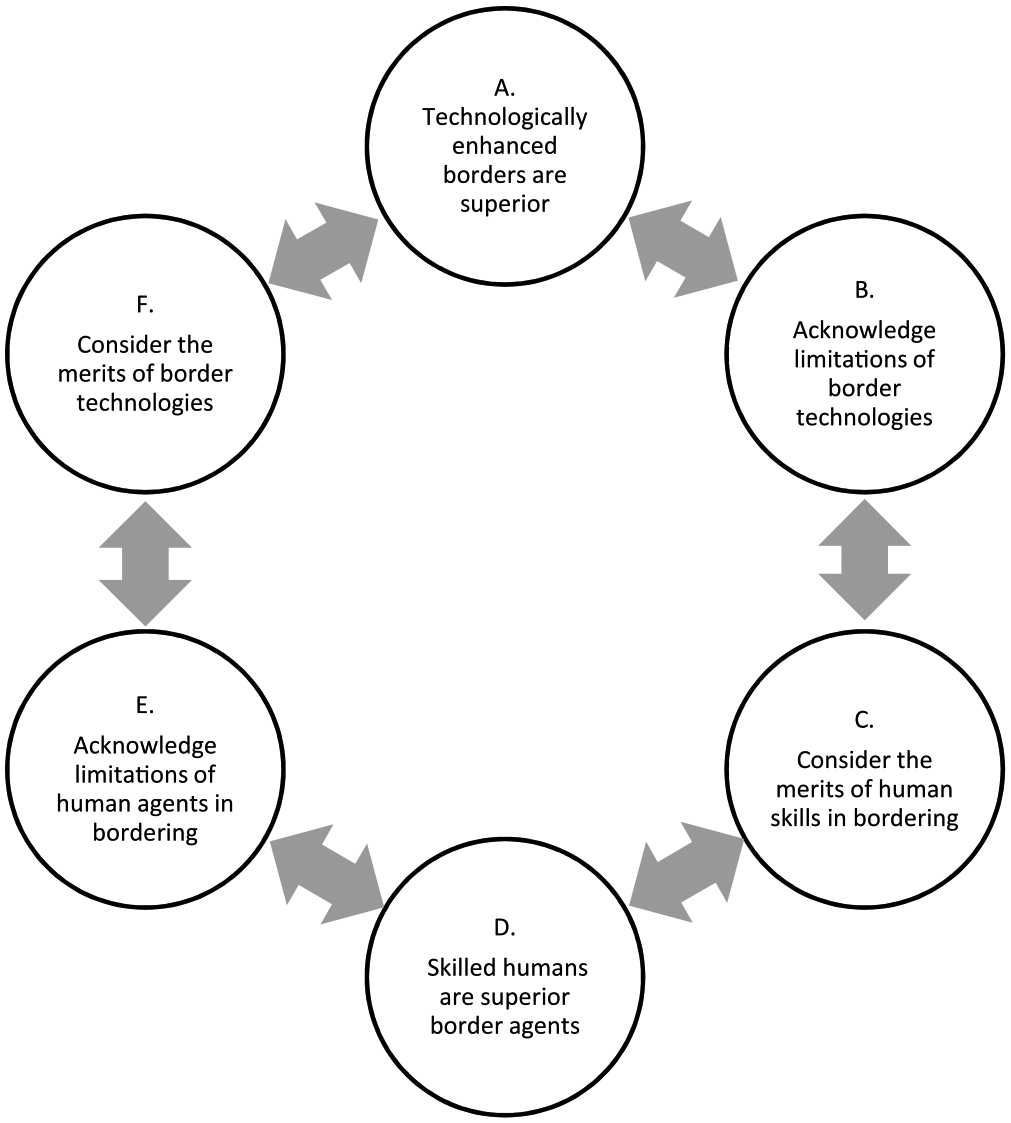
The turbulent cycle of automation.
We detected this cycle operating throughout customs, immigration and airport management, regardless of how ‘far along’ each sector was in terms of actually automating the border. We were struck by the reflexivity of our participants as they talked us through their supposedly ‘confident’ positions regarding automation. Once they had advocated for the superiority of either technology or humans in terms of improving their everyday working practices, they inevitably realised the limitations of their own pronouncements. As interviewers, we did not do much prompting on this, as our participants independently acknowledged that their rather absolute claims in favour or against automation could not be sustained. In that sense, we did not ‘push’ them clockwise around the cycle of automation, but rather observed as they followed their own reflections and considered alternative means of achieving a border decision. For example, after expressing his appreciation for the way that data-driven e-manifests were increasing the efficiency and accuracy of customs agents (i.e. point ‘A’ on the cycle), a senior UK cargo manager observed his colleagues manually opening a series of packages and immediately began a long explanation about the decidedly human skills and experience needed to identify suspect items (i.e. point ‘C’ on the cycle). Similarly, after sharing many stories of how skilled and experienced his colleagues were at identifying suspect passengers (i.e. point ‘D’ on the cycle), a senior EU immigration officer stroked the surface of a nearby decommissioned e-gate and told us how excited he was about the next generation of e-gates that were about to be installed (i.e. point ‘F’ on the cycle).
However, it was the turbulence of this cycle – the way it kept overturning and righting an assumed technology/human hierarchy – that revealed to us the very nuanced ways that our informants, often despite themselves, understood the entangled nature of the automated borders they worked with. Initially, we understood this cycle as bumpy but unidirectional (i.e. the arrows moving in a clockwise direction) such that further automation would always result. But as we worked alongside our informants, we discovered something much more interesting. Certainly, some of the border agents moved through the cycle quickly, smoothly and repeatedly, easily overturning and righting the technology/human hierarchy. However, some of our informants remained comfortably, often defensively, attached to specific positions; some bounced back and forth between two or three positions; and some got stuck or reversed direction. To better represent this turbulence, our arrows point in both directions along the cycle.
Turbulence, ambivalence and doubt in action
We were initially quite seduced by the confident manner in which many of our informants advocated for further border automation, and how comfortable they were asserting the superiority of technology over humans when it came to bordering. As a senior UK airport manager explained to us, ‘automation is absolutely the key … [it is] more fundamental than fundamental’. His pursuit of ‘an automation strategy with teeth’ was driven primarily by his desire to increase efficiency and speed: in his ideal airport, people, baggage and cargo would move through the border without stopping, which meant a seamless, frictionless and ‘touchless’ border that could enact what Broeders and Hampshire (2013) call ‘security at a distance’. Indeed, his excitement that new e-gate technologies, sensor systems and predictive algorithms would create a ‘secure, seamless 100% self-service walkthrough experience’ (SITA, 2017) was matched by an equally powerful disdain for ‘old’ technology such as the ‘disproportionately disruptive’ landing cards. In this pursuit of ‘permanent flow’, he talked enthusiastically about a future when facial recognition would operate when passengers deplane and then automatically open the e-gate as they approached. Those dreams of future automation underscored his lament when witnessing his employees try to help unwieldy passengers cross through the e-gates: ‘We don’t employ robots, but in some cases that’s what we want’. What most upset him was how much time passengers wasted queuing in front of the e-gates waiting for travellers struggling with passports, cameras, gates and touchscreens. As he explained with increasing irritation, ‘this is dead time – we can’t get it back, it is lost’. But as we pressed him on his strategies for using more border automation to improve the ‘flow rate’ of passengers, his answers kept coming back to the very human skills of interdepartmental diplomacy. The spatial politics of the UK border are crucial here: While UK Border Force (UKBF) are in charge of processing passengers at the border, airport management is responsible for all the spaces up to and after the border. This segregation of airport space brings up serious questions about who is responsible for procuring automated technologies that might increase security throughout the whole airport, rather than simply at the border. For example, the senior UK airport manager described the careful negotiations that took place over the recent procurement of ‘fish-eye’ cameras and backroom predictive algorithms for the check-in area. His team had to convince UKBF that ‘nonsecurity’ technology used to manage crowds and queues in advance of the border would actually make UKBF’s job at the border much easier, because they would know how many gates to open. What struck us in his story was how someone so committed to the superiority of technology over humans inadvertently acknowledged how dependent that technology was on the human–human negotiations required to procure it in the first place. The technology on its own was unable to announce its superiority, and while we were in no doubt about this manager’s belief in the necessity of this technology, he chose instead to speak about the hours of human labour required to advocate on behalf of these devices. Indeed, he went into great detail about the diplomatic strategies he used – how he ‘encouraged without menaces’ – when trying to get ‘buy-in’ from UKBF on joint funding bids for new technology and collaborative pilot projects.
His colleague in cargo management shared the dream that more border automation could reduce the bottlenecks and increase the ‘flow rate’ of cargo, freight and baggage through the airport, but he recognised that there was necessarily more human intervention in the handling of these items. As he explained, ‘the whole cargo system operates on manual as a default’. As we spoke with him, we detected a powerful sense of ambivalence about the stubborn presence of human action within the cargo system. On the one hand, he afforded human action a great deal of power, for example, praising the highly specialised skills of the agents manually sifting through the cargo in their allotted two-hour window, claiming that no automated technology could ever replace physically ‘scratching and sniffing’ through packages and boxes. Likewise, he acknowledged that no conceivable form of automation would be able to reduce the human endeavour required to design, build and secure each separate pallet of cargo in advance of air shipment. On the other hand, he lamented the stubborn presence of human action within the cargo system, which produced a curious sense of always failing to live up to more fully automated systems elsewhere. For example, he framed the automation of UK customs checks as constantly ‘behind’ its passenger counterpart (in part, because ‘you can’t ask a box any questions’), and while the automation of baggage checks was understood to be catching up with the passenger side, cargo and freight were still ‘much further behind’. Outside of these internal comparisons, the spectre of more fully automated airports constantly loomed large. In particular, Schiphol Airport seemed to operate as the industry standard with comprehensive data sharing, a centralised body for all air cargo, and highly mobile scanners. At one point, our informant shook his head and lamented, ‘it will take us ten years to get where they are now’.
We detected the same ambivalence about human action from European customs officers, but they seemed more confident that nothing will ever replace the unique and unreproducible capacities of human judgement, expertise and learning. As a very senior customs executive explained, If you were to try and tabulate everything that’s known in the human brain you’d never do it, so the machine can do so much – but you bring judgement, experience, trade craft and knowledge to it … they [customs agents] have all those years … that you can’t put into the machine, so the machine’s just a sort of number crunching.
There was a general feeling that the effort to remove the subjective human dimension of border decision-making through increased automation is risky because it cuts off the border guard’s best tools: his/her inherent human capacities (Frontex, 2014b). None of the European customs officers dismissed technology’s capacity to cope more efficiently with a greater volume of cargo, freight and baggage, but they kept insisting that ‘nothing beats boots on the ground’. For example, every morning customs officers are physically present in the cargo warehouses to undertake hands-on physical searches of packages in the two-hour window between the arrival and dispatch of goods. As a senior European customs officer explained: ‘I’m a believer in all the technology, but the physical presence, the one-on-one interaction, is invaluable’. She went on to explain that it is only by seeing the package, physically handling it and possibly opening it that they can confirm alignment between the data-driven e-manifests and the actual goods. However, this belief in the physical encounter between the customs officer and the package produced a contradiction. During our observations of customs officers at work in the European airport, we saw that they were only able to identify a small proportion of contraband because they simply could not physically examine as many packages as they needed to in the allotted time. While they were open about their inability to deal with the volume in front of them, they were adamant about their superior skills at correctly singling out suspect packages from the mass. Indeed, we witnessed a rich and complex set of human skills at work when customs officers simply looked at a pallet, a truck, or a pile of boxes and immediately identified ‘suspect’ packages. In an instant, they were able to take account of the size, colour, shape and package integrity and say with confidence where the package was from and what was inside. As one experienced officer explained, visual clues like the wrapping, the size, the tape, the colour, the writing, the way the package is ‘thrown together’ let you see ‘what you cannot see behind your laptop’. This echoed what we heard from the very senior European customs executive officer who explained, ‘machines don’t find stuff, customs officers do’. When we asked how customs officers knew who or what to single out, they often spoke about hunches, and a clear feeling ‘in your waters’ that ‘something is not right here’ (see also Allen and Vollmer, 2018). They could not articulate precisely what these hunches felt like, or how they learned to act on them, but there was a very powerful shared belief that ‘you can just tell’ when something or someone is not right. When we tried to get them to elaborate on this ‘art’ of bordering (Bigo, 2014), both senior and junior European customs agents said on more than one occasion, ‘you just know by looking’. What interests us here is the extent to which these intuitive and affective decisions create a pathway in which the category of ‘suspect’ is repeatedly associated with a combination of package aesthetics (e.g. colour of tape, style of writing) and country-of-origin. This is important for two reasons. First, that pathway will be constructed through prevailing geopolitical discourses about which countries are ‘suspect’ and which are ‘safe’, and those divisions may or may not map onto who is actually shipping illegal goods. Second, while some packages within that predetermined ‘suspect’ pathway will contain contraband, there will be many more packages containing illegal goods that do not ‘fit’ that particular combination of aesthetics and geopolitics, and will therefore will be missed. While we discerned the outline of such a pathway during our interviews and observations, we would need to conduct further ethnographic research at border sites to understand how it operates through everyday working practices.
The insertion of human capacities like intuition into the landscape of European customs and immigration was most intense when explaining how visual identification skills were required to supplement pregiven data on a suspect person or package. For example, a senior European immigration officer explained that while his employees felt comfortable starting from the biometric picture of a passenger generated by data points in advance of the border, much of their work was about paying close visual attention to affective cues inadvertently expressed by passengers (e.g. body movement, facial expression, eye movement, physical comportment and clothing). When we asked this immigration officer how he knew who or what to look for, he responded in the same way his colleagues in customs did: ‘You know it when you see it’. Here, the coordination that went into automated borders was replaced by a much stronger advocacy of human superiority over technology. Border agents articulated this most clearly when discussing how much (or how little) they trusted the automated technology they were using. As a senior European customs officer told us while we were observing the e-gates: ‘you always need to have the human element because technology gives bad results and technology fails’ (emphasis added; see also Leese, 2015; Lisle, 2018). In response to this claim, the senior EU immigration officer told us a story of how their pilot project of first-generation e-gates was short-lived because the tech company could not (or would not) provide enough routine maintenance or upgrades for the system. This idea of the human border agent functioning as a necessary backup to ‘untrustworthy’ technology is important in two ways. First, it leads to a stronger articulation of human autonomy and superiority with respect to bordering practices. As the senior European customs executive explained to us, the human border guard’s decision may be informed by pregiven biometric data, but he/she is able to ignore or override this information: the customs officer ‘has to have the autonomy to say that was bad, that was a nonintended consequence, it shouldn’t have happened so we’re not going to follow what the machine says … we’re going to decide what we can do and we overrule the results of the analysis’ (emphasis added; see also Frontex, 2014b). Second, the idea of a reassuring human presence at the border is supported by customer surveys. Passengers are in favour of automated borders when it makes their journeys more convenient, but they do not like being treated like an object or a dehumanised piece of freight: counted, labelled, dispatched, handled, transported, disaggregated, sorted and delivered. As a 2015 survey of nearly 6,000 passengers revealed, they feel ‘more comfortable when a staff member is on hand to help in case anything goes wrong’ (Future Travel Experience, 2015).
In their daily practices, customs officers, immigration officers and airport managers revealed an ambivalent and dynamic relationship to automated borders. We have made sense of this turbulence through a rather crude cycle of automation, but we don’t mean to lock these practices down to any one position. Indeed, our informants were often very reflexive and quite undecided about how the drive for automation was shaping their working practices. What most interested us in these accounts was how the daily practices of our informants kept breaking down the constitutive separation between humans, machines and other nonhumans, which in turn forced them to consider the limitations of their preferred bordering practices. While the reflexivity and the turbulence of this cycle certainly helped us grasp how our informants made sense of automation, we also wanted to explore how the logics of data-driven filtering were inserted into, and disrupted by, the wider spatial, cultural, embodied and material forces that shaped their working practices in and around automated borders.
Forces, interruptions and contestations
Paying closer attention to our informants’ anxieties and uncertainties, we wanted to explore the extent to which their everyday working practices were changing in response to the drive for more automation. Are automated borders producing new forms of coordination? Do these new coordinations interrupt or facilitate in/out decisions? Are there some working practices that remain unchanged despite the introduction of data-driven decisions, e-gates, e-manifests, and hypersurveillance? To explore this emergent landscape, we focused on the coordinated actions that are coalescing around four specific nonhuman forces surrounding the automated border: the wider institutional culture, mundane airport infrastructure, a metal drug loo, and sniffer dogs working with customs officers. Our intention in focusing on these particular forces and the working practices that constitute them is to identify the politics currently being generated by automated borders. Here, we build on Stacey and Suchman’s (2012: 1) claim that politically attuned understandings of automation must reveal continuing relations of ‘hidden labour and care’ between humans and machines. With that in mind, we ask two questions: (a) To what extent do familiar social asymmetries and forms of discrimination persist in the coordinated actions currently attending automated borders? and (b) are some of these coordinated actions capable of displacing, reordering and contesting those familiar logics of power? Here, we draw from recent critical work exposing how such logics of power hide within the algorithms designed to collect, filter and arrange data, and then circulate under the cloak of neutrality as they guide automated border technologies and human border agents (Amoore, 2013; Amoore and Piotukh, 2015; Hall, 2017). Indeed, our own earlier research into the laboratory-based development of border technologies reveals how prevailing social asymmetries and forms of discrimination materialise well before the actual border, as computer engineers become entangled in sensors, software, prototypes, algorithms and professional expectations (Bourne et al., 2015). Here, we are interested in extending those insights to explore how emerging working practices in, around and across automated borders sometimes entrench familiar logics of power, but often also disrupt, reorient and contest them. This more ambivalent articulation of politics extends our view of automation from the linear process of data-driven filtering and the turbulent cycle through which our informants made sense of that data, and examines how automation is constituted through entangled working practices that are informed by, but do not necessarily conform to, the abstract world of data-driven filtering.
The reach of institutional culture
While we did encounter contestations between management culture and frontline border guards (Allen and Vollmer, 2018), we became much more aware of the force, intensity and ubiquity of a wider institutional culture that governed how border agents did their jobs. This was expressed clearly in discussions about ‘professionalism’, and translated through formal institutional regulations (e.g. codes of conduct) as well as both formal and informal practices of training, mentoring, professional development and international cooperation. There was widespread consensus across both airports that professional regulations should be fair, egalitarian and transparent, but not a great deal of awareness that such norms are only the official face of a much wider institutional culture that operates largely through unspoken, informal and tacit registers. What particularly interested us was the extent to which this hard-to-detect atmosphere – or structure of feeling – directly shaped the working practices of our informants, and thus affected the supposedly ‘clean’ world of automated borders.
Quite quickly, we noticed a clear difference in general levels of formality between UK and European institutional cultures. For example, we observed a tone of propriety, distance and obedience to regulations in the UK airport, and highly formalised and often antagonistic relationships between airport management and the UKBF officers in charge of customs and immigration. Indeed, this formal atmosphere necessitated constant interdepartmental diplomacy, and also more subtle forms of persuasion (e.g. managers always reserved the best parking spaces for UKBF staff). In contrast, the European airport was characterised by friendly, collegial and informal relationships between all divisions, and while the border agents were clear about the seriousness of their work, they were open with each other, comfortable with light-hearted banter, and free with personal discussions, jokes, nicknames, gossip and swearing. Drawing from Basham and Vaughan-Williams’s (2012) arguments that borderwork is highly gendered, we interpreted the informal banter, joking and competition between agencies as a decidedly ‘masculine’ way of doing things. This is not to say that women were excluded from this culture; indeed, the few female border agents we engaged with participated actively in the milieu. Rather, ‘getting along’ in this professional culture, and by extension ‘getting the job of bordering done’, was greatly facilitated by an ability to use the informal masculine codes of humour, joking, banter, piss-taking and competitive teasing. As we know from organisational studies, these masculine codes have real effects in terms of gendered forms of institutional silence and exclusion (Butler, 2015; Johnston et al., 2007). It was no surprise, then, that with the exception of two relatively senior women, all the managers, customs, security and immigrations agents we interviewed were men. There were more women in ‘front of house’ service-oriented roles such as ‘customer ambassadors’, whereas the more manual ‘back of house’ roles were mostly filled by men. For example, in the European customs sheds, there were no women at all working on the shop floor, loading pallets or driving vans.
Like any workplace, those gender dynamics were embedded within managerial hierarchies that valued the supposedly ‘neutral’ characteristics of seniority and experience. Fundamentally, the managerial structures of both airports were deeply hierarchical, which meant they installed a predominantly one-way flow of information from seniors to juniors. This institutional structure has a direct effect on automated border decisions because only certain senior officials are able to authorise further inspections of suspect baggage, or more intrusive inspections, pat downs and strip searches of suspect passengers. But it was at the informal level that we became interested in how these managerial hierarchies might shape automated border decisions. As customs officers talked us through the important collective work of ‘building a case’ against an already detained suspect, they emphasised the ‘tradecraft’ required as they amass the evidence needed to satisfy legal and criminal justice authorities. While we saw that professionalism at work, we wondered what would happen if workplace relations had soured to such an extent that the pregiven data identifying a suspect was mishandled as a result. Might those seeking to impress their line manager be tempted to go beyond the pregiven data by subjecting more bags and passengers to further inspection? Might others seeking to undermine or irritate their line manager ignore the pregiven data completely, and consequently ignore potentially suspect bags and passengers? Amidst the turbulence of the cycle of automation and the logics of power inherent in any institutional culture, bordering decisions may be enacted not because of what the pregiven data reveals, but rather because of the health or toxicity of workplace relations. In this sense, we agree with Bigo’s (2014) claim that there is much more sociological work to be done exploring the unofficial divisions, contestations and struggles within particular institutional cultures that surround automated borders. But our initial observations revealed to us the extent to which informal institutional cultures actually shape the coordinated practices that produce in/out border decisions, no matter how automated that decision purports to be.
Improvising around stupid humans and brute materiality
Humans, machines and other nonhumans together produce ‘clean’ in/out border decisions. However, these entangled congregations never quite obey the rationalities of power supposedly disaggregating the safe from the dangerous. We witnessed these forms of disobedience most explicitly when observing the strange and anxious choreography performed by passengers in the lead-up to the e-gates. Automated borders can only operate by assuming that ‘the body does not lie’, that the body operates as the truthful, stable and sufficient entity that border technologies can ‘match’ with pregiven biometric data (Aas, 2006; Pötzsch, 2015). As Popescu (2015b: 105) explains, ‘[t]he belief is that the more accurately body characteristics can be technologically captured and interpreted, the more human subjectivity can be eliminated from the system and the more unfaltering personal identification becomes’. Within this ‘body-as-border-locus’, human agents seeking to cross the border are framed as passive and stupid, and somehow isolated from the border’s surrounding technologies, materials and objects.
We know, of course, that human passengers are not just biometrics, data points and statistics: They are corporeal, fleshy creatures who are tired, unfamiliar, confused, bored, frustrated, excited and zoned out. Indeed, it is precisely this excess of humanness that disrupts the technologised, instrumental and orderly processing of passengers through the e-gates. In the run-up to the e-gate, we witnessed a strangely ordered/disordered choreography between e-gates, airport infrastructure, passports, hand baggage, customer services agents, signage and immigration agents. Idiot humans were guided into this border choreography by a variety of materials and technologies such as brightly coloured signs identifying who can use the e-gates and how to use them, and screen-based video animations demonstrating how passengers should place their passports on e-readers and look directly at the camera. These visual cues were supported by crowd control infrastructure arranged to channel the flow of passengers to the e-gate itself (e.g. mazes of moveable poles, tape barriers, colour-coded floor arrows, diagrammatic images and bright lighting). We were struck by the force of these mundane objects; the supposedly ‘seamless’, hi-tech, automated decision enacted at the e-gate was actually made possible by the brute materiality of crowd control infrastructure. What became clear in our observations, however, was that even the most mundane technology was not able to discipline idiot-travellers into this preparatory choreography, and so additional guidance was provided by non-idiot (i.e. professional) ‘passenger ambassadors’. These individuals in brightly coloured jackets were employed by a private company to instruct individual passengers, guide them into specific queues, and help them present themselves and their passports to the e-gate for admission. As the senior UK airport manager explained to us, this congregation of materials, signs, infrastructures and helpers was a deliberate strategy: ‘We need to prepare people for what they are about to receive’. This preparatory choreography was never about rational humans confidently navigating inert infrastructures and passive technology, but was always about partial human–technology collectives that emerged and mutated at varying speeds, and that consequently did not always ‘properly’ control the behaviour of passengers. Tired passengers bumped into or knocked down barriers, anxious passengers fondled their passports, making them unreadable, bored passengers played on their phones and completely ignored the queue management system, and stubborn passengers tried stuffing their too-large suitcases through the e-gate.
This chaotic scene alerted us not just to the powerful force of mundane nonhuman infrastructure in the practice of automated bordering, but also to the creative practices of improvisation that border agents use when navigating nonhuman worlds. One of the most ubiquitous nonhuman actors in this milieu was paper: passports, printouts of e-manifests, airline tickets, risk bulletins, landing cards and customs declarations. Customs officers in both airports understood the wider imperative to ‘go paperless’ by only using the e-manifest, but they all relied on various forms of paper, as if its tangibility was somehow more trustworthy than a computer screen. We also witnessed ‘invisible’ nonhuman forces shaping the automated border, such as the ‘script’ learned by immigration officers working at passport control. We observed EU immigration officers obeying instructions and following the guidelines set by the pregiven data, but we were also surprised by the many creative adaptations, improvisations and work-arounds that changed our understanding of how passengers are received at the automated border. Processes of automation assume that border professionals (when they are needed) simply obey the pregiven data and use it to navigate a tree-like structure as they engage passengers (i.e. if yes then X, if no then Y). However, the face-to-face passenger interview with the presentation of identification is a much more contingent and unstable performance. As a senior EU immigration officer explained to us, the general reception script is based on a particular subsection of the immigration act. While those legal parameters operated as a background landscape, we witnessed immigration officers adapt, manipulate, embellish and adjust the pregiven script.
The improvisational excess of humanness that is needed to enact automated filtering is entangled with border infrastructures that shape where and how the border is materialised. Perhaps the most explicit example of the force of improvisation was the UK airport’s negotiation of the 2014 Ebola crisis. In order to ensure the proper health screening of passengers arriving or connecting from Ebola-infected countries, airport managers had to hastily erect a temporary ‘emergency’ border in the arrivals hall and arrange for a risk questionnaire to be distributed to all relevant passengers. While this temporary border was partially constituted by computers delivering passenger data to the relocated UKBF officers, it was also constituted by a particularly intense form of improvisation in which UKBF officers had to interpret real-time data about relevant flights, connections and passengers, and adapt their interview script accordingly. This border reconfiguration continued as the UKBF officer quickly identified high-risk passengers and directed them to new agents of bordering located behind the temporary border: public health officials carrying out the Ebola screening (Airport-Technology.com, 2014; Mabey et al., 2014). Here, the logic of visibility/invisibility central to the automated border (i.e. the border agent can see relevant data about you, but you cannot see data about yourself) materialised behind the border through the blunt instrument of the mobile medical screen. Passengers had to see enough evidence of medical expertise to feel that the crisis was being contained, but not enough to get anxious or worried. Of particular interest here was how the material objects required by a public health emergency (e.g. medical screens, stretchers, wheelchairs, blood collection kits, surgical masks, needle disposal containers and latex gloves) were enrolled into a this temporary ‘medicalised’ border apparatus.
We wondered whether similar reconfigurations emerged in routine (i.e. non-crisis) practices of bordering. We saw that the excitement around automated borders was always tempered with a deep frustration over the static, ageing and inert airport infrastructures within which those ‘smooth’ borders operate. Critical scholars have detailed the importance of both infrastructure and architecture in shaping the routine performance of airport borders, no matter how automated they purport to be (Adey, 2008; Salter 2008). However, border agents were able to creatively manoeuvre around the airport’s seemingly fixed infrastructure and architecture in order to get the job of bordering done. As the Ebola crisis demonstrated, there are many ways that the border itself – the ‘red line’ – can be moved around within the space of the airport. In one section of the UK airport, the border itself did not move, but the airport infrastructure funnelling passengers into the appropriate border did. What interested us were the coordinations and improvisations required to enact that move. Most of the airport terminal was characterised by fixed stands for receiving either domestic or international flights, but it also operated a number of deliberately flexi-stands that could be changed to receive either domestic or international passengers. Here, surveillance technologies monitoring flight arrivals predetermined whether the gate funnelled domestic passengers through a ‘customs only’ route, or international passengers through to immigration and customs. We became interested in how border agents interacted with the rather cumbersome and outdated infrastructure of buttons, levers and glass doors that constituted the flexi-stands themselves. As the senior UK airport manager showed us the different permutations of domestic and international channels, he outlined the risks of such infrastructural flexibility: ‘If we send the international passengers the wrong way, they miss immigration altogether and become a huge security risk’.
Another example of how improvisational practices around bordering can transform the infrastructure and architecture of the airport itself occurred at the European airport as customs and immigration tried to manage regular stopovers from Addis Ababa to Los Angeles. Because the American Transport Security Administration (TSA) did not trust the screening procedures in Addis Ababa, it required that all passengers deplane at the European airport, go through a more rigorous and trusted screening process, and then get back on the plane to Los Angeles. As the senior EU immigration officer explained, they were given very short notice of these arrangements and were forced to ‘hive off a big lump of the terminal’ on in order to create a completely separate checkpoint just for these flights. As he walked us through the area and showed us the relocated X-ray detector, he lamented, ‘this is where you feel how old the infrastructure really is’. The TSA’s need for data-driven, up-to-date security was met by repurposing older screening devices and renovating the actual airport building. The only way that the EU border agents could confidently keep the Addis Ababa to Los Angeles passengers sealed off from the rest of the airport was to build an external corridor with cement foundations and a mesh ceiling. Passengers arriving from Addis deplaned, got on a bus, exited the bus at the external corridor, went through to the specialised checkpoint for security screening, walked back through the corridor, got back on the bus and then back on the plane. Thanks to the improvisations and work-arounds of airport staff, the border materialised in multiple locations: in the data accessed by TSA and EU border agents, on the buses transporting passengers, in the concrete walls of the new walkway, and in the cavernous checkpoint far away from the busy hustle of the main terminal. All of these improvisations, choreographies and frustrations illustrate that the ‘automated’ border is not simply pre-emptive data-driven filtering and human/machine confirmation, but is instead a creative muddling through that connects wider forces, spaces, bodies, materials and imaginaries. However, the work and work-arounds of the institutional cultures and infrastructures attached to automated borders also set the scene for wider entanglements of care and control.
Judgement, empathy and the geopolitics of shitting
The TSA’s anxiety over the lack of ‘proper’ screening in Addis Ababa taps us into a powerful geopolitical imagination about which global populations are safe and trustworthy, and which are not. Underneath benign claims about the efficiency gains supposedly created by border automation are familiar cleavages between the ‘safe’ populations who will be granted access to frictionless mobility, and the ‘unsafe’ populations who will be subject to increased security interventions and surveillance (Lehtonen and Aalto, 2017). For example, these neocolonial assumptions appear in initiatives to globalise border technologies where ‘poor’ countries are infantilised as ‘too fragile’ to properly implement border automation or adopt the ‘new working methods’ associated with ‘modern processes’ – as if ‘they’ would treat these technologies like toys (DeWulf, 2011: 337; Frowd, 2018; Hoekman, 2011). Similarly, this geopolitical imagination loops back in to the practices by which border agents interpret the supposedly ‘impartial’ data guiding their decisions about suspect packages and passengers. We heard many problematic statements about the ‘types’ of people, nationalities and ethnic groups that were more likely to cross the border with contraband or send illegal packages. For example, the UK cargo manager echoed the TSA’s concern over security arrangements in Africa, asking whether you could really trust the limited capacities of ‘some bloke in a tin hut in Somalia’. Very similar assumptions directed the visual identification practices of European customs agents, who paid much greater attention to packages from particular countries. A particular shade of yellow packing tape, a certain type of dark brown cardboard, and strangely shaped writing immediately became ‘suspicious’ markers of nationality, ethnicity, culture, economic status and race. In the European immigration hall, judgements about ‘lax’ security measures were disproportionately focused on the ‘southern’ regions of Europe. For example, because Italian identity documents are easily available on the black market, immigration officers stop all passengers carrying these documents, question them further and place them under suspicion. We encountered visual expressions of this geopolitical imagination hung on the backroom walls of the European customs and immigration offices: maps of specific non-European regions already associated with the global drug trade and prevailing drug routes (i.e. Latin America, Central America, Southern Africa and Northern Africa/Southern Spain). In conjunction with pre-emptive data, these maps reminded customs and immigration officers to render all passengers arriving from these places additionally suspicious. This familiar geopolitical imagination did not hover over the border setting, but rather emerged in the moment of encounter between the prearranged data, the interpretive disposition of a particular border agent, and the particular package or passenger being presented.
Around the corner from these maps next to the interview rooms, we encountered more surprising and complicated entanglements that helped us understand how automation also functions within human practices of care and affection. We saw airport staff using their discretion to demonstrate care towards individual passengers, such as UK border agents allowing a young mother with her child to jump the security queue. More unexpected was how customs officers demonstrated care and attention when apprehending one of the most vilified human targets: the drug smuggler. These subjects are usually understood through a very gendered geopolitical imaginary with two predominant subjectivities: (i) professional and experienced smugglers who exert agency and see this as a necessary part of their job, and (ii) less experienced smugglers who are coerced into trafficking through debt, poverty and violence. Listening to European customs officers discuss their experiences apprehending drug smugglers, we noted a lurid fascination (tinged with respect) for the amount of drug pellets that each smuggler’s body can hold. As they showed us X-ray pictures of stomachs and intestines bloated with drug pellets (which in itself is an example of how automated borders extend into unlikely places), they tempered their admiration with a mixture of scorn for experienced smugglers (who will be caught by ‘superior’ detection technologies) and pity for inexperienced smugglers (who are abject victims). While the overriding framework for the apprehension of suspected smugglers is a legal one (e.g. making an arrest, amassing evidence, charging the suspect), initial attention to the human rights of the suspect quickly morphs into a complex set of caring practices that are afforded equally to both professional and inexperienced smugglers.
These practices are revealed in how customs officers coordinate various volunteer groups, translators and churches to accompany the suspect from the airport to the hospital to court. But its clearest expression is behind closed doors: in the automated drug toilet where smugglers are encouraged to void the contents of their bowels. More than the X-rays, body scanners and detection wands that confirm or deny already identified risks, the drug loo exemplifies the convergence of human flesh and brute technology in the service of bordering. Here, customs officers (and sometimes public health workers) watch as the drug smuggler mounts stairs to an enclosed steel toilet, and wait for the digestive system to do its work. Fixed, portable and even covert drug loos are in use around the world, and manufacturers claim that they recover illegal substances as ‘safely, hygienically and as sympathetically as possible’ (Drugloo, 2019). The fixed version we observed consisted of a large metal box in an isolated room, stairs up to the metal toilet, a clear Perspex screen so agents can see the smuggler’s seated torso, and a metal panel below the waist to grant the user privacy. Below the toilet are a range of buttons and levers operating a ‘hermetically sealed agitation unit’ that allow the customs officers to use built in gloves to separate the voided drug pellets from faeces. These materials protect the customs agent from odour and infection, but they also prevent the contamination of evidence that will help build the subsequent legal case. We were immediately struck by the coming together of the human, biological, material and technological in the drug loo. Its material and technological elements enabled the most intimate form of extracting nonhuman forms (i.e. drug pellets) from the digestive systems of human bodies, but it also allowed some humans (e.g. customs officers, public health workers) to avoid touching the voided contents of those bodies. For us, the drug loo was an unacknowledged and invisible component of automated bordering that required the palpable coordination of humans and nonhumans. Unlike the e-gates where fleshy human bodies meet their digital double rendered through data points, the backstage drug loo is where the human body becomes physically disaggregated in its encounter with mundane materials such as steel, toilet seats, rubber gloves, water, toilet paper and laxatives. We came to think of the drug loo as a belated and displaced machine in the circuit – a machine that replaces and transposes human labour, but that operates after the pregiven data has aligned with border technologies, and is therefore sequestered out of sight.
This coming together of bodies, machines and materials through complex practices of care and control was not neutral. Some bodies (e.g. customs agents, public health workers, police officers, legal teams) had power, law and force on their side, whereas the drug smuggler was an abject body – a criminalised subject forced to endure the indignities of shitting in front of others on a giant steel toilet. What most surprised us, however, was how the customs officers articulated enormous sympathy towards the smuggler having to undergo this procedure under the watching eyes of nurses and border agents. They showed us how they carefully helped the smugglers use the drug loo by gently placing a guiding hand on the top of the smuggler’s arm to take them from the interview room through the back hallway and into the drug loo room (a guiding hand, they noted, that could exert force if needed), and they demonstrated how they explicitly stood to the side and looked away while the smuggler was shitting. These were important practices of care in the most unlikely circumstances, a collective generation of sympathy towards a criminalised body that was mediated by a large, metal, sanitised toilet.
Josie the sniffer dog: Affection, play and love
As we observed the many facets of automated borders at these two airports, we became interested in a parallel border practice that disrupted many of our initial assumptions about how humans, machines and other nonhumans coordinate themselves in the practices of bordering. As sensors, e-gates, fingerprint scanners and surveillance cameras coordinate themselves in the process of translating pregiven data used to detect suspect passengers, specially trained customs handlers and their sniffer dogs coordinate themselves in the process of translating pregiven data used to detect illegal substances. Despite the inexorable drive towards data and technology-based automation, airports across the EU and UK are investing more in sniffer dog training and deployment. Reflecting on Joint Operation Minerva in 2014, Frontex (2014: 93) claimed that ‘a well-trained dog can out-perform technology due to its mobility and lack of dependency on circumstances and environment’. As we had discovered in previous research, the superior biological capacity of the sniffer dog functions as a key threshold for scientists developing portable detection devices for use at EU borders (Bourne et al., 2015; Lisle, 2018). This sensory capacity is highly valued by customs handlers who rely on their dog teams to undertake highly specialised forms of detection; that is, the dogs are trained to locate specific substances and items (e.g. drugs, cash, food). The European customs team introduced us to ‘Josie’, a young Labrador sniffer dog, and we were taken backstage to see the newly built dog kennels. We then observed Josie and her handler in action behind the baggage hall as she was guided along a moving conveyor belt between a number of bags, and followed them out into the baggage hall as she was guided between the legs and carry-on bags of waiting passengers. The practice of detection here is highly orchestrated: If the dog finds a predesignated target (e.g. drugs, cash, food) they ‘signal’, which gives the customs handler immediate legal grounds for a manual search. Conversely, if there was a pregiven risk indicated by the data but the dog does not signal, agents can decide not to intervene further. This was an alternative pathway for detection that was neither human (i.e. using the ‘tradecraft’ of border agents) nor machine (i.e. using sensors, cameras, screens).
The dog’s liminal position as neither human nor machine posed interesting questions for us with respect to how coordinated practices emerge at automated borders. Haraway (2003: 12) argues: ‘Dogs are about the inescapable, contradictory story of relationships in which none of the partners pre-exist the relating, and the relating is never done once and for all’. Dogs might be considered ‘biotechnologies’, since they are selected, trained and used by humans, but Haraway (2008) positions them as one of the many companion species that humans become with. During our interviews and observations at the European airport, we became fascinated by how these human–dog relations translated the pregiven data through practices of affection, love and intimacy. A more caring disposition has become the norm in sniffer dog training, which has shifted from more disciplinary punishment-based ‘old’ training methods to the ‘new’ methods focusing on ‘positive reinforcement’. The head of the Frontex dog training programme, Radu Anton (Frontex, 2014: 95), claims: ‘You have to make them willing to do something, by rewarding them, rather than forcing them to do it through punishment. The dog will try to please you so the training becomes fun’. But these reward mechanisms are not just a means to an end in terms of performing ‘good’ detection, because ‘on the job’ practices are integrated into a complex relationship of love and care between the handler and the dog, who live together as well as work together. Although the dog’s purpose is to detect banned substances, detection could not occur without loving, caring and intimate practices that are repeated everyday (e.g. an affectionate stroke behind the ears that bonds the handler and dog, the toss of a tennis ball that rewards the dog for a successful detection). What we witnessed resonates with Haraway’s (2008) account of the historic symbiotic relationships between humans and working dogs, and the need to recast our relations with such ‘companion species’ by focusing on mutual acts of love, care, intimacy and affection. These practices of love and care stretch beyond the co-produced action of detecting banned substances: They shape the way customs agencies share sniffer dogs between airports and other land and sea borders, how they promote the work of dog teams to the public (e.g. through promotional bookmarks featuring dogs like Josie), and how border teams like Frontex (2014) now consider potential danger to the dog itself (rather than just the handler) when choosing larger or smaller breeds for particular types of border. The palpable expressions of love, care and affection between the dog and handler muddy the waters in terms of where responsibility for the in/out border decision lies. The sniffer dog is not an inert ‘tool’ like an e-gate, nor a cognitively sophisticated human like a customs officer; rather, the sniffer dog can only be understood in a strange co-emergent space between humans and machines, and through the practices of love, care and affection that loop between the dog and the handler.
Conclusions
The prevailing pro/anti debate over border automation would have us believe that in/out border decisions are the result of either superior technologies capable of translating pregiven data with more speed, accuracy and objectivity, or superior human capabilities such as intuition, experience and tradecraft offering more relevant translations of pregiven data in specific situations. But these two narratives share a crucial assumption: that proper, robust and reliable in/out border decisions come primarily from single actors – either automated technologies or sophisticated human agents. This article contests that deeply reductive ontology and looks instead at what kind of sense-making and working practices emerge when we approach border automation through a lens of entanglement. Our observations and interviews at two airports revealed a complex set of coordinated practices between some expected humans and machines (e.g. immigration officers and e-gates), as well as some unexpected other nonhuman actors (e.g. parking spaces, packing tape, sniffer dogs, cement walls, shit). We came to understand automated borders not as a single moment of decision where an e-gate or e-manifest confirms or denies entry based on pregiven data, but rather as an elongated set of coordinated practices that are irreducible to either human or technology. To be sure, there is much more research to be done on how these practices emerge and transform. For example, what kind of automated border appears in the dedicated training sessions for specific technologies, or the professional mentoring structures that sustain its use? What kind of coordinated practices emerge around the care, maintenance, fixing and cleaning of automated border technologies? And if our turbulent cycle of automation operates across airport space, what are the different intensities operative in each sector? Our purpose in reframing automated borders through their constitutive entanglements and emerging practices of coordination, is to reveal the profound contingency of in/out border decisions, no matter how automated those decisions purport to be. The insights we gleaned from our interviews and observations helped us to contest the isolation, instrumentality and purity of automated borders, and foreground the congregation of agents and multiplicity of ‘situated actions’ that are enrolled in these seemingly simple in/out decisions.
Footnotes
Acknowledgements
We would like to thank all our participants who generously shared their time, knowledge and experience. For constructive comments on earlier drafts of this paper, we would like to thank Claudia Aradau, George Glouftsios, Matthias Leese and participants in LSE’s ‘Security and Statecraft’ seminar.
Funding
The author(s) disclosed receipt of the following financial support for the research, authorship, and/or publication of this article: Our project ‘Treating People as Objects? Ethics, Security and the Governance of Mobility’ was funded by the ESRC (ES/L013274/1) and ran from October 2014 to December 2016.
