




Abstract
On 18 November 2011, students at the University of California, Davis staged a protest as part of the Occupy movement. The reaction of the on-site police force was heavy-handed, and images of an officer pepper-spraying the faces of peacefully protesting college students provoked widespread criticism of the police’s repression of non-violent dissent. However, this reaction, the author argues, betrays a deeper racism in the consciousness of the US Left; while this particular scene of policing has provoked liberal anger, it has been isolated from the historical conditions that enabled it. The very similar policing of African Americans is excluded from the narrative of state violence, taking for granted the fundamentally racist structure of US policing. Is it possible, asks the author, that the critical response to events at UC Davis is actually condoning this racist structure rather than challenging it?
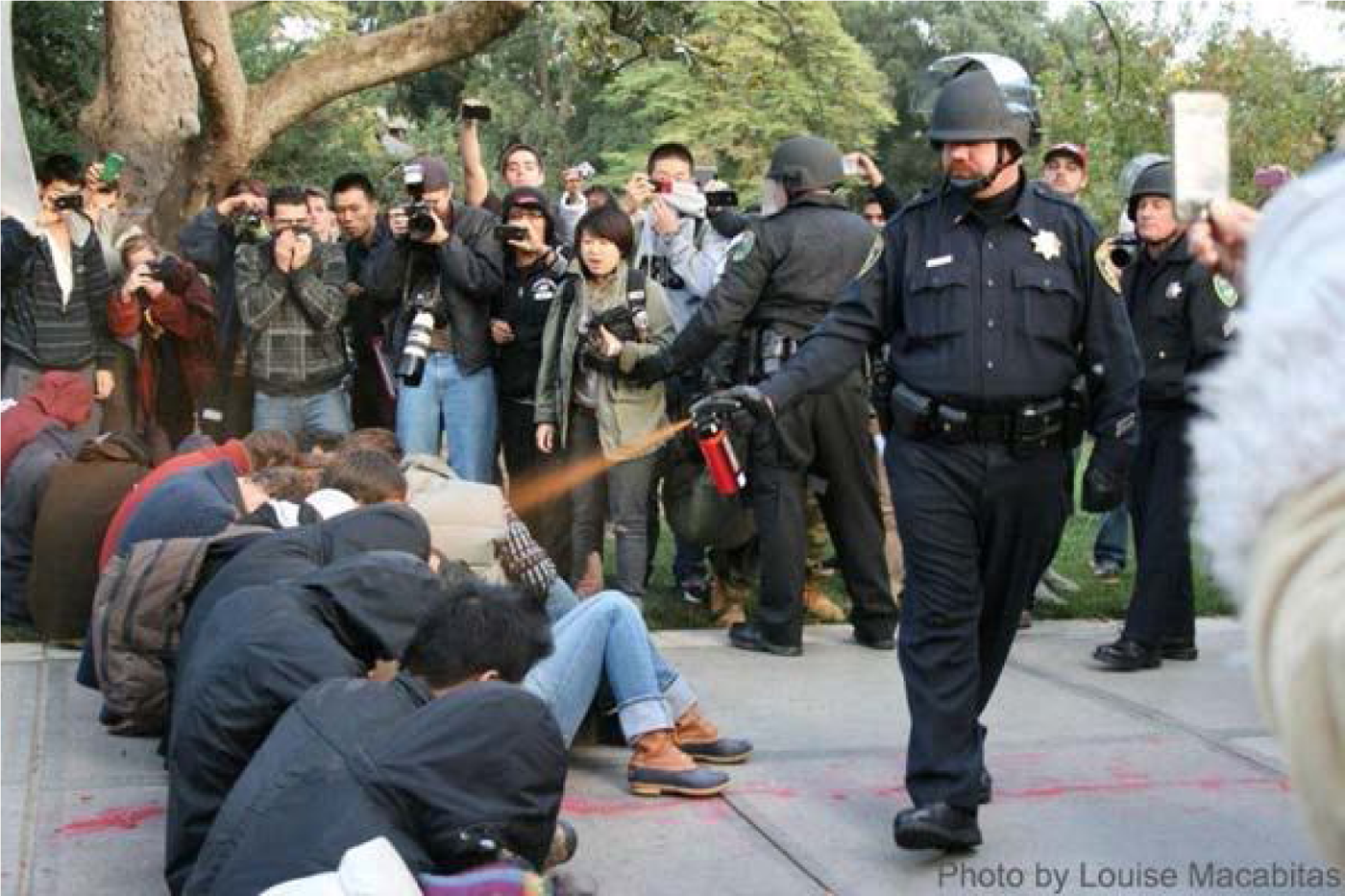
Police officer pepper-spraying protesting students at University of California, Davis, 18 November 2011 (photo: courtesy of Louise Macabitas, UC Davis student)
Since 18 November 2011, a mind-boggling number of observers have at least fleetingly absorbed some version of the image below. The picture of University of California, Davis police officer John Pike (whose prior police work has earned formal accolades from UC Davis and whose alleged homophobic behaviour figured centrally in a 2003 racial and sexual discrimination complaint filed by a fellow officer; the suit was settled for $240,000 in 2008) seems to perfectly convey a parable of political state repression during what appears to be a budding renaissance moment for the US and the global Left. 1 Lieutenant Pike’s brazen use of compressed chemical spray on a seated line of Occupy protesters (in this case, college students) once again demystifies the stubborn, provincial notion of the college campus as a place of rational, disinterested knowledge production and measured political exchange and reveals, once again, how the presumed distance between ‘town and gown’ may momentarily collapse at the marshalling of state (political) coercion. While this constitutes an utterly necessary and productive shattering of the university’s spatially privileged, assumptive innocence for some, it is a completely unneeded reminder of the regular, legitimated viciousness of the (racist) police apparatus for others.
It is in this sense that the events of 18 November 2011 at UC Davis bear the mark of a peculiar kind of American racial-political spectacle, one in which the narrative of the events has more impact than the events in and of themselves. Why is this particular scene of policing so resonant, and therefore so politically useful, to the liberal, progressive and otherwise leftist political sensibilities that significantly define (but also significantly exceed) the Occupy movement in most of its iterations?
Recall that the eruption of police violence at UC Davis on that afternoon – what most have named an act of ‘police brutality’ – catalysed a national and international response, focused on the vulnerable bodies of young white people engaged in an act of civil disobedience. (With due respect to the people of colour who were also in the line of fire at Davis, my contention is that their bodies were not the ones with which the national/international response was primarily concerned, nor was their vulnerability centrally responsible for inciting this global outrage in the first place.) The political outcry was catalysed by the viral circulation of cell phone, Facebook and YouTube videos depicting the mobilisation of riot-geared police officers, culminating in their dousing of UC Davis occupiers with the caustic yellowish fluid. As the scene becomes, at least momentarily, enshrined in the political narratives of the US and global Left, as a reference point for exposing the repressive tendencies of a state (and university system) in crisis, it is also clear that the spectacle of UC Davis has been isolated from the historical context that enabled it.
As a point of vital contrast, it is worth remarking that two months after the UC Davis pepper-spray incident, on 19 January 2012, a far more massive and militarised display of police force/violence occurred at my home campus of UC Riverside (about one hour east of Los Angeles), in which students were actually shot with ‘less than lethal’ police pellets during mass protests at the UC Regents 2 meeting. (Significant protests have marked virtually every recent ‘public’ meeting of the Regents, in large part due to their consistent, majority-based endorsement of incremental increases in student fees/tuition, which have more than doubled the normative cost of UC schooling in less than a decade.)
During the January meeting at the Riverside campus, UC police were mobilised from every UC campus, other than Davis and Merced, and were supplemented by officers from the City of Riverside Police Department and Riverside County’s Sheriff Department. Police helicopters periodically circled over the protest, and officers took what seemed to be sniper positions at strategic points atop campus buildings. The climate throughout the day of protests was thick with the police presence, and the pageantry of political intimidation amounted to a massive show of force against the students, faculty, staff and ordinary people who made up the crowd. The police demonstration posed a rather stunning contrast to the protest’s well-disciplined adherence to tactics of ‘non-violence’. (By way of definition, I do not consider loud chants, intense and vitriolic protest rhetoric, militant refusal to disperse an alleged ‘unlawful assembly’ or sit-down blockades to constitute ‘violence’; furthermore, even if one wishes to perform the academic gymnastics of labelling such activities as forms of discursive, symbolic, existential and/or immanent violence, they are certainly not of a kind remotely comparable to the aforementioned marshalling of legitimated state violence.) Yet, for reasons I will attempt to explain, we should not be surprised that UC Riverside’s scene of police repression – images of which are also easily accessible via email listservs, YouTube videos, Facebook photos, and the like – has not attracted remotely the kind of attention and righteous indignation as the matter at UC Davis.
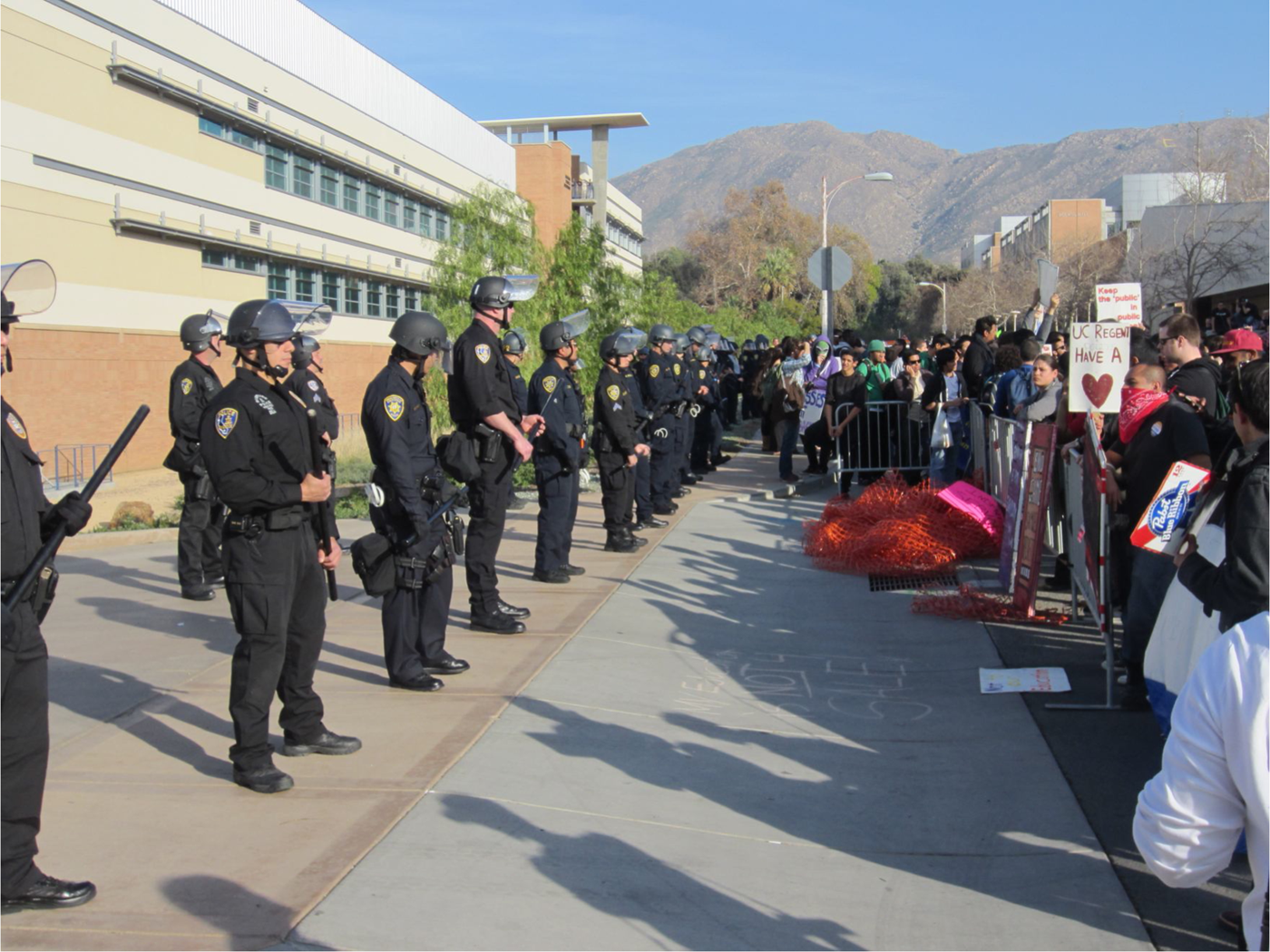
UC police militarisation at UC Riverside, 19 January 2012 (photo: author’s own)
Rather than stagnate in the discourse of righteous outrage that is almost reflexively spurred by such events, it may be more useful to pose questions: for example, is it possible that the entwined narratives of moral outrage and institutional (university/police) accountability surrounding UC Davis and other select police spectacles are part of a common-sense conspiracy of silence regarding the where/when/why (and not merely the how) of state and racist violence writ large?
Beyond police brutality
We should be clear: the UC Davis police used caustic ‘non-lethal’ spray on student protesters because they could. The institutional entitlement to use such force, however ill advised it may seem in hindsight, is neither incidental nor ad hoc; it is systemic, legally supported and absolutely normal. As we approach the twentieth anniversary of the acquittal of five Los Angeles Police Department (LAPD) officers’ street torture of Rodney King, it is urgent to once again examine how police violence shapes our everyday realities in different and contradictory ways. 3
The public response to the display of police violence at UC Davis has predictably been characterised by a combination of righteous outrage and institutional shaming, accompanied by somewhat more muted and unconvincing, though equally predictable, defences of the UC Davis police department and chancellor. Two facts are not in question: first, the campus deployed an armed police force to squash a conventional act of civil disobedience that was, in the recent historical scheme of things, quite institutionally polite and undisruptive; and, second, that same armed police force was authorised to use non-lethal weapons on non- violent student protesters. (We must also remember that the spraying of such chemicals has been known to cause death in many instances.)
What does remain in question, however, is how and why these facts are being translated into a liberal-progressive political reaction that seems to naturalise (i.e. take for granted and/or completely obscure) the fundamentally racial and racist structure of US policing, which has its modern roots in slave patrols, US colonial military outfits (in the Philippines, Puerto Rico and elsewhere), Texas Rangers (killers of Apaches, Cherokees and Comanches) and white citizens’ militias throughout the post-Civil war era, both north and south. In other words, is it possible that much of the critical response to the scene at UC Davis is actually condoning racist police violence rather than challenging it, and, if so, what is enabling such critically minded people to do so?
The liberal racial sensibility
The video evidence of police repression widely circulated from the UC Davis campus via YouTube and various other media outlets has quickly taken hold of a liberal racial sensibility that absolutely abhors ‘police brutality’ when it is waged on peaceful and/or non-violent student protesters. (Progressives, radicals, anarchists and other leftists often share in this liberal racial sensibility despite their left-of-liberal self-identifications.) We must be willing to acknowledge that the political and moral indignation over such excessive displays of non-lethal state violence (that is, pepper-spray rather than bullets) is quite openly amplified when such tactics are used on white students in the space of historically white institutions (as of autumn 2010, Davis had more white students enrolled than any UC campus besides UCLA).
There is something structurally white supremacist about this very indignation: the political expressions of outrage and institutional shaming over the spectacle at UC Davis are fuelled by an over-identification with (historically white) university campuses as places of presumed innocence, wherein enrolled and employed (white) bodies are also presumed to presume innocence. If we are to be honest in this moment, we must also recognise that many have only now been provoked into talking and thinking critically about the violence of the police because they are moved to defend the presumption of white bodily and spatial innocence, and are not necessarily concerned about police violence against those whose bodies (and the spaces they inhabit) are presumed guilty – or something close to it.
De-provincialising UC Davis
As the dust begins to settle from the spectacle and outrage surrounding the campus police’s use of chemical weapons on those students at UC Davis, it becomes ever more necessary to de-provincialise this form of state violence. By this, I mean something beyond the self-evident assertion that the acts of the UC Davis police and chancellor are ‘not isolated incidents’: the question is whether we adequately understand how they are not isolated incidents. The installation of militarised police forces on US college and university campuses, a practice several decades old, must be understood within the general social and historical context of domestic policing, and the specific policing imperative to engage in undisguised modalities of domestic racialised warfare, by way of wars on gangs, drugs, migrants, terror(ists), and so forth.
To de-provincialise the police violence at UC Davis is to take seriously the notion that the non-lethal (though no less repugnant) violence of those particular university-based police officers would have been impossible without the absolutely lethal and regular exercises of police violence in places (and on bodies) nowhere near that grassy campus quad. My more fundamental concern thus lies with the policed, human raw material that precedes and exceeds those pepper-sprayed students at Davis.
Apolitically policed black and brown bodies – young and old, urban and rural, transgender, queer and straight – are incapable of extracting anything remotely like the consensus of liberal outrage surrounding (and ultimately protecting) the openly political policing of white, able-bodied college youth. While all policing is fundamentally ‘political’, only a select few of its forms are addressed as such. This political abyss, which allows for acute indignation to be reserved for the policing of those presumed racially innocent (white), reflects a political and spatial provincialism that some of us simply cannot stomach and which gets to the heart of a racial antagonism that structures major strains of many progressive, social justice-orientated struggles, including the domestic Occupy movement.
Despite the outpouring of righteous and anxious statements from university administrators and other public officials disavowing this allegedly isolated instance of excessive state violence, there was a reason why those riot-geared UC Davis officers (who had to know they were performing for the cameras) did not hesitate to (non-lethally) fire. It is not difficult to see that, in the post-1960s period, militarised police repression of actual and potential political disorder is as American as the atom bomb. However, what is too quickly taken for granted is that the primary places in which such police power is exercised are the very same ones that are least likely to send their young people to places like UC Davis, and which are the primary sites for which the state has trained its police to engage in domestic, low-intensity warfare by way of drug sweeps, no-knock warrants, street harassment, traffic stops and justified use of (deadly) force. What is to be made of the UC Davis police action of 18 November 2011 once we understand that the foundation of those officers’ presumed right to violence lies not in some failure of bureaucratic protocol, nor in the obvious evidence of poor administrative leadership, but instead derives from the generalised legal, political and cultural mandate of the US policing apparatus to dispense force as it sees fit?
Whether or not the officers and administrators implicated in these latest exercises of campus police violence are kept in employment, we can be almost certain that they will not face legal or criminal sanction, a fact that is so broadly assumed that any possibility to the contrary is almost never mentioned in public discourse. The UC system has kick-started the inevitable pageantry of administrative and internal UC police investigations into these matters, from the UC Davis campus taskforce and UC system-wide review of ‘police protocols and policies as they apply to protests’, to University of California president Mark Yudof’s convening of a ‘panel of experts’ to review ‘the health effects of pepper spray’. 4
By design and procedure (that is, as a matter of routine assumption), these taskforces and panels foreclose (according to accounts from students and faculty, who have already participated in some of these discussions before walking out) any attempt at a historical analysis or critical institutional examination of the now-naturalised presence of a militarised police force in the world’s largest public university. In so doing, these institutional procedures rule out the question of whether or not one of the primary purposes of such a police presence is less about ‘crime control’ and more about preparation for political repression, campus-based counter-intelligence and everyday surveillance and detention of bodies (including enrolled, racially profiled students, for whom the campus is an inherently hostile site). Of course, these are precisely the things that many of us talk about every time we see the cops milling around political events on campus, particularly at places like UC Riverside, whose institutional calling card has recently become that of student demographic (read, ‘racial’) ‘diversity’. Furthermore, given these recent events at Davis and Riverside, it will be interesting to see whether the UC pepper-spray panel actually talks to anyone who has been on the receiving end of this chemical police weapon.
The insulation of policing from the very criminal legal apparatus that it supposedly serves (and many would contend that the relation of service is the other way around) is what constitutes the operational premise for such exercises of state violence. It is this relation, and not the alleged excessiveness, illegality or ‘brutality’ of the police violence itself, that must be confronted if the end is to be something more than just another piecemeal expression of localised shock and awe.
The diverse and complex practices of police violence are not only inseparable from the institutional evolution of policing in the last half century, they are essential to the very institutional integrity and identity of the US police regime writ large. If the policing apparatus cannot be corrected, punished or reformed against its own institutional entitlement to exercise violence more or less at will, in accordance with the law and ‘within policy’, this begs a fundamental question: if the solution is not simply to get the cops to ‘do their jobs better’, since, in most everyday exercises of police violence (including fatal ones), they are generally affirmed as having done their jobs pretty damn well, then what political responses are available, and toward what ends?
Yudof and Bratton: the case for (low-intensity) war
Now that UC president Yudof has called in domestic war expert and former LAPD chief of police William Bratton and his high-tech Kroll Security Group to conduct a ‘truthful and objective’ 5 (Bratton’s words) investigation of the mess at UC Davis, the lesson should be clear: the site of the (public) university is as much a focus of strategic state (and police) militarisation and repressive mobilisation as it is of budgetary ‘crisis’ and defunding.
Let us not forget that this is the same Bratton who pioneered ‘zero tolerance’ (or ‘broken windows’) policing as a method to surveil, terrorise and criminalise black, brown and poor people in New York City throughout the 1990s. Bratton’s policing strategy during this period facilitated a dense climate of police harassment and violence against black and Latino/a youth, based on often flimsy suspicion of such offences as loitering, public noise, avoiding subway fees and truancy. His name remains anathema to the many who experienced (survived) the grip of his regime in NYC.
It was also Bratton who, as the Los Angeles police chief, endorsed a rather incredible 2007 study by the LAPD Internal Affairs Group that concluded that, despite more than 300 official complaints filed by LA residents, LAPD officers had not once stopped, detained, questioned or otherwise engaged a civilian as a result of their perceived racial identity (about 80 per cent of these racial profiling complaints were dismissed out of hand by internal affairs as ‘unfounded’). This was the sixth consecutive year in which Bratton would proudly assert that there was not a single example of racially based misconduct among his officers. Further, despite the explosive and recent revelations of the Ramparts Division scandal in the late 1990s, the videotaped police beating of disabled black teenager Donovan Jackson towards the beginning of Bratton’s first LAPD term in 2002, the now infamous 2007 police riot at the MacArthur Park immigrant rights rally, the rampant use of ‘gang injunctions’ to detain, humiliate and physically violate black and brown children and youth, and myriad other instances of police violence, it was the same Bratton who stated, in 2008, that the LAPD ‘is not a racist department. It is not a homophobic department. It is not a brutal department.’ 6 In addition, it is also Bratton who has advocated hiring police officers from communities of colour in order to magically make ‘policing more attractive to a changing population’. 7
Without labouring the point, the fact that Bratton has been hired by Yudof, will be paid with public funds to conduct the UC Davis investigation and retains even a shred of credibility as an impartial or ‘objective’ investigator of police violence/brutality is somewhere beyond absurd. It is no less than a pronouncement that the University of California is a place of toxic hostility for those who rationally (and self-defensively) view Bratton (and, for that matter, the police) as the diametric opposite of peace and security. Some would venture to say that Bratton’s entry is merely the crystallisation of an institutionalised racial hostility that has aggressively inclined since the passing of Proposition 209 in 1996, which exterminated affirmative action initiatives, dramatically shifted the racial and socioeconomic demographics of the UC student body and brought even more suspicion upon those black and brown bodies walking across campus.
There is something else about the UC president’s hiring of Bratton and the Kroll Group that is worth considering. State and campus administrators seem to clearly understand that, in the history of progressive, leftist, radical and revolutionary social movements, university and college campuses worldwide have consistently played central roles as on-the-ground thinktanks, centres of massive political mobilisation and major catalysts for the initiation, sustenance and fulfilment of world-altering visions of political insurgency and social change. American apartheid was dismantled in significant part due to the political organising undertaken by and with students, on and adjacent to college and university campuses. The recent emergence of the anti-prison industrial complex and prison abolitionist movement has been fuelled by major public gatherings and consistent political actions at places like Columbia Law School, Laney College (Oakland, CA) and UC Berkeley. Recently, Occupy sites have sprouted at colleges and universities all over the US, although perhaps most conspicuously on UC campuses (thanks to the UC Davis police). This history is further proof as to why the recent UC Davis police violence must be de-provincialised: because campus police and their administrators already view themselves within a global and historical context of managing, containing, co-opting and repressing the potentially explosive and disordering political mobilisations that can happen just outside their office windows.
I will briefly mention another recent development at my own place of work to illustrate the point in detail. On 22 November 2011, a mere four days after the pepper-spray had cleared at Davis, the UC Riverside Office of Student Affairs, led by the dean of students, issued a declaration of ‘Protest Guidelines’. The document is framed by the affirmation, at once paternalistic and Orwellian, that ‘Free speech is welcome here’ (all caps in the original). It proceeds by providing a detailed protocol for ‘How to have a successful protest at UCR’.
What follows reads more like amateur political satire than serious university policy. First, the ‘Checklist to plan your protest’ dictates that a registered UCR student organisation or campus department must ‘sponsor your protest’ at least one month before the event. Then, at least two weeks prior to the event, protest organisers must contact the assistant dean of students and meet with an ‘event review committee’ that will ‘preview your preliminary plans’. In the meantime, potential protest organisers are put on notice that ‘protests with multiple risk factors, and/or an expected audience of over 100 will take more time to approve’. During the actual event, protesters are directed to appoint a ‘contact person’ who will ‘consult with the Assistant Dean of Students or UCR designee throughout the event’. To top it off, this protest contact person and the assistant dean/UCR designee are instructed to ‘exchange cell phone numbers’.
Such are not simply small-minded rules conceived in the friendliest spirit of political intimidation (the consequences for not following the protocol are never mentioned in the document). We must recognise that they comprise a particular tactic within the framework of low-intensity domestic war. Implicit threats of student suspension and expulsion, faculty subjection to conduct and disciplinary procedures (via the Committee on Charges, to which a case against the author was brought and dismissed in 2002–2003) and police intervention hover over the UCR ‘Protest Guidelines’ and similar campus protocols elsewhere. While none of this is to be confused with the worst of Bratton’s NYPD or LAPD, the UCR document’s criminalisation of potential political disorder (‘free speech’ run amok, without permission or approval) is not far from the police chief’s ‘zero tolerance’ philosophy of social control.
On 14 December 2011, six days after the initial circulation of an earlier version of this essay, UCR chancellor Timothy White publicly withdrew the ‘Protest Guidelines’ document. Confronting multiple faculty and student petitions objecting to the guidelines, as well as the real threat of First Amendment legal scrutiny, it became clear that the attempt to construct this repressive bureaucratic schema was creating more trouble than it was containing. In his announcement of the withdrawal, Chancellor White expresses regret over ‘any confusion and discontent caused by the document’, while asserting that its contents did not ‘accurately reflect UC Riverside’s demonstrated commitment to free expression and peaceful, non-violent protest’. He concludes by announcing ‘the formation of a task force to review and rewrite our rules of assembly as appropriate for an institution committed to free speech’. At the time of writing, the internet link to the previous document reads ‘under construction’. From one set of ‘free speech’ rules to another.
If they’ll do that to them …
The galling ease with which the UC Davis cops sprayed those students – as if they were exterminators treating an ant infestation – is not best understood as primary evidence of mentally unstable, corrupt or evil individual police officers who must be individually punished and held accountable for their actions. Rather, it is the very casualness of their violence that provides an insight into the historical depth and institutional reach of the late twentieth- and early twenty-first century US racist state. The bare fact that armed police officers at an elite public university can douse (white) students with clouds of pepper-spray provokes some of us to translate that scene into a language of deeper alienation and terror: if the cops are willing to do that to white college kids, what are they willing – and probably eager – to do to us? Of course, the ‘us’ cannot be homogenised here because anyone remotely familiar with the history of racist US state violence recognises that the police consistently deploy different strategies and intensities of force on different bodies, based on geographic location, racial profile, perceived gender and sexual identity, presumed non-citizen status, and so forth.
Nonetheless, the point should be clear: if we are to treat the UC Davis scenario as something more than an isolated incident of officers gone wild – and many students, activists, teachers, journalists and other thinkers clearly wish to do so – we cannot help but come face to face with the enduring and complicated machinery of the racist state. If they’ll do this to upwardly mobile white people on a liberal northern California college campus, what will they do to the rest of us, especially those whose guilt is more or less presumed in the eyes of the police, as well as their recent critics?