




Abstract
In 2010 the British government announced that the outrage of child detention for immigration purposes was to end. Simultaneously, however, it commissioned the opening of a new family detention centre called CEDARS. An acronym for Compassion, Empathy, Dignity, Approachability, Respect and Support, CEDARS is run under novel governance arrangements by the Home Office, private security company G4S and the children’s charity Barnardo’s. This article draws on focus group research with migrant advocacy groups, to examine the ways in which Barnardo’s’ role within CEDARS is variously imagined as mitigating and/or legitimating the use of detention as a border control mechanism. In particular we ask: what are the consequences of the co-option of charities and voluntary organisations within the immigration detention market? Has the neoliberal trend towards the ‘professionalisation of dissent’ diminished political opposition to immigration detention in Britain and the wider world? 1 Has humanitarian activism on behalf of migrants (unintentionally) contributed to the exponential growth of for-profit migrant detention markets?
Keywords
As a principle, migrant children should not be subjected to detention.
At Barnado’s, we believe in children – no matter who they are, what they have done or what they have been through. We believe in the vulnerable, the abused and the forgotten. We will support them, stand up for them and bring out the best in each and every child.
How can a charity which exists to protect the most vulnerable children in our society, assist in the detention and deportation of children? Barnardo’s disgusts me.
‘Doing the right thing’
In their 2010 election manifesto the Liberal Democrat Party, then the third-biggest political party in the UK, pledged a series of radical policy reforms that vowed to make the UK migration system more just and humane, including ‘ending the detention of children for immigration purposes’, allowing asylum seekers to work whilst their claims were being processed and introducing a route to citizenship (amnesty) for the estimated 500,000 to 1 million ‘illegal’ immigrants who had been resident in Britain for at least ten years without papers. 4 On 12 May 2010, a new coalition government between the Conservative and Liberal Democrat parties was formed. As details of the coalition agreement emerged, it transpired that the only element of the Liberal Democrats’ progressive agenda on migration which had survived was the pledge to end the detention of children.
On 16 December 2010, Nick Clegg, Britain’s Deputy Prime-Minister (and leader of the Liberal Democrat Party), took to a podium in St Luke’s charity and community centre in London to announce to waiting television news reporters that ‘the moral outrage’ of child detention was to end. Clegg stated: [W]e are ending the detention of children for immigration purposes in the UK … we are ending the shameful practice that last year alone saw over 1000 children – 1000 innocent children – imprisoned … today’s announcement marks a big culture shift within our immigration system. One that puts our values – the protection of children – above paranoia over our borders. One that prioritises doing the right thing over looking and sounding tough.
5
However, in 2011, details of plans to open a new specialist family detention centre in England emerged. Named CEDARS – an acronym for Compassion, Empathy, Dignity, Approachability, Respect and Support – this detention centre is run under novel governance arrangements by the Home Office, the private security company G4S and the children’s charity Barnardo’s. This was not in fact ‘the end of child detention’, but rather, as one government minister put it, ‘the end of child detention as we know it’; in Clegg’s later revision, they ‘ended child detention as it existed under Labour’. 6 This obfuscating rhetoric was satirised by the British political cartoonist Martin Rowson in his cartoon ‘The Pinocchio Protocol’ (see Figure 1), which depicts government ministers detaining a child with ‘double-speak’ while growing gigantic prison-bar noses.
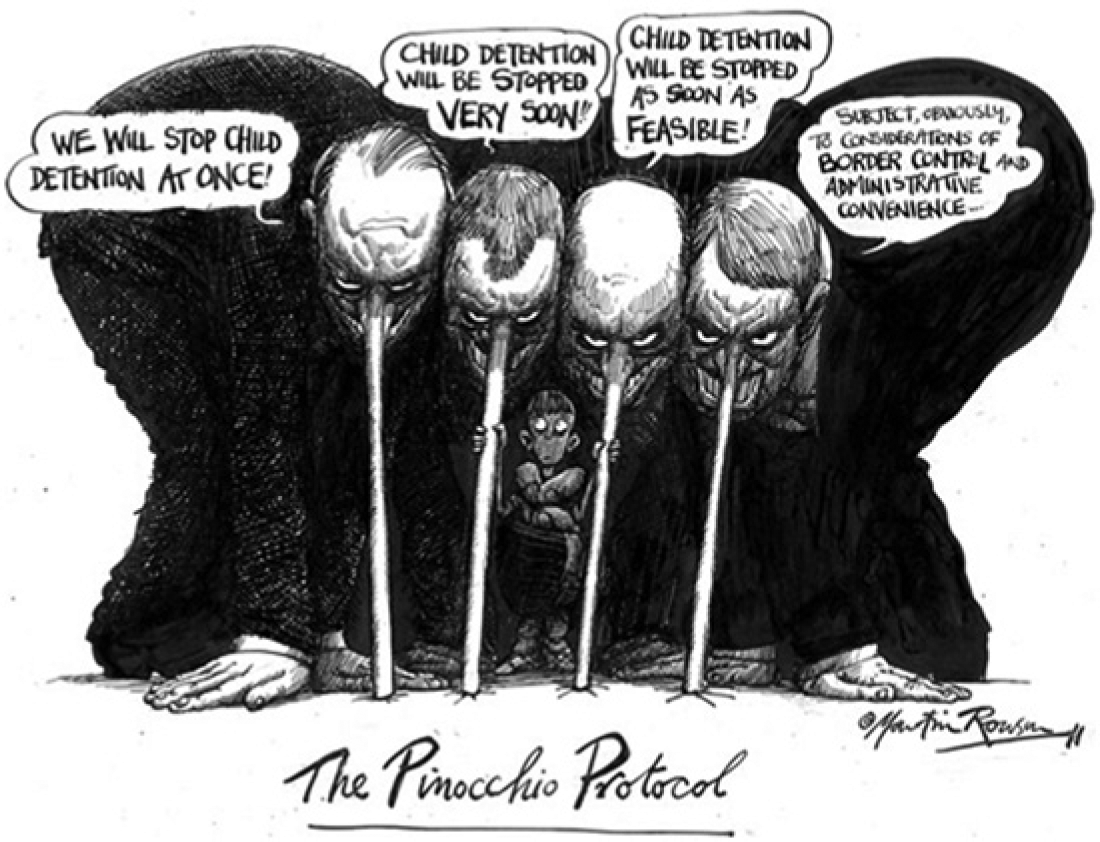
‘The Pinocchio Protocol’ (courtesy of Martin Rowson).
The dilemmas of co-option
At a time when migrants’ rights and migrants’ lives were becoming increasingly precarious as a seemingly endless ‘armoury of technologies of control and exclusion’ was being mobilised against unwanted migrants, 7 we surveyed 130 migrant support groups, interviewed thirty-five groups in-depth, observed a series of advocacy and activist meetings, and undertook focus groups around ‘live’ issues and relevant debates in this diverse sector. 8 Cuts in welfare provision and legal aid, diminishing human and economic resources amongst charities and voluntary groups, combined with the political and media scapegoating of migrants, created a toxic environment for irregular migrants in everyday contexts.
One common concern amongst the UK-based migrant advocacy and support groups we worked with was that a preoccupation with economic survival was diverting resources away from oppositional forms of practice. Organisations in this sector were under pressure to abandon principles of autonomy and bid for UK Border Agency (UKBA) contracts and/or to enter into contractual arrangements with private corporations (such as Serco and G4S) commissioned to run the UK’s immigration detention centres and manage housing provision as well as other services for asylum seekers in the UK. Private sector bids for government contracts are reliant upon corporations being able to demonstrate competence and expertise in working with migrants. As this expertise is largely the preserve of public and third-sector organisations, corporations are keen to enter into partnership with them. As John Grayson of South Yorkshire Migration and Asylum Action Group (SYMAAG) notes on the shift to the private contracting of housing for asylum seekers: In their efforts to extend their ‘asylum markets’ and ‘detention estates’ into asylum housing, all the private security companies involved in the £620 million contracts – G4S, Serco and Reliance – set out to encourage voluntary organisations, and charitable housing associations with experience in refugee and asylum housing and services, into partnerships as subcontractors. None of the security companies favoured by the Home Office had any previous experience in the field of housing – they needed to absorb and build in this experience, and credibility, to the contract bids.
9
While third-sector and private-sector commissioning is commonplace in the delivery of statutory migrant services in the USA and some parts of Europe, tensions around this shift from advocacy to service provision are acute in the UK. This is due in part to a spate of high-profile scandals involving G4S and SERCO, including failures to safe-guard migrants in their care, leading to the deaths of migrants during detention and deportation. 10 Many of our research participants felt that the compromise involved in entering into partnerships with state and/or corporate organisations was fundamentally eroding the capacity of advocacy organisations to effectively protest the deleterious effect of border-control mechanisms on migrants’ lives.
Tensions between individuals and groups with different perspectives on this evolving commissioning culture emerged most dramatically in the focus groups we held at the end of our project. The case of CEDARS and Barnardo’s raised what Frances Webber describes as ‘the vexed question of when, if and how we should engage with statutory bodies and whether it is possible to do so without jeopardising the principles which led us to get involved in this work in the first place’. 11 In these focus groups, our research participants were asking themselves, each other and us: what happens when migrant support and advocacy organisations are ‘repurposed’ as service providers? What is the impact of this shift on the ethos, politics and ‘cause’ of these groups and organisations? Does co-option within the newly devolved landscape of service provision undermine the capacity of migrant advocacy groups to resist and oppose the very border control regimes and politics of exclusion which they were ostensibly set up to contest?
The history of child detention for immigration purposes
For over a decade now, Britain has been massively scaling up migrant detention and deportation programmes. This is part of a global trend, as Michael Flynn writes: Two key features of contemporary immigration detention are its gradual institutional entrenchment in the nation-state (as observed in the shift from prisons to dedicated detention facilities) and its global expansion.
12
The administrative detention and deportation of adults classified as ‘illegal’ escalated in the late 1990s with a policy shift from the detention of very small numbers of migrants in mainstream prisons to the development of specialist migrant detention facilities. Today, between 25,000 and 30,000 ‘illegal’ migrants are held in detention per year in the UK: approximately 2,000 to 3,000 people detained on any given day. There are thirteen specialist privately-run immigration detention centres and several smaller holding facilities managed by UKBA at major airports and ports. As migration scholars Stephanie Silverman and Ruchi Hajela detail: The price tag for this ballooning estate is substantial: the average daily overall cost of one bed per day in the immigration detention estate is £120, with a typical immigration removal center (IRC) costing almost £8.5 million per year to operate.
13
Successive UK governments have argued that this escalation in detention is ‘an essential, everyday facet of immigration control’ and ‘regrettable but necessary’. 14 However, while arguments about the ‘necessity’ of detention are grounded in notions of deterrence, threat and security, the expansion of immigration detention, and the practices that determine who is taken into detention, are also driven by business interests. The profitability of detention centres is dependent upon them being as full to capacity as possible. The private companies contracted to run detention centres take migrants into custody (through dawn-raids or other arrest procedures) and transport migrants between centres to fill empty beds, working together to utilise capacity.
Advocacy groups understand the economic drivers of forced internal migration. Detention is a business, and the profits to be made are key determinants of both state-level policy formation and everyday detention practices. As Webber notes, ‘Immigration detention, for asylum seekers and others, has become a growth industry, with the convergence of interests between politicians seeking policies of containment, electoral imperatives and private companies seeking profits’. 15 Indeed, immigration detention is more attractive than prison from the perspective of investors, since, ‘[u]nlike prison contracts, immigrant detention contracts only require housing, food and medical services, not rehabilitation … services’. 16
Unlike migrant detention systems in some other European countries (such as Sweden), immigration detention in Britain means being housed in secure prison-like facilities with intensive internal surveillance, networks of corridors and locked rooms, razor-wired security fences and radically curtailed freedoms of communication with the outside world. Furthermore, Britain has no legal limit on the administrative detention of non-citizens. In principle, European case law decrees that detention can only be employed ‘as long as deportation proceedings are in progress’ and ordinarily only immediately prior to deportation. 17 In actuality, there are many documented cases of adults and children being held for months, even years. Migrants are, in effect, criminalised through the process of being detained but paradoxically lack any of the legal rights of criminals or prisoners.
The classification of migrants as ‘illegal’ effectively produces a population within the British state that is excepted from the regular rights of citizenship. 18 The children of ‘illegals’ are also classified as such because of the peculiar fact that citizenship status is bestowed not by virtue of place of residence or even place of birth but by the citizenship status of their parents. 19 Without status (and if they are born in Britain to parents without status they are often technically ‘stateless’), children are detained on the basis of the classification of their parents as illegal. In other words, they are illegalised by association – they are, in effect, genetically determined illegal. 20
Until 2001, children were very rarely detained in Britain. It was the 2002 government White Paper on Asylum and Immigration that formally set out the intention to detain families ‘for longer periods than just immediately prior to removal’. 21 Specialist ‘family accommodation’ was designed within existing and new places of migrant imprisonment in order to facilitate this growth in child detention. In order to fill this new family accommodation in detention, there was a corresponding intensification in dawn raids by UKBA and private securities companies from 2001 onwards. 22 These dawn raids were concentrated in designated ‘family dispersal cities’ across the UK, the largest of which is Glasgow.
In Glasgow many asylum-seeking families were concentrated in specific local authority housing estates, such as the Kingsway estate, 23 which enabled migrants and activists to document this escalation of dawn raids upon families. Many of the families targeted for deportation had lived in Glasgow for several years before their leave to remain was refused and were well known in their local communities. In 2006, one Kingsway resident, Jean McLeish, wrote in the Times Educational Supplement about the impact of ‘disappearing children’ upon her local school.
Children have ‘disappeared’ from this school. Some are believed to be in hiding. Others have been wakened from their beds, bundled into vans and driven to detention centres before deportation – sleepy, bewildered and frightened children who came to Scotland for sanctuary.
24
This growth in family detention came despite Her Majesty’s Chief Inspector of Prisons 25 repeatedly expressing grave concerns about the conditions under which, and length of time for which, children were being detained. 26 The expansion of child detention was also introduced in defiance of international legal guidelines and guidance, such as the international Convention on the Rights of the Child, which determined that children ‘should not be detained for reasons related to their migration status’. 27 As European Human Rights Commissioner Thomas Hammarberg has argued, migrant children are ‘in a position of triple vulnerability: as children above all, as migrants, and as undocumented migrants’, making them ‘one of the most vulnerable groups in Europe today’. 28
Every child (of a British citizen) matters
While the British government busied itself with expanding the detention estate to accommodate the children of migrants, it also committed itself to a comprehensive system of reforms to safeguard vulnerable children. The Every Child Matters (ECM) policy framework, and subsequent 2004 Children’s Act, stated that every child in Britain had a right to access the support they need in order to: be healthy; stay safe; enjoy and achieve; make a positive contribution; and achieve economic wellbeing. 29
Underpinning ECM was the idea that all the governmental agencies and professionals who encountered and supported children, be they youth workers, medical professionals, social workers, teachers, police or prison officers, should be more thoroughly networked so that vulnerable children were less likely to ‘drop through’ welfare safety nets. This integrative, multi-agency model of child protection involved a major restructuring of local services, with inter-disciplinary children’s services emerging to accommodate this policy shift. The changes ushered in under the ECM framework had a profound and largely positive effect on the delivery of services to the most vulnerable children in Britain. 30
ECM was supported legislatively by the creation of the position of Children’s Commissioner for England. The first commissioner was Sir Al Aynsley-Green (2005–2010), a former paediatric clinician and child health specialist who, as the ECM champion, made several visits to detention centres to talk to children and parents and to review the conditions in which they were held. Aynsley-Green noted that while in theory ECM’s policy framework applied equally to every child in Britain under the age of 18, whatever their background or citizenship status, in practice the children of parents subject to deportation orders were excluded from its protections. This was despite the fact that it was the brutal torture and murder in London of an undocumented migrant child from the Ivory Coast, Victoria Adjo Climbié, which led to the development of the ECM programme. In effect, the treatment of undocumented migrant children is ‘largely separated and different from’ the treatment and rights of other children in Britain. 31
The children of people classified as ‘illegal’ were caught at the nexus of two radically contradictory policy frameworks: the ECM commitment to safeguard all children resident in Britain; and a governmental commitment to make Britain appear ‘tough’ on ‘illegal’ migrants (the ‘deterrent model’ of border control described by Nick Clegg above as ‘looking and sounding tough’).
The children of non-citizen parents subject to immigration controls and deportation orders are in a deeply paradoxical position with regard to competing policy frameworks of ‘care’ and ‘security’. As the detention of families escalated, the overlaps and tensions between these competing policy frameworks became more evident in everyday interactions between state actors and children. For example, public sector workers such as teachers, nurses and social workers now had a legally enshrined responsibility to protect the children in their care from harm through the implementation of ECM policies. However, the same local agencies, schools, GPs and social services were simultaneously being asked ‘to perform tasks of immigration control traditionally assigned to the Home Office’.
32
As Nando Sigona writes: This is illustrated by the responsibility placed on health professionals in establishing a patient’s residency status, by asking social workers to assess failed asylum seekers’ entitlements to access support (which might lead to the breakup of the family), and by asking schools to cooperate with the UKBA on parents who do not comply with immigration controls.
33
Given that all the existing medical and psychological evidence reveals that the trauma of dawn raids, and the radical uncertainties of immigration detention and forced deportation have a deleterious effect on children, 34 the professionals delivering ECM are placed in an intolerable position. 35
The culture of commissioning
Commissioning involves the privatisation of public goods and services through contracting services to private companies. It is one of the central mechanisms through which neoliberal ‘free market’ economic principles are practised by national governments. While in theory commissioning is ‘bottom up’, opening the state up to the ‘democratising effects’ of market competition, in reality it is a top-down process through which multinational corporations ‘suck up’ public goods and services. Perhaps the most striking example of this can be found in the activity of G4S, the world’s largest security company (measured by revenues) and third-largest private-sector employer. Despite public scandals and failure to deliver on contractual agreements, G4S’s turnover was £7.5 billion in 2011, 36 a considerable amount of which is from the booming immigration detention business. Indeed, the planning application process, and the commissioning of G4S to run CEDARS, offers an exemplary case of how ‘free market competition’ works in practice.
Less than two months after Nick Clegg’s announcement that child detention was to end, a planning application was made to Mid Sussex District Council by an international hotel chain, Arora International Hotel, on behalf of UKBA, proposing to convert a small residential private school, Crawley Forest School in the village of Pease Pottage near Gatwick Airport, into a new detention centre for migrant families. Crawley Forest School was owned by Arora, a company that had previously made a failed attempt to enter the lucrative immigration detention market in 2009 thanks to local opposition to the conversion of a hotel at Gatwick airport. 37
In their justification for awarding the contract to manage CEDARS, without tender, to global securities company G4S, UKBA stated that this new detention centre was not a ‘new’ detention facility, but rather the extension of an existing family detention wing at Tinsley House. As they stated in a ‘voluntary transparency notice’: [CEDARS] is an extension of family service provision via an existing contract (Tinsley House Immigration Removal Centre), which was procured and awarded to G4S … The geographical co-location of the Pre Departure Accommodation, and the need to draw upon existing services and expertise from Tinsley House dictated that the Pre Departure Accommodation service requirement be attached to the existing G4S contract as a contractual change notice.
38
There is a contradiction between this legal document, which claims the new family detention centre is an extension of an existing facility, and the planning application document, which suggests that this new facility is not a detention centre at all but, instead, a new and as yet unclassified type of space termed ‘pre departure accommodation’. 39
From security to care
This shift from security to care was highlighted in a letter sent to local councillors and local residents by the planning consultancy company CgMs, the agent working on behalf of UKBA with regard to the CEDARS planning application. The letter stated: ‘The facility will be run on a care model rather than a secure one, supported by a third sector organisation. In short it will look and feel very different to the UK Border Agency’s immigration removal centres.’ Furthermore, the planning document stated ‘Importantly, the facility will be part-operated by a well-known national children’s charity, who are already working with the UKBA in relation to [CEDARS] design and way it will function [sic]’. 40 Further correspondence associated with the planning application revealed the children’s charity to be Barnardo’s.
Barnardo’s, founded in 1866, is the largest children’s charity in the UK and describes its mission as transforming ‘the lives of the most vulnerable children across the UK through the work of our services, campaigning and research expertise’. 41 The chief executive of Barnardo’s, Anne Marie Carrie, claimed that the charity’s decision ‘to provide welfare and social care services to asylum seeking families at the new pre-departure accommodation goes back to our core purpose: supporting the most vulnerable children in the UK’. 42 The involvement of Barnardo’s angered activists who felt that it lent credibility and a ‘charitable gloss’ to detention and legitimised claims that ‘child detention as we knew it’ had ended. 43 In a series of newspaper, radio and television interviews, Carrie sought to reassure critics that Barnardo’s was acting in the best interests of migrant children and their families. In interviews, when asked how Barnardo’s would be able to hold the government to account about the detention of children when in receipt of government funding to effectively support detention as a mechanism of border control, Carrie frequently responded with the question ‘If not us, then who?’ 44 To further underscore this shift from security to care, the government naming of ‘CEDARS’, an acronym for ‘the principles staff will work to – compassion, empathy, dignity, approachability, respect and support’, 45 deploys the language of care as a public relations exercise specifically designed to soften the perception of this new immigration detention centre as a carceral space.
CEDARS was opened in August 2011 to widespread and vocal opposition from many of the organisations and activist groups who campaigned to end child detention. Activists described it as ‘an internment camp for refugee families with children, who are awaiting deportation’.
46
This stark invocation of the language of imprisonment (see Figure 2) was part of a concerted effort to rebuff the governmental and corporate marketing of CEDARS as the softer and kinder face of child detention. As Frances Webber puts it: Pease Pottage [CEDARS] is a short-term detention centre, complete with 2.5m high perimeter fences and staff authorised to use control and restraint techniques on non-compliant adults and children. [It is important to note that] detention, per se, not just the conditions of detention, traumatises children.
47
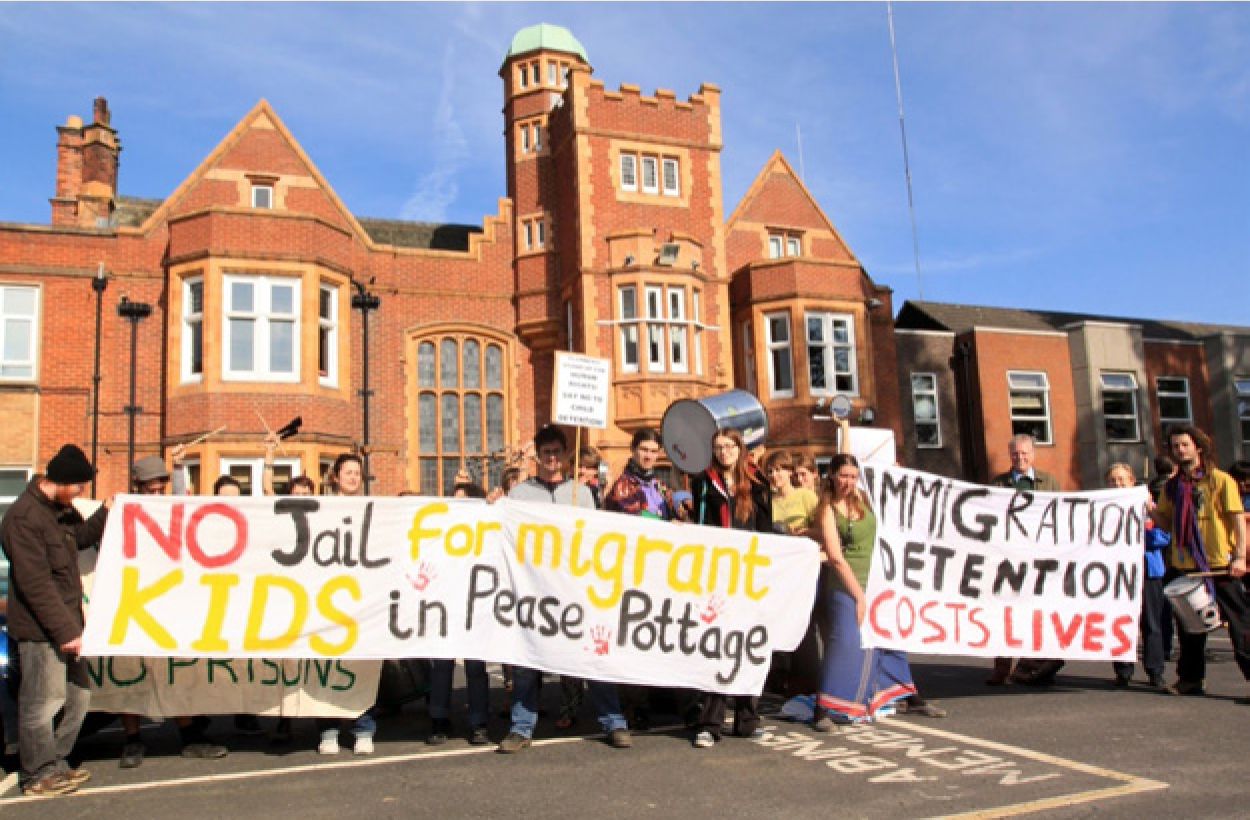
Demonstration outside the planning application meeting for CEDARS (photo: courtesy of Brighton No Borders, Creative Commons Licence).
One notable exception to the activist outrage to the opening of CEDARS, however, was the public support for this new centre by Citizens for Sanctuary, an arm of the community group alliance network Citizens UK. Citizens for Sanctuary had played a significant role in garnering mainstream political consensus to end child detention in the run up to the 2010 general election, employing a strategy of targeting parliamentary candidates in marginal seats and asking them to take a pledge to campaign to end child detention if they won. When CEDARS opened, Citizens for Sanctuary claimed, and continues to claim, that child detention in the UK had ended, stating: ‘Before the last election over 1,000 innocent children from our communities were locked up in detention centres like Yarl’s Wood for immigration purposes every year. Now none are.’ 48
This claim is supported by a graphic of a ‘child freedometer’ which purportedly illustrates the numbers of children that Citizens for Sanctuary have ‘saved from detention’, and an animated film entitled ‘Barbara the Brave’ which illustrates the role played by Citizens for Sanctuary in ending child detention.
Undoubtedly, the material conditions in CEDARS are different from those previously experienced by families in the family designation section of Yarl’s Wood Immigration Detention Centre. Further, the length of stay at CEDARS is restricted, in principle, to one week. One visitor to CEDARS notes on the Citizens UK website: The rooms are spacious. The furniture is new. Beds are comfortable. The facilities are well laid out providing for convenience and privacy. The décor is creative and very welcoming. Children themes are reflected in both living and play areas.
49
For Citizens for Sanctuary, the time limitations and the caring environment afforded by Barnardo’s child welfare workers nullifies the fact that the children are being detained and deported. In contrast, for anti-detention activists and most child welfare groups, CEDARS is still by any material or legal definition a secure immigration detention facility, to which people are forcibly taken, normally through dawn raids, before they are forcibly deported from Britain. As the lawyer and activist Syd Bolton notes, ‘children still experience detention AS detention, in all its forms and in all its stages, even if the physical conditions are, on objective, external scrutiny much better than before’. 50
While Citizens for Sanctuary seeks to make detention as humane as possible, for many other activists the imprisonment of children without trial and for reasons of citizenship status is fundamentally wrong. The case of child detention is particularly pointed in this regard, as children clearly have limited agency as regards migration choices. Research into family detention points to alternatives to detention that are in operation elsewhere in Europe. 51
How close is too close?
In September 2011, representatives of migrant support organisations took part in a series of focus groups, bringing together members of seven organisations. The fifteen participants represented a range of asylum and migrant support groups in the UK, from salaried professional representatives from large NGOs, to small groups of volunteers. They included organisations that have an established history of working with government and had what one participant described as ‘a seat at the table of power’, meeting regularly with government ministers and civil servants and invited to directly intervene within and inform policy debates. Alongside them were small, local and more precarious organisations, which focused on, for example, visiting migrants in detention centres and/or providing pastoral, legal and welfare supports to destitute migrants. Two of the large organisations had received government funding and were fully immersed in the commissioning and contract culture, but the majority of the organisations we worked with were self-funding and almost all of them had charitable status. 52
In the context of the often chaotic restructuring of local services and welfare systems, one of the most pressing dilemmas confronting many asylum advocacy and support organisations is the issue of whether or not they should bid for the contracts that emerge as local and central government devolve service provision to private companies. One of the risks for migrant support groups in an era marked by the rise of mandatory partnership working 53 is that they become entangled within the very governmental systems of immigration and border control which they ostensibly contest. 54
During the focus group discussions (and at break times between sessions) the conversation repeatedly returned to the recent opening of CEDARS and in particular Barnardo’s’ decision to work with G4S and UKBA. A senior professional from one large organisation described ‘working with government’ as ‘the big issue’ which was dominating policy debates in his organisation. He revealed that conversations amongst staff revolved around ‘co-option’ and repeatedly focused on Barnardo’s, including questions such as ‘what are they doing? What is their justification? What are the criticisms?’ For some participants, Barnardo’s’ involvement in child detention marked the crossing of a catastrophic moral line. Others responded to Barnardo’s’ decision sympathetically, describing it as a dilemma between a desire to assist children in detention and the known fact that enforced detention and deportation was inevitably traumatic and harmful to children: I think there is some really tough questions about … about judging Barnardo’s, basically, should they be in there or should they not? Exactly, [Barnardo’s decision] gets to the heart [of] this contradiction between short term and long term strategy and working with government. I can kind of argue both sides equally really being a bit relativistic myself, if Barnardo’s weren’t doing it perhaps someone else would do it and they will do a much better job certainly than G4S. That is one side. The other side is that they should boycott it because it [child detention] is fundamentally unjust.
55
Another strong line of argument was that if Barnardo’s pulled out of the contract because the ‘red lines’
56
it had set out in its negotiations and contractual agreement with UKBA were crossed, this would present an incredible political opportunity for migrant advocacy groups in exposing the problems endemic across the entire (adult) immigration detention estate. As one individual noted: Barnardo’s … are such a well-established charity, inside the psychology of almost everybody in this country, if Barnardo’s turn around and say ‘we can no longer work with you UKBA’ the impact is going to be felt in middle England … if Barnardo’s said ‘no we’ve got our bottom line we said what it was’ and if they pull out that is going to have quite a dramatic impact on [public opinion], it will be very difficult to cover up Barnardo’s [withdrawal].
What became clear over the course of three hours of discussion within and between the focus groups, was that the Barnardo’s case was provoking important critical self-reflection. For example, discussion about Barnardo’s prompted one participant to reveal: we are in the process of developing a memorandum of understanding with the governor at the detention centre and that was a mighty, mighty big question. Should we even go there, should we talk to the enemy, should we do this … I mean we want to work with him because it gives us access and I am sure he wants to work with us because it gives him control and so we are entering into that sort of discussion about how do we get the best bit we can.
Increasingly, to ensure governmental (or corporate subcontracted) funding streams, migrant advocacy groups have to de-politicise their mission and present themselves as neutral actors. 57 This transformation into contracted service provider ‘turns confrontation into negotiation. It depoliticises resistance.’ 58 This is why experienced advocates in the field of migrant rights in Britain warn about the ‘grave dangers in the “voluntary sector”, including churches and charities, getting involved in the mechanisms of control’. 59 It is not only that humanitarian and immigrant rights groups are being systematically co-opted to provide a ‘humanitarian gloss’ for global security companies, but that humanitarian organisations become central organisers within the governance arrangements required to support these new networks of humanitarianism and security. 60
For some organisations, Barnardo’s’ involvement raised deeply unsettling questions about the changing ‘cause’ of their organisations. As one participant put it ‘[i]f there isn’t enough self-reflection in the organisation … what happens to your cause, your real motivating cause as an organisation, why you exist in the first place’. This question of the ‘loss of cause’ manifested itself in terms of a sometimes-tense airing of differing political views. For example, one participant argued that Barnardo’s was flagrantly selling UKBA its ‘brand’ and accused another well-known migrant advocacy organisation (represented by a participant in the focus group), of being complicit with exactly the same problematic practice when it had accepted government funding: ‘if I was a government minister for Borders, or whatever it’s called at the moment, then I can see how I’d want your brand. You know, as a way in which your brand legitimates my policies.’ This prompted a volunteer from a small activist organisation to ask, ‘So do you think if you work with government too closely, you can be too aligned with the forms [of power], it stops you being oppositional in the way you need to be?’ Dan,
61
a professional employed by a large NGO, replied: We would always deny that, but we always deny that we have sold out any of our operational independence … any of our independences for campaigning for individual clients … any of it at all. Personally I don’t think that is true … conflicts of interest [do] restrict our ability to campaign [and] our ability to help individuals as well … but the organisation hasn’t really even engaged with that whole discussion that … well I think we have been in denial about it for a long time.
Here Dan reveals that the culture of commissioning, and the conflicts of interest between different client groups (governmental and migrant) that this generates, has impacted on the ability of the organisation he works for to openly campaign against government policies. Later in the discussion he reflected further on this: the first step on the road to managing your conflict of interest, even dealing with it, is to acknowledge it … I don’t think we have ever really got to the first stage of acknowledging that there are conflicts of interest … when we take the money … it’s incredibly thorny.
Clearly it is difficult for migrant advocacy organisations to retain a credible, independent and critical position with which to lobby for change if they are entangled within a for-profit market in ‘migrant services’. As one participant stated, groups are ‘taking tens of millions of quid off UKBA to do these contracts while fiercely trying to cling onto [their] independence’. Interestingly, some of the participants described the financial problems faced by their organisations, and in one case the loss of government contracts, as an opportunity to turn back to their founding ‘cause’ and engage in more openly political work again: ‘the cut in funding isn’t … totally negative, but it’s … a way to actually have that moment of self-reflection about what are we, who are we for, what are we doing, how close are we to power’.
As a consequence of the ties (and perceived ties) between migrant support organisations and the state, migrants themselves have become increasingly suspicious about the motivations of the groups and organisations from which they might seek support, perceiving them to be arms of government and fearful that any information they share in seeking assistance might be passed on to border officials. 62 The trust migrants have in some ostensibly independent and progressive groups has been compromised as a result of their proximity not only to states, but to private corporations. In February 2012, G4S was one of three multinational security companies, alongside Serco and Reliance, which took over provision of asylum accommodation in the UK for the next five years. According to its website, G4S has selected the charity Migrant Helpline as its ‘strategic partner’ from the voluntary sector. 63 This delegation of responsibilities from state to global security corporations to third sector organisations obfuscates lines of accountability and nurtures unease in the sector.
While the number of children detained at immigration detention centres has declined since the British government announcement that child detention had ceased, the number of children detained in temporary holding facilities at ports and airports appears to have significantly increased in the same time period. 64 CEDARS is now the kinder and more humane public face of child detention in Britain, 65 but significant numbers of children are still being detained in adult detention centres and at temporary holding centres. However, when CEDARS was opened, a family unit was simultaneously refurbished at Tinsley House immigration detention centre. 66 At the same time, forms of in-community surveillance and what could be termed ‘soft-detention’ have rapidly expanded, as the use of electronic tagging and private asylum housing stock has increased.
In 2012, the UK Border Agency created a new asylum market by removing the statutory responsibility for housing asylum applicants from local councils and commissioning asylum housing for the private sector. £620 million worth of contracts were granted to three companies: Serco, Reliance and the world’s largest security company G4S. 67 Together, these changes suggest that child detention has not ended but, rather, that forms and methods of detention have diversified and continue to proliferate.
Footnotes
Acknowledgements
We acknowledge the support of the Economic and Social Research Council (grant ES/J021814/1).
Imogen Tyler is a senior lecturer in Sociology at Lancaster University and author of Revolting Subjects: social abjection and resistance in neoliberal Britain (Zed, 2013). Nick Gill is a senior lecturer in Human Geography at Exeter University. Deirdre Conlon is a lecturer in Critical Human Geography at the University of Leeds. Ceri Oeppen is a lecturer in Geography at Sussex University.