




Abstract
Vishnu Sharma (1921–1992) came to Southall, West London, in 1957 as a seasoned political organiser in the peasant and trade union movements of the Punjab, who had already, under the Raj, been imprisoned for his political activities. A member of the Communist Party for most of his life, a vice-chair of the 1960s’ Campaign Against Racial Discrimination (CARD) and a founder of the Joint Council for the Welfare of Immigrants, where he also worked for many years, he was involved in a number of national organisations including the National Council for Commonwealth Immigrants (from which he resigned in protest in 1968), the National Council for Civil Liberties, the Institute of Race Relations (IRR) and the Anti-Nazi League. He talked, in 1982, during the filming of A Town Under Siege – one of a series of films made by IRR’s sister company in the early 1980s for Channel 4 – about his early life in Southall.
Keywords
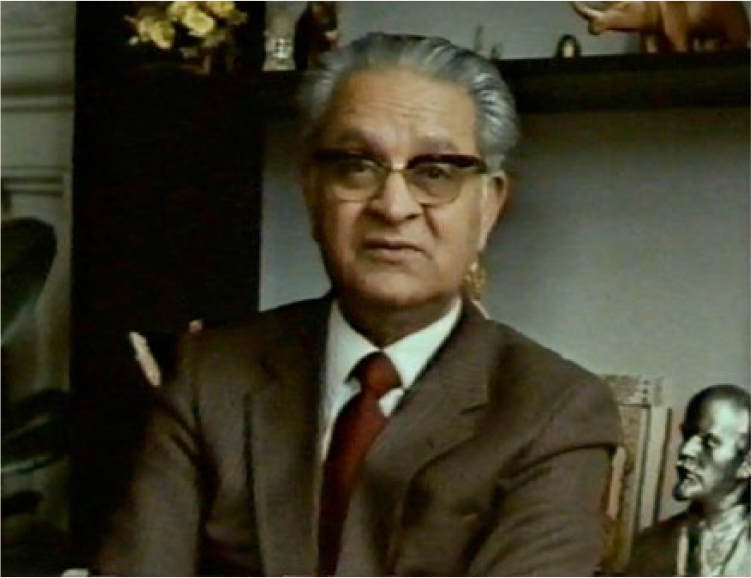
Vishnu Sharma, 1982 (image courtesy of Race & Class Ltd)
How did Southall become the Asian town it is today?
I came to this town in 1957 from India and then the population of Indian people was less than one thousand and very few factories employed Asians. R. Woolf factory was the first to recruit. There was a Mr Dunn, he had been in the army in Punjab and knew Asians; he said they are very hard-working and he started recruiting from Aldgate in East London.
But then people began to come from central Punjab, from Hoshiarpur, Jullundhur and Ludhiana, for economic reasons. You know at independence in 1947 the two provinces of Punjab and Bengal were affected because of Partition, so most of the Hindus and Sikhs from Pakistan had to migrate to what was then called the Indian Punjab. In the districts I mentioned before, the land holdings were not large, so there was too much pressure on land and they had to go somewhere to seek work. So some of them started coming to Britain. Most of them, till about 1963, were from the rural areas: they were either poor or middle peasants, or simply agricultural workers. But just before the Commonwealth Immigrants Act of 1962 some educated people from the towns and cities as well as retired soldiers started coming, and after that many teachers and businessmen, but the vast majority who came to this town were from the rural Punjab.
First single men came, but when they had paid off their debts or whatever, after four or five years, they thought of bringing their families in. So people started buying houses. Before 1962 there was no control on Commonwealth citizens, all they had to do was establish their identity. Most who came just arrived with addresses of their relations, village folk or friends.
When I came, I brought only two addresses and one of the sons of my friends used to live in Southall, so I came to Southall. But he had moved to Derby. But I told the people at the address I had, ‘I came last night from India’, and they took me into their house! They did not know me at all. Then they asked who I was, from which village. Next morning (this man had been on night shift) three people at the factory who knew me from Punjab, who could not believe that I was here, came to greet me. In two days, I found forty people who knew me here in Southall so I felt at home. I was the third person who came from my village, but the first one in Southall. After me, twenty-three followed to Southall and all came to me, to my premises here, at this address, not even telling me beforehand – just came to the airport and had my address. When I saw a taxi parked outside my house, I immediately thought, oh another one has come from my village. This was happening not to me alone, this is how it worked.
And how was it working at Woolf’s rubber factory?
Most people coming from villages were not used to working in industry and it was difficult in the beginning for them to adapt to the new environment. There was the problem of language for many, and colleagues who knew English would interpret from charge-hand and foreman. We, with the Irish, Polish, few West Indians, were in the smelly jobs, burning rubber, and so on. White people were in the white-collar jobs like transport or admin. Immigrants were concentrated in production. [Woolf’s made rubber accessories and the process used carbon black and sulphur which made the work smelly and unpleasant. A sixty-hour week was considered normal and pay so low that most men did overtime, taking their week to some seventy-five hours over seven days. 1 ]
There was no union in the factory for a very long time and people thought, because of the appalling conditions and very low wages, we must form one. Some of the people [Sharma himself] already had trade union activity in India so it was not difficult for them to realise that till we formed a union, our interests would not be protected nor could we compel management to accept our conditions. So the first meeting for this purpose was held on 1 May 1957 in the community centre. But the management resisted and sacked one or two workers who wanted the union. [Attempts were made in 1958 and again in 1960 to establish a union.] But then in 1963, we in the Indian Workers’ Association brought in the Transport Workers’ Union and tried to get everyone to join, but secretly, going house to house in the community, so management could not know the people who were actively behind this. After two, three, months majority of the workers in production department had become members of the union and then the matter was handed over to union officials to negotiate with factory management.
When did the Indian Workers’ Association form, then?
The first Indian Workers’ Association was formed in the UK in late 1930s, but with hardly any branches, perhaps London, Manchester, Huddersfield and Coventry. Southall people were first members of the London branch, but Southall branch had its inaugural meeting on 3 March 1957 at the community centre and I think there were about 200 members. They had then no separate office but met at the community centre. IWA was set up for three main purposes: as a platform to make people realise they were no longer farmers but now workers – hence Indian Workers’ Association. (It was not a separate ethnic union, it was also encouraging its members to join a union to protect their rights.) Second, most of the people found difficulties in approaching doctors, going to hospitals, or solicitors to buy houses and such things, so IWA provided a free service, for example of interpreters to people in need. The third purpose was to organise a campaign against the overwhelming racial prejudice and discrimination we faced: IWA gave a lead.
How did the community respond when it came to the showdown with R. Woolf in the 1965/6 dispute when a worker was sacked and the union refused to make the subsequent strike official?
The first dispute was for recognition of the union branch, so the management had to recognise the union but after a few years there was another dispute about wages, bonuses and working conditions in the factory. This second dispute went on for over one month. The community massively supported the dispute in many ways: landlords, for example, for weeks till it was over, did not ask for rent and the grocers were providing all kinds of goods to people on strike as a sort of loan and the gurdwaras opened their kitchens for the strikers and the premises for us to organise meetings. The community was in many, many ways helpful to this dispute.
Can you tell us something about how the community developed, were people buying shops in Southall by now, for example?
In 1957 when I came there was only one shop, near the railway bridge, it was a cafe and they used to deliver groceries at home in vans. Later on, people worked hard and saved, working nightshifts, then slept for a while, then during the day [were] working at the shops and this is how businesses started. The population grew during the mid-1960s when thousands more people came here.
The first problem that people faced was to get places in schools for their children, particularly those of, say, 10 to 13 who didn’t know a single word of English – so first enrolment was an issue, and then how to deal with the language ‘problem’. The local authority was just not ready to face these sorts of issues, although community leaders had been warning the local authority this was about to happen.

Cover of CARD campaign newsletter (image courtesy of Black History Collection, Institute of Race Relations)
So racism was rife?
At this time, there was what I would call sheer hypocrisy because the politicians were saying there is no discrimination in this country – Britain is the most tolerant country, it just couldn’t be. But in 1963, when the Campaign Against Racial Discrimination (CARD) was formed, it studied local situations. There was for example in 1964 a team of students from Oxford University who were testing discrimination by sending a West Indian or Indian to a certain job to see if he was refused even at the factory gate. And later on a white person was sent, and invariably taken in, recruited. CARD did this sort of testing not just in factories but also in public bars which wouldn’t serve Asians or black people. 2 This kind of testing then compelled the government to pass the 1965 Race Relations Act, otherwise there would have been absolutely no realisation that discrimination existed in this society.
How did the Commonwealth Immigrants Act of 1962 affect levels of racism?
It created immigration controls on Commonwealth citizens via a system of employment vouchers so people could not come to Britain to settle without acquiring the voucher from the Ministry of Labour. Vouchers were issued in three categories, a, b and c. A was for skilled and highly qualified people, b for semi-skilled and c for unskilled people. The Act put first control on immigration and there was much talk among politicians about there being ‘too many’ coming in. Yet they were talking all the time about those from New Commonwealth countries, those who were black or Asian, not immigration as a whole. In Southall, there were few people or organisations that were, you know, pro-immigrants. There were some trade unions that were trying hard to educate white workers that, if Commonwealth immigrants were in this town, it was because the British government wanted them to be here, had recruited them in certain countries and [they] were only let in when immigration officers allowed. So it was no sort of invasion as some rightwing lobby was propagandising at that time. Apart from a few in the unions, many people were hostile. Semi-fascist organisations were formed here, like The Southall Residents’ Association – this was not a Southall residents’ association, it was an association of Southall’s white residents. And people like John Bean who were fascist and belonged to British National Party in those days used to organise street meetings against immigrants coming in to the town. [Bean stood in Southall in the general elections of 1964 and 1966.]
There were incidents of personal assaults during the first dispute at R. Woolf when people attacked Asians coming home. For some time they tolerated these things, and then there was a fight back within the community. People organised themselves and gave on one or two occasions good hidings to Teddy Boys (as they were called in those days). Later on, that stopped them wanting to do that sort of thing in Southall again.
Do you feel the community is stronger now in Southall?
The community now has grown enormously – out of a population of 78,000 almost half are Indians, West Indians, Pakistanis, with a few from Uganda, etc. So stronger in numbers. But also stronger because they now have well-established community organisations – the IWA, at least three Sikh gurdwaras, two Hindu mandir, cultural and literary organisations, so now the community is more organised. And the people are more radicalised. Because the more they live in this country, the more they get aware of the political, socio-economic situation. And the more they are conscious of discrimination, the more they are keen to fight back and not to tolerate it at all. The community has built up, over the years, a great confidence.
Southall has always been a town at the forefront of the fight against laws like immigration acts – from 1962 when the first Act passed and the IWA had a very big meeting. It was addressed by Fenner Brockway, George Pargiter, then the MP for this area, as well as members of the Pakistani community and Claudia Jones who was in those days a great name within the black population. 3 The Labour government was elected in 1964 and in August 1965 it published a White Paper where the employment vouchers were reduced to 8,500 per year and much more restrictive, so again the IWA with CARD and others fought against it. 1968 another [immigration] act [largely directed at Asians from Kenya under threat of expulsion] was passed, controlling those citizens and British passport holders who had acquired that status overseas. Against the 1971 Act [affectively ending all primary immigration], again Southall was active. Southall was always active against such discriminatory immigration laws and also was campaigning to strengthen the 1965 Race Relations Act and exposing its weaknesses.
We also had to fight at the local level too. When families started coming in the 1960s, the local authority was not ready to cope and then there were racially prejudiced organisations, and even fascist organisations like the British National Party, that started agitating that teachers were too involved in having to teach English to Asian children for whom it was a second language. They threatened the council that they would withdraw their white children from school, particularly from the Junior School at Beaconsfield Road. And then Edward Boyle, minister of education, with Tories in power, he came down to Southall and with the council evolved a sort of formula that in any class or any school in Southall there should not be more than 33 per cent immigrant children. And those 33 per cent were even taken into a separate reception class, segregated as it were. And this is how a discriminatory attitude started. The surplus number of immigrant children were bussed away from Southall to schools as far as six miles from the catchment area. This caused controversy within the community – some Asian parents thought it might be for the long-term good of the children and others asked why they did not build new schools if there were not enough places in existing schools. It was around 1968 that people realised that bussing was racially discriminatory. Why did Asian parents not have the same rights under the education acts as white to choose the school for their children? Bussing started in 1965 and not stopped until a very extensive campaign was launched in the 1970s in Southall, going house to house, explaining how disastrous the policy was. In the 1974 local elections, bussing was one of the major issues in Southall and the case was taken to the Race Relations Board [in 1975] and heard by the High Court and then the local authority had to accept the ruling to phase out bussing over three years, which they have now. So for that they had to build three new schools in Southall. The community campaigned for years to win that battle.
Can you tell me a bit more about the campaigns against immigration laws? What kind of alliances did the IWA make?
There was the IWA and other organisations, and in September 1967 the Joint Council for the Welfare of Immigrants 4 was born in Southall in the Dominion Cinema. IWA was one of the sponsors and its first conference was held there. The main task of JCWI was to provide a free service to individuals who faced immigration difficulties – say, if at the airport, officials say, we are not satisfied that this is your wife or these are your children. So our job was to convince the authorities, this was his wife or his children and get all kinds of documentary evidence. We were deeply involved in providing a personal service to victims of discriminatory immigration policy and we used that information, based on concrete casework, to campaign through JCWI and groups like the IWA as a pressure group to get changes and gradually to suggest to the government. This was great work done by JCWI, the IWA and in the beginning West Indian Standing Conference. This continuous work created a kind of consciousness about the discriminatory nature of the law.
In Southall, the IWA the first body, provided facilities to other communities like the Afro-Caribbeans of Southall under the guidance of Jimmy Barzie to organise themselves and Pakistanis were also encouraged to form their own organisation. There was a time in Southall when they could not even get premises in Southall for their Eid prayers, which are very auspicious, and we provided the hall in the Dominion Cinema to them and said, have Nawaz here. We had very close and cordial relations between the communities.
How were relations, though, with state agencies like the police?
Things were bad in Southall, particularly after the 1976 incident of Chaggar’s death [Gurdip Singh Chaggar was knifed to death on 4 June 1976 by a group of white youths, prompting the formation of the Southall Youth Movement 5 ] no doubt when youth organisations started forming here and West Indian youth had their own organisations. Park View centre, organised and managed by West Indian youth, was continuously subject to all sorts of attacks and all sorts of criticism by the police particularly. And no doubt the relations between black youth and Asian and police was very strained. Relations with the police never have been very good actually in Southall. 6
Relations between Southall and the state seemed to come to a head in 1979 over the death of Blair Peach 7 and then the notorious virginity testing?
The IWA began to hear rumours that the local council had given permission to the National Front to hold one of their election meetings in the Southall town hall. So all organisations, irrespective of their political creed, community organisations, the people from churches, gurdwaras, West Indians, Pakistanis, all of them, their organisations were invited to a planning meeting on 12 April. [It led to the whole community taking to the streets on 23 April to protest at the invasion of the town. Businesses, factories and transport were stopped from 1pm onwards. Anti-fascists from across London came to Southall in support. The protest was met by an enormous police presence of 2,700+ officers, including the Special Patrol Group, which first penned people between cordons, to protect the fascists, and then used inordinate violence to clear the streets, during which Blair Peach was killed by a blow to the head and others received serious injuries. 8 ]
Virginity tests [intimate vaginal checks, supposedly to detect whether fiancées were bona fide, were carried out at points of entry to the UK] not only outraged Southall but the whole country. And there was much more upheaval in India where every paper and magazine covered it, and for the first time there was a debate on UK immigration matters in the Indian parliament. The Indian government made strong diplomatic protests and took the case to the United Nations. In two days, the British government had to stop these shameful acts. (We had known that this was going on from 1969, and were complaining about it but government denied it was happening.) But a girl came from Delhi to Southall in 1979 and at the airport she was given a gynaecological test. All of a sudden, because the fiancé found she had signed a so-called letter of consent when she had no idea what she was signing, it became an issue. The consent form was brought to the IWA and then was publicly released and published on the front page of the Guardian and debates then held in the British parliament. The community had a great victory, they knew that they could move governments!
How do we fight on?
We have to be organised. And I am very proud of the Southall community, I can tell you, because here, not only the young people who have been victims of racism, not only women, the whole community, not just the black and Asian, even white people organised in trade unions and conscious, radical people, the whole Southall community, when it feels that it is threatened, all come out in the streets – this happened in 1976, this happened in 1979 and it happened last year in July 1981. These three examples show quite clearly not just that Southall community is able to fight back, but also Southall community is able to move international opinion on these sort of matters. I am very proud that Southall is at the forefront of the overall fight against racism.
In my view, racism has gone much further than just personal attacks and damaging property or daubing slogans, in areas where black people are settled like St. Pauls Bristol, Chapeltown Leeds, Toxteth, Brixton, Southall, a whole town is being discriminated against – look at housing, streets, traffic, education. Local authorities are deliberately ignoring those towns, and that is where we must fight.
There are sometimes differences on strategies and tactics, whether we should come out on the streets or not; businessmen might not want that, sometimes differences between West Indian community and Asian or amongst Asians, say, between Indians and Pakistanis, Sikhs and Hindus but all these are very minor things. I think our attitude in Southall clearly shows that if our existence is ever threatened, we act together like anything, and that is marvellous, that is what we need. That in spite of religious, political, ideological differences on country or national origin, we forget if our existence is at stake. And that is the need of the hour, complete unity on at least a minimum programme.
Footnotes
Harsh Punja, who now lives in Rome, worked at the Institute of Race Relations as a researcher for the film, A Town Under Siege, part of the Struggles for Black Community series, by Colin Prescod for Race & Class Ltd. These films are still available direct from the Institute of Race Relations as a DVD:  .
.