



Abstract
The painting of murals and graffiti is a widespread and well-established practice in Colombia. Most of the artwork is not directly political. However, a significant number of murals speak directly to the political problems of the society; to the protracted violent political conflict and the emerging peace process in Colombia. They articulate the memory of violence and represent the demands of victims for acknowledgement, reparation and justice. That articulation varies through different regions in Colombia, depending on the balance of forces between guerrillas, former paramilitaries and the state. The phenomenon of mural painting represents the meeting between victims’ agency and activist art in Colombia.
Two hours by bus from Cartagena and half an hour by motor bike along unpaved roads, nestling in the Montes de María is the village of Mampuján. On 10 March 2000, a group of armed gunmen from a paramilitary group, Héroes Montes de María, entered the village with the intention of massacring inhabitants whom they accused of assisting Fuerzas Armadas Revolucionarias de Colombia (Colombian Revolutionary Armed Forces, FARC) guerrillas. In the previous month the armed group had killed more than fifty people in nearby El Salado. But for some reason, the plans were changed in Mampuján. Instead of a massacre, the armed group ordered 620 villagers to leave under pain of death. 1 The paramilitaries then went on to the neighbouring hamlet of Las Brisas where they killed eleven people. A decade later, as part of the Justice and Peace process, the Superior Court of Cundinamarca arraigned the leaders of Héroes Montes de María and issued a judgement, sentence 34547, which authorised reparations for the people of Mampuján and Las Brisas. This was the first sentence to emerge from the Justice and Peace process. The judgement was not enacted immediately, so the villagers had to continue to agitate, including organising demonstrations in Cartagena and lobbying in Bogotá. Eventually 105 houses were rebuilt; at the people’s request they were simple structures. The bridge has been rebuilt, but there is much development to be tackled. There are few services in the village. The village ‘plaza’ is an unpaved area of empty land. Yet at one end of the plaza, on the side of the largest building in the village, is a huge colourful mural, painted by Bogotá artist Guache in collaboration with local people (see Figure 1). Delivered as part of the process of symbolic reparation, it is clearly the pride and joy of Juana, the community leader who shows us round. It depicts a history of suffering and final victory for Mampuján – attacks during the Spanish conquest and La Violencia in the 1950s, as well as the villagers being forced out by the paramilitaries in 2000. But it also notes the judicial success and the return of those formerly displaced.
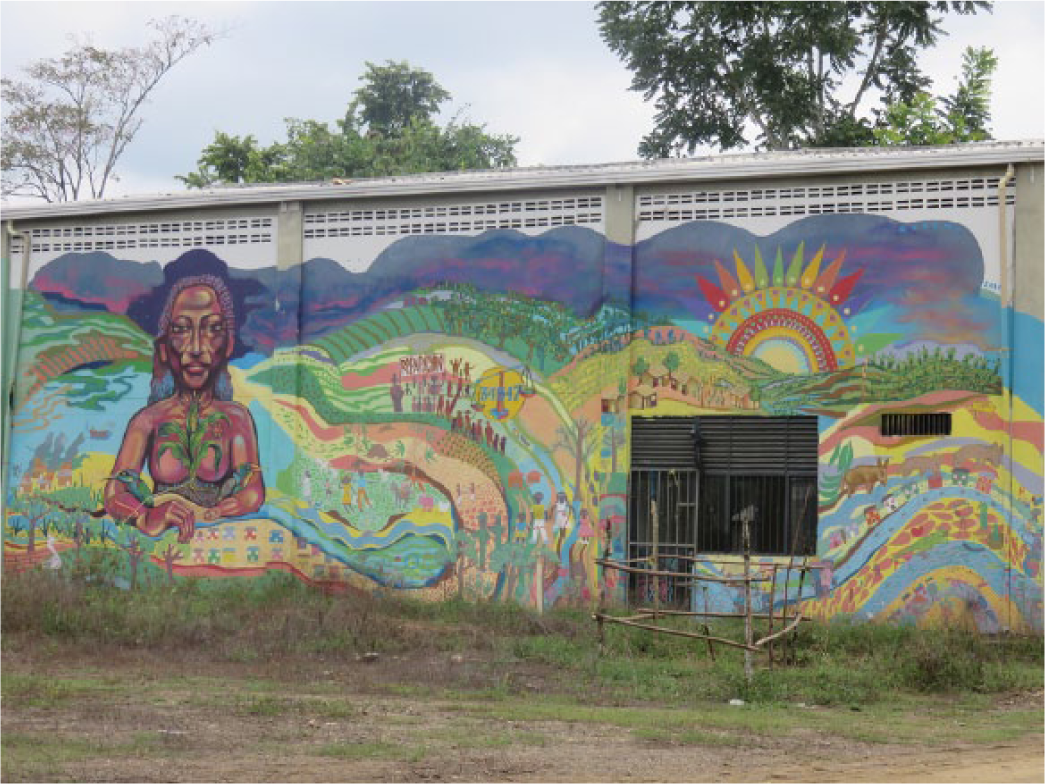
Mampuján, mural displaying the history of conflict in the village.
At the other end of the country is the region inhabited by the Nasa people, an indigenous group. On a road through the mountains of northern Cauca from the old colonial town of Popayán and near the small town of Toribío is a mural commemorating the massacre of Gargantillas. On 26 March 2011, a group of local youths convened for a workshop organised by an alleged FARC militant who offered them food and money. The Colombian military and anti-narcotic forces attacked the meeting, killing sixteen indigenous youth, including minors. 2 Soon after the massacre, the government reported a major blow against the FARC. However, the military had dressed the dead youths in FARC combat uniforms and reported them as guerrillas killed in action. This was denounced by the Nasa community as a case of ‘false positives’. The mural commemorating the massacre is an amateur affair, its effect lessened by the disrespect shown by others; the depiction of dead teenagers and blood-stained shirts is overlaid with pro-FARC graffiti, election posters and advertisements for music performances (see Figure 2). Yet, it is clear that the mural holds pride of place in the heart of Floralba, the mother of two of the dead, who explained its symbolism to us.
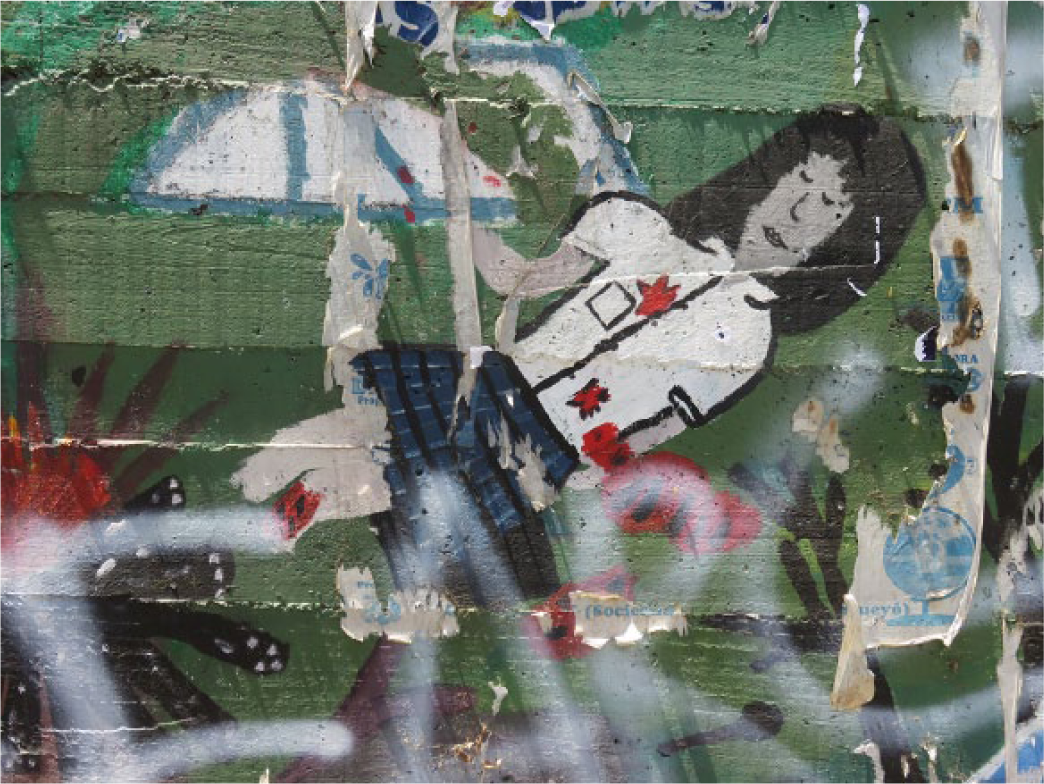
Gargantillas, commemorating the massacre of local young people (detail).
These two displays, at either end of Colombia, raise a number of pertinent questions about the role of symbolic representation in relation to bloody conflicts. Why do the mothers of Gargantillas want to be reminded as they travel this road regularly of the trauma which befell their families? Why should a mural be valued in a village lacking many amenities? Where does this urge to respond to unbearable suffering through symbolic representation stem from? And who, ultimately, is the message on the walls directed at?
These are the questions we sought to answer in a survey of political murals throughout Colombia. In October 2015, we travelled from Buenaventura to Putamayo, from Cartagena to Cali, not forgetting the two major cities of Bogotá and Medellín. 3 We conducted fieldwork in ten different locations and interviewed twenty muralists and twenty-five representatives of victims’ and women’s groups which painted or commissioned murals, as well as peace and human rights activists. 4 (Many of our respondents had reservations about their identities being revealed in print.) Before presenting our findings, we will briefly recount the conflict in Colombia followed by a discussion on victims and memorialisation.
The Colombian conflict
The roots of the most recent period of conflict in Colombia lie in the dispute over political power between Conservatives and Liberals between 1946 and 1958. Known as La Violencia, its effects were felt most keenly by the peasantry. In the 1960s, insurgent groups were born in reaction to the timidity of social reforms during the transition process, particularly in rural areas. One insurgent group, FARC, made its base among the beleaguered peasantry. Another insurgent group, the Ejército de Liberación Nacional (ELN, National Liberation Army), mobilised middle-class youth and sympathisers of liberation theology. For the next half century, these and other insurgent groups (for example, M-19 and Quintín Lame) were at war with the Colombian state. In parallel, from the 1970s onwards, some rightwing ‘self defence’ (autodefensa) groups started evolving into paramilitary structures in different regions, frequently with official backing from wealthy landowners and politicians, to combat the guerrillas directly. In 1997 the disparate paramilitary groups combined and consolidated as Autodefensas Unidas de Colombia (AUC, United Self-Defence Forces of Colombia). 5
The height of insurgent power came in 1998 when President Andres Pastrana began peace talks by conceding that the FARC could control a 42,000-square kilometre Zona de Distensión, a demilitarised zone in which they could operate unimpeded by government military intervention. 6 Both guerrillas and paramilitaries became involved in the illegal drug trade, both as a form of fund-raising and as a means to territorial control.
Plan Colombia initiated under President Andres Pastrana after the failure of the Caguan peace process and continued under President Álvaro Uribe, elected in 2002, was carried out with financial support from the United States; it provided $4.7 billion, 75 per cent of which was allocated to the military and police. 7 At the same time, between 2003 and 2006, Uribe ostensibly negotiated the disbandment of the AUC. Some paramilitary groups did not disband entirely while others segued effortlessly into criminal gangs, known as bacrims (bandas criminales, criminal gangs), continuing to hold sway in many areas. 8
Uribe’s successor, President Juan Santos, switched policy radically by recognising the existence of internal conflict and its consequences. In 2011 he signed the Law of Victims and Land Restitution and in 2012 serious peace talks began which directly addressed many of the political priorities of the FARC, not least the question of structural reform. By the end of 2015, progress had been made. The creation of a peace tribunal was envisaged with the mandate to investigate, judge and impose sanctions on perpetrators of serious crimes, whether guerrillas, state agents or civilians responsible for providing financial or other support to the armed groups. 9 Later, agreement was reached for the creation of a truth commission, a missing people’s unit, and a special jurisdiction for peace and reparation measures and, in January 2016, the creation of a tripartite mechanism led by the UN Security Council to oversee the implementation of peace agreements. 10 The talks led to a peace agreement which was signed on 26 September 2016 and narrowly rejected in a national referendum on 2 October 2016. 11 On 30 March 2016, the Colombian government began peace talks with the ELN, the second oldest insurgency group. Some resistance to both peace processes has been voiced by rightwing ex-President Uribe and his allies.
The main impact of the protracted armed conflict has been on civilians. 12 The death toll between 1958 and 2012 is estimated to be at least 220,000, of whom 82 per cent were civilians. There were 27,023 kidnappings, 25,482 by guerrillas and 2,541 by paramilitary groups. The guerrillas were mainly responsible for laying land mines which claimed the lives of 2,156 people and wounded 8,454, the highest landmine casualty rates in the world. 13 There were an estimated 150,000 selective killings, committed mainly by paramilitaries. This figure also included at least 1,400 ‘false positives’, innocent civilians killed by state forces and labelled as guerrillas in order to increase the army’s body count. 14 Almost 5 million people were displaced when at least 8.3 million hectares of land and 350,000 properties were abandoned or seized. More than 11,700 people were killed in 1,982 massacres, the bulk of which were committed by paramilitaries. The paramilitaries were also responsible for decimating the Unión Patriótica (UP, Patriotic Union), a leftwing political party with partial affiliation to FARC, between 3,000 and 5,000 of whose members were murdered (see Figure 3). 15 The military and paramilitaries together ‘have been responsible for 70–75 percent of non-battlefield killings (such as the executions of civilians and surrendered fighters)’. 16 As already noted, some of these atrocities have been portrayed in murals and others will be looked at below.
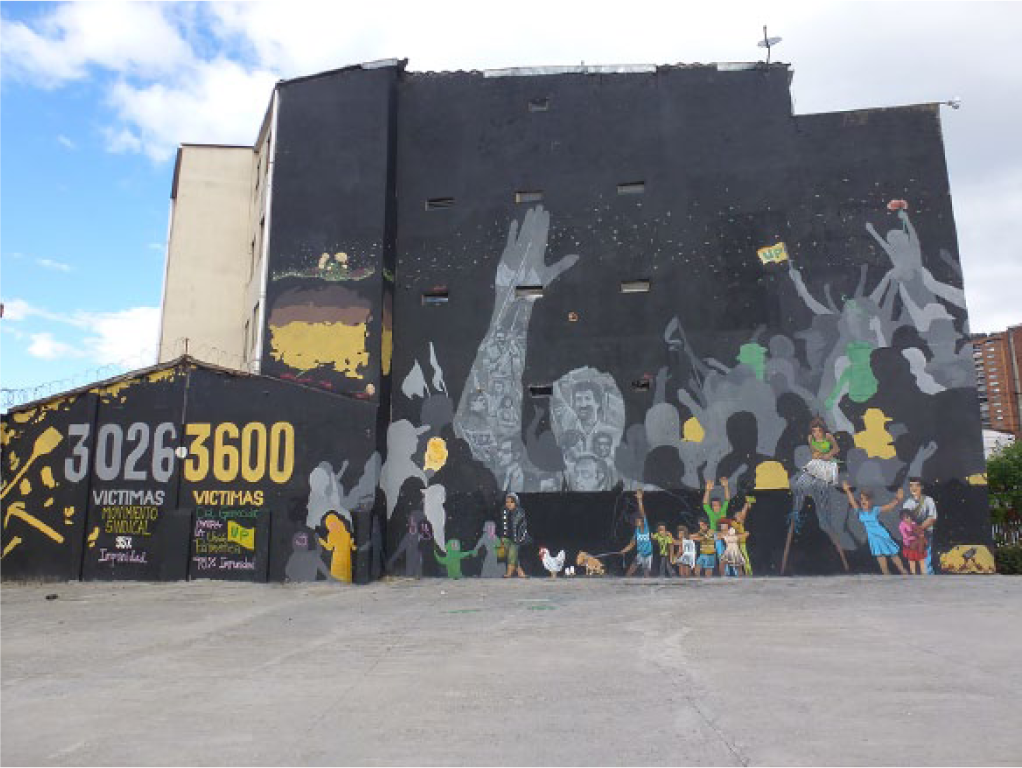
Calle 26, Bogotá, memorial to murdered Unión Patriótica members and supporters.
Victims and memorialisation
Given that protracted history of violence and its consequent legacy for many, it is not surprising that calls to memory – memoria – are common in contemporary Colombia. There are two centres of memory in Bogotá and others throughout the country. The word arises repeatedly in conversations with victims’ groups. It also appears frequently in murals, as at the Universidad Nacional in Bogotá (see Figure 4).
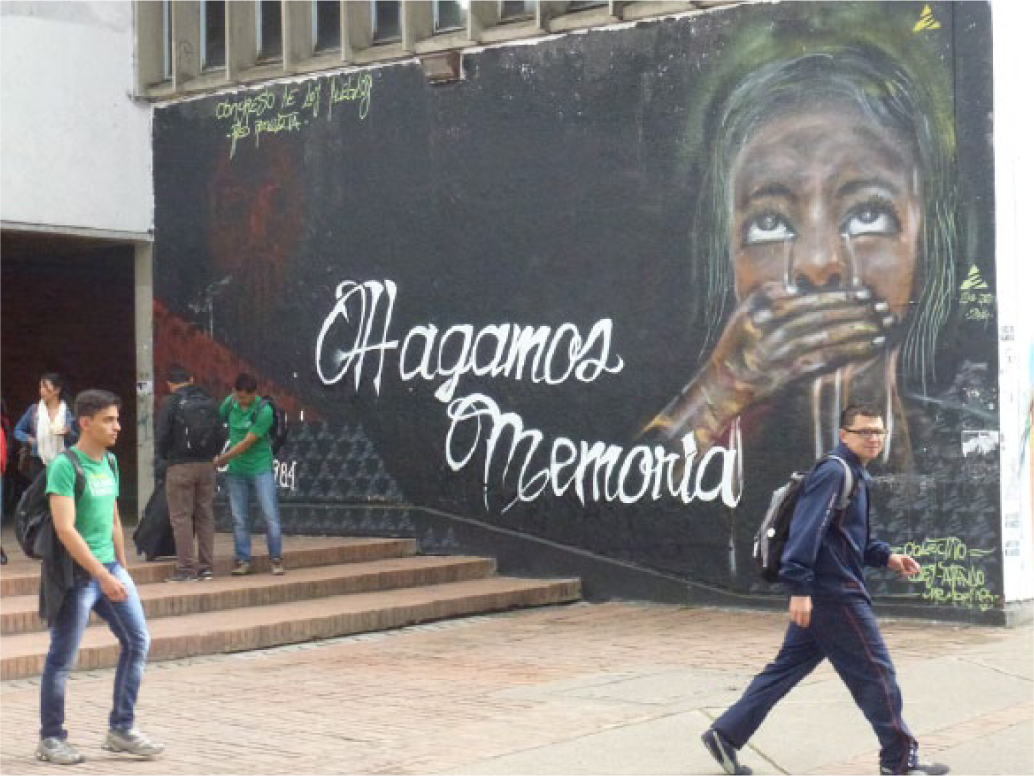
Universidad Nacional, Bogotá: ‘Let’s remember’.
Even if not explicitly stated, memoria is often implicit in many murals about conflict and peace, murals which exist to remember and honour the dead. Such murals are often shrines, ‘created by regular, everyday people who feel a need to commemorate the loss of life, to call attention to how the life was lost, and to consecrate the place where the unthinkable happened’. 17 The last function is most important when the mural is site-specific.
But more than simply a site marker, the memorial mural broadcasts a powerful symbolic message. It speaks to the truth of what happened and acknowledges the injustice involved. It creates ‘a place for grieving, publicly recognizing suffering … acting as a permanent reminder of a crime so that it may not be repeated’. 18 These memorials play the role of ‘providing first and foremost a framework for, and legitimation of, individual and family grief’. 19 But there is more involved. Explicitly or otherwise the mural memorial acts as a call to justice directed at a range of audiences – perpetrators, society at large and ultimately the state. As Jelin puts it, ‘the meaning of the past that is being fought about is, in fact, part and parcel of the demand for justice in the present’. 20
This begins to explain why memorialisation takes on such a public form. After all, the experience of grief and trauma is highly personal and individualised, leading one to expect that dealing with the experience ought to be an intensely private affair. But atrocities during political conflict often require a different, more public register. One reason for this is the often highly public nature of the original injustice; in the case of Mampuján, for example, the inhabitants of an entire village were forced out at gunpoint; the massacre of teenagers at Gargantillas involved special military forces, helicopters and all the characteristics of a full-scale military operation. The original injustice can be compounded by the public nature of the silence or denial afterwards. The state, the media and other powerful institutions in the society can unite to deny that injustice occurred by rejecting the account of the victims, survivors and relatives; this is especially true if the action involves state forces or non-state actors operating with the approval of the state. Lies are circulated about the dead – they were guerrillas; they opened fire first; there are no disappeared – they are probably in hiding because they are guilty. Those who continue to insist on the truth – whether relatives or human rights activists – are themselves dismissed as overly sympathetic to terrorists. The intense frustration resulting from silence and denigration is that their ‘rights claims remain politically irrelevant or ineffective if they are unheard and unseen by others who do not recognise the claimant as sufficiently human’. 21 This public judgement of irrelevance requires that the claims to truth and relevance need to be loudly broadcast in the public arena.
The memory work of victims, survivors, relatives and their supporters can be an intense battle waged against those who reject their memory of the atrocity. Their challenge is directed at society in general and sometimes more specifically at the state. The demand is that the state be an active participant in the memory work of victims and survivors; otherwise the invisibility and marginalisation of the victims and survivors continues. ‘Memory efforts that are not publicly visible do not exist … When people in new democratic circumstances confront the past, such a confrontation must find cultural expression. Recognition in a purely formal sense – through apologies, for example – is not enough.’ 22
It is not enough for the state later to simply own up to its role in silencing truth after atrocity. The demand of the victims and their supporters is that the state play a full part in the acknowledgement of the original injustice and the rehabilitation of the memory and dignity of the victims. 23 While victims can erect private memorials, murals or shrines endlessly, persuading or coercing the state to lend its support in memorialisation brings a level of societal acknowledgement which in itself begins to feel like something approximating justice.
Victims’ groups are in a subaltern position, as defined by Gramsci, namely a group under the hegemonic domination of a ruling class so that it is unable to participate fully in the making of history and culture. 24 As such, these groups are seeking to articulate their memory from the bottom up in the face of the state articulating official memory from the top down. The contest is skewed. For a start, ‘Defenders of vernacular culture … are “ordinary people” whose interest lies in protecting values and memories based on their own firsthand experience of events or narratives of the past and views of reality developed at a local level in small-scale communities.’ 25 On the other hand, official ‘memory invariably synthesises and simplifies diverse and potentially contradictory narratives’. 26
The state’s approach to memorialisation may differ radically from that of subaltern groups. ‘The state primarily sponsors the preservation of memory in tangible objects and structures – museums, commemorative monuments, memorials and public statues – not in intangible, traditionally rooted, popular, community-based expressions such as festivals, songs, performances, rituals and ephemeral markers.’ 27
Finally, there may be times when the needs of the state coincide with those of subaltern groups: if that is not the case, the state has the greater power to ensure its version becomes the official one. For those engaged in memory work from below there are numerous goals: to preserve the site of atrocity; to give voice to injustice; to seek acknowledgement and justice; and to ensure that atrocities are not repeated in future. For its part the state may have its own goals: to cover up its role in previous atrocities or to harness the power of memory to serve its current political needs. The task facing the subaltern group is to move the state ‘from denial to reluctant dialogue’ by one means or another. 28
But, why should visual representation, including murals, be so important for subaltern voice and resistance? This question has been meticulously researched throughout Latin America where struggles over memory and memorialisation have been common and frequently intense. 29 Further light can be shed on the answer through considering research findings on the trauma of the Holocaust. People had expectations about human decency which were obliterated in the camps; such a fundamental shock was difficult, if not impossible, to assimilate. 30 This can have catastrophic consequences in relation to what we regard as memory. Memory requires assimilation before it can be classed as experience; trauma ensures that the person cannot move on to the point of looking back on the experience because he or she is still caught in the middle of the event. ‘The original traumatic event has not yet been transformed into a mediated, distanced account … Trauma is failed experience’. 31
There is a further consequence. As writers such as Halbwachs have argued, memory requires language; all memory involves a dialogue, at the very least with oneself.
32
The failure of memory is also, according to Jelin, a failure of language: The presence of trauma is indicated by the coexistence of an impossibility of assigning meaning to past occurrences, by the ability to incorporate it in a narrative … To transform an occurrence into ‘experience’, even those who lived through it must find the words to convey it.
33
But where does one get the words to explain something so brutal? Edkins argues that ‘the language we speak is part of the social order, and when that order falls apart around our ears, so does the language. What we can say no longer makes sense; what we want to say, we can’t. There are no words for it.’ 34
Holocaust survivors testify that it is not just that the events are difficult to describe to an audience which has not witnessed or experienced them. The inhumanity of the system and its guards goes without saying. What disillusioned victims most of all was the effect the events had on their own humanity. 35 Faced with ‘choice’ between two evils, inmates had, in fact, no choice but to tolerate or support evil. Given that the system had dehumanised them as much as it did its originators and administrators, they concluded that they had reached the point ‘of really knowing the truth about people, human nature, about death, of really knowing the truth in a way that other people don’t know it’. 36 There were no words to convey such knowledge.
Tautological as it may sound, the antidote to memories of horror is to find a mechanism for communication to take place whereby, somehow or other, the event is assimilated and takes on the character of experience; in short, that trauma is transformed into memory. Where language has been shown to fail as such a mechanism, artistic expression can fulfil the task. As Scarry concludes, ‘pain does not simply resist language but actively destroys it, bringing about an immediate reversion to a state anterior to language’. 37 Artistic expression may be the first step for victims and survivors in rebooting their sense of humanity and dignity.
Victims in Latin America, women in particular, have used the language of artistic expression as testimony. For example, in Chile, women created arpilleras, textile pictures which at one and the same time told the story of horror and brutality and acted as a form of resistance. 38 As Agosín argues, the women found that words were insufficient to describe ‘so many thoughts of pain, of anguish, or rage and impotence’; there was not ‘enough paper in the world to tell what those years have been like’. In this context, arpilleras offered ‘the women a new way of thinking about and representing the stories that could not be told in words’. 39 In similar vein, when indigenous women in Peru testified to the Truth Commission they did so through presenting a large arpillera. 40 Women in Mampuján have also used an identical art form to narrate their traumatic displacement and in November 2015, their group, Weavers of Dreams, won the Colombian national peace prize for their efforts. 41 The quest for justice can provide victims and survivors with a voice. And one way to find that voice is through art.
Activist art: murals and the quest for justice in Colombia
Politico/memorial murals are at the interface where victims’ agency meets art practice. Victims turn to art, including murals, to make their case. But what about the other side of the encounter: why do street artists in Colombia engage in politics – not simply commenting on politics but aiding transformation? Where is the space for this encounter?
Some street artists do not engage in a specifically articulated political way at all. While sociologically it may be argued that even the simplest street art is political, in that it is a statement by marginalised and alienated youth that they exist and have commandeered some personal space in the public arena, 42 the fact is that most street art in Colombia is not political either in the sense of having a clearly thought-out political message or of being linked to a wider politicised social movement. Most of the estimated 5,000 street artists in Bogotá, 43 for example, are content to tag or produce ornate and imaginative ‘pieces’ in which they reprise and develop the international movement of spraycan art.
Other street artists drop political references into their otherwise mainstream street art or go further and paint on themes that are global but not directly related to the political violence in Colombia. Thus in Bogotá anti-capitalist, pro-ecological, feminist or pro-animal rights themes can be found in the murals painted by grafiteros such as DjLu and crews such as Toxicamano. 44
Some approach political issues head on, but in a relatively cerebral, programmatic way. The campus of Universidad Nacional in Bogotá provides a prime example. 45 Although the capital was affected by the conflict, it did not suffer the mass enforced displacement of peasants that rural areas suffered, the murderous control of the paramilitaries in other places, or the experience of being caught in the middle as guerrillas and state forces battled for territorial control. So muralists in Bogotá have had relative luxury and safety for political commentary.
Some street artists exploit the interface, either in an individual capacity or through working in collaboration with local victims’ groups or other social movement groups on specifically Colombian themes. There are thus in Bogotá powerful murals on themes such as ‘false positives’, the massacre of thousands of UP members and femicide. A prime example is the case of Beligerarte, a crew whose goal is to seek to persuade grafiteros/as to consider the political role of graffiti while at the same time convincing social movements that there are different, more imaginative ways to communicate their political ideas and mobilise support. Such interventions have to be glaringly obvious. They are struggling to be heard, not just in the face of the silence and dismissal of the justice claims of victims, but also in the midst of the visual noise of the urban landscape.
The venue for the traditional artist is galleries and museums – controlled spaces where the art itself does not need to speak very loudly because all attention is focused on it. Political art has a dauntingly large venue: the street, the marketplace, the mass media. This is an out-of-control space where one competes with the cacophony rather than retreating into silence and solitude. Political art, responding to this space, is often brash and loud. Subtlety is sometimes not its strong point.
46
The murals of Colombia are not confined to the capital. However, it is striking that there are strong regional differences in the quantity, quality, themes and articulation of the murals. Ultimately these differences rest on the differential relationship of each place to the protracted violent conflict. The space for mural painting, and in particular the interface between murals and victims’ groups, is starkly different where the area is dominated by paramilitaries, where it is dominated by guerrillas, where these forces battle it out for territorial control, or where there is no outright domination by either of those two armed factions. For example, the occurrence of massacres by paramilitaries and/or state forces may encourage memorialisation in a transitional period; alternatively such memorialisation may be suppressed because of the continued links between paramilitaries and state forces in an area. We will now examine the range of political murals in five places: Bogotá, Medellín, Barrancabermeja, Mocoa and Toribío.
Bogotá
The capital city of Bogotá is the most prolific site for mural painting in Colombia, involving local and international writers. 47 Most of the murals and graffiti produced are not specifically political, but Bogotá, along with other places in Colombia, is relatively unusual in global terms in that there is a clear link between graffiti and political articulation. In most places across the world, graffiti painters are engrossed in style or are disillusioned about politics. Evidence of such graffiti exists in Bogotá also, but beyond that there is a clear affinity between graffiti painting and political commitment. For example, grafitero DjLu has painted a number of pieces depicting homeless men in Bogotá, painstakingly using complex stencils. The effect is eye-catching, so much so that it takes some effort for the viewer to divert the gaze to some of the other things happening in his work: insects with automatic weapons instead of wings, a champagne glass with a miniature automatic rifle as the stirrer, a dollar sign where the central upright is an automatic weapon rather than parallel lines. Apart from the careful empathy with which the topic of homelessness is treated, there is a wider critique of capitalism and militarism almost hiding in full view in these murals.
There has traditionally been a tension between writers and the authorities about painting on public walls. In 2011, a 16-year-old writer, Diego Felipe Becerra, known as Trípido, was shot dead by police in Bogotá. The mass reaction from writers which followed led to intervention by the progressive mayor. The city authorities agreed to allow, even encourage and support, murals, while muralists agreed to be ‘responsible’ about where and what they painted. 48 In December 2015 the Bogotá City Council adopted a project to establish an annual ‘Street Art Day’ on 19 August to recognise the work and significance of street art in the city. 49 There are numerous tributes to Trípido and his trademark cat Felix in Chapinero and elsewhere, but the larger and more impressive tribute is the proliferation of legal murals resulting from the dialogue between grafiteros/as and the city authorities.
And in Bogotá there is nowhere more impressive than Calle 26. Known as the ‘Axis of Memory’ (Eje de la Memoria) the street displays an array of impressive murals on a range of themes – the murder of 3,026 union members, of 3,600 Unión Patriótica members, of Jaime Garzón, a TV political humorist, lawyer and peace activist, in 1999. One mural spells out the message of hope (esparanza) and another declares that ‘la paz es ahora’ (peace is now). One mural speaks directly to the ongoing peace negotiations and is sponsored by Constituyentes por la Paz con Justicia Social; ‘paz con pan’ it states (peace with bread). Not everyone receives these murals well. Thus in 2014 a rightwing neo-Nazi group vandalised the mural commemorating the murder of Unión Patriótica members. 50
Overall, Bogotá provides space for more direct political messages than many other parts of Colombia. This is because of its relative distance from the most violent regions of the country. There were anti-paramilitary slogans in Bogotá which were not possible in rural areas: ‘Uribe paraco’ (‘Uribe paramilitary’), for example. And Beligerarte, one of the most politically direct and articulate groups, has produced murals against Uribe, criticising Santos, against militarisation, including the presence of US bases, and about political prisoners. Another graffiti crew, Inzane Toyz, has painted a mural on the topic of ‘false positives’, people killed by state forces who are then passed off as guerrillas, and another on the topic of femicide, specifically the brutal murder of Rosa Elvira Cely in May 2012. 51
The largest concentration of politically articulated murals is on the campus of the Universidad Nacional. They are periodically whited out by the university authorities, only to be replaced within a short time by the next generation of political murals. In autumn 2015 the themes tackled ranged from Latin American leftwing heroes such as Camilo Torres and Che Guevara, through the rights of indigenous peoples, to women’s rights, as well as references to memory and justice in relation to the Colombian conflict. Groups such as JUCO (the youth wing of the Communist Party), Grupo Estudiantil Anarquista, FEU (La Federación de Estudiantes Universitarios) and Marcha Patriótica are among those whose names and emblems are attached to the murals. Most of the murals on campus are painted by students. Elsewhere in Bogotá there are many graffiti writers and groups painting on political themes or including political references in otherwise apparently straightforward graffiti: Toxicamono, MAL, Gauche, etc. And Bogotá boasts a number of female writers, grafiteras, such as Bastardilla. 52
Medellín
Medellín is starkly different from Bogotá. There is a long history of violence, beginning with Pablo Escobar and his drug cartel. Later the city was wracked by the rise of the paramilitaries and the ongoing confrontations between the guerrillas, on the one hand, and the paramilitaries and state forces, on the other, over control of territory within the city.
One area, Comuna 13, in many ways represents the cockpit of this confrontation. For the paramilitaries and state forces, it was seen as an area overly sympathetic to the FARC, so it suffered a number of major military incursions, in particular Operación Mariscal (21 May 2002) and Operación Orión (16 October 2002). The end result was that the military and paramilitaries forced the guerrillas and their civilian supporters out, leaving Comuna 13 under unchallenged paramilitary control. After the ‘disbandment’ of the paramilitaries, there has continued to be a strong bacrim influence in the city overall.
This has had an effect on the mural and graffiti scene in the city. There are hundreds of writers involved in painting everything, from tags to murals of species endangered due to illegal trafficking. There are grand spraycan pieces painted during the periodic Pintopia event with city council support. And murals about indigenous and Afro peoples can be seen.
But it is in Comuna 13 that painting is a relatively risky occupation. 53 Grafiteros tell of young bacrim members driving by on motor bikes checking them while they work. And there are still those in the area who sympathise with the paramilitaries and who would be angered by any anti-paramilitary messages on the walls. There is a counter-force, however, that of young people in the vibrant hip-hop youth culture in the city. Comuna 13 boasts Casa Kolacho where young people are taught rap, graffiti, breakdancing and DJ skills. The crucial point is that these endeavours are not seen as escapist or apolitical but as highly politicised responses to conflict and in particular to the role of the former paramilitaries in continuing conflict. In short, the rappers and grafiteros of Comuna 13 see themselves as a radical force against bacrim control. 54
In relation to murals, that opposition is sometimes expressed explicitly, as in one mural which insists that there never again be military intervention in the area (see Figure 5). But the political message in the murals is usually more oblique. In one, a map of South America doubles as a mask on a person’s face in a message of resistance. Even more oblique is the set of murals commemorating Operación Mariscal. A bird represents a military helicopter, a Black Hawk, and a family of elephants with white handkerchiefs stands as a metaphor for a grieving human family (see Figure 6). The metaphors and symbols speak to those who know how to read them and can be missed or ignored by those who do not.
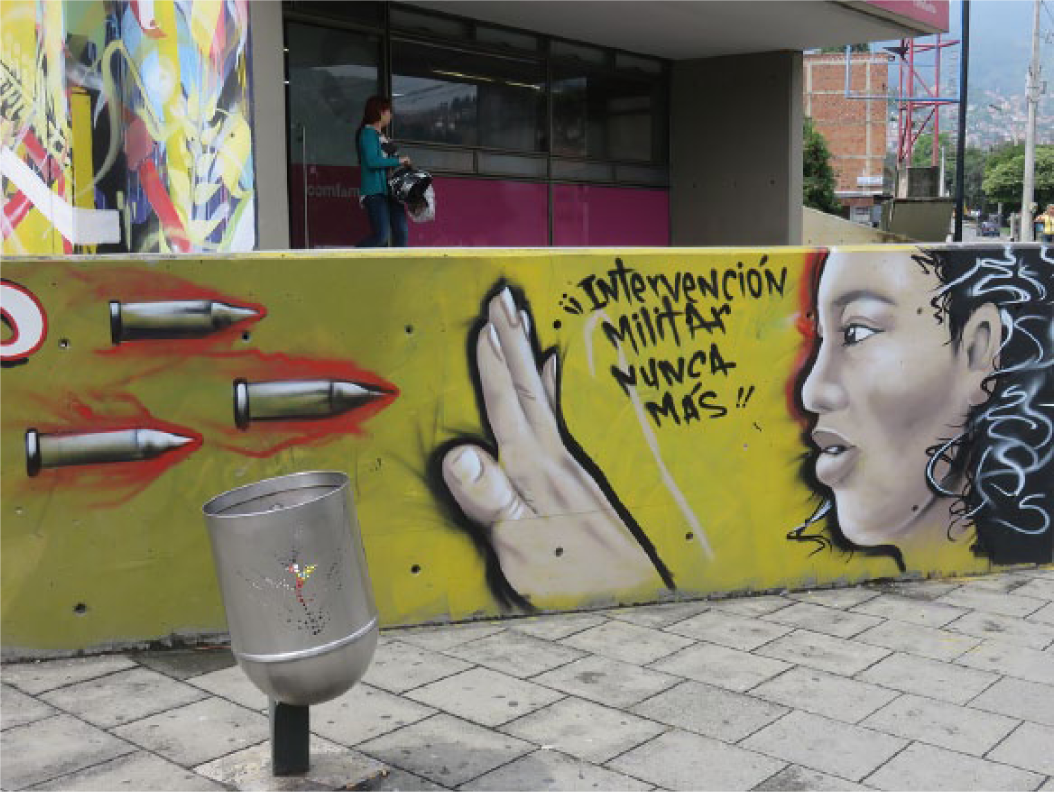
Medellín, ‘Military intervention never again’.
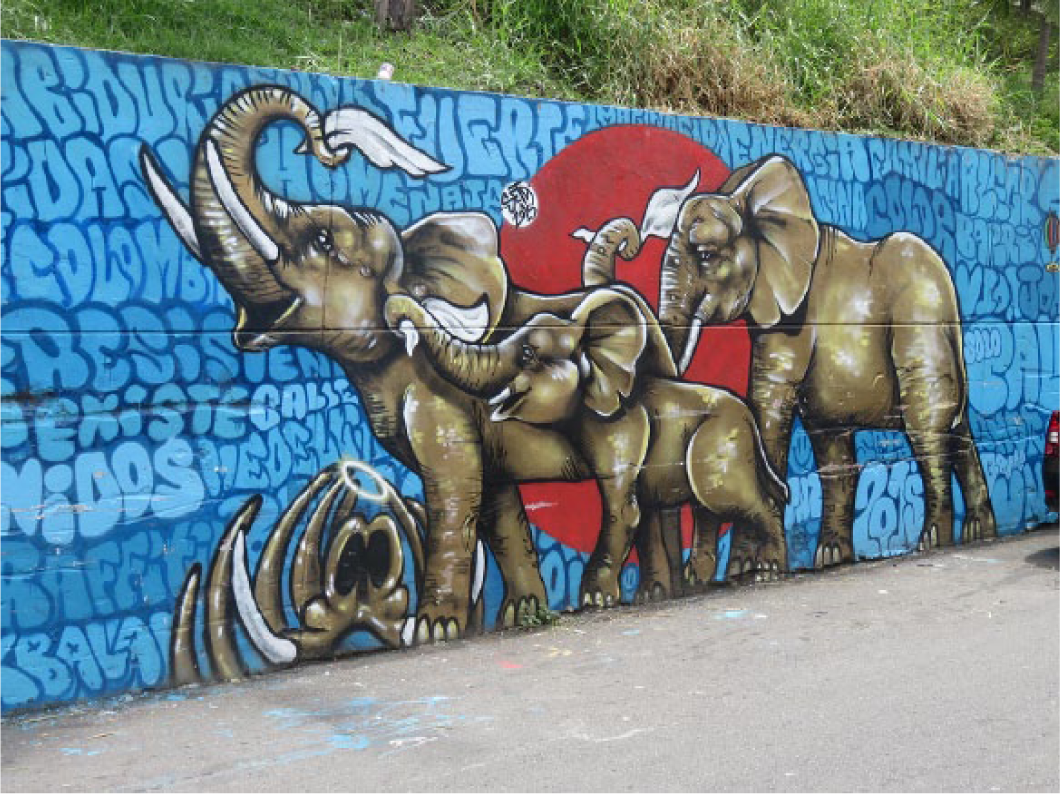
Medellín, commemorating Operación Mariscal.
Barrancabermeja
The town of Barrancabermeja grew out of the oil boom beginning in the 1920s in the Department of Santander. The first oil refinery, and currently the largest in Colombia, was built there and the Unión Sindical Obrera (USO), grew as the industry did. The ELN operated in the area from the 1960s and the radical priest, Camilo Torres, a founder member of the ELN, was also based in the town for a period. Subsequently, in the late 1990s, the paramilitaries emerged as a powerful presence here. They were guilty of a number of massacres, such as that in the Miraflores district in May 1998, when seven locals were killed and twenty-five were disappeared. There has thus been a complex web of power and violence in the town involving the paramilitaries, the guerrillas, state forces and the USO. 55 The paramilitaries still exist in the form of criminal gangs and, although broken into factions that on occasion end up killing each other, are still a force to be reckoned with. The union is still a major force in the town. And the memory of Camilo Torres is still popular; there is a college named after him and a statue on one of the main roads. One mural, near the university, pictures Torres along with Luisa Delia Piña who, as a political and community activist from the 1960s, worked with Camilo Torres, became the first female municipal councillor in Barrancabermeja and died in 2005 (see Figure 7).
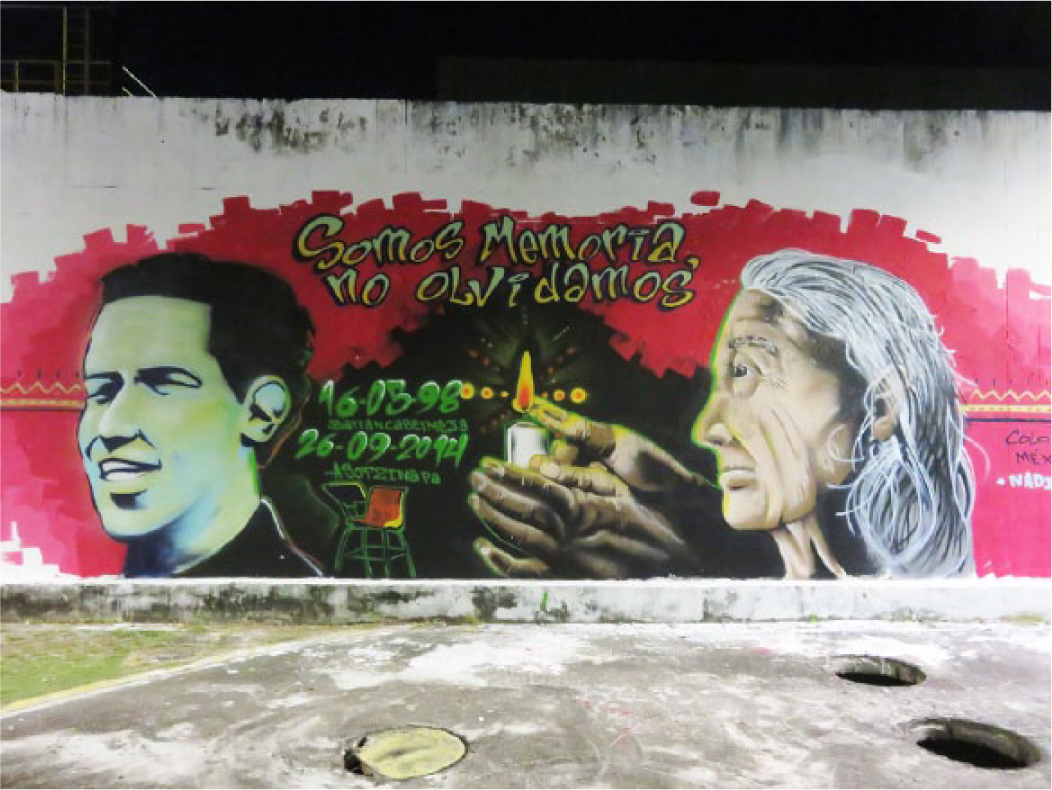
Barrancabermeja, memorial to Camilo Torres and Luisa Delia Piña.
Given the tension, mural painting faces restrictions. Painting memorials to Camilo Torres or to USO officials who have been murdered is done with one eye on the lookout for trouble. Some murals have been destroyed after completion, such as a memorial to five men massacred by Red 007, an intelligence section of the Navy, in La Esparanza district. The extant mural memorials to murdered USO officials such as Fermin Amaya killed in 1971 by a soldier inside Ecopetrol and Manuel Gustavo Chacón, killed by the army in 1988, are inside the USO compound and are thereby afforded some protection (see Figure 8).
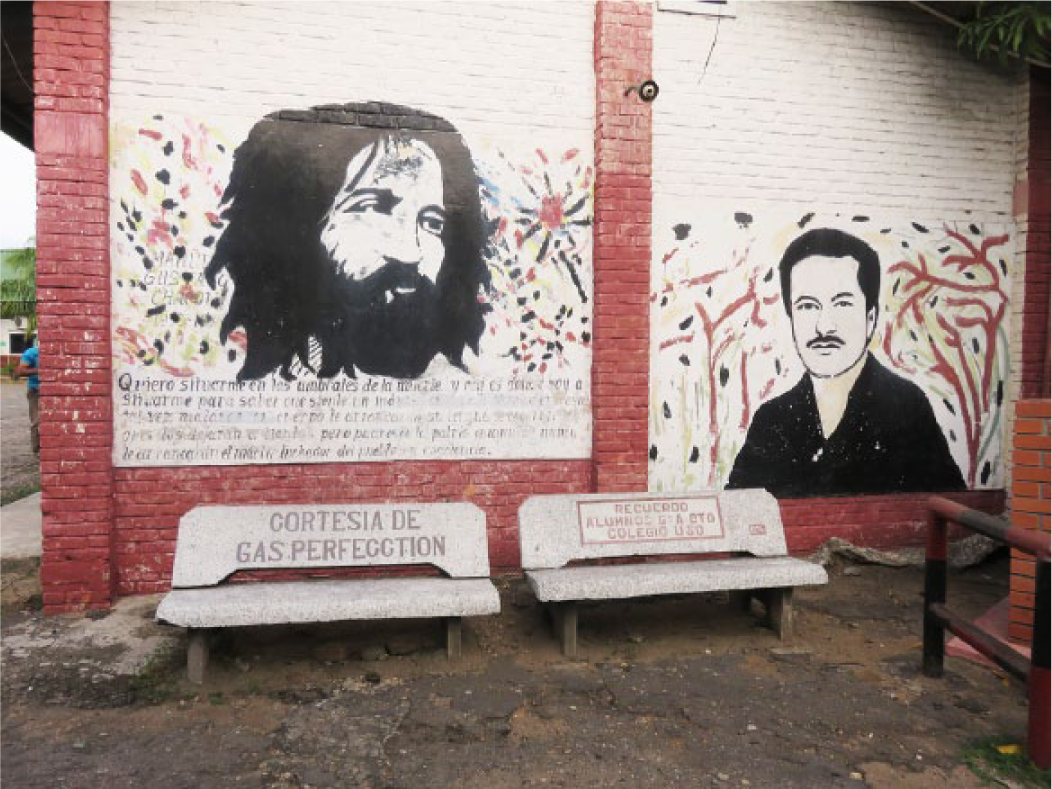
Barrancabermeja, memorial to murdered union officials, Manuel Gustavo Chacón and Fermin Amaya.
One group in particular, Hijos y Hijas por la Memoria y contra la Impunidad, has displayed ingenuity and courage in relation to organising cultural resistance in various barrios in town. This has included murals on Afro identity and on tolerance and that already mentioned in La Esperanza.
Mocoa
Mocoa is in Putamayo on the edge of the Amazon region. There has been violence in this region since the mafia started to plant coca in the late seventies. The FARC started to attack laboratories of the drug dealers and eventually controlled drug-trafficking in the area. As the struggle between guerrillas and paramilitaries to control coca production escalated, ‘cocaleros’, campesinos who live in areas controlled by FARC, were attacked by paramilitaries who accused them of being FARC collaborators. The massacres of El Placer and El Tigre committed in Putumayo are cruel testimonies to these attacks on civilians. The FARC recruited child soldiers and many women became victims of sexual violence committed by armed men.
There are not many murals in Mocoa, but a women’s network, Tejedoras de Vida (Weavers of Life), are strongly influential as ‘memory entrepreneurs’. 56 They have commissioned murals such as ‘Muro de la Verdad’ (Wall of Truth) to depict women disappeared and killed as result of the armed conflict (see Figure 9). The murals in Mocoa and Villagarzón list the names and circumstances of women killed in the conflict in the region or demand to know the whereabouts of the disappeared (see Figure 10). Every 25 November, women’s organisations and relatives of the 174 women victims portrayed in this mural gather at its site in Mocoa to pay tribute to their memory and to call for an end to armed conflict.
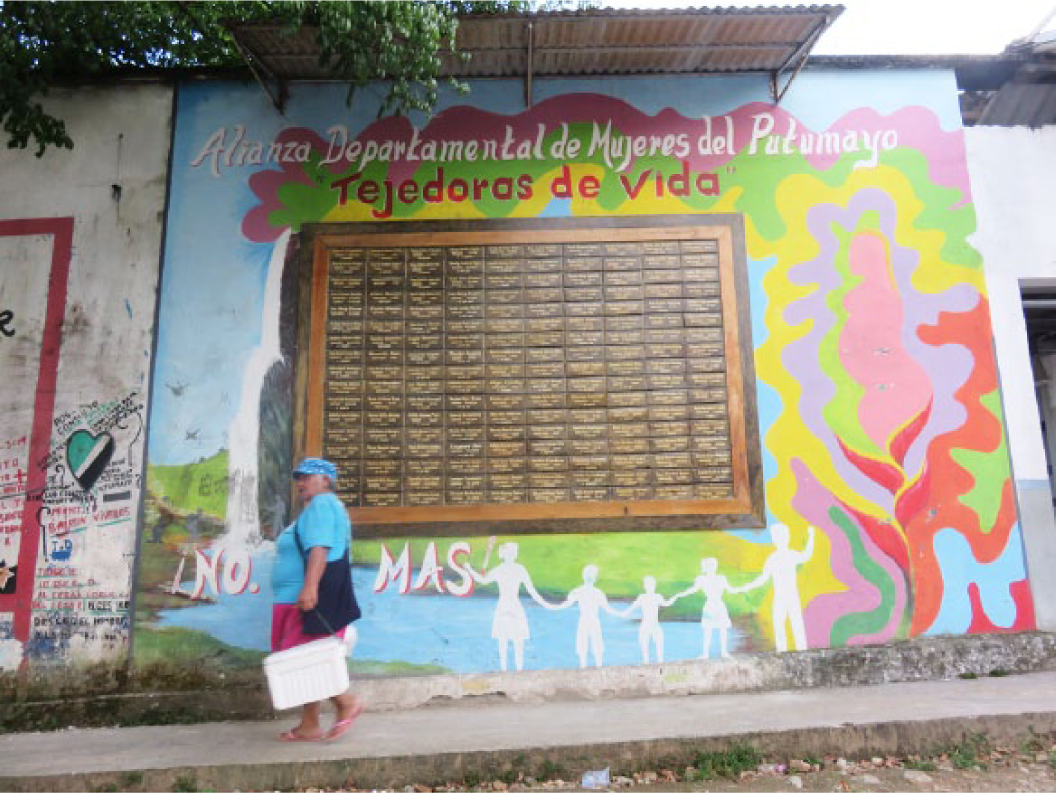
Mocoa, in memory of women casualties.
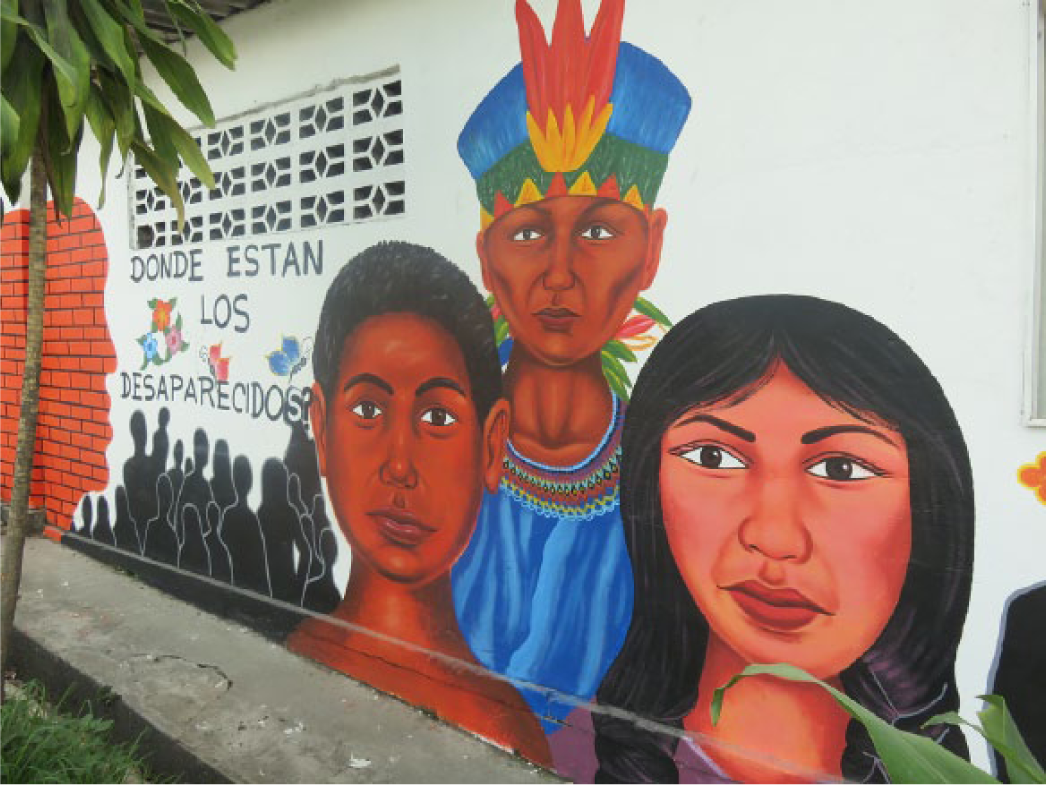
Mocoa, ‘Where are the disappeared?’.
Toribío
The town of Toribío is the centre of a resguardo (reserve) for the Nasa indigenous people. Highly politicised and well-organised, the Nasa are fiercely proud of their independence, and have been at the forefront of fighting for their identity, protecting the environment, opposing the effects of neoliberalism and the proposed Free Trade Agreement of the Americas. They are key activists in indigenous resistance in Colombia, characterised by Avilés: Armed resistance, land occupations, marches, alliances with other social movements, and judicial politics have all been employed by indigenous peoples to protect their lands from cattle ranchers, to ensure that their languages are taught in indigenous schools, and to resist the incursions of armed actors and the encroachments of transnational corporations upon indigenous territories … some communities have chosen not to be displaced or victimized by armed actors, pursuing an ‘alternative path that is neither fight nor flight’.
57
As guardians of their culture, identity and environment, the Nasa people seek to protect all three through their devolved political structures as well as through their Indigenous Guards, a non-violent civil defence group who play a key role in that protection. From time to time, this entails taking on the state and multinationals; in addition the Nasa have suffered as a result of the political conflict. 58 In July 2011, the FARC left a bomb on a chiva (a truck-like bus) at the police station which killed four local people, injured 103 and demolished 400 houses. The axle of the bus ended up at the wall of the local church and has since been incorporated into a memorial to the victims. In November 2014, the FARC killed two indigenous guards who had removed a billboard honouring Guillermo León Sáenz, alias Alfonso Cano, the FARC supreme commander killed by the Colombian army in November 2011. 59 State forces have killed locals, including in the massacre at nearby Gargantillas. The paramilitaries, convinced that the Nasa people are sympathetic to the guerrillas, have also carried out murders. This last point is significant: superficially there would seem to be an affinity between Nasa beliefs and the leftwing ideology of the FARC. But in fact, the Nasa are fiercely proud of their independence, determined to side with no military group from outside. 60
Toribío has suffered numerous raids and attacks, an experience which could have led to demoralisation if not for the constant efforts of the community to maintain its local pride and solidarity. One such example is a minga muralista (mural festival) in 2014, where Colombian and other muralists gathered in the town for over two weeks, painting dozens of murals. 61 Many of these murals acknowledge and display indigenous culture (see Figure 11), recognise the significance of the Indigenous Guards (see Figure 12) or speak out against military incursions in the town.
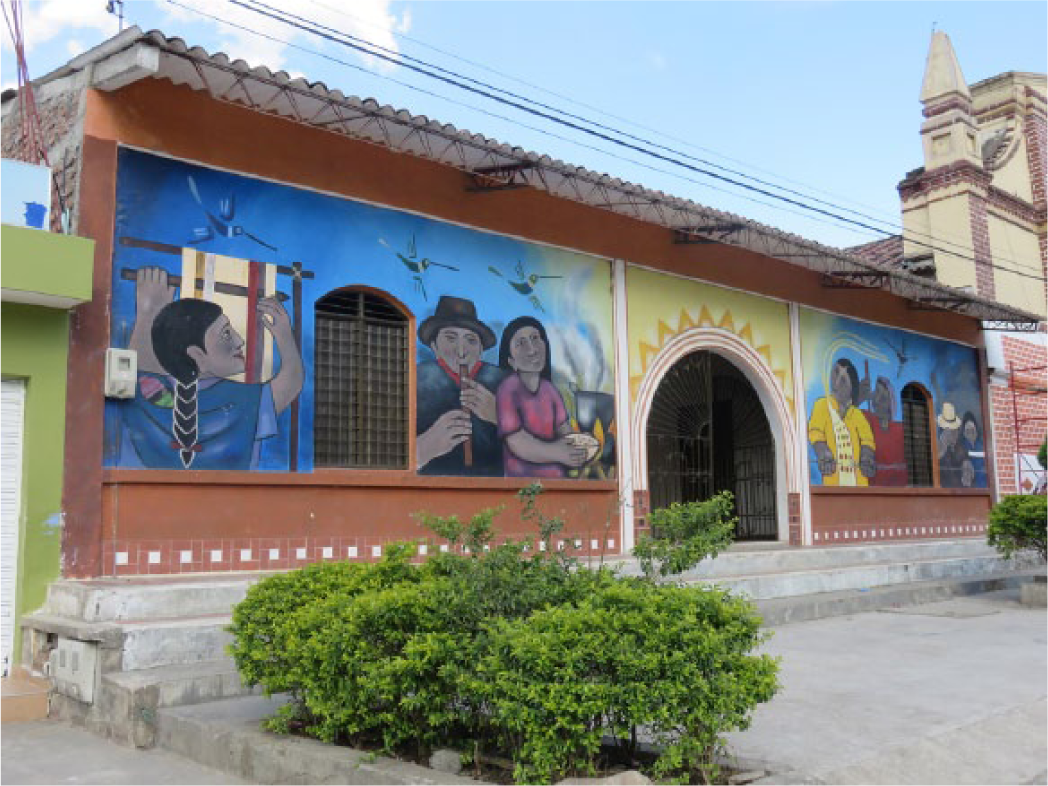
Toribío, indigenous identity and resistance.
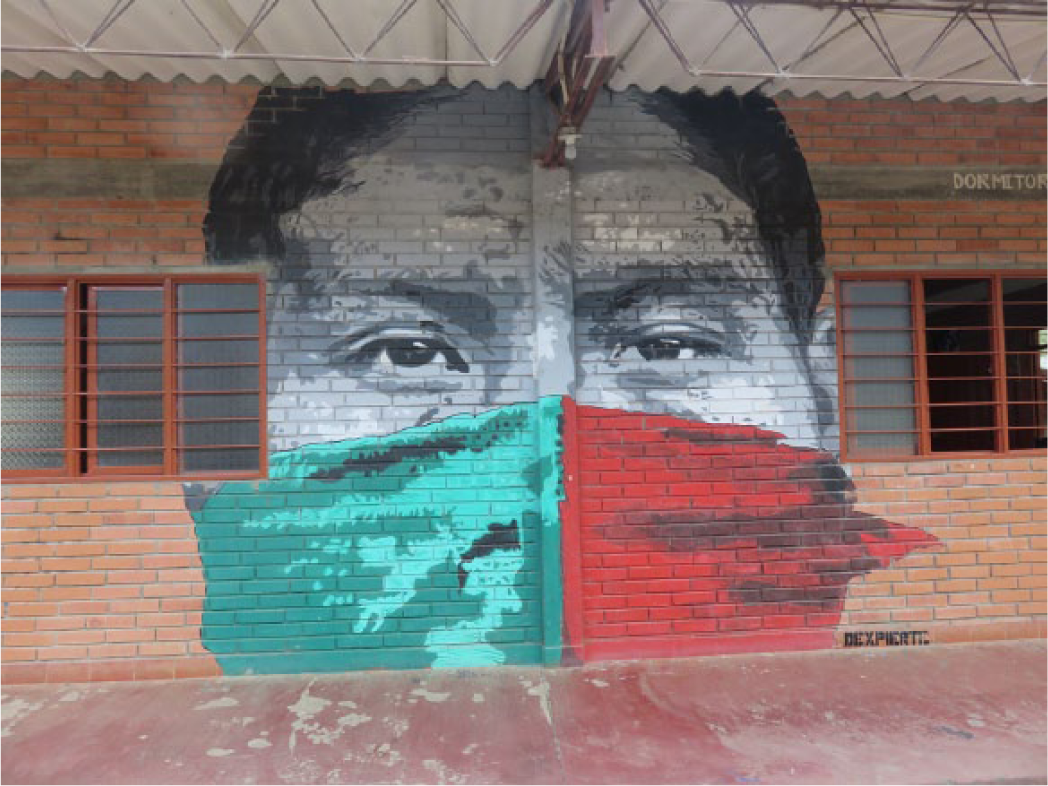
Toribío, mural portraying an Indigenous Guard.
Victims, art and transformation
In the words of Laplante, ‘Revealing the truth of past crimes supposedly protects against cycles of retributive violence and the repetition of dangerous patterns of behavior’ – a statement that is now seen as axiomatic in relation to transitional societies. She continues by asking an apparently simple but disarming question: ‘But how?’ 62 The answer lies not in the institutions of transition per se, but in the agency of those who use the opportunities provided by such mechanisms and indeed the space provided by transition to seek acknowledgement and justice. Above all, it rests on their vigilance to continue to ensure non-repetition of the past.
The problem is that one effect of conflict is the creation of a particular view of victims. For example, in the case of Kosovo, women victims were relegated to a limited number of discrete categories: the passive refugee, the waiting wife, the rape survivor. 63 More generally, as Christie has concluded, the ideal victim must be ‘weak enough not to become a threat to other important interests’. 64 In this interpretation, passivity is the essence of victimhood; the ideal victim lacks agency.
The victim as agent can be viewed as a nuisance, even a threat. Yet victims who assert their right to acknowledgement, who pursue truth and justice, are playing a socially constructive role which goes beyond the immediacy of their personal troubles. In as far as they succeed in naming and communicating injustice, they are not simply attempting to hold the state responsible for the past but challenging the state to live up to democratic ideals in the future. Victims may make demands on the state in an adversarial and combative manner, but, in as far as the demands are realised, they are contributing to the emergence of a society which goes beyond injustice and impunity.
Thus victims who establish memorials are not simply stuck in perpetual melancholia. On the contrary, such memory work triggers agency, not stasis. In refusing to let the memory of abuse die they are ultimately harbingers of a society radically different from the one which gave rise to the abuse. Their memorial is built on the premise that ‘a different world is possible’, one based on human rights and justice, and their challenge to the state is to be at the forefront of establishing and guaranteeing such a society. In this sense, memorial murals, although looking back to the past, can have a very clear role in conflict transformation. Firmly planted in the present, they link the past and the future.
This is where murals can play a crucial role in transition. As Mani argues, ‘restoring culture and art after the devastation of conflict serves an essential humanising and deterrent effect’. 65 There is evidence that this message has got through to the Colombian state. In 1995, reparation to the citizens of the town of Trujillo included a symbolic element. Part of the compensation for victims of a massacre was the state’s financing of a park and a mural painted by a Kurdish/Dutch artist. Ten years later, Article 8 of the Justice and Peace Law 935/2005 on the Demobilization of Paramilitaries allowed for symbolic reparation as a way to restore the dignity of the victims. In 2011, Article 141 of the Victims’ and Land Restitution Law 1448 /2011 used the same concept of symbolic reparation to establish a national day of memory and solidarity with victims.
These developments fit neatly with other international developments. The Inter-American Court increasingly recommends symbolic reparations 66 and the United Nations has issued advice regarding satisfaction for victims. Satisfaction, it is stated, should include truth recovery, prosecutions, the search for the disappeared, the return of abducted people and of bodies, public apologies, plus ‘commemorations and tributes to the victims’. 67 In short, along with material outcomes, symbolic ones are seen as important. No matter what this says of the ability of states in future to willingly give more space to victims’ voices than previously, it underlines the fact that the grassroots work of victims’ groups, women’s groups and artists in Gargantillas, Mampuján, Mocoa and elsewhere in Colombia is crucial. Through their agency they may help to heal – not simply their trauma, but that of the nation.
Footnotes
Acknowledgements
With thanks: to Keshava, Nicolás, David, Mariana, Emilio, Uriel and Alvaro for insight on the graffiti and murals of Bogotá; to Arturo, Kbala and Jeihhco for insight on the graffiti and murals of Medellín; to Brayan and Santiago for insight on the murals and political situation in Barrancabermeja; to Fatima and Jonathan for insight on the murals of Putamayo; to Jafeth, Floralba and Norma Lilliana for insight on the murals of Toribío.
Bill Rolston is an emeritus professor at Ulster University and former director of its Transitional Justice Institute. He has researched political murals in his native Northern Ireland over many years and more recently the murals of Chile, the Basque Country, Sardinia, Iran and Gaza. Sofi Ospina is a Colombian anthropologist. In the last twenty years she has worked as an international consultant on gender, peace and security in countries affected by armed conflict such as Timor Leste, Cambodia, Afghanistan, Pakistan and the Democratic Republic of Congo, among others. She is an activist for peace in her country of origin and is part of national and international networks of women peace builders.