




Abstract
In 1971 a young teacher was sacked from a London East End school after publishing a book of poetry written by its working-class pupils who acutely observed the sights and people’s struggles around them. In an unprecedented move, the school children and those from neighbouring schools went on strike to demand the reinstatement of their teacher. That teacher, Chris Searle, who went on to be one of the most radical and internationalist educationalists, has begun to write his memoirs in terms of the way poetry influenced him and he, in turn, used poetry as part of his educational practice. This is an excerpt from the memoirs which gives his account of life at Sir John Cass and Redcoat School, the publishing of Stepney Words and the way in which the public reacted to it. It reflects the history and changing nature of working-class London and the influence, in practice, of cultural tensions thrown up by ‘the 1960s’.
Keywords
In 1971, the unthinkable happened: school children downed tools and marched to the centre of London to protest at the sacking of a teacher who had the audacity to publish school children’s poetry telling it like it was in London’s grim East End. And so Stepney Words
1
became a cause célèbre attracting support from radicals in the arts, the unions and the church, and opprobrium from the Church of England school’s governors. In an unprecedented move, the mass media reported sympathetically on the imaginative venture of probationary teacher Chris Searle, himself from the Essex suburbs of London, who had been radicalised during travels in 1960s USA, the Caribbean and Canada. Some forty-five years later, Searle, one of the UK’s most innovative educationalists,
2
has begun his memoirs. In Isaac and I: a life in poetry: volume 1 (published by Five Leaves Press, 2017), he tells of the historical class influences that made him and the progressive poets and educationalists who inspired him. Key to his growth were Isaac Rosenberg (1890–1918), the working-class, Jewish, Stepney-based war poet, about whom he wrote a thesis in 1967, and William Blake, who, like Isaac, saw the world ‘in a grain of sand’. And Searle pays homage, too, to the teachers who had validated and formed him: ‘Chiefie’ (Norman Hidden) the unconventional head of English at senior school who introduced ‘eleven-plus failure’ Searle to radical writings,
3
and, at university, Marjorie Hourd and her pioneering The Education of the Poetic Spirit in which she showed the relationship between child development, the teaching of English and imaginative writing – ‘the creative-critical principle’.
4
For it was from his own struggle to make sense of an alien and alienating world of middle-class cultural expectations and values that Searle developed his own ‘pedagogy of the oppressed’. It took him from Stepney Words, via Mozambique and the revolution in Grenada, to a Sheffield headship where he was forced out of a job because, believing in every child’s right to education, he refused to exclude challenging pupils. In this edited excerpt from one chapter in his forthcoming memoirs, we publish his account of what happened to him and his pupils in 1971 when they used poetry as a tool to see, feel and reflect on the East End around them. There is not room here to tell of all the repercussions in detail. But more than two years later, after the parents, the Inner London Education Authority, the National Union of Teachers, and even Margaret Thatcher, then Education Secretary, came out in favour of Chris Searle, he got his job back. Stepney Words sold more than fifteen thousand copies, with the poems published in national newspapers, broadcast on television and read at the Institute of Contemporary Arts.
I started teaching in Stepney in September, 1970. I had little idea of the school I was getting into, and should have done some research. If I had, I would have discovered that its Church of England governance was certainly not slumbering, and that it was founded by one Sir John Cass, a wealthy city merchant and alderman with definite Caribbean and slave-owning connections, who signed away a portion of his wealth as he died in 1718 to found a school for East London children. Every year, on ‘Founder’s Day’ the schools’ pupils were marched to St Botolph’s Church in the City of London, to hear a service of remembrance and be given red feathers for their buttonholes. The legend was that as the founder died making his bequest, he coughed up blood which soaked the quill he was using. The ecclesiastical inheritance was still strong: the Chair of Governors was rector of Stepney Church; the vice- chairman (who had been a high court judge in colonial Tanganyika) was the rector of St Botolph’s. As for the teachers, several were Church of England priests, one of whom would, on a daily basis, patrol the corridors complete with dog-collar, academic gown and brandished cane. Organised to emulate a public school ‘house’ system, the four ‘houses’ were in fact called ‘guilds’ to reflect city business confederations.
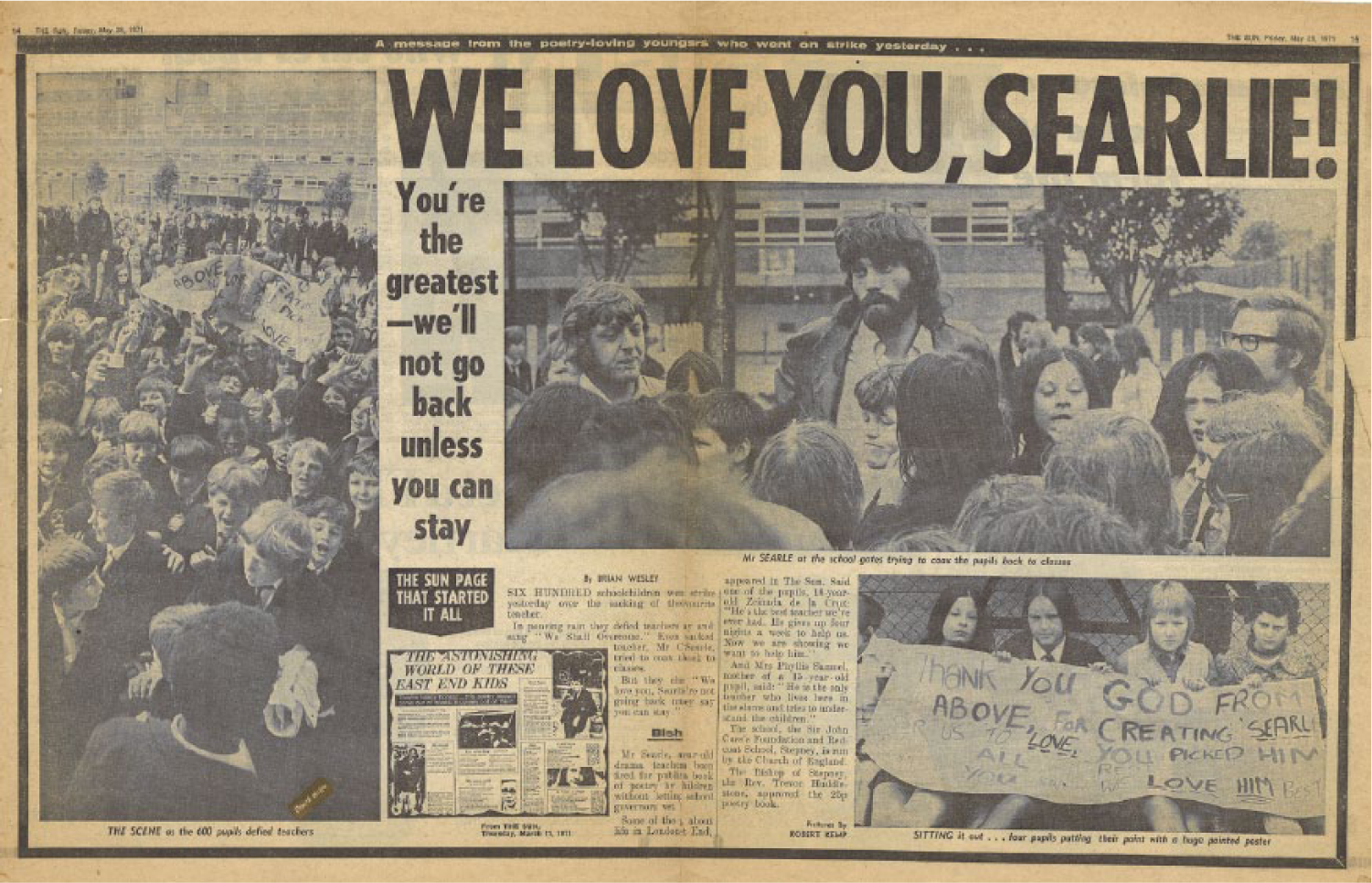
School children strike in support of the author. Sun, 28 May 1971.
I found a flat very close to all these addresses, in Albert Gardens, a Georgian square off Commercial Road, with a beautiful glade of plane trees and a 1904 statue of a barefoot, idealised agricultural labouring boy looking out over the main road, sickle upright in one hand, rake in another, standing in front of a wheatsheaf. Erect, Grecian featured and pre-Raphaelite, he didn’t look much like a local boy. Many of the square’s residents were Jewish families, and bustling mothers would take their children across Commercial Road, with its heavy eastward traffic, to Marion Richardson Primary School, just opposite the square. On the next street along were the remnants of the first pioneering Dr Barnardo’s home and, in the other direction towards the city, was the derelict East London Maternity Hospital where many of the parents of my students were born. Next to it was 400 Commercial Road, the house of the Bishop of Stepney, which was to become an important place for me. As I came home from school or in the mornings, I would see and hear the birds in the plane trees.
As for the school, if I thought I had met vicious streaming in my own education, it hardly compared to what I found at Sir John Cass. There were five streams before you reached the ‘remedial’ stream, which wasn’t a class with small groups and more teachers to give close attention to students’ learning problems. It was simply another class of more than thirty students with a single teacher: the rock-bottom stream. As this class gradually rose up the school, the students became more and more disaffected, gained less and less self-worth, more and more self-contempt – conscious of their own exclusion. As an English teacher I taught two fourth year classes, one a non-examination ROSLA (Raising the School Leaving Age) class which, since the recent change in the law, meant that they were compelled to stay on at school until they were 16, despite almost all of them hating every moment of it.
Three incidents very early on in my time at Sir John Cass gave me a very keen insight in to what I was dealing with. The first was when I was present at a ‘business studies’ class with a combined cohort of 15-year-old girls, most of whom were being prepared through this class to join typing pools in City offices. The teacher, in her singular authoritarian way, was reprimanding the girls for their lack of interest and motivation, but then went on to call them all ‘cheap’. I knew well how much of a contemptuous insult this word was to young East London women, and after the class I asked her why she had used that word. ‘Well they are, aren’t they?’ she said. I was seriously shocked. I taught some of these girls and found them to be full of wit, humour and warmth, and I couldn’t understand how any teacher could use that word. Then one dinnertime, I found one of my first-year students, a boy called Timmy, about to be on the end of the unsheathed cane of the patrolling priest. This Timmy was in my English class; his writing, particularly his poems, bristled with life and beauty. I asked the priest what he thought he was doing, and told Timmy to leave the room. The conversation I had with this man of God was anything but cordial and, I thought, that’s another enemy made.
The third event was about poetry. I asked one of my low-stream classes to write about how they saw themselves at school, how they saw their futures. Among many poems of optimism, despair, egoism and complexes was this untitled and anonymous piece left on a desk, which I picked up after the pupils had left the classroom. I looked at it, studied it and tried imaginatively to fill in its spaces as I have done for four and a half decades since. It became the preface of the anthology which was published in May 1971; Stepney Words: I am just a boy with a lot of dreams But what’s the point I won’t get nowhere I’m just ordinary nothing special just ordinary Got no chance in this world unless you’re clever which I’m not.
5
I started taking my classes out into the streets around the school with their pens and their notebooks, asking them to write down what they saw: the houses, the few trees, the birds, the people who passed them by. We went by the river towards Wapping and to Shadwell Park, and right opposite the school was the churchyard where there were still the discernible mounds that signified the mass graves of the Great Plague of 1666. We acted out imaginary scenes from that catastrophe, and then sat on the benches to write poems. On one October morning, two eleven-year-old girls, Lesley and Karen, sat down together on an iron bench. Lesley wrote this:
Autumn Morning in Stepney Churchyard
The church was standing in a spot where the light of a thousand candles were glowing in the mist of the morning, And the faint beams of sunlight came through, and the cold air was gently overflowing and in a second it was gone. The churchyard was dead and the birds only were there. And the leaves were falling, falling, falling And the dew that lay by the ever-lay leaves is fainting into the background to die.
And Karen wrote: The grass is covered by brown leaves, The sun is peering through the trees, The dew on the grass is delicate Like a baby’s tear. The grass mingles with the graves, Behind the graves there dwells fear. The church is ancient with its dull-coloured walls, Surrounded by black railings Surrounded by trees All ancient. So I’m sitting on a bench as the sun goes down, Night draws in, all goes calm.
As I read these poems for the first time I thought of Blake and the Garden of Love: So I turn’d to the Garden of Love That so many sweet flowers bore; And I saw that it was filled with graves And tombstones where flowers should be.
And wasn’t this beautiful London oasis near the very place that Donne had worked as a minister, and at the end of the road where Isaac [Rosenberg] had lived and grown to poetry? I wasn’t imagining it, it was real: here was the true place of London poetry, forged as ordinary people passed by, to and fro, morning and evening, to walk through the rare trees of East London to Stepney Green underground station, and here were two 11-year-old poets forging their craft from their ordinary words.
Back in the English classroom the poems came teeming out about the lives of the poets and the lives of others, particularly the old. It was as if these children had a particular empathy with the old people they saw all around them;
I’m old and frightened In this darkened world I’m shut behind bars…
Or: I live on my own In a cold damp room, No one to talk to No one to see My children are married They live far away, My husband died On a cold winter’s day…
Or the blind man who passed them: As I walk along the street As blind as a bat I think I will never see the world ’till I die As a blind man I can’t see one thing In this lovely world Dark is a terrible thing To live with.
Sandra considered the school day: We’re to sit and work. All day long we sit. The pips go. We rise. We leave. All regulated Step out of place We get told off. ‘Wear school uniform! Wear flesh-coloured tights!’, It’s sickening how these things go, They never know what we think.
And Gillian told a short story of one of the school’s allies in The Tall Man with the Grey Hair: A knock comes at the door A tall man With grey hair Steps in. ‘I understand’ Says he ‘You have not been at school’ Mum’s face Grew long and yellow, ‘Haven’t you?’ Says she. Her long boney hand Came swiftly round my face And the tears run down my face.
These were nearly all girls writing these poems about school, and their criticism stung.
The poems were in the forefront of my mind one Saturday when I went into Whitechapel Library. I saw that it had become a gallery for a week or two, showing the work of a young photographer whose name was Ron McCormick, a graduate of the Liverpool College of Art and the Royal Academy. The exhibition was called Neighbours and, a leaflet told me, they were all photographs of Spitalfields, where McCormick also lived. I was captivated by his images of children, of the aged, of families in their homes or on their doorsteps, of the streets and blocks where many of my students lived, in the same way that I had been surprised by joy at their poems. I asked the librarian about the photographer. ‘Why don’t you leave a message for him in the comments book?’ he said to me. So I did, telling him of my students’ poems and how his images had moved me in the same way. I also left my address.
The very next day, he called on me at Albert Gardens. We talked, then walked the Stepney and Spitalfields streets like Isaac and his friends, and ended up at his flat on the first floor of an old, dilapidated Georgian house in Princelet Street off Brick Lane, its ground floor being used as a garment store by its Jewish owner. On the way he used his camera like a third eye, stopping and snapping at everything that fired his interest: he never went out without it. His flat was basic, with homemade furniture and a bathroom which also served as a darkroom. I met his wife Linda. I had some copies of my students’ poems, and Ron and Linda were deeply moved by them. He exclaimed in his Liverpudlian accent, and when I pointed to some of the similarities between his photographs’ visual images and the words and figurative power of the poetry, he nodded and marvelled. He offered to come to some of my classes, bringing blown-up prints of some of his photographs to see how the young poets would react. I thought this was a tremendous idea, and we discussed the photographs we should use and how we should use them. Very quickly we became friends, through the agency of poetry and photography.
Ron became a regular presence in my classes, particularly my first-year class, and his photographs became powerful and provocative stimuli. His pictures of an old man in the market with a Sainsbury’s shopping bag and stick was the source of Jimmy’s poem: I’m old I need rest Maybe it’s the gardening I do Maybe it’s the long walks I take Maybe it’s in my mind At night in bed I rejoice the rest I’m having My muscles are getting stiff Sometimes I get rheumatism in my legs I’m getting very old I need rest
When Carol saw Ron’s picture of an Asian girl standing alone in front of a half-demolished wall, she wrote: I am just a lonely mermaid I only have myself to look at I have no friends like the people on the beach When I see the children playing on the beach I wonder why no one will play with me And why I’m so lonely
Ron was helping them to observe, to notice detail, to think in figurative language, to empathise, to make whole stories from single images.
As we walked the streets, there, naked and explicit, were the settings and subjects of both Ron’s photographs and the children’s poetry. We considered another way of bringing the two forms together. Why not an anthology combining both? But to do it with beauty and respect, we needed some money, which neither of us had. Ron scraped together a frugal living designing book covers, posters, and his photography occasionally made the papers, while I was a probationary teacher. So we decided to ask the school, to see if it would provide funding. The Sir John Cass Foundation was wealthy enough, owning land and many houses north of Victoria Park, and we thought that this might be the kind of project that it could support. We put together a ‘dummy’ compilation of poems and photographs and called it Stepney Words, showed it to the head teacher, and awaited his response. He seemed to be quite enthusiastic at the outset of our meetings, but said it was an idea that needed approval of the school governors. He also said that a previous English teacher had come up with a similar idea without photographs, which she had wanted to call The Star in the Mud, but that had not been approved and she had left the school soon after. So we went away and waited.
I had an intimation of what might be coming one morning when the Reverend Chair of Governors approached me in the corridor outside the school staff room and told me that he’d been reading some of the poems. He didn’t say much about them, but said of the children-authors: ‘You have to remember that they’re all fallen children, that they’re all in a state of sin.’ And that was it, he walked off. I stood there, deeply affected. What did he mean, what was he saying? When I told Ron, he was bemused too. We decided to get another clergy view, and arranged to meet Trevor Huddleston, the Bishop of Stepney, to show him the poems. So we knocked on the door of 400 Commercial Road. Huddleston was friendly and warm, and to me, having read his searing critique of the apartheid regime in South Africa, Naught for Your Comfort, he was something of a hero, despite my having left organised religion behind, many years before. As the priest of Sophiatown on the outskirts of Johannesburg, where he had befriended many of the key figures of the South African resistance movement like Nelson Mandela and Oliver Tambo, he had fought against racism, and set down his experiences as an early exposure of apartheid. We left copies of the poems with him.
When I called in to see Huddleston a few days later, as I walked in to his office he looked at me directly and pronounced: ‘Christopher, I love these poems. These children are the children of God!’ To say I was taken aback would be stating it mildly, for the Reverend Chair of Governors’ opinions were still reverberating in my brain. Huddleston said that he would certainly support the proposed book being published, and would help us in whatever way he could. Ron and I were both heartened, and we decided to show the poems around the community to get further support. We went up to the top floor of Latham House, a tower block almost next to the school, to meet the recently retired Dockers’ trade union leader, Jack Dash, who did his keep-fit exercises and weight training on his tiny balcony overlooking the now defunct London Docks and their derelict cranes. To the establishment and its press, Jack – with his communist politics and record of leading many official and unofficial strikes – was the Devil incarnate. While we were at his flat Ron took the photograph which we used for the eventual cover of Stepney Words, which was also Jack’s view from his balcony. Jack loved poetry, and said he wrote some himself. He was deeply impressed by the poems, especially because he recognised the names of some of the poets, from families who were tenants of the council estate of which his block was a part, and which was next to the school: Mountmorres Estate. ‘Anything I can do, mate’, he said, ‘just let me know. I’ve got some good contacts in the press.’ And he gave me a paperback copy of his autobiography, Good Morning, Brothers! With a preface which he said would be his epitaph: Here lies Jack Dash All he wanted was To separate them from their cash.
The only negative opinions, unfortunately came, as we feared, from the school governors. I was invited to one of their meetings where they said, they thought the anthology was ‘unbalanced’, too ‘gloomy’ and couldn’t I find some more ‘cheerful’ poems to make it more positive? I remembered the song that Woody Guthrie used to sing, how those in power always wanted to silence and wipe away ‘the pictures from life’s other side’. These governors did not want the children to write about the real world. As I said later, they wanted the cockney sparrow to sing cheerfully from his cage. The collection held within it deeply contradictory impressions of the poets’ home neighbourhoods, exemplified by the two views of Stepney which we had set side-by-side: I think Stepney is a very smokey place But I like it People in Stepney do things wrong But I like them Everything in Stepney has its disadvantages But I like it. It does not have clean air like the country But I like it The buildings are old and cold But I like them The summer is not very hot But I like it.
And: I come from Stepney, lived there all me life Loads of cheap markets Bargains at half price, Jumpers and skirts, trousers cheap All muddled up in any old heap Dirty old women, shouting out their wares Everybody stinks, nobody cares All greasy dirty things bunged into bins, Stinkin’ rotten hole is Stepney.
The affectionate and sentimental were adjoined to the stark, the dismissive and the ruthlessly realistic. Both were true, both were original, both, in different ways and from different standpoints, were critical. I felt as if they were manifesting Marjorie Hourd’s principles: this was a part of her ‘education of the poetic spirit’.
Ron, Linda and I thought that we shouldn’t be deflected. Linda had spent a lot of time typing, pasting and checking, and keeping records of everything we did. Ron had found a printer along Brick Lane, a Mr Weinberg, who had an astonishing personal history. Ron had shown him the poems and he was very keen to do the printing for a very reasonable price. We found out much later that he was Issy Weinberg, the son of Baruch Weinberg, a Jewish socialist militant who had escaped from Tsarist Russia and become a writer, printer and instigator-founder of the Yiddish ‘Workers Circle’ in East London. ‘He was a worker and a dreamer who longed for a different life to the one people had, not only for himself but for others’, Issy said of his father. ‘The Workers’ Circle Friendly Society helped Jewish workers and craftsmen survive when they were on strike for better pay and conditions.’ He had passed his printing skills on to his son, who had inherited his tiny Brick Lane printshop. The beauty and skill of his printing was a source of immense pride to him. So it seemed that we were all set, and we couldn’t have found a more fitting and masterly printer. Ron had done the design and production and had come to school especially to photograph the eyes of a second-former called Angela, so he could put the image directly above her poem called Mirror. It looked beautiful, as did his landscape over the river, docks and cranes taken from Jack’s balcony, to which he gave a sepia gloss, making it even more evocative.
So with our own money and donations, we published Stepney Words, calling ourselves ‘Reality Press’, and paying for 2,000 copies. It all came to just over £300, which, considering the sheer quality of the printing, we considered very reasonable. As soon as we had copies, I tried to find the home addresses of all the poets by searching for them in the school registers; I began visiting their homes and taking around their complimentary copies, from Limehouse in the east, all around Stepney, Shadwell and Whitechapel, to Spitalfields and as far as Clerkenwell to the north. I was received with both surprise and warmth by parents, who were not only taken aback to get a visit from a teacher, but delighted to see their son’s or daughter’s creative writing in print, and in such a fine publication, too. I’d met some of them before, particularly the families who lived close by, and some knew me through the film club I’d set up at school, which had become quite popular. We showed some good films too, both English 1960s’ classics like A Taste of Honey and The Loneliness of the Long Distance Runner, as well as quality American fare like Marlon Brando in One Eyed Jacks and Paul Newman in Cool Hand Luke. It was an innovation which sometimes got packed houses, and it introduced the students to some fine films. But, the home visits with Stepney Words gave me a face-to-face opportunity to explain to parents why we’d done the book as well as compliment the skill of their children’s work in their own front-rooms. We also sent copies of Stepney Words to people we admired and who we thought might be interested.
We had some more than encouraging replies. From Suffolk, A. S. Neill, the educational pioneer of ‘Summerhill’; from Yorkshire, the champion of comprehensive education and educational progress in the West Riding, Sir Alec Clegg, who a few weeks later wrote a letter of support to the Times Educational Supplement. Stepney Words, he said, had ‘so moved me by its depth of feeling and by the statement that it made as a whole, that I took what was for me, after 26 years in Yorkshire, the wholly unprecedented step of sending a modest contribution to the next issue’. James Britton, education author and Professor of Goldsmiths College, University of London, called the poetical language ‘unliterary … but full of honesty and conviction’ and the playwright Arnold Wesker, himself a Spitalfields boy, sent us an unpublished poem from his own boyhood, Sitting Waiting for Auntie Ann, as a contribution to the next issue, which was already in our heads.
A group of the young poets took part in a ‘Festival of Racial Harmony’ at the People’s Palace in Mile End Road, which later became a part of Queen Mary College, University of London. On a stage famous as the venue of trade union rallies, political meetings and the East London concerts of Paul Robeson, the Stepney Words poets read their poems in front of slides of Ron’s photographs. They did the same a week later in a morning school assembly, and accompanying them was not Hills of the North Rejoice and All Things Bright and Beautiful but the Hollies singing He aint Heavy, He’s my Brother and Nicky Thomas’ rampaging early reggae version of If I Had a Hammer. The students were almost dancing in the aisles at Thomas’s final chorus: It’s the hammer of justice It’s the bell of freedom It’s the song about love Between my brothers and my sisters All over this land
And this was a message ringing out over a post-Powell East London, multiracial and internationalist to the core.
***
Jack had been more than true to his promise. So true, it got me in all kinds of trouble! He’d got on to his contacts in The Sun and the Daily Mirror and the next thing I knew was that both tabloids were running big features on the Stepney Words poets, quoting several of the poems in full with photographs and pen portraits of their writers. I doubt if either paper ever published more poetry, before or since. There was also another profile of the book and its authors in the last ever issue of the Daily Sketch, which ceased publication after its Stepney Words edition. This meant, of course, that hundreds of the Sir John Cass parents and their friends read these poems, and the local paper, the East London Advertiser, not to be outdone by the nationals, also did a double-page spread. Suddenly, the contents of Stepney Words were everywhere. We’d made sure that we sent a copy to the headteacher, so suddenly the cat was out of the bag, and I waited for the reaction, not really knowing what would happen next.
It didn’t take long. A few days later I was sent a letter telling me that I would be dismissed at the end of the school year. As this was late May, with the school year ending in July, I had less than two months left. To the school governors I was simply a ‘probationary teacher’, nothing else, and thus it would be simple and straightforward to get rid of me. 6
It was the week before the final half-term of the year. Sitting in my classroom during the lunch hour, several of my third-year class came in and sat down with me, which was quite usual. They must have noticed that I was looking a little glum, so they asked me what was bothering me. So I told them: I’d got the sack and I wouldn’t be around from September onwards. They asked me why, so I told them. They found it hard to believe. ‘What, you’re getting the sack because of the book you did of our poems?’ They were astonished. Then shortly after, the bell rang for afternoon school and we went our different ways.
After that, I had no idea at that time what was happening. As I understood it much later, Michelle, a girl in my class whose poem was in the book, told her brother in the fifth year, and soon it was all around the senior pupils, several of whom were film club regulars. The fifth year had games all afternoon at Fairlop playing fields out in Essex, and apparently on the coach home were discussing what they should do. The next day was very strange. I could tell that something unusual was up, but I didn’t know what. It was only at the end of the afternoon a first-year girl, giggling as she passed me in the corridor, gave me a big smile and said something like, ‘you wait until tomorrow Sir, you’ll see!’ I decided to get right out of the way so that night I went back to my parents’ house in Hornchurch and stayed there, wondering what tomorrow would bring.
When I came in the next morning, I got the tube, walked up Stepney Green and came through the school’s side entrance and into the staffroom. Already there were some huge sounds coming from the Green at the front of the school, sounds only comparable to Upton Park [West Ham’s football ground] on a Saturday afternoon. It was pouring with rain, too, but nobody there seemed deterred as they sang with a huge sound We Hate the Governors and Roll out the Barrell!, punning on the headteacher’s surname and evoking memories of communal sing-songs at Saturday morning pictures. Most of the teachers were amazed and very uncomfortable, although as I learned later, some of them had some idea of the proceedings. The Head of Art had been approached the previous day by students in his class as to whether they could use his room, paper and paint to make banners and placards. He had left his door unlocked. The Australian Science teacher had acted similarly. Even though there were only a handful of children still in the school and pickets stood at the students’ entrance, the Deputy Head entered the staffroom just before the morning bell with her customary declaration and armful of registers: ‘The children are waiting! The children are waiting!’ I went upstairs to my class on the first floor. There wasn’t a student present; they were all outside on the green with the reporters and photographers of the local and national press milling around them in the rain.
It seemed that the evening before, after school, there had been a mass meeting on the Green, and a strike vote of raised hands, just like the Dockers, had been called and approved. The strike leader was a fifth-form girl from a local Gibraltarian family called Zeinaida; she and Jackie, from my fourth-year ROSLA class, had alerted the East London Advertiser which in turn had contacted the national press. The Advertiser sent a young reporter, Steve Nice, who a few years later achieved pop fame as Steve Harley, the lead singer and songwriter of the pop group Cockney Rebel whose song Come Up and See Me became a big, big hit. That morning he was one of the soaked reporters with their even wetter notebooks, scouring the Green and Stepney churchyard for the word from the young strikers. When a group of them tried to find shelter in the church’s large porchway, The Times reported that they were shooed away by a very angry Chair of Governors but undeterred they carried on singing and waving their banners.
One by one the teachers ventured outside to order or implore them to come into school, but to no avail. Eventually I went out too, thanked them profusely and told them I was going to fight the sacking through my union, and asked them to come back to school, out of the rain. ‘No!’ scores of them declared from behind their banners, ‘not until they give you your job back!’ and they waved with their determined smiles. There were parents there, too, I noticed. One of them I knew was an active trade unionist, a postal worker who had recently been on strike. He seemed to be teaching them how to picket at the main school gate.
The priests in the school, the ‘guild wardens’ and the hierarchy were very much on the side of the head and governors, but the younger teachers were much more divided. Some simply couldn’t believe that the students were capable of organising a protest and strike that had been so effective, and suspected that I was the instigator. But these were children who lived within the ethos of strikes and labour protests, and some of their parents were very much a part of that culture. Also, there had been recent large-scale strikes of dustmen and postmen, and the docks had long been in industrial turmoil with the onset of containerisation. So there was nothing unusual about strikes in the midst of their lives. It was the same for the generations of school cleaners, who were all local women. They had refused the school hierarchy’s orders to wash away the slogans written in chalk and paint by the young protesters.
The strike carried on until the half-term holiday. The headteacher called in Zeinaida and other fifth-formers for a futile meeting, but they refused to change their demands. Zeinaida told the East London Advertiser: ‘We have most of the school out here today – we’ll have twice as many tomorrow. We’ll have every school in East London out on strike.’ On the second day, a large group of the strikers marched through the City and along the embankment to Trafalgar Square, carrying banners. The secondary boys of the school on Ben Jonson Road, nearly opposite Sir John Cass, Stepney Green School, had climbed the tall iron gates of the school to join the strike on its first day after their headteacher had tried to lock them in, and as the news was carried around the borough, the girls of Tower Hamlets School along Commercial Road came out, as did the students of Robert Montefiore School in Whitechapel. Such ‘secondary action’ gave the students’ action more and more the character of a mature industrial strike, and it was only the interruption of the half-term holiday that seemed to quieten things down.
Half-term was something of a respite for me, too, but not for long. Suddenly messages of support were reaching me from many quarters. Local members of the National Union of Teachers turned up at my door, promising support. M. S. Mitra, the Deputy head of Robert Montefiore (who was subsequently to become East London’s first black head teacher) sat down with me for two hours, helping me with a letter for the Inner London Education Authority; Ron set up a meeting for me in his flat with the historian and Queen Mary College lecturer, Bill Fishman – author of classic East London working-class histories like The Insurrectionists and East End Jewish Radicals – and he advised me about fighting back and kept me laughing all afternoon with his wit and narrative. Trevor Huddleston had gone public with his support on the first day of the strike, and was quoted on the front page of The Sun under the headline ‘Please Don’t Sack Sir; Bishop hits out at “stupid” decision’, saying of the governors of this church school: ‘I just don’t know how they reached this stupid decision. I’m certainly going to take this up. The poems were exceptionally good and deserved the widest audience.’
Marjorie Hourd had seen the children’s march to Trafalgar Square on the television news, and wrote to me: ‘I nearly wept when I saw your kids crossing Trafalgar Square on Friday – I felt that all I have fought for in nearly forty years was indeed coming to pass.’ And as for Chiefie, Norman Hidden, he was now a teacher educator in Tottenham All Saints College, had become Chairman of the Poetry Society, and he wrote a piece called Protest Poem which was published in Tribune: They’ve sacked Chris Searle today Anonymous men in clerical grey Who govern with absolute rule This voluntary aided Church of England Ever so Christian school It may be joy, it may be misery; But suffer the children to write what they see Quickly the answer came back: They gave him the sack, the sack, the sack From this voluntary aided Ever so Christian school We’ll publish some poems, the governors said, The ones that are pretty – and pretty nigh dead! The rest of course will never do They’re far too fresh and much too true For this voluntary aided Victorianly faded Ever so Christian school We cannot say the writing’s pornographic It merely shows the people, the streets, the traffic But we’d prefer the bright-eyed vision narrow Into the dead old cliché, ‘cheerful cockney sparrow’ In this happy, oh so happy Church of England school. And so they’ve sacked Chris Searle today Who broke their first commandment: to obey. Governors who preach the truth, the life, the way – Get down on your knees and pray, pray, pray For your ever so Christian Tarnished and faded Your ever so Christian soul.
My life began to change irrevocably after that first extraordinary day at Stepney Green. Every newspaper prominently carried the story of the strike and its ramifications and, during the night after the first day of the strike, an old friend took me down to the Fleet Street all-night café, ‘Mick’s’ to wait for the first papers to come off the presses. I couldn’t believe it; the children’s faces as well as mine were everywhere, and even the most notorious rightwing papers – the Daily Mail, Daily Express, Daily Telegraph and The Times were sympathetic. The Guardian had contacted me to write an article, Nicola Tyrer the Evening News reporter did a long interview around my flat and the Sunday Times columnist Peter Lennon asked me for an interview with some of the poets. We all met in my bedsitter, with plenty of cups of tea – it was an engaging encounter. One of the girls in my class, Cheryl, produced a piece of writing which she read out loud to an engrossed Lennon, who ended his article, titled ‘Poetic Injustice?’ with it: ‘What have we learned at the end of the day at school? Precisely nothing, although facts have been pushed through our minds. We’re like machines being programmed with orders. We carry them out and then we are fed with more. It is like a long string which cannot be digested enough to please them. I would like to chop the string to leave a loose end to join up again to a new, worthwhile life at school.’
I was contacted by the Principal of Kingsway Further Education College, an eminent language scholar, with a very tempting job offer, and the educational publisher Routledge and Kegan Paul wrote to me asking whether I had written anything for publication. I sent them my M.Ed thesis that I had written on racism in language, based on my teachings in Tobago. Published under the title The Forsaken Lover (the title of a poem which one of my students had written), it was, a few months down the line, republished as a paperback by Penguin, and in 1972 won the Martin Luther King Award. I was all right financially by that time as the National Union of Teachers had secured my salary from the Inner London Education Authority, so I donated the award to the liberation forces fighting to free Zimbabwe from Ian Smith’s rule – something my Tobago students had been passionate about. I had shown Chiefie my novel Poilu, and he wanted to publish it through his own Workshop Press. When I thought of what the students had done for me, I felt that I had no other option but to fight hard to get my job back and prove them right. There was also a precedent to win, the NUT lawyers told me. It was important to win the right for probationary teachers to have a hearing if they were threatened with dismissal.
Ron, Linda and I talked about our next step. With all the publicity, we had sold out the first edition, reprinted and nearly sold that out too. Linda was processing all the sales and sending out the books, and it was soon clear that we had enough money to publish a second edition. I certainly had enough good poems, and others were being sent in. So we compiled Stepney Words Number 2. By this time the summer holidays had started and a group of us had taken over the old, disused Bethnal Green Fire Station and had converted it into a combination of Summer School and Adventure Playground. It was proving to be very popular with local children, and some Sir John Cass students came over from Stepney. When one of them, Maxine, saw a bare white wall, she took up a paint brush and with absolute spontaneity she painted: This fire was put out by water Our fire is in our hearts
Just as she had printed it, a small boy stretched up with a paintbrush and painted a black line through her words. Ron and I both looked at it, Ron photographed it and the image became the cover of Stepney Words, Number 2 – made in Bethnal Green. It sold just as quickly as the first edition and included both Ron’s photographs next to the poems and the drawings of a fourth-former, a Docker’s son called Jimmy May. Jimmy was in the school’s lowest stream, dumped into a non-examination ROSLA class for two years until he was 16, eager to start work yet being given little preparation or encouragement for it. The school called his class 4R. Jimmy and his classmates called his class ‘4 Rejects’ and they felt angry and resentful about how the school had categorised them.
Jimmy never wanted to write much, but he was a very good artist and the students in his class would write poems and pass them across to him to illustrate. Then he would sit with complete concentration and focus. His picture of an elderly couple, beside Gary’s few lines, weeps empathy, as his image reflects the words, so stark and simple: There are lots of old women Men as well All sitting in rooms and Looking at hell They wonder if they shall See the world or even See the sky as well…
And when his classmate Kathleen wrote her short poem about a young boy being taken from his grandmother into care, inspired by a moving photograph, Jimmy was there, sitting next to her to add his own visual heart to her words: She holds him tightly Tears rolling down her cheeks She thinks this may be the last time she will see him, Gone, gone for ever Into a different world, New people, new home. Then she kisses him And slowly he walks away Into the dark and lonely street.
In 1972 Jimmy’s drawings in Stepney Words 2 also inspired the BBC documentary makers of the ‘Man Alive’ series to make a film about him, and the prospects of millions of young people like him. Born to Fail? shows Jimmy, having left school, carving up meat in a Stepney butcher’s, still trying to persevere with his drawing. In one moving sequence, he organises all his family to, in turn, contribute to a collective portrait while sitting around the dinner table in their Shadwell council flat. Jimmy, from his school’s bottom rung, from the ‘Rejects’ class, becomes a teacher of art – the pursuit he loves best, and a very effective one, too.
Last week, as I was going through some photographs of the events around the strike, I found one from the Press Association of the students marching down Victoria Embankment, laughing, singing and waving banners. I had it blown up to see if I could identify some of the demonstrators at the back of the march. Suddenly there was Jimmy, smiling and holding up a drawing of a 27-year-old man with a beard and leather jacket. ‘Blimey!’ I thought, ‘that’s me!’ and I thanked his loyalty, his courage, his humanity and his art and that of all those with him, even in my seventies, sitting here at my writing table in Sheffield in 2015.