



Abstract
This article includes material from a work-in-progress, Barbara Harlow’s major book on South African writer and political activist, Ruth First, assassinated in 1982. Ruth First’s own life followed many paths, intersecting along the way with several historical trajectories, national narratives that remain incomplete today, and political events and eventualities that are still being negotiated, contested and resisted. The author follows these paths in an attempt to locate a framework and a direction for writing what she calls a bio-bibliography, an intellectual biography that is at once a political history.
Keywords
Looked Class, Talked Red, whose title is inspired by A. Sivanandan’s description of Ruth First when she applied for a reader’s card at the Institute of Race Relations on her arrival in London in 1964, proposes an intellectual biography or bio-bibliography of Ruth First, a South African anti-apartheid activist, historian and educator, who was assassinated in 1982 by a letter-bomb sent from Pretoria to her office in the Center for African Studies at the Eduardo Mondlane University in Maputo, Mozambique. 1
As bio-bibliography, Looked Class, Talked Red emphasises not so much generic life-writing, e.g. biography per se, but the specificities of Ruth First’s own writing life. A public figure distinguished by her political commitments and a reputed historian of Africa, Ruth First’s intellectual career was itself at stake in the amnesty hearings of South Africa’s Truth and Reconciliation Commission (TRC) in which two of the men (Roger ‘Jerry’ Raven and Craig Williamson) implicated in her assassination applied for amnesty. When Ruth First’s killers applied for amnesty to the TRC in 1995, a significant aspect of the Commission’s deliberations concerned whether or not she was a ‘legitimate target’, whether, that is, her assassins had acted out of ‘political motivation’, one of the criteria for amnesty as determined by the 1995 Promotion of National Unity and Reconciliation Act that established South Africa’s radical experiment in committing truth. African National Congress-South African Communist Party (ANC-SACP) colleague Mac Maharaj testified to the Commission that Ruth ‘did work with students who were in exile in Mozambique and … that she was doing major research work assisting the development process in Mozambique’, testimony that – almost paradoxically, even problematically – would seem to suggest that First’s position at the time of her death, as research director at the recently founded Center for African Studies at newly independent Mozambique’s Eduardo Mondlane University in Maputo, should have been decisive in determining that she was by no means a ‘legitimate target’. She was, after all, an academic. The TRC’s Amnesty Commission, however, decided otherwise, and Ruth First’s unrepentant and ‘politically motivated’ killers were granted amnesty. Academic affiliations may, when all is said and done, not be an excuse after all. But then who is to say?
Ruth First’s life story, that of a lifelong South African anti-apartheid activist, journalist, historian, member of the South African Communist Party (SACP) and the African National Congress (ANC), political detainee, and exile, is in its own ways instructive perhaps in reconsidering the contemporary issues facing the humanities as both academic discipline and intellectual tradition. What might have been, might even now be, indeed might yet become, productive methods towards a renewed politics of response and resistance, the paradoxes and conundrums of living and working in an age of torture and terror? Was Ruth First in 1982 a ‘legitimate target’ for apartheid’s politically motivated assassins? Was she ever ‘tortured’ during her 117 days of detention in 1963? Who cared anyway? And why? Why care now?
Ruth First’s writing life was and remains both copious and controversial. As an investigative reporter in South Africa during the first decade of National Party rule, she stood before the court with the Treason Triallists, edited several opposition papers and magazines, and wrote critical research reports on topics ranging from the bus boycott to the farm labour scandal, writing that eventually led to her banning by apartheid authorities. Arrested in 1963 under the 90-Day Detention Law, she spent 117 days in solitary confinement; following her release, First left South Africa with her three daughters – Shawn, Gillian and Robyn – to join her husband, Joe Slovo, himself a prominent ANC/SACP leader, in exile in London. Looked Class, Talked Red focuses in significant part on First’s work in the last two decades of her political career, from her detention in 1963 to her death on 17 August 1982, albeit with reference to her early journalism and political activism in 1950s’ South Africa. 2 The organisation of the book is structured around critical readings of her major publications and complemented by materials available in The Ruth First Papers, maintained by the Ruth First Memorial Trust, particularly as these published works manifest the complications – both personal and polemical – inherent in her own intellectual and political itinerary. 3
In addition to solidarity work with the Anti-Apartheid Movement in London, her continued participation in the activities of the ANC and the SACP in exile, as well as her involvement in other African national liberation struggles and post-independence developments more broadly, Ruth First authored, or co-authored, seven books over the course of those two decades in exile: South West Africa (1963); 117 Days (1965); The Barrel of a Gun: political power and the coup d’etat (1970); The South African Connection: western investment in apartheid (with Jonathan Steele and Christabel Gurney, 1972); Libya: the elusive revolution (1974); Olive Schreiner (with Ann Scott, 1980); and Black Gold: the Mozambican miner, proletarian and peasant (1983).
Each of these books marks both a particular moment in Ruth First’s curriculum vitae and a critical conjuncture in the continental narrative of African independence, and will be read in that cross-hatched context as individual lives are implicated in political processes. While Ruth First never returned to South Africa, she died just over its border in newly independent neighbouring Mozambique. The last years of Ruth First’s biography begin as well to articulate not only a personal, if politically committed, research trajectory, but a pedagogical commitment to the larger issues of development and the debates over world systems and strategic investment in decolonised Africa. Her several years at the University of Durham (UK, 1973–1977), her semester at the University of Dar es Salaam (Tanzania, 1975), and final years at Eduardo Mondlane University (Mozambique, 1977–1982) highlight crucial new directions in rethinking – even now – historical and bio-bibliographical issues relating to the critical roles available to the public intellectual and university teacher.
The intersection of personal papers and public lives
‘I’ve been trying to recall’, Nelson Mandela began his letter to Ruth First written from Robben Island, ‘when in ’62 I last saw you. I well remember one bright Sunday morning in late July that yr when I welcomed you, your hubby & friends I’ll never see again. You came out of the vehicle in all your glory, confidently tossing about that pruned figure of yours & looking an inch taller than you actually are.’ Mandela continued: ‘It will come as no surprise for you to know that I’ve thought of you repeatedly over the last 13 yrs & hope the kin is still holding tight together.’ As he recalled, however, Mandela had caught a glimpse of Ruth First in a photograph that had found its way into his Robben Island prison cell: ‘About 6 mths ago’, he wrote, I saw pictures of a women’s indaba in Paris & the eye was immediately caught by a photo in coat and slacks, resembling a face once very familiar at cor. Commissioner & Von Wielligh. Bespectacled & hawknosed & with a sheaf of papers as usual, she sat almost flat on the floor, & even looked humble & soft & nearest to me than she has ever been before. Seeing that picture after so long evoked pleasant memories & made me forget about her flashes of temper, impatience & barbed tongue. Does that ring a bell? If I’ve guessed well, then she seems to have kept her age well. By now, I expected to see a matronly ouma, ravaged by more than a decade of hard thinking, hard work, unfulfilled expectations. I never suspected that today you’d appear so trim & young.
4
It was more than a decade of hard thinking, hard work, unfulfilled expectations for them both. In October 1975, when Nelson Mandela wrote to Ruth First, he had spent more than a decade on Robben Island in fulfilment not of expectations of liberating South Africa from the hold of apartheid, but in completion of the terms of a life sentence. Ruth First, for her part, had spent that same amount of time in London exile, where she had fled in early 1964 with her three young daughters to join her husband who had escaped South Africa just before her detention. Ruth First left South Africa shortly after her own release from 117 days in a South African prison, and only months before Nelson Mandela and his fellow Rivonia defendants were spared the death penalty and sentenced instead to life imprisonment. As it turned out, Mandela would see First’s ‘hubby’ and many of those friends again. SACP leader and head of MK (Umkhonto we Sizwe, the armed wing of the ANC), Joe Slovo joined – over the objections of the representatives of apartheid – the negotiating team of the anti-apartheid movements following Mandela’s prison release and the unbanning of the ANC and the SACP in 1990. He went on to become Minister of Housing in the Mandela-led Government of National Unity (GNU) elected to power in 1994 in South Africa’s first ever democratic elections. But Ruth First was not there to celebrate in the post-apartheid party. She had been assassinated in Mozambique in 1982 by a letter-bomb sent to her from Pretoria. 5
Plot summary
Ruth First’s intellectual biography spans two continents, Africa and Europe, and crosses three decades, the 1950s, the 1960s and the 1970s. The political geography of her personal history is a critical part of the longer story of decolonisation and national liberation in the late twentieth century and exemplifies in important ways the peripatetic procedures of practical engagement on the part of public intellectuals and academic activists. But what is the history that such bio-bibliographical details underwrite? She may have ‘looked class’ and ‘talked red’, but Ruth First’s story would come to combine the multiple narratives of a ‘redlined Africa’ as well: the British imperial red, in which Cecil Rhodes had once wanted to paint the continent at the end of the nineteenth century; a socialist red of transformative justice in the course of the twentieth century; an IMF/World Bank policy of ‘redlining’ an already debt-ridden continent at the turn of the twentieth into the twenty-first century; and the blood-red that African peoples have long bled as successive – and more and less successful – entrepreneurs have sought to extract the land’s wealth and despoil its resources.
Biography
To be sure, there is the personal story – dates of birth and death, marriage, children, moving house, changing jobs – to be told. Ruth First was born in South Africa in 1925 to Julius and Tilly First, Jewish immigrants from Lithuania who brought their communist background with them to share in the complicated contributions of other like-minded refugees to their new country’s engagement with the historical processes of the twentieth century. Their daughter was educated in Johannesburg schools, and graduated with a degree in the social sciences from the University of the Witwatersrand in 1945. Her student years were marked by political activism and an increasing involvement with progressive and communist organisations. In 1949, she married Joe Slovo, another communist whose family similarly hailed from Lithuania, but whose economic position was less financially endowed. Her career as a journalist took off with the reporting on the 1946 mine strike, and she went on to edit a series of alternative newspapers. Her participation in the Defiance Campaign in the early 1950s and the drafting of the Freedom Charter in 1955 perhaps warranted her inclusion as one of the 156 defendants in the epic Treason Trial that lasted from 1956 to 1960, culminating in the dismissal of all charges against all accused. But in 1963, she was arrested once again, under the newly passed 90-Day Detention Act, and spent 117 days in prison. She went from there to London, to resume her career as a writer and activist, wife and mother. She travelled widely in researching her books – east, west, and north across Africa, as well as in Europe. From South Africa in the 1950s, to London in the 1960s and 1970s, to southern Africa where she died in 1982: three eras, three locales. Do they constitute chapters in a life story?
Bibliography
What tales are told by a bibliography? What intellectual processes emerge from a CV? Is there perhaps an unwritten teleology of personal growth or political consciousness to be discerned between and behind its lines? Or do the writings themselves instantiate a dynamic interaction between the pressures of current events, along with the just as pressing needs to support a family, and the imperatives and priorities of a liberation struggle? The relation between Ruth First’s biography and her bibliography tell of an intellectual itinerary not just between or behind the lines, but on the very front line of critical analysis and historical adamancy.
A narrative trajectory emerges from the sequence of Ruth First’s eight books that followed quickly upon each other after she resettled in London. Her first book, South West Africa – a study of the territory’s struggle against German and South African colonialism – had just been published in 1963, shortly before her arrival in the UK. 117 Days, the account of her prison experience, was published in 1965. Two years later in 1967, along with Ronald Segal, she edited Travesty of Trust, a collection that presented the findings of a 1966 symposium on South West Africa. The Barrel of a Gun, her study of military coups in Africa, appeared in 1971 and was followed by The South African Connection, on economic sanctions against South Africa, in 1972, which was co-authored by Guardian reporter Jonathan Steele and Anti-Apartheid News editor Christabel Gurney. In 1974, her study of Colonel Qaddafi’s emerging regime, Libya: the elusive revolution, appeared. The biography of Olive Schreiner co-authored with Ann Scott was completed in 1980 after the move to Mozambique, while her last book, Black Gold: the Mozambican miner, proletarian and peasant, based on her collaborative research in Maputo, was not published until after her death in 1983.
Ruth and Rosa
Ronald Segal left South Africa in 1960. A distinguished activist in his own right, and an accomplished writer and critic, Segal escorted Oliver Tambo clandestinely out of the country to safety – and eventual ANC leadership – in exile. Segal, who had edited Africa South at home went on to re-edit the journal as Africa South in Exile, and to found the Penguin African Library series, which published many of First’s books. Segal remained a friend and confidant, indeed a mentor, and has suggested – cryptically – that ‘in order to understand Ruth it is necessary to understand Rosa Luxemburg’. Rosa Luxemburg and Ruth First: two women and a Party.
Writing of the ‘Boer War and Union’, Ruth First commented: ‘At the same time it must be said that if Olive Schreiner failed on the Boer war, who did not? Perhaps only Rosa Luxemburg.’ According to First, it was by ‘[a]nalysing the historical conditions of capitalist accumulation and the tendency for capital to overwhelm pre-capitalist methods of production’, that Rosa Luxemburg was able to have ‘illuminated this process through the example of the Boer War’. 6
Ruth First, the South African communist and anti-apartheid activist of Lithuanian extraction, and Rosa Luxemburg, the Polish communist and militant anti-imperialist of the Second International, writing half a century apart, nonetheless share more than a common interest in the Anglo-Boer War of 1899–1902. Their national origins and their party affiliations suggest common commitments, and the circumstantial details of their respective biographies propose suggestive comparisons between their life histories. Each woman, for example, had made a career as a journalist; each, too, spent time incarcerated as a political prisoner of the governments that they challenged; and both Ruth First and Rosa Luxemburg were assassinated.
Their biographies are, however, just as much composed of their bibliographies as they are made up of such life experiences, for in their writing, each woman took on the task of criticising dominant tendencies within their party formations, and of re-addressing the crucial issues of their historical contexts and contests: imperialism, nationalism, colonialism, militarism, and party priorities and practices for engaging with these issues. In works like The Accumulation of Capital, or the essays on ‘the national question’, as well as in interventions at the various congresses of the Second International, Rosa Luxemburg insisted on arguing not only on behalf of the rights of the masses but for the right of dissent on the part of the party members. Similarly, Ruth First was relentless in her critical assessment not just of South Africa’s apartheid regime, but of Africa’s anti-colonial history. In her studies of coups in Africa, as in her argumentation in favour of Eritrea’s claims to independence, or her activism on behalf of the sanctions movement against South Africa, she diligently reworked the shibboleths of struggle. The integrity of such a corpus was not to be buried with their mutilated corpses.
Re-reading the critical writings of ‘Ruth and Rosa’, from the Anglo-Boer War to late twentieth-century civil wars, and in conjunction with the tendentious stories of the women’s lives as at once historically exemplary and long since become commonplace, would provide the occasion for a reconsideration of their respective significance, and for a renewed understanding of these ‘two women and a Party’ and the long narrative that leads from imperialism to globalisation that they contended with in their respective life-times.
‘A day in the life’
But then there are the shorter narratives as well, the day-to-day exigencies and exercises of a woman with three young girls, a husband who is more elsewhere than at home, engaged as he is in the arming and training of a guerrilla movement and the oversight of a party’s political programmes, and the demands of deadlines and datelines that necessarily befall her as a writer and an active intellectual. Thus, like her curriculum vitae, Ruth First’s day books and the items on her ‘to-do’ lists reveal the concatenation not just of publishing commitments, but of appointments both public and private, and scheduling conflicts that can seem to loom no less importunately than global conflict.
Personal finances become part and parcel of political economies, as one such list suggests (see Figure 1). 7 The list is undated – as such self-reminders often are – but probably comes from the early to mid-1970s, when First was busy with teenage daughters, anti-apartheid work, South West Africa, Libya, and the Olive Schreiner book, and contemplating her teaching position at Durham. It is partly typed – Ruth was constantly at the keyboard, as her daughter Gillian remembers – and partially scratched out in her inevitably illegible semblance of handwriting, and most of the items seem to have been dispatched, at least if the checkmarks and overlinings are to be taken at face value. What was Ruth First up to at that time? And how should one read the notes? To what effect?
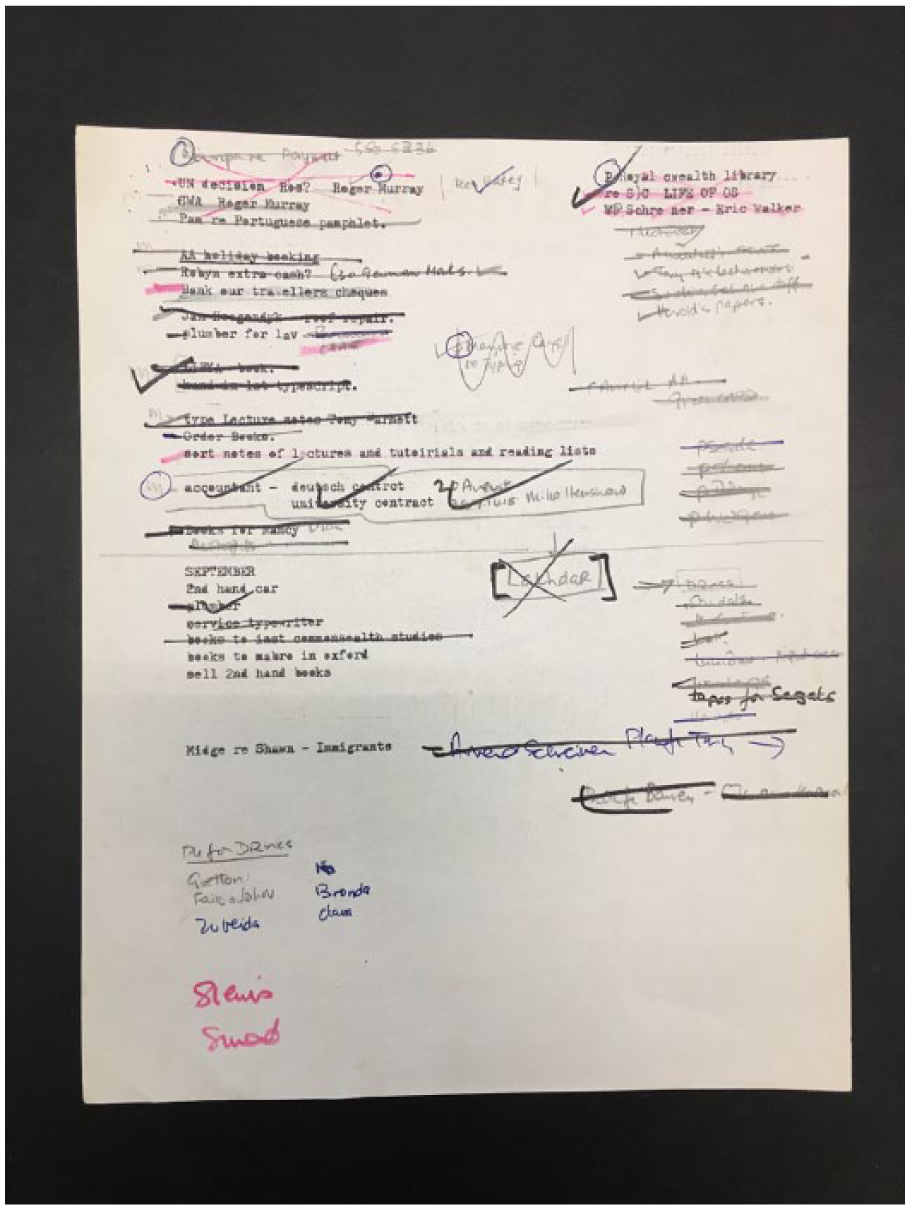
Senate House Library (SHL), Ruth First Papers, 117/12/18: Daily Programme [c.1970–1975] To-do list.
And in handwriting, there is a shopping list as well: dress, sandals, hat, Lancôme night cream, tapes for the Segals, and, finally, hairdo; along with a separate guest list, for ‘drinks’. There were, in other words, parties to be hosted and Party work to be done.
In the first week of September 1966, a year and a half after her arrival in London, for another example, Ruth planned to meet the Africanist Ulli Beier, the South African poet Dennis Brutus, and to ‘fetch tape’. On Thursday, she had a hair appointment of her own and an optician appointment for Gillian. And on Friday, there was an AA (Anti-Apartheid) party at 8.30pm. She was no less involved in late June 1972, when she had a Monday 8.00am ANC meeting with Oliver Tambo, for example, another on ‘peasants’ on Wednesday afternoon (following a Tuesday ‘hairdo’), a discussion of Ghana on Thursday evening, meetings with David Horowitz and Ralph Miliband on Friday; on Saturday, there was yet another hair appointment and, once more, an anti-apartheid function. It was only when she settled in Mozambique, photos and friends say, that First ceased straightening her curly hair and let it grow loose and frizzy.
No dawdler, Ruth First was, however, very much a doodler, and the scraps of paper that she filled during the myriad meetings that she attended suggest as well some of the contradictions and complications that riddled her everyday existence and the many and varied obligations that she lived with and up to. For example, on a much marked sheet of Penguin Books letterhead, she scribbled such comments as ‘I don’t like caucus work’, or ‘perspectives of struggle – lopsided’, or again, ‘members’ rights & roles + nature & role the ANC’, and still again, ‘AA large amorphous body’ and ‘ANC cannot control Anti-Apartheid’.
Such notes – from checklists, to weekly agenda entries, and doodles – describe in fractured frames the commitments and critical perspectives of an engaged participant in political processes and her personal involvements and private concerns (see Figure 2). Ruth First’s story, its history, is written in her own hand as well as through her printed words and public addresses, suggesting that her intellectual history is a more than complex amalgam of biography and bibliography.

SHL, Ruth First Papers, 117/12/18: Daily Programme [c.1970–1975] Reminder Pad.
In London
In 1963, after 117 days in solitary confinement, Ruth First was obliged to contemplate exile. Finally released from detention on 7 December 1963, following a false hope at the expiration of the original ninety days, Ruth wrote to her husband Joe in London: ‘It is over. At least so they say. They say no re-arrest. No charges. After all that. Love you, you me? R.’ Two weeks later, on 21 December 1963, she wrote him again, concerned about his insistence that she and the children relocate and join him in exile. While in prison, First had missed her university exams, and her degree in library science was in jeopardy. Her banning orders prevented her from working as a journalist in South Africa. Could she sell the house? Would she be able to secure a passport? ‘You might think that I am being bogged down in a trivial matter like exams. But I can’t suspend myself here in limbo while you work out plans for a new life. I have to face the fact that my earning capacity is NIL at present, in spite of what you say about my so-called talents, and I admit that survival in a place like London terrifies me. You don’t seem to share my apprehensions. But I’ve got them all the same.’ With the new year, and the impending transition into exile, Ruth shared with Joe still another of her anxieties in a letter dated 4 January 1964: ‘can they’, she asked him, ‘straighten hair in London?’ 8
Ruth First’s reputation in South Africa as an investigative journalist, an anti-apartheid campaigner and former political prisoner, preceded her arrival in London in March 1964. It was a reputation that she would maintain and elaborate during her years in exile, contributing to the struggle to be sure, but also perhaps eventually to her death warrant as a ‘legitimate target’ of apartheid’s assassins in 1982. In any case, two decades earlier, and with the future still ahead, she attended her first meeting of London’s burgeoning Anti-Apartheid Movement (AAM), which had begun in 1959 as a boycott campaign and now waged a full-scale international sanctions appeal, as well as activities around the release of political prisoners, public demonstrations and protests, and political lobbying. Its executive committee included MPs and religious and professional people, and its ranks numbered students, housewives and trade unionists, alongside other South African exiles. Ruth First’s journey from South Africa took her within days of her London Heathrow disembarkation to the manifold forums and platforms of the AAM.
When Barbara Castle introduced Ruth First to the meeting on 25 March 1964 of the National Committee of the Anti-Apartheid Movement, the South African guest had been in London only a few months. According to the minutes from 25 March 1964 AAM National Committee under item 3(a), Rivonia Campaign: Mrs. Castle introduced Ruth First, who arrived from South Africa recently, who addressed the Nat. C. on the situation there: She spoke of her solitary confinement for 117 days under the 90-day clause, where one’s only contact with the outside world was the shadow of a foot under the door, and a friend’s shout in the night. One must appreciate that S. Africa is in fact a country itself in solitary confinement, many white South Africans choose to live in this state because they do not realise they are driving themselves into a state of neurosis. Ruth First went on to say that one of the good things about her experiences was that you knew that you had friends in AMM [sic] and possibly thousands of friends throughout the world. The people in S.A. think the AAM is that shout in the night that shadow under the door. Your rallies in Trafalgar Square had their echo in Pretoria, your campaigns on S. African political prisoners are a rope of strength to people in S.A.
The minutes continued the discussion of the Rivonia Campaign and Ruth First’s introduction, concluding with the encomiums: In conclusion she made the point that the Verwoerd Government was leaning more heavily than before on Britain, whose policy is that of a safety net under the Government. There were now a very great number of political trials going on in S.A., since December the Defence & Aid Fund had been unwilling to take on responsibility for costs of further trials. Ending with a resumé of the people on trial in the ‘Rivonia’ case, she said that the outcome of this trial would determine the course of events in S. Africa. The men who stood in the dock today in South Africa were unconcerned with their own lives – we must save them.
9
Item 3(b) of the minutes then went on to list the proposed activities that the AAM had undertaken with regard to the political prisoners – including Nelson Mandela – then standing trial in the Rivonia case: deputations to the Foreign Office, solidarity messages from MPs, announcements of the coming April sanctions conference against apartheid meeting, collecting signatures for the petition, distributing leaflets, dissemination of Oliver Tambo’s UN speech, and demonstrations and protests at the South African Embassy.
Ruth First remained involved with the AAM over the course of her decade and a half sojourn in London. In October 1965, for example, she joined in an open briefing on South West Africa, and contributed regularly to the columns and features of the Anti-Apartheid News on topics that ranged from prisoners to the political economy of southern Africa and its prospects for liberation and independent development. She was also elected – and re-elected – to the AAM’s National Committee, standing on her credentials as a ‘regular speaker for AAM’ (1972), the ‘author of many books and pamphlets on Southern Africa’ (1973), and, in 1974, as a delegate who ‘represents and speaks for AAM nationally and internationally’. 10
Ruth First was all the while speaking and writing nationally and internationally in the struggle against apartheid. In addition to her work on behalf of the AAM, however, she was also carrying on the complicated task of fetching and fending for the South Africa-based liberation organisations, such as the ANC, whose relationship with the AAM was occasionally strained by the different pressures of publics and political exigency. No less importantly, she was carrying on with her own research into coups in Africa, in particular in West Africa, in 1967–1968; in the two years immediately following the coup in Libya in 1969, she visited Qaddafi’s country three times; she commuted as well between London and Durham in order to maintain her teaching responsibilities at the university there; and visited Dar es Salaam on a teaching exchange in 1975. Hers was a peripatetic itinerary, but home away from home remained 11 Lyme Street, in London’s Camden Town, the several-storey flat that the Slovos maintained throughout those years. But there were other addresses as well: her research privileges at the Institute of Commonwealth Studies; and others denied, like that of the Institute of Race Relations, where she had gone to apply for a reader’s card, shortly after her arrival in London.
Looked class, talked red
A. Sivanandan, director of the Institute of Race Relations, remembered the one and only time that he met Ruth First. It was shortly after her arrival in England and she had come to the Institute to apply for a reader’s card there. This occasion was not that long before Sivanandan and several of his associates hoisted the Institute lock, stock and barrel from its premises and wrested it out from its conservative directions and restored it to a commitment to race and class liberation. Sivanandan remembered that First had been ‘black-balled’ and denied those requested reader’s privileges by the then directorship. He also remembered the applicant as a woman who might have ‘looked class’, but who ‘talked red’. Indeed, Ruth First was much recognised and remains just as much remembered for her fondness for Italian shoes and fine leather as well as for her ‘sharp tongue’, 11 or ‘barbed tongue’, as Mandela recalled it in his letter to her. She had, it was said, an impatience that did not ‘suffer fools gladly’.
Ruth First’s apprehensions about her professional abilities and personal resources to cope with the struggle to survive in London at times might have expressed themselves in the perhaps apparently mundane matters of hair care and reader’s cards. But the issue of economic survival, the means of making ends meet, for herself and her three children was paramount, second only to the survival of the struggle itself, the struggle against apartheid and the international struggle for national liberation and decolonisation. Her husband, so crucial to that struggle, was more out of town than at home. Stuart Hall, for example, remembered visiting Harold and AnnMarie Wolpe, South African friends and colleagues in London, and talking ‘long into the night about South African affairs’, when ‘very often, at about quarter to twelve, we would be aware that Joe Slovo had come into the house. He appeared and disappeared without anybody quite knowing how he had come.’
12
And when he was at home, Ruth and Joe would quarrel as often as not: China or the Soviet Union, or Eritrea versus Ethiopia? Robyn, Ruth and Joe’s youngest daughter, remembered that, for her, the important part of the politics is that I always felt that it was a very clear choice – that my mother and father were totally absorbed – particularly my mother . . . And I always interpreted that as being my fault, because I wasn’t interesting enough, or I wasn’t important enough.
13
Gillian, her older sister, recalled: There is a whole thing in our family about Joe being the warm one. But he wasn’t that present. Ruth was present. My comparative memory, also in the middle of the night, is of Ruth typing away, you know tippy-tappying in the middle of the night. Yes, she was definitely present.
14
Shawn, the oldest of the three Slovo daughters, carries with her still other memories: The thing is that yes, you couldn’t have seen the way things were going to go. But I also think that there could have been a different way to handle the whole experience as well; in my family anyway. We were never told the truth because they wanted to protect us.
15
The means to the end of economic survival, of making ends meet in London, became once again for Ruth First those activities that had been formerly denied her in South Africa – her research and her writing – and these means were inextricably connected to that larger end of liberation. Or vice versa. The end directed the means, but the need to earn the means in turn determined the imperatives of that research. These conflicted agendas underwrite Ruth First’s intellectual biography and her critical bibliography, as she nickeled and dimed (or penced and shillinged) her way towards her own economic survival and the political survival of the struggle for which she lived, and would die.
Unfinished projects
Robyn used to say that if she heard me mention mine or migrant labour once again, she’d scream. It is unfortunately the pivot of my working/waking life. Letter from Ruth First to daughter Gillian Slovo
16
corporate behaviour – reach out in a literary way to capture the personality of the Corporation. Firms have a personality. are unique in some ways. Ruth First, notes for Profile of a Corporation
Ruth First began her career as an investigative journalist with an inquiry into the 1946 Mine Strike by African mine-workers on the Witwatersrand. The strike in support of a demand for higher wages lasted a full week despite massive police and army repression. When it was over, according to official counts, 1,248 workers had been wounded and nine men had been killed. When First was assassinated thirty-six years later, on 17 August 1982 in Mozambique, she was director of the Research Center of Eduardo Mondlane University in Maputo, conducting research into the role of Mozambican migrant labour in the South African mines. Between the stories of the 1946 strike and the posthumous publication of Black Gold: the Mozambican miner, proletarian and peasant in 1983, she had published seven books, lectured internationally on questions relating to the African struggle for independence from Namibia to Libya, spent 117 days in prison in Johannesburg and nearly two decades in exile, first in London and subsequently in Mozambique, where she would be killed just across the border from her native South Africa. But, as she wrote to her daughter Gillian, mines and migrant labour remained throughout those years the ‘pivot of [her] working/waking life’. First’s biography and bibliography alike translate a history of the mines in South Africa in particular, but throughout southern Africa more generally, indeed across much of sub-Saharan Africa, if not transcontinentally, from the Cape to Cairo.
Among Ruth First’s papers from her years in London in the mid-1970s are notes relating to three unfinished projects. One of these projects was a tentatively entitled book Messiah, Mob and Guerrilla that proposed to examine the ‘sources of popular disturbance in Africa’. A second draft outlined a ‘scheme for a book on Power Over Africa’, which was intended to complement her 1970 study, Barrel of a Gun (or, its US title, Power in Africa) which, according to First’s notes, ‘focuses on political power and its frailties in Africa as revealed by the coup d’etat. A companion volume would take up the related and even more seminal theme of the relations of power inside Africa and power exercised from outside.’ Finally, there are the notes towards a book entitled Profile of a Corporation, in which she proposed to ‘reach out in a literary way to capture the personality of the Corporation’, for, as she went on to observe, ‘Firms have a personality . . . are unique in some ways.’ A corporate ‘profile’ would, according to First, have to consider the ‘kind of people who work in the Corporation’, as well as those ‘who invest in it’. There would be questions of the ‘[d]ifferences between investment in mining and in industry’, since ‘[r]isk capital is highly profitable’, making ‘[b]ig investment in mining much more profitable’. It was, she noted, a ‘vicious circle’: ‘more politics goes into mining’, that is, and ‘mining also lives on its fat’. The corporations that First identified for ‘profiling’ reached from the Anglo American Corporation and the Suez Canal Company. 17
While Ruth First was particularly interested in the ‘strange convulsions of pressure during 7 years 1958–1965’, her corporate oversight reached back to the late nineteenth century and into the very beginnings of South Africa’s mining industry, with a query into the ‘Milner kindergarten-type recruit’, or the ‘young officers of some background, manner and objective’. It looked ahead as well to the post-second world war ultra-conservative, rightwing and anti-immigration Monday Club and the ‘real generation split’ in ‘Brit politics, finance and industry’. In selecting Anglo American Corporation and the Suez Canal Company, moreover, Ruth First gave her project in profiling a corporation not only a historical narrative that reached from the apogees of imperialism through the era of decolonisation, and on to an anticipation of neoliberal globalisation, but a geographical – intercontinental – articulation as well, ‘from the Cape to Cairo’, as Cecil Rhodes had once designed the trajectory of his own British imperial ambitions. From the Cape to Cairo, then, and from imperialism to decolonisation and, now, after the turn of another century, globalisation, Ruth First’s unfinished Profile of a Corporation promises geopolitical revision and, perhaps, historical redress.
Life after death
When asked by a reporter about the amnesty provisions to South Africa’s post-apartheid Truth and Reconciliation Commission that he had helped to negotiate in the transition years of 1990–1994, Joe Slovo replied, ‘Now I know that my wife’s killers will go free’. 18
Did those individuals who applied for amnesty for their role in the death of Ruth First know who she was? And if they did know, who did they think she was, what did they think made her a ‘legitimate target’? There were nine applicants in the hearings, which were held in September and again in November of 1998, and concluded in February–March 1999. Two other incidents besides the assassination of Ruth First were in question. Each of them involving cross-border operations and implicating a significant part of the structure and policy of the South African Security Forces: the bombing of the London headquarters of the ANC in 1982, and the murder by letter-bomb in Angola in 1984 of Jeanette Schoon and her 6-year-old daughter Katryn. George Bizos, of the Legal Resources Centre, who had previously represented the families of Steve Biko, Neil Aggett and others at inquests into deaths in detention under the apartheid regime, served as the lead attorney for the ANC, and the Schoon and the Slovo families. Amnesty was granted to all applicants on 15 October 1999 for the London bombing, but the decisions on the killings of Jeanette and Katryn Schoon and of Ruth First were still pending nearly a year after the conclusion of the hearings in early March of 1999. In June 2000, the two assassins were granted amnesty. But the questions raised around the women’s deaths remain urgent still.
In the twenty-nine days of hearings into the amnesty applications made by Ruth First’s assassins, there was much discussion that focused on what was called ‘identification of targets’. What gainsaid such identification? What were the criteria? And what were the consequences? The South African Security Forces had designated a service to be assigned with this task of ‘identifying targets’, but then there existed also what was repeatedly invoked throughout the hearings as a more generalised culture of ‘need to know’ – an alleged limitation on the intelligence and information available at any given time to the contributors to the assassination – and thus, too, on their culpability and capability of identifying higher-ranking officials. The invocation of the reputed ‘need to know’ culture provided the alibis for a repetitive challenge to the amnesty requirement of ‘full disclosure’. Did they know? What did they know? But even if they had known, what difference would what they knew have made?
Full disclosure was, and remains, important to the work of discovering and rendering as part of a public record the ‘truth’ as elemental to the mandate of the Truth and Reconciliation Commission. But the second requirement of ‘political motivation’ plays no less a significant role in the legacy inherited by the TRC and left to its successors in the international fora that have been established to address the past and redress the future. The question of whether Ruth First was a ‘legitimate target’ for assassination by the combined South African Security and Defense Forces matters, not just for bringing to judgement her killers, but counts as well in determining the example that she set by her life, in her life’s work, and through her death.
Bridget O’Laughlin, an anthropologist at the Institute of Social Studies in The Hague, had worked with Ruth First in Mozambique. She was in the office of the Eduardo Mondlane University when the lethal letter-bomb detonated. In February 1999 at the TRC’s amnesty hearings, she described First’s work in Mozambique at the time of her death in response to a question from Mr Levine, who was representing Craig Williamson at the hearings. Levine was concerned to find reason and time in First’s schedule to warrant identifying her as a ‘legitimate target’. After all, what was she doing there? Levine asked: ‘You see it is quite possible is it not that Ruth may have had a private life and private avenues along which she was working, which you were never made privy to?’ And Bridget O’Laughlin responded, with not just a summary biography, but with an analysis of the gendered suppositions lurking in the question: It’s a possibility, but listen, Ruth, in Mozambique we started work at seven thirty, Ruth was religious, she got into that car and at seven thirty she was at the Centre. She left you know, at six or seven. We generally had lunch together and we often went to the cinema or had a meal together or whatever. She didn’t have much time. Occasionally we went to the beach. She wrote the Olive Schreiner Book, she wrote most of Black Gold, she learnt Portuguese and did lectures in Portuguese, prepared teaching texts. You know she was a super-human person, a really special person, but she didn’t have any other time. What you can’t admit is that she considered that work so important. Maybe that’s hard to accept, but she did.
19
‘That she considered that work so important’: who was she? what was the work? what was so important about it? And what, indeed whose, considerations should figure in the adjudications as to when it should all come to an end?
One end came on 17 August 1982. And the TRC’s amnesty hearings continued more than a decade and a half later. The reconstructions of the history were telling. According to Jerry Raven, who manufactured the letter-bomb that killed Ruth First, the end, as he presented it on the twelfth day of the TRC’s September 1998 amnesty hearings was as follows: ‘Well, I believed in the powers that be, that a legitimate target had been identified. This target was a high-ranking official of either ANC/SACP alliance and that whoever should open the packet, would at the worst be seriously injured but most likely, be killed.’
20
Raven went on to distinguish between a ‘potential activist’ and a ‘potential terrorist’: the activist, according to Raven, was a ‘non-combatant who is not personally involved at grassroots level in actively taking part in acts of terrorism’, whereas, Raven went on, the terrorist is ‘also a member of said organisation, who does the acts of terrorism, planting bombs, etc. etc.’
21
Craig Williamson, who had passed the lethal orders to Raven to produce the bomb, responded to questions put to him by advocate Bizos: When it comes to Mrs Ruth First, she was seen also as a obviously not as high a profile or as an important, if I can put it that way, a target as Mr Joe Slovo but as a very high-ranking member of the South African Communist Party/ANC Alliance and one who was engaged in two levels of activity in Mozambique which related to the ANC/Communist Party struggle against South Africa. One is as a high-level functionary of the Communist Party and the other as a member of the ANC structures – so she played a political role as well as a practical role and this as far the security forces and myself individually are concerned made her also an important target of the security forces.
22
Then, when hearings resumed in November 1998, Mac Maharaj was called as a witness on behalf of the victims. Maharaj, who was at the time that he testified Minister of Transport, had previously been a secretary of the ANC underground in Lusaka following his release from prison in 1976, and had known all of the victims of the cross-border operations that were being presented to the TRC Amnesty Committee. When asked about Ruth First, Maharaj replied to the question from Mr Du Plessis, who was representing still another of the applicants, as to Ruth First: I said number one, that Ruth First was not involved with the internal struggle of South Africa, that is from the internal structures, military or political. I said that she was a member of the ANC like every other member. I said that she was of high standing in the international community. I said that she did work with the students who were in exile in Mozambique and I said that she was doing major research work assisting the development process in Mozambique. But I did not say that she was not involved in the anti-apartheid struggle. I did not say that she did nothing for the struggle. A major distinction in my mind because the ANC maintained two separate structures, external and internal.
23
Du Plessis followed up, with regard to the testimony by Ruth First’s daughter, Gillian Slovo: ‘You would agree with Ms Slovo, Ms Gillian Slovo when she testified that her mother’s death was a loss for the ANC?’ And Mac Maharaj replied, concluding the day’s hearing as well as the November session: ‘Yes Sir and a grievous loss to South Africa today.’ 24
As Nelson Mandela had written to Ruth First, while he was still in prison and she was still alive: ‘I’ll always remember you in terms of the exciting times we spent together – the days of our youth. For 13 yrs I’ve carried the picture of that Sunday morning in July when I welcomed you, your hubby and other friends . . . ’. Ruth First may have had a preference for fine leather and Italian shoes, but she was not known to wear gold or diamonds, and she had a ‘sharp’ – ‘barbed’, even – tongue. Hers is the story, an exemplary one, at once biography and bibliography, writ large and small through her personal papers and in her public life, of a woman with personal standards and political ideals, who both ‘looked class’ and ‘talked red’.
Footnotes
Barbara Harlow (1948–2017) was the Louann and Larry Temple Centennial Professor of English Literature at The University of Texas at Austin, a member of the Editorial Working Committee of Race & Class, and the author of many publications, including Resistance Literature (1987), Barred: women, writing and political detention (1992) and After Lives: legacies of revolutionary writing (1996).