



Abstract
The ongoing trial of sixty-eight members of Golden Dawn, a violent neo-Nazi political party in Greece, has been called ‘one of the most important trials in contemporary Greek history’. Based on direct observation and insights from a trip to Athens in September 2019 to observe the trial, which coincided with the sixth anniversary of the murder of the anti-fascist rapper Pavlos Fyssas, this article documents the role that activists, lawyers and the families of victims of racist violence have played in bringing members of Golden Dawn to justice. The author examines the trajectory of authoritarian violence inherent in recent Greece history and the culture of police impunity and collusion in racial violence that continues today.
Keywords
In the years to come, no doubt countless academic papers will be written about the rapid rise between 2008 and 2012 and apparent fall in September 2013 of Golden Dawn (Chrysi Avgi), and various explanations given as to how such a violent semi-military National Socialist party, founded only a few years after the end of the Regime of the Colonels (1967–1974) by those with close ties to the military dictatorship, 1 could become the third largest grouping in the Greek parliament. This article, written in the final stages of the trial of sixty-eight members of Golden Dawn, looks at the phenomenon of this far-right party from the vantage-point of the anti-fascist, anti-racist resistance, both today and historically. It utilises key anti-fascist texts compiled by Dimitris Psarras and Dimitris Christopoulos, 2 and examines the role that activists, lawyers and the victims of racist violence have played in bringing members of Golden Dawn to justice, considering also the ways in which they continue that fight today, following the election of a reconfigured hard-right conservative New Democracy (Nea Dimokratia) government. My observations are based on witnessing anti-racist innovation and the cementing of anti-fascist political identity in practice during a five-day trip to Athens in September 2019 to observe the Golden Dawn trial which coincided with the sixth anniversary of the murder of the anti-fascist rapper Pavlos Fyssas. 3
‘The trial of the century’
The trial of sixty-eight members of Golden Dawn, including all its eighteen MPs, started in April 2015. It has variously been held inside the women’s wing of Korydallos prison and the Athens Court of Appeals – and was still ongoing, four years later, at the time of our visit. Having gone through all the security checks at the Court of Appeals, we enter an exceptionally large court chamber which seemed to me less of a courtroom and more like a lecture auditorium. There is an unusually large space for the public, split down the middle: half for the supporters of Golden Dawn, half for the families of the victims as well as anti-fascists. Every day the court fills up with anti-fascists who, in order to leave a full archive of Golden Dawn’s terror, have diligently monitored the trial proceedings since day one, through organisations such as Golden Dawn Watch and Jail Golden Dawn. This is ‘one of the most important trials in contemporary Greek history’, they explain, and ‘we consider it our obligation to monitor it closely and our duty to overcome fear’.
It is striking that the other side of the ‘public gallery’, the space reserved for Golden Dawn and family members, is virtually empty. And this is apparently the same nearly every day. Except on the days when the top brass testifies, Golden Dawn’s supporters stay away. The fact that even their mothers stay away, something unheard of in Greece’s highly patriarchal society, is remarked upon by the presiding judge Maria Lepeniotou who mocks Giorgios Roupakias, the murderer of Pavlos Fyssas, for the fact that his mother failed to attend court at a critical point in the proceedings against her son.
The court set-up is unfamiliar to me, very different from a UK courtroom or the special Munich anti-terrorist court in Germany where the National Socialist Underground trial was held. 4 There is no dock in which the defendants sit, instead the five judges (which include two substitutes, just in case the presiding judge falls sick or dies during the long drawn-out process) sit on an elevated platform behind a long table, and the defendants sit below, behind desks, like naughty schoolboys (only five of the defendants, including the leader’s wife, an MP and central committee member, are women). The judge is a matriarchal figure, who shouts, nags and ridicules the Golden Dawn defendants – some of whom, unbelievably, don’t turn up to court, sending various ridiculous excuses. I cannot but feel that judge Maria Lepeniotou is infantilising the defendants. Her appearance of strictness is at odds with the fact that she does not subpoena suspects who fail to attend court – another major difference from the more formal German and UK criminal justice systems. The lack of Greek TV interest in the trial is a subject that infuriates Magda Fyssa, the mother of the murdered anti-fascist rapper Pavlos Fyssas. In a long and painful interview with journalist Kostas Arvanitis of Radio 24/7, 5 Magda Fyssa expresses her incredulity that, in the initial stages of proceedings, the court decided against video-taping, or audio-recording ‘the trial of the century’. 6
As Golden Dawn collapses from within, under the weight of this four-year prosecution and its consequences, the leadership is deserting the foot soldiers. Leading Greek anti-fascist researcher Dimitris Psarras explains it simply: ‘the first priority’ for the leadership is ‘to ensure its own immunity’. For Golden Dawn leaders the tactic is to depoliticise the crimes, disassociate themselves from the ideology of the party, accuse former loyal members (now witnesses for the prosecution) of suffering from mental disorders, and attribute any proven violent acts to the actions of a few out-of-control local branches and their supporters. (The official line now is that Golden Dawn did not have members, only supporters.)
Whether this argument is convincing the judges, nobody as yet knows (the verdicts are expected in April 2020). But it is bizarre that all the MPs of a political party can be accused of forming a violent criminal conspiracy, but still be allowed to contest elections – with their founder and leader Nikos Michaloliakos, after his initial arrest, even allowed to broadcast to huge public rallies from his prison cell. 7 The justification for this strange state of affairs lies in the Greek Constitution of 1975, which was drawn up immediately after the collapse of the military dictatorship and establishment of the Third Hellenic Republic, and forbids the banning of political parties. It is ironic that Golden Dawn should benefit from a Constitution designed to protect democracy, especially as Michaloliakos, having met the late dictator Georgios Papadopoulos while in prison in 1976 for an assault on journalists, was handpicked by Papadopoulos to lead a reconfigured far Right. During that period of prison ‘apprenticeship alongside high-ranking members of the military dictatorship’, as Dimitris Psarras explains, Michaloliakos became ‘acquainted with the structures of the “Deep State”, the ties between state institutions (the police, secret service, the military, politics and administration), the church and right-wing extremists’. Various commentators, such as sociologist Nicos Mouzelis, 8 describe this as a ‘para-state’, a structure of dominance that operates outside the scope of democratic institutions, acting, often unlawfully, against society or parts of it. In the Greek context, the para-state is understood as inhabited by informal groups of far-right supporters who seek to expand their influence and position and organise clandestinely within the military, judiciary, the police and the Church.
Athens’ alternative culture and the legacy of the Left
During my stay, the organiser of our delegation, Ioanna Meitani, was constantly rushing us across Athens, from meeting to meeting, and also to and from the courtroom. As much of this movement was conducted on foot, it served also as a lightning tour of Athens’ alternative left-wing and anarchist neighbourhood culture, particularly in the district of Exarchia, where the Conservative government, elected by a landslide in July 2019, quickly ordered a police crackdown on anarchist and migrant squats. Another of our guides was Olga Lafazani, an academic at Harokopio University, who is also a housing activist. 9
In a city where rented housing and the protection of renters is in short supply, Exarchia’s alternative political and artistic culture is under threat. Since 2018, as real estate is snapped up by foreign and local investors, there has been a sharp rise in short-term rentals through Airbnb, which are now transforming this beautiful district of old buildings, courtyards and restaurants as the government seeks to turn Exarchia into a ‘showcase quarter of Athens’. 10 Rents are soaring and local inhabitants are being driven out. One of the New Democracy government’s promises in the last election was to ‘take back control’ of Exarchia – which it describes as a ‘no go area’ for police. A police trades union representative, commenting on recent evictions, reportedly described migrants as ‘dust’, adding, ‘We are the new silent vacuum cleaner that will suck up all the garbage.’ 11 Since then, masked riot police armed with tear-gas carried out the first evictions and armed police attempt to maintain their presence in Exarchia. Everywhere we go, we see them standing nervously outside buildings recently emptied. One wonders, given austerity, whether a twenty-four hour presence maintained by the police to stop the squatters returning to buildings, the doorways of which have been bricked over, is a good use of resources! Also conspicuous on our travels is the constant armed police presence outside the offices of all political parties, giving a feeling that despite the dictatorship formally ending nearly fifty years ago, democracy is fragile and political violence never far away. But then, this is not surprising, given the deep imprint that two spells of dictatorship since the interwar years, as well as the German occupation, has left on Greek political culture, and the constraints this has placed on any democratisation process.
But to understand the mark of the Left on Athenian culture, you need to go back even further, to the precursor to the military dictatorship, the authoritarian 4th of August Regime under General Ioannas Metaxas (1936−1941). When this collapsed, the Axis powers (Germany, Italy and Bulgaria) took over and the Nazi occupation of Greece, and the near eradication of the Jewish population, began. With the King and the bulk of the army fled, and a government in exile established in Egypt, the national resistance to the occupation was led by the Left, primarily the Communist party. Nicos Mouzelis has drawn attention to the collaboration of some Royalist army officers who remained in Greece with the German suppression of left-wing resisters, forming security battalions to deal with the ‘enemy inside the walls’. 12 In 1943, when the Greek government in exile returned, these paramilitary formations were incorporated into the state’s new security forces. And in the new cold war world, the ‘White Terror’ unleashed against the Communist forces was backed by the US and the UK. The Civil War (1944−1945 and 1946−1949) left the Communists decimated. In 1949, with the imprisonment, exile (to deserted or uninhabited islands), or extermination of thousands of left-wing members of the resistance and their leaders, the military established firm control over the whole of Greek territory and consolidated a system of ‘repressive parliamentarianism’ or ‘guided democracy’ – an apolitical system of repressive controls engineered to prevent the masses from taking an autonomous part in the political process.
Greece’s current ruling party, New Democracy, now aggressively targeting the squats in Exarchia and bussing migrants out of the capital to far-off destinations, has its roots, according to journalist Achilles M. Peklaris, in the National Radical Union party (ERE). Peklaris writes that after the Rule of the Colonels ended in 1974 and with political parties no longer outlawed, ‘the National Radical Union morphed into New Democracy, under the same leadership, and playing the exact same role as before – but this time for the “orphans” of the military junta: It provided them with a safe and comfortable shelter.’ 13
I got a momentary glimpse of the authoritarian violence inherent in recent Greek history on another of our many hurried walks across Athens. Alone this time with Ioanna, we were on the way to a public meeting at the Feminist Autonomous Centre when she took me past the National Technical University of Athens, which lies on the border of Exarchia, just before it morphs into the busy district of Omonia. We did not have time to enter but, behind the university gates, my eye was caught by a vast sculpture of the soulful leaning head of a young man. We stopped and peered at it through the gates. It was, Ioanna explained, a commemorative monument to the twenty-four students mown down by the military during the November 1973 Athens Polytechnic uprising for ‘Bread-Education-Freedom’ (see Figure 1). The sculpture by anti-fascist artist Memos Makris 14 stands as a powerful reminder of the hatred of free-thinking students shared by far-right regimes and military dictatorships across the world, as well as their security battalions, like Golden Dawn, which have and still do target left-wing and anarchist students. In 2004, as support for Golden Dawn increased, the police were accused of supporting Golden Dawn members, who disguised themselves as ‘indignant citizens’, 15 when they attacked students in Athens commemorating the Polytechnic uprising. Police continue to attack students commemorating the uprising to this day. 16
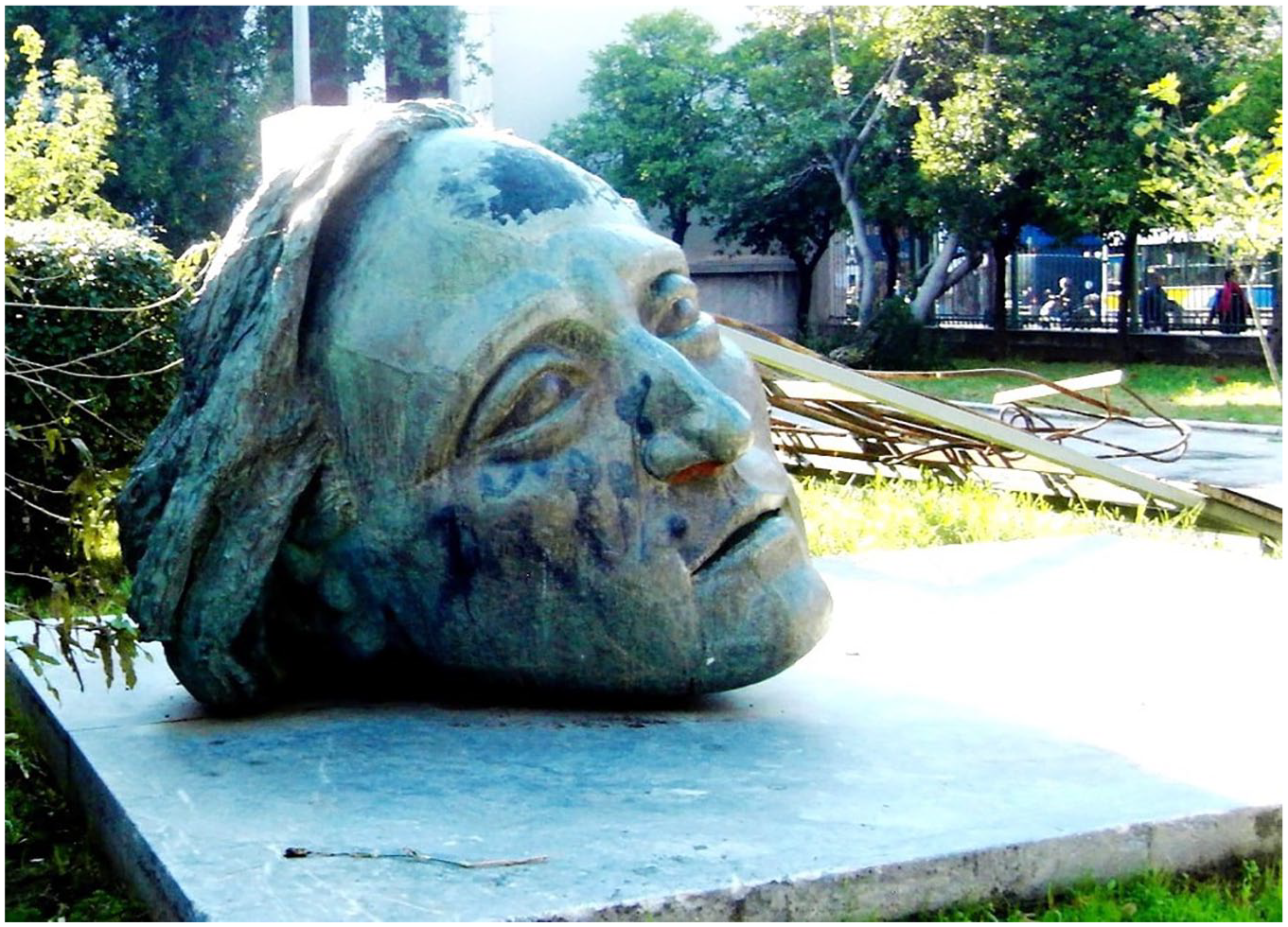
Sculpture by Memos Makris of the head of a youngster that is located at the entrance of the NTUA commemorating the 1973 Athens Polytechnic Uprising. (Photo © Zimina / WikiCommons.)
Who is absent from the courtroom?
Golden Dawn is a reflection of a permissive political culture in Greece which is open to fascism – as long as movements express a form of Greek nationalism that does not overstep the mark and threaten state authority. Golden Dawn emerged from those who supported the Colonels. Its registration as a political party was not a sign that Golden Dawn had broken with the past. On the contrary, as Dimitris Psarras explains, the aspect of the Greek Constitution which protected political parties from criminal prosecution was ‘precisely the reasoning behind Michaloliakos’ decision in 1994 to have Golden Dawn run for election every so often’.
Now, it is not so much that the electorate is turning away from Golden Dawn because the prosecution has exposed its violence. The visible presence on the streets of its security battalions in the 2000s had already revealed that. It is rather that Golden Dawn, which used to look like winners, now look like losers. Just a step into the courtroom shows this, as defendants and witnesses stumble and stall as they try to give evidence. And outside the courtroom, it is blocked too. In the 2019 general election, Golden Dawn failed to meet the 5 per cent threshold to secure any parliamentary representation, with many of their supporters now casting their vote for the traditional party of the conservative Right, New Democracy. As state funding is suspended, 17 one by one, Golden Dawn offices around the country are being shut down, with its central Athens HQ on Mesogion Avenue closing – its logo removed from the building (witnessed by two journalists in our party, who rushed off to photograph such a significant moment).
When one enters the courtroom, the most notable observation is who is absent. Where are the police officers who aided and abetted Golden Dawn, the military officers who provided unofficial training at abandoned military camps and ammunition depots? Where are the media outlets, such as Greece’s leading Sunday newspaper, Proto Thema, which acted as its cheerleaders? Where are the Greek Orthodox Bishops, whose hate speech inspired nationalist ferment, as well as the religious zealots, waving their crucifixes, who demonstrated in October 2012 alongside Golden Dawn and rioted outside a production at the Chytirio Theatre of Terence McNally’s play ‘Corpus Christi’ threatening to kill the actors before finally beating them up and causing substantial damage to the theatre? 18
Psarras is in court at the time of our visit – a modest, shy figure and one of the very few Greek journalists nearly always present. 19 Author of several books on Golden Dawn, and member of the journalist researchers’ collective ‘ios’ (virus), Psarras’ work is vital to the archive that the anti-fascist movement is patiently building. In his various publications he has charted the process by which a ‘murderous organisation’ came from the margins into the very ‘centre of political life’, explaining also how, for Golden Dawn, ‘violence is not only means: it is also the organisation’s end goal’. 20
Unparalleled in post-war Europe, a violent neo-Nazi party used the electoral process to penetrate the organs of the state and subvert democracy from within. And this fascist party was widely tolerated, if not applauded – though no applause is heard in the courtroom on the days of our visits. Despite never having renounced its National Socialist sympathies, Golden Dawn massively expanded its electoral support in the 2000s, emerging in 2012 as the third largest electoral force in the country, with 440,000 votes and eighteen seats in parliament. During all the time that Golden Dawn’s Nazi-saluting MPs were sitting in parliament and local municipality chambers, they were openly expressing contempt for representative democracy. It’s hard to understand the appeal of Golden Dawn’s demonic leader Nikos Michaloliakos. A veteran of far-right movements, Michaloliakos openly boasted that parliament filled him with ‘disgust and revulsion’, while MP Ilias Kasidiaris – who, with his supposed film star looks and attractive girlfriend, was the darling of the Greek press – boasted that Golden Dawn hates ‘MPs and their parliamentary crap’. Greek MPs are allowed to carry guns under licence, which the neo-Nazis relished. 21
Clearly, Golden Dawn did not follow the usual path of Europe’s electoral far Right, even those with fascist roots like the Alleanza Nazionale in Italy, the Freedom Party in Austria or the Front National in France (now National Rally). All these parties had, on paper at least, distanced themselves from violence. They jumped through the necessary hoops to enter parliament, most importantly declaring support for Israel and distancing themselves from street fighting formations (albeit while indulging in an incendiary language that encourages them). But Golden Dawn – a Holocaust-denying party that is virulently antisemitic – did not even go through the pretence of this faux process. On the contrary, it strengthened its own security battalions while providing a boss-friendly violent trades union presence at Athens Perema Shipyards, where wages were declining as the shipyards were being privatised under the austerity regime. 22 Assault battalions were not only there to discipline the Communists, but to ‘cleanse’ the streets of migrants, the ‘subhumans’, the ‘scum’, and the ‘dirty garbage of the earth’, as Ilias Panagiotaros MP, put it. 23 In organised purges, immigrant shops and market traders were attacked and houses and apartments marked as ‘Greek’ or ‘Christian’.
And what did the prosecutors and judges do to curb this? From 1992−2013, there were just four successful prosecutions against Golden Dawn. During this time, the neo-Nazis were engaging in dozens of attacks targeting left-wing opponents, autonomous centres and students, such as Dimitris Kousouris, the central committee member of the National Students’ Union of Greece who was beaten with truncheons and left brain damaged. 24 And there were the daily attacks on migrants, like the one which killed Pakistani national Shehzad Luqman, who was attacked on his bike and stabbed to death on his way to work in the Patralona neighbourhood of Athens in 2013. 25 All this and more were recorded by film-maker Angélique Korounis in her outstanding documentary, ‘Golden Dawn: a personal affair’, based on six years’ grassroots work following the organisation and its supporters. 26 All this time, the judiciary proved totally ineffective – in the words of Christopoulos, reproducing the ‘judgements and views that consolidate as the normative horizon . . .. The common view of what is just’ in a ‘culture that may be convincingly shown to share most features of the ultra-right’. 27
The spirit of resistance
It was the murder, on 17 September 2013, of the well-known anti-fascist rapper Pavlos Fyssas (also known as Killah P), that finally signalled the end of state tolerance towards Golden Dawn. Pavlos was stabbed through the heart, dying at the scene of the attack in the working-class neighbourhood of Keratsini, near to the dockyards of Piraeus. The impact that the grief and anger of Pavlos’ mother, Magda Fyssa, has had on Greek society (see Figure 2) through her unstinting campaign to get justice for her son reminds me of Doreen Lawrence, the mother of Stephen Lawrence, a young black teenager murdered by racists in London in April 1993, whose grim determination led to a government inquiry into the police’s failures in the investigation of her son’s death.
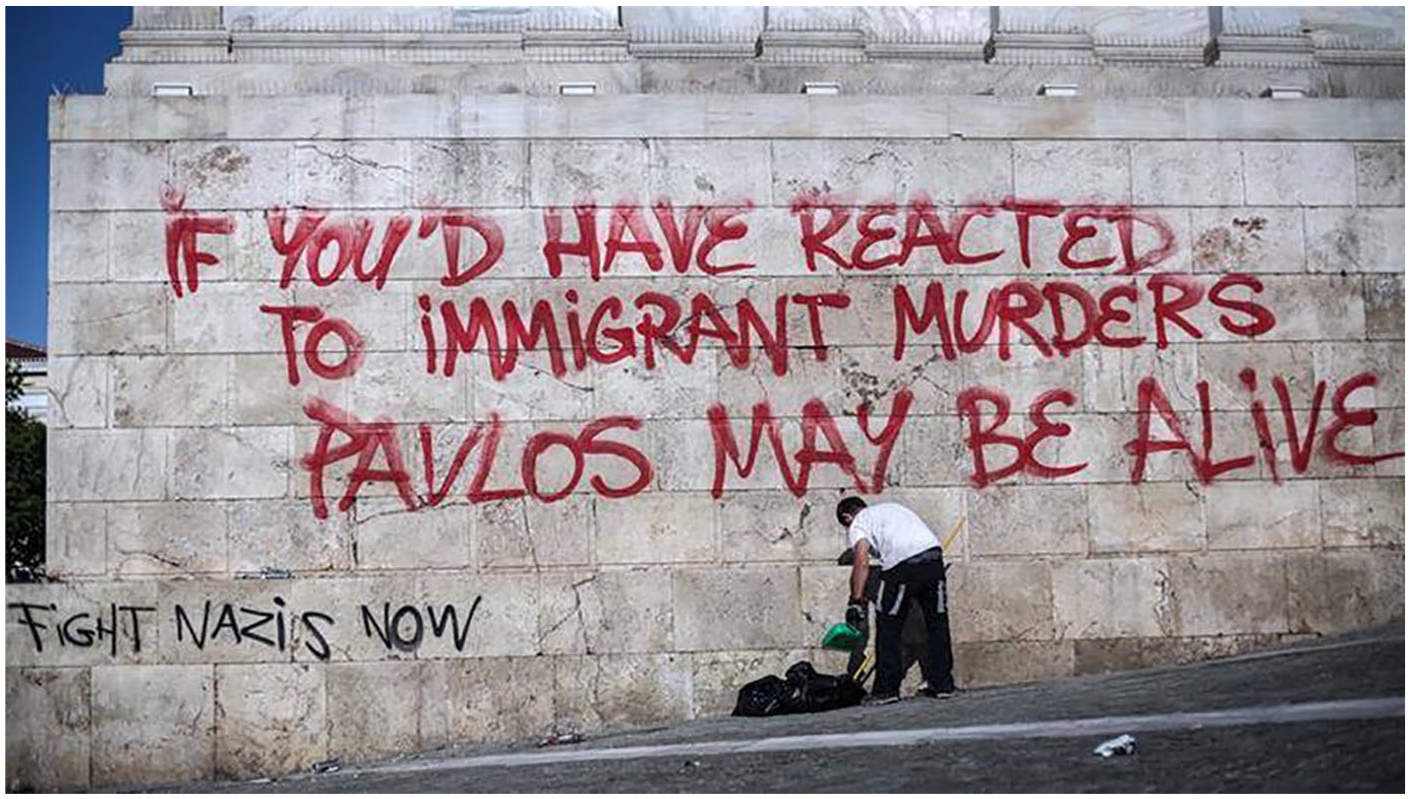
Graffiti on the wall of the Academy of Athens, September 2014. (Photo © Nick Paleologos/SOCC.)
On the final day of our visit, we travel by taxi to the working-class neighbourhood of Keratsini to attend the memorial march on the sixth anniversary of Pavlos’ death, which, as ever, is led by his mother. It’s the same spirit here in Keratsini that I witnessed on the Falls Road, West Belfast, in 2017 at the thirty-fifth annual remembrance procession for the 1981 Republican hunger strikers who died in the H-Blocks after they refused food as part of a campaign to force Margaret Thatcher’s government to give them political status. Pavlos, like Bobby Sands, the first hunger-striker to die, was a poet, and like Sands he was an extraordinarily popular figure locally. The fact that he was loved is evidenced by the huge mural on the side of an abandoned factory (see Figure 3), a memorial at the site of his murder and in the renaming after him of the street where he died.
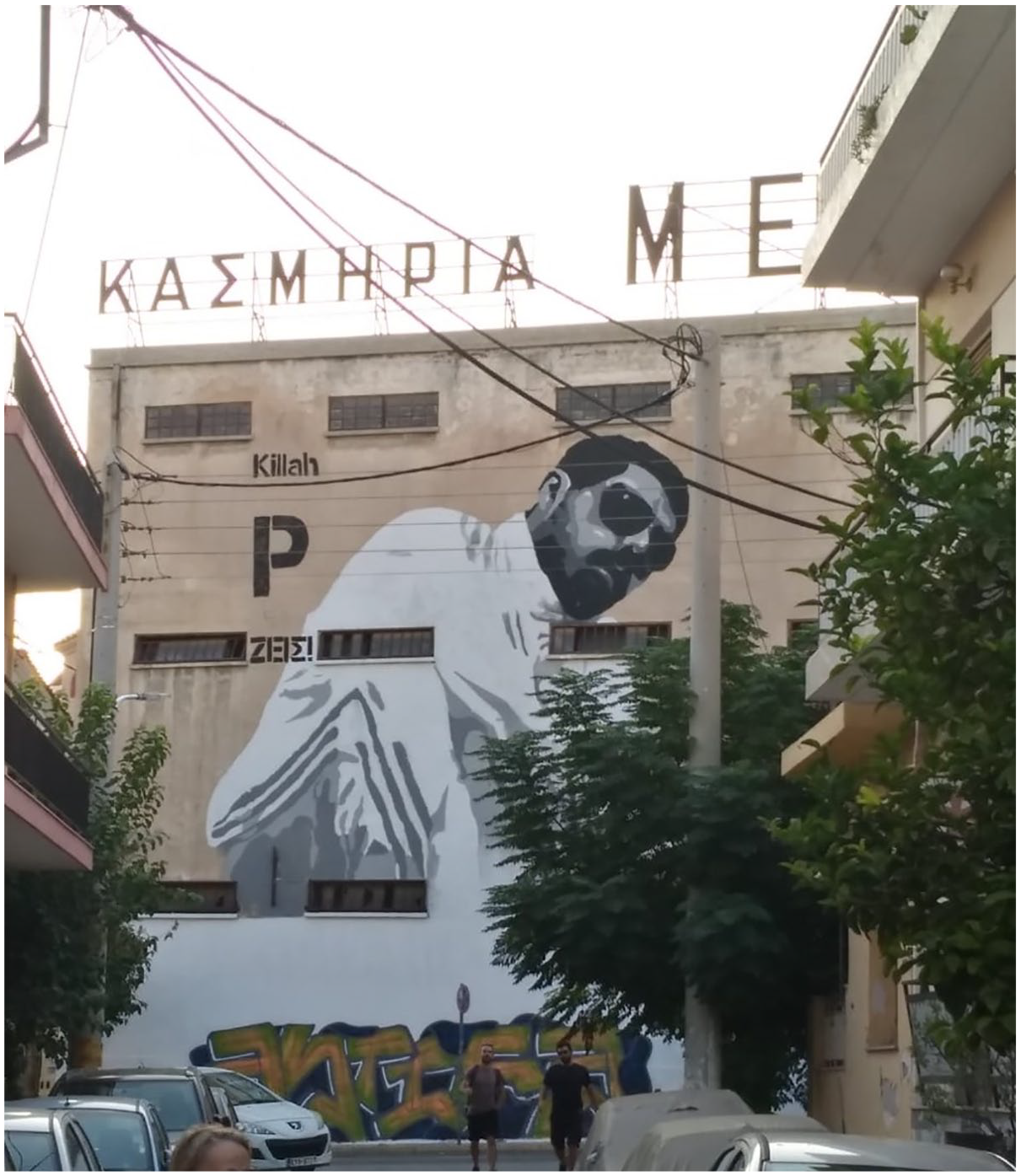
A mural of Pavlos Fyssas on a former factory in Keratsini, the suburb in which he was killed. (Photo © Maria Oshana.)
Back in 2013, there was immediate revulsion at the murder of what was, after all, a white working-class Greek man – the very constituency that Golden Dawn, with its soup kitchens and blood banks for ‘Greeks only’, boasted of representing. And as angry working-class young people clashed with the riot police in Keratsini, and as evidence emerged that a section of the military (Special Forces Reserve Officers Community) were planning a coup, the state miraculously woke up to the danger of Golden Dawn. They arrested and charged sixty-nine people, including all its MPs, central committee members, and leaders of local branches and cells, heads of the ‘hit squads’, and ordinary members, such as Giorgos Roupakias, who stabbed Pavlos as other members of Golden Dawn’s Nikea branch pinned him down. The mass arrests were made possible by the belated acknowledgement that Golden Dawn was not a political party (and therefore protected by the Constitution) but a criminal organisation that could be prosecuted under Article 187 of the Penal Code.
Who guards us from our guardians?
When the trial began on 20 April 2015, it was held in the women’s wing of Korydallos prison, where the defendants were initially held. (Nearly all the defendants were subsequently released on bail.) There are four major cases addressed by the court: membership and direction of a criminal organisation; the June 2012 attack on the home of Egyptian fishermen in Perema; the September 2013 assault with nail-studded wooden beams and shafts, expandable batons and crowbars on twenty members of the Communist party-affiliated All-Workers Militant Front (PAME) trades union; and the September 2013 murder of Pavlos Fyssas. Further cases have been tried separately. Some are still ongoing. These include attacks on Albanian women in Athens, a pogrom and arson attack targeting Roma in Etoliko, western Greece, the murder of Shehzad Luqman in Patralona, Athens, and the attempted murder of a school pupil in Paleo Faliro, Athens. 28
Although the verdict is by no means guaranteed, the civil action brought by the family of Pavlos Fyssas, lawyers for PAME and the independent monitoring work carried out by Golden Dawn Watch and Jail Golden Dawn, mean that this exceptional trial has proved a challenge to the Greek criminal justice system. Lawyer Thanassis Kambayiannis, who in the past had represented the victims of racist violence, took time off to talk to us at the offices of the Rosa Luxemburg Foundation. The Greek legal system does allow a civil action to be brought on behalf of the victims of crime, he explains, but as the Greek state does not provide legal aid, it is not a right available to poor migrants. Kambayiannis, who was determined that an anti-fascist perspective would be represented in the courtroom, reached out to the Egyptian fisherman, who could not afford legal representation, and agreed to represent them free of charge. Every day Golden Dawn Watch, an initiative run by lawyers and volunteers, are present in the courtroom; lawyers tweet on main developments and publish a daily synopsis on the Golden Dawn Watch website. The importance of this cannot be over-stated. As there is no video recording or audio record of the trial, this reportage represents an essential part of the historical record. 29 As Ioanna later observed, ‘Our sole role is to monitor the trial and report factually on what goes on in the courtroom. We do not allow ourselves to comment. Let’s say we are an amplifier of the trial.’ But there is another important initiative called Jail Golden Dawn which is more overtly political. ‘Golden Dawn Watch observes and reports, Jail Golden Dawn comment, analyse, and make demands’, Ioanna concludes. 30
‘In the end courage wins’
During my stay, I was also invited by the Feminist Autonomous Centre to speak at a meeting at a social centre it had recently refurbished, very close to Aghios Panteleimonas square, in the centre of Athens. The Feminist Autonomous Centre is just one of a number of alternative centres, particularly those run by LGBTQI+ groups, springing up in Aghios Panteleimonas as part of a conscious effort to ensure a long-term presence in areas where Golden Dawn were formerly in control. It’s as though the movement had imbibed the message of Magda Fyssas who, in telling Radio 24/7 of the enormous courage her son Pavlos showed on the night of his murder, had commented, ‘In the end, courage wins.’
One of our delegation, writer Daniel Trilling, had first come to Athens when he started researching Lights in the Distance: exile and refuge at the borders of Europe, his epic story of the refugee crisis. He talked to me about the ways in which Aghios Panteleimonas had changed since he first visited Athens in 2012, emphasising the role played by the anarchist movements, which confronted Golden Dawn on the streets and helped immigrant communities defend themselves. ‘Back in 2012’, he explains, Aghios Panteleimonas was the
epicentre of Golden Dawn’s effort to take over Athens neighbourhoods by terrorising immigrants and turning their Greek neighbours against them. When I first visited the square was deserted, and there was Greek nationalist graffiti marking out the territory.
But now, thanks to the activities of anti-fascists and immigrants who have won back the space, the area has been transformed. ‘When I visited again around 2014/2015’, Daniel continues, ‘the nationalist graffiti had all been crossed out and replaced with anti-fascist messages.’ Now, returning again as part of our official delegation, he finds the area ‘unrecognisable – residents from Greek, Middle Eastern and Asian backgrounds sharing space in the square’. This would have been an ‘unremarkable scene of everyday multiculturalism elsewhere’, but for Trilling the sight was bitter-sweet, given all that had passed. 31
For fascists to operate on a neighbourhood level, they start on an individual street, slowly conquering a neighbourhood, transforming it into a ‘foreigners free’ zone and into sites of vigilante violence and summary justice. The transformation of Aghios Panteleimonas, from a bastion of Golden Dawn’s racist power, into a multicultural neighbourhood, has not been achieved overnight, or merely through imposition of an anti-racist model over a xenophobic one. The prevailing mood amongst the Greek establishment is to forget the crimes of Golden Dawn as quickly as possible. That’s why the campaign ‘X them out! The Black Map of Racist Violence’, was launched by the Rosa Luxemburg Foundation and Human Rights360 in 2019 to provide a permanent visual record of the racist violence that had defaced Athens at the time of Golden Dawn. 32 At first the initiative was directly connected to the Golden Dawn trial. ‘The idea was to detail the history of racist violence in public places and also show ordinary people how Golden Dawn was behind most of the attacks’, explains Ioanna. 33 But this would be done visually through the ‘Black Map of Racist Violence’ in Athens that exists both on the internet and at a street level. On the streets, stickers, each with a different QR-code, are placed on lampposts and other objects at the site of different crimes. The idea was that passers-by would scan the QR-code with their mobile phones and be directed towards the project’s website where they would then find the full story about the violence at that site, and in other neighbourhoods (see Figure 4). Twenty-five graphic artists, some celebrities, others less known, provided illustrations for the project which later turned into an exhibition that toured all over Greece. At the end of 2019, the book The Black Map of Racist Violence was published. 34 It includes information on over 100 attacks plus more sketches done by graphic artists who were then coming from abroad to attend the trial and support the project.
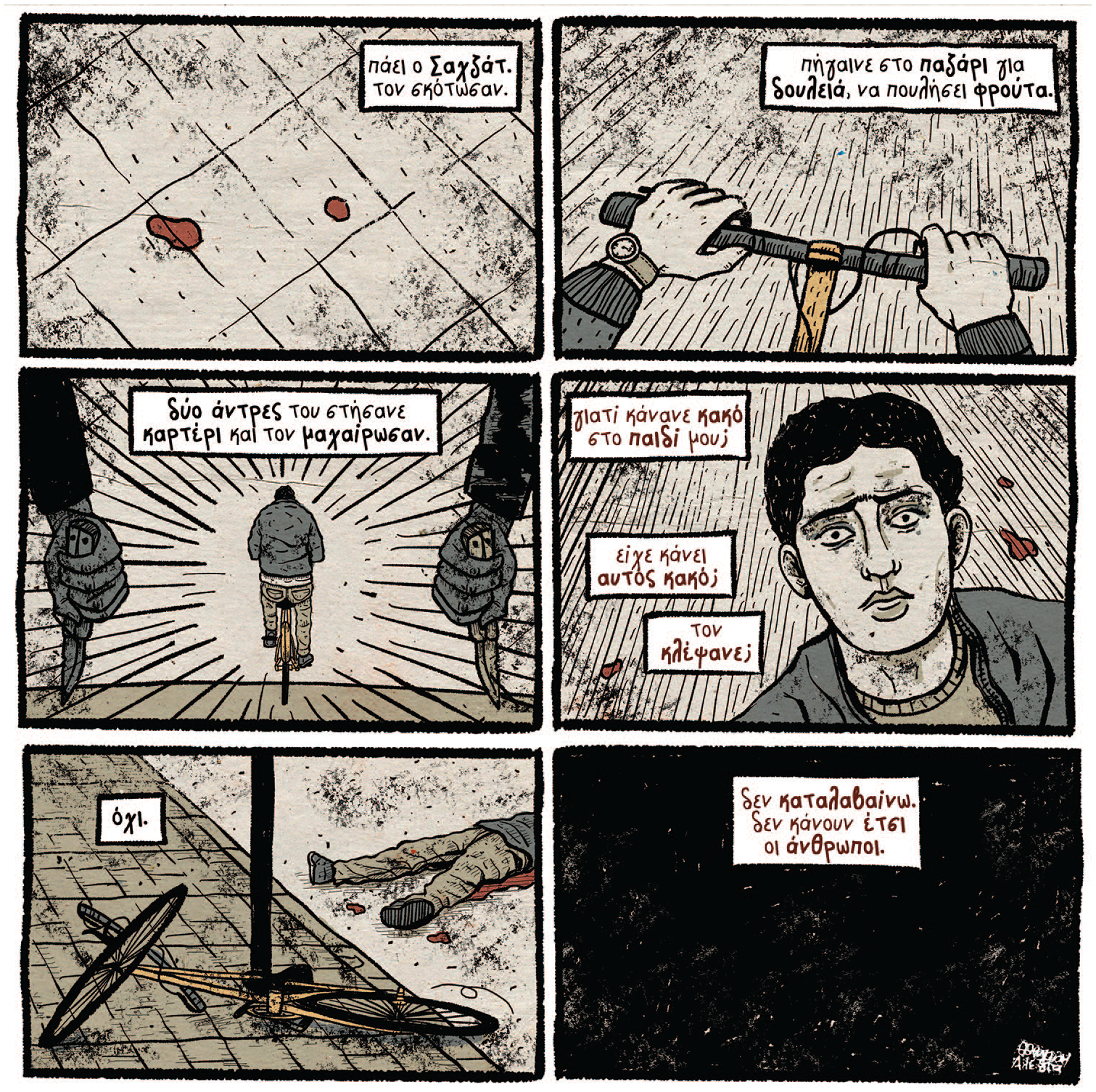
Alexia Othonaiou’s graphic of the murder of Shehzad Luqman in Patralona, January 2013, published in The Black Map of Racist Violence. (Photo © Alexia Othonaiou, reproduced with the permission of Rosa Luxemburg Stiftung.)
Policing and the culture of impunity
Back in the calm atmosphere of the Feminist Autonomous Centre, I was learning about far-right violence directed against LGBTQI+ communities and the collusion of the police. And I was meeting with friends of Zak Kostopoulos, who was beaten to death in broad daylight in Athens in September 2018.
Zak Kostopoulos (also known as Zackie Oh!) was a queer performer and committed anti-fascist. On the day he died, something had distressed him, and he ran in a panic into a jeweller’s shop close to Omonia square for reasons that are not clear. The two shop workers locked him in and beat him up, and, when he tried to escape by crawling through a smashed window, not only did the crowd in this busy pedestrian area join in the attack, but also the nine police officers called to the scene beat him and kicked him while he lay unconscious on the ground. The whole attack, which was captured on video, has been described as a lynching.
Zak was pronounced dead on arrival at hospital and his family and friends, supported by Amnesty International, are now campaigning for two civilians and four police officers to be charged with homicide and, in the police officer’s case, also torture, as opposed to the existing charge of grievous bodily harm. Police made little effort to investigate Zak’s death and did not collect sufficient testimony or footage from the numerous mobile phones and CCTV cameras that captured the incident. The assailants were not immediately arrested, and the crime scene was not sealed, allowing the jewellery shop owner to clean up potentially critical evidence.
The police’s failure to secure the crime scene means that vital forensic evidence has been lost, and repeats their failures in the Pavlos Fyssas case. 35 The fact that the chair of Athens Police Union, Dimosthenis Pakos, has said the police violence used against Zak ‘is standard practice, whether you like it or not’ has raised further questions about the lack of democratic accountability and the dangerous culture of impunity within the police. 36 According to Christopoulos the police is ‘the sector of the State that is by far the most exposed to ultra-right intrusion’ with the Hellenic police ‘contaminated with Nazi enclaves’. But of course, the whole issue of police impunity and police collusion with racist crimes is a vital component of the case against Golden Dawn, although, as mentioned previously, the police are notably absent from the dock.
The creation in 1981 of a new Hellenic police force under the government of PASOK (Panhellic Socialist Movement) was meant to fully purge the police of its undemocratic tendencies and remove the influence of the military. But while the new police service was instructed in its duty to uphold the Constitution, very soon it was going back to old practices, precisely because nothing had really been done to change its work culture. It is clear that Golden Dawn, at its most powerful, was acting as an adjunct to the police, cleansing neighbourhoods of immigrants at the same time as the Hellenic police was involved in mass immigrant swoops based on racial profiling. Between August 2012 and February 2013 under a New Democracy government, the Hellenic police launched Operation Xenios Zeus (named after the mythical Greek god of guests and travellers) which led to almost 85,000 suspected foreigners being forcibly taken to a police station for verification of their immigration status.
Policing in Athens has developed from the model established under the military dictatorship. Then, the police acted as an anti-Communist force and were known to use torture, such as beatings, falanga (beating or whipping the soles of the feet), rape with a truncheon and the use of electric shock. In one scandalous case at the height of Golden Dawn’s power, the police were accused of torturing fifteen anarchists arrested during a protest against Golden Dawn’s racist violence against migrants and refugees. 37 They were arrested, beaten with batons and then taken to the Attica General Police Directorate (GADA) where they say they were spat upon, slapped, beaten, strip-searched in the corridors in full view, burnt with cigarette butts, had flashlights and lasers shone in their eyes. Meanwhile, Golden Dawn members were mingling in the police station corridors with police. 38
The allegations of police collusion with the far Right go beyond Athens. Golden Dawn’s influence was especially pronounced within the border police, the riot police and DELTA squad (Force of Control Fast Confrontation). Ever since the 1990s, and migratory movements from the Balkans region, the Greek Border Guard and the Special Guard (which have less training than the regular police) were associated with violent, paramilitary-style behaviour. But what happened in terms of border policing in Greece, though extreme, is not necessarily an aberration in the European context. Border policing is the least accountable form of policing in Europe today and, over the last decade, arbitrary police behaviour at borders has been combined with the growth of far-right vigilantism. The job of these vigilantes, at best non-interfered with, at worst encouraged by the police, is to enforce belonging, by doing the dirty work of harassing and punishing immigrants. In a pattern that is repeated again and again across Europe, the police turn a blind eye to the violence, or actively collude and participate in it.
‘The police and Golden Dawn are one’, concludes a heart-broken Magda Fyssa in her Radio 24/7 interview. ‘They were there [at the scene of the murder] and they did nothing.’ In the courtroom, where her trauma continued, she had the same feeling. Those police officers who were at the scene of the murder of her son uniformly responded to questions in court with ‘don’t know, can’t remember’ although some fainted under pressure of questioning.
The new ‘enemies inside the walls’
As the Golden Dawn trial comes to an end, are we witnessing the end of Golden Dawn, or are we merely returning to the old culture where far-right nationalism is absorbed by New Democracy and nurtured within the para-state? Will the racist nationalist forces that gave rise to Golden Dawn be purged, or will the same forces be allowed to regroup, choosing to hatch their eggs in old political nests?
In a different context, but one that resonates with the situation in Greece, the Irish Republican activist Bernadette McAliskey, coined the term ‘breakfast-table collusion’ to explain the factors that gave rise to collaboration between the Royal Ulster Constabulary and loyalist paramilitaries in the north of Ireland. ‘Breakfast-table collusion’ describes the normative environment that takes hold when the police, the army, the judiciary are socialised in segregated communities and are therefore drawn from the same social milieu as the paramilitaries. 39
Collusion is an important tool for understanding developments in Greece, a country which since 1936 has suffered occupation by the Nazis, two spells of dictatorship, and the deformations of cold war politics that led to extermination policies against the Left. The southern European anti-Communist dictatorships – like western Europe’s colonial powers – have cast a long shadow over Greek (and Iberian) societies, only today the ideology of dictatorship has replenished itself, directing its venom against immigrants, refugees and LGBTQI+ communities, the new ‘enemies inside the walls’. Dictatorship, like empire, is a structure of dominance that does not just belong to the past, but leaves its mark on the structures, policies, processes and political culture that govern us in the present. Greece’s ‘deep state’ is like a many-headed hydra. It just keeps coming back. Cutting off one head is not effective, it needs to be completely cauterised.
Postscript
On 18 December 2019, the state prosecutor, in her summing up, suggested that all of the Golden Dawn parliamentary group should be found not guilty of membership of a criminal organisation and that only a total of six people on trial should be found guilty of any felonies at all. Her suggestion is not binding on the judges. A final verdict is expected by April 2020.
Footnotes
Acknowledgements
I would not only like to thank the Rosa Luxemburg Foundation (Athens) and Golden Dawn Watch for officially inviting me to observe the Golden Dawn trial but also to specifically thank Ioanna Meitani for coordinating the trip and for her advice and friendship since.
Liz Fekete is the director of the Institute of Race Relations. Her most recent book is Europe’s Fault Lines: racism and the rise of the Right (Verso, 2017).