



Abstract

One member, Ailia Zehra, 22, a journalist from Pakistan, said becoming a member of the board means she can share her experience of censorship: “As a journalist in Pakistan, I often have to practice self-censorship for safety purposes while covering ‘sensitive’ issues. I have also seen critical voices in my country being dubbed ‘anti-state’ and criticism of the state being met with brute force.
“As a member of the youth advisory board, I want to share my experience with journalists and stakeholders in other parts of the world so we can work out a way to collectively fight censorship and strengthen freedom of speech.”
Another member, Oliver Jones, 24, a PhD student and the online editor of Free Speech Debate, a University of Oxford-based online research project studying free speech, said: “I hope to use my time on the advisory board to show that those of us with the privilege of free speech must use it to ensure similar rights for others and hold power to account.”
A member serves a six-month term, a period which has just come to an end for Maria Porta, a 22-year-old graduate journalist from Universitat Autònoma de Barcelona. She said: “Being part of the board has allowed me not only to meet people from other countries who are also interested in freedom of expression issues but also to get to know the realities of their countries.”
Speaking of her time on the board, Saba Meshesha, 21, a German law student at Free University Berlin, added: “It was great to get to know more about the countries where the other board members live and the political situation.”
Index travelled to Amsterdam in June, where deputy editor Jemimah Steinfeld and I joined other organisations – including the Free Word Centre, the Academy of Ideas and Bulgaria’s The Red House Centre for Culture and Debate – that have an interest in free speech, for the fifth Time to Talk – European Network of Houses for Debate meeting. The meetings, held this year in De Balie, a theatre and centre for politics, culture and media, bring together organisations from all over Europe to debate and discuss the issues affecting free speech across the continent.
Irina Nedeva, who runs debates at The Red House in Sofia, spoke of the rise of a tabloid newspaper culture that she argues does not report all the news, telling Index: “Investigative journalism in Bulgaria is in danger.
“They don’t criticise the government or businesses, they criticise only the civil society organisations that are daring to show wrongdoings, for instance of the government.”
Nadine Strossen at the launch of her new book Hate: Why We Should Resist it With Free Speech, Not Censorship, held at the London School of Economics in June
CREDIT: Nicole Ntim-Addae/Index on Censorship

Also in June, Index hosted the book launch of US author and professor Nadine Strossen’s Hate: Why We Should Resist it With Free Speech, Not Censorship, at the London School of Economics.
Joined by Index CEO Jodie Ginsberg and Joanna Williams, associate editor of online magazine Spiked, on a panel chaired by Peter Ramsey, professor of law at LSE, Strossen told the audience: “The only effective and durable way to resist racism and discrimination is through speech and other non-censorial measures.”
Strossen, whose father survived the Holocaust, expressed her commitment to resisting hate and racism, describing it as “a very serious and rising problem, not only in the USA but all over the world”.
Speaking on how to combat hate speech in a significant way, Ginsberg highlighted the importance of social media, as “it helps people find supportive communities”, adding that it was “important for people to realise they’re not alone”.
Meanwhile, our Freedom of Expression awards fellows face continued pressure. The winner in our campaigning category was watchdog the Egyptian Commission for Rights and Freedoms. Its founder and executive director, Mohamed Lotfy, and his wife, activist Amal Fathy, were arrested on 11 May on charges of “inciting against the state, using social media to spread fake news and defaming Egypt”.
The couple and their son were arrested two days after Fathy posted an 11-minute video calling out the government for its failure to end sexual harassment, as well as criticising Egyptian authorities for “the deteriorating socio-economic conditions and public services in the country”.
Despite Lotfy and their son being released three hours later, Fathy, at the time of writing, is still under custody, with her pre-trial detention extended for a fifth time by 15 days on 13 August.
Fathy has a history of chronic depression, bipolar disorder and anxiety, and was unable to walk unassisted at her 4 July trial, having lost sensation in her left leg.
“Index supports Amal’s case and many others as we believe that activists such as Amal are being deprived of fundamental human rights,” said Perla Hinojosa, fellowships and advocacy officer at Index on Censorship.
“We are also aware, and concerned, that the Egyptian government has continued to find ways of limiting freedom of expression by approving a press and media law where users can be targeted, which will make things even more difficult for activists.”
Described as an “assassination of journalism” by Egyptian journalist Yehia Qalash on Facebook, the new media laws in Egypt could see social media users with more than 5,000 followers monitored in an attempt to combat “fake news” online. Index has reported several other incidents of the ongoing crackdown against critical voices within the country, including human rights activist and blogger Wael Abbas, who was arrested at dawn in his home in Cairo on 23 May, according to a post he put on Facebook.
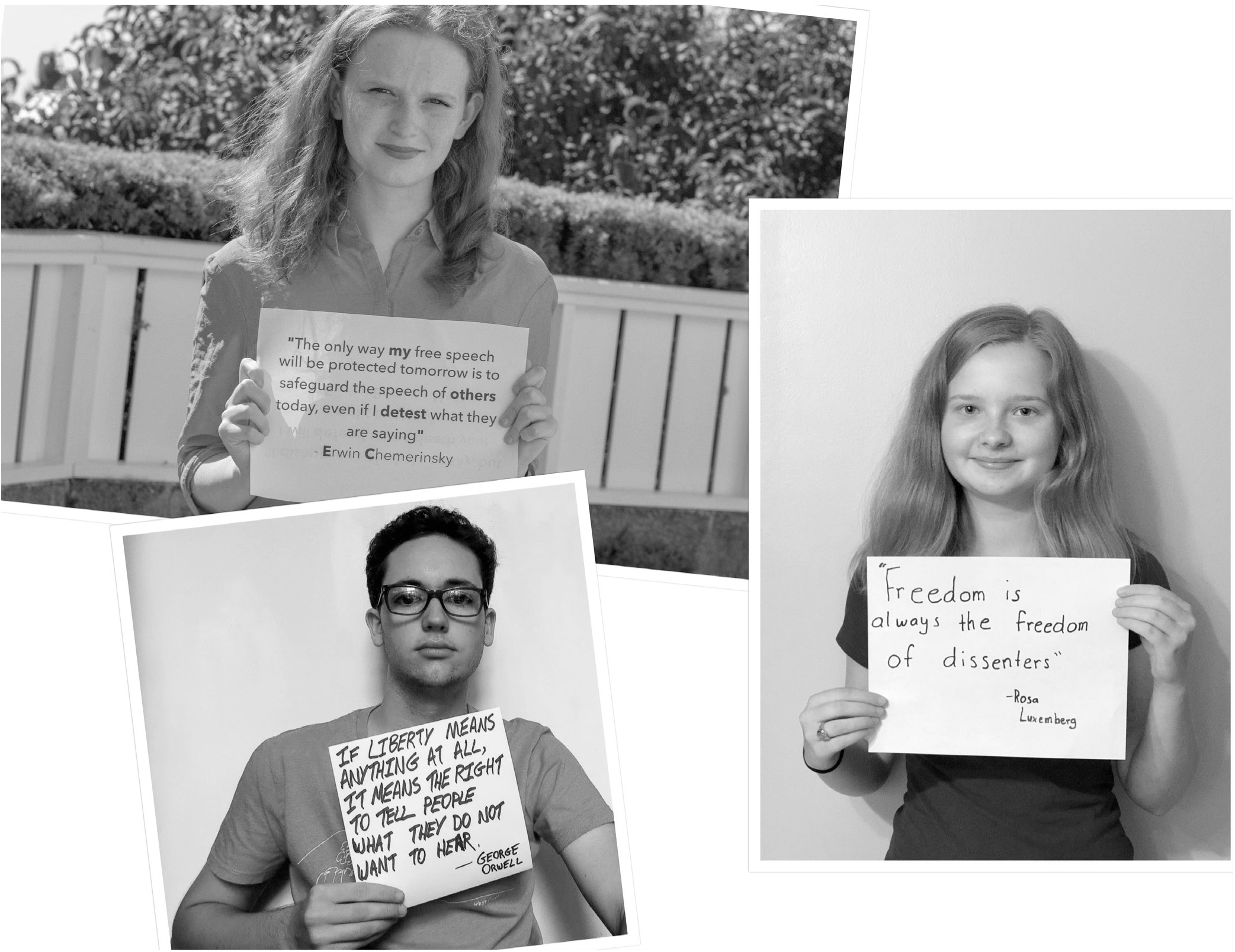
Members of Index’s new youth board displaying their favourite quotes related to free speech, from top: Marie Mannes, Jack O’Dwyer-Henry, Elizabeth Meisenzahl
More recently, Lius Manuel, co-founder of The Museum of Dissidence in Cuba, which won the arts category, was detained on 21 July, following protests against Decree 349, a new law allowing the Cuban government to sanction what art can be displayed or exchanged in private settings. He was released two days later.
Elsewhere, Index has helped journalism winner Wendy Funes formally establish her online newspaper Reporteros de Investigacion allowing her to apply for funding, keeping her investigative reporting on Honduras’ ongoing crisis for free speech alive.
Purely volunteer-based, the site has reported on issues such as sexual assaults against women within the country, highlighting the dangers Funes and many others face.
Index has also helped ECRF during its fellowship year with security training, and has worked with the other 2018 fellows, such as helping Digital Activism winners Habari RDC to prepare for reporting and to stay safe during a potential election in the Democratic Republic of Congo, and creating links between Cuba’s Museum of Dissidence and relevant partnership organisations.
“At a time when the world is beset by conflict, and in many cases repression, the case for diversity of voices globally could not be plainer,” said writer and broadcaster Trevor Phillips, who takes up the position of chair of Index on Censorship’s board of trustees this autumn.
Succeeding Times columnist David Aaronovitch, Phillips is a writer, journalist and television producer based in the USA and UK.
“Trevor believes passionately in argument, debate and free expression. He’s not afraid of expressing a view and he’s not afraid of others expressing theirs. He’s a great fit for Index,” said Aaronovitch.
Phillips begins his new role as part of Index’s plans to increase its work on reporting issues in the USA and censorship online.