




Abstract

With elections approaching, the president of Nicaragua has introduced a set of bills designed to muzzle what independent media remains.
“Ortega is waging a relentless and savage persecution of journalists and independent media in Nicaragua,” said Bianca Jagger, founder and president of the Bianca Jagger Human Rights Foundation, in an interview with Index.
Jagger, one of the most prominent voices against the government, was in Nicaragua in 2018 to support the release of the Amnesty International report on Ortega’s shoot-to-kill policy of repression. The trip was far from peaceful as it happened at the same time as the aforementioned protests were rocking the country. They erupted over since-scrapped planned cuts to welfare benefits and later spread into broader protests against Ortega’s increasingly authoritarian rule. Police and paramilitary groups (turbas sandinistas) crushed the protests, killing hundreds, injuring thousands and forcing thousands to flee the country.
Jagger witnessed first-hand the brutality of the police and the death squads when she participated in one of the largest demonstrations in Nicaragua at the time, on 30 May – Mother’s Day. At least 11 people were killed and 79 were injured and, today, the situation has worsened so much that she would not risk going to the country.
“He would kill me,” she said of Ortega, who she describes as a “murderous, brutal dictator”.
“It is a harrowing situation in Nicaragua. We are witnessing a brutal repression of the media, the opposition, the students, the church. There continue to be executions of poor farmers, and members of the opposition and young people are put in jail.”
Jagger speaks of “heinous” sexual violence used as torture and also says farmers are being executed in remote regions with few people knowing anything about it.
“Ortega not only has his army, he has his police, his riot police, and he has his death squad,” she said.
With few NGOs and media networks now operating, those who are calling the government out on its crimes are few and far between. This makes the attack on Canal 12 all the worse.
The attacks on the media have come from all angles and journalists work in an increasingly hostile environment. Death threats, arbitrary arrests and harassment campaigns are commonplace. This situation became bad during Ortega’s re-election in 2016, which saw him go after critical media, and then worse following the protests of 2018. Journalists could not cover the protests safely as they were seen as participants and were (and still are) denied the normal press safeguards. Most could not afford bulletproof vests and other equipment necessary to protect them. One reporter, Angel Gahona, was shot dead while live-streaming the protests.
The dangers don’t lie just in covering protests. Some journalists have been arrested and jailed on terrorism charges, such as Miguel Mora and Lucia Pineda Ubau, the latter of whom reported on corruption and allegations that Ortega had sexually assaulted his stepdaughter.
But there are other ways the government has been working to silence the media. Shortages of newsprint, for example, have pretty much wiped out printed newspapers, including the daily El Nuevo Diario, which had been in circulation since 1980. Television stations have been blocked; critical radio station Radio Dario was torched; and the government continues to confiscate journalists’ equipment.
Then, in October, a “foreign agents” bill was passed that would allow Ortega’s government to exert control over the work of virtually anyone who received funding or support from abroad, including rights groups and independent media outlets. At a similar time, pro-government lawmakers introduced a “cybercrime” bill, criminalising the spread of “fake news” and other speech on the internet. Ortega has also recently proposed a “hate speech law”, which he threatened to use against government opponents. If passed, it would allow sentences of life in prison.
Many believe these bills are part of a strategy designed to crush opposition ahead of next year’s elections. The Nicaraguan Independent Press Forum said in a statement that the cybercrimes bill was intended to “control and censure information on the internet, the only space for free communication that the dictators cannot dominate”, while Jose Miguel Vivanco, Americas director at Human Rights Watch, said: “These bills appear designed to provide legal cover for the Ortega government to harass and prosecute journalists, rights groups and virtually anyone who criticises his government.”
All of this comes at a critical time in Nicaragua. In addition to the elections next year, the country is facing a worsening economic crisis. Added to this mix is the response to the Covid-19 pandemic. Official reports place the number of cases as being far lower than they are believed to be and, as a result, the government is encouraging people to go to mass gatherings of all kinds, schools to stay open and doctors to wear minimal protective gear.
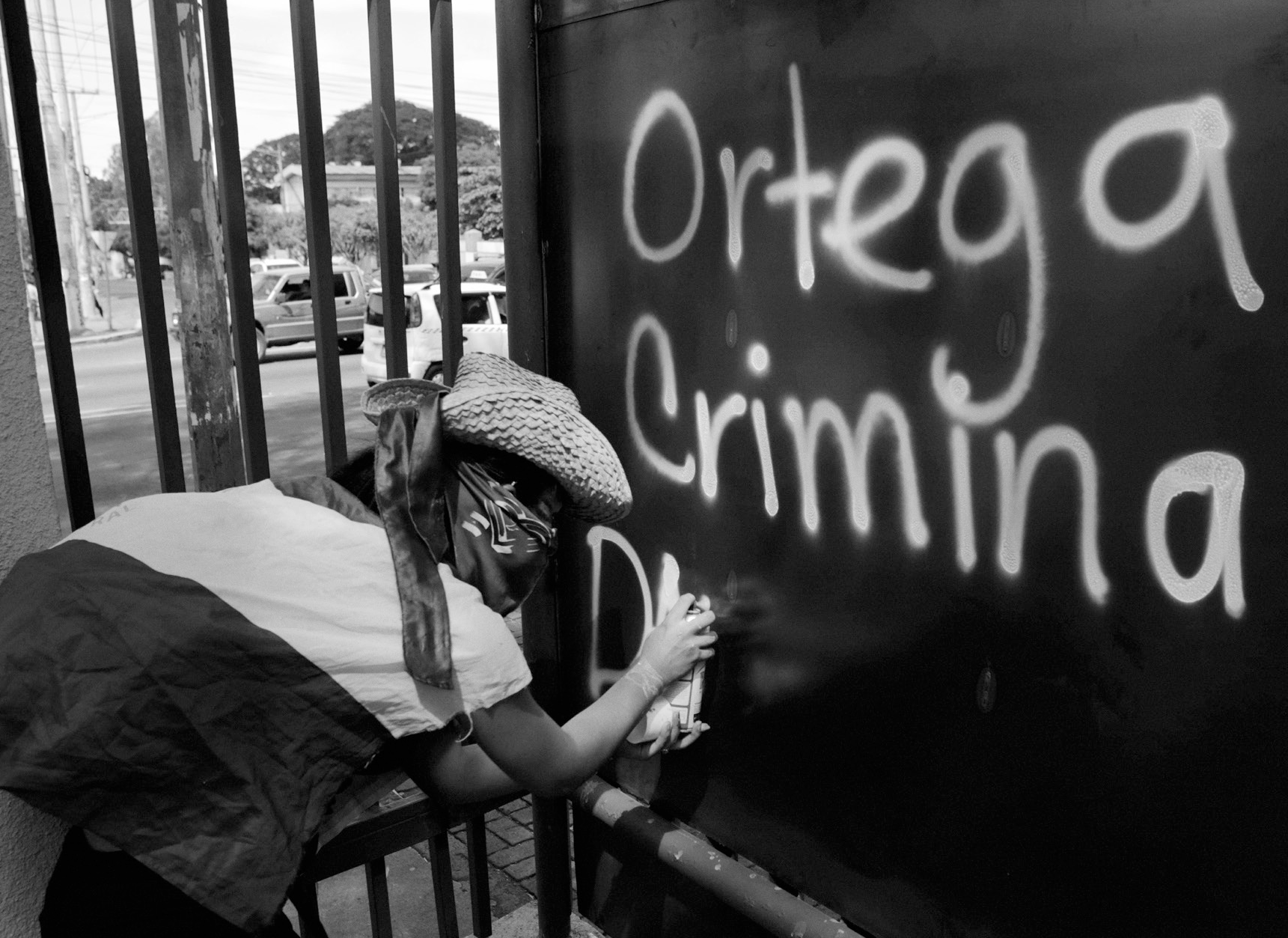
A student graffitis on the campus of the Central American University in Managua, November 2019
CREDIT: INTI OCON/AFP/Getty
Attacked From All Angles
All means to silence the media are used in Nicaragua, as BENJAMIN LYNCH shows in these examples
Prominent newspaper Confidencial was raided in 2018 and equipment including laptops were seized by armed police.
In October 2018, freelance journalist Carl David Goette-Luciak was criticised online for his coverage of anti-government protests before the authorities successfully sought to deport him for it. Earlier that year, Brazilian documentary maker Emilia Mello was arrested whilst trying to film a demonstration. She was subsequently deported.
TV channel 100% Noticias was ordered off the air and two of its journalists, Miguel Mora and Lucia Pineda, were arrested on terrorism charges and for “inciting violence” in April 2018. They were subsequently released.
In 2019, TV journalist Suyen Cortez was shopping with her daughter when she was approached and assaulted by a university professor with strong links to pro-government figures.
In March 2020, at the funeral of priest and writer Ernesto Cardenal, journalists were attacked by supporters of Daniel Ortega. Police were accused of “standing idly by” while reporters were targeted by the group.
But the deaths of journalists are not a new development. In June 1979, US journalist Bill Stewart was travelling in a clearly marked press vehicle and was shot dead by government forces at a roadblock.
“Many doctors are risking their lives,” said Jagger, who added that over 100 doctors and health care workers had died as a result.
For many in Nicaragua, the assaults remind them of the dark days of the 1970s under the Somoza dictatorship.
“The Ortega regime is worse than Somoza in many ways,” Jagger said. “It is worse because Daniel Ortega is killing children, students, women, the media, and he is persecuting the church.”
The attacks on Catholics in particular represent a break from the dictatorship of Somoza. The Catholic Church has historically played a powerful role in the country, but under Ortega bishops have been targeted for their support of protesters, while churches have been desecrated, including the recent burning of a cathedral housing a widely venerated crucifix.
Why has the world not paid more attention to these crimes? The distraction caused by Covid-19 is one reason, but Jagger believes there is more to it.
“The British media have given very little attention to Nicaragua, which has been quite shocking to me,” she said. “I believe that because it is not a former British colony it is simply not high up on the British agenda.” She says the French, American, Latin American and Spanish media have given the country far more attention.
Earlier this year, the USA also imposed sanctions on the Nicaraguan National Police over accusations of human rights abuses.
As for Nicaraguans themselves, while some continue to protest, others are less vocal and active. It’s not just that they fear the current brutality, it is that they fear what could come next.
“As a student I campaigned against Somoza. Daniel Ortega is far worse,” said Jagger. “Ortega was among the leaders of the revolution, but he betrayed the revolution and that’s one of the reasons the people of Nicaragua are not ready anymore to embark upon an armed revolution. They know what happens – you get rid of one dictator to be replaced with another one.”