




Abstract

El Salvador’s president denies that his government is in bed with the country’s biggest gang.
In September, online media outlet El Faro reported that the government of President Nayib Bukele had been negotiating with MS-13 to lower the murder rate and win members’ support in mid-term elections in exchange for prison privileges. El Faro said it had obtained a cache of government documents to prove these claims. Bukele took to Twitter, denying the claims and attacking El Faro.
The incident has highlighted the issues now underlying politics in El Salvador. Dissidents are unable to speak out while there is a gang willing to kill anyone who protests against it and a government willing to cross the boundaries of the law to protect itself from criticism.
While the behaviour of Bukele, who has been in power since 2019, might seem relatively common among the aspiring autocrats of the Americas, there is a deeper problem illustrated by the revelations in El Faro. The government has lost control and has begun to restrict freedom of speech in an attempt to conceal this fact.
Miguel Angel Cruz Blanco is a professor of sociology at the University of El Salvador. He feels that explaining the evolution of MS-13 is essential to understanding the issues that the government is now desperate to conceal.
The genesis of the group, like much of the country, is rooted in the civil war that ran for more than a decade until the 1990s.
“There was a mutation of these gangs, from simply being groups of ‘rebellious’ youths, along with deported migrant children, into groups that were more profoundly criminal,” he told Index. “This then afforded the gangs access into the Salvadorean establishment.” Politically, the first demonstration of gang power came in 2012 with the ceasefire agreement brokered by the government of Salvador Sanchez Ceren. The ceasefire, between MS-13 and bitter rivals Barrio 18, was aimed at reducing the astronomical murder rate in the country, but it overlooked all other crimes, allowing the gang to diversify activities while receiving lenience from the authorities.
The aggressively militarised Mano Dura (Iron Fist) anti-gang policies introduced by the conservative government of Antonio Saca and strengthened increasingly by his successors eventually led to conditions that collapsed the ceasefire. The subsequent response resulted in the Salvadoran murder rate becoming the highest in the world, at 105.4 per 100,000 during 2015.
This demonstration of power proved that MS-13 was above the rule of law. While the Mano Duro policies militarised the police, increasing violence and oppression against innocent Salvadorans, governments were negotiating under the table with the same gangs they targeted in the streets, achieving by crook what they could not by hook.
This forced communities to openly turn to the gangs for assistance, consolidating their popular support and allowing them to fill the vacuum left by the state. Cruz Blanco attributes the overall failure of the government to enforce control as a result of failing to understand this.
“Ever since the third Arena [Nationalist Republican Alliance] government, they have tried to use violence to fight greater violence, but they never bother to address the underlying issue, which is extreme inequality within El Salvador,” he said.
Bukele’s desire to strike back at media critics may be motivated by the trail of prosecutions and convictions of former leaders who have dealt with MS-13 in the past.
The architect of the 2012 truce, David Munguía Payés, was arrested this July for criminal activity relating to the establishment of the ceasefire. Most of the previous organisers were arrested in 2016. Of the seven post-war leaders of El Salvador, Antonio Saca is in prison, Mauricio Funes is in exile, Francisco Flores, architect of Mano Duro, died while on trial and Bukele is mired in corruption allegations.
What has effectively happened in El Salvador is a brutal form of regulatory capture, whereby MS-13 is able to operate with relative impunity across the region. “It is important to note”, explained Cruz Blanco, “that during the early Arena administrations, the gangs had not reached anything near the levels of violence or power that they enjoy now.”
Members of the Mara 18 and MS-13 gangs at a prison in Izalco, El Salvador this September
CREDIT: Yuri Cortez/AFP/Getty Images
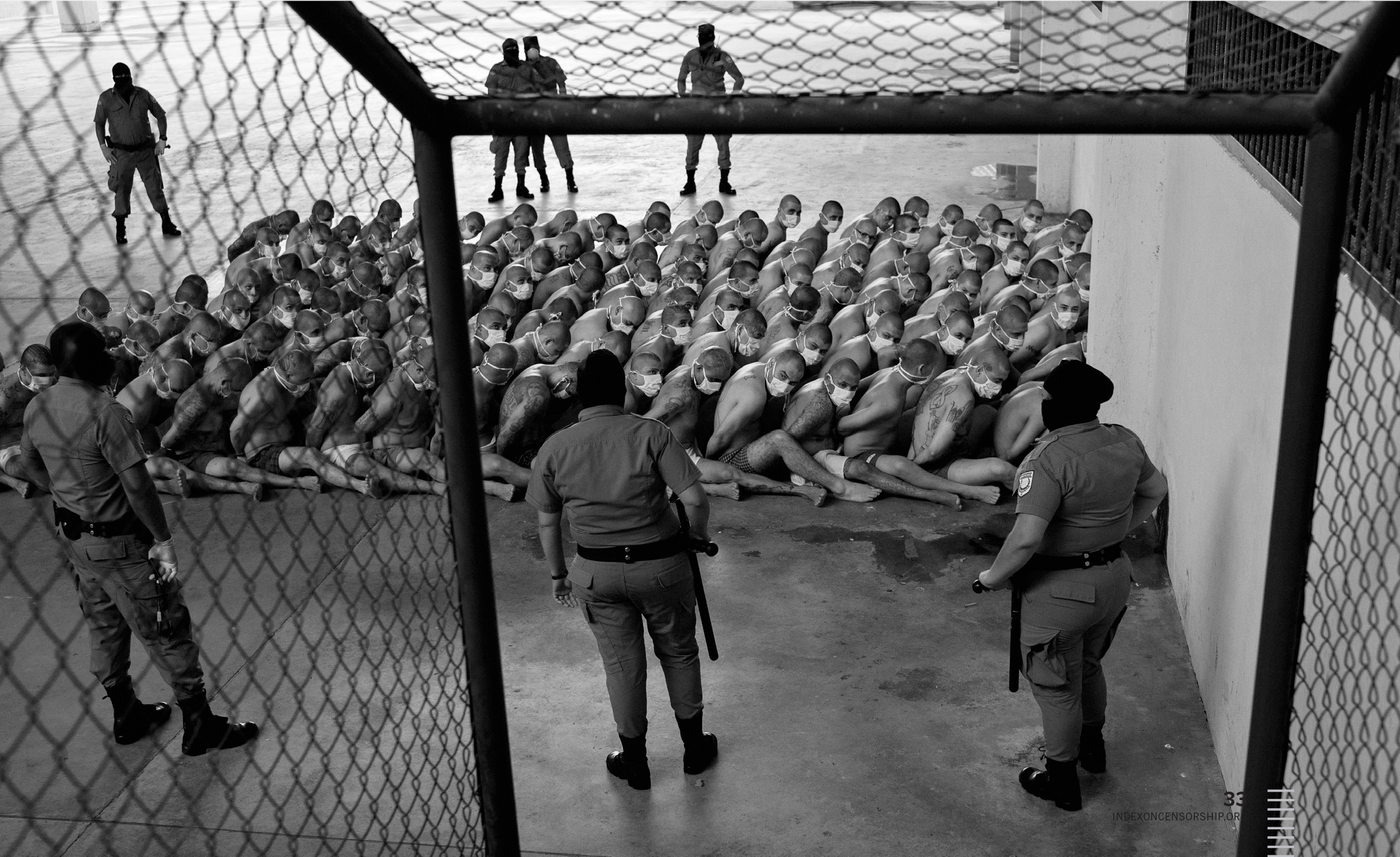
Alma Ortensia Martínez Escobar works for the regional government in the west of El Salvador. “This goes even beyond freedom of expression,” she explained. “There are other fundamental rights that these gangs restrict, including freedom of movement. There are many young people who have been killed at the hands of these gangs.”
This has created a state where there is no longer any clear delineation between right and wrong. While gang members subject victims to excruciating violence, abandonment of the people by successive governments and brutalisation by security forces mean that overall popular power and control are now on the side of MS-13 – rather than the government.
When asked if he believed that MS-13 held tangible political control of El Salvador, Cruz Blanco was direct in his assessment. “Yes. They do.”
This loss of power shapes the desire of politicians in El Salvador (Bukele especially) to control the narrative. The illusion of control – that the government is in charge, and that the gangs understand their place – is an important one. Free reporting threatens this concept and has been increasingly targeted as the social situation has worsened in the country.
It is now very difficult to publicly criticise either side of the conflict. Bukele has demonstrated time and time again that he is willing to go beyond the law to prosecute his detractors, and MS-13 has demonstrated that it is happy to execute anyone it feels is threatening its dominance, as evidenced by the murders of several journalists documenting MS-13 activity over the course of the last decade.
Martínez is blunt when asked how openly people can express their feelings towards gangs. “For the people here, there is a certain fear when these groups are mentioned,” she said. “It is necessary to face the reality that most Salvadorans have a family member involved in these criminal groups, so you cannot freely express your opinions for fear of your own security.”
In the Reporters Without Borders (RSF) Press Freedom Index, El Salvador dropped 15 places during the first year of the Grand Alliance for National Unity government, and while it has recovered slightly (it’s currently at position 74 of 180 countries), the recent clampdowns and intense coronavirus reporting restrictions are likely to cause an even greater decline in 2021.
Press freedom is eroding under the current administration and political freedom of speech in general is increasingly difficult. Emmanuel Colombié, RSF Latin America chief, expressed concern at the attitudes of the Salvadoran government.
“President Bukele’s repeated attacks and threats against journalists critical of his administration signal an extremely worrying shift towards authoritarianism,” he said.
“The systematic denigration and attempts to create the image of a press that is the enemy of the people are not just dangerous and counterproductive, they also reinforce the entire society’s mistrust of journalists, whose reporting is nonetheless vital in a country badly affected by violence and corruption.”
Ultimately, it matters relatively little why politicians have sought to negotiate with MS-13. What matters more is that they have surrendered power to a group that will not willingly return it and, as a result, placed El Salvador into a sociopolitical limbo that has no obvious point of return. With the unrestricted brutality of MS-13 reprisals on one side and the abuse of law on the other, freedom of speech in El Salvador is becoming ever-more limited.
As for the challenges facing the country in 2021, as long as Bukele is in power, there is unlikely to be a significant change in circumstances for anyone attempting to hold two sides of a brutal conflict to account.