




Abstract
Mali has been gripped by huge protests following a recent coup. But people are not protesting for more democratic freedom – far from it, writes
Mylmo’s assessment was at odds with the majority opinion. The hundreds of thousands of Malian citizens who had taken to the streets in the preceding months to protest against the rampant corruption, ineptitude and venality of Keita’s democratically elected government saw the army as the saviour of a nation that was, until 2011, regularly lauded as a model of peaceful, stable and open-minded African democracy.
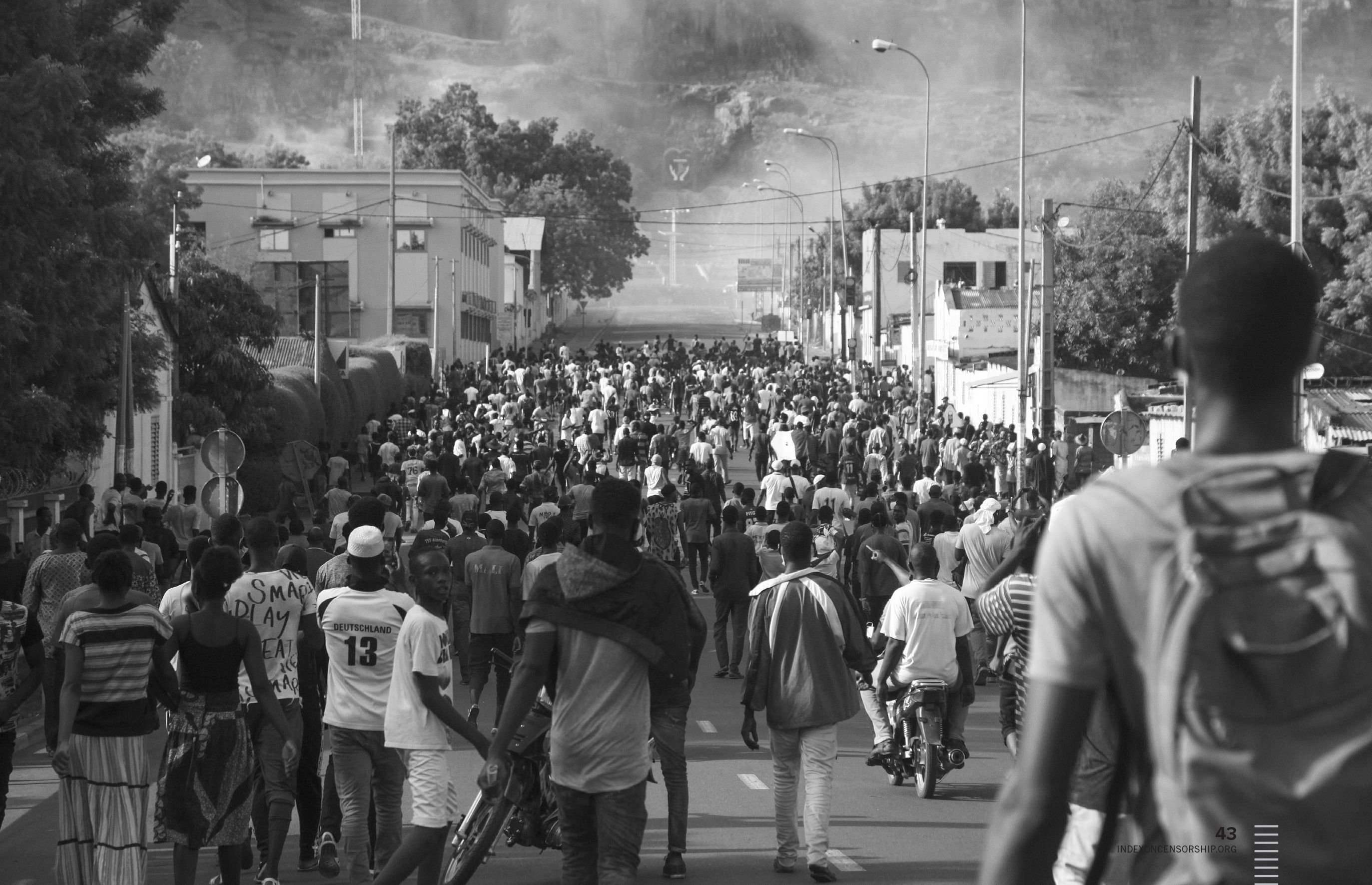
The fact that Mylmo was able to upload his song without fear of a midnight visit by men in jackboots is an indication of the relatively healthy state of freedom of speech in Mali. True, his audacity was rewarded by a deluge of abuse on Facebook, including threats to smash up his home in the capital, Bamako, (never carried out) which forced him to lie low for a while. It’s also true that the government’s violent crackdown of mass protests in Bamako on 10 and 11 July resulted in 11 deaths and more than 140 injuries, as well as the closing down of the internet during the unrest. But overall, Mali’s journalists, bloggers, TV and radio presenters and rappers (who play a crucial role in the country’s media mix) have been allowed to document the growing opposition to Keita (known by the acronym “IBK”) with relative freedom.
Mali’s biggest question mark hangs not so much over freedom of speech but over democracy itself. The events of August elicited wildly divergent reactions at home and abroad. The international community cried foul, lamenting the curtailment of IBK’s five-year democratic mandate. But in Independence Square in Bamako, the crowds were jubilant, honking horns and waving Malian flags.
It is widely believed that Keita’s regime was one of the worst in Mali’s 60-year history as an independent nation. Not only did it fail to solve any of the country’s deep-seated problems, it made them worse. When Keita came to power in 2013, voted in by a population traumatised by the events of 2012 (a civil war and jihadist occupation in the north, a military coup in Bamako), Mali had regained control over most of its territory with massive help from the French army. Now, two- thirds of the country is no longer under government control.
The jihadist threat has spread out from the far north and taken hold of the centre of the country, stoking ethnic tensions between sedentary farmers and nomads. Violence is at an all-time high. The Armed Conflict Location & Event Data Project, an international conflict monitoring project, recorded 300 civilian deaths in the first three months of 2020, up 90% on the previous quarter. The UN peace-keeping mission Minusma documented 119 extra-judicial killings committed by Malian security forces during the same period.
Strikes, underfunding and mismanagement have brought the country’s education, health and judicial systems close to collapse. Conflict and climate change have pulverised the farming sector. People are hungry. And meanwhile corruption runs rampant at all levels of government, with popular ire focused on IBK’s son Karim Keita, who is accused of embezzling huge sums when he was in charge of the National Assembly’s Defence Committee.
But it’s France and the international community’s insistence on applying democratic norms at all costs that angers many Malians. “In a country where there’s no security, no justice, no schools, how can democracy function?” asked Choguel Maiga, former trade minister and one of the leaders of the M5-RFP protest movement, in an interview with Index.
Protesters demanding President Keita’s resignation in the capital Bamako, Mali, June 2020
CREDIT: Baba Ahmed/AP/Shutterstock
“People are dying in their thousands. The fight against terrorism exists in word only. And when the people rise up to say they can stand it no longer, then the so-called international community form a bloc to suffocate the revolution. Everybody bore witness to how the National Assembly elections [of March/April 2020] were rigged. All the Western ambassadors saw it. So in truth, it’s not democracy. It’s hypocrisy.”
Malians have long suspected France of interfering in multi-party democracy to ensure that the candidate most favourable to its interests always wins. And it’s clear that France’s interests and those of the Malian people do not coincide. Where the latter crave security, food, jobs, education, health and non-corrupt governance, the former focuses doggedly on the fight against terrorism, stemming migration and the rigid application of democratic norms.
No wonder events and attitudes in Mali so often seem to come as a total surprise to foreign powers and observers. It’s estimated that it costs France about $1.2 million for every “terrorist” killed by French special forces. And yet many of the people those special forces are supposed to be protecting feel nostalgic for the security that the armed jihadist groups imposed when they occupied the northern two-thirds of the country in 2012.
“Back then, security was guaranteed and justice assured,” said Sane Chirfi, a teacher, writer and former head of the government tourism agency in Timbuktu.
“We saw armed men stealing cars and motorbikes at gunpoint and every time it happened, the so-called ‘jihadists’ intervened to return them to their owners. We saw cases of violence against women whose perpetrators were subsequently whipped. Then after the end of the occupation, insecurity became the norm – theft, rape, mugging, car-stealing on a daily basis.”
Seckou Toure, a musician, agrees.
“It was better then. You could leave your motorbike out in the street and nobody would touch it. All the jihadists wanted was sharia. Now things are bad between us. It’s just pure bandit-ism. That’s the difference.”
These testimonies, and dozens more I’ve heard from other northerners, beg this question: how is it possible to organise free and fair elections in territory where there’s no security and no state control? Toure confirms that only the main towns in the Timbuktu region – Timbuktu, Niafunke, Dire, Goundam – are secured by the army and police. And the only safe means of travel through the region is by boat or pirogue up the Niger river. And yet in March and April this year, the government held National Assembly elections that were deemed to have ‘proceeded well’ according to a report by the Malian pool of citizen electoral observers POCIM. Local people know this to be a lie.
In March, Soumaila Cissé, the head of the main opposition party in the National Assembly, the URD, was kidnapped by an al-Qaeda-affiliated jihadi group whilst on the campaign trail near Niafunke. He was released only on 12 October. Imagine Joe Biden being kidnapped but the US presidential election still going ahead in a “free and fair” manner.
Perhaps, sadly, that doesn’t sound as farfetched as it should, but the point is that real democracy in Mali appears impossible at the moment. Not only because of the insecurity, the corruption and the lack of democratic “awareness” amongst much of Mali’s illiterate population but because many have simply lost faith in democracy itself.
“For years and years, Mali was held up as a fine example of democracy while it wasn’t true at all,” said a Malian UN employee who wished to remain anonymous. “I don’t think the international community paid much attention. They didn’t give a damn. Even though elections were held, and observers were here, there was so much stuff happening – stuff you couldn’t miss. And gradually people lost faith in elections. When you mention elections now, it’s ‘Oh, no, it’s never going to be fair, so why bother voting for someone?”
After Cissé was freed, he gave an interview to Le Monde in which he was asked what lessons he had learned from his experience. “What I’ll remember is that in front of us are men,” he answered, referring to his Islamist captors. “Today, everybody’s saying that we have to smash terrorism in the face, but we need to extract ourselves from that dogma.”
That’s true. Every young Malian with a gun is a man – a brother, a son, a husband, a father – who has chosen this path because he saw no other viable way to survive the anarchy in northern Mali.
Toure, the musician, said: “There’s no work, no money. That’s what pushes people into crime. If there was work and everyone was earning a little money, none of that would exist.”
The West’s often knee-jerk aversion to politicised Islam is misplaced. The reason that imam Mahmoud Dicko, former head of the High Islamic Council and de-facto political leader of M5-RFP, is the most popular man in Mali right now is because he’s seen to be above the mire of Malian politics. His decision to “return to the mosque” after the coup and leave the transition to the soldiers and career politicians only reinforced this opinion. Malians are desperate for leaders who can show they understand the needs of the common people.
The Malian people put democracy in the dock on 18 August. Now it’s time to listen carefully to their testimony.
Far From Independent
It’s been 60 years since Mali gained independence from France. But as BENJAMIN LYNCH highlights looking at its recent history, independence hasn’t always meant freedom
1960
The French colony gains independence as part of the Mali coalition. When fellow coalition members Senegal and Sudan withdraw, the Republic of Mali comes into existence. The new republic – which celebrates its independence every September – is led by Mobido Keita.
1960-68
Keita declares a socialist state, which sees his opponents routinely imprisoned. By 1968, Keita’s grip on power slips and a military coup allows Moussa Traore to seize power. Keita is arrested and imprisoned and Traore enforces a police state over the coming years.
1975
The Democratic Union of the Malian People is formed by Traore in 1975, moving Mali to a one-party state. Traore declares himself general secretary and he and his party win the next two presidential and four national assembly elections with 100% of the vote.
1980
There is a clampdown on student and teacher protesters and students die in detention. Public memorials take place in July but are dispersed. Up to 40 teachers are taken into custody.
But during this decade Traore does allow some new media to start up, as Index documented at the time.
1990
Exiled opposition leader Bassirou Diarra is arrested and released. Unrest in Mali grows due to austerity programmes.
1991
Protests continue and a peace agreement is briefly reached. Still, protests are met strongly by police. In March, an estimated 148 civilians are killed in what becomes known as the March Revolution.
Soldiers increasingly refuse to fire at civilians. By the end of the month, after fierce rioting, the military arrest Traore. Steps towards a multi-party democracy begin to take place and a “permissive media environment” is allowed.
1992
Alpha Oumar Konare is elected president.
2002
The new constitution proposes a two-term limit on the presidency and Konare leaves in 2002. Amadou Toumani Toure becomes president.
2007
Five journalists are convicted on charges of insulting Toure.
2012
The Mali War breaks out. Toure is ousted in a coup d’etat fought by several insurgent groups who seize control of areas of the country.
2013
Elections are held and president Ibrahim Boubacar Keita takes charge. His control of Mali results in restricting press freedom.
2020
Street protests against Keita begin, and in August there is another coup.