




Abstract
Index continues to chart the attacks on journalists around the world at the same time as we mourn one of the UK’s greatest, writes
Index on Censorship CEO Ruth Smeeth wrote of his contributions to the protection of free speech in the UK, saying he was: “A journalist who was fearless in challenging the establishment and shining a light on some of the most appalling scandals of his age, reinventing investigative journalism, ensuring that his work changed minds and the law. A publisher who changed the political landscape.”
Evans was a patron of Index and wrote for the magazine on many occasions.
He was also one of the most admired journalists of his time, known for speaking truth to power.
His many achievements included bringing to light the thalidomide scandal in the UK. This was a drug to help with morning sickness which was routinely prescribed to pregnant women during the late 1950s and early 1960s and was found to cause a number of miscarriages, as well as birth defects.
The Sunday Times Insight team led the investigation into the scandal very much under the drive and direction of Evans. Unable to report many of the facts due to reporting restrictions, Evans eventually won a case at the European Court of Human Rights against the UK. It was a landmark moment for journalism in the country.
By this point, Evans had already risked prosecution when publishing extracts from memoirs of the recently deceased Richard Crossman, a former Labour cabinet minister. The Official Secrets Act imposed a 30-year rule on the publication of cabinet memoirs, but this is a rule which is now largely ignored – thanks in part to Evans.
We also mourned another fighter for free speech in October when news reached us that French teacher Samuel Paty had been brutally murdered outside his school merely for showing pictures from French satire magazine Charlie Hebdo. Paty was teaching his students about free expression and its importance. While never directly involved in Index, Paty was of course promoting the core values we fight for. To this extent we have written several tributes to him online and in this magazine (see p52).
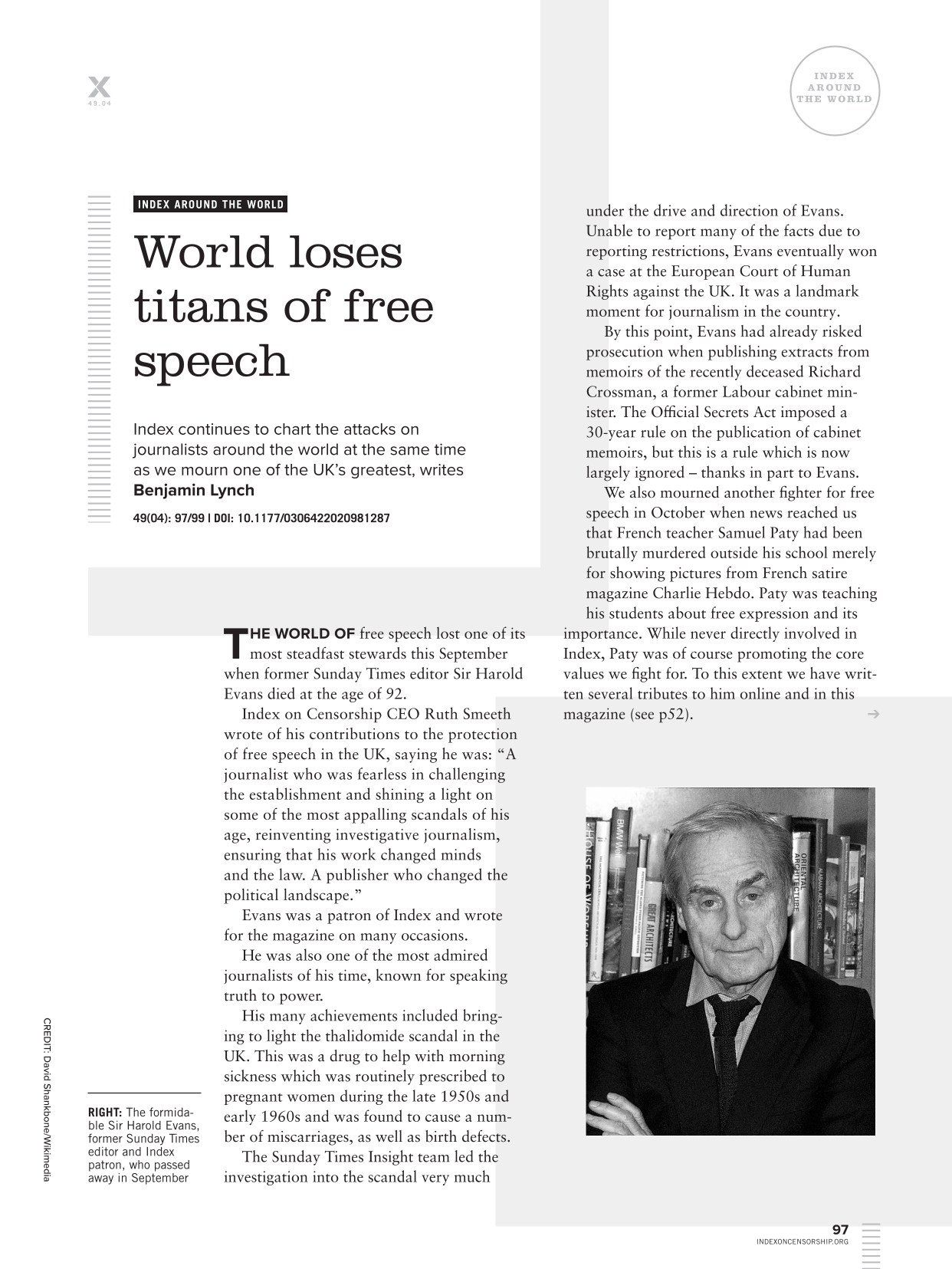
The formidable Sir Harold Evans, former Sunday Times editor and Index patron, who passed away in September
CREDIT: David Shankbone/Wikimedia

Awards and upwards
Evans continues to remind modern audiences of the virtues of bravery and the power of words in the face of adversity and journalists, artists and activists from around the globe are being recognised for such acts. After receiving nominations for the 2021 Index awards from people across the globe, the nominations are now closed. The awards ceremony is planned for next autumn, Covid-19 depending. They have been moved from their usual date in April because Index is keen to hold the ceremony as a live event.
Senior events and partnerships manager Leah Cross said: “We have only three categories this year, which are journalism, art and campaigning.”
The pandemic changed the face of several projects Index is heavily involved in. Hampered but not prevented by the pandemic was Banned Books Week, the yearly celebration of the freedom to read, which also moved its events online.
Cross said: “It was very different because we had to move to digital events instead of live events. The British Library has a great set-up for online events, so I feel it was still really interesting. It was nice to have an opportunity to attract writers from different parts of the world.”
She also spoke of the importance of donations and funding which allow Index to continue to carry out its work. Index recently secured a grant from Arts Council England.
“The idea of this fund is to support charities and organisations at risk because of the current pandemic,” she said. “It is a grant that will sustain us but also lead us into our 50th anniversary year, giving us a chance to reflect on the work we have done over the last 50 years.
“It will give us the chance to think about what Index wants to do in the future and where our efforts are best placed to help those persecuted.”
Media violations mapped
Many of the nominations for the awards, for which donations and grants certainly help, will be reflections of courageous acts under tough conditions caused by the pandemic. Crises, both national and global, often allow governments to ramp up restrictions and clamp down on basic civil liberties. Media freedoms are no exception.
The report of our map Disease Control, which has tracked attacks on journalists that have happened as a result of Covid-19
CREDIT: Index on Censorship
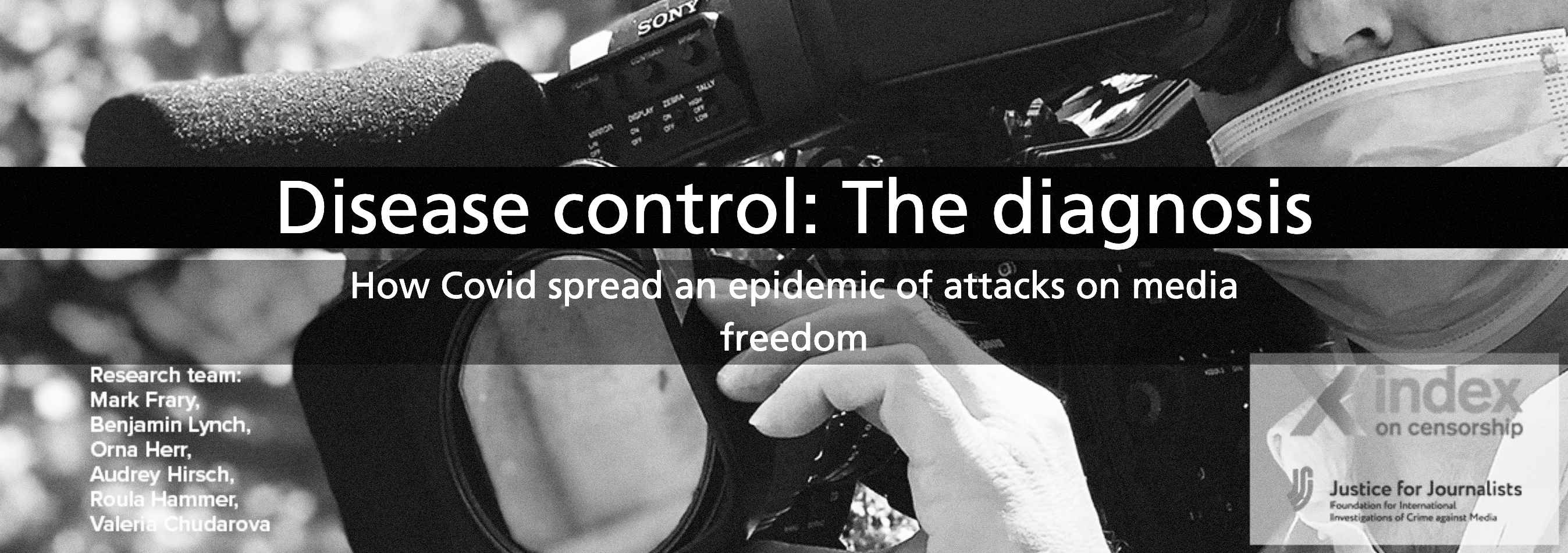
In partnership with Justice for Journalists, Index put together an interactive map of countries using the coronavirus pandemic to introduce harmful legislation towards journalists and media outlets. Around the world, emergency legislation has been implemented, journalists have been attacked and buildings have been raided with important equipment seized.
Index associate editor Mark Frary helped to develop the map, which has so far logged 245 verified incidents around the world. The most common are cases of journalists who have been detained or arrested – currently 63.
A report on the map, published at the end of October, lays out the extent of the problem.
Frary said: “It really was a team effort. We just wanted to see if there were any sort of overarching trends that came out of it. It really showed that this is a global problem – even in northern Europe, where you would expect media freedom not to be under attack.
“It indicates our thoughts when we launched the project in that at times of crises, authoritarian governments and even non-authoritarian governments actually clamp down on media freedom. People are arrested just for telling the truth.”
Slapps continue
Index continues its research into the worrying trend of strategic lawsuits against public participation (Slapps), which are vexatious lawsuits that target journalists with the intent to exhaust them financially and physically.
Index first introduced a collaborative project to set out the problems with anti-media legislation in countries across Europe earlier this year. Since then, it has issued an advisory report with recommendations on how to avoid Slapps and “give journalists back their voice”. In end of November it launched a toolbox to help journalists identify if they are being “Slapped”. Leading the research and campaign is Index’s senior policy research and advocacy adviser Jessica Ni Mhainin.
Knowledge of Slapps among the general public is still relatively low, so the likes of Ni Mhainin are attempting to change this. She expressed the importance of making the effects of the damaging legislation more widely known.
“Most people don’t understand what Slapps are,” she said. “Most of our work is research. We need to inform people of the need for access to information and the threat to it.
“It isn’t just the threat to individual journalists; it is about the threat to the access of information and human rights defenders. We need to show that it affects people and that it affects their democracy.”
Ni Mhainin believes there are positive signs that steps towards anti-Slapps legislation are being taken in EU countries. The murder of Daphne Caruana Galizia certainly drove up awareness.
In October 2017, the Maltese investigative journalist was killed by a car bomb. She had been responsible for bringing to light numerous cases of corruption by Maltese officials. Her revelations resulted in many lawsuits being brought against her in an attempt to silence her – suits which have been passed on to her living relatives.
Ni Mhainin said: “In the UK we are nowhere near [anti-Slapps legislation, so] the focus is on the EU. The Daphne Caruana Galizia cases have brought things to light. It has been useful for starting the conversation around this subject. The EU has expressed interest in imposing a directive to offer protection to journalists.
“We are trying to reach out to member states to make them understand what is happening in their own country and we are hopefully close.”