Abstract

CREDIT: National Archive of Ukraine
NEARLY 35 YEARS after Vasyl Stus died in Soviet labour camp Perm 36, a new book about the Ukrainian poet’s prosecution and trial has been censored.
Stus was prosecuted for speaking out against repression in the Soviet Union and his poetry was prohibited. He spent five years in a camp from 1972 to 1977 and two years in “internal exile” in Magadan, 11,000km from his Ukrainian homeland.
He was then sentenced to 10 years in a labour camp in 1980 for “anti-Soviet activity” because of his membership of the Ukrainian Helsinki Human Rights Union. His defence lawyer during that trial was Viktor Medvedchuk, who is now an influential Ukrainian politician and friend of Vladimir Putin.
Many Ukrainians blamed Medvedchuk for Stus’s death. In 2019, journalist Vakhtang Kipiani published a book, The Case of Vasyl Stus, which suggested that he was complicit in the poet’s prosecution.
Medvedchuk took legal action, and in October 2020 a Kiev court banned references to him in the book.
Dmytro Stus, the poet’s son, says that the title of the offending chapter, Did Attorney Viktor Medvedchuk kill Vasyl Stus? is not a totally accurate characterisation. But Kipiani cites the Ukrainian poet and human rights activist Yuriy Lytvyn who was incarcerated in Perm 36 with Stus and was also defended by Medvedchuk. At the time, Lytvyn said the case against Stus was fabricated and the “passivity” of his defence lawyer Medvedchuk was because of “instructions from above”. The comments, originally published in 1981, corroborate Kipiani’s argument that Medvedchuk was complicit in Stus’s prosecution. Censoring the book will not strike those comments from the record.
Despite the censorship order, the book continues to be printed in its entirety in Ukraine and topped the bestseller lists shortly after the October judgment came into force.
Stus, who died on 4 September 1985, became a hero to many Ukrainians because of his tenacity in the face of oppression. He wrote hundreds of poems during his incarceration. His work expresses the resilience of the individual who finds strength from the simple experience of perceiving the world and he describes Soviet reality with absolute honesty.
His work expresses what Stus saw and felt rather than the aesthetics of Soviet sloganeering. His style ranges from beautiful lyricism to grotesque fables reminiscent of Miroslav Holub.
The KGB reviewer of his first collection, Zymovi Dereva (Winter Trees), described it as the poetry “of decadence and ideological decline”.
Stus was as uncompromising in his political views as he was in his poetry and in 1978 he renounced his Soviet citizenship, saying: “To be a Soviet citizen is to be a slave. The greater the... abuse I endure, the greater my resistance to this system which abuses humanity... becomes.”
None of the four poems below was ever published in the Soviet Union.
Thirty years after its fall, the banning of a book about Stus’s case shows that politics still confronts freedom of expression in Ukraine.
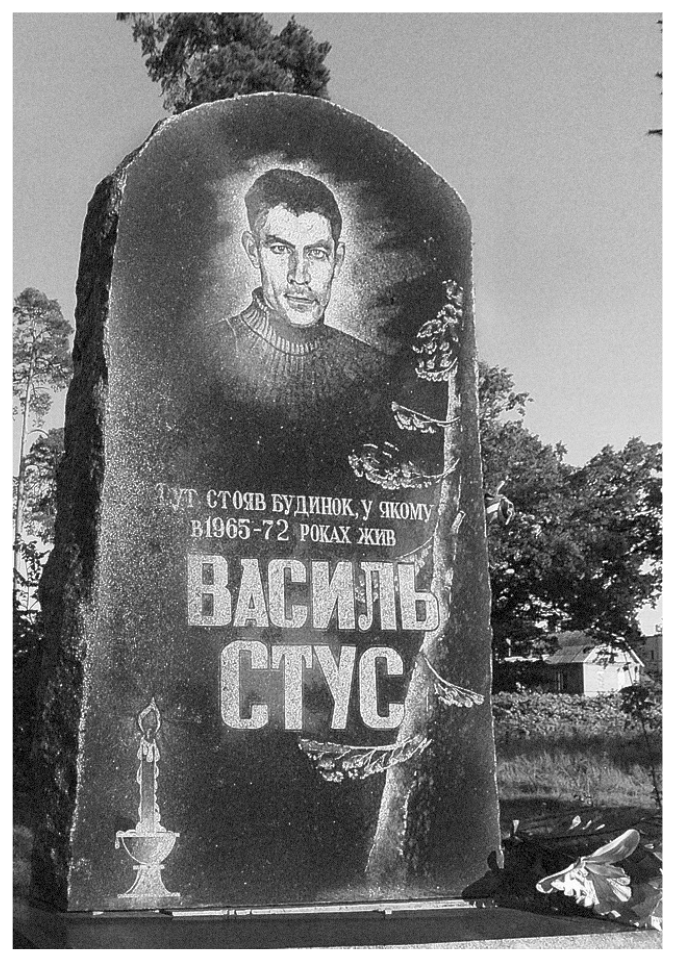
A monument in Kiev to Ukrainian poet Vasyl Stus on the site where he once lived
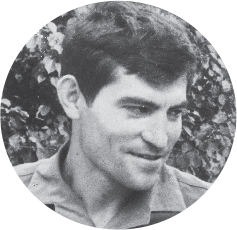
The KGB’s photo of Vasyl Stus after his arrest in 1972.
CREDIT: Qypchak/WikiCommons
The Sea
The sea
A dark fragment of sadness, The soul of Mephistopheles Solitary.
The piano endures Beneath girlish fingers, falls Into the water From the rim of the earth. The withered grasses Capture the damp passages The moan of the elements Engulfed in fog.
***
Evening thickens with a sura from the Koran A guttural sound streams through the ravine. How much truth and anguish lie in the throat? Too much to narrate before the morning.
***
The morose crackle in the empty forest A bird’s sharp whistle.
Leaf fall.
Where shall the butterfly settle?
For Vintsas Kuzmitskas
The cold stellar glow of the Priuralsky dusk Grew. The frost ordered its organ pipes And the pines truly and symbolically seemed Like a provincial theatre auditorium Where, whatever the bogus gestures of the conductor
However many fake notes and profiles are struck Nothing can drown out the cold-eyed, severe glow Of Johann Sebastian’s cosmos. The night grew And I grew within it. The winds blew. The frost crackled. The winds blew. The knuckled Branches of fir trees crackled. One red eye Of an electric lamp blinked sleeplessly illuminating the area. The drowsy orderly Broke his dream under his boots... The frost crackled.
The store. The Medsanbat. And in addition to the poor first kit, Vintsas, our battalion paramedic, Ascribed to the register between bandages and alcohol Pyramidone, iodine, formidron, Silent and solemn himself, like a bandage. The frost crackled. He turned on the lamps, Crazily and dreaming between the long shadows, That were like shards of their own arid longing, And the spotlights on the wall delineated, Where some old Flemish landscape canvas Came to life. The soldier’s impoverished palette Darkened with Lithuanian nostalgia, While Vintsas made an illuminated target Where Čiurlionis aimed pine needles, Walking through a forest engraved in darkness. “Speak” He asked me, “speak!” And some words About Vilnius, about Taras, about the Vilnia And Salomeja sighed softly, A stream slenderly piercing the aperture, Of this sombre, enthralling landscape. He was like a god sandwiched between walls, Hidden in the hermetic store cupboard, And awkwardly held out his prickly hands, Where the half-metre Vilnia flowed. “Tell me,” he requested, “about Taras...”
Gediminas’s scream lifted the ceiling, Grew under the stars. The prickly forest of Čiurlionis rustled outside the windows And the coastal “Letuva” murmured “Like that and not like that” – He cast aside his brush, Warmed his inhaler, approached, turned back, And went again, silent, in his assault on the dyke strengthened by Ruisdael. “The Ural taiga is painfully similar To my Lithuania. Orenburg. Shevchenko. And I have so many compatriots here, Going all the way to Pechora. Indeed, because it is the Fatherland. You all asleep – and, hairy as coils of fibre, Wound over, over centuries, your dreams Roam insensate flattened. And your throat too grows hairy. Tell me. Tell me. Speak!”
Winter Trees
They folded their arms and didn’t scream (How could they without moving their limbs?) But settled within their snowy twigs: The poplars were unmoved, Resting, radiant as candles Whose cold flame Was thinned and weakened By the harsh December day And immersed utterly in their reflections: Amphorae brimming with the frosted sandy air Of this Ukrainian Africa. Each of them was beyond desperation A hermetically sealed night Where the branched nerve flails Against some primal forest An antenna that frighteningly catches The repeated patterns of day, With its radar corona: The embroidery of a crow’s cry, The clarity of children’s laughter And the round warble of a police whistle On the corner of Kreshchatyk Street
Untitled
I knew almost for sure That he had robbed my friends, Made my mother miserable, And given the wife tuberculosis, So I resolved To pursue him for payback. “Where are you, my tormentor?” – I shouted to the whole deserted hall, In which my tormentor dwells. And in response the four echoes, Of my shouts roared off the walls, Hit the ceiling And then fell dead at my feet. “Where are you, my tormentor?” – I cried for the second and third time, And my four roars rose from the dead, Struck the ceiling And fell dead on the ground again. “He is really dead?” I decided he was happily. But when I got home, I saw stood by my door Two legs, two arms and a torso (there was no head).
“What are you doing here?” – I took him by surprise. And, afraid, those two arms, two legs and a torso Composed themselves into a headless corpse.
I grabbed that decapitated body without a head, And shouted into the neck’s empty hole: “Tell me, where is my tormentor?” “Don’t hit me,” the hole said. “Go back to the house where you were earlier. In the first room people without heads sit, In the second they are without legs too In the third without arms, In the fourth room you will see the torsos, And in the fifth room, nothing.
“That is where your tormentor dwells.
“However, repeat and repeat endlessly Everything you want to tell him. Just don’t believe in your eyes For where he is not, he is.”
Translated by Steve Komarnyckyj
Vasyl Stus was a Ukrainian poet, translator, literary critic, journalist, and an active member of the Ukrainian dissident movement. He died in 1985
CREDIT: Hendrik Jonas / Ikon Images