




Abstract

Alexei Navalny is sharing details of his hunger strike and ill-treatment via social media.
Navalny at an opposition rally in Moscow, 2018.
CREDIT: Victor Vytolskiy / Alamy Stock Photo
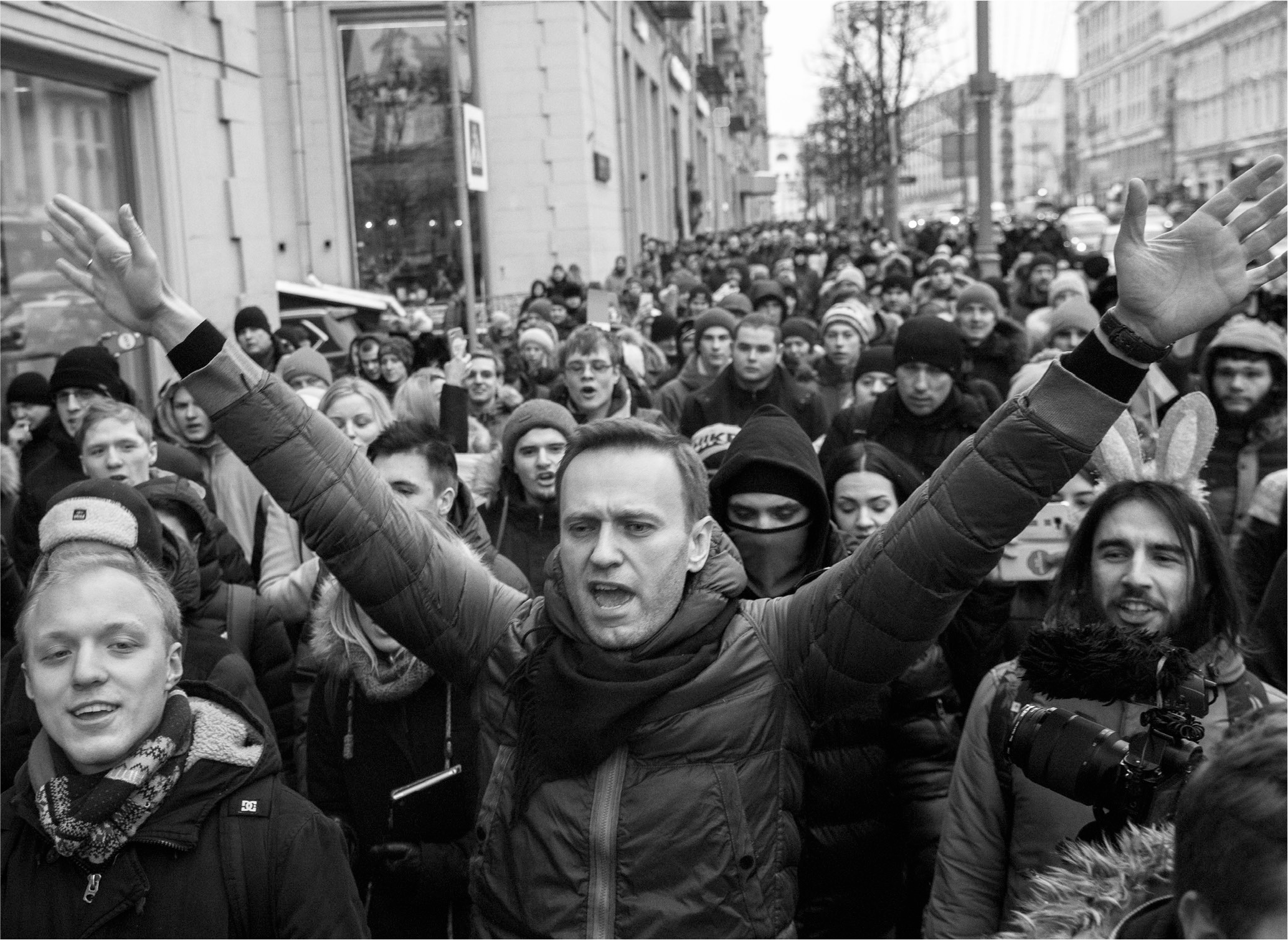
ALEXEI NAVALNY, THE Russian opposition leader and critic of president Vladimir Putin is being held in a penal colony. He has been denied medical care, tortured with sleep deprivation and forced to live in unsanitary conditions, with many of his fellow inmates suffering from tuberculosis.
He is also facing new criminal charges, filed since he was imprisoned, and which have been brought – he believes – in a bid to silence him.
Navalny has been in the colony since February, and we know what is happening to him because of letters which have been smuggled out and posted on Instagram.
His ordeal began in August last year. He collapsed on a flight from Siberia to Moscow, which was diverted to Omsk, where he was treated before being airlifted to Berlin. The doctors there concluded that he had been poisoned with the nerve agent Novichok, with the Russian secret service, the FSB, in the frame for carrying out the attack.
Navalny spent a month in Berlin recovering before returning to Russia, despite threats that he would be detained.
On his return, he was arrested and put on trial for violating parole conditions associated with an embezzlement case from 2014.
Index and others believe that the charges are politically motivated and designed to stop Navalny from contesting elections. He says he could not register twice a month as stipulated in those conditions because he was in hospital.
Despite his arguments, he was sentenced to almost three years in a penal colony in Vladimir Oblast, east of Moscow.
It is from there that he is now passing messages to the outside world.
On 31 March, Navalny announced he was going on hunger strike to protest that he was not receiving adequate medical treatment for acute pain in his back and a loss of feeling in his legs, and that he was being deprived of sleep.
“I have the right to call a doctor and get medicine. They don’t give me either one or the other. Instead of medical assistance, I am tortured with sleep deprivation (they wake me up eight times a night),” he wrote in one post.
A week later he revealed that there was a high incidence of tuberculosis in the colony, with three out of 15 in his “detachment” showing symptoms.
“Inside there are unsanitary conditions, tuberculosis, a lack of drugs. Looking at the nightmare plates on which they put gruel, I’m generally surprised that there is no Ebola virus here,” he wrote.
On the 13th day of his hunger strike, he complained that his books had been confiscated and that others he had requested – including a copy of the Koran he had asked for to better understand Islam – had not been provided.
He wrote: “I came here a month ago and brought a bunch of books. And ordered a bunch of books. But so far, I have not been given a single one. Because all of them ‘must be checked for extremism’. It takes three months.”
He has now filed a lawsuit against the colony for their failure to provide them.
“Here, books are our everything, and if you have to sue for the right to read, I will sue,” he wrote.
Four days later, his captors threatened to force-feed him.
“This morning, a woman colonel stood over me and said, ‘Your blood test indicates a serious deterioration in health and risk. If you do not give up on your hunger strike, then we are ready to move on to force-feeding now’. And then she described the delights of force-feeding to me: straitjacket and other joys.”
By 20 April, Navalny called himself a “walking skeleton” but revealed that the messages of support from Russia and around the world were sustaining him.
On 23 April, he wrote: “As Alice from Wonderland said, ‘Here you have to run to stay put. And to get somewhere, you have to run twice as fast’.
“I ran, tried, fell, went on a hunger strike, but all the same, without your help, I just broke my forehead.”
Navalny says that the attention focused on him has meant that he has finally started receiving some medical treatment.
“Two months ago, they smirked at my requests for medical assistance, they did not give any medicines and did not allow them to be transferred,” he wrote. “A month ago, they laughed in my face at phrases like, ‘Can I find out my diagnosis?’ and ‘Can I see my own medical record?’“
He has now been examined twice by a council of civilian doctors and has abandoned his hunger strike.
Exiting from a hunger strike is not just a matter of starting to eat again, it must be taken slowly.
“It will take 24 days and they say it is even harder [than the hunger strike itself]. Wish me luck.”
On 27 April, he looked back on the previous 12 months, calling it “the year of doctors and nurses and physicians in general”.
“I have never talked so much with them in my life,” he wrote. “First, the doctors saved me, who was dying from chemical poisoning on the plane.
“Then they rescued me a second time, risking their careers, explaining to my wife and everyone that I should be immediately taken away from the Omsk hospital, where their evil colleagues will kill me (they will not just treat me) on the orders of the Kremlin.”
“Then the Charité doctors [in Berlin] turned me from a vegetable back into a human being.”
Navalny said in his Instagram message that some doctors had fought a desperate campaign to get him normal treatment.
“Thanks to my prison doctors – I understand that they are just working within the framework that was given to them by their superiors, and therefore by the Kremlin – I can see now that people are sincerely trying to help. Yesterday, the nurse made a mark on my wrist with a pen, so as not to forget the hour when I had to have the next three tablespoons of oatmeal.”
He added: “You know, even though what I had been through all these months, I want one of my children to be a doctor. Although the children are probably not already. Well, let one of the grandchildren then.”
On 2 May, the day that the Russian Orthodox church celebrates Easter, the following message was posted on Instagram: “Christ is risen. Life and love won. Traditionally, I congratulate everyone on the best holiday: believers (who I am now), unbelievers (who I was), and militant atheists (who I was too). I hug everyone and love everyone.”
But the message then took a darker turn: “How long I have been waiting for this Easter? Lent this year turned out to be difficult for me. Unfortunately, I will not be able to share a fully-fledged Easter meal today: I am still in the first half of my fascinating transformation ‘from a skeleton barely dragging its feet into just a hungry man’. But I will eat a few spoons of porridge allowed for me with an excellent Easter mood. Indeed, on such a day, I know and remember for sure that everything will be fine.”
On 20 May, Navalny said he been craving bread.
“The fact is that I really love bread. If I had to eat one meal for the rest of my life, I would choose bread. Plus, bread is important in prison, you can’t eat without it.”
Navalny has decide to treat Sundays in prison like holidays to relieve the monotony.
“I didn’t take bread all week and on Sunday morning I took a loaf, spread butter on a piece of bread, brewed coffee and had such a divine festive breakfast,” he wrote, adding: “The plan almost fell through. They gave bread and butter in the morning, but I didn’t have coffee. Fortunately, a neighbour with a jar of instant coffee ‘drove’ into my cell.
“I opened the window – and to hell with it that there is a grate – brewed coffee, buttered a piece of white bread and sat on the bunk. I took a bite and drank from the mug.
“I tell you: if there were a device that measures happiness, then no oligarch who has breakfast on a yacht, not a single visitor of a Michelin restaurant would have experienced even one-tenth of the complete happiness that I had.”
On 25 May, Navalny reported that an investigator visited him in prison to say he was facing three new charges. Navalny styles himself as a criminal mastermind – Professor Navariarty – with the investigator as a Russian Sherlock Holmes.
The investigator alleged that Navalny stole all the donations people sent to the FBK, the anti-corruption foundation that Navalny founded in 2011 to investigate corruption cases among high-ranking
Russian government officials.
He was also told that a case had been initiated against him for the “creation of a non-profit organisation that infringes upon the personality and rights of citizens” and for “encouraging citizens to refuse to perform their civic duties”. The case relates to Navalny’s posting of the film Putin’s Palace “without permission”.
Finally, he has been accused of insulting Judge Vera Akimova, who presided over the case in which Navalny allegedly “insulted a veteran”.
Navalny also used Instagram to send a message to the families of Kremlin critics Dmitry Gudkov and Andrey Pivovarov, who were both detained in early June on what he called fabricated charges.
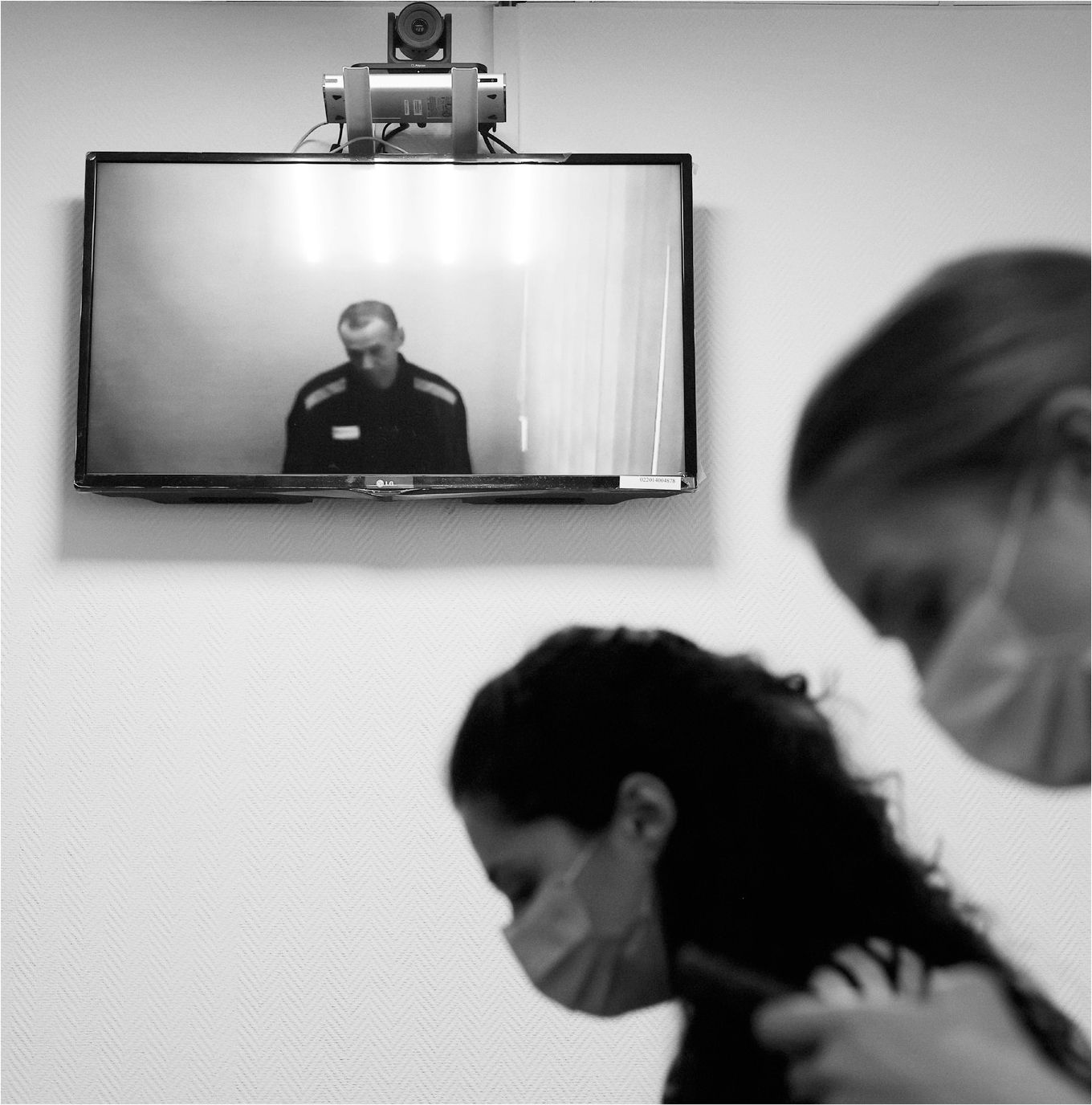
Navalny seen on screen during a hearing through a video link. May, 2021.
CREDIT: Maxim Shemetov / Reuters / Alamy Stock Photo
“These are honest people who are being persecuted,” he wrote. “This disgusting deceitful government is very cowardly. She will continue to eat people one or two at a time to intimidate everyone, but of the people she is terribly afraid.
“But as long as the people themselves are frightened, and are silent, observing the proposed rules, the power will never stop. She will eat and eat: people, families, national wealth, our future.”
“They feed on our fear. Don’t feed them.”