




Abstract

And that’s even before you consider some of the more difficult issues such as misinformation, outright lies and political propaganda.
It should come as no surprise, then, that if you enter the term “free speech” into the Google news search function, more than 7.6 million articles appear.
Exploring issues such as academic freedom, freedom of expression, cancel culture, culture wars, misinformation, conspiracy theories, the role of social media and online speech, our collective right to free expression is constantly debated and scrutinised.
Of course, as chief executive of Index on Censorship, I don’t just welcome this conversation, I celebrate it. I fundamentally believe that free speech as a human right should be cherished. But in order to do that it must be debated by every generation to see what we really mean by the term and why it is important. This is even more crucial as technology advances and enables us to think and communicate beyond our own communities and cultures.
Every generation and political movement needs to embrace the concept on its own terms and apply it to its own battle and ideology. And those of us for whom the right to free speech is a core democratic right must be prepared to argue vociferously for it.
We must be able to make the argument that without our collective right to free speech and free expression, it won’t be just the perceived “wrong-uns” who are silenced – it will be the trans activist, the feminist, the anti-racist, the politician, the pro-choice campaigner, the pacifist, the academic, the artist and the journalist.
You simply can’t have free speech for the group of people you like and ban those that you don’t – that isn’t the way it works. It’s free speech for all or you end up with free speech for no one.
But free speech, even at its broadest definition, doesn’t include incitement to violence or extremism. It shouldn’t, facilitate hate or empower extremists at the cost of undermining democratic norms. But what those norms are, and where the lines should be, is what we should regularly debate, because we have a fundamental responsibility to those people who don’t have it: a responsibility to those people who have been killed in the fight for it; to those who live under repressive regimes and who must think twice about what they say, and to whom; to those who are arrested for articulating their beliefs or doing their jobs as journalists or academics; and to those who cannot leave their homes without the fear that they won’t return to their families because of what they have tweeted or painted – or even what they have taught.
CREDIT: Gary Waters/Ikon Images
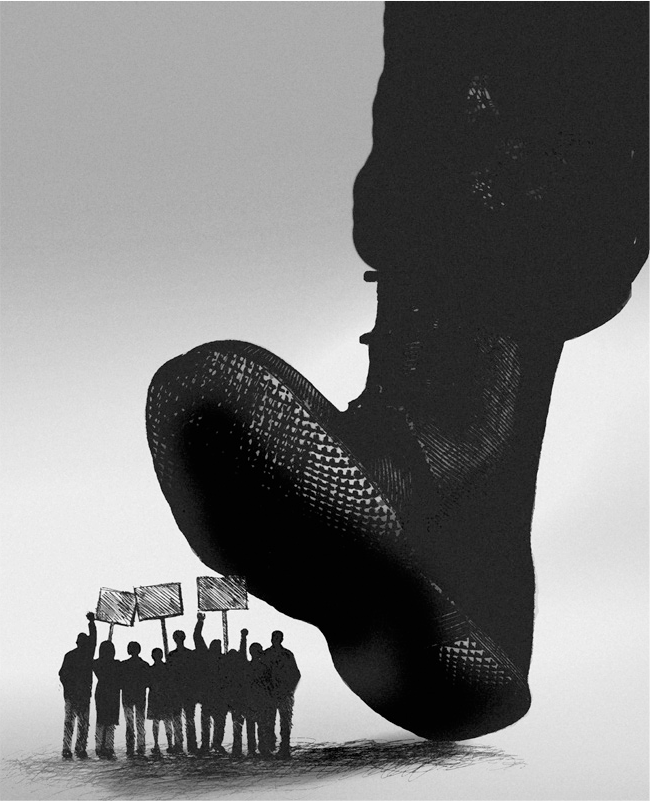
According to the Economist’s Democracy Index, more than 35% of the world’s population currently live under an authoritarian regime.
They have no rights under Article 19 of the Universal Declaration of Human Rights – or at least they are afforded none by their own governments. Free speech is a dream, free expression a wish, and so many people around the world strive to achieve them every single day.
It is for them that Index was established in 1971. And it is for them that I fight every day for our collective rights to free speech and free expression, all around the world.
The team at Index proudly exists to be a voice for the persecuted, to publish their work, to shine a spotlight on their fights, and to be a small but determined beacon of hope for those who think the world has forgotten them.