Abstract

Filled with people jailed for doing their jobs, Myanmar’s Insein prison is a place to be feared.
Picture it as dank and dark, with near inedible food, a place where the people keeping you in there can abuse you at any moment.
Hell on Earth might just be Myanmar’s Insein prison.
Situated in the country’s most populous city, Yangon, Insein has been a favourite of regimes to punish political activists and dissidents. Ousted leader Aung San Suu Kyi was imprisoned there.
Since the coup of 1 February, Insein has become the home for yet more journalists and activists who are there merely for doing their jobs – be it reporting on acts of brutality by the military or the number of deaths or, in the case of one former detainee who spoke to Index, taking photographs (which are shown over the following pages). Ye Myo Khant was arrested earlier this year while covering a protest.
“The interior is painted light blue and the ceiling is painted green with a hint of horror. The exterior walls are painted white, and the doors are painted white,” he said.
“The smell is nauseating with the sweat of people. We were uncomfortable and there are concerns about suicide.
Prisoners released from Insein Prison on the outskirts of Yangon, Myanmar, after being set free on general amnesty in May 2011. Then president Thein Sein had announced the amnesty for more than 14,600 inmates across the country on state TV the previous day. It is now home once more to opponents of the military junta.
CREDIT: Newscom / Alamy

The smell makes you choke.”
His story is not uncommon. As of 6 September – according to Reporting ASEAN – 98 people working as journalists in the country have been arrested. Forty are still detained.
Early July saw a brief period of hope when around 2,000 people, including journalists, were released. Some 700 of them were reported to be from Insein prison.
But for those still detained across the country, life behind bars has remained an unjust tragedy.
There are few photos of the inside of Insein, but it is known to be stiflingly hot, cramped and unhygienic.
Overcrowding is a problem, and with well over 10,000 people reported to be contained within its walls, it houses more than double its official capacity of 5,000.
Political prisoners are not separated from those jailed for heinous crimes, and it leads to threats and intimidation which are not stamped out by the prison guards. Prisoners are, in fact, reminded by guards that harm can come to them at any time.
“We had to live in a big prison room with probably 400 detainees,” said Ye Myo Khant. “We don’t even get our own space. I could not sleep throughout the night and I missed my home.
“In my mind I was thinking, ‘I am not a criminal. Why did they arrest us? I am just doing my work as a photojournalist’.”
He said he felt that his life was in danger, adding: “In the prison there are no human rights, no humanity and no empathy. I saw that the other detainees were abused by sexual harassment, beating and other types of bullying.
“I was threatened many times.”
The ordeal for those detained in the prison is both physical and mental. On 23 July, a brief strike (which unconfirmed reports suggest was dealt with severely) by political prisoners was called to protest, in part, the conditions in the jail but also the lack of medical assistance.
Covid-19 in Myanmar was and is rife and quickly spread through Insein, reflecting the junta’s inability to control the spread of the virus. The UN has voiced concerns that half the country’s population of about 54 million people could be infected, turning the country into a “super-spreader state”.
There is little to no access to oxygen or proper medical equipment, and vaccination rates are low. Queues of desperate people hoping to refill oxygen bottles can be up to 12 hours long.
A number of prisoners have died as a result, including the politician Nyan Win.
He was Aung San Suu Kyi’s lawyer in 2009 when she faced five years in prison and, more recently, one of her senior legal advisers.
He joined the National League for Democracy, the party in power before this year’s coup, in 1988 – shortly after it was formed – and became a key part of its pro-democracy movement. Over the course of his life he was arrested and detained several times, but his belief in democracy for Myanmar remained undeterred.
Nyan Win befriended Ye Myo Khant in Insein and offered words of guidance, speaking of his past experience of being detained and tortured by the military juntas that have ruled over the years.
Ye Myo Khant recalled: “He was tortured during his previous imprisonment. He recounted torture in that prison, interrogation, and even worse times. ‘I wish you all good health and we will one day be free, and we will work for the restoration of democracy in Myanmar,’ he told me.”
“He would say, ‘The military council cannot detain me for my whole life, and I will be released one day’. [With other imprisoned politicians] we discussed Myanmar and talked about how to fight the dictatorship and how to build the future of Myanmar. Now that I am out, I will continue participating in the revolution [calling] for democracy in Myanmar. I remember Nyan Win’s words and I am sorry that he passed away.”
While the elder statesmen of the pro-democracy movement may offer words of encouragement, hope – understandably – is hard to come by in Insein. The odds are stacked against journalists, activists and dissidents from the very start. Legislative changes have made sure dissent is easily punished.
Myanmar’s penal code previously made it a crime to publish or circulate any “statement, rumor or report” “with intent to cause, or which is likely to cause, any officer, soldier, sailor or airman, in the Army, Navy or Air Force to mutiny or otherwise disregard or fail in his duty.”
It has been replaced with much broader language clearly designed to penalise those encouraging members of the civil service of the security services to join the Civil Disobedience Movement.
Under the revised provision, any attempt to “hinder, disturb, damage the motivation, discipline, health and conduct” of the military personnel and government employees and cause their hatred, disobedience or disloyalty toward the military and the government is punishable by up to three years in prison.
Because of the country’s prohibitive laws, criticism of the regime is impossible to get away with. By their very nature, protests are critical of the regime and coverage of them is seen by the authorities as a mouthpiece for dissent.
Many reporters have fled the country and now that reporting is so clearly viewed as an act of revolution, it is up to journalists to weigh up the threats versus their own ideals.
Ye Myo Khant said: “[These journalists say] ‘it is not convenient for me to live in this country. There is no law and justice for journalists. I can be rearrested at any time. I really want to be a journalist [and cover] the crimes of the coup in this country. If I cannot live in this country at all, I will have to move to another country for my work’.”
Indeed, he has not been active since his release. Prior threats of intimidation towards his family are cause for concern and they have had to move to a safer location within the country.
“When I come back one day, I want to take pictures of the injustices of the military,” he said. “I would like to treat my parents and family and travel with them. Of course, I completely miss my home.”
Myanmar’s crisis looks as though it is set to get worse, however. Prisoners returning from Insein are being released into a country in chaos. As the regime struggles to deal with Covid-19 outbreaks, civil war is also on the cards. The National Unity government’s armed wing, the People’s Defence Force, is reportedly attempting to unify various civil militias and armed resistance groups.
It is incumbent on the international community not to forget about Myanmar when their attention is focused elsewhere to ensure those detained are set free.
Reportage from the protests by photojournalist
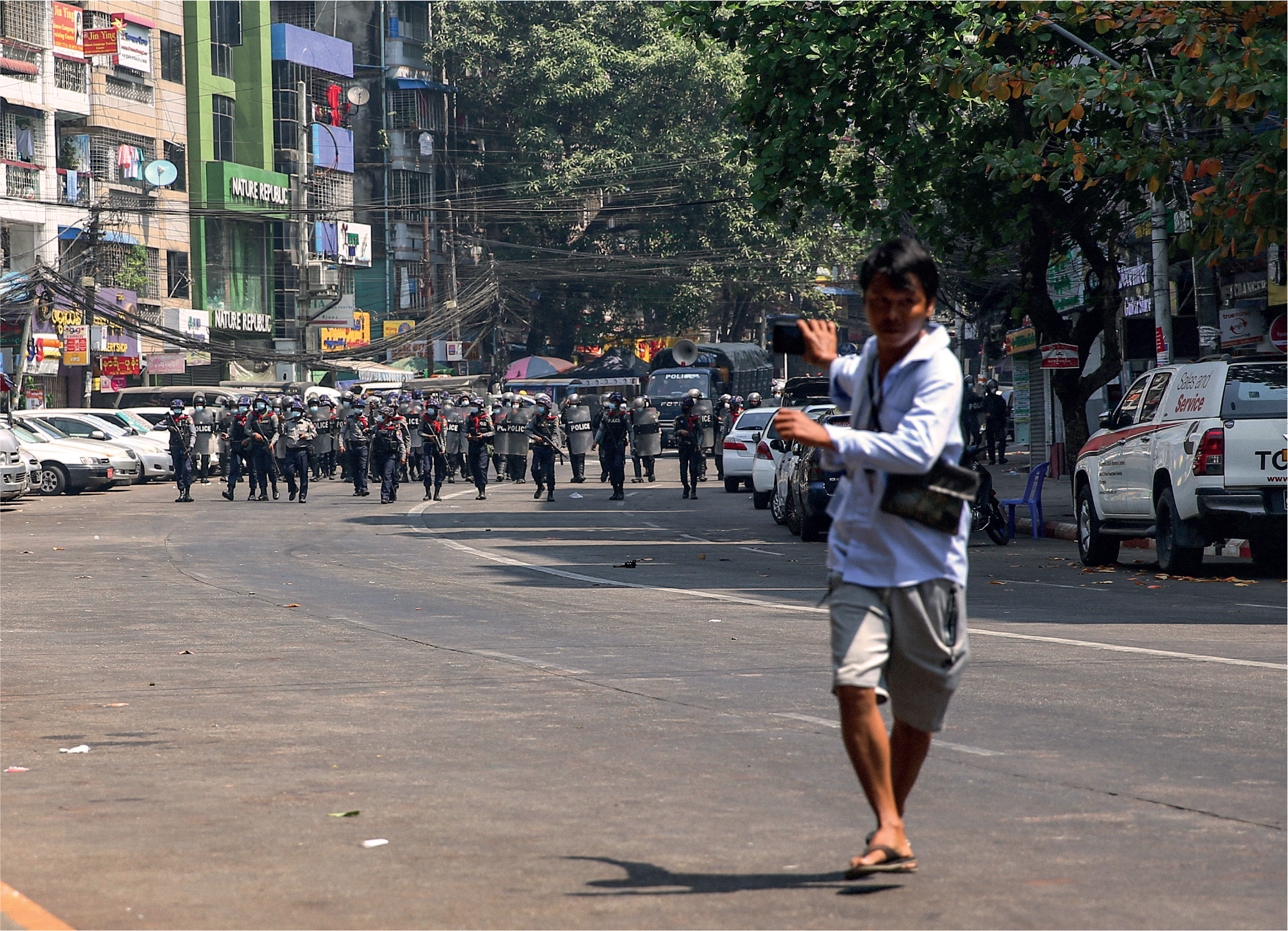
A man filming a violent crackdown by police near the Hledan Center in Yangon. 26 February 2021.
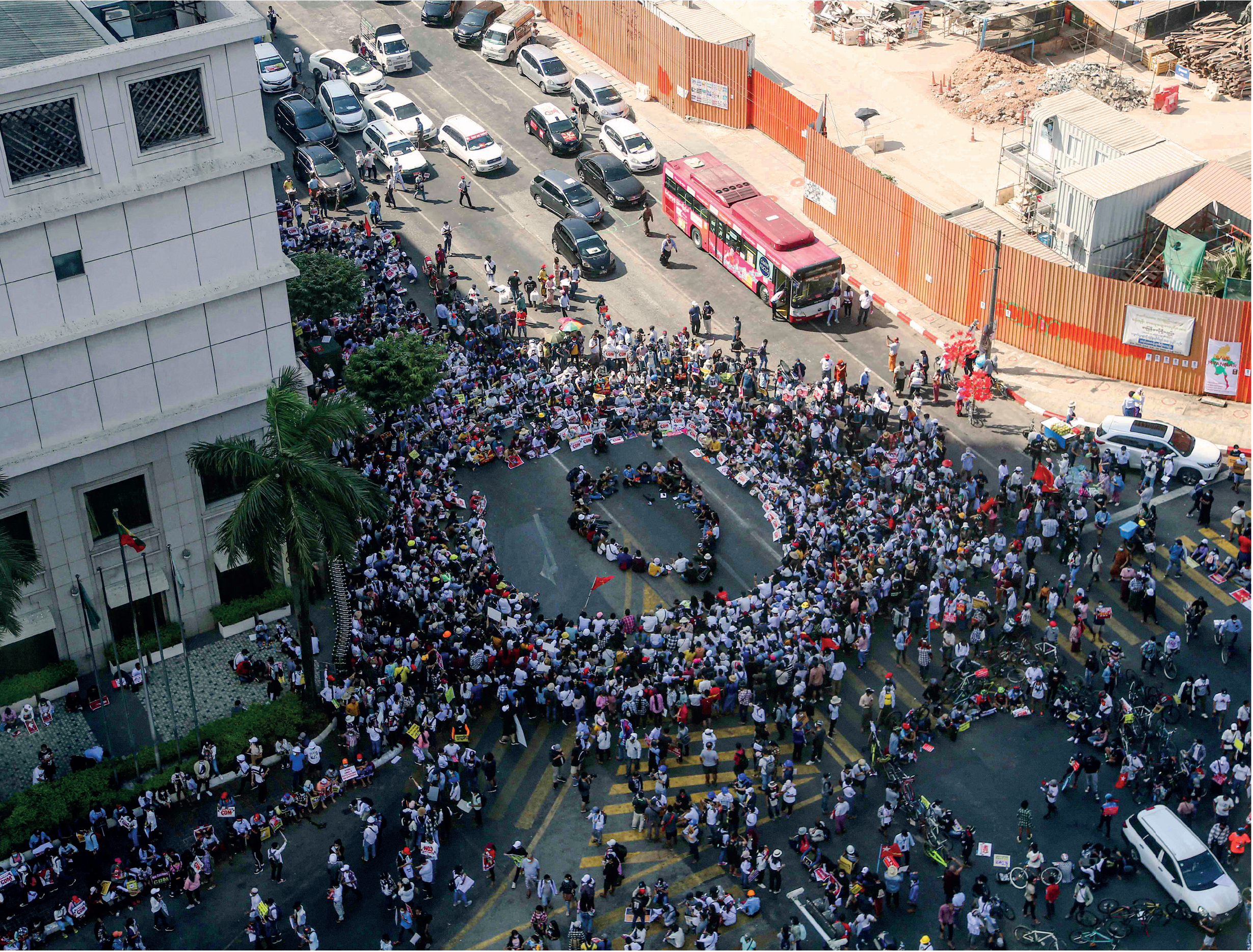
A mass gathering in Yangon, 17 February.
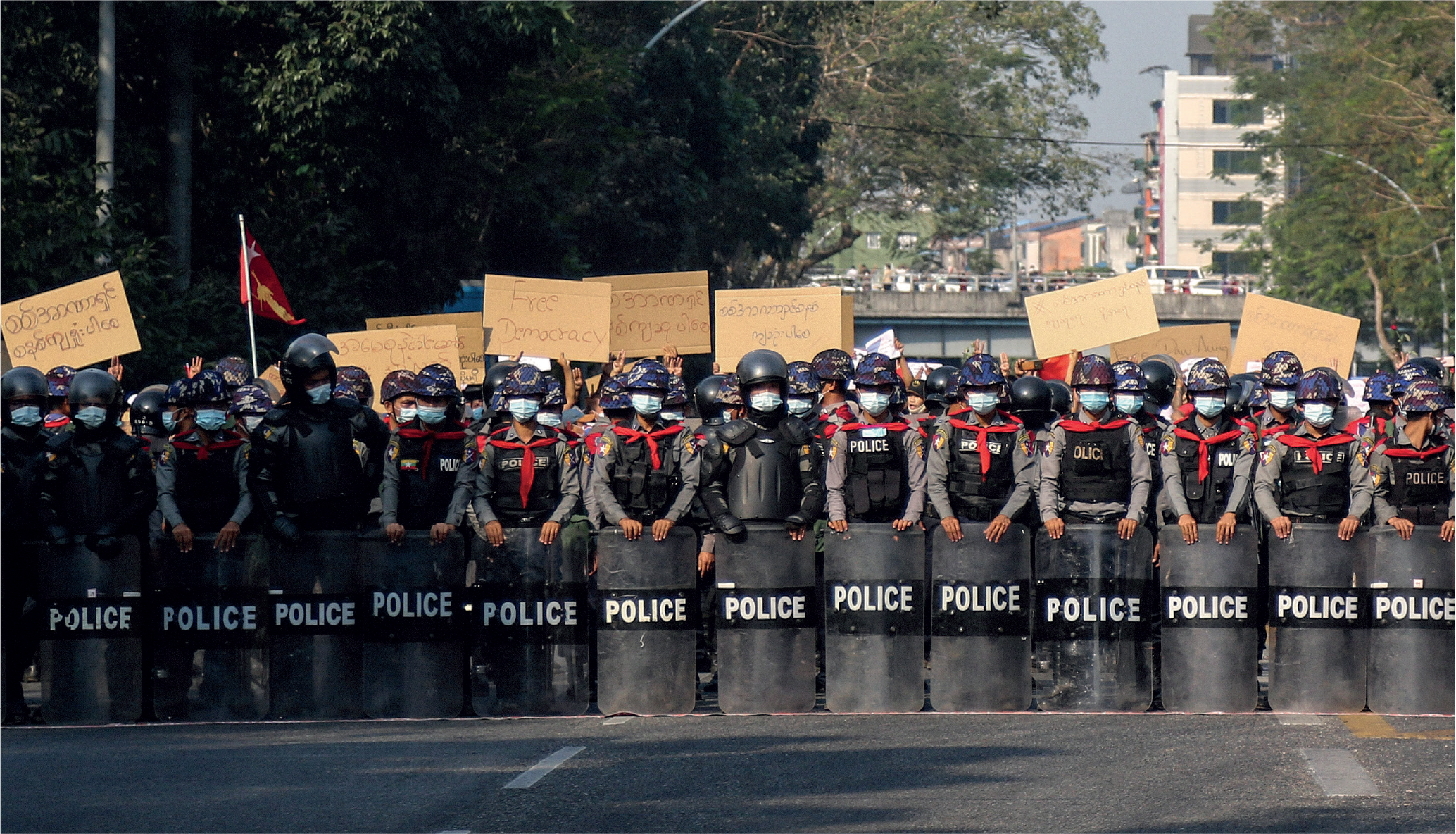
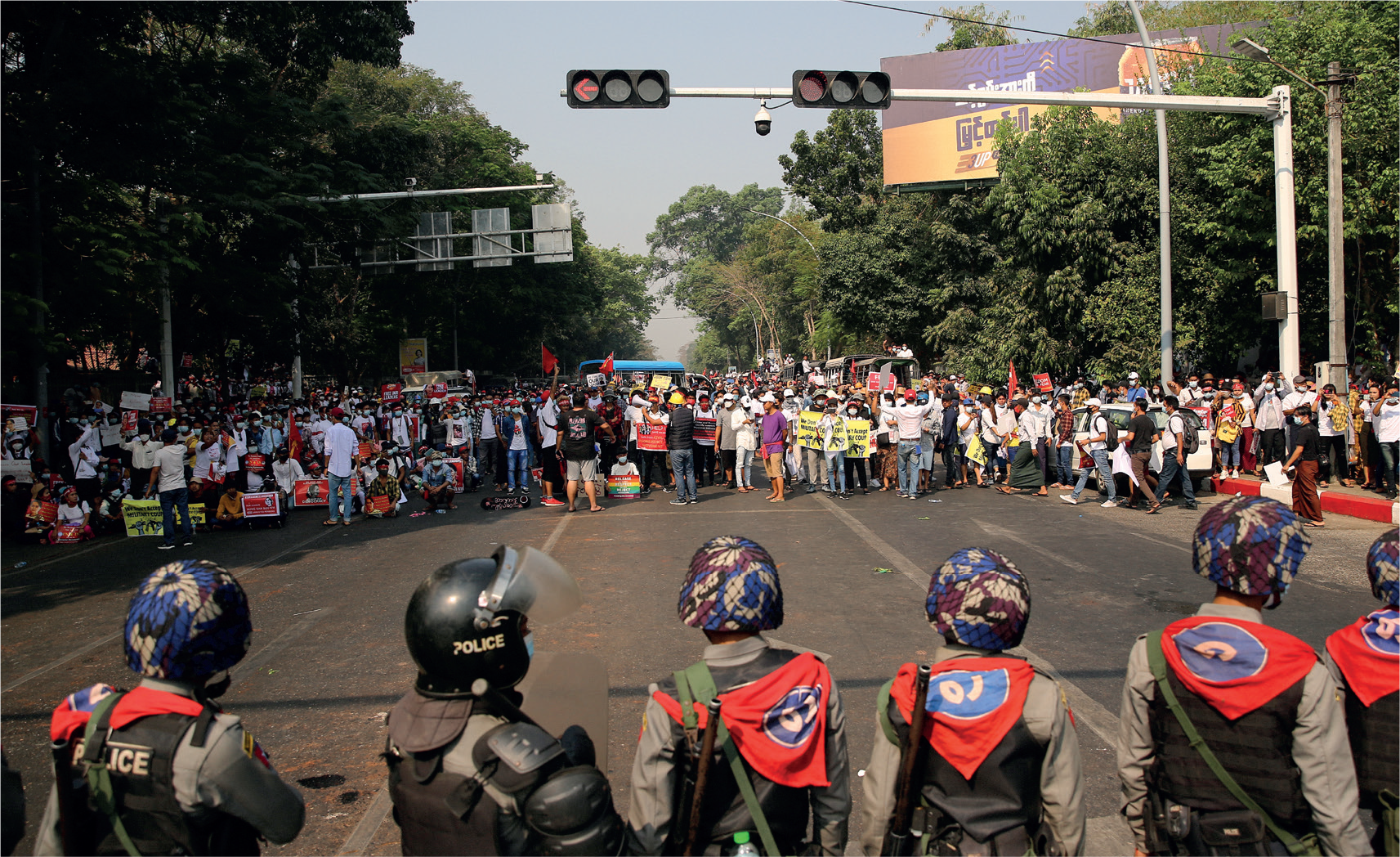
The junta’s police forces block demonstrators near the American Center, 22 February.
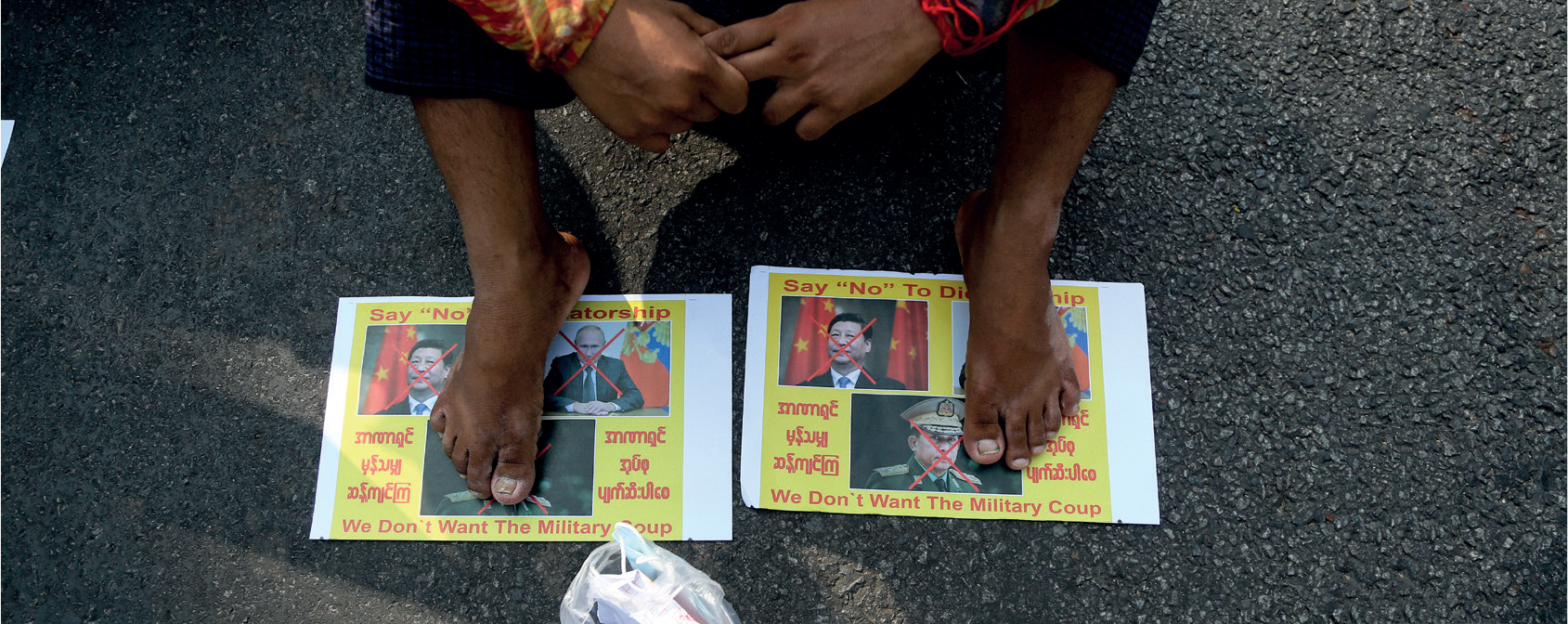
Outside the HQ of the National League for Democracy, Aung San Suu Kyi’s party, 15 February.
A woman protesting at the Indonesian embassy, Yangon, 21 February.

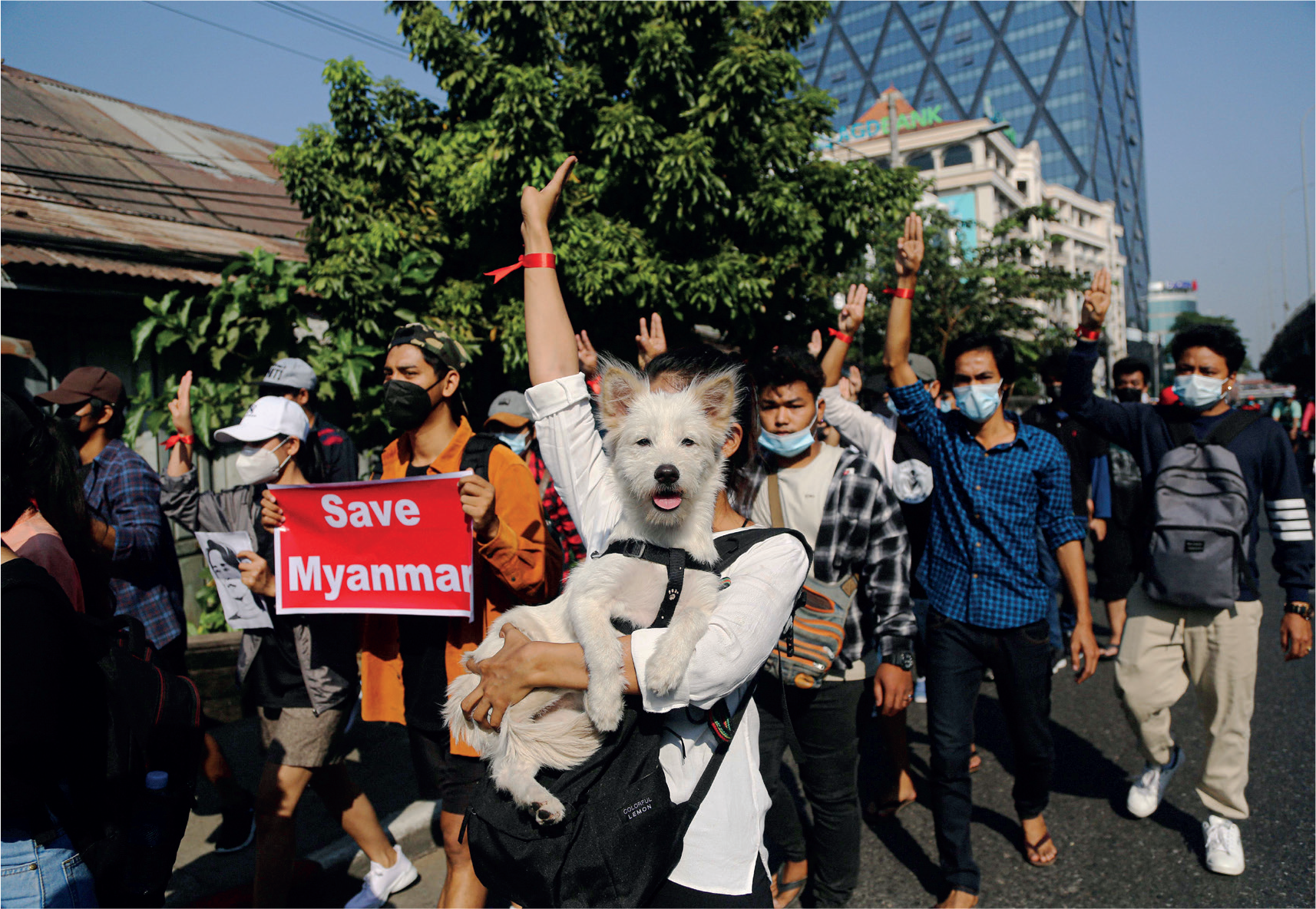
A girl protesting with her dog near the Hleden Center, Yangon, 8 February.
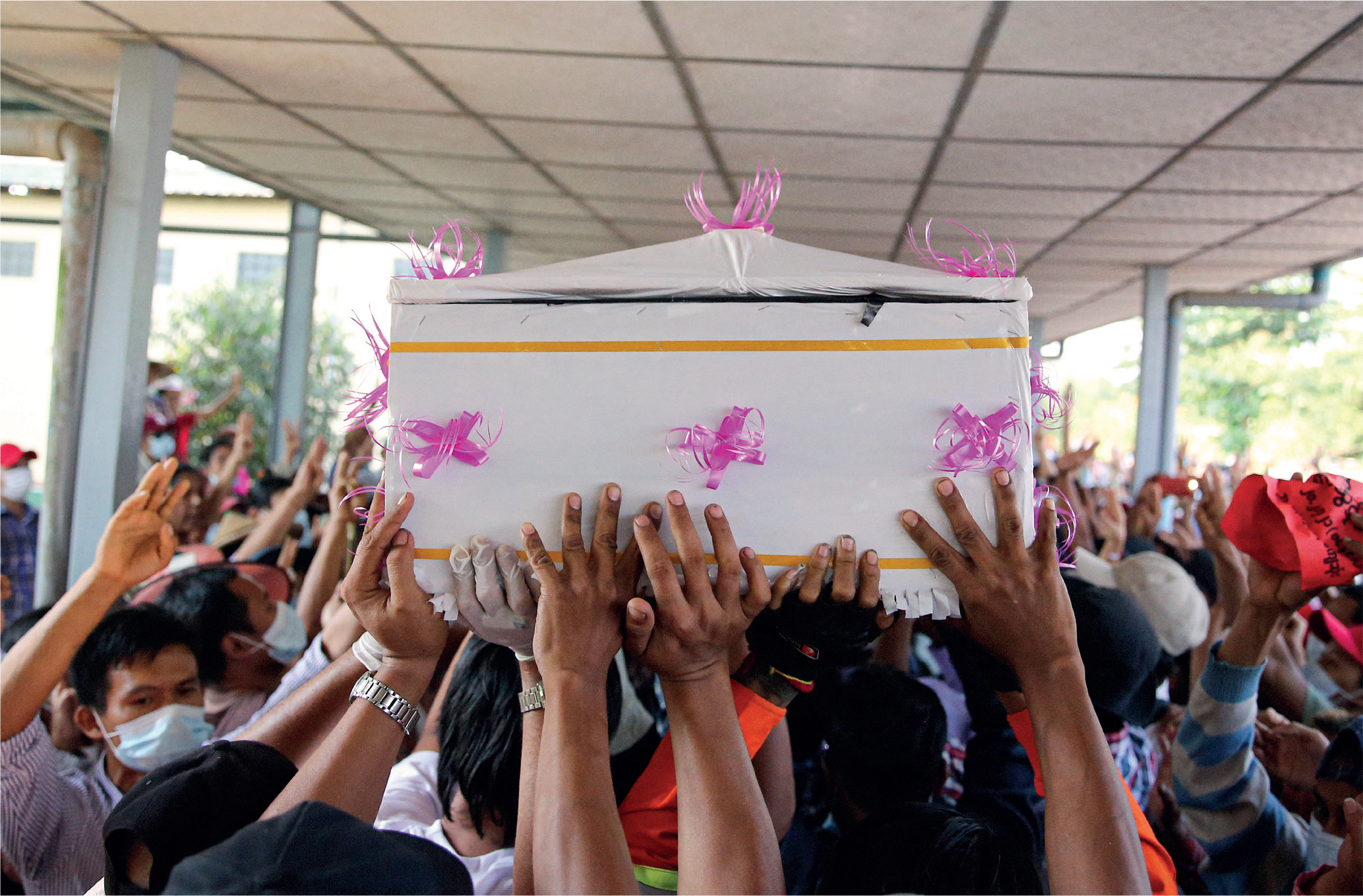
People carrying the coffin of Tin Htut Hein, a volunteer guard for a neighbourhood watch group who was shot and killed. The group was set up to address fears that the regime was using newly released criminals to terrorise citizens. 20 February.
Police forces block protests near the University of Yangon. 7 February.