




Abstract

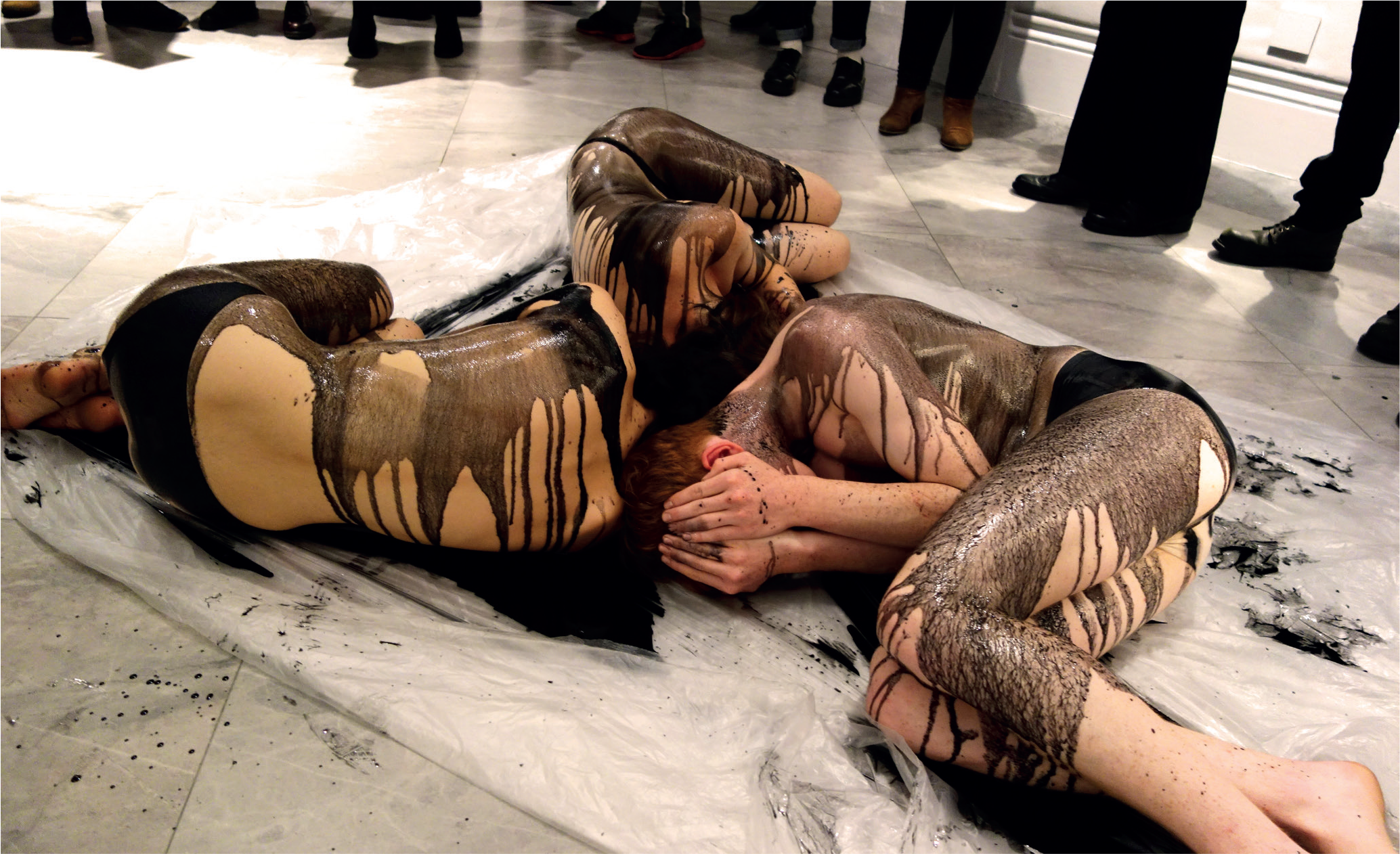
A protest against BP at the National Portrait Gallery in London
CREDIT: (main) Jamie Lowe; (Smith) Kelly Hill
One of our inspirations was the Indian novelist Amitav Ghosh’s 2016 book, The Great Derangement, which criticised literary fiction’s failure to address climate and ecological breakdown.
“It’s our job, as writers, to make imaginative leaps on behalf of those who don’t, can’t or won’t,” he wrote.
His book unsettled me. He was right that most fiction wasn’t rising to the occasion, but I wanted him to be wrong.
Then, in the early summer of 2019, I spotted a tweet by novelist Monique Roffey asking if there were any other writers concerned about the climate and the ecological emergency. I responded – and so did the novelist and academic James Miller. Our initial conversations revolved around how to engage our creative writing students and fellow writers on the biggest issue of our times. But our good intentions felt tame, so I called my younger son.
The previous year, at the age of 23, Raphaël Coleman had joined XR and found his tribe.
Raphaël – who played the role of Colin Firth’s unruly boffin son, Eric
Brown, in the 2005 film Nanny McPhee – was an early recruit to XR’s media and messaging team. Known in XR as Iggy Fox, Raphaël was active in XR Youth and he introduced us to screenwriter Jessica Townsend. Before we knew it, we were working within XR.
Monique, Jessica, James and I were soon joined by the Mexican novelist Chloe Aridjis, and by the time we had decided on a name our core group had expanded to half a dozen. We knew that if we could assemble enough writers we could be part of the upcoming October Rebellion, so we hit our contacts lists.
Soon, Naomi Alderman, Susie Orbach, Philip Hoare, AL Kennedy, Romesh Gunesekera and Ali Smith had signed up. Some of Britain’s top literary figures agreed to perform, unpaid, from a soapbox on an illegally held site. When Margaret Atwood sent us her blessings and agreed to appear on XR’s podcast with Jessica, we felt another shift. By now we had 40 writers for our three-hour event – and a waiting list.
The rebellion began. I met Raphaël the day before our event in a café on Charing Cross Road. He was evading the police. He sat on his phone, and advised me to do the same, as he told me in a low voice some of what he’d been up to – including running the team claiming Trafalgar Square, where we’d been promised a platform. Now we were not just mother and son but fellow rebels.
What we came to call The Marathon was a high-risk undertaking: a far cry from Cheltenham or Hay-on-Wye, and like no literary festival any of us had been involved in before. The crazy literary extravaganza included bravura performances from AL Kennedy, Salena Godden, David Graeber, Irenosen Okojie, M John Harrison, Simon Schama and dozens more.
Hundreds of people crowded onto the pavement to watch. The sun shone, and the police looked on, bemused. When it started to pour, we decamped to the shelter of an archway next to Waterstones, and the show went on.
Soon after, one of our most stirring performers, novelist Toby Litt, joined the core team, and the American novelist Jenny Offill contacted us asking how she could help. “Set up WR in New York,” we replied. And before we knew it, she, Elissa Schappell, Nick Laird and other writers had done just that.
By the new year, Toby, James and our new team member Beth Pitts, a freelance activist-journalist based in Ecuador (see her article on page 50), were building our website, commissioning blogs and scheduling the weekly newsletters which are central to our output.
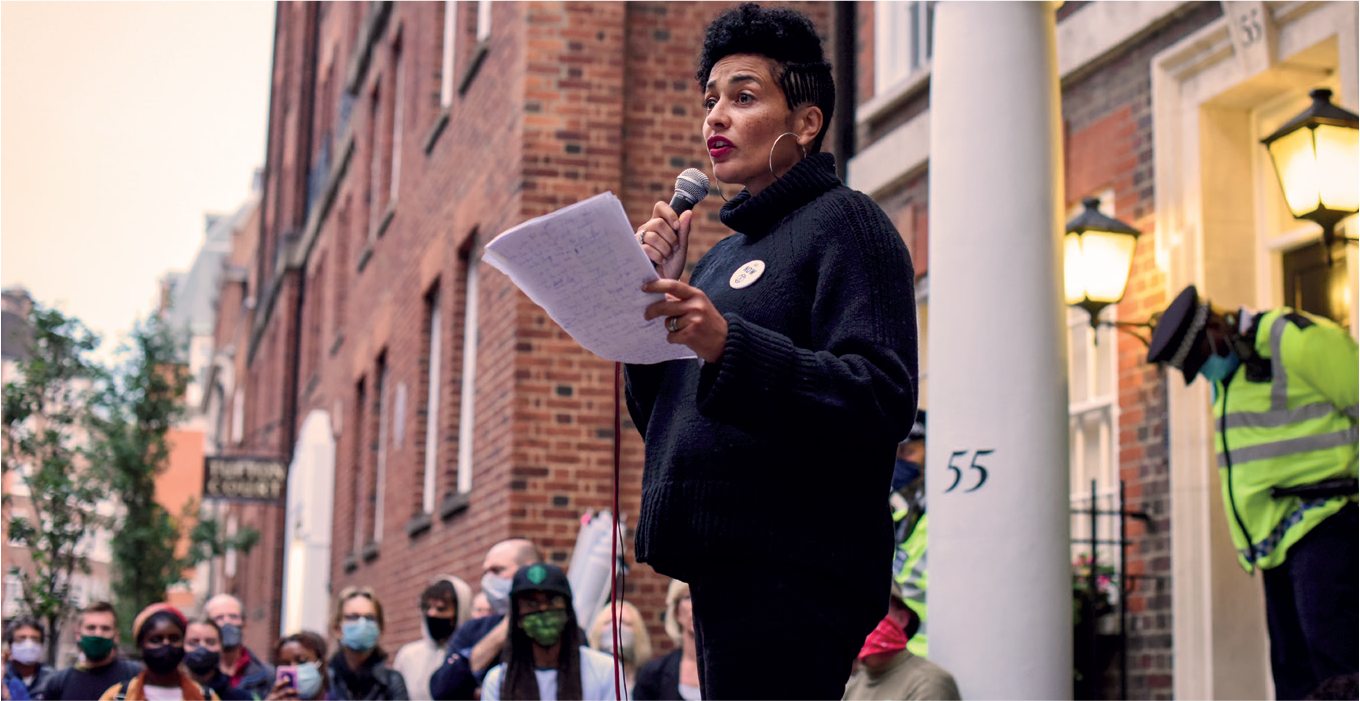
Author Zadie Smith speaks at an XR Writers Rebel event in London
The site’s launch, paired with the social media following built up by James, was a step-change for our group, and added excitement to our weekly Zooms.
As a small team of us began working on a Rebel Library as a resource for the site, Raphaël was expanding the wildlife workers’ network, The Wildwork, he founded as a student, and planning a documentary film about the all-female anti-poaching squads in South Africa and Zimbabwe. Everything felt like it was moving forward.
Then, shortly after his arrival in South Africa, Raphaël’s father phoned me unexpectedly.
Our son was dead.
He’d been running, and he’d collapsed. Later it emerged that his heart had failed due to a previously undiagnosed condition.
“I can’t even imagine what it must be like,” friends said when they heard the shocking news.
My honest answer, at the time, was “I can’t either”, because my imagination had failed. Even though I saw his corpse in the South African morgue and touched his cold, lifeless hand, I couldn’t imagine him dead. Until then, my biggest fear was that he’d be jailed for vandalising the Brazilian embassy in London some months before.
While we cremated him in South Africa, my colleagues at Writers Rebel joined hundreds of activists attending the vigil XR held in his memory in central London. They remained a vital connection to my sanity in the terrible months that followed. So did the knowledge that part of my healing would lie in honouring Raphaël’s spirit in every way I could.
In the blurred time that followed his death I read the blogs we published weekly on our site, such as Homero Aridjis’s scathing attack on a forest-despoiling tourist train line through Mexico and powerful addresses to juries by Jay Griffiths and Tom Bullough – part of a rich literary archive of defence statements that had been building since XR began. Their words gave me strength.
As more and more writers from around the world offered us their work, I came to feel that our little group had created something diverse, vibrant, committed and essential.
I wasn’t up to planning or participating in Writers Rebel’s next major event, which took place in October 2020, in collaboration with XR’s Money Rebellion. But the others were there in force, and it was another landmark moment. The protest readings were held in Tufton Street, in central London, home of fossil fuel lobbyists and denialist think-tanks. Zadie Smith, George Monbiot, Juliet Stephenson, Mark Rylance, Caroline Lucas and others gave hard-hitting speeches.
Raphaël Coleman at an XR protest at the Brazilian Embassy in London in August 2019
CREDIT: Terry Matthewssurname#
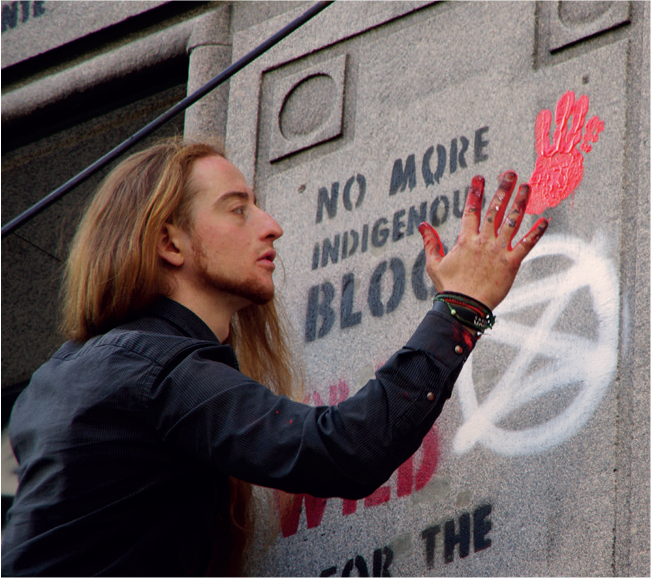
WR’s Jessica spray-painted the word “Lies” on one of the pillars of the building’s facade, and was arrested alongside Prof Rupert Read and XR founder Clare Farrell. They are due to appear in court on 28 October, charged with criminal damage. (You can support the Tufton Three at https://uk.gofundme.com/f/support-the-tufton-3)
A month later, to mark Lost Species Day, Chloe Aridjis, Kelly Hill, Paul Ewen and Alex Lockwood masterminded On the Brink, a huge international Zoom event highlighting endangered wildlife, featuring Margaret Atwood, Ben Okri, Lydia Millet, Amitav Ghosh and other stellar writers championing species threatened with extinction.
This year, On the Brink 2: Insectageddon focused on the crash of the insect population. Meanwhile, WR’s Amber Massey-Blomfield, Tamzin Pinkerton and Gully Niu have built a taskforce to work on a campaign to persuade the publishing industry to switch to 100% recycled paper.
We also decided to offer a service to our readers and the public in the form of online writing workshops with an ecological focus. The first of these, The Word For World Is Forest, featured masterclasses from Toby Litt, Charlotte du Cann, Laline Paull and the poet Dom Bury. Alongside it, we began publishing instalments of Toby’s incisive and essential primer, How To Write A Novel To Save The World.
In late June, to the surprise of Londoners, a huge green and yellow banner appeared on the River Thames, adorned with a two-line poem by Ben Okri grown in living grass by the artist-activists Heather Ackroyd and Dan Harvey. It marked the launch of our Paint the Land campaign, in which much-loved writers and prominent artists teamed up to create messages urging the delegates to the UN’s COP26 climate change summit to take action.
The creative team – Kelly Hill, Paul Ewen and I – hope the idea will take root elsewhere and become part of a grassroots global tapestry of geoglyphs.
A third On the Brink event focusing on ocean wildlife is scheduled for October, and our Rebel Library has just launched new monthly themed book lists, curated by librarian Matt Rose.
What has changed since WR began?
Although we can’t take the credit for it, there’s no doubt that the literary world is waking up to the crisis now that so many of yesterday’s dire scientific predictions have come measurably true. Fiction and the public imagination have always fed off one another – perhaps never more so than now.
At WR, we hope to be both a catalyst and a channel for that evolution.
But those in power are slow to shift their thinking – or refuse to shift it at all.
Today’s climate censorship is a shapeshifter. Yesterday’s denialists are today’s green-washers and purveyors of delayism. Nobody is gagging us, but with so many toxic truths dominating the public conversation, the struggle is for a space to be heard.
In July, almost 18 months after his death, the jury trial of four of Raphael’s fellow activists was presided over by Judge Perrins in Southwark Crown Court – the same judge whose advice was ignored by a jury the previous month when they acquitted seven XR rebels for vandalising the Shell HQ.
Humiliated by the Shell Seven, the judge’s advice to the Brazilian embassy jury was more specific and stringent. As a result, three of the four who appeared in court were found guilty. A fifth was self-isolating and is still awaiting trial.
The guilty verdict made me think that historians will look back on this era and note its defining paradox: that while the public was increasingly occupied with the dangers ahead, those in power were either in active denial, busy plotting how best to profit from a range of oncoming disasters, indifferent or – at best – doing far too little, far too late.
But those same historians may also note that today’s storytellers, inspired by solid science and the evidence of their own eyes, have begun to reclaim the power of the prophets and seers of past ages by resuming their almost forgotten role as the cognitive avant-garde. And that, collectively, we bear a vital message summed up best by what Raphaël planned to say at his trial: “There is no greater cause to stand for on this green earth than the green earth itself.”
