




Abstract

One paragraph in my piece read: “To refer to the classics, like the Bacchae in Euripides, they lose the shackles of civilisation, connecting to deep, repressed parts of the human psyche that needed expression and recognition.”
In more than 200 online comments I was pilloried as a psychopath, a sociopath, an idiot who should be in prison and a disgrace to my father and the Jewish people.
Some excoriated The Sunday Times for publishing the article. Others said they had cancelled their subscriptions. Among my detractors was a lady who wrote: “This made me cringe – especially the part about the Bacchae. What next? Rapists are fine because of Zeus and Europa?” “Sod the Bacchae,” another added.
But in the Bacchae, I believe, lies a good explanation for the phenomenon of football hooliganism.
Is there a lost ritual that has allowed football hooliganism to develop and thrive?
A healthy society recognises the need for its members to access coping mechanisms that help them survive the controls necessary to make that society function. Confident, open societies license certain drugs and activities, the panem et circenses which allow their members to let off steam.
Less confident, oppressive societies outlaw them. The Taliban recently humiliated and executed the comedian Nazar Mohammad, better known as Khasha Zwan, after a video emerged of him being abused by them. (Dictators don’t like being laughed at, as exiled Soviet poet Osip Mandelstam discovered.)
As a warning to overly rule-bound societies, The Bacchae, Euripides’s remarkable final play, first performed in Athens in 405 BCE, supplies the urtext. Dionysus, god of wine and other ecstasy-inducing substances and activities, arrives from Asia attended by his band of Bacchae (also known as Maenads), female revellers high on the drink and dance integral to his rites.
In Thebes they are confronted by the city’s ruler, King Pentheus, who is deeply alarmed to see the citizens of Thebes, members of his own family included, drawn into this rowdy cult.
Pentheus arrests Dionysus, who is disguised as a stranger, but the god’s magic is too powerful for a mortal ruler to contain. Dionysus, sometimes known as Lusios (the liberator), frees himself and destroys the king’s palace with earthquake and fire. He then asks Pentheus if he would like to see what the Bacchae get up to on Mount Cithaeron.
Pentheus cannot contain his voyeuristic curiosity. With little encouragement, he dresses up as a woman so he can pass himself off as one of the Bacchae and spy on their activities. Once on Cithaeron, Dionysus leads Pentheus to a horrific fate – torn limb from limb by Bacchae led by his own mother, Agave.
Russian and Polish fans fight at Euro 2012
CREDIT: Peter Andrews / Reuters / Alamy
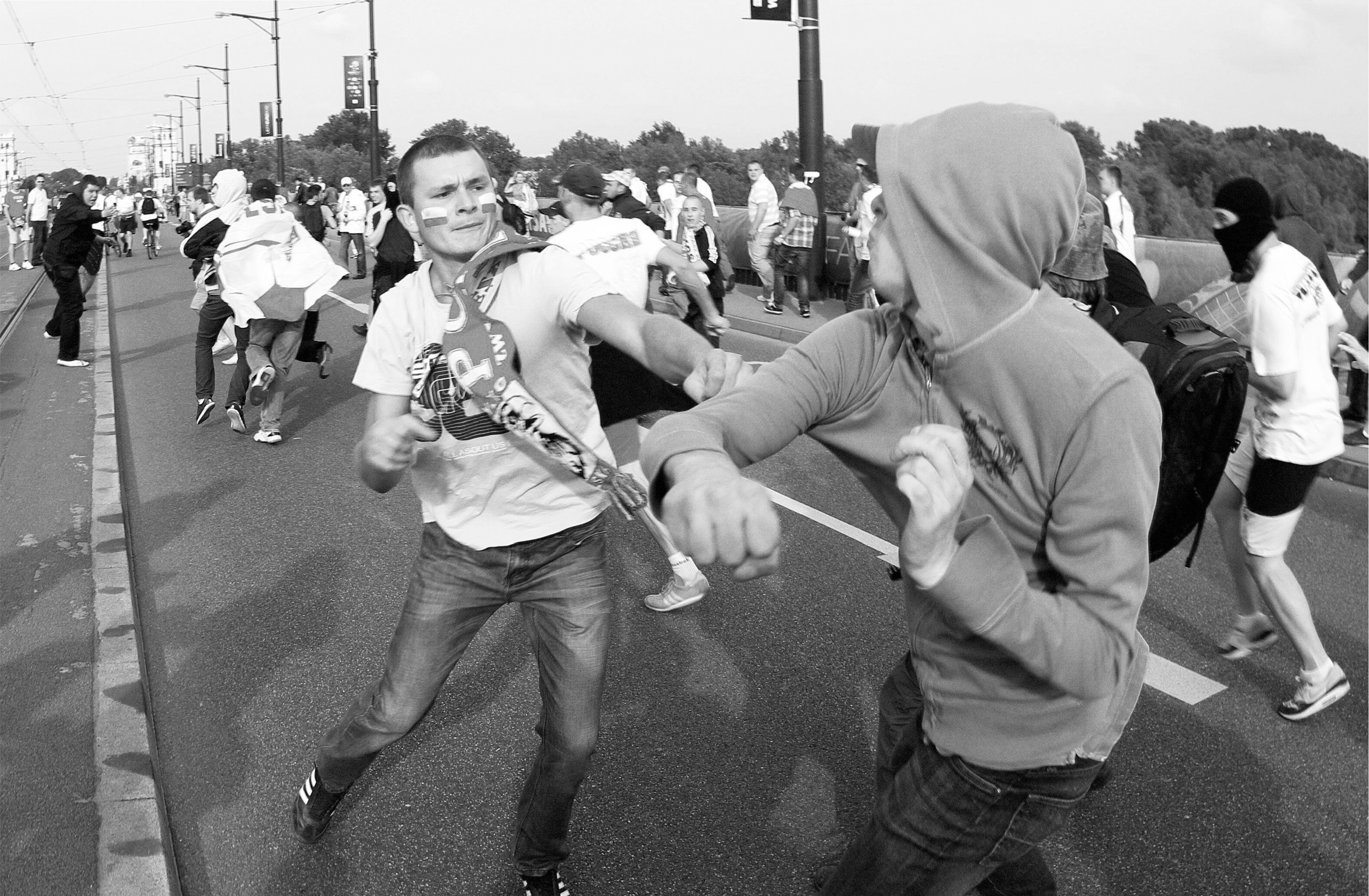
Dionysus represents the ecstatic, anarchic element of the human psyche that one suppresses at one’s peril. In The Bacchae he is nature, red in tooth and claw. It is telling that his destruction of Pentheus and what he stands for – man’s attempt to control not only the behaviour of men but nature itself – is initiated with the uncontrollable natural phenomenon of an earthquake.
Dionysus’s terrible vengeance on the symbol of law and order in The Bacchae – Pentheus, King of Thebes – is a warning to all who would repress the outlets needed to survive social repression. The Bacchae’s message is that anarchic, ecstatic behaviour, at least in a limited form, should not be discouraged, and certainly not stamped on. It is part of who we are.
Let us drink, dance and play the tambourine. If not, we might start indulging in genuinely anti-social behaviour, such as tearing people apart or fighting at football matches.
Football hooligans, their antics often fuelled by drugs and alcohol, have a lot in common with the Bacchae.
The police, representatives of law and order, are a sworn enemy.
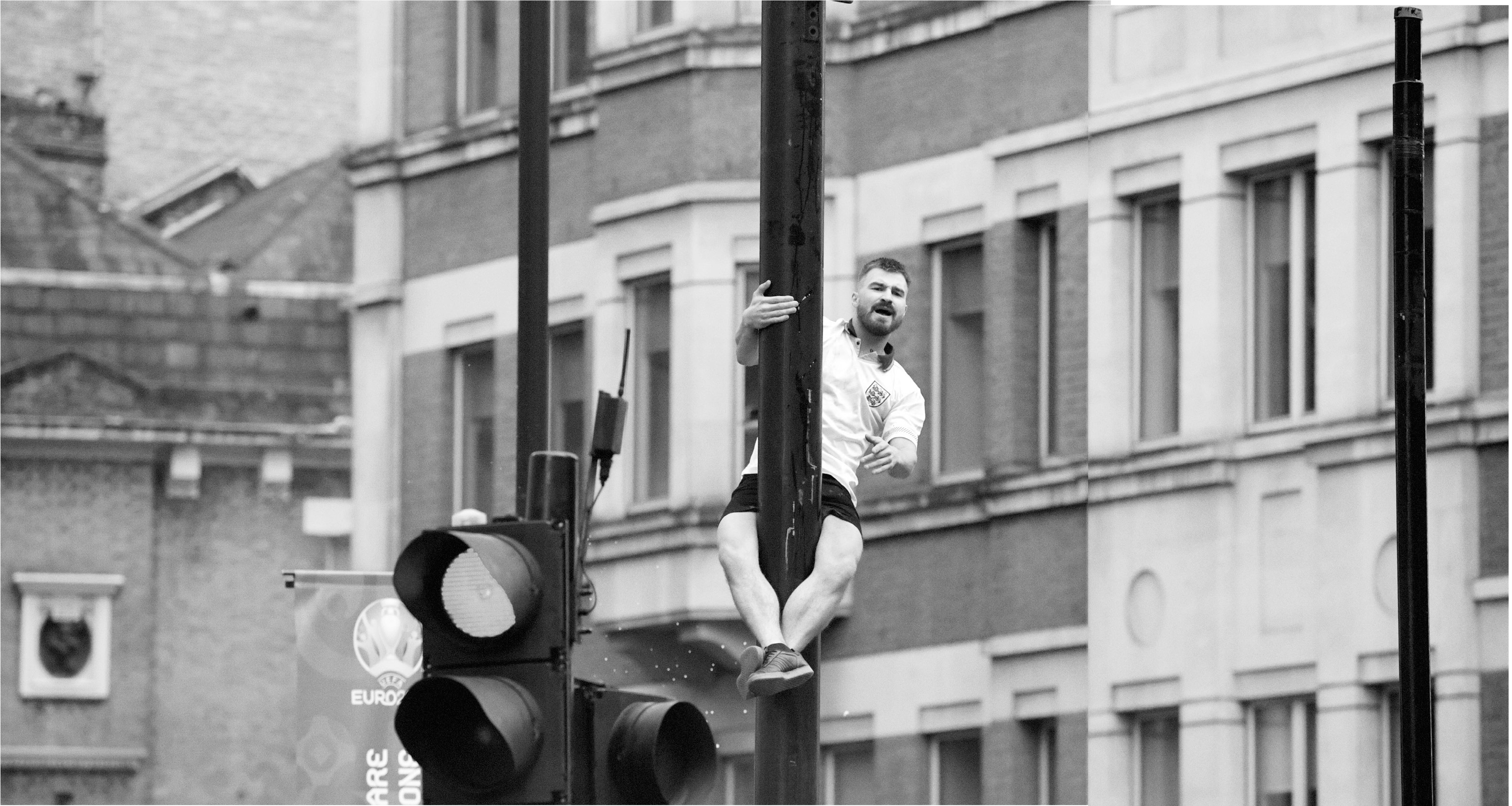
An England fan ascends a lamppost in Leicester Square, before the Euro 2020 final, July 2021
CREDIT: Ian West / PA Images / Alamy
In turn, the police regard football hooligans as a criminal, anti-social element to be repressed and imprisoned.
In the UK, those involved in football violence receive more severe sentences than those breaking the same laws in a different context, such as at the pub on a Saturday night.
Football hooligan conspiracy (arranging a fight in advance) is met with especially severe penalties. A Burnley hooligan received a five-year sentence for organising a fight with rivals that did not even take place!
Conspiracy is redolent of secretive, underground societies. The mysteries of cults, from the Bacchae of Asia to the Millwall Bushwackers, make them seem more dangerous and troubling still to non-initiates such as Pentheus and the police.
ER Dodds, the great Greek scholar and commentator on Bacchae, distinguished between the black, destructive Maenadism practised by the Bacchae in Thebes as a consequence of repression – “a punishment upon the too respectable” – and the white Maenadism of ordered ritual described in the choral ode at the beginning of the play, which he believed was derived from an actual Bacchic hymn sung by celebrants.
Oh
Blessed is he who, happy one,
knows the rites of the gods,
lives purely and
initiates his soul in the Bacchic revels.
The Tarantism of Puglia – arguably a direct descendant of the Dionysiac rites practised by that region’s locals at the time Bacchae was written – might also be seen as a ritual catharsis conducted according to certain rules and customs.
Taranta culture evolved in medieval times as a cure for people, usually women, who had apparently been poisoned by the tarantula bite.
Most researchers in the field have concluded that there never was a spider. These were women suffering from depression in a patriarchal, repressive society, their symptoms relieved by dancing to an ecstasy-inducing rhythm.
Watching Taranta, Gianfranco Mingozzi’s extraordinary 1962 film documenting the final throes of the tradition, you also see how ritualised the process of curing afflicted women was.
The band plays set melodies, the woman mimics the movements of the spider that supposedly bit her and an icon of St Paul, patron saint of the tarantulas ever since the tradition was commandeered by the Catholic church, oversees proceedings.
Each year, on 29 June, those suffering from this illness – known as tarantism – gathered to be cured in the Church of St Peter and St Paul in Galatina.
As the society that gave rise to it became more enlightened, the tradition died, and its music has become an entertainment.
Performing it in London clubs with my group, Amaraterra, one sees how joyful it makes people looking for release from the stresses of modern urban life today. It is a safety valve, offering brief, harmless escape from an over-ordered society.
But ecstatic dance in an uncontrolled, non-ritual environment, as with the Bacchae, has historically led to dance crazes, such as those of post-Depression America and 14th century Germany following the Black Death.
Like football hooliganism, they are what Dodds would call black Maenadism. Some football thugs even refer to fighting as “dancing”.
Is there a lost ritual that has allowed football hooliganism to thrive? It started to evolve around the time National Service was no longer obligatory – an environment in which young, testosterone-charged men had their aggression channelled in a ritualised, disciplined way. Is that a coincidence?
Dodds wrote: “If I understand early Dionysiac ritual aright, its social function was essentially cathartic, in the psychological sense. It purged the individual of those infectious irrational impulses which, when dammed up, had given rise, as they have done in other cultures, to outbreaks of dancing mania and similar manifestations of collective hysteria; it relieved them by providing them with a ritual outlet.”
Ritual is, arguably, another form of social control, but by channelling hysterical and destructive impulses, it provides a harmless outlet for them.
Football hooligans, their antics often fuelled by drugs and alcohol, have a lot in common with the Bacchae
My Sunday Times article was intended not only to challenge its readers but to provoke their curiosity.
Interestingly, as well as receiving a shoal of negative, mostly ad hominem, criticism, it was also the fifth most-read article in the paper that day.
“It’s left me feeling strangely odd – part disgusted, part despairing and part weary. It’s rare to get a glimpse inside the mind of the type of person I despise, and I’m now feeling like I should have a hot shower and scrub myself clean. No thanks to the Times team for this one,” wrote one lady, perhaps a latter-day Pentheus curious to get a glimpse into an elemental part of herself that she would rather was left untouched.
Some were critical of The Sunday Times for publishing my article at all. Was I saying the unsayable? Is it better not to dig too deeply into those areas of ourselves, for fear we may stumble upon an elemental place that the rule-obeying part of our psyche is unable to control?
Dodds was in no doubt. “To resist Dionysus is to repress the elemental in one’s own nature; the punishment is the sudden complete collapse of the inward dykes when the elemental breaks through perforce and civilisation vanishes.”
As someone replying to the shower lady pointed out: “If it is true, it shows what civilisation is up against.”