Abstract

Index has a long history of promoting the work of dissident playwrights, writes
Around the world, stages were empty, actors out of work. And yet some still managed to keep the flame of theatre alive even during the worst of times. The Winter 2021 edition of Index is a tribute to them.
Index has a proud history of supporting the theatre of resistance and this issue marks our determination to continue the tradition. The centrepiece of the magazine is a profile of long-time Index collaborators Belarus Free Theatre by the celebrated theatre writer and Index trustee Kate Maltby. BFT have long played a central role in resistance to the Lukashenko dictatorship and we are pleased to have been able to work together on a project to publish letters from dissidents held in Belarusian prisons over the past year.
We are delighted to publish Turkish playwright Meltem Arikan, who found refuge in the UK after being forced out of her home country by the Erdogan regime. Following the performance of Arikan’s play Mi Minör, she was accused of sparking the Gezi Park protests in 2013. She writes for us about her continuing struggles, particularly after being diagnosed with autism.
Jonathan Maitland discusses his experience of censorship and the limits of free speech on the stage in the UK.
We also publish Muzzled, a new work by Iranian playwright Reza Shimarz written exclusively for Index as a response to Samuel Beckett’s Catastrophe, published in the magazine in 1984.
The situation in Afghanistan for writers, artists and journalists continues to be of great concern since the fall of Kabul in August. In the light of developments, Afghan journalist Zahra Nader, now based in Canada, calls for responsible reporting of her country by the Western media and highlights the brave work of the women journalists of Rukhsana Media, who continue to report from the country.
We also publish an extract from Hamed Amiri’s memoir, The Boy With Two Hearts - now turned into a drama - which tells the story of the family’s flight from the Taliban when Amiri’s mother, Fariba, gave a speech calling for freedom for Afghan women.
Elsewhere, Jemimah Steinfeld interviews the Hong Kong activist Nathan Law, now exiled in the UK, about his new book, Freedom, with an extract from it published alongside.
John Sweeney asks why the Nobel Peace Prize was not given to the Russian dissident Alexei Navalny and we continue our partnership with Carcanet Books with a selection of Amharic poetry from Ethiopia.
This is my fourth and final edition as editor of Index on Censorship. I have been proud to work on a magazine I have read since I first visited eastern Europe as a young journalist in 1989. I deliver it back into the capable hands of Jemimah Steinfeld as it enters its 50th year of publication.
Burning desire
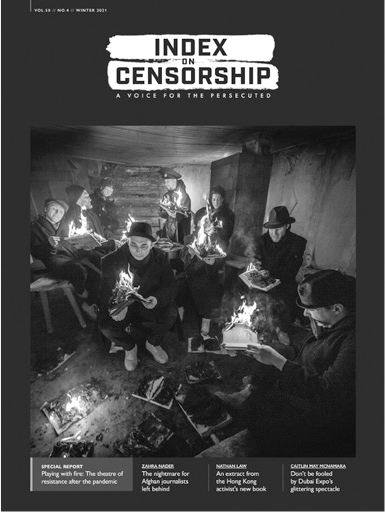
The photograph on the cover of this issue of Index has a distinctly painterly feel to it, reminiscent of Rembrandt’s Night Watch or a Dutch Golden Age tronie. Yet the work is contemporary, showing actors with the banned theatre group Belarus Free Theatre as they prepare for a production of Dogs of Europe. It is based on the novel by Alhierd Bacharevic, widely considered one of the country’s most important literary works; it offers a powerful warning about the corrupting influences of dictatorship. The photo was taken by Mikalai Kuprych under the eye of BFT’s artistic director and co-founder Nicolai Khalezin.
CREDIT: (cover) Mikalai Kuprych, Belarus Free Theatre