




Abstract

It’s not just pens and notebooks that journalists need in the USA, reports
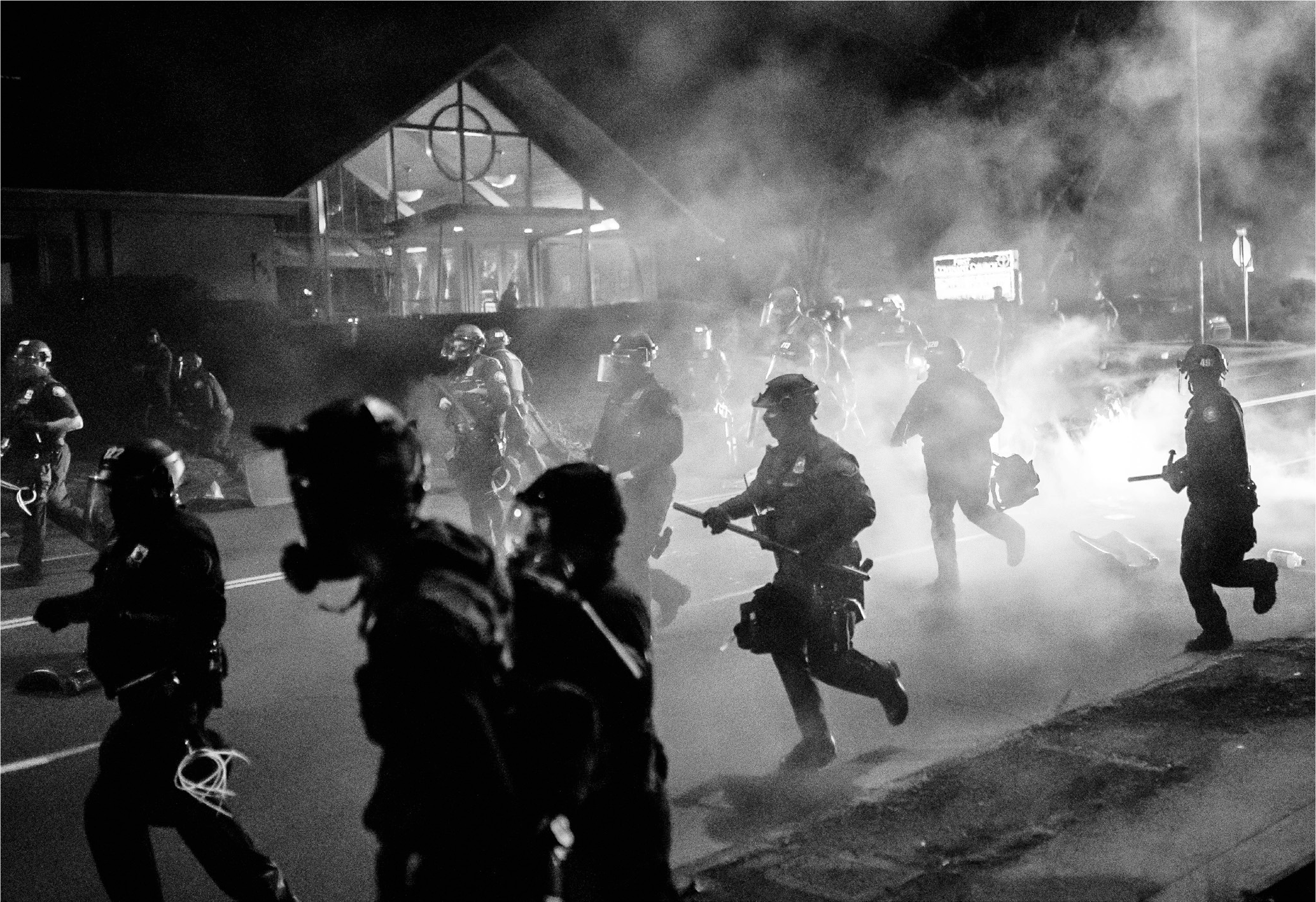
Another night, another protest in Portland. This time, on 12 April 2021, the murder of Daunte Wright, 20, led to conflict between police and demonstrators.
CREDIT: Nathan Howard / Stringer / Getty
With protesters, police and spectators all carrying guns, reporting conditions can be as risky as those for war correspondents, according to one newspaper editor.
The idea that journalists are there to report demonstrations impartially is disappearing fast as protesters, from both the left and the right, turn on them, signalling that they believe the press is the enemy.
“We became conflict journalists in our own city,” said Therese Bottomly, editor of The Oregonian, a daily newspaper in Portland, the biggest city in Oregon, which has been one of the hotspots for protests - often ending in violence - throughout 2021.
“I think covering any event where weapons are openly displayed may require US journalists to think in ways we have not before about safety.”
Portland’s demonstrations have covered everything from Black Lives Matter to immigration to anti-vaccination rallies. They often involve confrontations between protesters and the police who, in some cases, have been supplemented by the National Guard. Buildings have been set on fire, with clouds of tear gas billowing around the city night after night as demonstrators meet lines of heavily armed law enforcement officers carrying AR-15 style weapons and munitions launchers.
Editors such as Bottomly have been forced to rethink their approach to staff safety. She said: “We initially were most concerned about protection against tear gas-type agents so provided gas masks, goggles and the like. Several of our journalists were struck by police batons or police-fired munitions as they were trying to disperse protesters.
“We had safety conversations every night and the editor on duty repeatedly encouraged our journalists to put safety first, maintain awareness, have an exit strategy.”
And she said The Oregonian’s journalists did not have to cover stories where they feel unsafe.
“We purchased six ballistic vests to go with the helmets most of our journalists were already wearing,” said Bottomly. “Several times we engaged outside security guards to accompany journalists and provide an extra set of eyes and ears to keep them safe.”
For one protest near the state capital of Salem, the paper rented several motel rooms as a “safe harbour” for journalists.
While some might imagine that tension has decreased since the inauguration of Joe Biden as president, on the streets in key cities across the USA it remains high.
At the time of going to press, the US Press Freedom Tracker reported that of the 134 assaults on journalists it has documented in 2021, 105 of those are related to protests.
Journalists have had thousands of dollars-worth of equipment stolen. They have been kettled and restrained, beaten and chased down streets. They have also been tear-gassed by police but have also had to call the police to hold off crowds throwing things at them.
Index spoke to journalists in Washington, Los Angeles, Michigan and Portland about the violence they have been facing this year.
In July, photojournalist Eric Levai had $1,000-worth of equipment stolen when masked people turned on him while he covered a transgender-rights protest in Los Angeles.
Levai, who works for the Daily Dot website as well as hosting a podcast, told the US Press Freedom Tracker website that he heard a shout before being charged and having his backpack containing a gas mask, goggles and a tripod snatched by seven or eight people.
“Protest coverage remains risky,” Levai told Index, adding that he worries about wearing media ID while working. “Sometimes it’s safer to wear it but sometimes not.”
Reporter Joey Scott, who freelances in LA, is also wary of what can happen at protests, and he teams up with a friend for safety.
He told Index: “Despite the temporary restraining orders against police, they seem more than eager to harm protesters. [The police] will be investing in millions of dollars of training to better use less-lethal weapons and to infiltrate/surveil protesters. This will all most likely be used against the press in some way. They will also be changing tactics, though in what ways it is unclear, in terms of managing protests on the ground.
“When I feel there may be confrontation at a protest or rally, I pack my helmet and goggles. If I find it may be particularly confrontational, I pack my plate carrier [protective vest] to protect myself from any less-lethal rounds. I still feel unsafe out there at the moment.
“The adversarial relationship between the press and police still remains the same. That said, our state just passed a bill - SB98 - that allows the press to remain at a riot/protest/ unlawful assembly without arrest. That has not been tested in the real world yet and I imagine cops will find a way to invalidate who a member of the press is or find another excuse to arrest us. Lately, cops have been pointing their flashlights into cameras and being as confrontational as possible.”
Marcin Wrona, a bureau chief in Washington, DC, for Polish TV channel TVN Discovery, has worked in the USA for many years. He said there had been significant changes in the past year.
“I can see that the hostile attitude towards the press is more and more obvious, or more visible; it’s easier to get yourself in a difficult situation today than, let’s say, a decade ago,” he said.
Wrona’s TV crew was attacked at a Black Lives Matter protest and had insults hurled at them during the attack on the Capitol on 6 January. In July, while covering a protest in Lafayette Square, Washington, the crowd turned on them and started to damage their equipment, throw things and threaten them, forcing them to abandon filming and flee the scene as demonstrators chased them. Police officers on bicycles came to their aid.
“Those three instances show me that people do not care what country you are from, what you are reporting about, how truthful you are, or whatever,” said Wrona. “No, it’s just enough to be a member of press to have a big target on your back.”
He said the threats against journalists at protests were already affecting reporting. “When you have to watch your back all the time, and when you know that getting in the centre of developments may be dangerous, then you have to make a decision: ‘OK, am I risking everything or not?’ And of course, it influences reporting. I mean, there is no doubt about that.”
A photographer captured in direct confrontation with a protester in Washington DC on 6 January 2021, the day the US Capitol was stormed by supporters of Donald Trump
CREDIT: Al Drago / Stringer
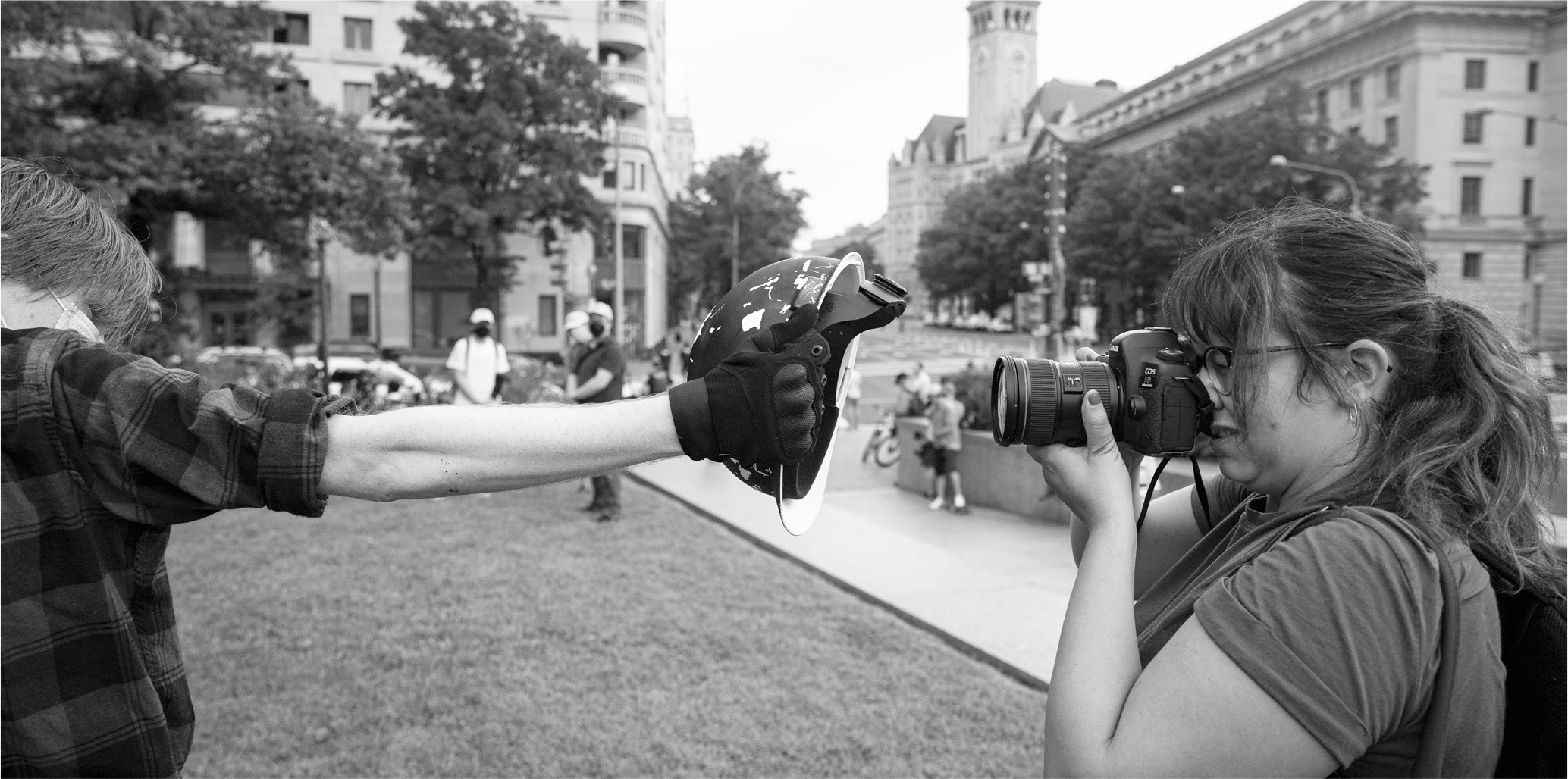
Part of the problem, he said, was that people were impersonating journalists by wearing press badges and media helmets, and that ramps up antagonism. “The word ‘press’ is now used not only by us.”
Wrona, who has covered many protests including huge anti-war rallies during the George W Bush presidency, said the atmosphere towards the media had never been like it is today. He has now removed his address from his business cards and takes more safety precautions when preparing to cover a march or protest.
Some TV crews, although not his, are now working with security guards, which can affect reporting because it might deter people from talking to journalists.
He said the anger on the streets mirrored some of the narratives in the media. “Some of the news outlets are kind of chasing their audience, which is becoming more and more polarised, and then the audience is watching only things that they agree with, but those things are polarising them even more.”
Journalists working in small towns have also experienced changes. In August, Eric Baerren, a reporter in Mount Pleasant, Michigan, was covering a school board meeting about mask wearing. Afterwards, a parent asked him to remove photos from his camera. The parent tried to grab his phone and kick his camera out of his hand and police were called.
“It’s a very difficult environment for journalists in this country right now.” Baerren said.
The US Press Freedom Tracker has detailed other tactics used against journalists covering protests, including eggs being thrown and umbrellas being opened in front of TV crews and photographers to impede their work. And journalist Alissa Azar was chased and beaten by a mob of the far-right group the Proud Boys in Olympia, Oregon.
Kirstin McCudden, managing editor of the US Press Freedom Tracker, said: “In Portland, there were more than 100 nights in a row of protests. And from that, we saw multiple journalists assaulted, arrested and equipment damaged multiple times.”
These sorts of attacks have been recorded across the USA. She said the rise in incidents against reporters had happened as distrust in the media had risen. And while that distrust used to be embedded in only certain sections of society it is now widespread. “It’s everybody,” she said.
With the Pew Research Centre showing that trust in the media is at an all-time low, McCudden said “it follows that media is in the crosshairs time and again”.