




Abstract
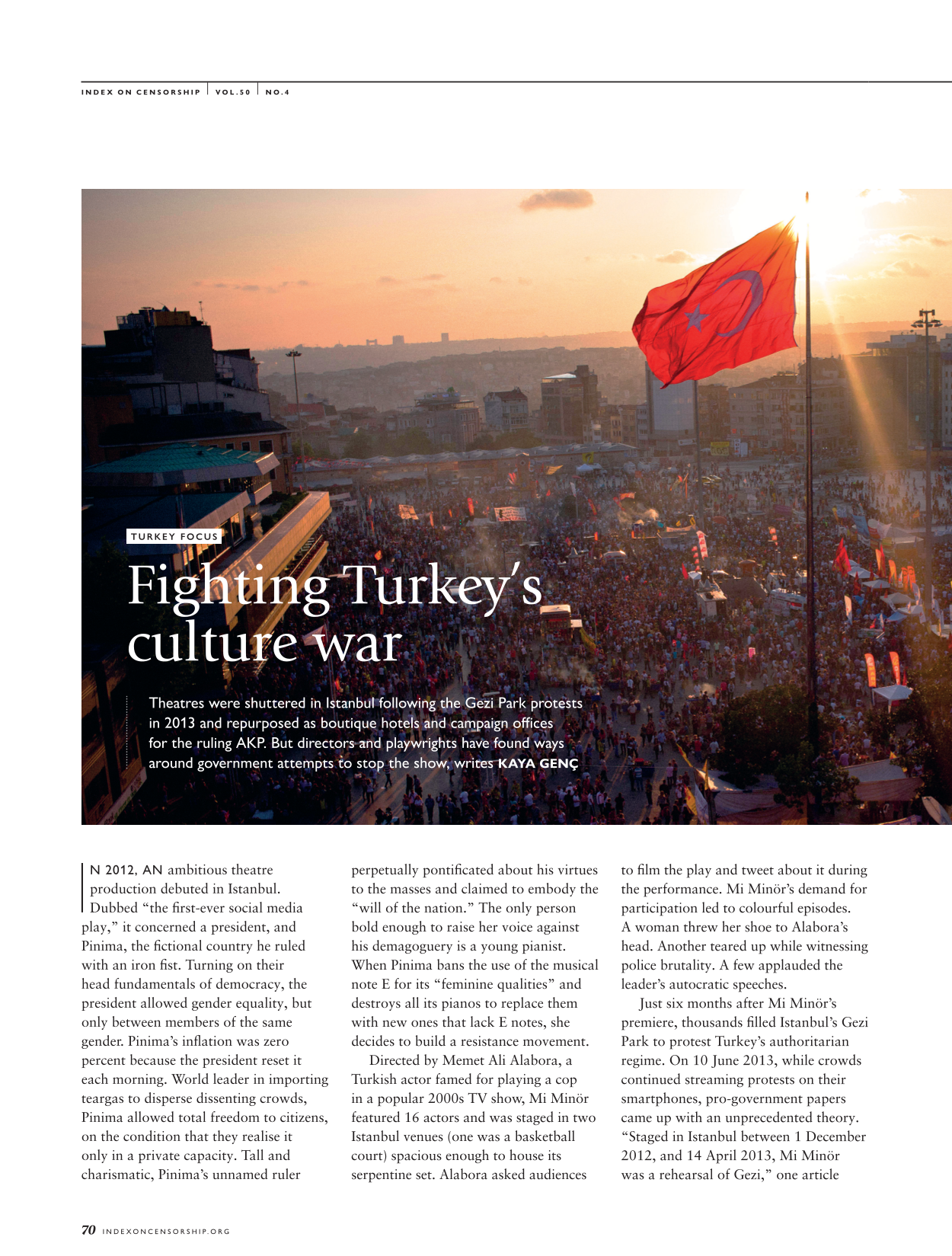
Theatres were shuttered in Istanbul following the Gezi Park protests in 2013 and repurposed as boutique hotels and campaign offices for the ruling AKP. But directors and playwrights have found ways around government attempts to stop the show, writes
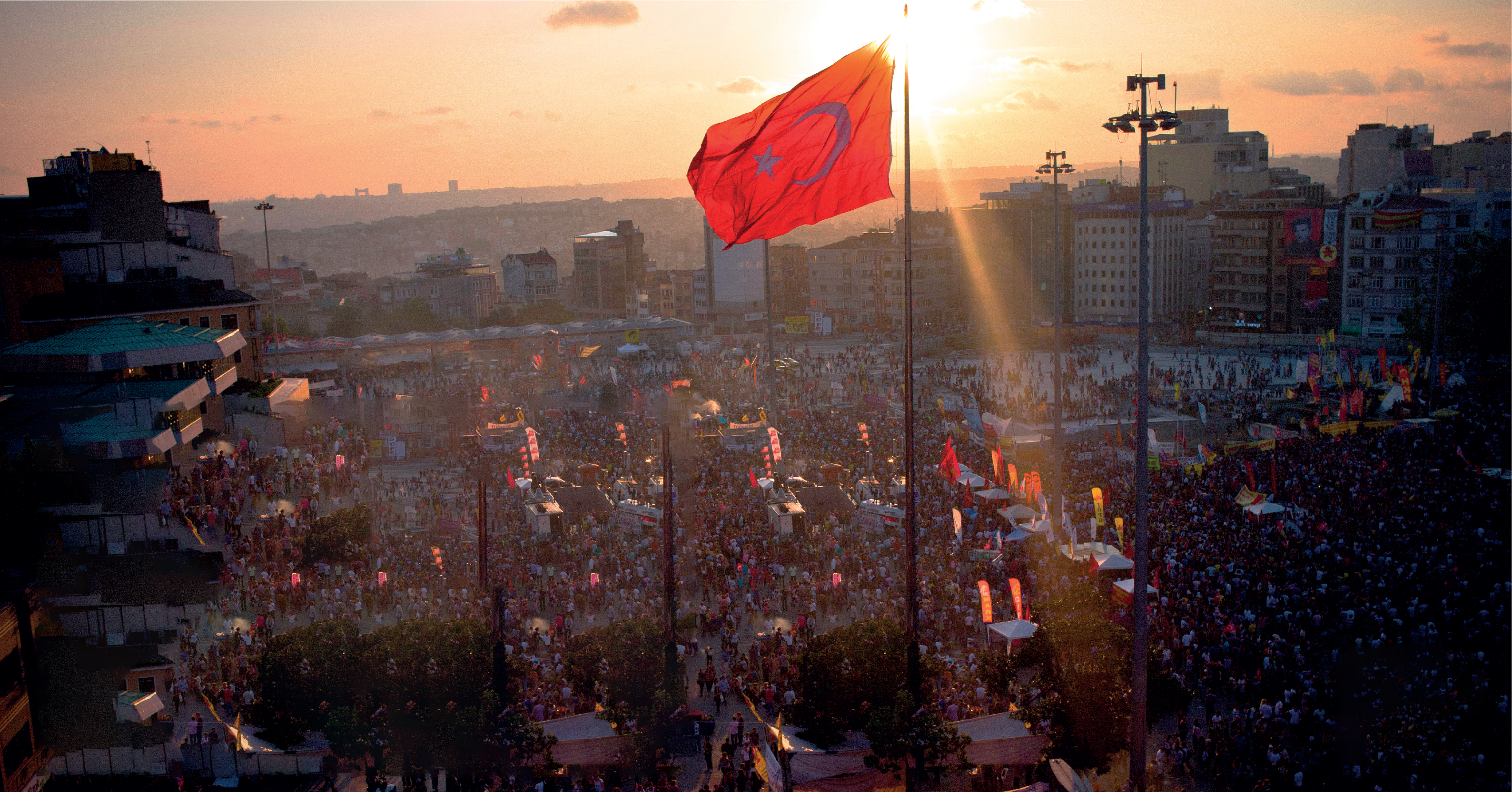
PICTURED: Protesters crowd Taksim Square, Istanbul, during the Gezi Park uprising in 2013.
CREDIT: Jordi Boixareu/The Passenger/Alamy
Directed by Memet Ali Alabora, a Turkish actor famed for playing a cop in a popular 2000s TV show, Mi Minör featured 16 actors and was staged in two Istanbul venues (one was a basketball court) spacious enough to house its serpentine set. Alabora asked audiences to film the play and tweet about it during the performance. Mi Minör’s demand for participation led to colourful episodes. A woman threw her shoe to Alabora’s head. Another teared up while witnessing police brutality. A few applauded the leader’s autocratic speeches.
Just six months after Mi Minör’s premiere, thousands filled Istanbul’s Gezi Park to protest Turkey’s authoritarian regime. On 10 June 2013, while crowds continued streaming protests on their smartphones, pro-government papers came up with an unprecedented theory. “Staged in Istanbul between 1 December 2012, and 14 April 2013, Mi Minör was a rehearsal of Gezi,” one article claimed. “New information has emerged that casts doubt on the innocence of Gezi protesters, who are funded by the interest lobby in their attempt to turn protests into a global operation.”
A concerted campaign to intimidate Mi Minör’s crew forced Alabora to fear for his safety. Fleeing the country, he moved to Britain. After a court order for his immediate arrest in 2018, he’s unlikely to return. Mi Minör’s author Meltem Arıkan, charged with toppling the government, settled in Wales (you can read her story on page 73).
In the years following Mi Minör’s debut, Turkey’s theatre world remained defiant while licking its wounds.
Thirteen different theatre venues in Istanbul’s Beyoğlu quarter, once filled with eager audiences, have pulled the shutters down, 10 shortly after Gezi’s suppression. “You could walk from Taksim Square to the tail end of Istiklal Avenue and spot a theatre in every corner,” recalls Bahar Çuhadar, theatre critic for Turkey’s leading daily Hürriyet.
Most of these venues were in former car repair shops and carwashes, laundries, dusty photography studios, former caravanserais, or inns. Nowadays, Olivia Han had been turned into a boutique hotel, and Rumeli Han, sold off. Taksim Stage, one of Istanbul’s beloved theatre venues, famed for its medium-sized stage and central location, was repurposed as a party campaign office for the ruling AKP. It later became a Sofitel hotel. “People stopped frequenting Beyoğlu as it turned into a centre for shopping and tourism,” says Çuhadar.
By the time Çuhadar started her career a decade ago, the view was different. She witnessed the birth of a new theatre climate in Turkey when her first review appeared in the leftist newspaper Radikal in July 2011.
“In 2010, independent and alternative theatres had blossomed. Not funded by Ankara or local municipalities, these small theatres supported themselves through ticket sales and began mushrooming in every corner.” These groups resembled Europe’s off-fringe theatre companies: “they were avant- garde, experimental, even revolutionary.”
Spearheading the movement was DOT, a private company founded in 2005 by Murat Daltaban, Süha Bilal, and Özlem Daltaban. DOT quickly built a reputation with a flurry of in-yer-face plays, a genre that had already dated in Britain but was eagerly received in Turkey. Numerous English plays, freshly translated to Turkish, were staged in Istanbul’s new black box stages.
Audiences who once abhorred theatre because of cumbersome, traditionalist plays now savoured the intimacy of small apartments where they watched passionate actors in their daily outfits arguing or kissing just a foot away. “There was a new language, a revolution in how actors interacted with audiences,” says Çuhadar. “They talked about the most intimate, taboo subjects, like domestic violence or incest.”
The founder of London’s Arcola Theatre, Mehmet Ergen, was a key figure. His adaption of Lucy Kirkwood’s It Felt Empty When the Heart Went at First But it is Alright Now, first staged in 2011, won critical acclaim. DOT’s adaptation of David Ives’s Venus in Fur turned into another box-office hit. Sarah Kane and Mark Ravenhill became household names among theatre lovers.
But soon, audiences became uneasy about this wave of imported plays. “We said: ‘Enough with John and Mary’s problems. Tell us something about our people!’ It felt like constantly watching dubbed films,” Çuhadar recalls. Local playwriting flourished in response. Sharing features of the in-yer-face style—tonally direct and attempting to grab audiences by the scruff of the neck to communicate their message— that emerged in the 1990s these plays pondered taboo topics: homosexuality, draft evasion, suppression of Minorities, and others. Kurdish playwright and director Mirza Metin’s Disko Number 5, for example, told torture sessions in Diyarbakir in the 1980s. This renaissance of a theatre of resistance was exciting but by no means unprecedented: plays by Melis Cevdet Anday or Adalet Agaoğlu also tackled similarly sensitive themes in recent past. “It was the tone of these new plays, what I call Turkish in-yer-face, that was different,” says Çuhadar.
Still, these plays largely refrained from tackling Turkey’s contemporary problems openly, instead excavating stories of inequality and violence from Turkey’s past, when the secularist CHP, or military juntas ran Turkey.
But alarm bells rang when, in February 2012, the Turkish government came up with a “Turkey Art Council” project which planned to close down all state and municipality theatres. Claimed to be based on Arts Council England, it would fund each assignment separately. Fixed salaries and job security would vanish. Pro-government pundits were attempting to portray unwilling theatre workers as ungrateful elites misusing public funds. The theatre world’s reaction was loud and powerful. A protest event, Freedom From Fear, collected hundreds in central Istanbul. One actor played the guitar while a director delivered a speech; the festive mood continued until the morning.
Mi Minor was born in this atmosphere. “It was the time of Wikileaks, Anonymous and Occupy,” Meltem Arıkan, Mi Minör’s playwright, told Index. “I witnessed how social media provided a platform to share our personal stories when traditional media remained silent.” On social media, she noticed, “interactions happened regardless of the barriers of distance, language, nation, religion or ideology. This inspired me to create Mi Minor.” As a playwright, she added, it was crucial to highlight how this affected the relationship between people and their government. “Men rule the analogue world, which is hierarchical.
Women, meanwhile, have always been governed through being forced into passivity. In the analogue era, our perception was shaped by whatever the media presented to us. But the transition to the digital suggests that whatever ideological, racial or religious differences there might be, individuals are liberating themselves from the logic of the herd and demanding the right to think freely and to express themselves freely.” This idea of liberation from orthodoxies empowered Mi Minör and Gezi alike.
But the government’s clampdown in late 2013 was unrelenting. Many actors had to flee Turkey in Gezi’s wake. Fifteen theatres, including Genco Erkal’s Dostlar Tiyatrosu, lost all their funding. Erkal could no longer stage his plays in Anatolia, as local administrators stopped him from performing. “Theatre people weren’t afraid, but their support networks were,” says Çuhadar. “And those who stayed didn’t want to stage sterile plays or adopt British games any longer. They continued to act because they had something to say. All the plays we’ve seen since Gezi have been based on a foundation of dissent.”
Over the next half-decade, the Turkish theatre’s centre of gravity shifted from Beyoğlu to Kadıköy, where a slew of new companies came up with ingenious tactics to tackle Turkish autocracy.
They took classic plays by Chekhov, Shakespeare, and others and adapted them in such a way that the texts conduct a secret dialogue about Turkey’s contemporary ills. Bir Baba Hamlet, staged by Baba Sahne, is an important example. “It’s a Hamlet adaptation, and on the surface, all the action takes place in Denmark,” Çuhadar says. But the play ingeniously alluded to Turkey through Shakespeare’s murderous villains. “The audience was experiencing a catharsis, and the hall echoed with slogans. I wouldn’t be surprised if the police showed up at the door.”
Between 2014 and 2021, Gezi-themed plays flourished. Mekan Sahne, an Ankara group, staged Nothing Will Be The Same Anymore, Clean Your Tears (2014), highlighting how the protests brought together young people who would otherwise never meet: a boy raised in an orphanage and a college graduate couple. In 2015, Ceren Ercan and Gülce Uğurlu’s play The Unwanted pointed to interSpecial Reports of the Arab Spring and Gezi, interrogating how massive public events affect private lives. Another play, titled Karabatak, by Berkay Ateş, was devoted to people who died in Gezi. Ceren Ercan’s I Love You Turkey was a trilogy, each instalment looking at lives forever changed by the uprising.
In 2018, a progressive politician, Ekrem İmamoğlu, won Istanbul’s mayoral elections, and everything changed. The following year İmamoğlu appointed Arcola Theatre’s Mehmet Ergen to the general art director position of the Istanbul Metropolitan Municipality City Theatre to the dismay of far-right supporters of the government who claimed, without evidence, that Ergen was a “terrorist supporter.” During the pandemic, Ergen opened these stages to independent theatres to help them survive Covid’s financial toil.
A decade after Mi Minör, Turkey’s culture war continues. On 29 October 2021, AKM, the city’s most celebrated stage, reopened. The honour of being the first writer to be staged there fell to Necip Fazıl Kısakürek, the Islamists’ favourite playwright who was a far-right polemicist and the Turkish translator of The Protocols of the Elders of Zion. “There are lots of Sultan stories in state theatre’s programme for this year,” says Çuhadar. “I don’t think AKM’s directors even know the names of Turkey’s new generation of independent playwrights.” Still, she remains hopeful. “The young theatre makers we supported a decade ago are now in their 40s. The seeds we planted a decade ago are sprouting.”