




Abstract
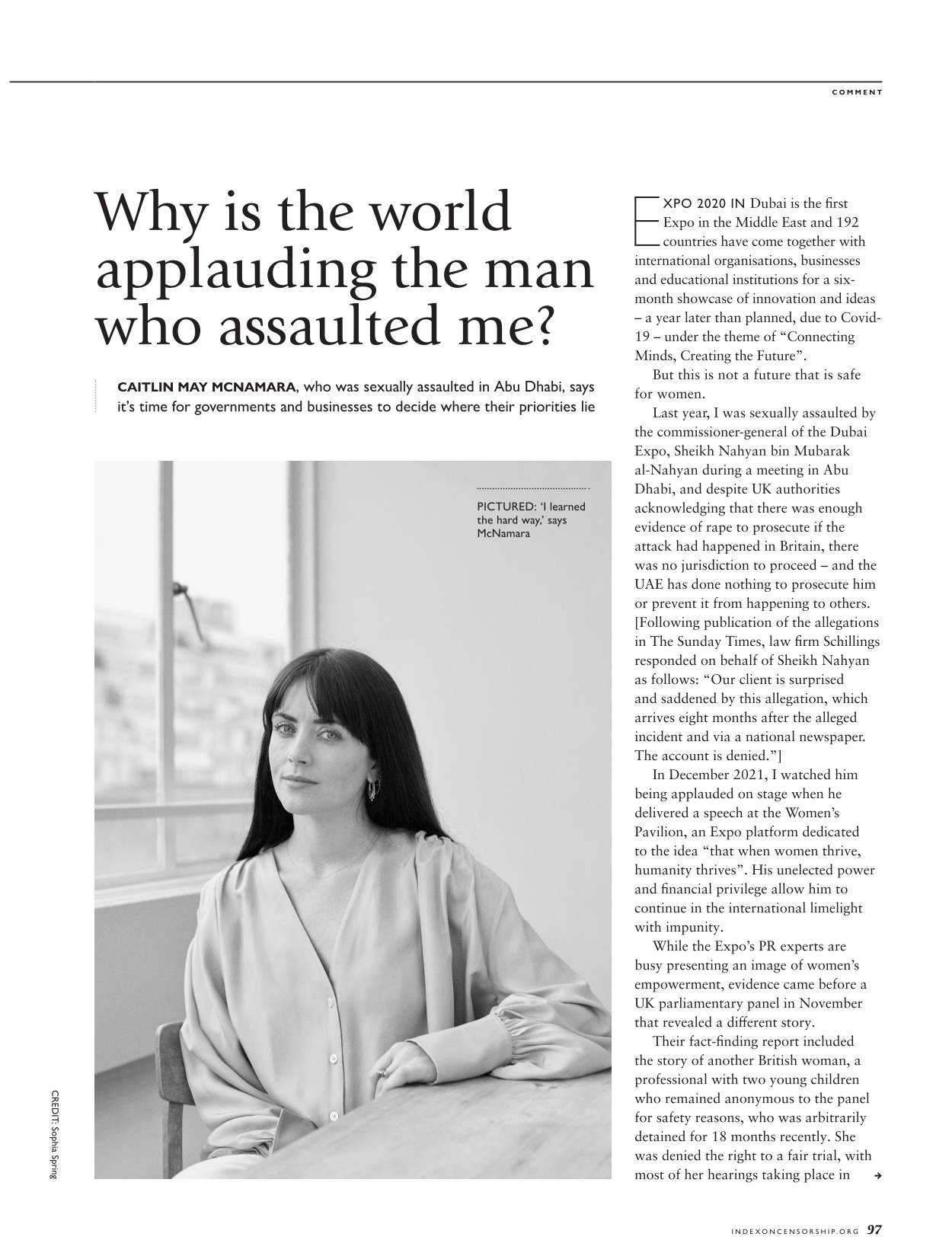
PICTURED: ‘I learned the hard way,’ says McNamara
CREDIT: Sophia Spring

But this is not a future that is safe for women.
Last year, I was sexually assaulted by the commissioner-general of the Dubai Expo, Sheikh Nahyan bin Mubarak al-Nahyan during a meeting in Abu Dhabi, and despite UK authorities acknowledging that there was enough evidence of rape to prosecute if the attack had happened in Britain, there was no jurisdiction to proceed - and the UAE has done nothing to prosecute him or prevent it from happening to others. [Following publication of the allegations in The Sunday Times, law firm Schillings responded on behalf of Sheikh Nahyan as follows: “Our client is surprised and saddened by this allegation, which arrives eight months after the alleged incident and via a national newspaper. The account is denied.”]
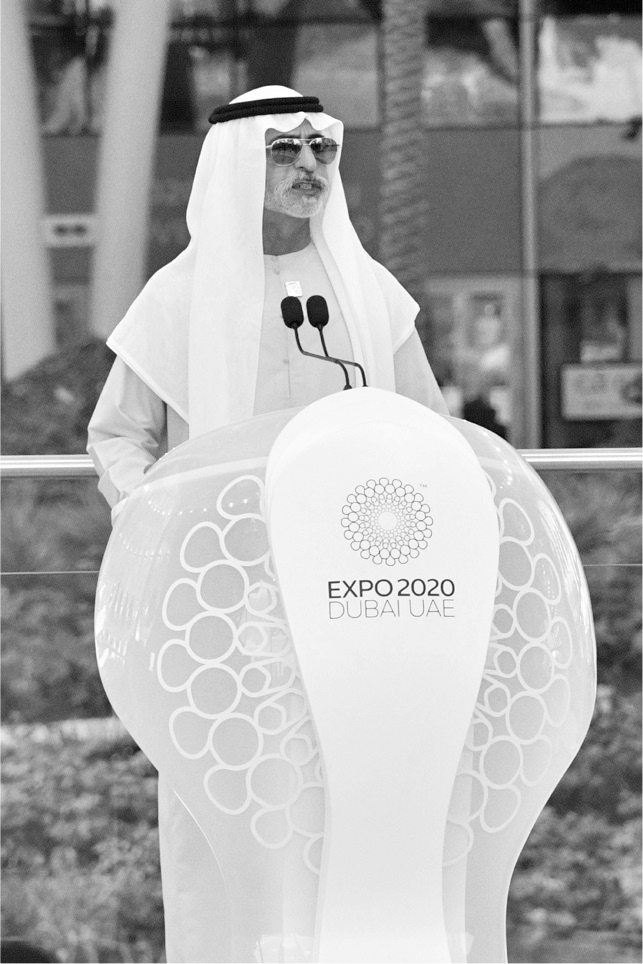
In December 2021, I watched him being applauded on stage when he delivered a speech at the Women’s Pavilion, an Expo platform dedicated to the idea “that when women thrive, humanity thrives”. His unelected power and financial privilege allow him to continue in the international limelight with impunity.
While the Expo’s PR experts are busy presenting an image of women’s empowerment, evidence came before a UK parliamentary panel in November that revealed a different story.
Their fact-finding report included the story of another British woman, a professional with two young children who remained anonymous to the panel for safety reasons, who was arbitrarily detained for 18 months recently. She was denied the right to a fair trial, with most of her hearings taking place in Arabic, and denied direct access to legal representation. She was allowed to see her children only once in those 18 months, and for just 25 minutes.
Fashion brand Cartier is the partner of Expo 2020’s Women’s Pavilion
CREDIT: (left) Expo 2020 ; (right) Alexander Astafyev/POOL/TASS/Alamy
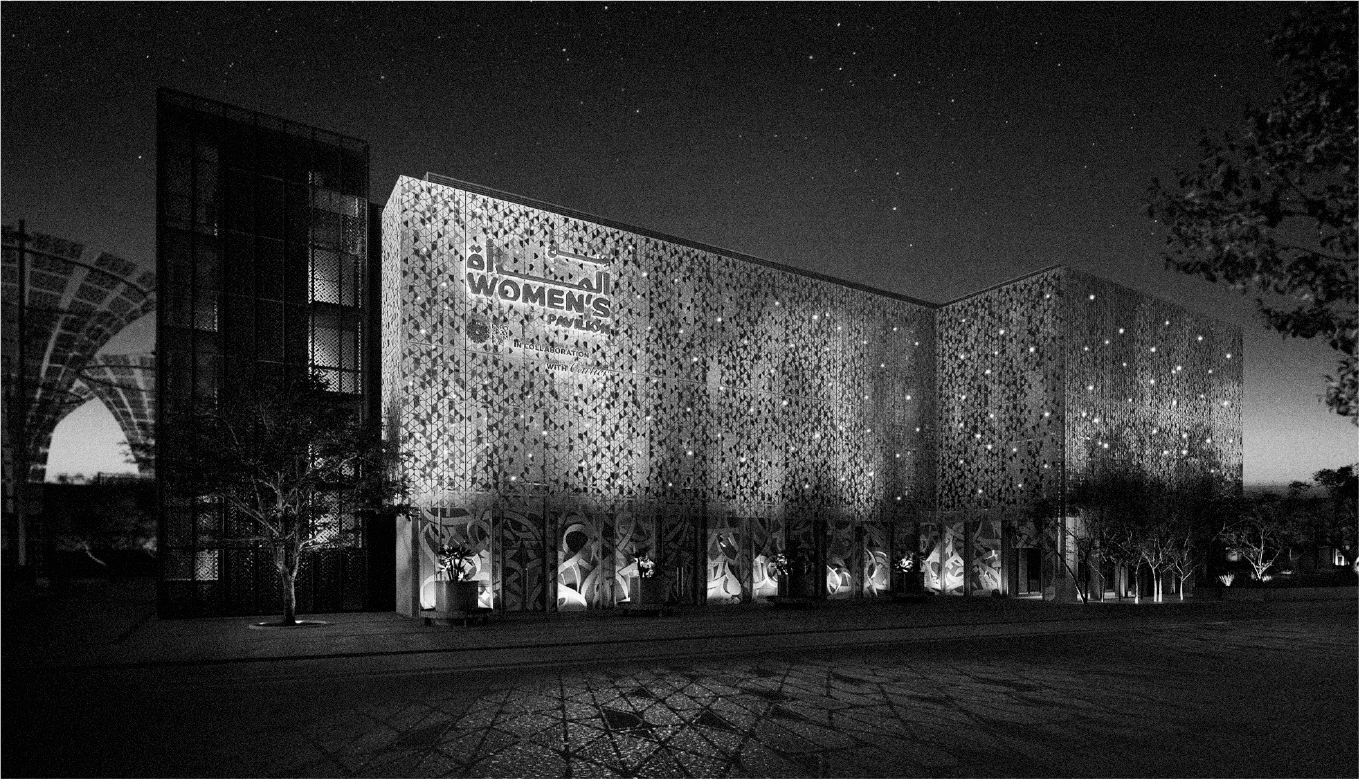
The Alternative Human Rights Expo, a campaign of more than 20 rights groups, has been dedicated to countering the glimmering narrative of the Dubai Expo’s spin by highlighting the repression still happening in the country.
Emirati laws fail to criminalise marital rape, as well as “chastisement” in the form of physical violence by a husband. Laws also still give male guardians authority over women and loopholes allow reduced sentences for men who kill female relatives.
On a day-to-day level, freedom of expression appears to be a luxury not afforded to women in the UAE. Peaceful activists such as Maryam al-Balushi, Amina al-Alabdouli and Ali Abdulnour have been detained and tortured for speaking out. Abdulnour eventually died in custody, while a prominent UAE activist, Alaa al-Siddiq, was subjected to an intense government- requested surveillance campaign via the controversial Israeli technology firm NSO before her death in the UK this summer in a car accident.
The experiences of Dubai princesses Shamsa, Haya and Latifa, who have either disappeared from public view or been targeted after falling out with Dubai’s ruler Sheikh Mohammed bin Rashid al-Maktoum, show that even the most progressive of the Emirates’ rulers remain oppressive in their own households and women cannot count on state-led reforms to protect them. If seemingly privileged women are treated that badly, what chance do other women there have?
The UAE likes to remind its critics about recent reforms such as the amendment to laws allowing unmarried couples to cohabit and criminalising so- called “honour killings”. A requirement under the Personal Status Law for women to be “obedient” to their husbands has also been revoked.
The country has also ratified an updated Federal Crime and Punishment Law, which promises enhanced protections for women, which is due to take effect on 2 January 2022.
Experiences like mine have focused international attention on the UAE. These efforts are a step in the right direction but do not go anywhere near dismantling the deep discrimination against women both in UAE law and in social and government attitudes, especially when it comes to the interests of the rich and powerful. It also remains to be seen whether the new laws will apply to the UAE’s ruling families and their entourages.
After I was assaulted in Abu Dhabi, my instinct was to report what had happened to the police. However, everyone I turned to for help reminded me of my attacker’s royal status and the threat of the UAE’s medieval extramarital sex laws, which load rape survivors with the risk of imprisonment. Finally, the British consulate’s legal counsel cut to the chase, telling me that no one inside the UAE would be able to take on a case against al-Nahyan in an independent way. I was advised to leave the country immediately for my safety.
These reforms are nothing more than a sham if they don’t treat the rich and powerful as they routinely treat poor black and brown people.
I suspect that the outcome to my case would have been very different had the sexual violence I survived occurred at the hands of the Filipino man who cleaned my room instead of a royal. But some rapes are considered more important than others.
These reforms too often exclude the rights of domestic workers, many of whom are women from India and south-east Asia.
Gaping holes in gender-based violence laws such as this are of particular concern, while international law remains unfit for purpose to protect women, epitomising how our rights are susceptible to neglect globally.The UAE is by no means alone in using high-profile events such as Expo to court international validation while disguising its human rights record. There has long been a strain in the Gulf between countries’ human rights records and the international cultural and sports events held there.
What is perhaps more shocking is how easily the UK government, businesses and tourism are willing to turn a blind eye if it serves their financial interests.
As I awaited the UK’s Crown Prosecution Service verdict in my case, a couple of miles away from my flat the UK Prime Minister Boris Johnson hosted three other al-Nahyans, negotiating a £10 billion trade deal, which his country is more reliant on than ever post-Brexit.
Afterwards, his office released a statement to say that Johnson was looking forward to the Dubai Expo.
In November, as Iranian delegates were being wined and dined at COP26 in Scotland, Richard Ratcliffe sat outside the UK’s Foreign Office at the end of his three-week hunger strike, which was a desperate plea for help to secure the release of his wife, Nazanin Zaghari- Ratcliffe, who has been arbitrarily detained in Iran for more than five years.
Sports stars, brands, tourists and entertainers flocked to be part of lucrative contracts in the Saudi Arabian motor-racing Grand Prix in December, helping to restore the reputation of a regime that puts women’s rights activists on trial and kills its critics. Football fans will do the same at Qatar’s 2022 World Cup next year, with little thought to the human cost of the migrant workers who have been building their stadiums.
When I was first approached to work in the UAE, I was hesitant. I had specialised in cultural diplomacy since studying politics at university, and collaborated with arts, media and human rights organisations across the Arab world in the decade since.
I was aware of the moral predicament of working on a platform of free expression in a country that regularly locks up prisoners of conscience and had no desire to be a pawn in an Emirati PR stunt.
These reforms are nothing more than a sham if they don’t treat the rich and powerful as they routinely treat poor black and brown people
However, I believed that engagement was a more productive means of moving forward than boycotting and that a British cultural organisation crying “boycott” over engaging with a country that invests in its arts sector would be short-sighted.
My view has changed. Learning the hard way that the law does not protect me in the UAE, the beliefs that I previously lived by have lost their shine.
In October 2021, the European Parliament passed a resolution that cited my case, advising EU member states to boycott the Dubai Expo in disapproval of UAE’s human rights record.
Sheikh Nahyan bin Mubarak al-Nahyan: “His unelected power and financial privilege allow him to continue in the international limelight with impunity,” says McNamara
If the UK is serious about women’s rights - and women’s rights are human rights - it should follow the European Parliament’s lead and reconsider whether we want to participate in an event and, in doing so, legitimise a country that has such poor justice provisions for women.
Expo 2020 aims to attract a total of 25 million visitors. But without adequate justice provisions for women, these visitors are not safe.
During my six-month stay in the UAE, I was struck by the warm hospitality and humour of the Emirati community that I was working with and the sense of possibility and optimism that felt stark in contrast to the UK. I met people and organisations doing formidable work and who were courteous and collaborative enough to request the engagement and approval of the international community.
Yet the country is impoverished by leaders and institutions who treat women, girls and other marginalised communities - migrant workers, Yemeni civilians, those without means and privilege - as disposable objects devoid of human rights.
Expo 2020 Dubai presents an uncomfortable but deeply important choice for business and government leaders: stand with women or stand with those who wish to silence us by any means necessary.
Please choose wisely.