




Abstract

Reverting to stereotypes when we talk about non-Western countries is lazy and feeds into the hands of dictators, says
WHEN PROTESTERS FILLED the streets of Kazakhstan in January, I tweeted about the Western media’s failure to adequately engage local experts and accurately represent the complex dynamics of the unrest. The tweet envisaged a conversation between Western media and experts on the country, in which the former try to understand the events there but fail to because they can’t move beyond an assumption of the country as both “mysterious” and “exotic”. Although it was intended to be satirical, the tweet gained traction. It was born out of my increasing frustration with the way in which the Western media was reporting on these events. I am neither a Kazakhstan expert nor a “Central Asianist” but – as someone who has spent years both studying and working in the region that is often referred to as “Eurasia” – there was something deeply troubling about the way these events were being represented to a nonspecialist Western audience.
Kazakh soldiers guard a checkpoint after protests triggered by the increase in the cost of fuel in Almaty, Kazakhstan, in January this year
CREDIT: Mariya Gordeyeva/Reuters/Alamy
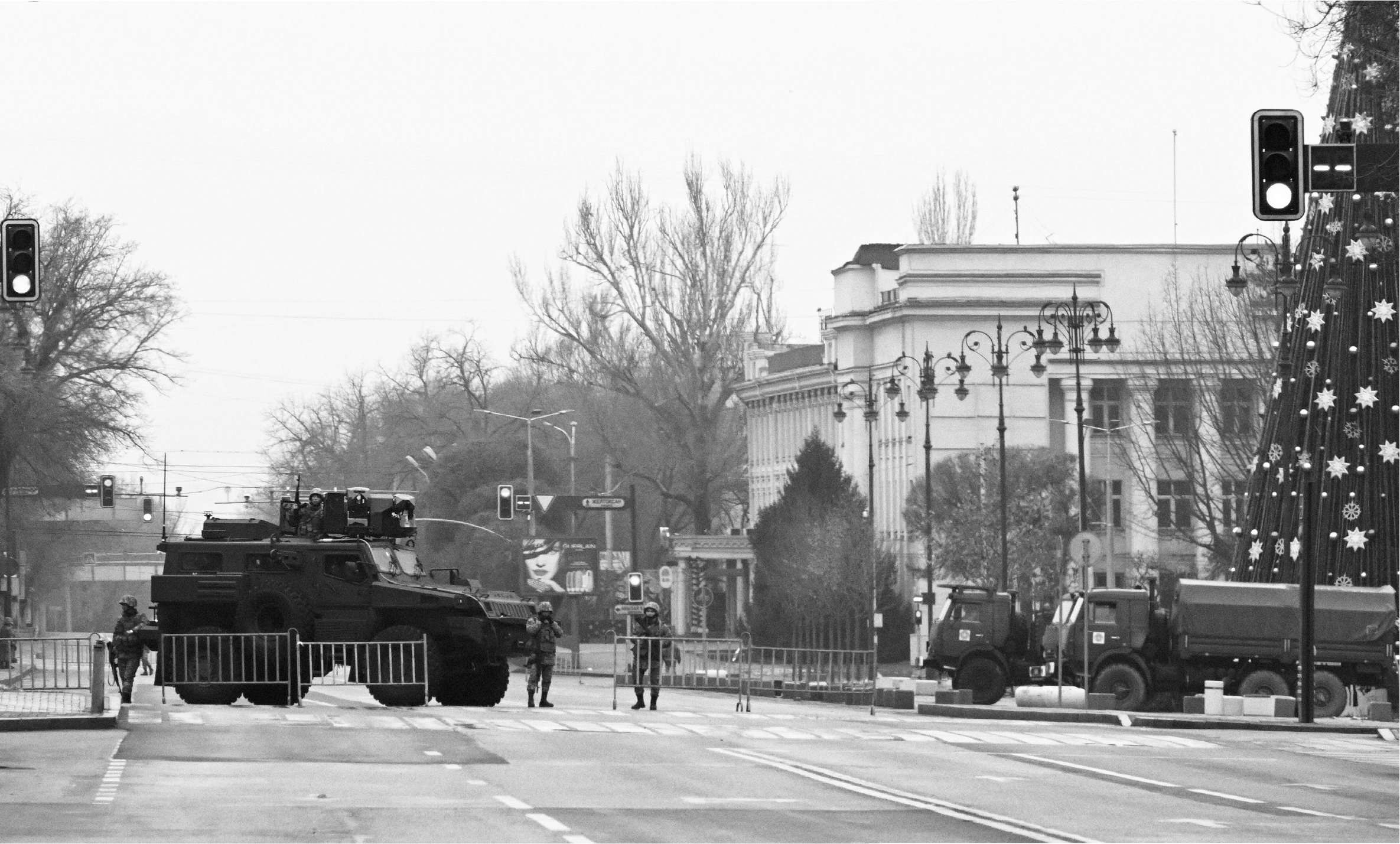
Of course, no respected media outlet would use the term “exotic” outright, but exoticism – that is, the portrayal of something as “mysterious” or “dangerous” because it supposedly exists outside of Western norms – can pervade the perceptions and analyses of a place even if that particular word is absent. This distorted lens not only does a disservice to the citizens of these countries but also prevents us from truly understanding and engaging with the region in a meaningful way. It is commonplace to blame malign actors – namely, the Kremlin – for propagating misinformation or disinformation about the countries of the former Soviet Union. Western analysts, however, must also consider the role that they play in skewing perceptions of the region.
How exactly did exoticism manifest itself in the coverage of the January protests in Kazakhstan? Although the majority of citizens on the streets expressed their grievances peacefully, major news outlets ran stories that focused on the violence and destruction perpetrated by a minority, referring to the events as “riots”. The BBC, for example, had an article headlined “Kazakhstan: Why are there riots and why are Russian troops there?” Le Monde wrote “Riots in Kazakhstan leave 225 dead”. The use of the word “riots” rather than “protests” carries an implicit moral charge. “Protests” legitimises the expression of discontent, presenting it as orderly and confined to socially acceptable boundaries. “Riots”, by contrast, shifts the focus away from the grievances of participants and implies chaos and illegitimacy.
Contrast this with the ongoing unrest in Belarus. Here, the focus has been on the peacefulness and dignity of the protesters in the face of the Lukashenka regime’s cruelty. While it is true that Belarus has not seen the seizing of key buildings and burning cars – images which have characterised the coverage of the unrest in Kazakhstan – the choice to focus on these images, and not on the many more which would illustrate that the majority of street actions were peaceful, is striking.
Central Asia as a whole also suffers from a Western tendency to consider it as one homogenous block. The habit of referring to the countries in this region as “the Stans” – the Orientalist connotations of which Diyora Shadijanova eloquently highlighted in a piece for The Calvert Journal – is a clear indication of this.
The rather embarrassing error of The New York Times in which an article referred to the non-existent country of “Kyrzbekistan” – as well as its, alas intentional, reference to Central Asia as “the moustache belt” – provide almost satirical examples of how Western discourse lumps these very different countries into one imaginative space.
Approaching the issue with an even wider lens, we can see that the problem of exoticism in Western perceptions affects the whole of what is often referred to as the “post-Soviet space”. The term itself indicates that while the Iron Curtain may have vanished three decades ago, it remains an anchor for the Western imagination: on this side, there is us; on the other, them. The prevalence of the term “Putin’s backyard” or – in policy circles – “Russia’s sphere of influence” to refer to any country that was once a Soviet republic reinforces this notion that they are fundamentally different from the West by denying the assumption of autonomy and sovereignty accorded to countries such as the USA and France.
Take Ukraine for example. Since the Revolution of Dignity in 2013-14, Ukrainians have fought hard to show the world that they are part of Europe. Visit Kyiv and you will see almost as many EU flags as you would in Paris or Berlin. Yet, still, many Western observers and policymakers struggle to take this conceptual step, continuing to perpetuate the Kremlin-backed narrative that Ukraine is an irreparably divided country shackled to its past.
As developments in Eurasia and eastern Europe once again dominate our headlines, it is vital that we have a broader conversation that examines the diversity within each of these countries – each has its own historically marginalised communities – and how internal Orientalist dynamics interact with those coming from the West. We should also unpack the racial dynamics implicit in conceptions of “the exotic”, which were particularly evident in the media portrayal of the Kazakhstan protests. As these examples highlight, Western observers and policymakers have failed to treat these countries with the same degree of nuance and respect that we would expect for our own.
As someone who works in the human rights field, it is clear that over-simplistic perceptions play into the hands of authoritarians. The more we consider a society to be “mysterious”, distant or fundamentally different from ours, the easier it is to think “that’s just what happens over there”. Only by moving away from this mindset can we make informed policy decisions that respect the agency of countries and citizens in this region and create meaningful networks of transnational solidarity.