




Abstract

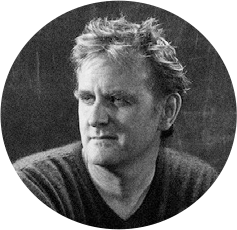
The author Nick Harkaway (Cornwell), who is known for his mind-bending looks at the ills of modern society
CREDIT: Nadav Kander
CONVIVIAL AND WITH a mind that leads conversations off in tangents, Nick Harkaway is the kind of person who’d be great to have a drink with, which is fitting given his short story is set in a bar. In an Index exclusive, the award-winning author has reimagined the early days of the magazine when its content – and the magazine itself – would be smuggled across borders. In Harkaway’s story a motley crew congregate in a dark, sweaty bar somewhere behind the Iron Curtain sometime in the 1970s. Harkaway, nom de plume of Nick Cornwell, says he was inspired by a trip he made to Russia years back and by the “smoky room craziness of the Writers’ Union”.
Harkaway went to a different writers’ club when in Moscow, which was in “a dismal basement selling terrible food” and “was duly obliterated with vodka”.
“It clearly had that history of having been exactly the same place doing exactly the same thing for about 100 years and having had to wear different hats in order to be allowed to do that. It was a club, it was a library, it was a union headquarters, it was a this and a that, but it was always a bar with terrible food and too much vodka.” Most significantly, it was somewhere people could speak more freely.
“It doesn’t matter what the world is doing – there is always a bar where people can go and get drunk and say rash or inappropriate things they might not otherwise be able to get away with,” said Harkaway.
His story reads like a thank-you to Index. “Essentially I just thought the original Spender letter was extraordinary,” said Harkaway, of Stephen Spender’s 1971 letter in The Times Literary Supplement that outlined the reasons for and ambitions of the magazine. Harkaway also has a personal connection to Index. He briefly worked at Article 19, which has close ties to the organisation, and his father, the late David Cornwell (better known as John le Carré), contributed to the magazine.
When he was writing the story for Index, he “thought about doing a full-on smuggling story – trying to get a document out or get something in”, but decided against it. He feared that would feel like “a budget, espionage tribute to my dad”.
Harkaway’s background has clearly informed his writing, and not just when it comes to Index. His fourth novel, Gnomon, is a detective story set in a dystopic future of total surveillance. He started writing it in 2014. He wanted to write a short, literary book in which he warned “about the dangers of creeping totalitarianism and the possibilities of totalitarians popping out of the woodwork”. It wasn’t published until 2017, by which stage Donald Trump was president in the USA.
“I took a little bit too long over it to be prescient… When the book came out that was already happening,” he said.
The creeping rise of totalitarianism has persuaded Harkaway to pivot away from darker material. “Essentially I feel since then I have kind of gone off dystopian writing because dystopia has moved into the real world.”
“One of the things I’ve noticed about the Trumps and the Boris Johnsons of this world is that you can’t really shame them into doing the right thing. You can’t hold up a mirror and say ‘This is what you are’ and have everybody suddenly decide that they’ll be a good person or a better person. All you do is sort of feed their narrative.”
Harkaway is currently working on something hopeful because for him being hopeful is “obligatory”. To give in to despair is to lose, to yield the high ground.
“The thing that a lot of these new populists depend on is a sense that things cannot get better, there is no agenda that can save you, there is no way that we can make things work for you so you may as well forget about it and let us get on with ruling you, which I find really depressing,” he said.
“And actually there is hope, there are solutions, there are people who are working on answers and some of those answers are not just structurally interesting, they’re also beautiful.”
Plus, says Harkaway, we have moved forward on some conversations. Privacy, for example. He has noticed a change in attitude around surveillance in just the last few years, especially in terms of corporations harvesting data. People used to be indifferent whereas now they are more concerned. Harkaway talks about “intangible bads”, which are things you know are bad but you can’t actually see them and touch them. Surveillance falls in this camp.
“What I hope is that we’re getting better and better at dealing with ambient bad effect and recognising that they do have causes and you can take precautions against them because otherwise we really are in deep trouble,” Harkaway said of this.
If we are in deep trouble we’ll have to hope there are bars still open where we can talk without fear, even if the food is terrible.
Anya’s Bible
THE RUSSIAN POET has Robbie in a headlock and is telling him he’s a genius: he, Robbie, is a genius, a great genius to rival Eliot and Pound (who were both very Russian, for complex reasons which will have to be explained later) and the poet knows this because the poet is himself a genius of astonishing proportions, as yet unacknowledged by a society which - though masquerading as an egalitarian and socialist one in which the means of creativity have been reclaimed by the proletariat - is for now still blind in an almost American way to the scale of the genius which has been given life within its borders.
“Hi,” Robbie says, to the poet’s armpit. “I’m Robbie.”
“Yes, you are!” The armpit agrees. “Robbie Malone, genius! I am Kuznetsov. It is to be a blacksmith, but I make words which are stronger than iron. In my cradle I was kissed by Ahmatova. In this I am enviable but also by this I was touched with poetry. Call me Dima, I will call you Robbie: we need beer and vodka.”
Whether they do or not, it’s coming, and though Robbie was broadly prepared for it, the arrival is still formidable: a tall glass, European style, full of yellow Czechoslovak lager, and with it not the decorous shot glass of clear Russian booze he’d been anticipating, but a wide-bottomed tumbler into which his new friend pours a generous slosh which brings with it immediate condensation. Alexeev, Robbie’s state interpreter and politely acknowledged watcher, shakes his head.
“Oh, shit,” he says in English, and lifts his own glass. “Get some food as well, Mr Malone.”
Kuznetsov nods vigorously. “Only the best food for genius. The best food and the best drink. We have already ordered for you.”
Robbie says thanks, and receives as his comeuppance a scalding metal pan which he takes at first to be something like a Greek moussaka, but in fact contains button mushrooms and snails in a thick savoury custard or béchamel. Alexeev shakes his head.
“We should have gone to the Writer’s Union,” he says, with authentic gloom. “They have venison.”
“The place of writers is not within the state machine,” Kuznetsov reproves. “Loyal outsiders, expressing the spirit of Marxism Leninism. The bird of freedom must live wild, or it is just a pet.”
“And it must eat really horrible crap,” Alexeev murmurs, as Kuznetsov turns away to say something to a woman with thick hands and a severe grey dress, “this is vital to the creative process.”
Sitting around the end of the refectory table, they’re a curious trio: Kuznetsov, huge and hirsute, smelling strongly of sweat and the inside of a hunter’s fur gilet he declines to remove even in the hot underground of the Library; Alexeev, prim and tweedy, his English note-perfect down to the spiteful asides, as if he learned the language from Robbie’s seriously disapproving sister, whose finger can find dust on any mantelpiece either side of the Iron Curtain. Not that she’d ever come to Russia, after the way they treated their royalty. Robbie, who took a second class degree in history, feels more tenderly towards doing away with monarchs, but draws the line at heirs and infants.
He looks around, soaking it in: blue tobacco smoke, tart and rough; a low ceiling and two wood-burning stoves, one at either end of the basement room. Stone flagging that must be two hundred years old, could be eight. Books on the panelled walls – the place was a club in Tsarist times, then immediately an independent writers’ union after 1917, then a library, and more recently notionally still a library, serving food and drink to those who live by the pen. According to Alexeev, almost nothing has changed across each of these incarnations. “Especially not that,” Alexeev says, nodding to Robbie’s congealing bowl.
The severe dress sits down at Robbie’s other side. He realises dimly that the vodka has already had an effect. How long has it been? Twenty seconds? Twenty minutes? Jesus, has Kuznetsov been topping up his glass? Too late to worry about that now. He smiles shyly in the direction of the grey wool. Everyone here wears muted colours. Dyes, he supposes, are expensive and frivolous, but he can’t shake the feeling that the uniform pastel and granite tones are also protective colouration. Standing out is not encouraged, even here in the interior, where the policing is less enthusiastic than hard by the border.
Grey dress looks back at him, expectant. He’s forgotten something.
“Am I drunk?” he asks Alexeev.
The little man shrugs. “That probably depends on your points of reference.”
Robbie decides that means yes.
“Elena,” the dress says kindly, “Semenova.”
His host, Robbie realises, and the whole
reason he’s here. They met in his publisher’s flat in Primrose Hill, an area his mother warned him was where rich men kept their mistresses. He stands up, which leaves Elena Semenova sitting down and looking up at him. Kuznetsov gets up too, so now it’s an occasion. There’s a ragged cheer from the other tables.
“The poet Malone,” Kuznetsov bellows, “‘Red Fire In The Heart’. London, 1972.”
Another cheer, and someone starts reciting the title poem. Robbie, when he reads it, does so with a hushed intensity he hopes is almost sexual, though evidence of this effect is scant. The woman by the stove now giving voice to his work is treating it like a pulpit oration, and the rhythms in her mouth are richer and surer. When she names the organs where the fire burns, he becomes acutely uncomfortable. They warned him at home: poetry in Russia is not poetry here.
Vodka and eye contact and blunt force eroticism. He looks away.
The severe dress is still waiting, indulgent of his un-Russian frailty.
“Robbie Malone,” Robbie says. “A pleasure to meet you.”
Elena Semenova tilts her head back to take him in. She is nearly sixty and famously beautiful, or at least beautiful and described that way in discussions at home, with silver hair arranged in what he thinks of as a Katharine Hepburn bun. Not a dissident, but a tolerated friend of dissidents, as any good organiser of literary exchanges must be. Not an informer, either, but too close to the state establishment to be entirely comfortable. Alexeev, on Robbie’s right, relaxes a little, as if her presence absolves him of one layer of paranoia
CREDIT: Alex Green

Don’t get into it, Robbie reminds himself sternly. If you start trying to work out who’s spying on whom, you’ll go nuts. They all are, in every imaginable direction, and no one, but no one, actually knows what’s going on.
“Welcome,” Elena Semenova says. “To the great literary superpower that is my home.”
“Not only literary,” Alexeev says, and Elena snorts as she raises her glass: ballistic nuclear explosives are evidently infra dignitatem, and he should know better.
“You should take a lover,” Semenova says, though whether to Robbie or to Alexeev is unclear.
The actual festival is very short, at least from Robbie’s point of view: direly hungover, he reads Red Fire and realises as he does so that it is appallingly sophomoric. Meeting the glassy yellow eyes of Kuznetsov, still in his pungent gilet and unrepentantly living on black cigarettes which stink of clove, he finds himself reassessing his benign and pastoral British socialist verse in the knowledge that his new friend is deeply moved precisely because the poem describes nothing recognisable. When asked to connect Freud and Nechaev with the leitmotifs from After Pessoa, all Robbie can think of to say is that he hopes he was successful in emulating Pushkin, which is as close to a safe answer in the context as can be imagined, and is met with polite acceptance. They move on to questions, with Kuznetsov translating and Alexeev sulking in the corner because this was his big moment and the other man has somehow finessed it away from him. A long first question, clauses complexly subordinated. Robbie recognises the type from innumerable events in the Home Counties: a long preamble intended to show the questioner has done the homework followed by one of the standard queries couched in highfalutin terms. With due respect to Shakespeare and Marlowe’s use of iambic pentameter and recognising the inferiority of the Patrarchian sonnet in the modern discourse, where do you get your ideas?
“Please,” Kuznetsov says, “the question is: do you believe that the Black Flag of Mosleyite Fascism will ever fly over the British Houses of Parliament and in this eventuality what action will you personally take to restore the Historical Process and midwife the socialist imperative?”
“Oh,” Robbie says, “right.”
When he’s answered that, plus a few other simple little gems, he’s free to go. Elena Semenova tells him he’s been perfect. He doesn’t know what that means and he isn’t convinced she does either. Alexeev takes him on a tour: architecture, historical interest, industrial and cultural superiority, then drinks. He shakes hands with a senior party member who tells him to come back soon. An American cultural attaché apologises for being unable to make the reading.
“I hear you were great.”
Robbie nods, hoping that the CIA doesn’t really believe that, or everyone’s in trouble.
“You were not great,” a voice says, and someone takes his arm. “You were ordinary.” The woman from the Library, the one who recited Red Fire, smiles up at him. “Anya.”
Robbie nods, afflicted with an instant form of panic he recognises as schoolboy infatuation.
She has brown hair and a wide face with a wide nose, a blue jacket and work trousers in the Land Girl mode, rendered stylish through an alchemical combination of needlework and confidence. Anya. This is Anya. This is what Anya looks like, the shape she makes in the world.
“I thought so too,” he tells her. “Or maybe just bad.”
“No.” Very definite. “Not bad. You gave what you had, with integrity. To imagine it does not possess quality is to submit to a mystification of the process of art. A hierarchy of poetry. Your work is naive. Tomorrow it will be less. We are all the product of our days.”
“Thank you.”
“You are polite.”
“Yes.”
She shrugs. “That also is a mystification.”
“Perhaps a permissible one, when a gentleman is speaking to a lady.”
The ghost of a smile. “What is your opinion of Evelyn Waugh?”
Robbie has no poetic nonsense left, and even if he had, he wouldn’t use it now.
“He’s fine. Studiously miserable. Everyone works hard to produce the most awful outcome imaginable. I rate the quality but I don’t enjoy him.”
She considers that. “Yes.” A passing grade. “We should enjoy. That is true. Pleasure is not a mystification. Are you a religious person?”
Robbie considers saying that religion is hardly compatible with modern dialectical Marxism, but doesn’t. He’s not a modern dialectical Marxist. He’s a poet, however lousy in his own internal reckoning. His poetry enforces his compassion, his compassion tells him unfettered commercial activity will not produce the kindly picket-fenced Utopia of advertising campaigns. But poetry about incremental change doesn’t stir, so he writes what he writes and does not entirely believe it.
“No, I can’t say that I am.”
She smiles and reaches inside the work jacket. The process is captivating. She laughs at him, but not unkindly, and passes a small paper-wrapped object the size of a deck of cards. On the paper
– not sealed, just folded – is written “return to sender” and under, what he takes to be the same message in Cyrillic. “For your Archbishop of Canterbury. It is his pleasure to send many Bibles to us, by many different routes. It is banned, of course. This one is the English Standard Version, made to look like a deck of cards. That way, it is to appear quite harmless.” She leans closer. “They are the wrong cards. To play Preferans, one needs only the Piquet deck. The design is from Las Vegas. Your Archbishop needs better spies. Also the language is impoverished by contrast with the grossly inaccurate King James.” Her hand grips his shoulder so that she doesn’t have to raise her voice. She’s laughing at the Archbishop of Canterbury, and he could touch his face to hers merely by bending his neck.
“An appropriate cultural gift, no doubt,” Alexeev says. Robbie, miraculously, does not murder him.
“Not at all,” Anya says. “It is a contraband Bible. I have defaced it with pornographic sketches so that it cannot be returned to the Motherland.”
Alexeev, in the act of reaching out to examine the little parcel, snatches his hand back again. “You have not!”
“No. I cannot draw.”
“What can you do?” Robbie asks her. “Are you a poet? An actress?”
She sighs. “I am a writer of technical manuals. Do you know how to replace the cylinders on the Stalinets S-65? I can show you.”
“I’d like that,” Robbie says, which makes her laugh again, and Alexeev rolls his eyes.
“Oh, my God,” he says. “Sex?”
“Not yet,” Anya says. “In about an hour, maybe.”
Alexeev goes a little pink. “Don’t keep the Bible,” he tells Robbie. “If the Border people feel like it, they can put you in prison for having one of those.”
But he forgets, courtesy of Anya’s quite accurate prophecy, and then in a whirl he’s back on the home side of the Curtain with his unintended contraband, unpacking in Lady Margaret Road, holding the thing up and looking, as if the Russian watchers are still peering over his shoulder, to see whether Anya really did draw a frank self-portrait on Proverbs 5:18.
And finding instead a letter addressed to Stephen Spender, care of Malone.
To you, Dear Friends, who speak for no organisation, but see our need and extend your support, we are forever grateful.