




Abstract

The 1970s and 80s saw battles rage between left wing and right wing governments, and guerrilla forces, across Latin America. Free speech was a casualty, but there was a not-so-secret way of subverting the system
As conflict gripped Central America, the power of communication between those fighting for survival was strengthened by the most basic of modern technologies – the radio.
LATE AT NIGHT in the Guatemalan mountains around Lake Atitlan, a tiny, medium-wave transistor radio picks up ‘Radio Sandino’ from Nicaragua. There’s a news programme discussing the private business sector and the anti-revolutionary activities of some of its members. Listening to the occasional machine-gun fire from the Guatemalan army troops outside, patrolling the Atitlan area, it’s as if the news is coming from a different planet. The power and importance of radio stations in Central America’s revolution becomes crystal clear.
Throughout Latin America, the distance, the mountainous and difficult terrain, make communications by land difficult. Few people are able to afford television in rural areas, and as the majority of the populations are illiterate, written information is of little use. The ruling military and right-wing governments which predominate in the region have learnt this lesson well and radio stations are their primary means for transmitting the information they wish the people to hear.
But the relatively cheap, simple and mobile technology of radio transmission and reception has made it the most appropriate means for popular and revolutionary groups to transmit their information – between themselves and to the civilian populations. Central America, and particularly Guatemala, El Salvador and Nicaragua, provide good examples of the new uses being found for old technology.
It is significant that Radio Sandino was the strongest station to be picked up around Lake Atitlan, for it was the Guatemalan people living there who first demonstrated some of the potential for local and community radio. But that was before Nicaragua’s revolution and before Guatemala had been turned into a war zone.
In 1964 in Guatemala there was one radio receiver for every twenty people while the six major daily newspapers produced in the capital were only circulating 2.3 copies for every 100 people. Five years later there were over 90 privately and commercially owned radio stations. The majority of them were inaccessible and run for profit through advertisements. Like the controlled press, they showed little inclination to provide any dissenting voice to government press handouts in reporting events.
But radio stations in rural areas – the majority set up by Catholic church groups in the 1960s – began to involve local people. With social, and particularly educational, provision virtually non-existent in rural areas, radios were seen as the best means to reach people in isolated areas. Throughout the 1970s, as peasant organisation grew around demands for land and an end to government military repression, the locally influenced or controlled radio stations took their place as community information services.
In February 1976 came the earthquake which killed 20,000 — mainly poor and Indian people living in ramshackle houses. This was about the same number as those killed through government repression over the previous ten years. As reconstruction began, the communities had to look to themselves for the organisation and help to rebuild their lives. Aid agencies which had come in with funds for the earthquake disaster stayed to support longer-term development projects — and some communities found themselves able to extend or begin new services by radio for surrounding areas.
Education by radio
Lake Atitlan is one of the most beautiful parts of Guatemala and became a prime centre for tourist development in the 1970s. The lakeside communities of about 50,000 mainly Tzutiyil and Cakchikel speaking Indians found themselves pushed off their small farming plots onto even worse lands around the lake. Already poor, the tourist influx disrupted their lives and conditions worsened. Malnutrition is widespread and health services minimal. 73% of men and 90% of women are illiterate and only a third of the children ever go to school.
The radio station was set up in Santiago de Atitlan in 1968 by local priests. As time went by it became an independent association made up of local community people. It was the only radio station in the country to be owned and run by Indian peoples although Maya Quiche Indians make up 60% of the total 7.5 million people in Guatemala.
The basic aims of the radio were those of a school; to promote adult education through literacy courses and programmes designed to improve living conditions, health and agricultural production. From classes given over the radio it became more of a community information centre announcing where teachers in the area would give classes. After 1976 and with the growth of peasant demands throughout the country, the radio took its part in local community demands.
But as a tourist centre, Atitlan had to remain free of disruption or dissent, as the visitors might otherwise take their much needed foreign exchange elsewhere. As peaceful, persistent demands from the peasants began to turn into guerrilla warfare against the military regime, so repression intensified. At the end of 1980, 18 truck-loads of troops took over Santiago de Atitlan. The director of the Voice of Atitlan radio station was killed by security forces and the station’s equipment taken away or destroyed.
Today, the rural population in the western highlands has to be as alert and mobile as the guerrillas themselves to escape army massacre. Systems of lookouts warn villagers against imminent attack while Radio Sandino reminds them what it can be like ‘after the revolution’.
Reporting the other side
Radio Venceremos, the official radio station for the Farabundi Marti Liberation Front (FMLN) in El Salvador, first broadcast on 10 January 1981. It combines the role of radio for military use, reports of guerrilla actions, local propaganda and, increasingly, as a means for sending out its side of the story to the international news media.
With propaganda so much a part of the war in El Salvador, local press, radio and TV reports are strictly censored by the government. The Catholic radio station ‘Panamerican Voice’ was shut down and the liberal newspapers La Cronica del Pueblo and El Independiente closed. Assassinations and imprisonment of journalists are (as in Guatemala) a favoured means of extending press censorship.
Venceremos, like Radio Sandino before it in Nicaragua, is intended to break the silence from the guerrillas and counter the misinformation sent to the national news agencies. Today, its short-wave transmissions reach not just Central America and the Caribbean but the USA and Europe as well. The BBC monitoring service listens in and Venceremos has begun to be cited as a source by news agencies and press alike.
A reconstruction of Radio Venceremos, at the Museo de la Palabra y Imagen, San Salvador
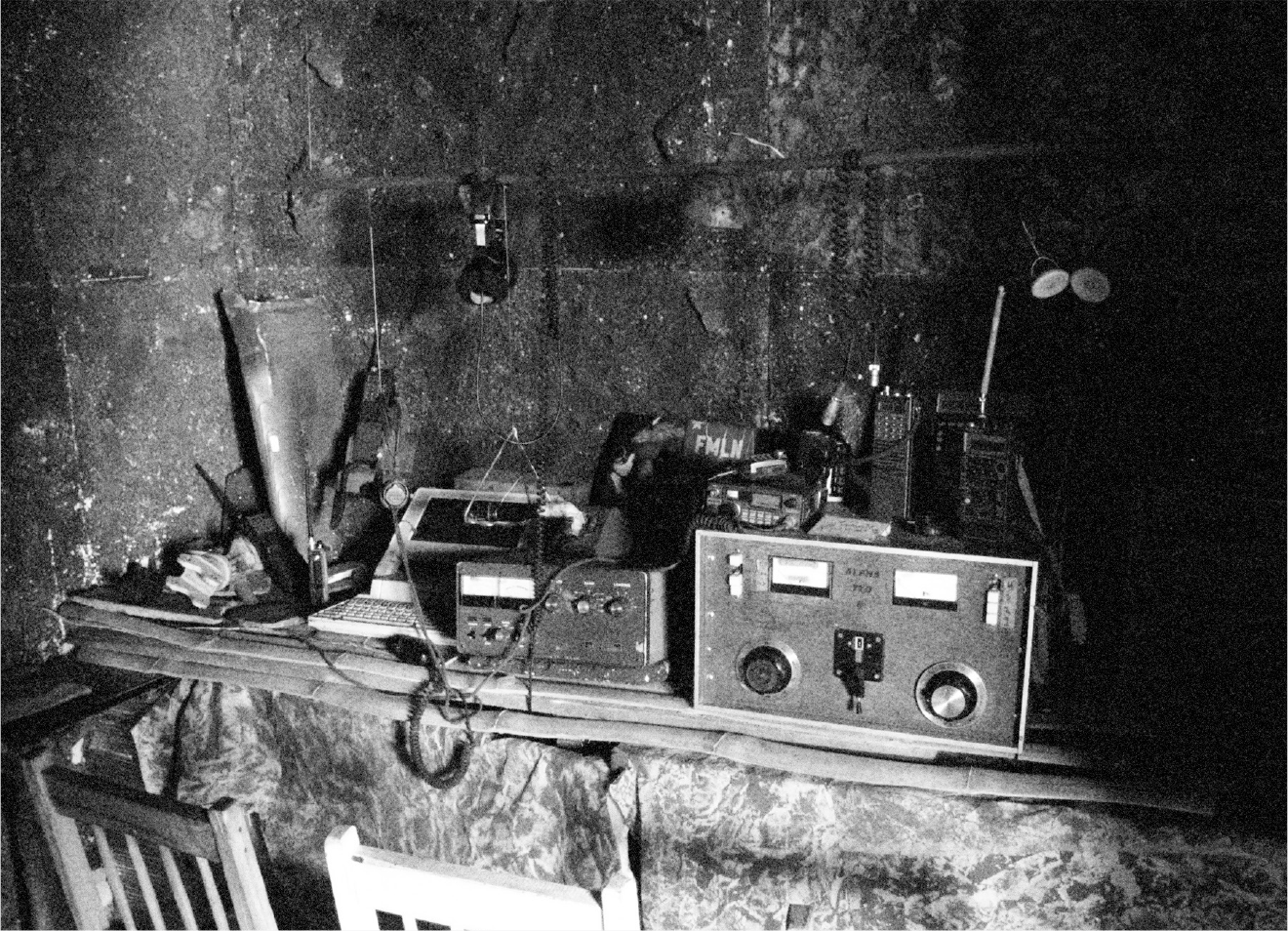
Clearly aware of the international media’s ability to affect its progress in what (through US support for the junta) was becoming an international war, Venceremos began to counter US attempts to claim Soviet and Cuban involvement in the civil war. Through on-the-spot reports, reports of guerrilla actions and interviews with victims of government repression, the other side of the guerrilla war began to be heard.
In January this year a team from Venceremos went into Mozote in Morazan province shortly after army troops had left the village devastated. Interviews with the survivors were enough to tell the story:
‘At the moment we are looking at a peasant who has the jacket of one of his sons. He continues to look hopelessly for his children, trying to recognise them among the mutilated bodies.’
In June this year, the FMLN shot down a helicopter and captured Colonel Castillo, the Deputy Minister of Defence, who was on board. The incident became an exchange between the army and Radio Venceremos which exemplifies the power the station has.
Initially the army completely denied the radio report that the helicopter had been shot down. Then it admitted the helicopter had suffered a mechanical failure and crashed in Morazan province and presumed the passengers, including the Colonel, to be dead. Venceremos went on the air to announce that the Deputy Minister was in guerrilla hands, which the army denied, saying only that he had ‘disappeared and not been recovered’. As the army was unable to find and reach the wreck of the helicopter, Venceremos asked the Red Cross to collect the bodies of those killed in the crash and to evacuate 43 soldiers, captured when the guerrillas seized Perquin, a town in the same province.
The army continued to deny Venceremos reports until the Colonel, the fourth highest officer in the Salvadorean army, was interviewed on the radio and admitted his capture by the guerrillas, albeit with a qualification, ‘in El Salvador we are not fighting a conventional war and I simply regard myself as a prisoner’ not a prisoner of war. He added, ‘I hope that an international organisation such as the Red Cross will try to rescue me’.
The radio transmissions from the guerrillas had not just managed to get the events straight in military terms but reported their military achievement in capturing a high-ranking officer. The reports reached Reuters and European newspapers within days.
Before Venceremos, news of the war had to be brought out of the country and sent in communiques from the individual organisations in the guerrilla Front. But now this single voice speaking for the guerrillas is beginning to be taken seriously and is, at least, an alternative source to the military government itself, as well as providing information to the civilian population.
Transformation
In revolutionary Nicaragua, the Sandinistas’ Radio Sandino was transformed during the reorganisation of the news media which had previously been dominated by the Somoza dictatorship. Two new newspapers have been set up, Barricada, the official Sandinista daily, and Nuevo Diario, an independent but pro Sandinista paper. La Prensa, the traditional opposition paper to the Somoza dictatorship, a mere shadow of its former self, is now right wing, rarely missing a chance to condemn the government.
Radio Sandino is the equivalent to Barricada on the air waves. After the civil war in 1979 it provided services such as helping to locate lost families and friends. Since then it has been of key importance involving Nicaraguans who live in isolated areas in the new social programmes and keeping them up to date with the trials and tribulations of the revolution.
But just as the popular movements have recognised the importance of community radio, so the hemispheric giants reflect its power at the other end of the scale. The US Voice of America, the BBC World Service and Radio Moscow all beam their own signals towards the transistors of Central America. The Reagan Administration has asked Congress for US$10 million to build a radio station in Miami which will tell the Cubans what is really happening on their island — from the US point of view. But at the end of June, Congress was up in arms when the New York Times reported that four 80-metre-high radio antennas had been built near Florida for the government’s Radio Marti. Some members of Congress are concerned about the damaging effect propaganda transmissions could have on the already cold US relations with Cuba.
The relatively cheap and accessible technology of radio is of key importance for people whose poverty, illiteracy, isolation and exploitation exclude them from other channels. As the sound of gunfire continues to resound throughout Central America, so the power of communication between the peoples fighting for survival can be strengthened by the most basic of modern technologies. Transmitting from one to another, celebrating victories and consoling in defeat, the rest of the world can now listen in to revolutionary radios in Central America.