




Abstract

It was the year that Index was born: 1972. Huge swathes of Europe were behind the Iron Curtain while other countries across the continent were in the grip of military dictatorship. Index’s mission was clear: to give voice to the voiceless, to metaphorically liberate those not free to talk. And in our first issue, Greece was a pressing concern
Published to be read alongside George Mangakis’ magnificent “Letter” from inside a Greek prison, this essay by an anonymous intellectual at large discussed the prison of the mind for those technically free
A GREAT DEAL HAS been said and written about the facts of the Greek dictatorship. Therefore I prefer to write about the psychology of the situation; the feelings and attitudes, the long-ranging impact of this harrowing experience. I can only speak for myself and others like me; and it is not for me to say how typical we are. I cannot speak for the prisoners, the tortured, the exiled: they need no arguments, they are their own arguments. 1 cannot speak for the indifferent, the unscrupulous, the cynical: they have no problem.
The question that is often asked of us is how the dictatorship affects one’s personal life. Has it really made all that difference? Is there real hardship, and real oppression?
In the first year of the dictatorship, quite a few people may have answered this question with: ‘As long as you mind your own business, you can live quite happily and peacefully’.
Apart from the fact that there do exist, after all, quite a large number of people who are not content, who are not able to reduce their lives to ‘minding their own business’, it seems to me that not even this contention is true. It is not enough to mind one’s own business. After these last few years, most people have found out that sooner or later, no matter what their position is, some demand will be made, some sign of submission or conformity will be required of them.
It may be something apparently trivial, like being ordered to put out the flag on the anniversary of the coup; or something not so trivial, like being ordered to send one’s child to a propaganda rally; or like having to make a ‘voluntary’ subscription to a Public Loan, or a contribution to various Funds.
There are other more pressing tests: a summons to sign some official statement needed for propaganda or security reasons, to co-operate in some state project, to sit on some state committee. Finally, there are the crucial tests, like whether to shelter a friend from the security men, help someone to escape, take part in subversive activity.
And so the moment of choice comes, sooner or later, for each and everyone. If the demand is a trivial one, it may seem easy enough to decide either way. One accepts, saying: ‘after all, it is only a formality’. Or one refuses, knowing the risk of punishment is not very great. In both cases, however, an entire, irreversible process of personality-change slowly begins. The first ‘yes’ brings a twinge of – can one call it shame? Not yet, perhaps. Uneasiness – which is soon gone, however, and buried away. The first ‘no’ also brings a twinge, an uneasiness, but of a different kind. Not fear, only a slight anxiety: has my action been noticed? Will it be held against me? Written down in a file?
The second choice will inevitably be more painful, which does not mean more difficult. On the contrary, the decision will be taken more quickly, because there is a precedent; a pattern of behaviour has been formed. But it will be more painful because the issues will be clearer (they will grow clearer with each new choice; it will become less and less easy to fool oneself, either way). And so, one enters the magnetic field where the pendulum swings. It is simple enough, in my mind: it swings between shame and fear. Both are ugly, corrosive and degrading emotions. But they are not clear-cut. There is not that comfort: choose and have done. For shame does not exclude fear. The little man, the obscure clerk, the man in the street who has signed all he has been asked to sign, who has attended innumerable, dreary, cretinous propaganda sessions, who has swallowed humiliation, bullying and blackmail, still does not feel safe. He still worries about his job. He still knows there is no guarantee for him, and no appeal if the worst does happen.
Fear, on the other hand, the fear of those who have said ‘no’, does not always exclude shame. There is always shame for not doing enough; for not risking more; for not going the whole way. And for feeling fear.
So fear and shame work on each other, reinforcing each other even while conflicting. Which of them is worse, under the circumstances? In some ways fear is more unbearable, its attacks are more acute, while they last. And it has a companion, which is suspicion. The person who has said ‘no’ in one way or another experiences blessed moments that are free of fear; but suspicion will fill in these gaps. It will always be present, tainting relationships, contacts, communications. I don’t want to go into the detailed description of the workings of fear, they have been written about extensively: the wellknown ring at the door at dawn, which one knows is not the milkman, etc. It is enough to say that fear feeds upon itself, grows large with its own irrationality, twists the very root of one’s life. In the end, one’s whole personality rests upon a void, a gaping, sucking hole – which is fear, eating away at one’s entrails. However, the long-term effect of shame has a more deteriorating effect than fear, even—or especially—when it is not acknowledged. Constant exposure to fear may lead to a nervous breakdown, or severe mental disturbance, while constant co-habitation with shame leads to a total decomposition of character. Of course, there are ways of overcoming both shame and fear. The first is overcome by self-interest, callousness, spurious reasoning, habit sometimes, or complicity. Fear is overcome by total dedication. Not everyone can use these remedies. For those who cannot, and I should think there are many, the pendulum swings. Fear – shame; and in the middle, hatred. Hatred of those responsible for this state of affairs, which sometimes helps to cover shame: it is a convenient way to soothe a bad conscience. It can also help to overcome fear, it can be cleansing and fortifying; if one hates hard enough, there is no room for fear.
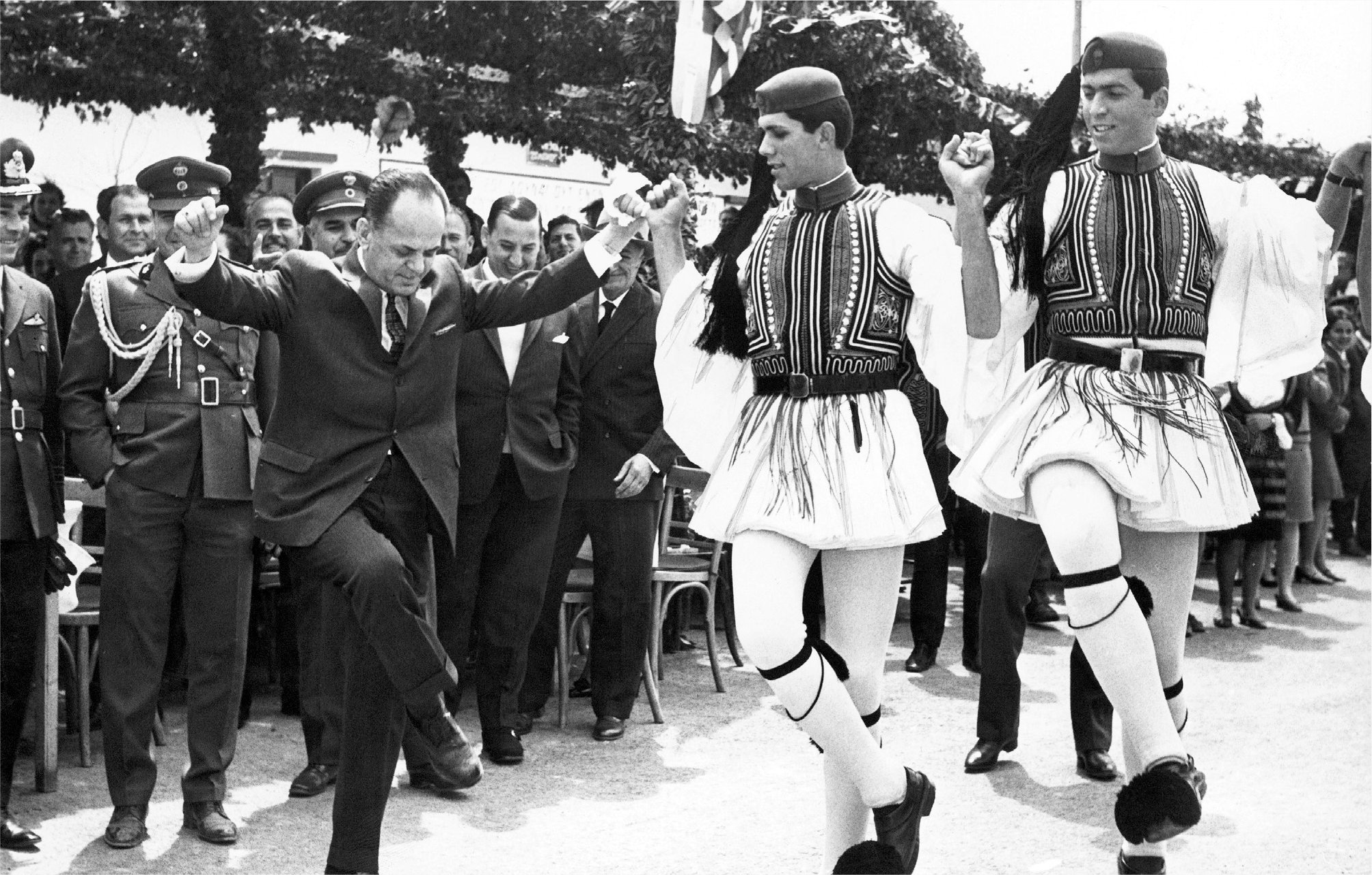
Coup leader George Papadopoulos dancing the traditional Sirtaki with the Royal Guard in 1968, on the anniversary of the revolution of 21 April 1967, which created the colonels’ dictatorship
In either case, though, living with it for a long, unrelieved period can do severe damage, especially when there are no real outlets for it. And one wonders, what can come of a nation fashioned by shame, fear and hatred? If one cares at all, then, for the people among whom one lives—I don’t want to use words like nation, country, motherland—simply, the people among whom one lives, it is difficult to remain indifferent. It requires a singular lack of imagination not to see the kind of life that is being shaped here. Education, literature, and to a lesser degree the fine arts, are the most obvious victims. Teaching in Greek schools was conventional and retrograde enough before the coup, with a very few exceptions. Now dogmatism, rigid uniformity, narrow paternalism are more than ever dominant in the attitude of the school to the child. Experimental and progressive methods are distinctly discouraged. Compulsory education has been reduced from nine to six years, and school hours in secondary education have been reduced to six hours a day. Some of this already inadequate teaching time is further curtailed by regular and compulsory attendance at church services, although the school curriculum includes at least 2 hours of religious teaching per week. Expenditure on education appears to have earned the singular distinction of being practically the only major item of public expenditure to have been consistently reduced since the colonels took over. Textbooks are shabbier and drearier than ever, and frequently biased. Some history books breathe not a word about the existence of dictatorships in Europe: they ingeniously refer to General Franco’s Concordat and to Portugal’s Guild Republic. Science books explain away scientific phenonena with phrases like: ‘Our good God has made things in such a way that…’ Children are gradually becoming expert in the art of lying and pretending at school. They know very well that certain subjects and words are taboo, only it is no longer the four-letter words that have to be whispered, as in the old innocent days, but words like ‘dictatorship’ and ‘junta’ and ‘Patata’—their nickname for Pattakos. The children often dare each other to tear out the title page of their text books, which usually bear the junta’s omnipresent emblem. The universities, of course, get their own share of brainwashing. In a speech addressed to the philosophy students at Jannina, Mr. Ladas, General Director of the Ministry of the Interior, assured his young audience that philosophy began and ended in Greece. He went on to refute any objection about other countries having also produced philosophers by loftily concluding that even if they had, it would not have been much use, since the Greeks had already said all there was to say.
These are only tiny examples of what is being done to the minds of the young, to the minds of all of us. In literature, pressure is not so blatant because writers do not lay themselves open to pressure, by the simple process of not publishing. Books are printed privately for the most part, with the inscription: ‘not intended for commerce’, and circulated by hand or by mail among friends. In other words, writing has become a strictly private, ingrown affair, no longer a means of wider communication or a civilizing factor. The art of the cinema in Greece, anaemic enough as it was, has been given lethal injections of conformism by means of encouragements such as the State prize (a very generous prize) which is awarded every year to the best Greek film on a ‘national subject’. Greek films on such subjects, rabid with chauvinism, have already flooded the market.
Artists who have chosen silence become frustrated, atrophied, often bitter, while those who have chosen to carry on regardless become aggressive, insensitive, somehow out of touch, perhaps as a result of their growing sense of isolation. Here again, shame and fear perform their ugly counterpoint. What kind of art will grow out of this climate? Our minds, whether we are intellectuals or not, are under constant attack by the two great enemies of truth: propaganda on the one hand and wishful thinking on the other. There is no chance of exercising responsible and objective judgement. There is no access to truth, so people either doubt everything they read and hear, or nourish themselves with rumours, hearsay, false hopes. This is poor meat for an active mind. As a result (a compensation?), people have become event-addicted. Something has to be happening or to be about to happen all the time, because one cannot bear the void; the moment there is a lull, unmarked by any ‘development’, despondency pounces, life becomes intolerable. It is like walking on burning sand—you have to keep moving. So life is continually being lived at a false, forced pace.
What is left? Personal relationships, in perhaps, the old panacea. But even these are undergoing radical changes. Real friendships are closer, deeper than ever before, because they have become a vital need: ‘we must love each other or die’. But at the same time, unbridgeable gaps have opened up between people and families of opposing views. There can be no common ground, for this is not merely a political disagreement that can be settled by civilized discussion. The very fact that friendship can succumb under such conditions proves what a wide area of our life the dictatorship affects. If it affected but a portion of it, it could be easily sealed off and friendship could flourish undisturbed. But the moment there is disagreement on this one vital subject, the whole edifice collapses, the whole function of friendship becomes meaningless. There is no longer anything to say—literally. Contact is cut off like a switch, sometimes against friends’ own will. One is forced into intolerance, ruthlessness, inflexibility. Forgiveness and understanding have become dangerous luxuries.
What I am trying to say is that one has to be pretty abnormal to remain impervious to all this. No matter how much of a conformist one is, no matter how self-centered or even how hard-pressed by practical considerations, there must come a time when one’s awareness and one’s concern extend beyond the strictly personal and take in the general, the public predicament. There is nothing more demoralizing than to be bound to a public body, an administration, a government with which one can never for a moment identify, which is the exact opposite of everything one believes in. One cannot live side by side with Philistinism, chauvinism, bigotry, blatant hypocrisy, crass ignorance, injustice, violence and brutality and not be affected by them, even if one manages—only just—to keep them out of one’s own life. The private and the public course are not parallel, they inevitably touch and mingle. When they are not allowed to touch, there is total civic alienation. There are no means of expressing dissent, or of taking action towards changing what is wrong. The extent of this alienation is also due to the all pervasiveness of the regime’s spirit. If a political party one disagreed with were to govern the country, there would still remain some persons in public positions whom one could respect and rely upon, there would still remain some newspapers one could read, there would still remain some independent organizations and institutions. But under this regime there is no relief; no exception: the regime has penetrated every single aspect of public life. One must take one’s daily dose of lying, hypocrisy and distortion in the press, or not read the papers at all—which one often does for a spell, only to go back to them again soon, in the hope of extracting, from between the lines, some particle of truth, some omen, some symptom. The radio is a thing one listens to cringing, when one must listen to it, or a thing one pounces upon to switch off the moment it abandons the neutrality of music for the far from neutral, to put it mildly, news bulletins. In the street one keeps one’s eyes lowered to avoid the slogans and posters, the screaming nationalism of which it is impossible to grow accustomed to. National holidays have become occasions for locking oneself up in one’s house, shutting out the clockwork show outside.
This dissociation from everything public, from everything that has to do with the state, becomes in the end a terrible malady. It causes debilitation and suffocation; we need windows to our house, no matter how comfortable it may be; we need to look out, and here there is nothing to look out upon. There is the feeling that we can invest nothing of ourselves—neither our work, nor our intelligence, nor our imagination, nor our enthusiasm, nor our children—in the world that surrounds us. We hate the present; we fear the future; we stand still, locked in a perpetual rejection. Many people, unable to bear this mutilation, leave the country, many more will leave if the situation remains unchanged. Those who remain, I suppose, have still not reached the ultimate point of dissociation. Possibly they can still sense the real Greece under the Greece of the colonels. But it needs a tremendous act of faith to hold on through all those solid layers of hate, shame and fear. I often think of the waste—the enormous vital energy, the talent, the courage, the virtue that is being expended every day in this harsh and thankless struggle, when it could have been put to such better use to make this country a place where the colonels would be an impossibility.
A sad and ugly picture, on the whole. Perhaps nothing more than that— nothing more than the picture presented by many countries in the world today. But suffering is not lessened by the fact that it is not exceptional. It is not its uniqueness, but the frequency of its occurrence that should impress us.