




Abstract

The 11 September terrorist attacks changed the global landscape. The pages of Index filled up with profiles of prisoners in Guatanamo Bay, reports from Iraq and Afghanistan and commentary on the “war on terror”
In the wake of 9/11, US Border Patrol ramped up security and surveillance of those entering and leaving the country.
LAST SUMMER I stood on the banks of the Rio Grande in Big National Park, Texas, and for a few moments I had trouble reconciling the fact that for some 1,000 miles the river — known to Mexicans as the Rio Bravo, the raging river — forms what is perhaps the most contested border in the world today.
It was August, and it was hot, yet there were no hordes of migrants gathered on the Mexican side readying to ford the slow, knee-deep waters (at many other points along the river, the waters can be deep and the current can be powerful enough to drag you under). Neither was there a phalanx of US Border Patrol agents waiting on this side. There was no evidence of the battery of surveillance equipment omnipresent at popular illegal crossings near San Diego, Tucson or El Paso — video cameras and seismic sensors, helicopters and unmanned ‘drone’ aircraft (the same kind currently being used in Iraq and Afghanistan).
Indeed, there wasn’t a fence, not even an obelisk announcing my side as American or the other Mexican. There was only the gentle rush of the river, the summer sun sparkling on the wavelets, and all around me — in the canyon cut by millions of river-years, in the stratified heights of the Sierra del Carmen, in the very sand I stood upon — the geological evidence that the land was here long before we or the border were, and would be here long after this very human frontier is lost to time.
In the midst of my reverie, two teenagers and an adult man appeared on the opposite bank. They called out a greeting to which I responded. The boys jumped into the river and came across to my side, clambering up on to the rocks above the waterline. They had now officially and illegally entered the United States of America. I took a quick look behind me; still no Border Patrol in sight.
The crew introduced themselves as denizens of Boquillas del Carmen, a modest town on the Mexican side, within plain view of the American shore. The older of the boys fished a plastic ziplock baggie out of his pocket. Inside was a stamped letter bearing an American address — a relative living on this side. He asked me the favour of dropping it off at the post office a mile down the road. If he attempted to do so himself, he explained, he might indeed be apprehended as an ‘illegal alien’.
Now the younger of the boys piped up and said that tomorrow was his birthday and would I do him the favour of buying some chocolate frosting at the general store (next to the post office)? I told him I would, and I did, though later I wondered how many ‘birthdays’ he’d had recently.
The father of the boys never completely crossed the river, preferring to sit on a rock about 25 feet from shore. He told me that things hadn’t always been this way. Gringos and Mexicans had moved back and forth at will, he said, dating back to 1848, when the Treaty of Guadalupe Hidalgo designated the river the boundary between the United States and Mexico. In the wake of 9/11, the Border Patrol had suddenly clamped down on this little ‘informal’ crossing. Presumably, Al-Qaida was about to smuggle dirty bombs across the Rio Grande.
Dragging this region into the post9/11 national security state devastated the livelihoods of residents in Boquillas. For decades, the town had subsisted largely on the trickle of American tourists ferried over on canoes and hosted at a couple of modest bars. Likewise, Mexicans had shopped and worked across the river in the US.
Before departing, the boys asked if I wanted to cross over to their side for a visit. I looked at the river, at the village rising from the sand on the opposite bank and at my new friends. And I realised that for the first time in my life, I was seeing the line between the US and Mexico the way Mexicans generally see it. If I crossed the river, I’d become an illegal American in Mexico. And if I returned to the US at the same spot, I’d be an illegal American in America.
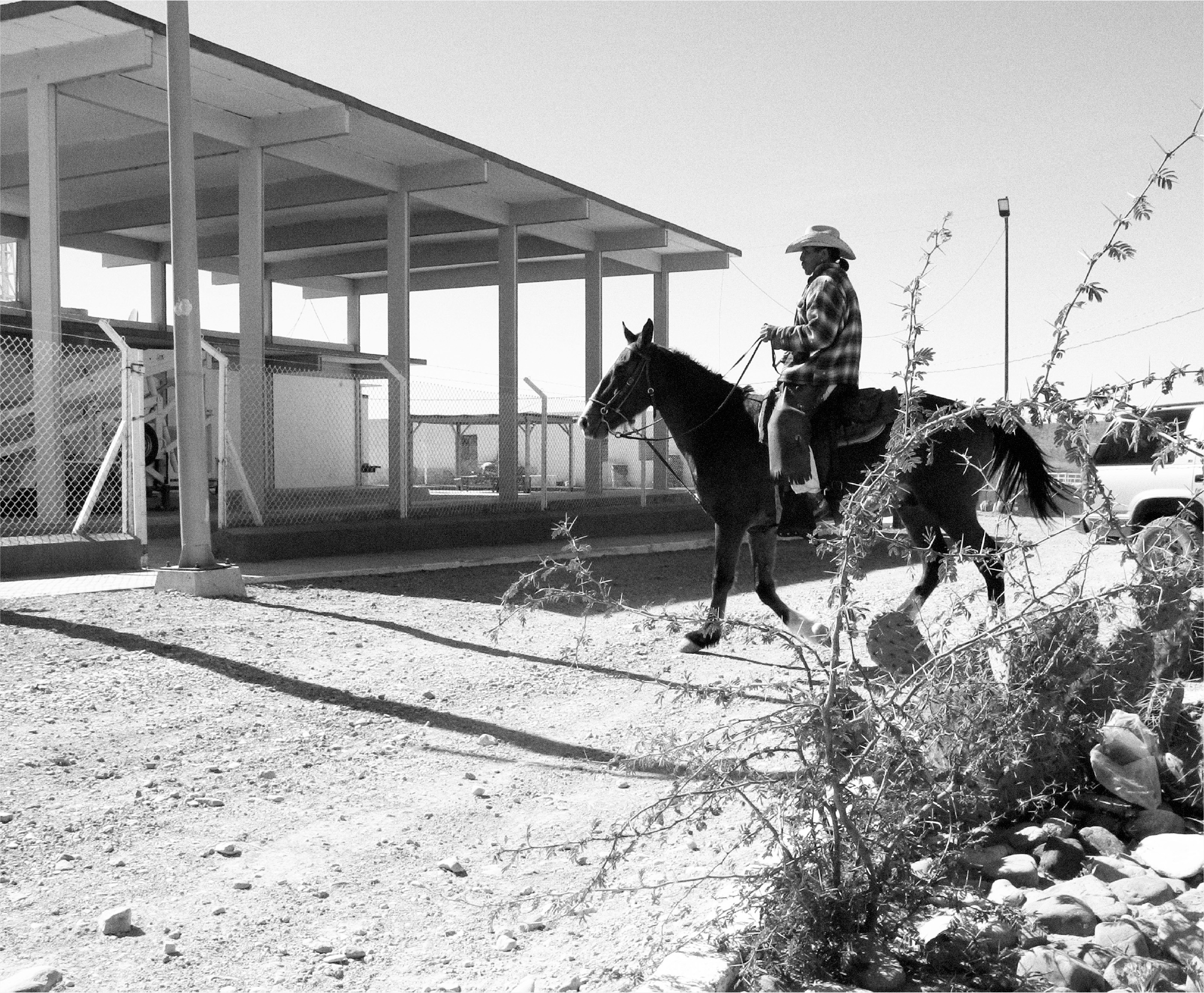
A rider crosses the border near Boquillas del Carmen, Mexico, in 2017
CREDIT: Denis Düttmann/dpa/Alamy
It is one of the great regrets of my life that I didn’t cross. Quixotic or not, I should have jumped across that river – because in the end, that’s what it is, a river, and rivers are meant to be crossed like mountains are to be climbed.
Afterwards, I began to think that this is precisely the real problem at the US—Mexico line today: that we, Americans, don’t cross over and see the border as the citizens of the developing world see it, those who live in the global realm, a world without borders. Americans do get around, of course — but as tourists, as consumers of the ‘other’. From the migrant point of view, borders are permeable rather than solid, moving rather than fixed, politically expedient rather than morally imperative.
In America, we speak of migrants as ‘illegals’ because they have broken the letter of immigration law. But from the migrant point of view, US immigration policy seems to be breaking the laws of nature — or at least of globalisation. For fiscal year 2004, the federal government has budgeted over US$9 billion for border protection. Credible politicians talk of building a wall along the entire southern frontier, the Great Wall of America.
And yet, to date not a single suspected terrorist has been apprehended trying to make illegal entry on the US—Mexico line. (Most national security experts agree that the much more likely scenario is for terrorists to attempt entry along the largely unguarded Canadian border; as for the 9/11 hijackers, all entered legally on tourist or student visas.)
The most concrete result of a decade’s worth of restrictive immigration policy is not a more ‘secure’ nation but the death of thousands of undocumented immigrants. Several walls – none of which runs for more than 20 miles – have been raised at the most heavily trafficked illicit crossings but they haven’t stopped or even stemmed the flow. Like water following the path of least resistance, the smugglers push their human cargo around the walls and thus into much more isolated and hazardous desert terrain. Every year since the first wall was built (at San Diego in 1994), the number of migrant deaths at the line has increased.
This year, by all accounts, will see a massive increase in migrant crossings, apprehensions and deaths. At the beginning of the year, President George W Bush proposed a ‘guest worker’ programme. The proposal was lambasted by advocates of immigrants’ rights as institutionalised exploitation (there would be no guarantee of citizenship after a worker’s ‘contract’ expired, no mechanism for family reunification, and the reform would only target immigrants in the lowest wage brackets), but for many other observers — in particular the migrants themselves — Bush had taken a step, however tentative, in the right direction; and many who’d been waiting for just such a signal decided it was the right time to cross over.
Unfortunately for the migrants, the Bush plan is more of a symbolic election-year stunt — apparently an appeal to those Latino citizens in the US (many of whom once crossed illegally themselves) who hold the proverbial ‘swing vote’ power in several key states. It is highly unlikely that there will be a vote on Bush’s plan, or on the Democratic Party’s more liberal alternatives, this year.
But the toll is already obvious on the border. Some 84 migrants have perished on the Arizona stretch of the border since last October, a rate triple that of the previous 12 months. On average, one migrant a day perishes on the US—Mexico line; in the last decade, well over 3,000 migrants have died attempting entry.
I have written about the border for going on 20 years now, and while I admit I probably indulged rhetorical excess back in the 1980s when I compared the situation here to the old divide between East and West Berlin, today the comparison is rather more precise. With billions of dollars’ worth of technology, the presence of some 10,000 Border Patrol agents — in addition to Customs, Drug Enforcement Agency and other federal officers — we are finally achieving in deed what restrictionist politicians have envisioned with their rhetoric: Fortress America.
The problem for the wall-builders is that the migrants continue to cross anyway. The Border Patrol tallied some 1,400 detentions in south-eastern Arizona on a single day last month. The general rale of thumb has long been that for each migrant detained, another gets through.
A long hot summer is predicted for the drought-stricken American Southwest. A new record number of deaths will be set. The politicians will try to proclaim success in ‘sealing the border’. But the migrants by their very numbers — those who die, those apprehended and turned away, those that make it into the interior — will tell us otherwise.