




Abstract
Publishing work by political prisoners – most recently letters from dissidents targeted by the Lukashenka regime in Belarus – has been a prominent feature of the magazine from the start
British-Iranian charity worker
NAZANIN ZAGHARI-RATCLIFFE COULD be facing her third Christmas away from her family. She was arrested on 3 April 2016 by Iran’s Revolutionary Guard at the airport in Tehran when returning to London from visiting her family. She was with her daughter, Gabriella, who was then 21-months old. No reasons were given at the time of her arrest.
She writes from prison about her experiences and thoughts via her poetry, published overleaf, and describes how the writing makes her feel.
“It is hard to write about freedom when you have so little of it in your life. It is hard to describe how it feels to be tied by force to one place. But it is the hope of being free that keeps me going, the hope of gaining freedom back one day,” she said.
“I realise now how I took freedom for granted. It is important to cherish freedom today, as you never know what tomorrow brings. The road ahead is bumpy and bendy, scary and still unclear.
“But I could not have come this far without the love and support of those outside – those I know who are out there, and those I don’t – who are following my story and sharing it with shock.
“Talking about freedom when surrounded by brick walls feels tough, but we all share the same sky. One day we will all be under the same blue sky, singing our freedom songs.”
In August 2018, Zaghari-Ratcliffe was released for three days from Evin prison, in Tehran, where she is now. Evin is notorious for housing Iran’s political prisoners.
Following a secret trial in August 2016, she was sentenced to five years in prison on unspecified charges relating to national security. She spent eight-and-a-half months in solitary confinement before she was transferred to the women’s political wing.
In October 2017, she was informed of three new charges and told that she could face an additional 16 years in prison. Her family was required to provide bail money to prevent her from being returned to solitary confinement. The court date was later postponed in the wake of then UK foreign secretary Boris Johnson’s visit to the country, and in May 2018 it was reopened.
Also in the prison is Golrokh Ebrahimi Iraee, a writer and political activist who is serving a six-year sentence for charges related to an unpublished story she wrote criticising the practice of stoning in Iran.
In September 2014, government forces searched the home of Iraee and her husband, Arash Sadeghi, in Tehran, where they found the unpublished story. They arrested them both. Sadeghi was taken to Evin, while Iraee went to a secret location for three days before going to Evin, where she was interrogated for 17 days. During this time, she had to listen to the guards beat her husband in the next cell.
Iraee was sentenced to six years in 2016 and had her stories and poems confiscated on her first night in prison.
On her poetry, Iraee said: “It is bitter writing about a generation that, four decades ago, had the same hopes that I have today who were hanged, burned, abused and tortured in prison. But it is a reality – to hold on to the image of those men and women, with their pain and suffering, with a song on their lips and aim in their heart, who looked for freedom and justice. The songs of those who endured the most shocking violence without knowing how or why.
“Today I am writing for them from here, from where they once sang the song of freedom. It means that their beliefs are still alive. Alive in me, alive in all of us here, and kept alive by those who hear our words in a faraway land and keep them in your thoughts and hearts.
“I also hope that the day will come when the scale of justice in our song will reach enough people’s ears that those responsible for such pain will be held to account.”
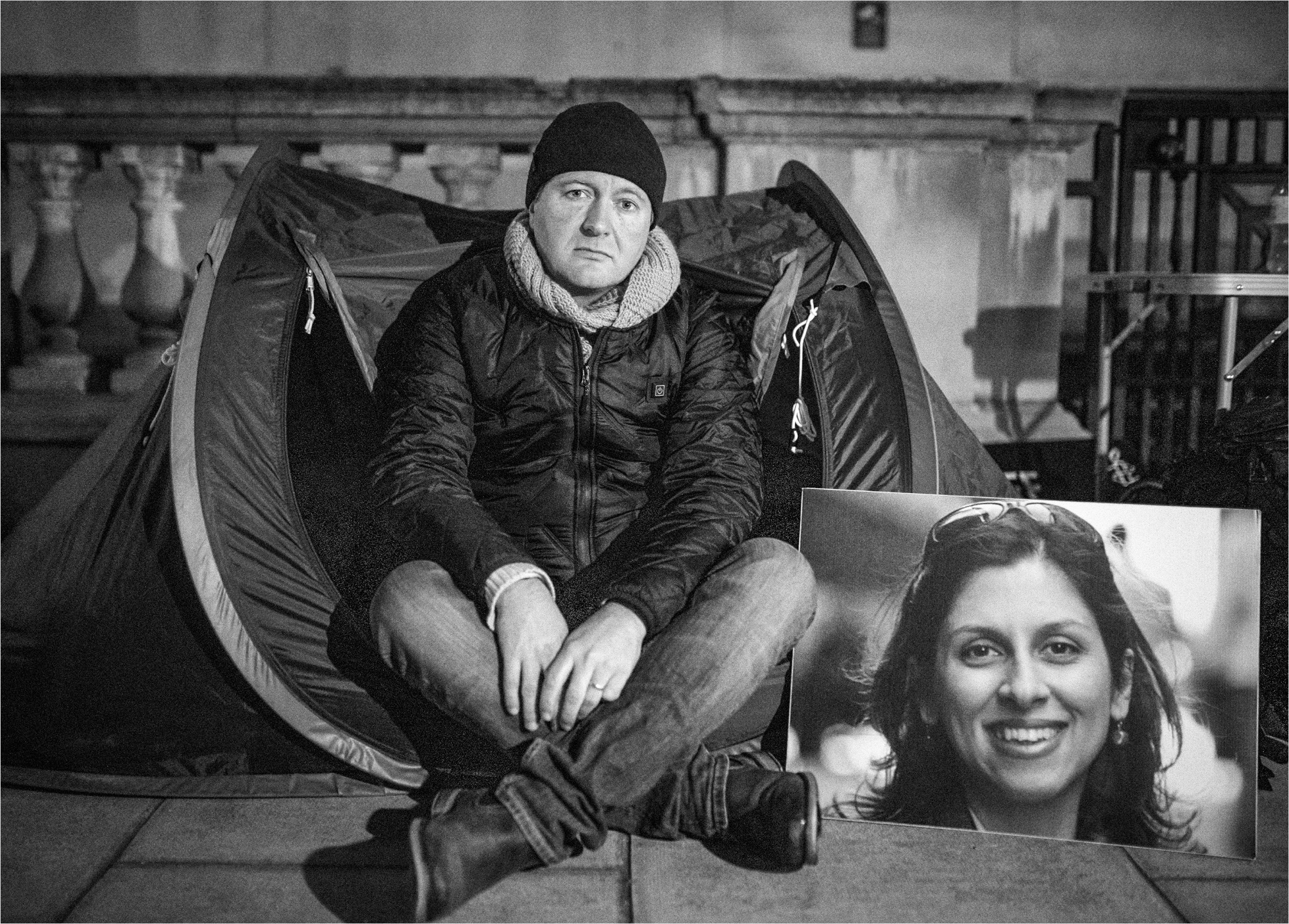
Richard Ratcliffe, the husband of Nazanin Zaghari-Ratcliffe, outside the Foreign Office in London last October during his second hunger strike in two years in protest at Britain’s lack of meaningful action to free his wife from incarceration in Iran
CREDIT: Aaron Chown/PA
Iraee was released from prison on 3 January 2017 after a 71-day hunger strike by her husband and a campaign on Twitter, but shortly after returned to prison.
In January 2018, she faced additional charges. She was subsequently transferred to Shahr-e-Rey prison, a former industrial chicken farm on the outskirts of Tehran, after she refused to go to court.
In early February, Iraee began a hunger strike which seriously damaged her health and in early April she was transferred to hospital in a critical condition. She is now back in the women’s political wing in Evin. For now.
Poems written in prison by Zaghari-Ratcliffe and Iraee are published here for the first time.
For Our Parents
I am sitting in a corner
Reviewing my dreams
And ploughing through my memories.
I think about my mum, who
Every time I touch Gabriella’s hair
Or kiss the back of her neck
Her eyes fill up with tears
I think of her safe hands, full of love,
And her longing look.
I think of my Dad
Whose hair has gone completely grey
Tired of walking up and down in the corridors
Of the courts
And the hope at the end of his eyes
That yet again reminds me
That these days will pass, however hard
I think of your mum
That nothing would make her happier
Than seeing and embracing her granddaughter
After 19 months
To bring a smile on her lips and her pale face
And give her energy on her tired body
Flattened from illness
I think of your dad
Who turned 68 this month without us
His silence is full of words for me
I think of freedom, of return
Of that glorious moment of rolling into your arms
The arms I have longed for the past 500 days
I think of my orchids and African violets
Have they bloomed without me?
It is true that the world in its great hugeness
Sometimes gets so small
As small as the eye in the needle
And unreachable like a dream
And I still
Am sitting in my corner
Reviewing my dreams
And ploughing through my memories
Autumn Light
The diagonal light falling on my bed
Tells me that there is another autumn on the way
Without you
A child turned three
Without us
The bars of the prison grew around us
So unjustly and fearlessly
And we left our dreams behind them
We walked on the stairs that led to captivity
Our night time stories remained unfinished
And lost in the silence of the night
Nothing is the same here
And without you even fennel tea loses its odour
Standing Straight
Standing
Mountains
Firm but quiet
While people of the city
Full of uproar
Crawl on their knees
From here to there
It is not that they are restless – No
But whoever is shorter Is safer
From constant bullets
And their whispers
Are not reported
To the ears of the city
By the wind.
It is the one who is standing
Against the grim vultures
Of the city Standing straight
Holding in the square
Of the city for a while
Where an unknown grave
Repeats their name with a tremble
And it is the one
Who puts their hand on their knee
Aiming to stand up In front of the grim vultures of the city
The vultures who
Dress like policemen
And pull the trigger without asking
Your name
The Lips of the Wind
I’ve left your hands
Beyond borders
Beyond time
Now I turn into wind
Over these mud bricks
Piled on each other
These cement bricks
That fill up the sky of the city
That city that has swallowed me
I turn into an arrow
On Arash’s bow
To pass through the darkness
Of night, whistling
To the sun
I turn into a flag
In the hands
Of Kaveh, fluttering
In front of the eyes
Of the people of the city
Who haven’t even asked
In whispers
What is the story of
This wall Standing up in front of them
I turn into a poem
On the lips of the wind
And pass through
This inevitable boundary
Over the dreams
And becomes real
Until the cups of our tea
Which are emptied next
To each other
To fill the loneliness of our afternoons
Until they won’t be gloomy anymore
And no longer will we be
Without each other
Counting Up, Counting Down
One, two, three
I have counted the bricks in this wall
I have counted
Your notches
On the walls of the cell
That has devoured me
And now it has been years
That I am counting that man
Who is a thousand bodies
In a shower of bullets
With his eyes closed
And hands tied up with a rope
And feet in chains
I have counted that woman
Who is a thousand women
Hanging from a gallows tree
Whose feet stayed still
When the wind
Swirled in her dress
I counted
Those virgin girls
Who had the freedom song
On their red lips
With their plaited hair
When just before execution
They turned to cry to the east of time
To the impudence of an action
Which planned to
Prevent them belonging to heaven
I’ve counted
The children of those rolled in blood
Lamenting in distress
Over unknown graves
I’ve counted
Every second of this
Open-ended, beginning
This dawnless night
This sewage
This decline
And this reaction
This wall fills up
With trembling notches
Which picture
The firmness of
A generation of pain
The entangled notches
Are an alphabet
That write the screams
Of the sewn lips
Until then
That sun passes by
Without distress
Over my city, Tehran
That as of many years ago
Has slept counting its own blood
And yet to wake up.
Sign up for updates on Zaghari-Ratcliffe’s story here: https://www.change.org/p/free-nazanin-ratcliffe.
For information on the Center for the Defenders of Human Rights, which aids women inside Evin, visit
http://www.humanrights-ir.org This article first appeared in volume 47, issue 3, 2018