




Abstract

The critically acclaimed animated film Flee tells the story of an Afghan family’s flight into exile through the eyes of one man. Its director, Jonas Poher Rasmussen, talks to
HALFWAY THROUGH THE film Flee, the protagonist Amin is in a Finnish prison which houses refugees. Conditions are bleak. Then a TV crew turns up. They come, Amin says, they take pictures, and they leave, he assumes without much thought for those inside. Amin feels as though his suffering has been exploited.
I’m chatting to the film director, Jonas Poher Rasmussen, who is Danish, about that scene. There is no doubt that Amin’s story is important and deserves to be told. It traces his family’s exile from Afghanistan in the mid-90s and their treacherous, difficult journey to safety. It deals with sexuality - Amin is gay - and gives a voice to someone who might otherwise be nameless. But, at the same time, it is a film, something to watch on a Saturday night in a cinema with popcorn. Anyone who works with stories concerning grave human rights abuses is all too aware of the immense responsibility in how they are told and when. Poher Rasmussen has thought about this too.
“There’s the sequence with the cruise ship where, when it passes them [Amin and his family] by, tourists are taking photos and when he told me that story I felt I was one of those tourists,” he says. “Because I am here in Denmark, I grew up in a very safe place and now I am telling his story. But the responsibility is really in how you tell it. If you spend the time and really go into depth and tell a nuanced portrait,” he says.
Poher Rasmussen has done that. Flee is a triumph, a shattering story about identity and exile. It has already won some of the biggest awards and is now up for the best documentary, animation and international feature at the Oscars. Some of the film’s strength is in its interesting cinematography – it blends illustration with real-life flashbacks and a soundtrack that, surprisingly, fizzes with nineties and noughties classics. But it’s also because of the time taken over Amin’s story. Poher Rasmussen, who has known Amin since his school days, says he spent as much as five years doing roughly 20 interviews with him. “It was a long, slow process,” he said.
Amin and his mother in Kabul before they were forced to leave
CREDIT: Final Cut For Real
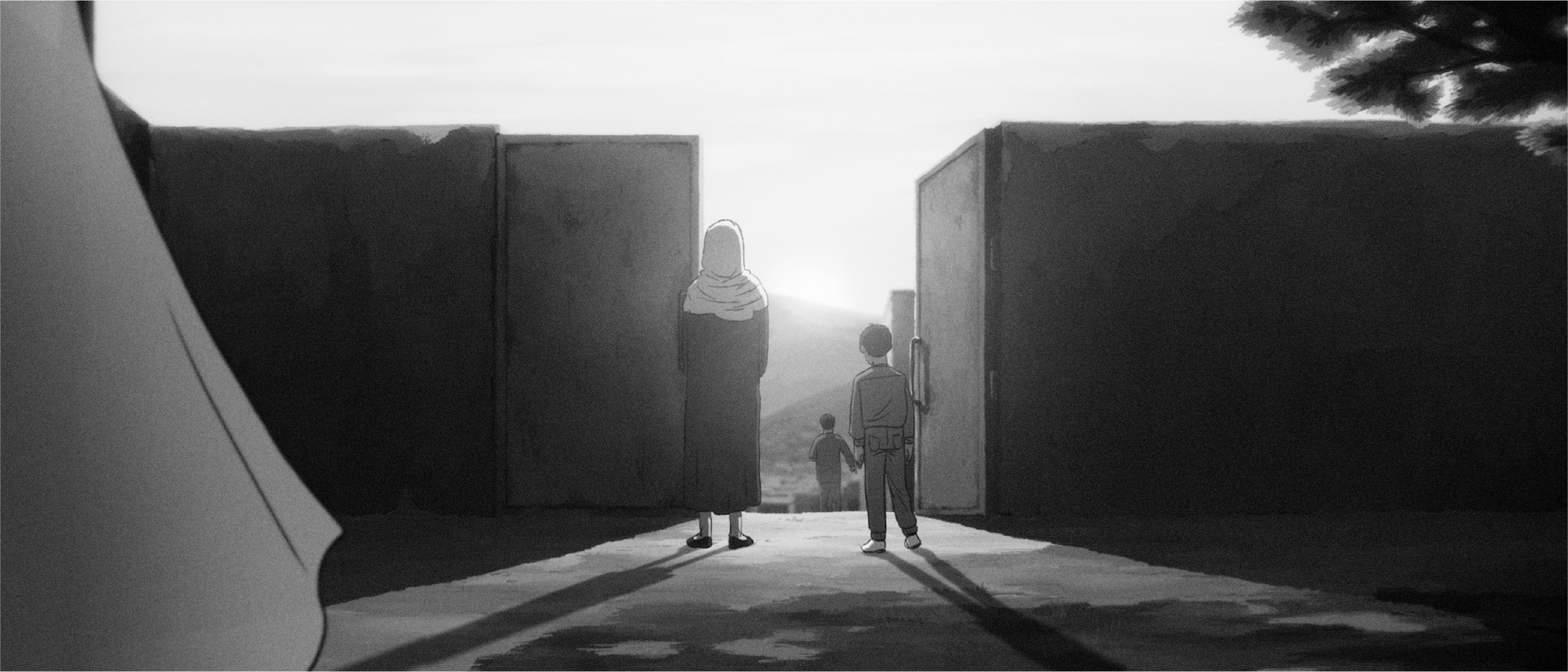
Part of getting Amin to open up was an agreement that his identity would be kept secret.
“He really didn’t want to be in the public eye,” says Poher Rasmussen, explaining that Amin was keen to avoid meeting people in the street who had seen the film and who would ask him questions about some of the most difficult points in his life, as if that was acceptable small talk.
Poher Rasmussen got Amin to close his eyes when telling the story. The technique, which was used primarily to get Amin to remember events from years ago, creates a sense of closeness between interviewer and interviewee that feels more like a therapy session. Poher Rasmussen says that he wanted the film “to show how important it is to listen to stories and to share stories. Just the act of listening – how healing it is.” He says that at “the core that’s really what the film is about”.
While the story takes place in the 90s and early 2000s, the film’s timeliness to a 2022 audience cannot be ignored. This is not just because of the escalating crisis in Afghanistan; it’s also because of a growth in anti-immigrant sentiment in Denmark. Last March Denmark became the first EU country to announce it would send Syrians back. The country’s prime minister, Mette Frederiksen, has set a goal of “zero asylum-seekers”.
Poher Rasmussen says Amin was welcomed when he arrived. “He was told that he was safe here and he was able to stay here. And that really enabled him to start building a life of his own.” It’s not the same today.
“The refugees who arrive now – if they’re allowed to stay – are told that as soon as they can they will send them back. That temporality doesn’t give them anything to build on. It just creates this kind of limbo where you can’t do anything and you won’t be able to educate yourself, to work and become part of the community.”
Poher Rasmussen says he wanted to bring “some nuance to the refugee story because a lot of time it is told in black and white and headlines and either you’re for or you’re against refugees”.
He continues: “But no one is really for refugees, least of all refugees themselves … being a refugee is not an identity, it’s really a circumstance of life and hopefully people get through it and can start building a new life for themselves. Yes, Amin was a refugee and, yes, he fled from Afghanistan to Denmark but he’s really so much more.”
Poher Rasmussen says that until recently he was proud to be from Scandinavia broadly, and Denmark specifically, because of a strong sense of trust in society. Today he’s not so sure.
“We trust each other, we trust the government, we trust our friends, we trust our neighbours and we trusted Amin when he arrived. But I have a feeling this sense of trust is eroding somewhat. I really hope that what the film can show is how much value it is to show trust in someone.”