




Abstract
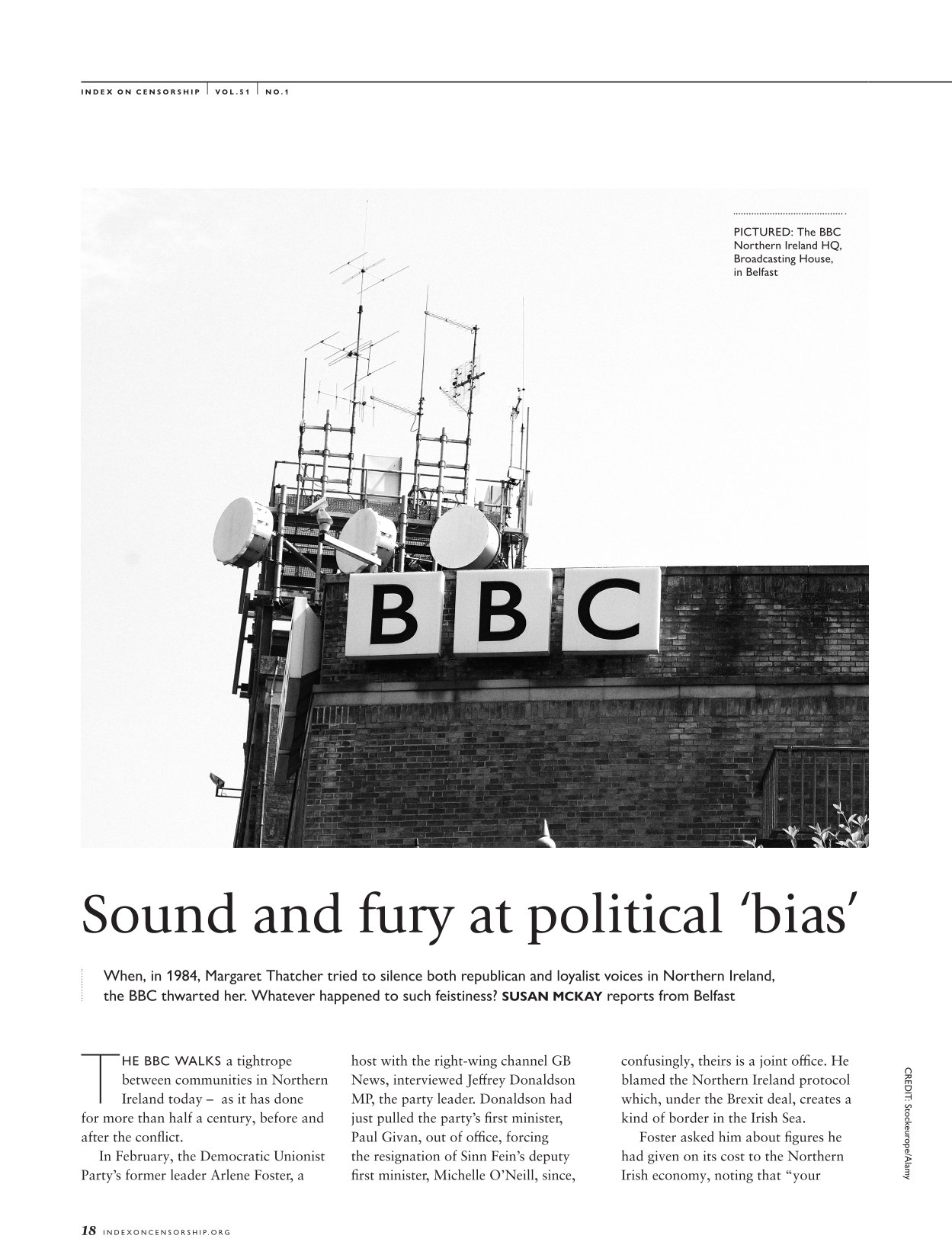
PICTURED: The BBC Northern Ireland HQ, Broadcasting House, in Belfast
CREDIT: Stockeurope/Alamy
When, in 1984, Margaret Thatcher tried to silence both republican and loyalist voices in Northern Ireland, the BBC thwarted her. Whatever happened to such feistiness?
THE BBC WALKS a tightrope between communities in Northern Ireland today – as it has done for more than half a century, before and after the conflict.
In February, the Democratic Unionist Party’s former leader Arlene Foster, ahost with the right-wing channel GB News, interviewed Jeffrey Donaldson MP, the party leader. Donaldson had just pulled the party’s first minister, Paul Givan, out of office, forcing the resignation of Sinn Fein’s deputy first minister, Michelle O’Neill, since, confusingly, theirs is a joint office. He blamed the Northern Ireland protocol which, under the Brexit deal, creates a kind of border in the Irish Sea.
Foster asked him about figures he had given on its cost to the Northern Irish economy, noting that “your opponents… including the BBC in NI”, had challenged them. She may have heard John Campbell, BBC NI’s respected economics and business editor, who had raised serious questions about Donaldson’s figures.
Donaldson ignored Foster’s loaded remark but the BBC was quick to reject her claim. “Our journalism is fair and impartial,” its statement said. “That is the BBC’s job. We are not in opposition to anyone.”
Northern Ireland was meant by its founding fathers to be a unionist state and the BBC was compliant with its role as the voice of the Stormont government, which meant that when it came to the injustices experienced by the minority nationalist community it was silent. The civil rights movement and the violent conflict that followed forced it to change. “There is no shared frame of reference on the question of Ireland,” wrote Anthony Smyth in his 1972 essay for Index on Censorship.
Today, almost a quarter of a century after the Good Friday agreement brought about a devolved power sharing regime, the DUP claims unionists are now discriminated against by the institutions of state, including the BBC.
The DUP has often complained when the BBC features voices it perceives to be insufficiently respectful of its politics. A perpetually angry unionist rump made up of hardliners whose votes the DUP covets have recently taken to calling some journalists (including this one) “anti unionist activists”. Its spokespersons declare support for the Defund the BBC campaign. The BBC, they say, is biased.
Mention the BBC in Northern Ireland and one name will immediately come up: Nolan. Everyone has an opinion. It tends to be a love-hate thing. The Stephen Nolan Show, which airs on BBC Radio Ulster on weekday mornings, boasts that it is the “biggest show in the country”, a claim the BBC defended when a local commercial station challenged it, though it does not provide figures.
The head of a manufacturing trade alliance recently told the Northern Ireland Affairs Committee at Westminster that NI’s public sector was insular, overly preoccupied with the local and so afraid “that they are going to end up on the Nolan Show” that they will do nothing “that has a bit of risk attached to it”.
Nolan is a big fish in the small pond of NI broadcasting. He cultivates the notion that he is an outsider, jokes about how the “sixth floor”, meaning the BBC bosses, are devastated by his success, the brash working class Protestant boy from Belfast’s inner city Shankill Road. Yet he is one of the BBC’s top earners, with a salary above £400,000 a year. He and his team are capable of a journalism that is forensic, ruthless and effective. He wins awards. His interview in 2014 with Iris Robinson, then a DUP politician, over her view that homosexuality was an “abomination” was transformed by Conor Mitchell into a powerful opera.
However, some, including marketing executive Tim McKane, argue that Nolan gives valuable and profile building primetime exposure to certain minority voices while rarely giving a platform to others. McKane asked the BBC last year for figures on the number of times Traditional Unionist Voice leader Jim Allister had been interviewed and was told that no such figures were kept. Allister is a kind of Northern Irish Nigel Farage. His party’s sole elected representative at the NI Assembly at Stormont, he has always opposed the Good Friday agreement, refers to the EU as a “foreign power” and champions the cause of bringing down the devolved power sharing institutions. His popularity is rising.
Stephen Nolan’s BBC Radio Ulster show boasts that it is the biggest in the country

Claims and counterclaims about bias in public bodies are significant in a post-conflict society still afflicted by sectarian hostilities – the reconciliation aspired to in the Good Friday agreement is far from being fully achieved. When I asked BBC NI how it dealt with this, I was referred to the Impartiality and Editorial Standards Action Plan, which is based on recommendations from the Serota Review into the BBC’s overall governance and culture. This, I was told, “focuses on impartiality [and] editorial standards” and “represents the BBC’s biggest and most significant push to ensure its programmes and content are fair, accurate and unbiased and truly reflect the broad public which it serves.” No information was offered as to how this was measured in the complicated context of Northern Ireland. There is no NI representative on the BBC’s governing body.
If the BBC in NI has been making efforts to diversify, it is not apparent. At both managerial and journalistic levels there is still a predominance of white men who look in the mirror and see – white men. Some women who work there describe a boys’ club ethos in which sexism and ageism collide. A number of court cases are pending. Ivy Goddard, project leader of the Inter Ethnic Forum, said that while “small changes” had been made in recent years, there were still, despite extensive lobbying, few faces and voices from minority communities, which include thousands of people.
Angry male callers dominate online phone-ins. When a senior male presenter, speaking at a recent conference, dismissed claims that women’s perspectives were not heard enough, one activist pointed out that if she wanted to talk about the right to choose abortion, she had to do so while arguing with Jim Wells, a DUP politician who is a fundamentalist Christian who once compared abortion to the Holocaust.
In 1984, when Margaret Thatcher prohibited the voices of spokespersons for republicanism and loyalism from being broadcast, BBC NI boldly thwarted her command, using actors of the calibre of Stephen Rea to do voiceovers. The ban ended in 1994. There is little sign of such feistiness now.
In 2017, BBC NI co-funded the documentary No Stone Unturned about a 1994 sectarian massacre by loyalists in Loughinisland. The documentary, by the Belfast based Fine Point Films, was directed by the internationally renowned Alex Gibney. It provided strong evidence of state collusion and controversially named the chief suspect. After a falling out over editorial issues, BBC NI failed to show it. Nationalist politicians were among those who demanded to know why, when the film was being screened in cinemas and was receiving huge attention in Ireland and abroad, the BBC in NI ignored it. The BBC said it would make its own decisions.
After the conflict in NI ended – more or less – many of the international media left. With the local newspaper industry struggling, the BBC’s relatively well-paid jobs are highly prized. It has some excellent journalists, some multi-award winning programmes. But investment in NI programming is falling.
Ofcom’s Media Nations report last year noted its hours of first-run content dropped by 6% to 568 hours, representing a drop of 30% in spend. Ofcom also reported that some 90% of people in NI, the highest proportion in the UK, are “very” or “quite” interested in news. News and current affairs programmes from the BBC’s Belfast and Derry bases reach 30% of the population, while its news coverage reaches half. It faces considerable competition from Ulster Television’s news output. It relies on older people – in 2019, among the under 24s, there was a 23% drop in numbers using it.

The BBC used actors to voice the words of Sinn Fein’s Gerry Adams, left, and Martin McGuinness when the Thatcher government tried to silence figures on both sides of the divide
The BBC’s Belfast press office declined Index on Censorship an interview. It was “a bit of a transitional period, with a new interim director and head of news”, I was told. And it was dealing with the licence fee issue [it is to be frozen]. Everyone was too busy.