




Abstract
The practice of destroying allegedly ‘offensive’ literature did not die out with Adolf Hitler and the Nazis, enthusiastic burners of books. It continues to this day and, alarmingly, is on the rise, notably in the USA
Kurt Vonnegut’s novel Slaughterhouse Five was consigned to the flames in a school furnace in North Dakota and books written by him were regularly thrown out of school libraries
VONNEGUT’S WROTE TO the chairman of the school board in Drake, North Dakota, published below, alongside Vonnegut’s exchange with Felix Kuznetsov, a Soviet Writers Union official, over the persecution of writers in the USSR.
‘You have insulted me’
My novel Slaughterhouse-Five was actually burned in a furnace by a school janitor in Drake, North Dakota, on instructions from the school committee there, and the school board made public statements about the unwholesomeness of the book. Even by the standards of Queen Victoria, the only offensive line in the entire novel is this: ‘Get out of the road, you dumb motherfucker.’ This is spoken by an American antitank gunner to an unarmed American chaplain’s assistant during the Battle of the Bulge in Europe in December 1944, the largest single defeat of American arms (the Confederacy excluded) in history. The chaplain’s assistant had attracted enemy fire.
So on 16 November, 1973, I wrote as follows to Charles McCarthy of Drake, North Dakota:
Dear Mr McCarthy: I am writing to you in your capacity as chairman of the Drake School Board. I am among those American writers whose books have been destroyed in the now famous furnace of your school.
Certain members of your community have suggested that my work is evil. This is extraordinarily insulting to me. The news from Drake indicates to me that books and writers are very unreal to you people.
I am writing this letter to let you know how real I am. I want you to know, too, that my publisher and I have done absolutely nothing to exploit the disgusting news from Drake. We are not clapping each other on the back, crowing about all the books we will sell because of the news. We have declined to go on television, have written no fiery letters to editorial pages, have granted no lengthy interviews. We are angered - and sickened and saddened. And no copies of this letter have been sent to anybody else. You now hold the only copy in your hands. It is a strictly private letter from me to the people of Drake, who have done so much to damage my reputation in the eyes of their children and then in the eyes of the world. Do you have the courage and ordinary decency to show this letter to the people, or will it, too, be consigned to the fires of your furnace?
I gather from what I read in the papers and hear on television that you imagine me, and some other writers, too, as being sort of ratlike people who enjoy making money from poisoning the minds of young people. I am in fact a large, strong person, fifty-one years old, who did a lot of farm work as a boy, who is good with tools. I have raised six children, three my own and three adopted. They have all turned out well. Two of them are farmers. I am a combat infantry veteran from World War II, and hold a Purple Heart. I have earned whatever I own by hard work. I have never been arrested or sued for anything. I am so much trusted with young people and by young people that I have served on the faculties of the University of Iowa, Harvard, and the City College of New York. Every year I receive at least a dozen invitations to be commencement speaker at colleges and high schools. My books are probably more widely used in schools than those of any other living American fiction writer.
If you were to bother to read my books, to behave as educated persons would, you would learn that they are not sexy, and do not argue in favour of wildness of any kind. They beg that people be kinder and more responsible than they often are. It is true that some of the characters speak coarsely. That is because people speak coarsely in real life. Especially soldiers and hardworking men speak coarsely, and even our most sheltered children know that. And we all know, too, that those words really don’t damate children much. They, didn’t damage us when we were young. It was evil deeds and lying that hurt us.
After I have said all this, I am sure you are still ready to respond, in effect, ‘Yes, yes—but it still remains our right and our responsibility to decide what books our children are going to be made to read in our community.’ This is surely so. But it is also true that if you exercise that right and fulfil that responsibility in an ignorant, harsh, un-American manner, then people are entitled to call you bad citizens and fools. Even your own children are entitled to call you that.
I read in the newspaper that your community is mystified by the outcry from all over the country about what you have done. Well, you have discovered that Drake is a part of American civilisation, and your fellow Americans can’t stand it that you have behaved in such an uncivilised way. Perhaps you will learn from that that books are sacred to free men for very good reasons, and that wars have been fought against nations which hate books and burn them. If you are an American, you must allow all ideas to circulate freely in your community, not merely your own. If you and your board are now determined to show that you in fact have wisdom and maturity when you exercise your powers over the education of your young, then you should acknowledge that it was a rotten lesson you taught young people in a free society when you denounced and then burned books — books you hadn’t even read. You should also resolve to expose your children to all sorts of opinions and information, in order that they will be better equipped to make decisions and to survive.
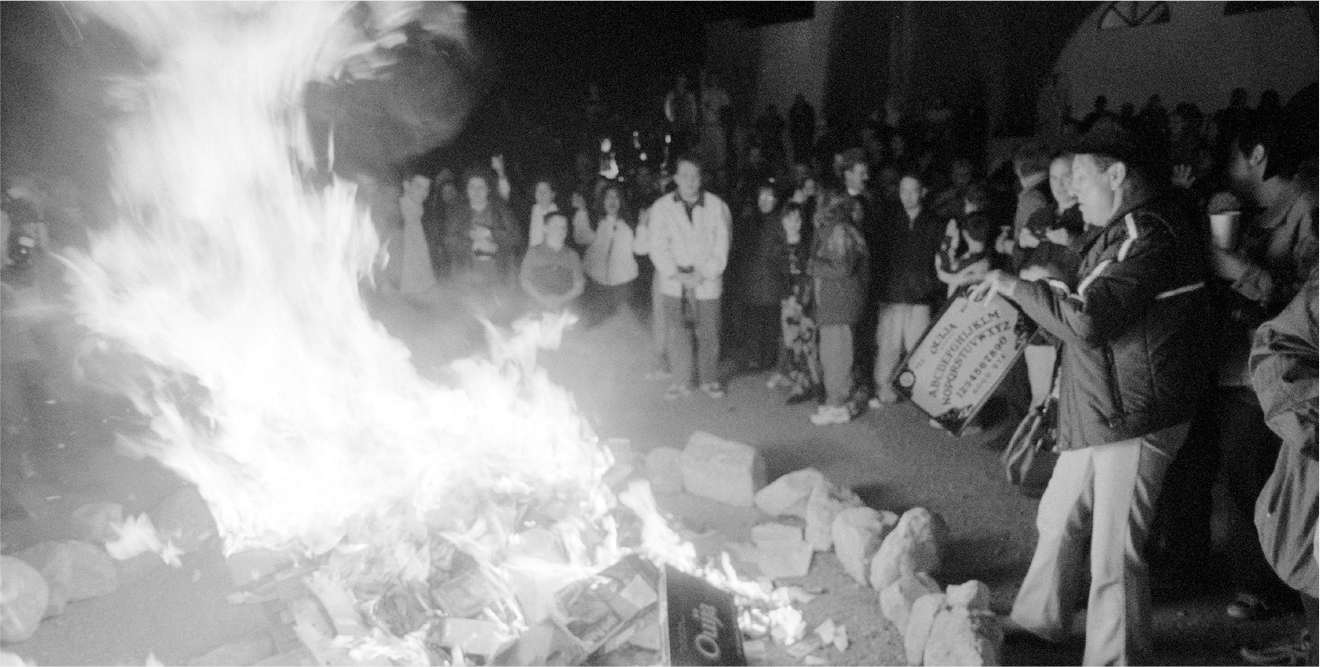
Book burning continues in the USA today. This scene from New Mexico 2001 sees copies of Harry Potter on the fire
CREDIT: Neil Jacobs/Getty
Again: you have insulted me, and I am a good citizen, and I am very real.
That was seven years ago. There has so far been no reply. At this very moment, as I write in New York City, Slaughterhouse-Five has been banned from school libraries not fifty miles from here. A legal battle begun several years ago rages on. The school board in question has found lawyers eager to attack the First Amendment tooth and nail. There is never a shortage anywhere of lawyers eager to attack the First Amendment, as though it were nothing more than a clause in a lease from a crooked slumlord.
‘We continue to care’
I spoke at Gatsby’s house in the afternoon of 16 September 1979. When I got back to my own house in New York City, I wrote a letter to a friend in the Soviet Union, Felix Kuznetsov, a distinguished critic and teacher, and an officer in the Union of Writers of the USSR in Moscow… Felix Kuznetsov and I had become friends during the previous summer — at an ecumenical meeting in New York City, sponsored by the Charles F. Kettering Foundation, of American and Soviet literary persons, about ten to a side. The American delegation was headed by Norman Cousins, and included myself and Edward Albee and Arthur Miller and William Styron and John Updike. All of us had been published in the Soviet Union. I am almost entirely in print over there — with the exception of Mother Night and Jailbird. Few, if any, of the Soviet delegates had had anything published here, and so their work was unknown to us.
We Americans were told by the Soviets that we should be embarrassed that their country published so much of our work, and that we published so little of theirs. Our reply was that we would work to get more of them published over here, but that we felt, too, that the USSR could easily have put together a delegation whose works were admired and published here — and that we could easily have put together a delegation so unfamiliar to them that its members could have been sewer commissioners from Fresno, as far as anybody in the Soviet Union knew.
Felix Kuznetsov and I got along very well, at any rate, I had him over to my house, and we sat in my garden out back and talked away the better part of an afternoon.
But then, after everybody went home, there was some trouble in the Soviet Union about the publication of an outlaw magazine called Metropol. Most of Metropol’s writers and editors were young, impatient with the strictures placed on their writings by old poops. Nothing in Metropol, incidentally, was nearly as offensive as calling a chaplain’s assistant a ‘dumb motherfucker’. But the Metropol people were denounced, and the magazine was suppressed, and ways were discussed for making life harder for anyone associated with it.
So Albee and Styron and Updike and I sent a cable to the Writers’ Union, saying that we thought it was wrong to penalise writers for what they wrote, no matter what they wrote. Felix Kuznetsov made an official reply on behalf of the union, giving the sense of a large meeting in which distinguished writer after distinguished writer testified that those who wrote for Metropol weren’t really writers, that they were pornographers and other sorts of disturbers of the peace, and so on. He asked that his reply be published in The New York Times, and it was published there. Why not?
And I privately wrote to Kuznetsov as follows:
Dear Professor Kuznetsov — dear Felix — I thank you for your prompt and frank and thoughtful letter of 20 August, and for the supplementary materials which accompanied it. I apologise for not replying in your own beautiful language, and I wish that we both might have employed from the first a more conversational tone in our discussion of the Metropol affair. I will try to recapture the amiable, brotherly mood of our long talk in my garden here about a year ago.
You speak of us in your letter as ‘American authors’. We do not feel especially American in this instance, since we spoke only for ourselves without consulting with any American institution whatsoever. We are simply ‘authors’ in this case, expressing loyalty to the great and vulnerable family of writers throughout the world. You and all other members of the Union of Writers surely have the same family feelings. Those of us who sent the cable are so far from being organised that I have no idea what sorts of replies the others may be making to you.
As you must know, your response to our cable was printed recently in The New York Times, and perhaps elsewhere. The controversy has attracted little attention. It is a matter of interest, seemingly, only to other writers. Nobody cares much about writers but writers. And, if it weren’t for a few of us like the signers of the cable, I wonder if there would be anybody to care about writers — no matter how much trouble they were in. Should we, too, stop caring?
Well — I understand that our cultures are so different that we can never agree about freedom of expression. It is natural that we should disagree, and perhaps even commendable. What you may not know about our own culture is that writers such as those who signed the cable are routinely attacked by fellow citizens as being pornographers or corrupters of children and celebrators of violence and persons of no talent and so on. In my own case, such charges are brought against my works in court several times a year, usually by parents who, for religious or political reasons, do not want their children to read what I have to say. The parents, incidentally, often find their charges supported by the lowest courts. The charges so far have been invariably overthrown in higher courts, those closer to the soul of the Constitution of the United States. Please convey the contents of this letter to my brothers and sisters in the Writers’ Union, as we conveyed your letter to The New York Times. This letter is specifically for you, to do with as you please. I am not sending carbon copies to anyone. It has not even been read by my wife.
That homely detail, if brought to the attention of the Writers’ Union, might help its members to understand what I do not think is at all well understood now. That we are not nationalists, taking part in some cold-war enterprise. We simply care deeply about how things are going for writers here, there, and everywhere. Even when they are declared nonwriters, as we have been, we continue to care.
Kuznetsov gave me a prompt and likewise private answer. It was gracious and humane. I could assume that we were still friends. He said nothing against his union or his government. Neither did he say anything to discourage me from feeling that writers everywhere, good and bad, were all first cousins — first cousins, at least.
And all the argle-bargling that goes on between educated persons in the United States and the Soviet Union is so touching and comical, really, as long as it does not lead to war. It draws its energy, in my opinion, from a desperate wish on both sides that each other’s utopias should work much better than they do. We want to tinker with theirs, to make it work much better than it does — so that people there, for example, can say whatever they please without fear of punishment. They want to tinker with ours, so that everybody here who wants a job can have one, and so that we don’t have to tolerate the sales of fist-fucking films and snuff films and so on.
Extracted from Palm Sunday by Kurt Vonnegut, published by Vintage on 18th June 1981 at £7.95 Copyright © Kurt Vonnegut
This article appeared in volume 10, issue 6