Abstract

We need to support the new dissidents fighting Putin’s war of fear and propaganda, writes
RUSSIA’S INVASION OF Ukraine at the end of February pitted a pluralistic society with liberal values and a straight-talking leader against a country synonymous with autocracy that has a “strongman” at the helm. People started talking about a New Cold War – not just because it involved Russia again but because it centred on values and ideals. Ukraine became a symbol of freedom, Russia one of illiberalism.
That said Vladimir Putin’s war has been far from cold and ultimately historical comparisons come with limitations. Understanding the new terms, documenting the unfolding abuses to free expression and supporting those being attacked is paramount.
This is the focus of our summer edition. In our special report, people across the spectrum talk about the corrosive effect of the war on their own freedoms. Viktoria Serdult, a journalist in Hungary, writes about how Europe’s most right-wing leader, Prime Minister Viktor Orban, used fears of being embroiled in the war to secure a resounding electoral victory. Hanna Komar, an activist from Belarus, tells how she is desperately trying to challenge her parents on the lies they see on their TV. These lies could lead young men and women to enlist in the war and must be called out.
We give space to Ukrainian writers and artists, with a moving essay from Andrey Kurkov on how today, as in the past, Russia is trying to erase Ukraine’s culture, and a discussion with the poet Lyuba Yakimchuk on children in Donbas being fed an alternative history.
Of course, when it comes to censorship Russia remains ground zero. The passage of the “fake news” law straight after the invasion showed that. And so we have several articles from those brave enough to make a stand. We publish the court statement from student journalist Alla Gutnikova, one of the Doxa Four sentenced to two years’ “correctional labour” in April, alongside an interview with her. Ilya Matveev, a Russian academic, writes about the incredibly difficult environment in his St Petersburg classroom, which eventually led him to flee.
You’ll also find the powerful words of murdered Russian journalist Anna Politkovskaya, reporting from Chechnya in 1999. Her warnings and experience of early Putin warfare resonate more today than ever and deserve a bigger audience.
We are aware of the sensitivities of publishing Russian and Ukrainian writers next to each other (and have invited two writers from opposite camps to debate the very thorny issue of the cultural boycott of Russian artists). But, to quote Polish poet Adam Mickiewicz in his poem To My Russian Friends: “As for those of you who are complicit, it is not you that I want to destroy, but your shackles.”
We are also aware that while Europe witnesses its first major war since the 1990s, attacks on freedoms continue elsewhere – only somewhat less reported. Please read the harrowing testimony of Uyghur “re-education” camp survivor Gulbahar Haitiwaji, and an interview with the writer Eduardo Halfon, who doesn’t mince his words on the horrendous rights situation in Guatemala. Halfon describes the country’s history as one of “silence”, something which is being repeated today. As always, it remains our duty to fill that silence.
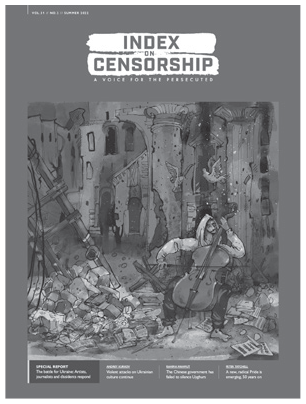
Art is eternal
Irina Potapenko is from Odessa. She says, “For many years I have been illustrating books for children and adults and painting watercolours. When the war started, I began to paint it too as I wanted to tell people all over the world about it. Bombs and rockets destroy our cities, forcing me and my husband to hide in the basement with our pets. Painting helps me maintain mental strength. With this illustration, I wanted to show that cities get ruined but art is eternal.”
CREDIT: (cover) Irina Potapenko