




Abstract
A ban on the sale of meat in some Indian states during a Hindu religious festival has made it dangerous to even admit to eating animals, reports
FOOD, AND THE history and culture associated with it, has always been fraught with political tension and ramifications far beyond what it really just is: sustenance. This is particularly true of India and South Asia, where vegetarians and meat eaters are often divided by religion, caste and class – leading to clashes, and sometimes violence, between vegetarians and meat-eaters, or ‘non-vegetarians’, as they are called in India. The uniquely Indian term ‘non-vegetarian’ is a nod to how vegetarianism is promoted as the norm and standard in the country.
This conceals the fact that only about 44% of Indians are vegetarian. But in India, vegetarianism isn’t just a choice, it is often a marker of caste, class and religion. Signs advertising apartments to rent only to vegetarians, or ‘pure-veg’ restaurants marked by a green dot, aren’t an unusual sign in the country. But food is increasingly being used as a tool of political domination against India’s largest religious minority, Muslims.
On 4 April, the second day of Chaitra Navratri, a nine-day long Hindu festival, during which many Hindus fast or abstain from consuming meat, the mayor of a municipal corporation in Delhi called for a ban on the sale of raw meat, for the length of the festival.
The mayor, Mukkesh Surayan, claimed that “[Hindus’] religious beliefs and sentiments are affected when they come across meat shops or when they have to bear with the foul smell on their way to offer prayers”.
The move was met with widespread outrage and condemned as a gross violation of many constitutional rights, and a targeted attack on the Muslim community.
Journalist, author and associate editor at The Hindu, Ziya Us Salam said that the Bharatiya Janata Party (BJP) government is trying to control the food habits of people, adding that the move sends out the message that “Navratri is paramount; Ramzan is subservient”.
Food writer and author Krish Ashok said that a ban on the sale of meat during a festival is almost always a “political, religious and majoritarianism assertion – a way of putting a particular community in their place, if you will.”
Over the last few years, with a shift towards right wing sentiment, the Muslim community in India has found itself the subject of multiple attacks -including calls for genocide, riots, police brutality, and controversies over Islamic practices like the hijab and halal meat.
“In this particular part of India [Delhi], small-scale meat sellers largely tend to be Muslims. It seems to be clearly targeted [at Muslims] – I don’t think there is any doubt about that,” Ashok added.
The move to temporarily ban the sale of meat in India’s capital was welcomed by many radical groups, and members of India’s ruling party BJP rushed to justify it. “If other communities respect the Hindu festival and welcome the decision, we will also show respect when their festivals will be celebrated [sic],” Parvesh Verma, a Delhi MP from the BJP party, told a leading news publication.
What Verma failed to take into consideration was that the Muslim festival of Ramadan was also underway, and meat is a large part of iftar (the evening meal) celebrations. He also failed to consider that in many Indian states, including West Bengal, Odisha, Bihar and Jharkhand, fish and meat are part of the religious offerings made during festivals.
Neetu Mattas, who is part of a Hindu (Pandit) community from Kashmir, shared how offering meat to certain deities on the ninth day of Navratri is an important ritual in her community, one that is still followed today. “The Navratri ban is unfair and unfortunate as it violates every Indian’s fundamental right of choice,” she added.
Moreover, the meat ban is bound to hit small businesses the worst.
This directive to ban the sale of meat did not extend to larger meat delivery businesses such as Licious, FreshToHome or Meatigo, but it forced small butcher shops, usually run by Muslims, to shut down for days on end – causing a significant loss of revenue. Historian and food writer Rana Safvi pointed out in a tweet how the meat ban will hit underprivileged Muslims the most, as they cannot afford to shop at online meat delivery companies like Licious. They depend on neighbourhood meat shops for iftar requirements, she tweeted.
This move to ban meat comes on the heels of a controversy over Indian Muslim students wearing the hijab, a head-covering, in Karnataka schools, and protests against the sale of halal, which refers to the Islamic practice of humanely slaughtering an animal for consumption. ■*
This persecution of Muslims in India tends to spring from a fear of supposed affronts to Hinduism, fanned by the ruling party of India. ‘Hindu khatre mein hai’ meaning ‘Hindus are in danger’ is a common refrain popularised by the BJP that sums up how many (but not all) Hindus in India feel.
“In how they feel, Hindus under Hindutva are in danger of becoming a majority with a minority complex, plagued by a sense of paranoia and persecution,” historian Ramchandra Guha said in a Scroll op-ed.
“However, in how they act, Hindus under Hindutva are in danger of becoming a majority with a majority complex,” he added.
Hindutva is a radical ideology that seeks to establish the hegemony of Hindus and Hinduism in India.
Former Chief Minister of Jammu and Kashmir, Omar Abdullah tweeted against the meat ban, saying, “During Ramzan we don’t eat between sunrise and sunset. I suppose it’s OK if we ban every non-Muslim resident or tourist from eating in public, especially in the Muslim dominated areas. If majoritarianism is right for South Delhi, it has to be right for J&K [Jammu and Kashmir].”
The weaponisation of vegetarianism
The political battle over meat has always been a point of contention, with the consumption of beef or cow meat (a creature considered sacred by many Hindus) at the heart of the issue.
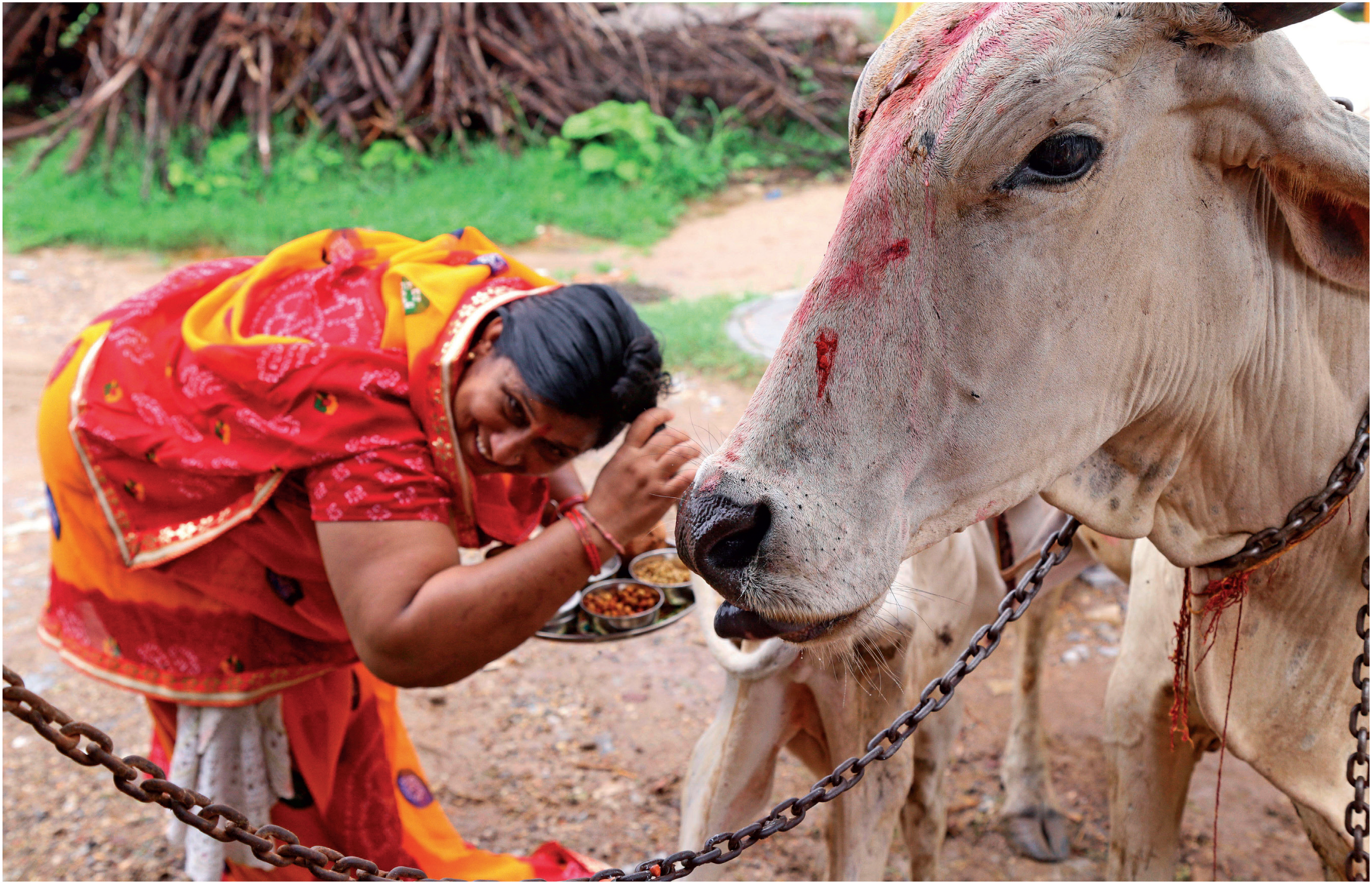
Cow slaughter is prohibited to some degree in close to 20 of India’s 28 states – but the weaponisation of cow protection and vegetarianism has intensified only since 2014, when the BJP came into power.
Since 2014, instances of people (usually Muslims or those from marginalised castes) being lynched to death on suspicion of cow slaughter have increased exponentially. “97% of lynching instances in the country [from 2010 to 2017] have taken place after 2014, according to Home Ministry figures. That says it all,” said Salam.
Many upscale restaurants in India resort to using euphemisms such as “buff” or “meat” instead of “beef”, even though they serve water buffalo meat, which is perfectly legal in India.
While one in 13 Indians admit to consuming meat (15% of whom are Hindu), according to the NSSO (National Sample Survey Office), the prevalence of right-wing Hindutva sentiment in the country has forced many people to keep quiet about their beef consumption.
Unconstitutional and illegal
Mayor Suryaan’s order was followed by an “appeal” by the East Delhi Municipal Corporation, to shut down meat shops. Neither order was legally valid, since a mayor does not have the power to enforce such a ban. The statements also violated Indians’ fundamental rights to freedom of trade, equality, life and personal liberty, and went against multiple Supreme Court and High Court judgements that have upheld the right to autonomy over food.
Although there was no official directive banning the sale of meat, butcher shops in Delhi remained shut out of fear of action by the authorities, or violence by Hindu vigilante groups.
“Owners decided to keep shops closed as the mayor has threatened serious actions against them,” Sanjay Kumar, manager at Bombay Fish Shop, told the New India Express.
“Every Muslim understands what this ‘ban’ means, but we can’t even express our anger. They are now using our religion to attack the bread we eat,” Mehfooz Alam, a 65-year old butcher who works in Delhi’s INA market, told Indian rights organisation Article14.
A woman praying to a cow in Beawar, India. Slaughtering cows is prohibited to some extent in 20 of the 28 Indian states, with cows considered sacred in Hinduism
CREDIT: Sipa US/Alamy
Index approached other meat sellers in Delhi, but they were reluctant to comment on the ban, claiming that they had always shut down their shops during Navratri. It’s unclear if this is true, or if they were too afraid to speak to a journalist.
“As much as we would like to believe that food unites, the truth is that food actually divides,” said Ashok.
Ashok said that we as a society need to reflect on the notion of attaching purity labels to food. “We wouldn’t have the kind of violence that we see today – [with vigilante groups] beating up people, lynching people – if there was no concept of purity attached to what you eat,” he said. “Today a Muslim feels insecure when he runs a dhaba (a small eatery); a Muslim feels insecure ferrying cattle; a Muslim feels insecure offering prayers; a Muslim woman feels insecure while wearing hijab,” said Salam.
“What is important today is the right to life, and the right to livelihood of Muslims is being encroached upon. And the institutions of government, and our state are silent bystanders,” he added.