




Abstract

Journalists in Haiti face corruption, violence and even murder, which largely goes unpunished.
JULY MARKS A year since the assassination of Haiti’s president, Jovenel Moïse. Since then, the country has been deep in a political crisis, with armed gangs taking control and both murders and kidnappings widespread. The situation for journalism and freedom of speech in this tumultuous country remains fraught, where a cacophony of opinions often collide with the reality of powerful actors willing to defend their advantages with guns.
Two important milestones in the Caribbean nation have already passed this year: the centenary of author Jacques Stephen Alexis’s birth and the 22nd anniversary of the murder of Jean Dominique, one of Haiti’s most prominent journalists, an advocate for free speech and the owner of Radio Haiti Inter. Alongside Dominique, Jean-Claude Louissaint, the caretaker at the radio station, was also killed.
In 2014, nine people were accused of the killings, many of whom had links to former president Jean-Bertrand Aristide, although none have yet been tried. Before his death, Dominique said he had “no weapons other than my journalism, my microphone and my unquenchable faith as a militant for true change”.
Dominique and Louissaint were killed in April 2000, in the midst of a bitterly-contested election campaign. The killings interrupted the fitful democratisation the country had witnessed since overthrowing the 29-year Duvalier family dictatorship in 1986. In the years since, although elections have occurred with relative frequency in Haiti, the actual fact of democracy – transparent, uncontested ballots after which politicians act as effective advocates for their constituents – has not.
The two decades have seen the institutionalisation of violence against journalists and other critical voices in the country to such a degree that some refer to Haiti as “the kingdom of impunity”.
This permissiveness somehow coexists with a noisy and rambunctious press corps along with an intellectual milieu that frequently serves up piercing commentary directed at the country’s powerful.
Haiti has been ruled for the last decade by the Tet Kale Party (PHTK), a political group created by former singer Michel Martelly, who served as president from 2011 until 2016. High-ranking members of the party have been dogged by allegations of links to weapons-smuggling, drug-trafficking and illegal armed groups, and recent years have seen the party fight a ruthless pitched battle with its political opposition, which has also proven it has little aversion to bloodshed.
Since Moïse’s assassination, the country has been ruled by an interim prime minister, Ariel Henry (who local human rights organisations accuse of possible links to the murder), in an uneasy coalition of some of Moise’s bitterest political enemies. Civil society, though vibrant, remains largely locked out of real political power.
“There is no justice today in Haiti, and the example of Jean Dominique is there to prove it 22 years later,” said Kettly Mars, a poet and novelist.
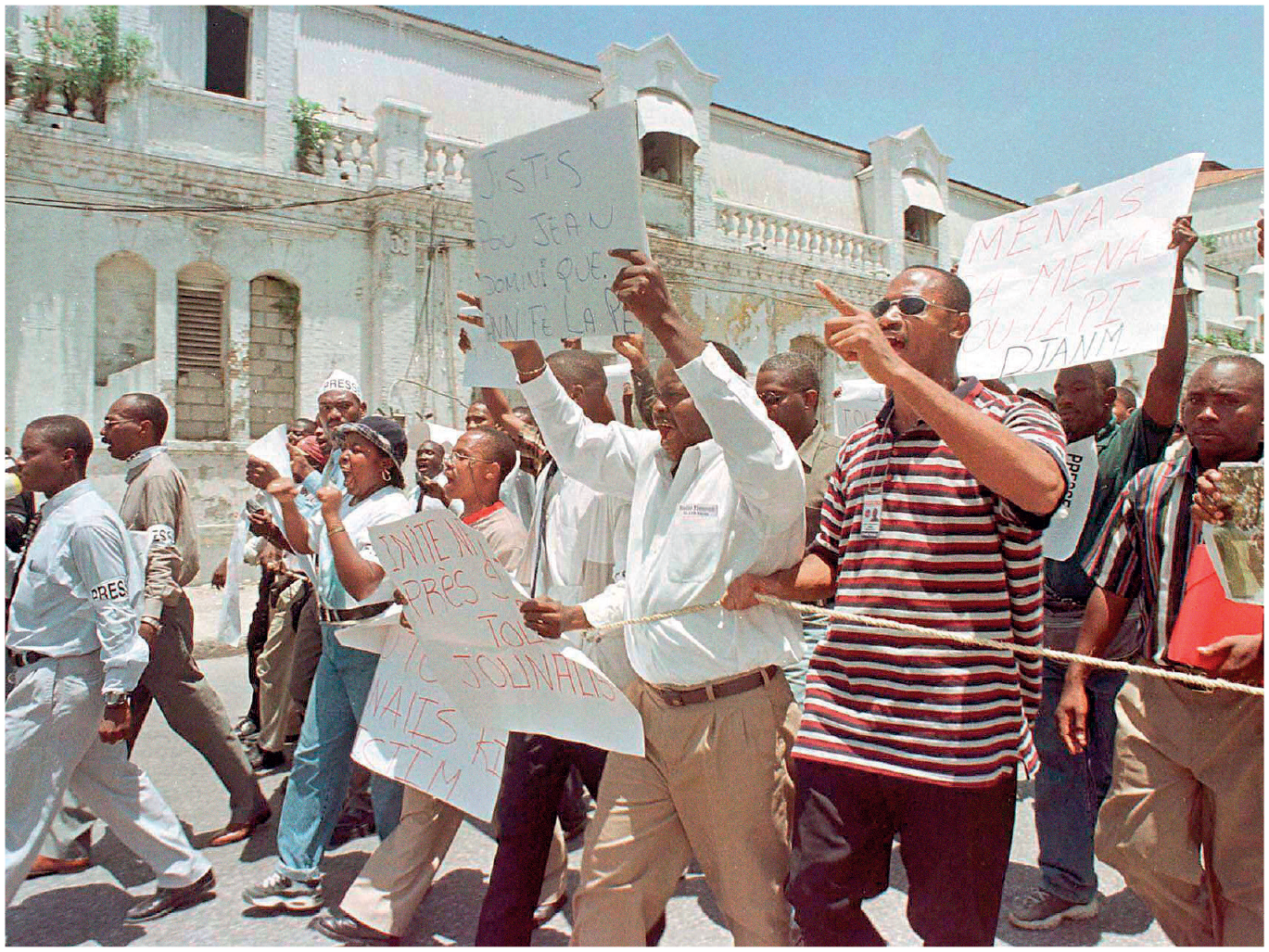
Hundreds of Haitian journalists march to the Justice Hall in Port-au-Prince, Haiti, in April 2000. The journalists demanded freedom of the press and justice for journalist Jean Dominique who was assassinated two weeks earlier
CREDIT: Reuters/Alamy
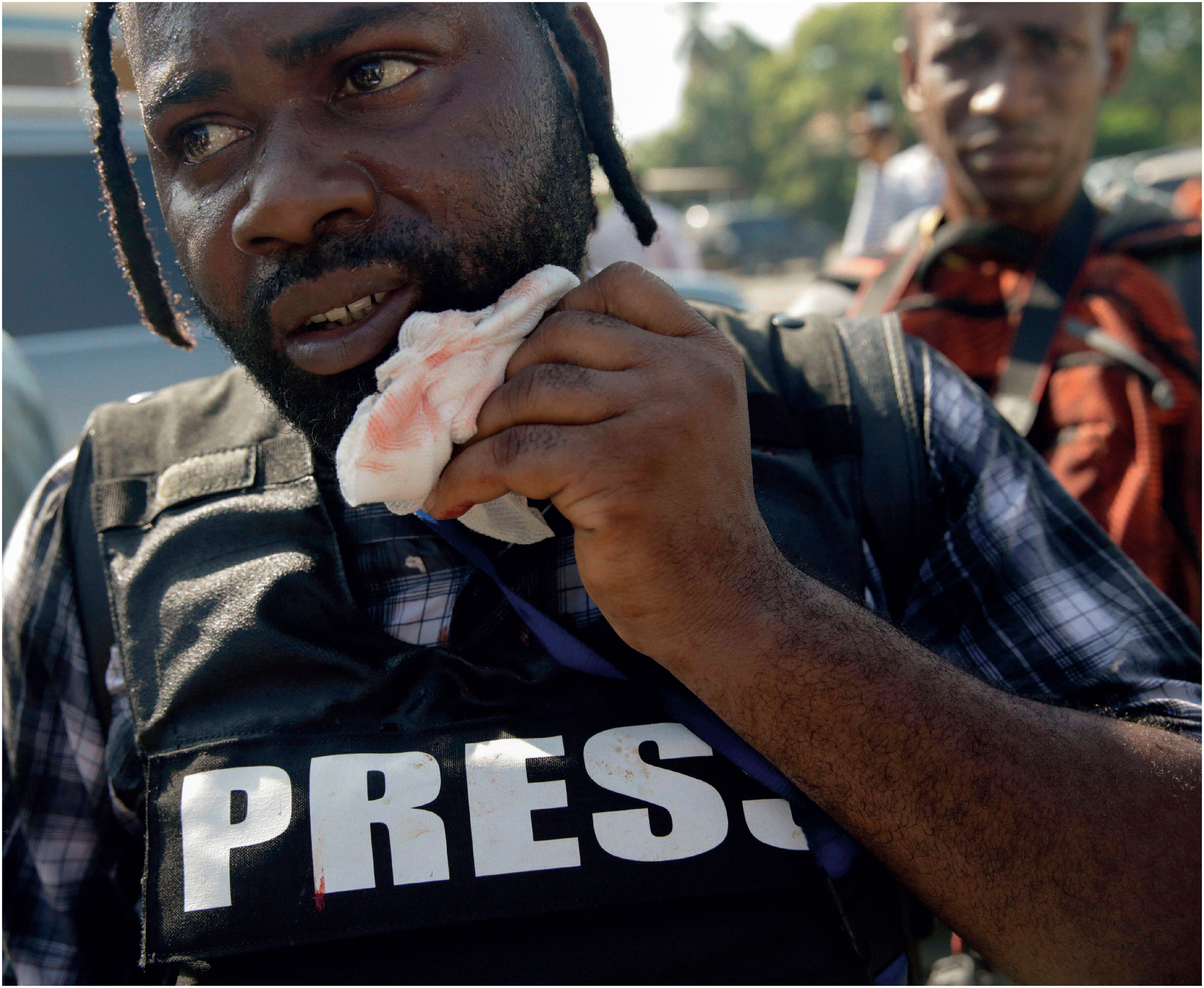
Photojournalist Dieu Nalio Chery was injured covering protests outside parliament in Haiti’s capital Port-au-Prince, September 2019
CREDIT: Andres Martinez Casares/Alamy
“We live in disorganised, anarchic and dangerous dictatorships, supported and tolerated by an international community whose motivations are not well understood. Healthy voices and the critical mass that could affect change cannot yet rise because the system is weighed down by reactionaries who take advantage of this chaotic situation. The balance of power is in great favour of the status quo.”
The impulse towards free speech and creative expression has a long and politically-charged history in Haiti.
During the country’s “Revolution of 1946”, which marked the overthrow of authoritarian President Elie Lescot, the movement to oust him was spearheaded by young Marxist intellectuals in the capital.
They included Alexis and fellow author René Depestre, and the painter Gérald Bloncourt – a group that coalesced around a revolutionary weekly called La Ruche (The Beehive). The movement drew inspiration from a series of lectures that French surrealist André Breton gave in Port-au-Prince at the end of 1945, during which he spoke about personal freedom and railed against dictatorship.
During the long night of Duvalierism – encompassing the 1957-71 rule of François Duvalier (known as Papa Doc) and the 1971-86 rule of his son Jean-Claude (Baby Doc) – stations such as Radio Haiti Inter tried to push the envelope of what was acceptable under a capricious tyranny.
After being brutally attacked and the station shut down by Duvalier in November 1980, Dominique, its owner, fled into exile for several years along with his wife and co-director Michèle Montas. Meanwhile, station manager Richard Brisson took part in an ill-fated attempted invasion in the north of the country by Haitian exiles, and was executed in January 1982.
As the movement to oust the Duvalier dictatorship gathered steam in the 1980s, musicians including Manno Charlemagne supplied a soundtrack of pointed political critique in songs such as Ayiti pa Fore (Haiti Is Not a Forest), which pointedly asked: “If Haiti is not a forest, why are there so many beasts around?”
The military juntas of the 1990s were greeted with expressions of popular discontent such as the song Ké M Pa Sote (My Heart Doesn’t Leap) from the band Boukman Eksperyans.
Once democratic icon Aristide’s drift towards despotism in the early 2000s was addressed obliquely in works such as Gary Victor’s novel À Langle des Rues Paralléles and the filmmaker Raoul Peck’s Moloch Tropical, as well as more directly in works such as film director Arnold Antonin’s GNB Kont Attila.
But over the last 20 years, there has been a staccato litany of killings of those who dared inform the public. In July 2005, the poet and journalist Jacques Roche was kidnapped and slain in Port-au-Prince. Two years later, photojournalist Jean-Rémy Badio was gunned down outside his home.
In March 2012, Jean Liphète Nelson, the founder of Radio Boukman in the impoverished neighbourhood of Cité Soleil, was killed by heavy gunfire. Both Pétion Rospide, of Radio Sans Fin, and Néhémie Joseph, of Radio Mega, were killed in 2019, with Joseph having publicly shared his fears over death threats from PHTK politicians.
Only a few days before Moïse’s assassination last summer, Radio Vision 2000 reporter Diego Charles and feminist activist Antoinette Duclaire were slain in Port-au-Prince’s Christ-Roi neighbourhood. Just months before, Duclaire told the television programme Haiti Sa Kap Kwit: “We face death on a daily basis. When we leave home, there is no certainty that we will return.”
More recently, in January this year, journalists Wilguens Louissaint and Amady John Wesley were killed by gang members as they attempted to report on a gang incursion in the mountainous Port-au-Prince suburb of Laboule. Journalists are also frequently mistreated by security forces when covering demonstrations.
“Unfortunately, crimes against journalists have all gone unpunished,” said Frantz Duval, editor in chief of the daily newspaper Le Nouvelliste.
“This was the case during the time of the Duvalier dictatorship, and it is still the case since democratisation. Haitian justice is struggling to deliver justice. The launch of the investigations for all the crimes are flawed. Trials are impossible in the majority of cases, [but] freedom of the press is still alive in Haiti. There have never been so many journalists, journalism schools, media of all kinds. Speech is free and even totally unbridled. The powers-that-be hope the cacophony will shield them from an effective press [but] the number [of journalists] does not equal quality and self-censorship does the rest.”
Those who criticise power in Haiti often find themselves drawing the attention of the baz, as the armed groups in the country’s more impoverished quarters are known. These gangs, often made up of young men and boys, act as neighbourhood protectors, tax collectors, muscle for political interests and freelance criminals. The use of these armed gangs as a political tool first came to prominence with partisans of former president Aristide’s party in the late 1990s and early 2000s, but has since spread throughout the country.
The baz come with unbridled power and protection from political connections. In November 2018, after a group of gunmen raided the capital’s La Saline slum in an attack the UN said left at least 26 people dead, three of those allegedly involved in the attack were sanctioned by the US State Department for their alleged roles in the killings – former police officer Jimmy “Barbecue” Chérizier and two Moïse government officials.
Chérizier subsequently announced the formation of the G9 An Fanmi E Alye, an alliance of armed groups around Port-au-Prince.
Perhaps the most chilling event for local free speech advocates was the March 2018 disappearance of journalist Vladimir Legagneur in the neighbourhood of Grand Ravine, a gang-ridden district in the south of Port-au-Prince.
Another of those who has felt the sharp end of Haiti’s political wars is Dieu Nalio Chery, an award-winning photographer who worked for the Associated Press in Haiti for several years. He fled after being targeted by threats from armed groups last year.
“It’s been very hard to work as a journalist for the last five years with the growth of gangs everywhere in Haiti, especially in the capital,” he said. In September 2019, Chery was shot (apparently by accident) by a sitting senator, PHTK’s Jean Marie Ralph Féthière, as he attempted to cover clashes between protesters and legislators outside parliament.
“Journalists do not feel safe writing meaningful stories about gangs, kidnappings, and corruption, because gangs threaten them and there is a lack of access to information,” Chery explained. “And local journalists face police brutality during protests because the police don’t like them reporting their brutality against protesters.”
The imbalance of power brought about by the hard grain of impunity in Haiti is something that also impacts those who work in the creative arts.
“Someone who has power and money in Haiti, he can prevent you from expressing yourself,” said Jean D’Amérique, a poet, playwright and novelist whose books, such as last year’s Soleil à Coudre, paint a piercing picture of modern Haiti.
“They will have no fear of doing so because they know that they do not necessarily have to answer to justice. We have all come to know it. If we speak or act until we concretely disturb those who want to take advantage of the privileges of power, we will be repressed.”
This year marks the 61st anniversary of Jacques Stephen Alexis’s death.
In April 1961, he led a small party of would-be rebels to land on the Haitian coast near Môle-Saint-Nicolas, a picturesque village in the north-west of the country still dotted with the ruins of French, Spanish and British forts. Hoping to topple the Duvalier dictatorship, Alexis and his compatriots were discovered and betrayed, and he was killed by the same forces he had critiqued in his work so eloquently years before. Years after his death, his name, like that of Jean Dominique, lives on in the hearts of many Haitians who believe that the country can – and must – change.