




Abstract

As Kenyans approach a general election in August, a list of words has been banned.
A HEAD OF THE country’s general election, Kenya’s National Cohesion and Integration Commission (NCIC) has banned more than 20 words it said were inciting hatred, discrimination and violence against ethnic groups. The outrage the decision triggered will likely linger for many years to come.
In a country where politics has been infested by ethnic divisions since its independence from Britain, the state-controlled NCIC’s decision has turned into a tribal war of words, as August’s election draws near and the campaign heats up.
The list of illegal language includes the Swahili madoadoa (spots), watu wa kurusha mawe (those who throw stones) and watajua hawajui (they won’t know what hit them).
There are also phrases in Sheng (Swahili pidgin), including kama noma, noma, kama mbaya, mbaya, which means “no matter what”.
Kikuyu language featuring on the censor’s checklist include kihii (young boy) and uthamaki ni witu (the throne is ours), alongside Kalenjin words such as kimurkeldet (brown teeth) and otutu labotonik (uproot the weed). Some English words have been banned too: fumigation, uncircumcised, eliminate and kill.
“This is a politically-motivated decision. We’ll not accept it and we’ll continue using these words no matter what happens,” a man identified as Disco, who claims to be a William Ruto hard-line supporter, told Index on Censorship in Nairobi.
Ruto, the country’s outgoing deputy president from the Kalenjin ethnic group, is the United Democratic Alliance flagbearer and one of the leading presidential contenders.
“We know who is behind this scandalous decision. It’s Uhuru. When will these Kikuyu begin to understand that this country belongs to all Kenyans?” said another Ruto supporter nicknamed Roho, referring to the country’s outgoing president Uhuru Kenyatta, a Kikuyu.
Kenya’s first and third presidents, Jomo Kenyatta and Mwai Kibaki, were Kikuyu. Now, speculation is rife that opposition candidate Raila Odinga – chosen by Uhuru Kenyatta to succeed him ahead of Ruto – is about to appoint a Kikuyu woman, Martha Karua, as his running mate.
Some observers believe the NCIC included another alleged piece of hate speech on the list, hatupangwingwi, meaning “no one can manipulate us”, because it seemed to target prominent families who have been in power for a long time, namely the Kikuyus and, particularly, the Kenyatta family.
The meaning is derived from Sipangwingwi, a hit song composed by popular rapper Exray, who claims his song is apolitical. Hatupangwingwi has since been adopted as a rally slogan by Ruto. Meanwhile, kama noma, noma, kama mbaya, mbaya can be found in the political language of Mombasa governor and Orange Democratic Movement deputy leader Hassan Ali Joho.
For Anna Gichuru, a Kikuyu vegetable trader, there is no doubt that the banned words and phrases are coded, and therefore dangerous. She hailed the NCIC for putting a stop to what she believed was a breeding ground for violence, intimidation, and chaos.
She says she still fails to understand why people from other ethnic groups hate the Kikuyu and blame them for everything that goes wrong in Kenya.
“We are peaceful people and mind our own business. We are all Kenyans and we shouldn’t be fighting among ourselves on behalf of politicians who do nothing for us but enrich themselves and their families,” she said.
NCIC chairman Samuel Kobia said that the commission had monitored Facebook, Twitter and YouTube, among others, and found that Facebook and Twitter were the main platforms where hate and incitement were spread through these banned words.
Gideon Chitanga, a political analyst from the Johannesburg-based Centre for the Study of Democracy, told Index that it was a governing responsibility to mitigate the negative and particularly violent use of language.
“In most cases where political violence is prevalent, before it gets physical, it starts with violent coding or targeting of certain individuals, then once they are coded in that way, the second thing that follows is physical violence,” he said.
He explained that when the use of language was protected, it actually reinforced freedom of association.
“Those people who are potentially labelled are also undermined from exercising their freedom of association through intimidation and fear, thus the whole political system can be undermined through the use of violent and negative violent language.”
He called on the authorities to address the deeper structures or factors that feed into ethnic violence and the issue of derogatory language and warned governments not to regulate freedom of expression for fear of creating a slippery slope where the state can slowly encroach into civic rights.
Governments could end up adopting authoritarian practices, where they bracket anything that uses violent language. It could also infringe on artistic freedom, he explained.
“Commissions are normally set up through an act of parliament, and because of that it creates structures that sometimes allow governments to unfairly regulate broader civic freedoms,” he said.
“This kind of work would require other civic bodies that will not only identify these words and seek ways to deal with the perceived perpetrators, but also address other societal issues which are reflected through the use of such languages, part of it being political behaviour and deeply ingrained societal issues that feed into tribalism in Kenya.”
Toby Mendel, executive director of the Centre for Law and Democracy, told Index that the ban certainly raised serious freedom of expression concerns.
“In general, while it is not only legitimate but also required under international law to ban a very narrow category of speech known as hate speech (as set out in Article 20(2) of the International Covenant on Civil and Political Rights), it must be noted that it is simply not possible that every use of a particular word would constitute hate speech,” he said.
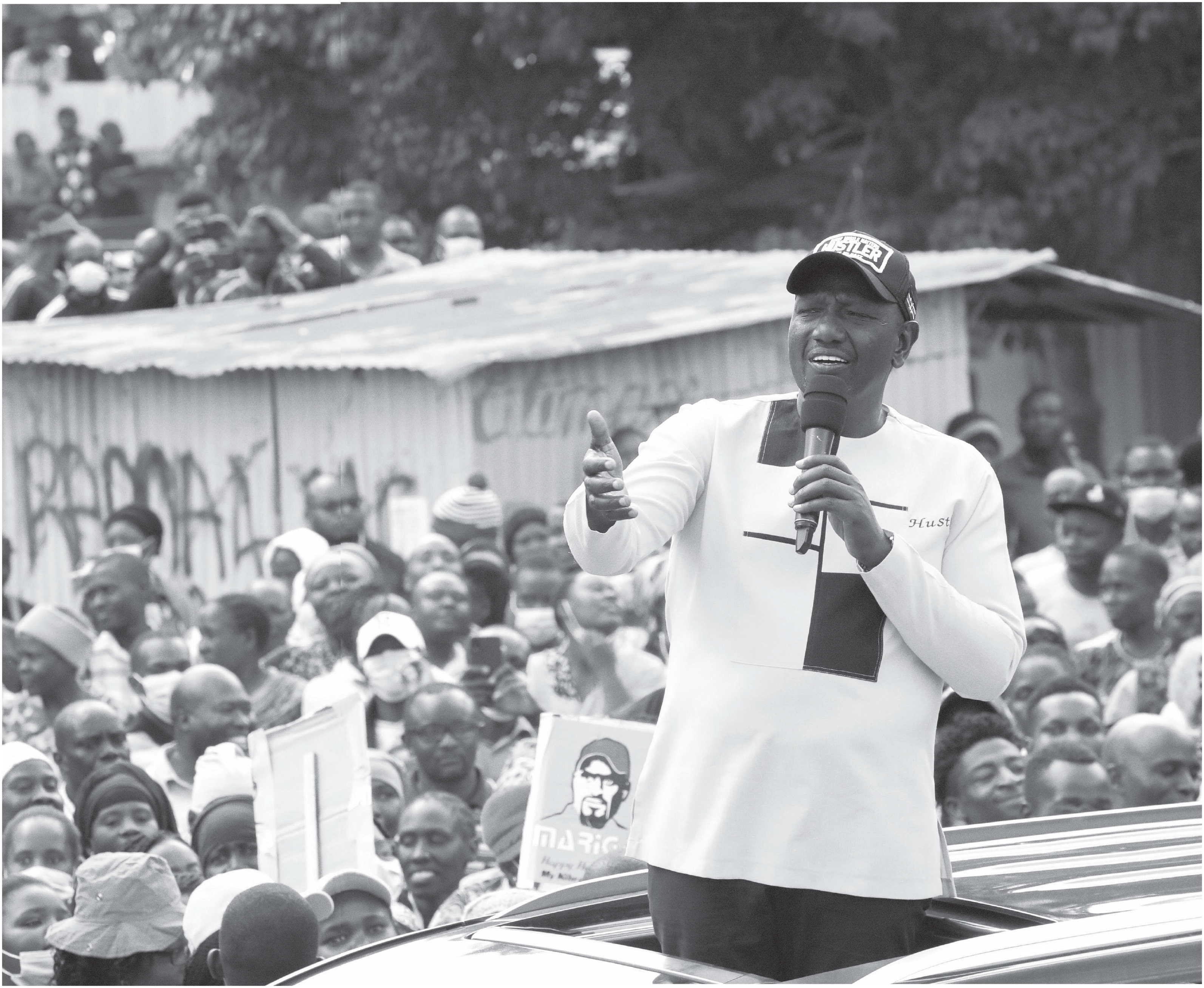
William Ruto, Kenya’s deputy president and a presidential candidate in the upcoming elections, addresses a campaign rally in Nairobi in January
CREDIT: Thomas Mukoya/Reuters/Alamy
He described the use of the extremely offensive N-word, which whilst sometimes used as hate speech does not always reach the extreme and narrow threshold of hate speech, even when used in racist terms.
“In some cases, the way it is used is not even racist and may even be used to highlight and push back on racism,” he said, explaining how words such as this can also be used artistically or ironically.
“Banning the use of these words generally, even if only during an election period, is not legitimate,” he said. “I would say that it is not even legitimate to ban outright their use by political parties and candidates, although this is obviously much narrower and hence less offensive to freedom of expression.”
Mendel has suggested ways the commission could have approached the issue. One option would be bringing leading parties together to discuss a voluntary and reciprocal avoidance of certain words. Another is making clear that the use of these terms would be scrutinised carefully, with measures taken against usage constituting hate speech. Mendel said the NCIC could also have consulted with media outlets to see if it could reach an agreement either not to use these terms or to use them only when not in a racist context.
Successive attempts to get comments from the NCIC, the Media Council of Kenya and the Kenya Law Reform Commission failed, with some saying the issue was too sensitive to be commented on by foreign media.