




Abstract

Hungary’s right-wing president secured another term in power through manipulating the Ukraine war narrative.
A FEW HOURS AFTER polling stations closed in Hungary’s general elections, Prime Minister Viktor Orbán greeted supporters outside his Fidesz party’s election headquarters, on the banks of the Danube. Dressed in his signature orange tie and surrounded by his closest political allies, he addressed the crowd after winning his fourth consecutive victory.
To chants of “Viktor, Viktor”, Orbán thanked his followers for leading him to victory, but also sent a message to his “opponents”, of which the president of Ukraine was listed as one.
As the EU’s closest ally to Russian president Vladimir Putin, it was no surprise that Orbán name-checked Volodymyr Zelensky. In the run-up to the election, Orbán tried to cast a February visit to Moscow as a “peace mission” and claim a vote for him was a vote for stability while a vote for the opposition was a vote for war.
With Hungary sharing a border with Ukraine, and its chances of becoming embroiled in the war therefore being much more than just an abstract possibility, his careful positioning – bolstered by a media that spun Kremlin propaganda – was a success.
And now Hungarians must brace themselves for further restrictions to their free expression.
Orbán’s victory was big – bigger than ever before – so he can now basically rule the country as he wishes. During his previous terms, Fidesz used its powers to consolidate control over the country’s judiciary, take over the media and universities, pass anti-immigrant and anti-LGBTQI laws, and crack down on nongovernmental organisations critical of the government. That approach – leading Freedom House to list Hungary as only “partly free” in its global Freedom in the World Index – is unlikely to change.
Orbán drew strong criticism from the EU for trampling on human rights, but such concerns have not resonated with Hungarian voters. That is partly because the majority of them do not consider democracy and the rule of law to be their main priority. In a major 2021 poll by Policy Solutions and the Friedrich Ebert Foundation, the most significant issues facing the country included poverty, the state of health care, low pensions and the cost of living.
A poster of Hungary’s Prime Minister Viktor Orbán before the parliamentary elections in April 2022, which reads: “Let’s preserve the peace and security of Hungary!”
CREDIT: Eva Voneki/Alamy
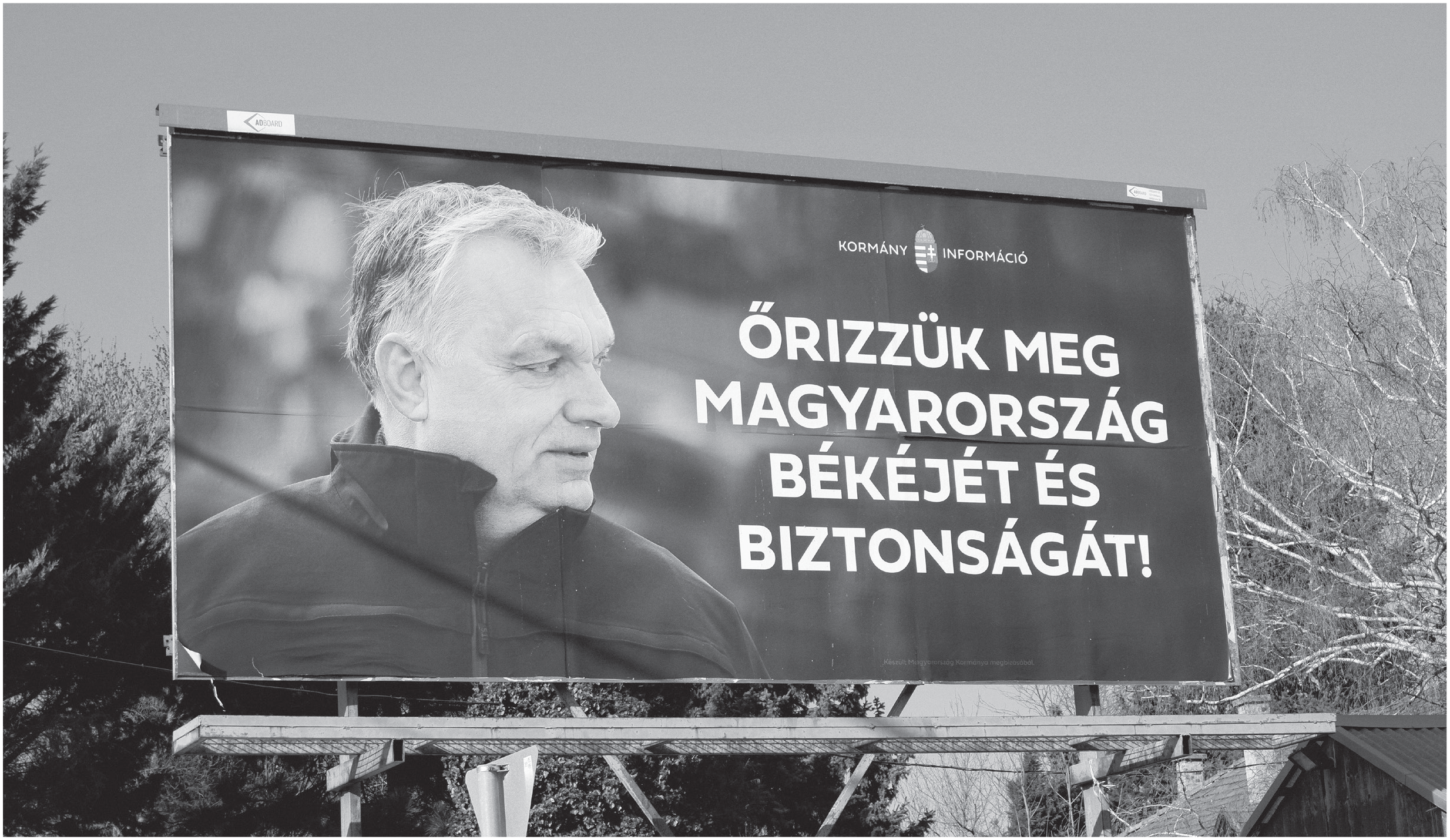
The prime minister may have never previously won with such a large majority, but neither has he faced such a tough period in power. Inflation, rapidly rising living costs and soaring energy prices will soon take a serious toll on the Hungarian economy.
The government has already taken steps to minimise the effects of this, including extending a price cap on basic food products and fuel. But if Orbán really wants to stay in power, he needs to do what he is best at: hide the harsh reality from his voters and divert their attention to less pressing subjects.
What these subjects may be are not hard to guess. Orbán – who has built his whole communications strategy on the “protection of Hungarians” – listed the domestic and international left, Brussels, George Soros and the international “mainstream media” as his opponents, alongside Zelensky.
Emboldened by his sweeping victory, there is a serious risk that Orbán will further challenge his opponents, including the EU, as the European Commission has for the first time in its history launched a conditionality mechanism against Hungary, meaning the country could be stripped of EU money for breaching democratic values.
The commission is worried about “systemic irregularities, deficiencies and weaknesses in public procurement procedures”, but the Hungarian government is once again using the fight to blame Brussels for interfering with “the will of the Hungarian people”.
Orbán’s messaging does not send a positive signal to Hungary’s vulnerable groups, including the LGBTQI community.
His government has already argued that the commission wants to punish it for staying out of the Ukraine war and for defending children from “sexual propaganda” – hinting at a series of anti-LGBTQI measures that were put into law last year. Civil rights activists fear that a new battle with Brussels over money could make LGBTQI people scapegoats at home.
Journalists worry that Fidesz will exert even more control over the media if the party wants to divert attention from the economic and social troubles. Convincing voters that government policies – including austerity measures – are justified could lead to even stronger propaganda, says Ágnes Urbán, an analyst at Mérték Media Monitor.
“In the shorter term, a calmer period may be expected, simply because there will be no need for propaganda until the European Parliament elections in 2024. But there is a possibility it may intensify over time,” she told Index.
“In previous years, the economy grew with the help of EU funds, [and] living standards increased in many layers of society. The main question is what to expect in a new economic situation, especially in the absence of EU subsidies. It is possible that the ruling party will try to hide the real processes from the population with increasingly intense propaganda in the long term.”
There are already signs of this happening. At the end of May, the government amended the Fundamental Law for the tenth time, making it possible to declare a “state of danger” because of the armed conflict and humanitarian catastrophe in Ukraine. Orbán then quickly declared a state of danger, which means that his government can enact laws by decree without parliamentary oversight for a period of 15 days.
Originally created during the Covid-19 pandemic, the law allows the punishment of “spreading fake news” with up to five years in prison. In 2020, police detained an opposition activist and a pensioner for publishing their opinions on Facebook on the basis of the very same law. And though no charges were brought against them, their cases were proof of how the government can intimidate civilians.
Even more worrying is that Orbán’s huge victory will encourage him to maintain his close ties with Putin. The Russian president may be a pariah in most of Europe and the USA but not so much for Orbán, who depends on Moscow for cheap energy – something that was crucial in winning his election. And although he has voted for every EU sanction imposed on Russia, Orbán has been careful not to antagonise Putin. He refused to transfer lethal weapons to Ukraine through Hungary and has come out against oil and gas embargoes.
It’s possible there may soon be no allies of Orbán other than eastern European autocrats. In March, two members of the Visegrad Four group of central European nations pulled out of their planned summit in Budapest. Soon afterwards, Hungary’s closest EU ally, Poland, criticised Orbán’s stance on Ukraine. (The Hungarian prime minister was also the only leader of the group not to travel to Kyiv to support Zelensky.)
With the fall of Janez Janša in Slovenia, Emmanuel Macron’s reelection in France ending the presidential ambitions of nationalist Marine Le Pen, and the German government welcoming the European Commission’s action against Hungary, it seems that Orbán has no allies left within the EU.
There are now fears that the increasing international isolation will push Orbán to forge even closer ties with Moscow. With Hungary long considered by many to be Russia’s Trojan horse within the EU, there is no doubt that an increase in Moscow’s influence will lead Hungary into an impossible position as far as its membership of the EU is concerned. With no friends left in Brussels, Orbán might feel he has only one option.
As one politician put it behind closed doors: “There is a real fear that Hungary will readily embrace a new normal, and that new normal in this case would be a return to Vladimir Putin and the prospect of cheap Russian oil.”
Telex tells it all
VERONIKA MUNK IS on a train bound for Budapest. She is returning from Prague where a sobering assessment on press freedom in the region was delivered the previous day.
In the most detailed study yet of the Visegrád countries (the Czech Republic, Hungary, Poland and Slovakia), researchers found widespread concern for media independence, with 43% of those surveyed in Hungary believing their media is not free.
For Munk, who spoke at the event about the situation in Hungary, which now ranks 85th in the Reporters Without Borders Press Freedom Index, the cause is an intensely personal one. In June 2020, she and her colleagues at news site Index.hu found their own operation under threat.
“Now there is trouble,” read an online post by Index.hu journalists. “The staff and independence of Index are in grave danger.”
A prominent critic of the state, Index. hu had grown to become Hungary’s largest independent news platform. But after a pro-government businessman took a 50% stake in the firm controlling Index’s advertising, staff feared for their futures. Those fears crystalised soon after when editor-in-chief Szabolcs Dull was abruptly fired. Index.hu’s 80-strong staff felt they were left with no alternative.
“The whole newsroom quit,” said Munk, who spent 18 years at Index.hu, going from intern to deputy editor-in-chief. “It was a horrible moment because everybody had difficulties in their life, but we thought it was not OK anymore, and not possible for us to operate at an independent, professional level.
“The same day we quit there was a large protest in Budapest. Thousands of people were marching for us, and we realised: ‘OK, these people need us’.”
Three months later and with 70 former Index.hu staff onboard, Telex.hu launched. Early editorial meetings were held in coffee shops and parks and their first office was a disused school.
“We didn’t care, though,” said Munk, Telex’s head of content development and founding editor-in-chief. “Because we could do what we wanted to do and provide fact-based news for Hungarians.”
To deliver its “correct, critical and curious journalism”, Telex – where Dull is now editor-in-chief – relies almost entirely on crowdfunding. It raised €1m in the first month, and it has more than 50,000 donors at home and abroad and around 600,000 daily readers.
“We now have one of the largest newsrooms in the country and we are flexible, we travel everywhere,” Munk said. “We have had eight Telex staff in Ukraine since the war started and we believe in spending the money on good journalism.”
Prime Minister Viktor Orbán’s far-right Fidesz party, re-elected in April, has steadily eroded press freedoms and space for good journalism since he first won power in 2010. Laws have been passed limiting access to public information, leading independent newspaper Népszabadság to close in 2016, and it emerged last year that Hungarian journalists were among those targeted by the Pegasus spyware tool.
Media plurality has crumbled further since the Central European Press and Media Foundation (Kesma), an organisation staffed by pro-Fidesz figures, launched in 2018. Kesma controls nearly 500 media outlets, and it is estimated that nearly 90% of state advertising spend goes to Kesma and other Orbán-aligned channels.
“Kesma has this centralised way of spreading the political messaging of the government,” said Munk. “It affects how people think about events in the country and outside.”
Telex, though, and other independent voices such as radio station Klubrádió – another victim of the state’s quest to monopolise the media landscape but which now runs an online station with its own crowdfunded model – continue to question narratives and populist propaganda.
“It seems our story has really convinced people to support the cause of press freedom,” said Munk.