Abstract

Criticise Russia by all means, but leave racism out of it, writes
WHEN RUSSIAN PRESIDENT Vladimir Putin launched a full-scale invasion of Ukraine, Western governments were quick to rally behind Kyiv and cast Russia as being definitively on the wrong side of history. This is all to be expected in a war where there is a clear aggressor and a clear victim. There is, however, a troubling strand to such rhetoric: the attribution of Russia’s aggression to its “Asian-ness”.
First, some examples. Canadian political analyst Michael MacKay tweeted in April: “Russia’s invasion of Ukraine is part of its war against Western civilisation … Culturally, historically, politically – Ukraine is the West. Russia is a Eurasian country, mostly in Asia. Muscovy never has been of the West.” Dirk Mattheisen, former assistant corporate secretary of the World Bank Group, has attributed Russia’s “tendency towards authoritarianism” to “the straight line from Mongol vassal, to Mongol agent, to oppressor, to empire, to autocratic (and predatory) socialism, to Putin’s national democracy”. In the wake of the invasion, Florence Gaub, deputy director of the EU Institute for Security Studies, posted a Twitter thread responding to the war, arguing that Russia was fundamentally Asian rather than European.
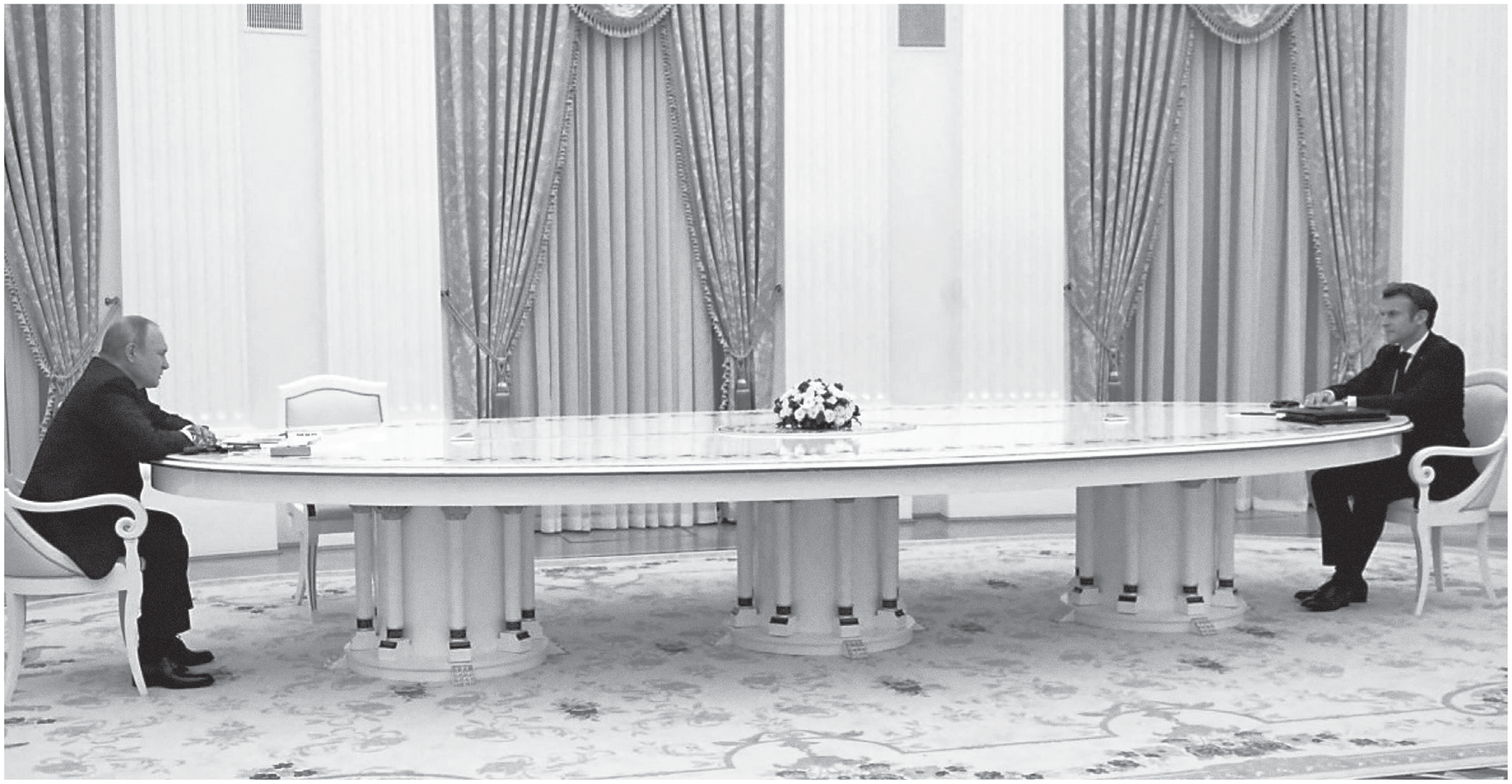
Vladimir Putin meets French President Emmanuel Macron in Moscow, in February 2022
CREDIT: Pictorial Press Ltd / Alamy Stock Photo; (Orientalism) Edward Said/Penguin
This rhetorical trope has not been the preserve of Western analysts. Erica Marat, associate professor of regional and analytical studies at the National Defence University, noted: “Russian intellectuals routinely blame Mongol and Tatar rule on Russia’s territory for contemporary authoritarianism in Russia.”
The following tweet by prominent Russian independent journalist Yulia Latynina exemplifies this. “We are witnessing the rebirth of the Kievan Rus. Everything democratic, market-oriented and Western will be concentrated in Kyiv. Kyiv will once more become the capital of the Rus. Moscow will be the capital of the horde.”
Marat explains the popularity of this rhetoric, stating that “unchallenged stereotypes against Asians … help Russians (russkiye [ethnic Russians] not rossiyaniye [citizens of the Russian Federation regardless of ethnicity]) maintain a sense of cultural superiority and innocence even in the face of genocidal war.”
These examples are by no means exhaustive, but they are indicative of the disturbing undercurrent present in liberal perceptions of the war.
The notion that Asian people are inherently violent and “uncivilised” is nothing new. One need only look to the justifications for Western imperialist projects penned over the last several centuries to see that.
In an interview with Index, Kate Antonova, associate professor of history at the City University of New York, expands on this historical pattern, saying: “That image goes back at least to the foreigner accounts of Ivan the Terrible’s court in the 16th century. It was created then, and maintained for centuries, by Britain, which lived in constant dread of Russian incursions on their trade empire, though this threat never materialised. After Europe nearly destroyed itself in two world wars … Americans took on the lore.”
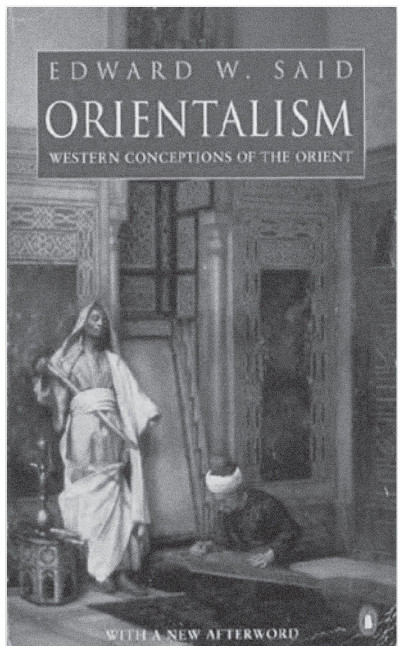
Edward Said addresses the construction of the “Orient” as a repository for Western fears and fantasies about physical and sexual violence in his influential book Orientalism.
Whether Russia is Asian or European has long been an intensely debated question. Arguments that it is the former take as a starting point the conquering of the Kievan Rus by the Mongol Empire – known as the Golden Horde – in the 13th century. The term “horde” has since become a byword for barbarism and military might. Not only do these ideas perpetuate racist stereotypes and disregard the cultural sophistication of the Mongol Empire they also do an immense disservice to the vibrant democracies that currently exist on the continent.
Testament to the absurdity of attributing Russia’s authoritarianism to Mongol influence is that Mongolia ranks as “free” in Freedom House’s Freedom in the World index with a score of 84/100. Russia’s score is just 19.
Even those who believe the opposite – that Russia is an essentially European nation held back by authoritarian and kleptocratic governance – implicitly buy into the conception of “European-ness” equaling democracy and civilisation while “Asian-ness” equals despotism and barbarism.
Relegating Russia to this constructed and highly problematic conception eases the path for anti-democratic actors within Western countries. By essentialising authoritarianism – casting it as a phenomenon that is inherent to certain countries and not to others – we refuse to turn our gaze towards the erosion of democracy occurring at home.
Moreover, the false binary between “barbaric Asian Russia” and the “civilised European West” obscures the latter’s history of imperial violence.
Attributing Russia’s war against Ukraine to this constructed notion will not aid the latter’s victory; nor will it help us to understand the former’s motivations for its horriic onslaught.
On the contrary, it plays into the hands of the Kremlin propagandists who seek, in their own way, to present Russia as besieged on all sides in a civilisational battle. It also obfuscates the not-insigniicant responsibility borne by Western countries for enabling the war by looking the other way to Putin’s earlier aggressions, and for the anti-democratic tendencies within their own societies.
Russia’s war against Ukraine is not a clash between Western and Asian civilisations. It has nothing to do with the country’s geographic location or historical connection with the Mongol Empire, but everything to do with the expansionist policies and ideologies of cultural superiority – similar to those of Western imperial projects – pursued by successive Russian regimes.
Only by understanding this can we stand as true allies to Ukraine.
Edward Said’s important work Orientalism, which looks at how the “Orient” was constructed as a repository for Western fears and fantasies