




Abstract
The writer
Guatemalan author Eduardo Halfon
CREDIT: (top) Eduardo Halfo; (left and right) Ferrante Ferranti

GUATEMALA’S GREATEST WRITERS are all buried outside Guatemala. You have generations of writers and poets and dramatists and journalists either disappearing – being killed off – or fleeing.” These were the words of Guatemalan author Eduardo Halfon, a winner of the country’s National Prize in Literature with almost 20 books to his name, including Mourning, which won the Edward Lewis Wallant Award and the International Latino Book Award.
Halfon is yet another Guatemalan writer working from outside the country of his birth. He was speaking with Index in a video call from his current home in Berlin. Halfon says he has been spared the extremes of censorship as a result of writing fiction, which provides him a degree of protection. “What I say is coded. It’s hidden within a metaphor or it’s someone else’s voice saying it.” Add to this a low readership of fiction in the country (according to Halfon “nobody reads novels”) and the novelist has a degree of creative freedom.
“It’s ironic, isn’t it, that fiction allows me to say the truth?” he said.
And yet for all that, Halfon has still been at the receiving end of serious threats. After publishing his first novel in 2003, he met a friend at a bar who told him to leave the country as soon as possible; later he was visited at home by someone he barely knew brandishing a gun and giving him a warning.
“That’s the way you get threatened in Guatemala. It’s never a direct threat [from those in power]. You’re never going to get directly threatened or explain why you are being threatened. It’s a way of provoking a general fear. And this has been going on for decades. All of these military dictatorships were just based on fear and silencing people.”
Halfon believes that his run-ins are the result of interviews he has done, and so he tries to avoid doing them in Guatemala itself.
He hasn’t let the gun experience deter him. While he writes mainly in Spanish, his fourth English novel (Canción) is due out in September.
He’s in no rush to return to Guatemala. The “culture of fear”, as he terms it, is worse today than before.
“The climate there is as dangerous as I’ve ever seen it,” he said, explaining how journalists are currently fleeing on a weekly basis, as are judges.
“If you’re not a corrupt judge and you’re trying to do right you have to either leave or you’re killed.”
In order to survive in the country, Halfon says Guatemalans have normalised behaviours that elsewhere would be considered extreme. “The psychotic manifestations of living in that danger”, as Halfon terms it, is perhaps best exemplified by the story of his friend, who drives with and speaks to a mannequin in the passenger seat at all times in an effort not to be targeted in her car. “And this friend of mine considers it absolutely normal that she would have to live this way,” he added.
Guatemalans have also developed an indirect way of talking, avoiding certain words entirely. “Genocide” is one, despite the massacre, forced disappearance and torture of the country’s indigenous Maya people by the security forces on and off for decades.
“They won’t even say it. It’s a dirty word. There’s a percentage of the population – which is a small percentage but a powerful percentage – who deny that genocide took place, so they want to just silence the word. The last time I said it in an interview one of my father’s friends (who is Jewish and a lawyer) called my father and asked me to stop saying it. He said no genocide had ever taken place.”
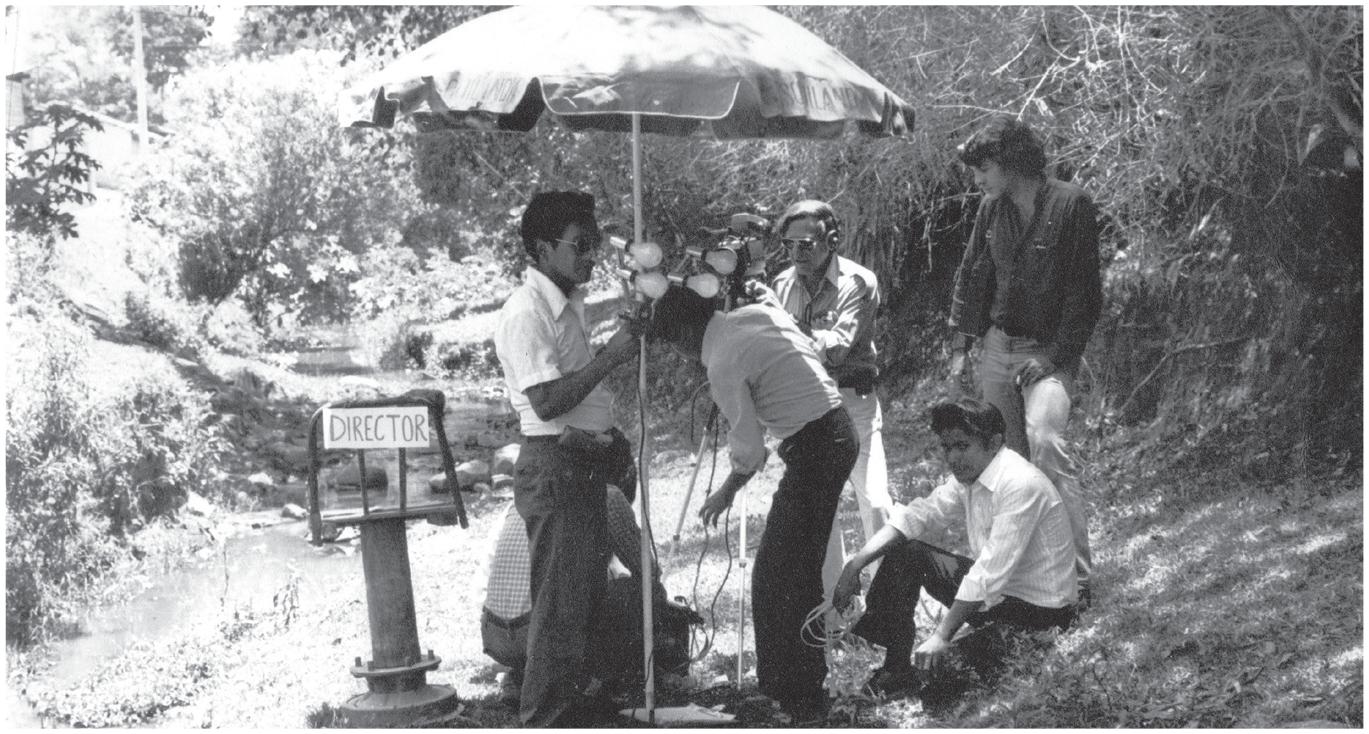
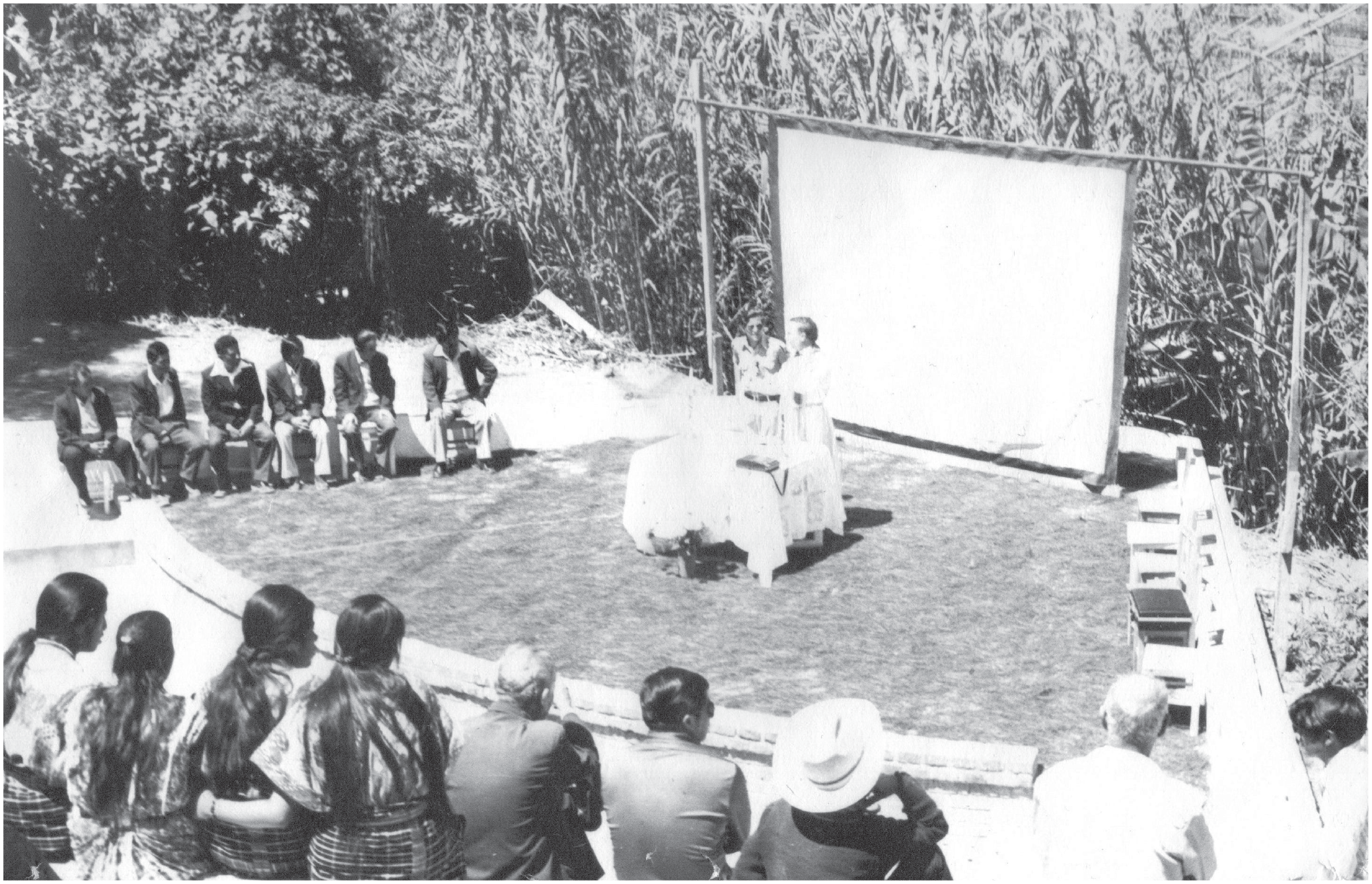
The only remaining images of the amphitheatre, where for a short while locals enjoyed films on a variety of topics
Then there’s “land reform”. “It’s another one of those words that is dangerous to utter in Guatemala because the oligarchs, the rich, the land-owners feel threatened.”
Halfon unites these taboo words in the short story overleaf, published for the first time here. It tells the story of doctors who built and ran an amphitheatre in the 1970s to air a mixture of entertaining and educational films for the indigenous people of the area. Some films were even shot by the locals, who were taught how to operate cameras as part of the project. The story is based on a true story, with some fictional embellishments. Halfon, who knows the doctor personally, reflects on the film project with awe – putting a camera into people’s hands and using stories to “try and reach those who needed reaching” was “a heroic effort”. The authorities took a different approach. The makeshift cinema was quickly shut down and all footage, bar the two images pictured here, were lost.
“The military government could not allow a place for the indigenous people to learn, to heal,” he noted.
In the story, which follows the doctor and another man walking through terrain where the amphitheatre was, a discussion ensues on zombobos – huge ants that would descend on the area during the wet season.
“I haven’t seen one in years and as a kid they were everywhere.”
Halfon first left Guatemala at the age of 10. He has memories of making the ants fight [two together in a box] and of the indigenous people eating them at special occasions. Now, due to climate change and the excessive use of agri-chemicals, they’re gone.
“What those zombobos represent is not just the death of a vital animal but also of a culture,” he said.
It all fits into the pattern of Guatemalan history, which Halfon describes as “a history of silence”. The only positive is that the country still has individuals like Halfon willing to speak, even if from afar.
The Amphitheatre
For Juan Jose Hurtado, in memoriam
I thought I felt a soft drizzle on my face. Although it could have also been nothing more than the evening mist. Or my nerves. We passed the vacant lot where I had left my car. We passed some market stalls around the central plaza, already closed and covered with black and blue plastic tarps. We passed a cantina that was probably a brothel. We passed a bundle of green bananas lying in the middle of the street. We passed a row of crumbling houses, and I remembered the earthquake of 1976. We passed a small bridge that crossed a black and rancid creek. We passed by a large piece of land full of apple trees and something that in the night looked to me like a grandstand descending to a small stage. Like an amphitheatre in ruins — like the bleachers of an amphitheatre in ruins. I asked Ramón what it was and he stopped and told me it had been a movie theatre. But years ago, he said. When I was young.
He placed his clay tinaja on the ground, pressed between his black rubber boots. He took a cigarette out of the pack of menthol Rubios and lit it with the fire of his torch. I accepted one. I also lit it with the fire of my torch. I felt prehistoric.
Ramón told me that, in the seventies, some doctors from the city came to the village on weekends and showed there, pointing to the small amphitheatre with his cigarette, all kinds of movies. He told me that the doctors had built it themselves, among the apple trees. He told me that as a young man he had seen there movies of Cantinflas and of Pedro Infante and some cowboy movies. He told me that the doctors also showed short films, in Kaqchikel, made by the villagers themselves. He told me that the doctors had a small sixteen-millimeter camera and they would give it to the local people and teach them how to use it and ask them to make very short films in Kaqchikel about nature, about basic health, about life in the village. He told me that the doctors would then show those short films in the middle of the Cantinflas and Pedro Infante and cowboy movies.
I looked down at the amphitheatre among the apple trees (I smelled or thought I smelled the apple trees in the night). I noticed that the bleachers were overgrown, abandoned, useless, and I suddenly imagined all the indigenous people of San Juan Sacatepéquez sitting there as they watched the short, blurry, sixteen-millimetre films in Kaqchikel, made by themselves. I asked Ramón what had happened to the movie theatre. Oh, he said, it ceased to exist. And his voice hurried to hide in the night. But it wasn’t difficult for me to guess the rest of the story, to guess why something like that could not exist (to use his word) in the Guatemala of the seventies. I asked Ramón what the short films had been like, if he remembered any of them. But he just threw away his cigarette, crushed it into the ground with his black rubber boot, and kept walking.
*
Soon, almost without realising it, we had left the outskirts of the village. We kept moving forward and reached a trail and began to walk among old oak trees, up the mountain. The ground was muddy and slippery. I looked back fleetingly. The entire village had disappeared.
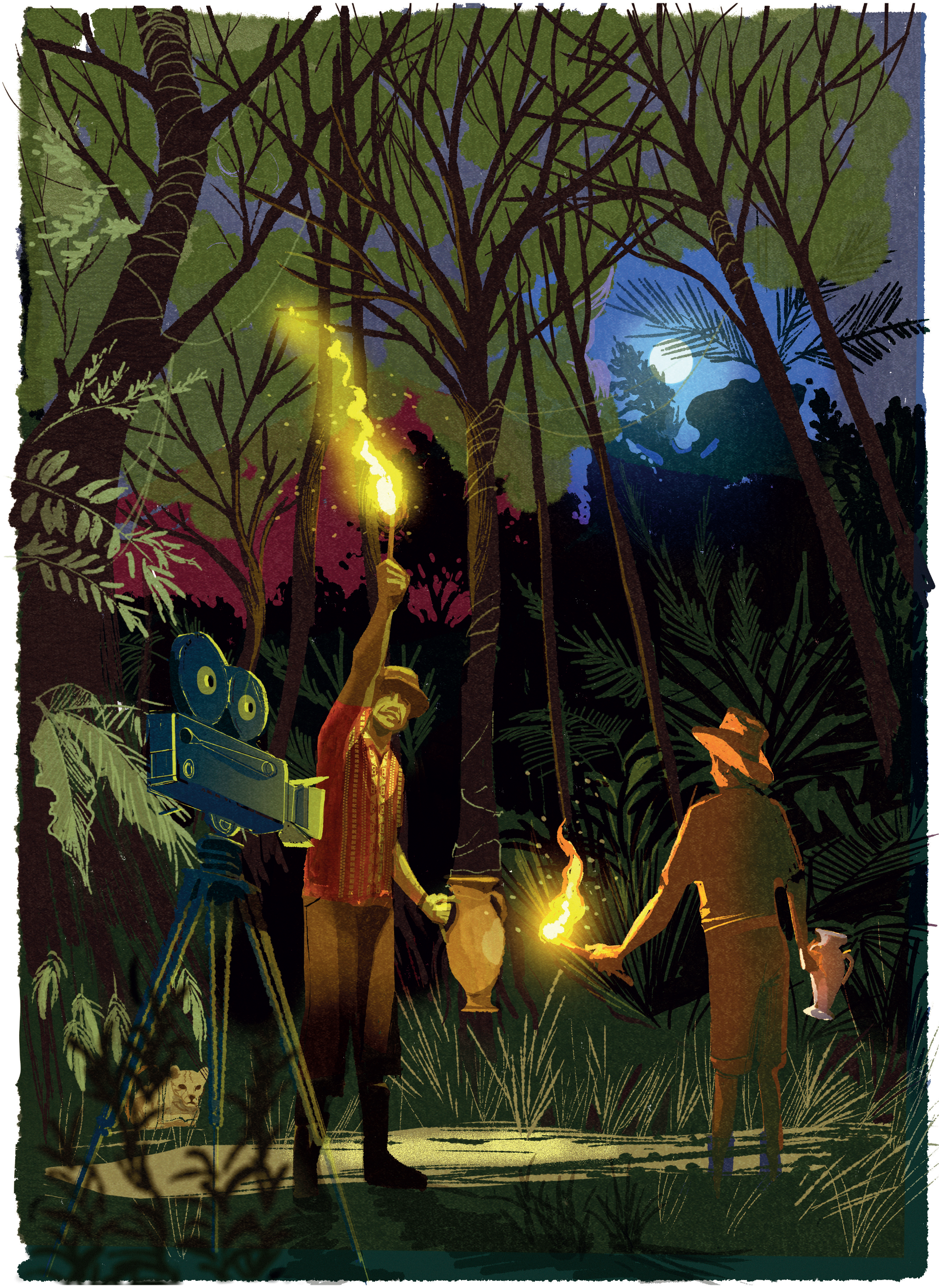
CREDIT: Alex Green
In front of me, while hacking away some loose branches from the trail with his machete, Ramón was telling me about the origin of the village’s name. San Juan, he said, is for John the Baptist, the patron saint of the municipality. Sacatepéquez, he said, is actually two words in Kaqchikel. Sacat, which means grass. And tepec, which means hill. I asked him about the origin and meaning of his own name. Ramón López Chumil, he announced softly but not without pride. Ramón López is for my father Ramón López and my grandfather Ramón López and my great-grandfather Ramón López. Chumil, he said, is my mother’s last name. It means star, in Kaqchikel.
After a while we stopped to rest and I asked Ramón in a whisper (as if my voice might scare them away) if he had seen any already. Not one, he said. They haven’t come out. Not as many come out as before, he said and spat a long slimy drool to the ground. He was silent for a moment, panting lightly, as he tucked the hem of his pants into the big black rubber boots.
Before, when I was a boy, he said, as soon as the first rains came in May, we would go up the mountain with my father and catch zompopos de mayo. They would fall from the sky, he said with the momentousness of a preacher. Imagine that. They would just fall from the sky and fly towards the flames of the ocote and with my father we would pick them up from the ground and put them in our tinajas. There wasn’t enough room for so many in our tinajas. Then we would return to the house and my mother would throw them all into a basin full of water, to wash them before removing their wings and legs and heads, since one only eats the small round body of a zompopo. She would then put the round bodies on the comal and toast them with a pinch of salt. I thought I saw Ramón smile in the amber light. Very tasty, he said. Only for special occasions.
We continued through the forest in silence, me slipping a little in the mud with each step, waiting for the zompopos to fall from the sky and fly into the flames of my torch. I wanted to see them, to catch them, to savour for the first time that tasty and salty and crunchy snack reserved only for special occasions.
We reached the top of the mountain. Ramón, crouching, his gaze sleepy or resigned, was silent. I thought about telling him not to worry, that I understood that the sky had already been emptied of zompopos (I would have to wait a few years before finally tasting one, on a not very special occasion, inside a nameless dining room on the shore of Lake Amatitlán). But I just asked him for another cigarette. And we both waited hopelessly as we smoked in the minty muffle of the night, our torches by now barely lit, our ancient clay tinajas almost forgotten on the ground.
*
There was a short film about a vaccine, Ramón suddenly said in the half-light. Among the films the villagers made, he added, for the doctors from the city. Although he was still crouching in front of me, I could barely see him in the moonless night. Chikop, it said on the screen at the beginning of that short film, said Ramón’s voice in the darkness. Chikop, I repeated. It means little animal, in Kaqchikel, he said. First, he went on, there appeared on the screen a boy from the village, his face all painted with red dots. Then a healthy boy appeared next to him, but after a while that boy’s face was also covered with red dots. Child after child appeared on the screen and each one’s face would suddenly be full of red dots. Chikop, said the voice in Kaqchikel. Not God, said the voice in Kaqchikel. Then a syringe appeared on the screen and the voice in Kaqchikel said that the red dots could be removed with a vaccine. That it was free, said the voice in Kaqchikel, that one could come there on weekends to get the vaccine from the doctors from the city. Then all the children would be on the screen together, playing happily, their faces clean. And the film ended.
*
There was a short film about the cat technique, Ramón said. That’s what the doctors from the city called it, the cat technique. I again felt a gentle drizzle on my face. The only light came from the glow of the embers of our ocotes. On the screen there was a man walking through the forest, said Ramón’s voice in the night. The man then pulled down his pants and squatted right there in the forest and relieved himself next to a nearby bush. Then the man’s fingers appeared on the screen throwing dirt on his droppings, covering them with dirt using his fingers. Ramón made a brief pause, necessary to smoke or maybe to overcome his modesty. And a voice in Kaqchikel said that one had to do as a cat does.
*
There was a film of a dragonfly, Ramón said in the night. B’atz’ibal, said a voice on the screen. It means devil’s needle, in Kaqchikel, he said. The dragonfly on the screen was crashing against the glass of a window. Over and over and over. The dragonfly wanted to go out, but the window was closed. A voice in Kaqchikel said that the nature of a dragonfly is to fly back to the banks of the river.
*
There was a film of the villager’s feet, Ramón said. The villagers were all lined up. They were waiting for something. But on the screen were only their bare feet. The film on the screen moved forward in the line, but one only saw the bare feet of the villagers. Nothing else. Just bare feet. Bare feet of men. Bare feet of women. Bare feet of children. Bare feet of old people. Many bare feet. All in a line, as if hoping to move forward toward something. But the only thing that moved forward was the film. The bare feet of the villagers never moved forward. K’o ak’wala’ taq winäq choj chik nimoymot yetzu’un, said the voice in Kaqchikel. There are people who are still young and no longer see well.
*
There was a short film about a half-naked woman, Ramón said. I could now barely make out his faint silhouette crouching and small in the night, but I was sure he had said it to me with the mischievousness of that child sitting in the amphitheatre among the apple trees, back in the seventies. I heard him exhale a puff of smoke. First a cow appeared, Ramón said, and a voice in Kaqchikel said that the mother cow’s milk was for the calf. Then a goat appeared, and a voice in Kaqchikel said that the mother goat’s milk was for the kid. Then a dog appeared, and a voice in Kaqchikel said that the mother dog’s milk was for the puppy. Then a woman from the village appeared, he said, and she pulled out one of her big brown breasts, and a voice in Kaqchikel said that the mother’s milk was for the baby. Ramón laughed softly, as if with shyness, or as if with cunning, or as if with the serenity of his years. In the night, somewhere near us, a frog chirped.