




Abstract

The news that the USA overturned Roe v Wade, which has protected the rights to abortion for almost 50 years, shook the country – and the world.
WOMEN IN THE USA have lost control over their bodies. They also face a void in the sharing of necessary information.
At the end of June, the US Supreme Court overturned its landmark 1973 ruling, Roe v Wade – the decision that led to abortion becoming a federal constitutional right. It said the US Constitution “does not confer a right to abortion” and “the authority to regulate abortion is returned to the people and their elected representatives”. Almost immediately several states moved to outlaw abortion.
Protests erupted across the country (with some protesters being teargassed in response). Eight states immediately banned abortions. According to the Guttmacher Institute, 22 of the 50 US states have laws or constitutional amendments in place that will ban abortion now that Roe v Wade is revoked. Pro-choice legislators in states that have unused “trigger” laws on the books are frantically researching new legislation to supersede these old laws.
In the decades since abortion rights were confirmed by the Supreme Court, they had already become increasingly unequal. Where you live and, of course, how much money you have decide your access to healthcare.
As with everything, those with means will gain access and those most vulnerable will be at risk.
Along with access, and almost as important, there is a public sentiment divide in the USA that already impacts women’s willingness to get an abortion. The country is “the red versus the blue”, not “the red, white and blue”.
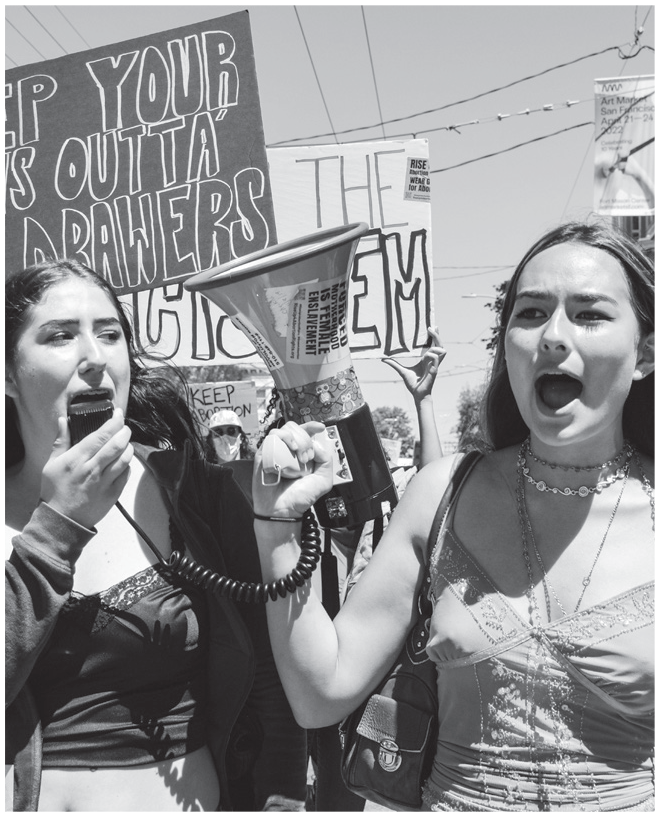
Demonstrators chant slogans through a megaphone, as pro-choice protests erupt across the USA following the Roe v Wade leak in May
CREDIT: SOPA Images/Alamy
The USA is an alignment of states that are increasingly warring against the federal patchwork. Cultural norms diverge profoundly across the land.
Surveillance of all kinds is becoming legal, including in Texas against healthcare workers and doctors, and those assisting women travelling for abortions. Underground networks to help them are already in place and are being encouraged by activists, but they will probably have to burrow deeper underground to help women who want abortions to cross state lines and to access the abortion pill.
Phone calls and any easily traceable messaging can be subpoenaed. Just as in an authoritarian regime, the use of encrypted texting apps such as Signal are gaining ground to protect women.
Especially hard hit will be teenagers. According to the American Civil Liberties Union, almost 350,000 US teenagers under the age of 18 become pregnant each year, and the pregnancies are overwhelmingly unintended. Most involve a parent in their decision, and 31% of the pregnancies result in abortions.
As anyone complicit in providing abortion aid becomes legally at risk, any public support for abortion rights or abortion providers will be fair game for attack.
If it takes a village to raise a child, it takes a village, too, to keep a teenager safe. But how will families and their support systems within communities cope with public witch-hunts that corner women and young girls in need?
Public speech, free and unhindered, is critically important to keep women safe. New draconian laws will make it harder for women to search for the care they need, endanger women in violent relationships, and create a culture of fear that re-emerges when rights are destroyed.